
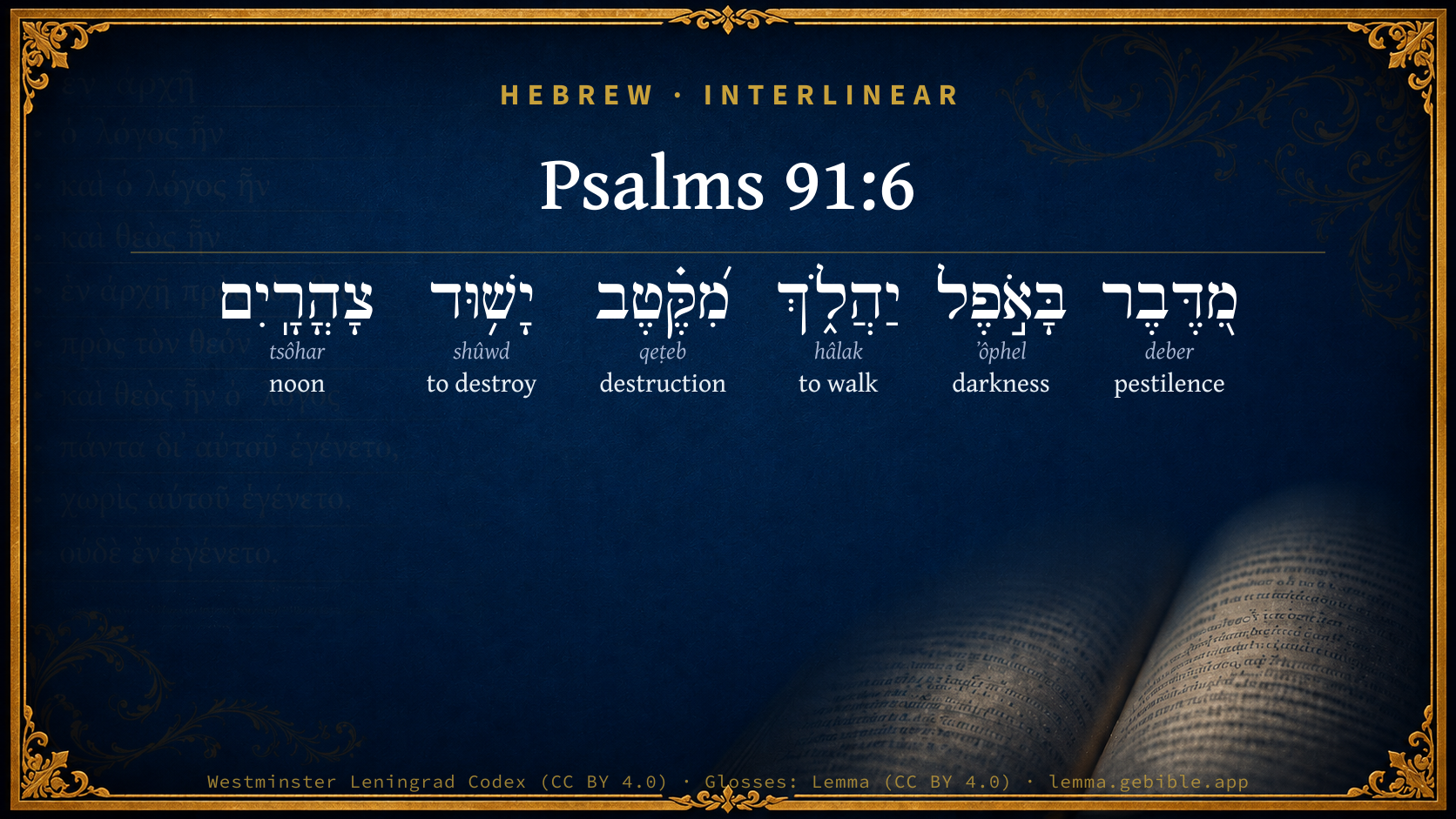
Psalms 91:6

Hebrew (Westminster Leningrad Codex) Psalms 91:6 appears in the Hebrew Old Testament. The text above is from the Westminster Leningrad Codex. Each word links to its Strong’s number, a concise gloss, and parsing drawn from the Open Scriptures Hebrew Bible morphology. Click any word for its full Brown-Driver-Briggs (BDB) entry.
Download image
Cite this verse

Psalms 91:6 (World English Bible). Public Domain. Lemma interlinear Bible study tool, https://lemma.gebible.app/v/psalms/91/6.

Show BibTeX & RIS
BibTeX
RIS
English Translation
Nor of the pestilence that walks in darkness, Nor of the destruction that wastes at noonday.
World English Bible · Public Domain
Highlights
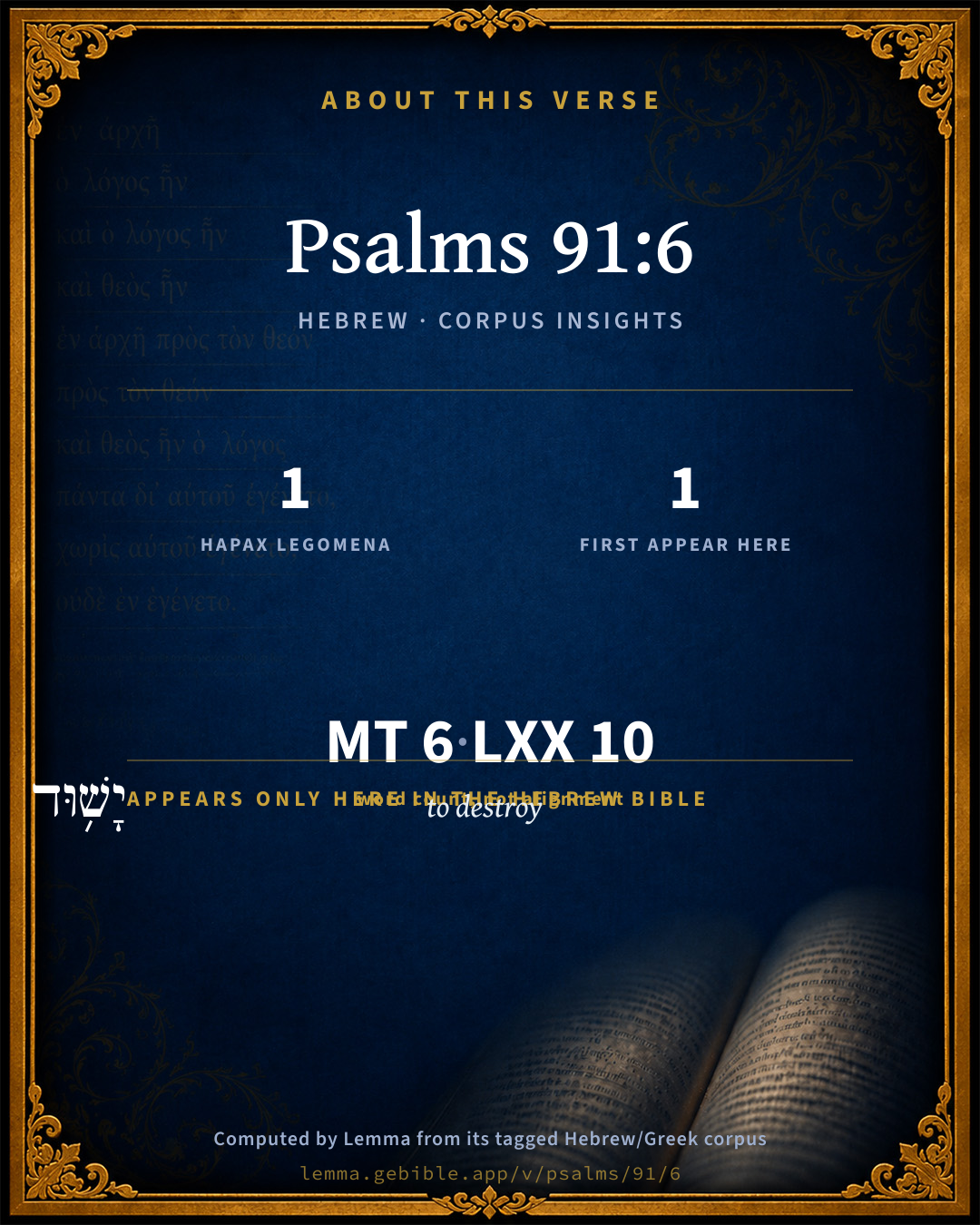
  • 1 hapax legomenon — only here in the Hebrew Bible
  • 1 first appearance in the Hebrew Bible
Full analysis ↓
Download a study sheet

One document with this verse’s original text, its word-by-word gloss line, the meaning frame, cross-references with their text, attributed commentary, and full source and license credits — printable, and it pastes into notes with its structure intact.

This verse Autodidact and up

Study sheet (.html) Plain text (.txt)

A passage Seminary Student

Up to 50 verses in one chapter. A passage sheet keeps up to 6 commentary sources and 12 cross-references per verse, in the order this page ranks them, and says so on the sheet whenever that leaves anything out. Ask for a single verse and you get the Autodidact verse sheet above.

Everything on this page stays free to read, with no account — the sheet is a download of what is already on screen, not access to it.

Want to remove ads? Support Godless Engineer
Compare translations 3

The same verse in 3 English versions, stacked beneath the original-language interlinear above. Click any original word for its lexicon entry.

Each is an independent rendering of the whole verse — the interlinear is not word-aligned to these translations.

Highlighted words mark where these versions differ — a whole-verse word diff, not a word-by-word alignment.

  • World English Bible Public Domain
    Nor of the pestilence that walks in darkness, Nor of the destruction that wastes at noonday.
  • King James Version Public Domain
    Nor for the pestilence that walketh in darkness; nor for the destruction that wasteth at noonday.
  • unfoldingWord Literal Text CC BY-SA 4.0
    of the plague walks in darkness, of the destruction that wastes midday.

unfoldingWord Literal Text — © unfoldingWord, licensed CC BY-SA 4.0. Word-aligned USFM3 via Door43 (git.door43.org/unfoldingWord/en_ult).

Versions to compare (up to 4)

3 of 4 selected

Show all 18 translations

Every available English version of this verse, each an independent rendering of the whole verse.

  • World English Bible Public Domain
    Nor of the pestilence that walks in darkness, Nor of the destruction that wastes at noonday.
  • Berean Standard Bible Public Domain
    nor the pestilence that stalks in the darkness, nor the calamity that destroys at noon.
  • Majority Standard Bible Public Domain
    nor the pestilence that stalks in the darkness, nor the calamity that destroys at noon.
  • King James Version Public Domain
    Nor for the pestilence that walketh in darkness; nor for the destruction that wasteth at noonday.
  • American Standard Version (1901) Public Domain
    For the pestilence that walketh in darkness, Nor for the destruction that wasteth at noonday.
  • Revised Version (1885) Public Domain
    For the pestilence that walketh in darkness, nor for the destruction that wasteth at noonday.
  • Geneva Bible (1599) Public Domain
    Nor of the pestilence that walketh in the darkenesse: nor of the plague that destroyeth at noone day.
  • Douay-Rheims (1899) Public Domain
    Of the arrow that flieth in the day, of the business that walketh about in the dark: of invasion, or of the noonday devil.
  • Young's Literal Translation Public Domain
    Of pestilence in thick darkness that walketh, Of destruction that destroyeth at noon,
  • Literal Standard Version CC BY-SA 4.0
    Of pestilence that walks in thick darkness, || Of destruction that destroys at noon,
  • Unlocked Literal Bible CC BY-SA 4.0
    or of the plague that roams around in the darkness, or of the disease that comes at noontime.
  • unfoldingWord Literal Text CC BY-SA 4.0
    of the plague walks in darkness, of the destruction that wastes midday.
  • Darby Bible Public Domain
    For the pestilence that walketh in darkness, for the destruction that wasteth at noonday.
  • World Messianic Bible Public Domain
    nor of the pestilence that walks in darkness, nor of the destruction that wastes at noonday.
  • Webster's Bible Public Domain
    Nor for the pestilence that walketh in darkness; nor for the destruction that wasteth at noon-day.
  • Free Bible Version CC BY-SA 4.0
    or disease that attacks at night, or catastrophe that falls at noon.
  • Bible in Basic English Public Domain
    Or of the disease which takes men in the dark, or of the destruction which makes waste when the sun is high.
  • JPS Tanakh (1917) Public Domain
    Of the pestilence that walketh in darkness, nor of the destruction that wasteth at noonday.

Literal Standard Version (2020), Covenant Press — licensed CC BY-SA 4.0. Text via the HelloAO Bible API (eBible.org). Unlocked Literal Bible (unfoldingWord) — licensed CC BY-SA 4.0. Text via the HelloAO Bible API (eBible.org). unfoldingWord Literal Text — © unfoldingWord, licensed CC BY-SA 4.0. Word-aligned USFM3 via Door43 (git.door43.org/unfoldingWord/en_ult). Free Bible Version, Dr. Jonathan Gallagher — licensed CC BY-SA 4.0. Text via the HelloAO Bible API (eBible.org).

Word by word

More ways to search: Search by grammar → Find every occurrence → Compare this word →

Practice this passage: Drill this verse → Learn its vocabulary →

About this verse

These counts appear in no published source. They are computed here, from the morphology-tagged text and Lemma’s own curated glosses. What Lemma adds →

6
words
6
distinct lemmas
Wisdom
section

Notable vocabulary

1 hapax legomenon — a word that appears only here in the entire Hebrew Bible:

  • יָשׁ֥וּד to destroy H7736

First appearance in Scripture

This word makes its first canonical appearance in the Hebrew Bible here:

  • יָשׁ֥וּד to destroy H7736

Shared distinctive vocabulary

מִ֝קֶּ֗טֶב destruction H6986 occurs in 3 verses of the Hebrew Bible. Also found in:

Grammatical profile

  • 2 verbs
  • 4 nouns

Verb forms

  • יַהֲלֹ֑ךְ Qal · Imperfect
  • יָשׁ֥וּד Qal · Imperfect

Hebrew & Septuagint length

In English translation the verse runs 16 words from the Hebrew and 18 from the Septuagint (LXX English) — closely comparable.

A rough comparison of the two English renderings, which tokenize alike — not a word-level alignment.

Word counts can differ between the Hebrew and the Greek without any difference in meaning — e.g. the Hebrew direct-object marker אֵת has no separate Greek word, and Greek often adds the article ὁ.

In the original languages it is 6 Hebrew tokens and 10 Greek tokens — but the two are counted differently (Hebrew bundles its prefixes and suffixes into one token; the Greek is in lemma form), so that isn’t a like-for-like length.

Cross-references

7

Topical passages linked to Psalms 91:6 in the Treasury of Scripture Knowledge — connected by theme and wording, ordered by reader-vote popularity; previews shown in the World English Bible.

  • Psalms 121:5–6 Yahweh is your keeper. Yahweh is your shade on your right hand.
  • Numbers 16:48 He stood between the dead and the living; and the plague was stayed.
  • Matthew 24:6–7 You will hear of wars and rumors of wars. See that you aren't troubled, for all this must happen, but the end is not yet.
  • Exodus 12:29–30 It happened at midnight, that Yahweh struck all the firstborn in the land of Egypt, from the firstborn of Pharaoh who sat on his throne to the firstborn of the captive who was in the dungeon; and all the firstborn of cattle.
  • 2 Kings 19:35 It happened that night, that the angel of Yahweh went forth, and struck in the camp of the Assyrians one hundred eighty-five thousand: and when men arose early in the morning, behold, these were all dead bodies.
  • 1 Corinthians 10:3–10 and all ate the same spiritual food;
  • 2 Samuel 24:15 So Yahweh sent a pestilence on Israel from the morning even to the time appointed; and there died of the people from Dan even to Beersheba seventy thousand men.

Cross-references courtesy of OpenBible.info (CC BY 4.0).

Hebrew and Greek witnesses Masoretic Hebrew ↔ Greek Septuagint

The same verse in the two great witnesses to the Old Testament, shown verse-for-verse.

You’re reading Greek Psalm 90 (Hebrew Psalm 91). The Septuagint counts the superscription, so verse numbers can differ from the Hebrew — chapter-level alignment, not verse-by-verse. Numbering follows Rahlfs.

These are two independent witnesses, not word-aligned to each other, and the Septuagint is shown in lemma (dictionary) form.

Hebrew Psalms 91:6 Masoretic · Westminster Leningrad Codex

מִ֭דֶּבֶר בָּאֹ֣פֶל יַהֲלֹ֑ךְ מִ֝קֶּ֗טֶב יָשׁ֥וּד צָהֳרָֽיִם

Nor of the pestilence that walks in darkness, Nor of the destruction that wastes at noonday.

World English Bible · Public Domain

Greek LXX Greek Psalm 90:6 Septuagint · lemma form

ἀπό πρᾶγμα διαπορεύομαι ἐν σκότος ἀπό σύμπτωμα καί δαιμόνιον μεσημβρινός

nor of the evil thing that walks in darkness; nor of calamity, and the evil spirit at noon-day.

LXX2012 (modern English Septuagint) · Public Domain

On this verse, Trapp's Complete Commentary discusses the Septuagint’s reading. Read the note in Commentary ↓

Hebrew: Westminster Leningrad Codex (CC BY 4.0). Greek: Septuagint (public domain); English from LXX2012 (modern English Septuagint) (Public Domain). How the Septuagint differs from the Hebrew →

Commentary

Notes on Psalms 91:6 from classic Christian and Jewish commentators (each source and its license shown beneath its notes). The classic Christian expositions comment on the surrounding passage and are grouped to its opening verse, so a note may address several verses; the Jewish commentaries on the Tanakh (Rashi and others) are per-verse, so they appear only where the commentator wrote on this verse.

Lemma curates 59 commentaries, every one of them public domain or Creative Commons licensed, each selected and text-cleaned for this edition rather than reprinted as found. About our sources →

Trapp's Complete Commentary

John Trapp

Psa 91:6 [Nor] for the pestilence [that] walketh in darkness; [nor] for the destruction [that] wasteth at noonday.

Ver. 6. Nor for the pestilence] Called before terror, and arrow, as some conceive, Hippocrates calleth it το θειον, the divine disease, because sent more immediately from God, as an evil messenger. Not but that a good man may die of the plague, as did Oecolampadius, and many others; Hezekiah is thought to have had it, so had reverend Beza (his family was four different times visited herewith), who was much comforted under that and other heavy afflictions by this sweet psalm, which, therefore, he hugged and held most dear all the days of his life, as himself witnesseth in his argument and use of this psalm.

Nor for the destruction that wasteth at noonday] For the noonday devil (so the Vulgate rendereth it after the Septuagint), as, for pestilence walking in darkness, one old English manuscript hath goblin. The Chaldee here expounds it, the company of devils. As in the next verse, "A thousand shall fall at thy side, and ten thousand," &c. R Solomon expoundeth, A thousand devils shall pitch their tents on thy right hand and on thy left; but shall not hurt thee, because the good angels shall guard thee against them. But it is better to understand all (as before) of the pestilence, though I doubt not but the devil, that old man slayer, hath a hand in this and other common calamities, yet not without the Lord’s overruling power limiting him.

John Trapp, A Commentary or Exposition upon All the Books of the Old and New Testament (1647–1656) — public domain. Text from a community e-Sword module.

Whedon's Commentary on the Bible

Daniel D. Whedon

6. Pestilence that walketh in darkness—The usual idea of דבר, pestilence, is here preserved, a mode of destruction, whether by sickness or other divine judgment, which is sudden, secret, and without warning. (See on Psa_91:3.) It “walketh in darkness,” like the angel of death. Amo_4:10.

Destruction that wasteth at noon-day—A description of a battle, and parallel to the “arrow that flieth by day,” Psa_91:5. It is better to thus take Psa_91:4-5, as one verse of four lines, as some do, and as the antitheses would justify. But קשׂב, destruction, seems best understood of the sirocco, the terror of all travellers and dwellers in and adjacent to the Arabian desert. In the two other places where the word occurs it is associated with “burning heat” (Deu_32:24) and violent “storm,” (Isa_28:2,) the known accompaniments of the sirocco. See on Psa_103:16. Bishop Mant thus understands it, and paraphrases Psa_91:6 :—

“Plagues that in the darkness waste,

Nor the noontide’s purple blast.”

See more on Psa_103:16

Daniel D. Whedon (gen. ed.), Commentary on the Old and New Testaments (1874–1909) — public domain. Text from a community e-Sword module.

J. A. Alexander on Psalms

Joseph Addison Alexander

6. (Psa 91:6) For the plague (that) in darkness walks, for the pestilence (that) wastes at noon. Here the words are to be taken in their proper sense, and not as in Psa 91:3, where they are figures for a different kind of danger, or for danger in the general.

Joseph Addison Alexander, The Psalms Translated and Explained (1850) — public domain. Text from a community e-Sword module.

Tyndale Open Study Notes

Tyndale Open Resources

91:6 The reference to disease represents any kind of affliction.

Tyndale Open Study Notes — © Tyndale Open Resources, licensed CC BY-SA 4.0. Text via the HelloAO Bible API.

Adam Clarke's Commentary

Verse 6. Nor for the pestilence that walketh in darkness; nor for the destruction that wasteth at noonday.] The rabbins supposed that the empire of death was under two demons, one of which ruled by day, the other by night. The Vulgate and Septuagint have - the noonday devil. The ancients thought that there were some demons who had the power to injure particularly at noonday. To this Theocritus refers, Id. i. ver. 15: -

Ου θεμις, ω ποιμαν, το μεσαμβρινον, ου θεμις αμμιν

Συρισδεν· τον Πανα δεδοικαμες· η γαρ απ' αγρας

Τανικα κεκμακως αμπαυεται, εντι γε πικρος,

Και οἱ αει δριμεια χολα ποτι ῥινι καθηται.

"It is not lawful, it is not lawful, O shepherd, to play on the flute at noonday: we fear Pan, who at that hour goes to sleep in order to rest himself after the fatigues of the chase; then he is dangerous, and his wrath easily kindled."

Lucan, in the horrible account he gives us of a grove sacred to some barbarous power, worshipped with the most horrid rites, refers to the same superstition: -

Lucus erat longo nunquam violatus ab aevo,

Non illum cultu populi propiore frequentant,

Sed cessere deis: medio cum Phoebus in axe est,

Aut coelum nox atra tenet, pavet ipse sacerdos

Accessus, dominumque timet deprendere luci.

LUCAN, lib. iii., ver. 399.

"Not far away, for ages past, had stood

An old inviolated sacred wood: -

The pious worshippers approach not near,

But shun their gods, and kneel with distant fear:

The priest himself, when, or the day or night

Rolling have reached their full meridian height,

Refrains the gloomy paths with wary feet,

Dreading the demon of the grove to meet;

Who, terrible to sight, at that fixed hour

Still treads the round about this dreary bower."

ROWE.

It has been stated among the heathens that the gods should be worshipped at all times, but the demons should be worshipped at midday: probably because these demons, having been employed during the night, required rest at noonday and that was the most proper time to appease them. See Calmet on this place. Both the Vulgate and Septuagint seem to have reference to this superstition.

The Syriac understands the passage of a pestilential wind, that blows at noonday. Aquila translates, of the bite of the noonday demon.

Adam Clarke's Commentary on the Bible (1810–1826) — public domain. Text from a community e-Sword/MySword module.

Ellicott's Commentary for English Readers

(6) Darkness . . . noonday.—Night and noon are, in Oriental climates, the most unwholesome, the former from exhalations, the latter from the fierce heat.

Destruction.—From a root meaning “to cut off;” here, from parallelism, “deadly sickness.”

A Bible Commentary for English Readers, edited by Charles John Ellicott (1878–1897) — public domain. Text from a community e-Sword module.

The Cambridge Bible for Schools and Colleges

gen. ed. J. J. S. Perowne

6. Plague and Pestilence are personified as destroying angels. Cp. Isa_37:36.

The Cambridge Bible for Schools and Colleges (gen. ed. J. J. S. Perowne; Cambridge University Press, 1878–1918) — public domain. Text from a community e-Sword module.

John Gill's Exposition

Nor for the pestilence that walketh in darkness,.... Some think, and not without cause, that what is figuratively expressed in the preceding verse is here explained; and, indeed, the "pestilence" may well be called the "terror by night": the name of the plague, at a distance, is terrible; the near approach of it is more so; when it enters a country, city, or town, what fleeing is there from it? and in the night season it is more dreadful than in the day; not only to think of it in the gloomy watches of the night, but to see the vast numbers carried out to be interred, and to hear the dismal cry, Bring out your dead: and so it is here said to "walk in darkness"; in the darkness of the night, or to arise from dark and unknown causes; when it moves and walks through cities, towns, and villages, and there is no stopping it: and this also may be the "arrow that flieth by day"; which flies as swift as an arrow, and that flies as swift as a bird (r); this is taken out of the Lord's quiver, has its commission and direction from him, and does execution by night and by day: the plague that smote the firstborn in Egypt was in the night; and that which was in David's time, and might be the occasion of penning this psalm, began in the day, Exo 12:29,

nor for the destruction that wasteth at noon day; as the pestilence, which may be increased, and rage the more, through the heat of the day; and which destroys great numbers wherever it comes: seventy thousand were taken off in three days by the plague occasioned by David's numbering of the people: the Targum is,

"of a company of devils that destroy at noon day;''

that is, thou shall not be afraid: some think respect is had to a pestilential hot wind, common in the eastern countries, which begins to blow about eight o'clock in a morning, and is hottest at noon; which instantly suffocates persons, burns them, and reduces them to ashes presently, which the Arabs call "sammiel", or a poison wind (s).

(r) "Voluces sagittae", Virgil. Aeneid. 12. "volante sagitta", Ovid. Trist. eleg. 10. (s) Vide Thevenot's Travels, par. 2. sect. 1. c. 12. p. 54. & l. 3. c. 8. p. 135.

John Gill's Exposition of the Whole Bible (1746–1763) — public domain (CC PDM 1.0). Text via the HelloAO Bible API.

Albert Barnes' Notes on the Bible

Nor for the pestilence - The plague or pestilence was common in Oriental countries.

That walketh in darkness - Not that it particularly comes in the night, but that it seems to creep along as if in the night; that is, where one cannot mark its progress, or anticipate when or whom it will strike. The laws of its movements are unknown, and it comes upon people as an enemy that suddenly attacks us in the night.

Nor for the destruction - The word used here - קטב qeṭeb - means properly a cutting off, a destruction, as a destroying storm, Isa 28:2; and then, contagious pestilence, Deu 32:24. It may be applied here to anything that sweeps away people - whether storm, war, pestilence, or famine.

That wasteth at noonday - It lays waste, or produces desolation, at noon; that is, visibly, openly. The meaning is, that whenever, or in whatever form, calamity comes which sweeps away the race - whether at midnight or at noon - whether in the form of pestilence, war, or famine - he who trusts in God need not - will not - be afraid. He will feel either that he will be preserved from its ravages, or that if he is cut off he has nothing to fear. He is a friend of God, and he has a hope of a better life. In death, and in the future world, there is nothing of which he should be afraid. The Septuagint and the Latin Vulgate render this, strangely enough, “Nor of mischance and the demon of noonday.”

Albert Barnes' Notes on the Bible (1834–1885) — public domain. Text from a community e-Sword/MySword module.

Matthew Poole's English Annotations

This verse explains the former, and showeth what that terror and arrow signifies.

That walketh; that spreadeth, or maketh progress.

In darkness; either invisibly, so as we can neither foresee nor prevent it; or rather, by night, as Psa 91:5.

That wasteth at noon-day; that like a bold enemy assaults us openly, and though discovered cannot be resisted.

Matthew Poole's English Annotations on the Holy Bible (1683–1685) — public domain. Text from a community e-Sword/MySword module.

The Treasury of David

Charles H. Spurgeon

Ver. 6. Nor for the pestilence that walketh in darkness. It is shrouded in mystery as to its cause and cure, it marches on, unseen of men, slaying with hidden weapons, like an enemy stabbing in the dark, yet those who dwell in God are not afraid of it. Nothing is more alarming than the assassin's plot, for he may at any moment steal in upon a man, and lay him low at a stroke; and such is the plague in the days of its power, none can promise themselves freedom from it for an hour in any place in the infected city; it enters a house men know not how, and its very breath is mortal; yet those choice souls who dwell in God shall live above fear in the most plague stricken places they shall not be afraid of the "plagues which in the darkness walk."

Nor for the destruction that wasteth at noonday. Famine may starve, or bloody war devour, earthquake may overturn and tempest may smite, but amid all, the man who has sought the mercy seat and is sheltered beneath the wings which overshadow it, shall abide in perfect peace. Days of horror and nights of terror are for other men, his days and nights are alike spent with God, and therefore pass away in sacred quiet. His peace is not a thing of times and seasons, it does not rise and set with the sun, nor does it depend upon the healthiness of the atmosphere or the security of the country. Upon the child of the Lord's own heart pestilence has no destroying power, and calamity no wasting influence: pestilence walks in darkness, but he dwells in light; destruction wastes at noonday, but upon him another sun has risen whose beams bring restoration. Remember that the voice which saith "thou shalt not fear" is that of God himself, who hereby pledges his word for the safety of those who abide under his shadow, nay, not for their safety only, but for their serenity. So far shall they be from being injured that they shall not even be made to fear the ills which are around them, since the Lord protects them.

"He, his shadowy plumes outspread.

With his wing shall fence thy head;

And his truth around thee wield,

Strong as targe or bossy shield!

Naught shall strike thee with dismay,

Fear by night, nor shaft by day."

Ver. 6. The pestilence that walketh in darkness; the destruction that wasteth at noonday. The description is equally forcible and correct. The diseases of all hot climates, and especially where vegetation is highly luxuriant, and marshes and miry swamps are abundant, as in the wilderness here referred to, proceed from the accumulating vapours of the night, or from the violence of the sun's rays at midday. The Beriberi of Ceylon, the spasmodic cholera and jungle fever of India, and the greater part of the fevers of intertropical climates, especially that called the yellow fever, chiefly originate from the first of these"the pestilence that stalks in darkness"; while sunstrokes or coups de soleil, apoplexies, inflammations of the brain, and liver complaints of most kinds, proceed from the second, "the destruction that wasteth at noonday." And it is in allusion to this double source of mischief that the psalmist exclaims most beautifully on another occasion, Ps 121:6: "The sun shall not smite thee by day, nor the moon by night." And hence the Israelites were miraculously defended against both during their passage through the wilderness by the pillar of a cloud in the daytime, to ward off the solar rays; and by the pillar of fire by night, to dissipate the collecting vapours, and preserve the atmosphere clear, dry, and healthy. J. M. Good.

Ver. 6. The putrid plague fever often comes on in the night while the patient is asleep; the solstitial disease seizes in heat of harvest upon a man in open air, and cuts him off, perhaps ere evening. It is safety from perils like these that is spoken of. All these blessings are derived from and rest on (Ps 91:1) the position of Him that claims them "under the covert of the Most High." Andrew A. Bonar.

Ver. 6. The pestilence that walketh in darkness. It walketh not so much in natural darkness, or in the darkness of the night, as in a figurative darkness, no man knowing where it walks, or whither it will walk, in the clearest light, whether to the poor man's house, or to the rich man's house, whether to the dwelling of the plebeian, or of the prince, till it hath left its own mark, and given a deadly stroke. Joseph Caryl.

Psalms 91:7*

Charles H. Spurgeon's The Treasury of David (1869–1885) — public domain. Psalms only. Text from a community e-Sword/MySword module.

The Pulpit Commentary

Nor for the pestilence that walketh in darkness. The plague god is personified and represented as stalking through the land in the hours of darkness. Parallels have been found in the literature of the Babylonians (see "Babylonian and Oriental Record," vol. 1, p. 12) and elsewhere. Nor for the destruction that wasteth at noonday. The rare word, bfq, translated "destruction" here and in Deu_32:24, is rendered by the LXX diamonion , and the entire phrase, "for the destruction that wasteth at noonday" becomes apo sumptwmatov kai daimoniou meshmbrinou ruin and the demon of the midday by which sunstroke would seem to be meant. (comp. Psa_121:6, "The sun shall not smite thee by day

The Pulpit Commentary (1880–1919), ed. H.D.M. Spence-Jones & Joseph S. Exell — public domain. Text from a community e-Sword module.

John Wesley's Explanatory Notes

Darkness - Invisibly, so that we can neither foresee nor prevent it.

John Wesley, Explanatory Notes Upon the Whole Bible (1754–1765) — public domain. Text via the GEBible commentary corpus.

Rashi

Rabbi Shlomo Yitzchaki (Rashi)

Pestilence, etc., destruction These are names of demons; one destroys at night, and one destroys at noon.

ravages Heb. יָשוּד, [equivalent to] יְשוֹדֵד.

Rashi on the Tanakh — English translations: “The Judaica Press complete Tanach with Rashi, translated by A. J. Rosenberg” (CC BY 4.0); “Pentateuch with Rashi's commentary by M. Rosenbaum and A.M. Silbermann, 1929-1934” (public domain); “The Metsudah Tanach series, Lakewood, N.J” (CC BY 4.0); and “The Book of Joshua, Metsudah Publications, 1997” (CC BY 4.0). Text via Sefaria.

Lesson kit

Teaching starters — assembled from the data on this page, not authored interpretation. Every prompt links to the verse data it draws on. Edit before teaching.

Psalms, in the Wisdom, opens this verse with 6 words (6 distinct Hebrew lemmas). Its most distinctive word is shûwd (“to destroy”). A historical commentator’s framing appears above. Read the whole chapter for the surrounding context.

Discussion questions

  1. How does “to destroy” (shûwd) shape what this verse is saying?
  2. This verse holds 1 word here found nowhere else in the Hebrew Bible. What might the rare word draw attention to?
  3. The word “to destroy” first appears here in Scripture. What is being introduced at this debut?
  4. Deuteronomy 32:24 shares the word «destruction» with this verse. How do the two illuminate each other?
  5. The translations on this page render this verse differently — a whole-verse word diff, not a word-by-word alignment. What might account for the different wordings?
  6. The verb «יַהֲלֹ֑ךְ» is Qal Imperfect. How does its form color the action?
  7. Reading how Trapp's Complete Commentary and Whedon's Commentary on the Bible read this verse, where do the two commentators agree and where do they part?

Things to notice

Reading settings

Reading text

Shown beneath each verse's original-language words.

Old Testament
Old Testament edition

Read the OT as the Masoretic Hebrew (MT) or the Greek Septuagint (LXX).

English shown for the Greek Septuagint (in the Hebrew ↔ Greek comparison).

Comparing translations? Open the Compare panel on any verse page to stack up to four side by side.