
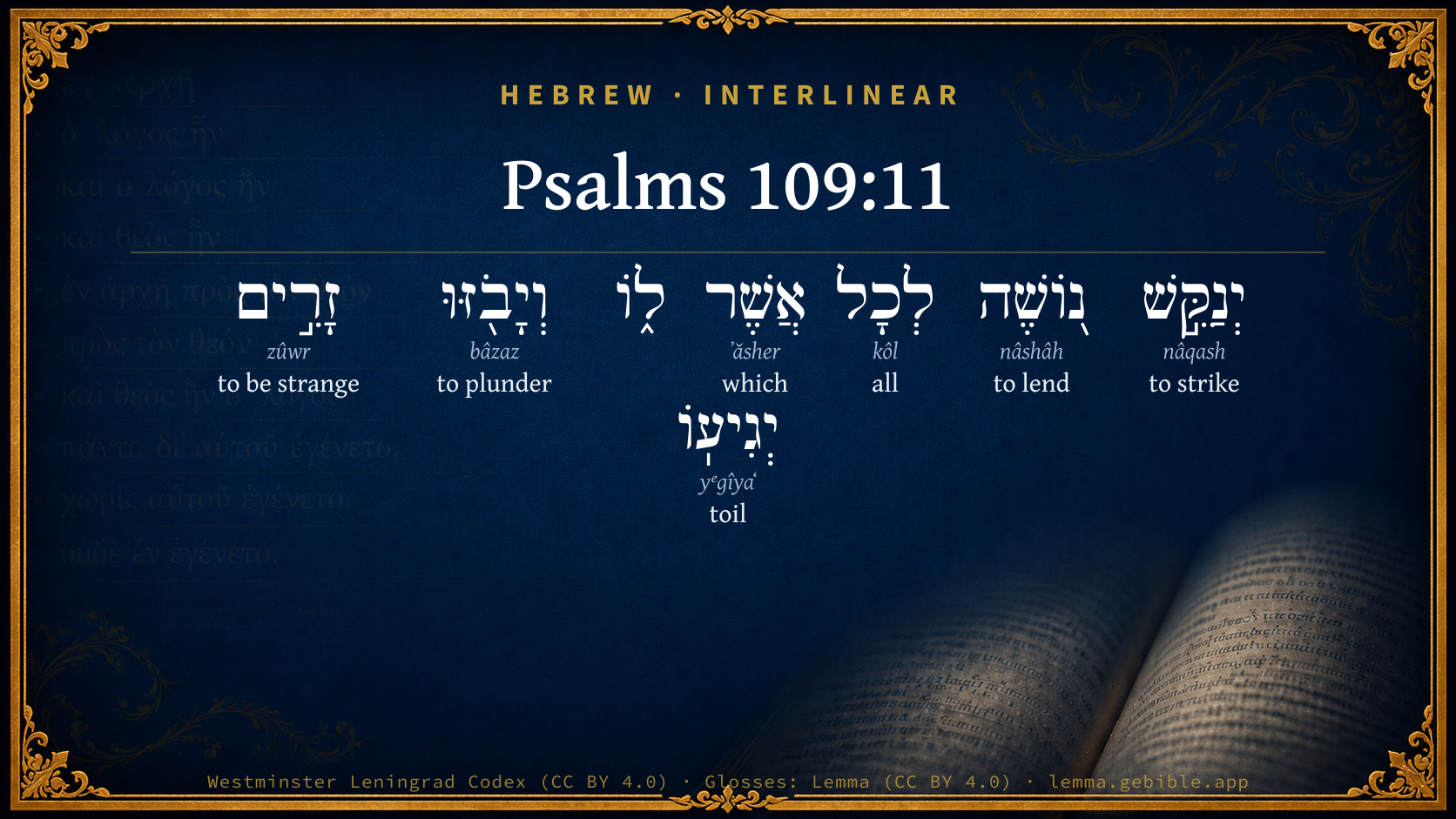
Psalms 109:11

Hebrew (Westminster Leningrad Codex) Psalms 109:11 appears in the Hebrew Old Testament. The text above is from the Westminster Leningrad Codex. Each word links to its Strong’s number, a concise gloss, and parsing drawn from the Open Scriptures Hebrew Bible morphology. Click any word for its full Brown-Driver-Briggs (BDB) entry.
Download image
Cite this verse

Psalms 109:11 (World English Bible). Public Domain. Lemma interlinear Bible study tool, https://lemma.gebible.app/v/psalms/109/11.

Show BibTeX & RIS
BibTeX
RIS
English Translation
Let the creditor seize all that he has. Let strangers plunder the fruit of his labor.
World English Bible · Public Domain
Download a study sheet

One document with this verse’s original text, its word-by-word gloss line, the meaning frame, cross-references with their text, attributed commentary, and full source and license credits — printable, and it pastes into notes with its structure intact.

This verse Autodidact and up

Study sheet (.html) Plain text (.txt)

A passage Seminary Student

Up to 50 verses in one chapter. A passage sheet keeps up to 6 commentary sources and 12 cross-references per verse, in the order this page ranks them, and says so on the sheet whenever that leaves anything out. Ask for a single verse and you get the Autodidact verse sheet above.

Everything on this page stays free to read, with no account — the sheet is a download of what is already on screen, not access to it.

Want to remove ads? Support Godless Engineer
Compare translations 3

The same verse in 3 English versions, stacked beneath the original-language interlinear above. Click any original word for its lexicon entry.

Each is an independent rendering of the whole verse — the interlinear is not word-aligned to these translations.

Highlighted words mark where these versions differ — a whole-verse word diff, not a word-by-word alignment.

  • World English Bible Public Domain
    Let the creditor seize all that he has. Let strangers plunder the fruit of his labor.
  • King James Version Public Domain
    Let the extortioner catch all that he hath; and let the strangers spoil his labour.
  • unfoldingWord Literal Text CC BY-SA 4.0
    May a creditor snare all that to him; may strangers plunder his work.

unfoldingWord Literal Text — © unfoldingWord, licensed CC BY-SA 4.0. Word-aligned USFM3 via Door43 (git.door43.org/unfoldingWord/en_ult).

Versions to compare (up to 4)

3 of 4 selected

Show all 18 translations

Every available English version of this verse, each an independent rendering of the whole verse.

  • World English Bible Public Domain
    Let the creditor seize all that he has. Let strangers plunder the fruit of his labor.
  • Berean Standard Bible Public Domain
    May the creditor seize all he owns, and strangers plunder the fruits of his labor.
  • Majority Standard Bible Public Domain
    May the creditor seize all he owns, and strangers plunder the fruits of his labor.
  • King James Version Public Domain
    Let the extortioner catch all that he hath; and let the strangers spoil his labour.
  • American Standard Version (1901) Public Domain
    Let the extortioner catch all that he hath; And let strangers make spoil of his labor.
  • Revised Version (1885) Public Domain
    Let the extortioner catch all that he hath; and let strangers make spoil of his labour.
  • Geneva Bible (1599) Public Domain
    Let the extortioner catch al that he hath, and let the strangers spoile his labour.
  • Douay-Rheims (1899) Public Domain
    May the userer search all his substance: and let strangers plunder his labours.
  • Young's Literal Translation Public Domain
    An exactor layeth a snare for all that he hath, And strangers spoil his labour.
  • Literal Standard Version CC BY-SA 4.0
    An exactor lays a snare for all that he has, || And strangers spoil his labor.
  • Unlocked Literal Bible CC BY-SA 4.0
    May the creditor take all he owns; may strangers plunder what he earns.
  • unfoldingWord Literal Text CC BY-SA 4.0
    May a creditor snare all that to him; may strangers plunder his work.
  • Darby Bible Public Domain
    Let the usurer cast the net over all that he hath, and let strangers despoil his labour;
  • World Messianic Bible Public Domain
    Let the creditor seize all that he has. Let strangers plunder the fruit of his labor.
  • Webster's Bible Public Domain
    Let the extortioner catch all that he hath; and let strangers spoil his labor.
  • Free Bible Version CC BY-SA 4.0
    May creditors seize all that he owns; may strangers take all that he worked for.
  • Bible in Basic English Public Domain
    Let his creditor take all his goods; and let others have the profit of his work.
  • JPS Tanakh (1917) Public Domain
    Let the creditor distrain all that he hath; and let strangers make spoil of his labour.

Literal Standard Version (2020), Covenant Press — licensed CC BY-SA 4.0. Text via the HelloAO Bible API (eBible.org). Unlocked Literal Bible (unfoldingWord) — licensed CC BY-SA 4.0. Text via the HelloAO Bible API (eBible.org). unfoldingWord Literal Text — © unfoldingWord, licensed CC BY-SA 4.0. Word-aligned USFM3 via Door43 (git.door43.org/unfoldingWord/en_ult). Free Bible Version, Dr. Jonathan Gallagher — licensed CC BY-SA 4.0. Text via the HelloAO Bible API (eBible.org).

Word by word

More ways to search: Search by grammar → Find every occurrence → Compare this word →

Practice this passage: Drill this verse → Learn its vocabulary →

יְנַקֵּ֣שׁ
nâqash
H5367
“to strike”
Verb, Piel, Imperfect, 3rd Person, Masculine, Singular
Part of Speech
Verb
Stem
Piel
Form
Imperfect
Person
3rd Person
Gender
Masculine
Number
Singular
Full BDB Definition

Origin: a primitive root

TWOT: 1419

to knock, strike, bring down - (Qal) to strike down - (Niphal) to be thrust after, be impelled - (Piel) to strike at, take aim at - (Hithpael) to be struck - (CLBL) to ensnare - (Qal) to ensnare - (Niphal) to be ensnared - (Piel) to lay snares - (Hithpael) to lay snares
  1. נ֭וֹשֶׁה nâshâh H5383 “lending” Verb, Qal, Participle Active, Masculine, Singular, Absolute
  2. לְכָל kôl H3605 “to/for · all of” Preposition + Noun, Common, Masculine, Singular, Construct
  3. אֲשֶׁר ʼăsher H834 “which” Particle, Relative
  4. וְיָבֹ֖זּוּ bâzaz H962 “and · to plunder” Conjunction + Verb, Qal, Imperfect, 3rd Person, Masculine, Plural
  5. זָרִ֣ים zûwr H2114 “strange” Adjective, Adjective, Masculine, Plural, Absolute
  6. יְגִיעֽוֹ yᵉgîyaʻ H3018 “toil · his” Noun, Common, Masculine, Singular, Construct + Suffix, Personal, 3rd Person, Masculine, Singular

About this verse

These counts appear in no published source. They are computed here, from the morphology-tagged text and Lemma’s own curated glosses. What Lemma adds →

8
words
7
distinct lemmas
Wisdom
section

Notable vocabulary

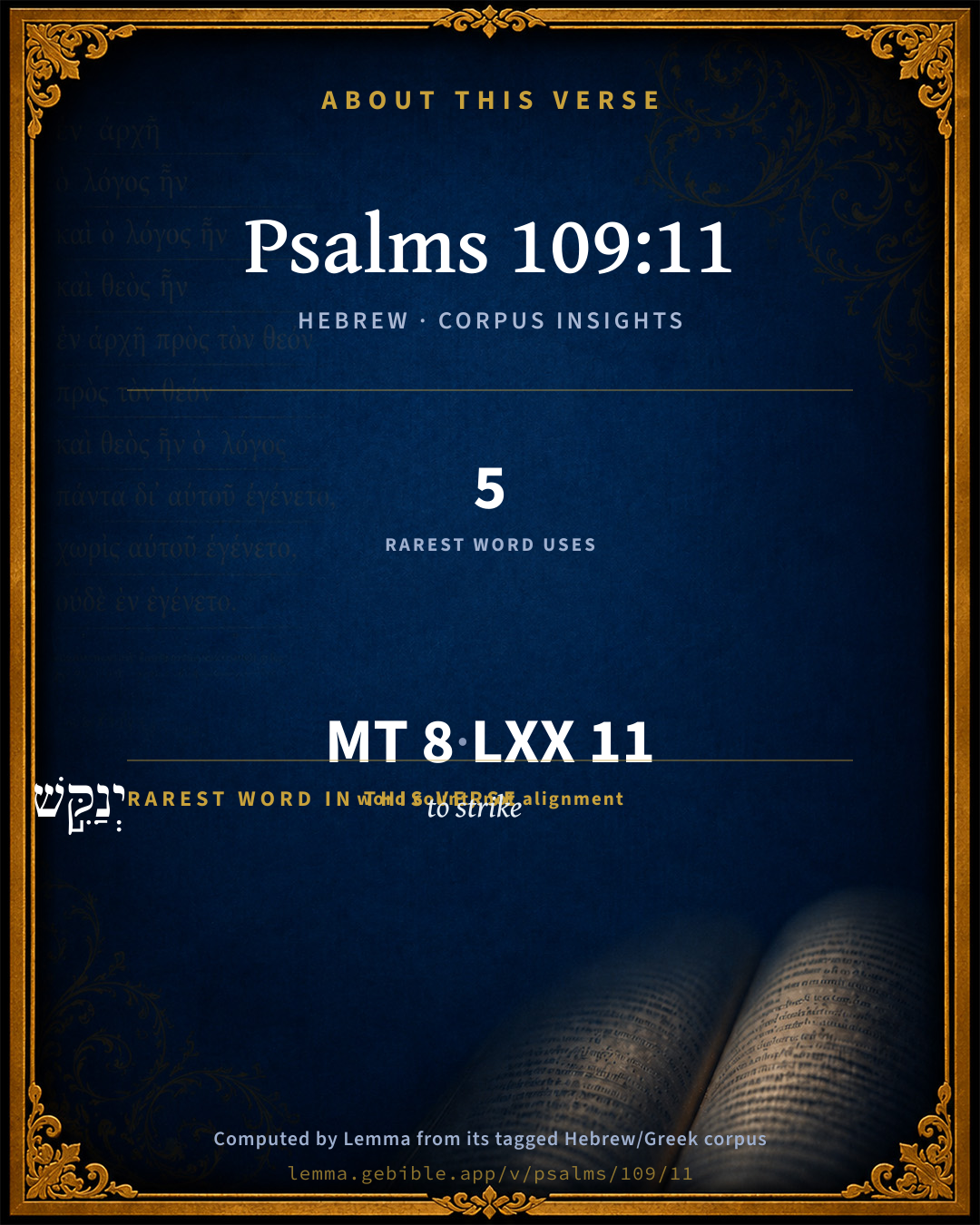
The rarest word here is יְנַקֵּ֣שׁ to strike H5367 — appearing just 5 times in the whole Hebrew Bible.

Shared distinctive vocabulary

יְנַקֵּ֣שׁ to strike H5367 occurs in 5 verses of the Hebrew Bible. Also found in:

Grammatical profile

  • 3 verbs
  • 2 nouns
  • 1 adjective
  • 1 preposition
  • 1 particle

Verb forms

  • יְנַקֵּ֣שׁ Piel · Imperfect
  • נ֭וֹשֶׁה Qal · Participle Active
  • וְיָבֹ֖זּוּ Qal · Imperfect

Hebrew & Septuagint length

In English translation the verse runs 16 words from the Hebrew and 15 from the Septuagint (LXX English) — closely comparable.

A rough comparison of the two English renderings, which tokenize alike — not a word-level alignment.

Word counts can differ between the Hebrew and the Greek without any difference in meaning — e.g. the Hebrew direct-object marker אֵת has no separate Greek word, and Greek often adds the article ὁ.

In the original languages it is 8 Hebrew tokens and 11 Greek tokens — but the two are counted differently (Hebrew bundles its prefixes and suffixes into one token; the Greek is in lemma form), so that isn’t a like-for-like length.

Cross-references

7

Topical passages linked to Psalms 109:11 in the Treasury of Scripture Knowledge — connected by theme and wording, ordered by reader-vote popularity; previews shown in the World English Bible.

  • Job 5:5 Whose harvest the hungry eats up, And take it even out of the thorns; The snare gapes for their substance.
  • Deuteronomy 28:29 and you shall grope at noonday, as the blind gropes in darkness, and you shall not prosper in your ways: and you shall be only oppressed and robbed always, and there shall be none to save you.
  • Deuteronomy 28:33–34 The fruit of your ground, and all your labors, shall a nation which you don't know eat up; and you shall be only oppressed and crushed always;
  • Deuteronomy 28:50–51 a nation of fierce facial expressions, that shall not regard the person of the old, nor show favor to the young,
  • Job 18:9–19 A snare shall take him by the heel; A trap shall lay hold on him.
  • Job 20:18 That for which he labored he shall restore, and shall not swallow it down; According to the substance that he has gotten, he shall not rejoice.
  • Judges 6:3–6 So it was, when Israel had sown, that the Midianites came up, and the Amalekites, and the children of the east; they came up against them;

Cross-references courtesy of OpenBible.info (CC BY 4.0).

Hebrew and Greek witnesses Masoretic Hebrew ↔ Greek Septuagint

The same verse in the two great witnesses to the Old Testament, shown verse-for-verse.

You’re reading Greek Psalm 108 (Hebrew Psalm 109). The Septuagint counts the superscription, so verse numbers can differ from the Hebrew — chapter-level alignment, not verse-by-verse. Numbering follows Rahlfs.

These are two independent witnesses, not word-aligned to each other, and the Septuagint is shown in lemma (dictionary) form.

Hebrew Psalms 109:11 Masoretic · Westminster Leningrad Codex

יְנַקֵּ֣שׁ נ֭וֹשֶׁה לְכָל אֲשֶׁר ל֑וֹ וְיָבֹ֖זּוּ זָרִ֣ים יְגִיעֽוֹ

Let the creditor seize all that he has. Let strangers plunder the fruit of his labor.

World English Bible · Public Domain

Greek LXX Greek Psalm 108:11 Septuagint · lemma form

ἐκἐρευνάω δανειστής πᾶς ὅσος ὑποἄρχω αὐτός διαἁρπάζω ἀλλότριος ὁ πόνος αὐτός

Let his creditor exact all that belongs to him: and let strangers spoil his labors.

LXX2012 (modern English Septuagint) · Public Domain

Hebrew: Westminster Leningrad Codex (CC BY 4.0). Greek: Septuagint (public domain); English from LXX2012 (modern English Septuagint) (Public Domain). How the Septuagint differs from the Hebrew →

Commentary

Notes on Psalms 109:11 from classic Christian and Jewish commentators (each source and its license shown beneath its notes). The classic Christian expositions comment on the surrounding passage and are grouped to its opening verse, so a note may address several verses; the Jewish commentaries on the Tanakh (Rashi and others) are per-verse, so they appear only where the commentator wrote on this verse.

Lemma curates 59 commentaries, every one of them public domain or Creative Commons licensed, each selected and text-cleaned for this edition rather than reprinted as found. About our sources →

Trapp's Complete Commentary

John Trapp

Psa 109:11 Let the extortioner catch all that he hath; and let the strangers spoil his labour.

Ver. 11. Let the extortioner catch all that he hath] As it were in nets and snares, that is, in bonds, debts, mortgages; so Chrysostom expoundeth Psa 10:9. Et ipsum et omnes eius facultates inexplicabilibus suis laqueis immites foeneratores irretiant, Let the merciless usurer make a prey of him and his estate.

And let the stranger, &c.] Who hath no right to it, and will show as little mercy. The Chaldee here hath it, Colligat fiscus omnia quae ipsius sunt. And Quae non capit Christus, rapit fiscus, saith Bernard.

John Trapp, A Commentary or Exposition upon All the Books of the Old and New Testament (1647–1656) — public domain. Text from a community e-Sword module.

Joseph Benson's Commentary

Psa 109:11-12. Let the extortioner catch, &c. — Hebrew, ינקשׁ נשׁה, jenakkesh nosheh, the creditor, or usurer, shall insnare all that he hath: that is, take it away, not only by oppression and violence, but by cunning artifices and fraud, whereby such persons are wont to entangle, and so ruin their debtors. Let the stranger — Who hath no right to his goods, and will use no pity in spoiling him; spoil his labour — All the fruits of his labour. Let there be — There shall be none to extend mercy to him, &c. — He and his offspring shall be unpitied and hated as the public enemies of mankind. “Since the destruction of Jerusalem how often hath this race been seized, pillaged, stripped, and empoverished by prince and people, in all the nations of the known world, none appearing, as in other cases, to favour and extend mercy to them:” see notes on Lev 26:21-39; Deu 28:29-68. “They have had no nation, none,” says Dr. Jackson, “to avenge their grievous wrong, which the Lord God of their forefathers had ordained they should suffer at all times and in all places, wheresoever they have come, without redress. Nay, their general carriage hath been so odious and preposterous, that albeit Christian magistrates had conspired together for their good, they would themselves have certainly provoked their own misery.”

Joseph Benson's Commentary on the Old and New Testaments (1811–1818) — public domain. Text from a community e-Sword module.

J. A. Alexander on Psalms

Joseph Addison Alexander

11. (Psa 109:11) Let a creditor entrap all he has, and strangers plunder (the fruit of) his labour. The first noun originally means a lender, but in usage has the accessory sense of a hard creditor, an extortioner. The verb means to lay a snare for, as in Psa 38:12. Strangers, not his natural heirs, not members of his family. See Deu 25:5.

Joseph Addison Alexander, The Psalms Translated and Explained (1850) — public domain. Text from a community e-Sword module.

Geneva Bible (1599)

Geneva Bible translators

He declareth that the curse of God lieth upon the extortioners, who thinking to enrich their children by their unlawfull gotten goods, are by God’s just judgment deprived of all.

Geneva Bible (1599) marginal notes — public domain. Text via Bolls.life.

Adam Clarke's Commentary

Verse 11. Let the strangers spoil his labour.] Many of these execrations were literally fulfilled in the case of the miserable Jews, after the death of our Lord. They were not only expelled from their own country, after the destruction of Jerusalem, but they were prohibited from returning; and so taxed by the Roman government, that they were reduced to the lowest degree of poverty. Domitian expelled them from Rome; and they were obliged to take up their habitation without the gate Capena, in a wood contiguous to the city, for which they were obliged to pay a rent, and where the whole of their property was only a basket and a little hay. See JUVENAL, Sat. ver. 11: -

Substitit ad veteres arcus, madidamque Capenam:

Hic ubi nocturne Numa constituebat amicae,

Nunc sacri fontis nemus, et delubra locantur

Judaeis: quorum cophinus, foenumque supellex:

Omnis enim populo mercedem pendere jussa est

Arbor, et ejectis mendicat silva Camoenis.

He stopped a little at the conduit gate,

Where Numa modelled once the Roman state;

In nightly councils with his nymph retired:

Though now the sacred shades and founts are hired

By banished Jews, who their whole wealth can lay

In a small basket, on a wisp of hay.

Yet such our avarice is, that every tree

Pays for his head; nor sleep itself is free;

Nor place nor persons now are sacred held,

From their own grove the Muses are expelled.

DRYDEN.

The same poet refers again to this wretched state of the Jews, Sat. vi., ver. 541; and shows to what vile extremities they were reduced in order to get a morsel of bread: -

Cum dedit ille locum, cophino foenoque relicto,

Arcanam Judaea tremens mendicat in aurem,

Interpres legum Solymarum, et magna sacerdos

Arboris, ac summi fida internuncia coeli.

Implet et illa manum, sed parcius, aere minuto.

Qualia cunque voles Judaei somnia vendunt.

Here a Jewess is represented as coming from the wood mentioned above, to gain a few oboli by fortune-telling; and, trembling lest she should be discovered, she leaves her basket and hay, and whispers lowly in the ear of some female, from whom she hopes employment in her line. She is here called by the poet the interpretess of the laws of Solymae, or Jerusalem, and the priestess of a tree, because obliged, with the rest of her nation, to lodge in a wood; so that she and her countrymen might be said to seek their bread out of desolate places, the stranger having spoiled their labour. Perhaps the whole of the Psalm relates to their infidelities, rebellions, and the miseries inflicted on them from the crucifixion of our Lord till the present time. I should prefer this sense, if what is said on Ps 109:20 be not considered a better mode of interpretation.

Adam Clarke's Commentary on the Bible (1810–1826) — public domain. Text from a community e-Sword/MySword module.

Ellicott's Commentary for English Readers

(11) Let the extortioner.—Better, let the usurer lay traps to catch all that he hath. So Timon:

“Let prisons swallow them,

Debts wither them to nothing.”

A Bible Commentary for English Readers, edited by Charles John Ellicott (1878–1897) — public domain. Text from a community e-Sword module.

The Cambridge Bible for Schools and Colleges

gen. ed. J. J. S. Perowne

11. Let a creditor ensnare all that he hath,

And let foreigners plunder his labour.

Ensnare is a graphic word for the wily schemes by which an unscrupulous creditor or usurious money-lender would contrive to get possession of all a man’s property. For examples of the destitution to which Israelites were sometimes brought by creditors see 2Ki_4:1 ff.; Neh_5:1-7.

The Cambridge Bible for Schools and Colleges (gen. ed. J. J. S. Perowne; Cambridge University Press, 1878–1918) — public domain. Text from a community e-Sword module.

John Gill's Exposition

Let there be none to extend mercy unto him,.... No pity is ever expressed at hearing or reading the sad case of Judas; and though the Jews were pitied of those that carried them captive to Babylon, Psa 106:46, yet, in their last destruction by the Romans, no mercy was shown them; the wrath of God and man came upon them to the uttermost, Th1 2:16.

Neither let there be any to favour his fatherless children: to bestow any benefit upon them; to relieve their wants, nor to protect their persons; no more respect shown them than to their father, being shunned and hated for their father's sake.

John Gill's Exposition of the Whole Bible (1746–1763) — public domain (CC PDM 1.0). Text via the HelloAO Bible API.

Albert Barnes' Notes on the Bible

Let the extortioner catch all that he hath - literally, “Let the extortioner cast a snare over all that he hath;” that is, let him seize all his property. The word rendered “catch” - נקשׁ nâqash - is a word which means to lay a snare, as for birds and wild animals, and hence, it means to ensnare, to entrap, to catch. The word rendered “extortioner” means literally one who lends or borrows money; a money-loaner; in our times, a “broker.” Here it refers to one who loaned money on interest; or who took advantage of the necessities of others to lend money at high rates - thus sooner or later seizing upon and securing the property of another. The prayer here is, that he might be in such circumstances as to make it necessary to fall into the hands of those who would thus come into possession of all his property.

And let the strangers spoil his labor - Let strangers “plunder” his labor; that is, the fruit of his labor. Let them seize and possess what he has earned and gained to enjoy it themselves. The remarks made on Psa 109:10, will apply to this verse and the following.

Albert Barnes' Notes on the Bible (1834–1885) — public domain. Text from a community e-Sword/MySword module.

Matthew Poole's English Annotations

Extortioner; or, usurer, or creditor. Catch, Heb. insnare, which is an emphatical expression, i.e. take away not only by oppression and violence, but also by cheats and cunning artifices, whereby such persons entangle, and so ruin their debtors.

The strangers; who have no right to his goods, and will use no pity nor measure in spoiling him.

His labour; all the fruits of his labours.

Matthew Poole's English Annotations on the Holy Bible (1683–1685) — public domain. Text from a community e-Sword/MySword module.

The Treasury of David

Charles H. Spurgeon

Ver. 11. Let the extortioner catch all that he hath. A doom indeed. Those who have once fallen into the hands of the usurer can tell you what this means: it were better to be a fly in the web of a spider. In the most subtle, worrying, and sweeping manner the extortioner takes away, piece by piece, his victim's estate, till not a fraction remains to form a pittance for old age. Baiting his trap, watching it carefully, and dexterously driving his victim into it, the extortioner by legal means performs unlawful deeds, catches his bird, strips him of every feather, and cares not if he die of starvation. He robs with law to protect him, and steals with the magistrate at his back: to fall into his clutches is worse than to be beset by professed thieves.

And let the strangers spoil his labour, so that his kindred may have none of it. What with hard creditors and pilfering strangers the estate must soon vanish! Extortion drawing one way, and spoliation the other, a known moneylender and an unknown robber both at work, the man's substance would soon disappear, and rightly so, for it was gathered by shameless means. This too has been frequently seen. Wealth amassed by oppression has seldom lasted to the third generation: it was gathered by wrong and by wrong it is scattered, and who would decree that it should be otherwise? Certainly those who suffer beneath high handed fraud will not wish to stay the retribution of the Almighty, nor would those who see the poor robbed and trampled on desire to alter the divine arrangements by which such evils are recompensed even in this life.

Ver. 11. Let the extortioner catch all that he hath. Note: he is most miserable who falls into the hands of usurers; for they will flay him alive and drain his blood. The Romans, that they might deter the citizens from usury, placed a statue of Marsyas in the Forum or law court, by which they signified that those who came into the hands of usurers would be skinned alive; and to show that usurers, as the most unjust litigants, deserved hanging, they placed a rope in the hand of the figure. Le Blanc.

Ver. 11. Catch. This refers to the obligations between creditors and debtors, and he calls these snares, by which, as it were, the insolvent debtors are caught, and at last come to servitude. Mollerus.

Psalms 109:12*

Charles H. Spurgeon's The Treasury of David (1869–1885) — public domain. Psalms only. Text from a community e-Sword/MySword module.

Whedon's Commentary on the Bible

Daniel D. Whedon

11. Extortioner—The lender, whether of money or other property for a pledge, especially one who takes occasion of the necessity of the borrower to extort and oppress. The idea is that of a merciless creditor. See Exo_22:25; Psa_89:22.

Strangers spoil his labour— Foreigners, heathens, shall make a spoil of his wealth; a special dishonour to a Hebrew. See Deu_28:33; Deu_28:51; Jer_5:17

Daniel D. Whedon (gen. ed.), Commentary on the Old and New Testaments (1874–1909) — public domain. Text from a community e-Sword module.

The Pulpit Commentary

Let the extortioner catch all that he hath; rather, the creditor, or the usurer; i.e. the man from whom he has borrowed money. And let the strangers (rather, let foreigners) spoil his labor; i.e. plunder his lands, carry off his crops, and leave him destitute.

The Pulpit Commentary (1880–1919), ed. H.D.M. Spence-Jones & Joseph S. Exell — public domain. Text from a community e-Sword module.

John Wesley's Explanatory Notes

Catch - Hebrew. ensnare, take away not only by oppression but also by cunning artificers. Stranger - Who hath no right to his goods.

John Wesley, Explanatory Notes Upon the Whole Bible (1754–1765) — public domain. Text via the GEBible commentary corpus.

Keil & Delitzsch

C. F. Keil & F. Delitzsch

The Piel נקּשׁ properly signifies to catch in snares; here, like the Arabic Arab. nqš, II, IV, corresponding to the Latin obligare (as referring to the creditor's right of claim); nosheh is the name of the creditor as he who gives time for payment, gives credit (vid., Isa 24:2). In Psa 109:12 משׁך חסד, to draw out mercy, is equivalent to causing it to continue and last, Psa 36:11, cf. Jer 31:3. אחריתו, Psa 109:13, does not signify his future, but as Psa 109:13 (cf. Psa 37:38) shows: his posterity. יהי להכרית is not merely exscindatur, but exscindenda sit (Eze 30:16, cf. Jos 2:6), just as in other instances חיה ל corresponds to the active fut. periphrasticum, e.g., Gen 15:12; Isa 37:26. With reference to ימּח instead of ימּח (contracted from ימּחה), vid., Ges. 75, rem. 8. A Jewish acrostic interpretation of the name ישׁוּ runs: ימּח שׁמו וזכרו. This curse shall overtake the family of the υἱὸς τῆς ἀπωλείας. All the sins of his parents and ancestors shall remain indelible above before God the Judge, and here below the race, equally guilty, shall be rooted out even to its memory, i.e., to the last trace of it.

Keil & Delitzsch — Biblical Commentary on the Old Testament (1861–1891) — public domain (CC PDM 1.0). Text via the HelloAO Bible API. (Old Testament only.)

unfoldingWord translationNotes

Door43 World Missions Community

the creditor

someone who lends money to another person but expects that the person will pay the money back

plunder

steal by force

May his children be cut off; may their name be blotted out

These two phrases have similar meanings and emphasize his children being destroyed. (See: Parallelism)

May his children be cut off

This can be stated in active form. AT: "Cause his children to be cut off" or "Cause his children to die" (See: Active or Passive)

may their name be blotted out in the next generation

Here the idea of there being no one to carry on the family name is spoke of as "their name being blotted out." AT: "may there be no one to carry on his name" (See: Metaphor)

translationWords

cut off

name

blot out

generation

unfoldingWord translationNotes — © Distant Shores Media and the Door43 World Missions Community, licensed CC BY-SA 4.0. Source: git.door43.org/Door43/en_tn.

Rashi

Rabbi Shlomo Yitzchaki (Rashi)

May a creditor search out all he has Heb. ינקש. A person who toils and searches, and longs passionately to do something is described by the expression מִתְנַקֵשׁ, i.e., shaken and going from place to place, like (Dan. 5:6): “and his knees knocked (נקשן) against each other.”

Rashi on the Tanakh — English translations: “The Judaica Press complete Tanach with Rashi, translated by A. J. Rosenberg” (CC BY 4.0); “Pentateuch with Rashi's commentary by M. Rosenbaum and A.M. Silbermann, 1929-1934” (public domain); “The Metsudah Tanach series, Lakewood, N.J” (CC BY 4.0); and “The Book of Joshua, Metsudah Publications, 1997” (CC BY 4.0). Text via Sefaria.

Lesson kit

Teaching starters — assembled from the data on this page, not authored interpretation. Every prompt links to the verse data it draws on. Edit before teaching.

Psalms, in the Wisdom, opens this verse with 8 words (7 distinct Hebrew lemmas). Its most distinctive word is nâqash (“to strike”). A historical commentator’s framing appears above. Read the whole chapter for the surrounding context.

Discussion questions

  1. The word nâqash carries the sense “to strike.” How does it shape the verse?
  2. Deuteronomy 12:30 shares the word «to strike» with this verse. How do the two illuminate each other?
  3. These translations render this verse differently. What is at stake in choosing one wording over another?
  4. The verb «יְנַקֵּ֣שׁ» is Piel Imperfect. How does its form color the action?
  5. Reading how Trapp's Complete Commentary and Joseph Benson's Commentary read this verse, where do the two commentators agree and where do they part?

Things to notice

Reading settings

Reading text

Shown beneath each verse's original-language words.

Old Testament
Old Testament edition

Read the OT as the Masoretic Hebrew (MT) or the Greek Septuagint (LXX).

English shown for the Greek Septuagint (in the Hebrew ↔ Greek comparison).

Comparing translations? Open the Compare panel on any verse page to stack up to four side by side.