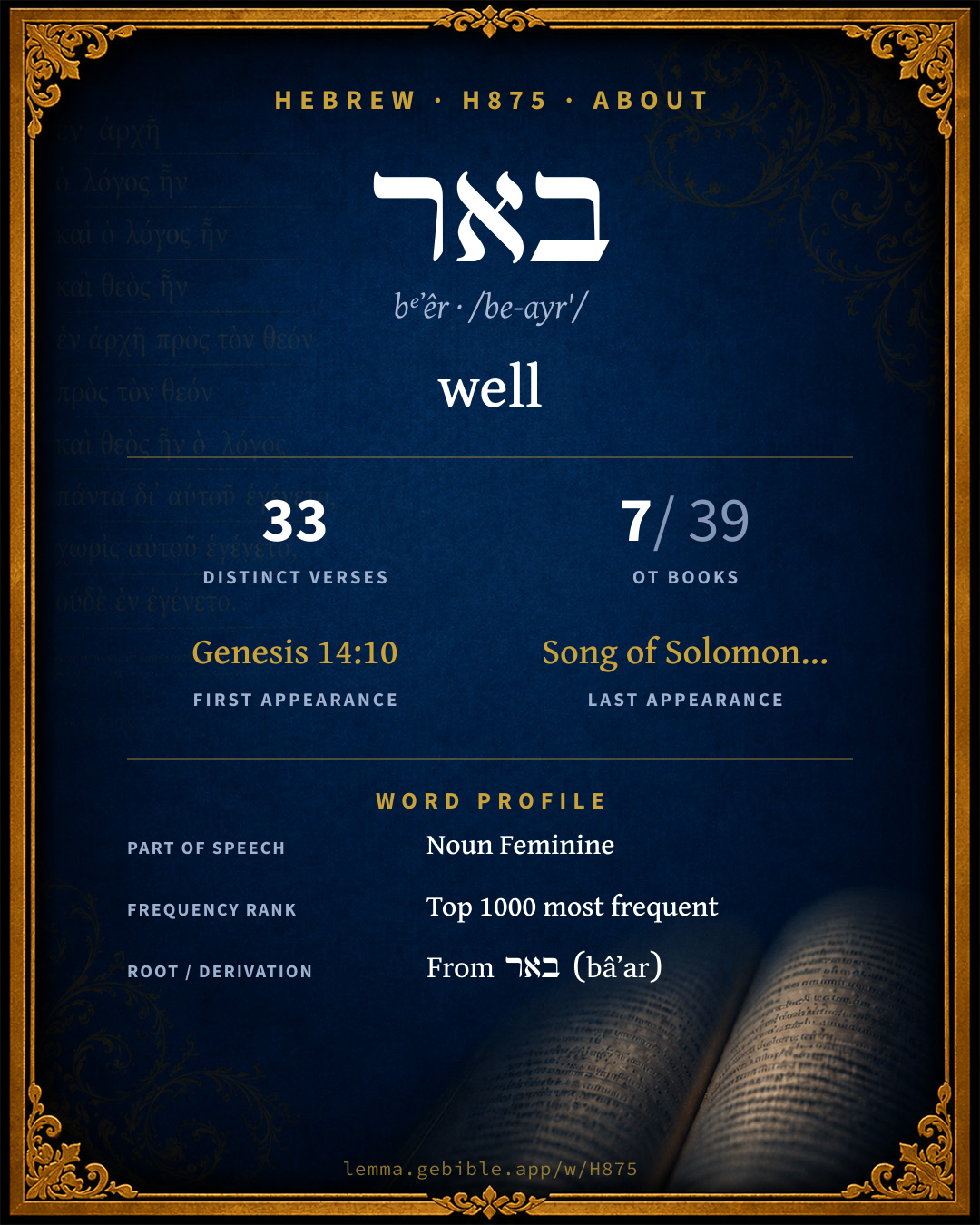
בְּאֵר
well
Full lexicon entry — Brown-Driver-Briggs (BDB)
From Brown-Driver-Briggs (BDB)
Where this word appears
See every Absolute-state word in the Hebrew Bible →
Grammar key — what these labels mean
Part of speech
- Noun
- A naming word — a person, place, thing, or idea.
Noun type
- Common
- A common noun — a general class of person, place, or thing (“king,” “city,” “water”), not a specific name.
State
- Absolute
- The independent form of a noun, not bound to a following word.
- Construct
- A noun bound to a following noun in a possessive / “of” relationship (the construct chain).
Gender
- Feminine
- Grammatically feminine.
Number
- Singular
- One.
- Plural
- More than one (in Hebrew, generally three or more).
Grammatical forms
- Noun, Common, Feminine, Singular, Absolute 26 times (70%)
- Noun, Common, Feminine, Singular, Construct 7 times (19%)
- Noun, Common, Feminine, Plural, Construct 3 times (8%)
- Noun, Common, Feminine, Plural, Absolute 1 time (3%)
Parsed forms decoded from the imported morphology (morphhb / Westminster Leningrad Codex — WLC text public domain, morphhb tagging CC BY 4.0), counted across 37 parsed occurrences — not distinct verses.
Every verse where H875 appears — 33 distinct verses across 7 books. Click any verse to open its interlinear word-by-word view. Verse text shown in the World English Bible for context — . Each verse’s Hebrew form is shown with its reference; the English is not keyword-highlighted, since the data carries no word-level English alignment. Use “Compare translations” on any verse to read it across multiple English versions. This concordance covers the Hebrew Bible; Septuagint (Greek Old Testament) occurrences are not indexed here.
Genesis 19 verses
- Genesis 14:10 בֶּֽאֱרֹ֤ת בֶּאֱרֹת֙ n c fp cs n c fp cs Now the valley of Siddim was full of tar pits; and the kings of Sodom and Gomorrah fled, and they fell there, and those who remained fled to the mountain.
- Genesis 16:14 לַ/בְּאֵ֔ר prep det + n c fs Therefore the well was called Beer Lahai Roi. Behold, it is between Kadesh and Bered.
- Genesis 21:19 בְּאֵ֣ר n c fs cs God opened her eyes, and she saw a well of water. She went, filled the bottle with water, and gave the boy drink.
- Genesis 21:25 בְּאֵ֣ר n c fs cs Abraham complained to Abimelech because of a water well, which Abimelech's servants had violently taken away.
- Genesis 21:30 הַ/בְּאֵ֥ר ptcl def.art + n c fs He said, "You shall take these seven ewe lambs from my hand, that it may be a witness to me, that I have dug this well."
- Genesis 24:11 בְּאֵ֣ר n c fs cs He made the camels kneel down outside the city by the well of water at the time of evening, the time that women go out to draw water.
- Genesis 24:20 הַ/בְּאֵ֖ר ptcl def.art + n c fs She hurried, and emptied her pitcher into the trough, and ran again to the well to draw, and drew for all his camels.
- Genesis 26:15 הַ/בְּאֵרֹ֗ת ptcl def.art + n c fp Now all the wells which his father's servants had dug in the days of Abraham his father, the Philistines had stopped, and filled with earth.
- Genesis 26:18 בְּאֵרֹ֣ת n c fp cs Isaac dug again the wells of water, which they had dug in the days of Abraham his father. For the Philistines had stopped them after the death of Abraham. He called their names after the names by which his father had called them.
- Genesis 26:19 בְּאֵ֖ר n c fs cs Isaac's servants dug in the valley, and found there a well of springing water.
- Genesis 26:20 הַ/בְּאֵר֙ ptcl def.art + n c fs The herdsmen of Gerar argued with Isaac's herdsmen, saying, "The water is ours." He called the name of the well Esek, because they contended with him.
- Genesis 26:21 בְּאֵ֣ר n c fs They dug another well, and they argued over that, also. He called the name of it Sitnah.
- Genesis 26:22 בְּאֵ֣ר n c fs He left that place, and dug another well. They didn't argue over that one. He called it Rehoboth. He said, "For now Yahweh has made room for us, and we will be fruitful in the land."
- Genesis 26:25 בְּאֵֽר n c fs He built an altar there, and called on the name of Yahweh, and pitched his tent there. There Isaac's servants dug a well.
- Genesis 26:32 הַ/בְּאֵ֖ר ptcl def.art + n c fs It happened the same day, that Isaac's servants came, and told him concerning the well which they had dug, and said to him, "We have found water."
- Genesis 29:2 בְאֵ֣ר הַ/בְּאֵ֣ר הַ/בְּאֵֽר n c fs ptcl def.art + n c fs ptcl def.art + n c fs He looked, and behold, a well in the field, and, behold, three flocks of sheep lying there by it. For out of that well they watered the flocks. The stone on the well's mouth was great.
- Genesis 29:3 הַ/בְּאֵ֔ר הַ/בְּאֵ֖ר ptcl def.art + n c fs ptcl def.art + n c fs There all the flocks were gathered. They rolled the stone from the well's mouth, and watered the sheep, and put the stone again on the well's mouth in its place.
- Genesis 29:8 הַ/בְּאֵ֑ר ptcl def.art + n c fs They said, "We can't, until all the flocks are gathered together, and they roll the stone from the well's mouth. Then we water the sheep."
- Genesis 29:10 הַ/בְּאֵ֔ר ptcl def.art + n c fs It happened, when Jacob saw Rachel the daughter of Laban, his mother's brother, and the sheep of Laban, his mother's brother, that Jacob went near, and rolled the stone from the well's mouth, and watered the flock of Laban his mother's brother.
Exodus 1 verse
Numbers 5 verses
- Numbers 20:17 בְאֵ֑ר n c fs Please let us pass through your land: we will not pass through field or through vineyard, neither will we drink of the water of the wells: we will go along the king's highway; we will not turn aside to the right hand nor to the left, until we have passed your border.
- Numbers 21:16 הַ/בְּאֵ֗ר ptcl def.art + n c fs From there they traveled to Beer: that is the well of which Yahweh said to Moses, Gather the people together, and I will give them water.
- Numbers 21:17 בְאֵ֖ר n c fs Then sang Israel this song: Spring up, well; sing you to it:
- Numbers 21:18 בְּאֵ֞ר n c fs The well, which the princes dug, Which the nobles of the people dug, With the scepter, [and] with their poles. From the wilderness [they traveled] to Mattanah;
- Numbers 21:22 בְאֵ֑ר n c fs Let me pass through your land: we will not turn aside into field, or into vineyard; we will not drink of the water of the wells: we will go by the king's highway, until we have passed your border.
2 Samuel 3 verses
- 2 Samuel 17:18 בְאֵ֛ר n c fs But a boy saw them, and told Absalom: and they went both of them away quickly, and came to the house of a man in Bahurim, who had a well in his court; and they went down there.
- 2 Samuel 17:19 הַ/בְּאֵ֔ר ptcl def.art + n c fs The woman took and spread the covering over the well's mouth, and strewed bruised grain thereon; and nothing was known.
- 2 Samuel 17:21 מֵֽ/הַ/בְּאֵ֔ר prep + ptcl def.art + n c fs It happened, after they had departed, that they came up out of the well, and went and told king David; and they said to David, Arise you, and pass quickly over the water; for thus has Ahithophel counseled against you.
Psalms 2 verses
- Psalms 55:23 לִ/בְאֵ֬ר prep + n c fs cs But you, God, will bring them down into the pit of destruction. Bloodthirsty and deceitful men shall not live out half their days, But I will trust in you.
- Psalms 69:15 בְּאֵ֣ר n c fs Don't let the flood waters overwhelm me, Neither let the deep swallow me up. Don't let the pit shut its mouth on me.
Proverbs 2 verses
Song of Solomon 1 verse
About this entry
At a glance — auto-summarized from this page’s data, not written by a person. Every figure links to its source below. This summary describes the numbers; it doesn’t interpret them.
באר (bᵉʼêr) is a Hebrew noun most often rendered “well.” Genesis dominates its distribution — 19 of 33 verses. The Hebrew Bible uses it across 33 verses — moderately common. It first appears in Genesis 14:10. Sharing its root, it stands alongside באר, באר and באר. The sections below give every sense, occurrence, and version rendering.
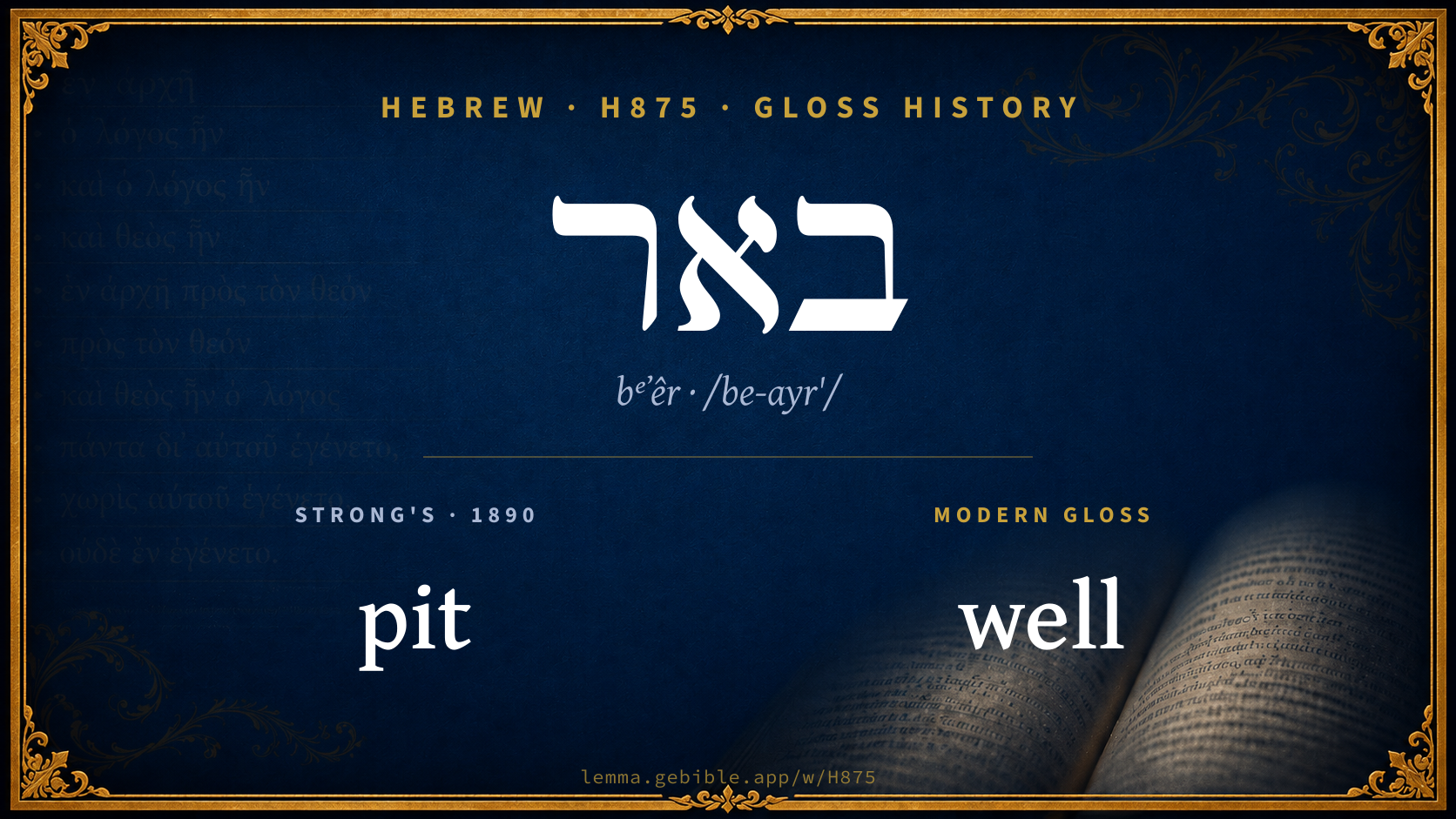
Gloss history
Strong's 1890 vs modern scholarship
About this word
Strong's H875 catalogs a Hebrew word from the Hebrew Old Testament.
These counts are not copied from any lexicon or concordance. They are computed here, from the morphology-tagged Hebrew Old Testament. What Lemma adds →
- 33
- distinct verses
- The word appears in 33 distinct verses.
- 7 / 39
- OT books
- The word appears in 7 of 39 Old Testament books.
- #967
- by frequency
- Top 1000 most frequent Hebrew words (rank 967 of 8,640 Hebrew words by occurrence).
View all 33 occurrences in the concordance →
By section of the Old Testament
By traditional corpus
Conventional, traditional groupings — biblical authorship is debated, so this is a traditional corpus grouping, not an authorship claim. Each share is this word’s portion of its verses in that division of the Hebrew canon. Each figure is a share of the word’s 33 distinct verses.
- Torah (Pentateuch) 25 verses · 76%
- Writings (Ketuvim) 5 verses · 15%
- Prophets (Nevi'im) 3 verses · 9%
How translations render this word
Counts come from each version’s own published word-to-Strong’s tagging or interlinear alignment — an approximate guide to how each version renders this word, not a word-level alignment the data otherwise carries. Because each total is that version’s own tagged count, the per-version totals vary from one another and need not match the appearance or distinct-verse counts above. These counts may also differ from a printed concordance because Lemma counts each distinctly tagged rendering and does not collapse phrase taggings into a single head-word total. This is a fixed set of word-tagged versions (KJV, ASV, BSB, ULT) and does not change with the reading translation you choose elsewhere. Each version’s license is shown beside its name below (and on Sources).
- King James Version: Well 17×, Well's 4×, Pit 2×
- American Standard Version: Well 19×, Wells 3×, Pit 2×
- Berean Standard Bible: Well 27×, Any well 2×, Pit 2×
- unfoldingWord Literal Text: Well 24×, Well of 5×, Wells 2×
King James Version Public Domain
Renders H875 across 37 tagged occurrences — most commonly:
Plus 12 renderings that appear only once — usually multi-word phrases or single function words the recovered tagging swept in, not distinct renderings.
American Standard Version Public Domain
Renders H875 across 37 tagged occurrences — most commonly:
Plus 13 renderings that appear only once — usually multi-word phrases or single function words the recovered tagging swept in, not distinct renderings.
Berean Standard Bible Public Domain
Renders H875 across 35 tagged occurrences — most commonly:
Plus 2 renderings that appear only once — usually multi-word phrases or single function words the recovered tagging swept in, not distinct renderings. Not rendered by a distinct English word in 2 further occurrences.
unfoldingWord Literal Text CC BY-SA 4.0
Renders H875 across 40 tagged occurrences — most commonly:
Plus 9 renderings that appear only once — usually multi-word phrases or single function words the recovered tagging swept in, not distinct renderings.
Senses in the full BDB
What do BDB’s symbols mean?
BDB uses these scholarly abbreviations:
| Symbol | Meaning |
|---|---|
| 𝔊 | the Septuagint (the ancient Greek translation, LXX) |
| 𝔙 | the Vulgate (the Latin translation) |
| 𝔖 | the Syriac version (the Peshitta) |
| 𝔗 | the Targum (the Aramaic translation) |
| ψ | the Psalms |
| √ | root (the underlying root or stem) |
| ‖ | parallel passage (a synonymous or contrasted parallel) |
| † | the dagger: every passage where the word occurs is cited |
The 5 senses and sub-senses the full Brown-Driver-Briggs lexicon distinguishes for this word, in lexicon order (not ranked by frequency), with BDB’s own verbatim wording and sub-sense lettering. Shown in Hebrew script with BDB’s own scholarly abbreviations. The condensed entry is in the Lexicon Entry tab. See also the Forms in the corpus table below.
- 1. a well, often as made by digging (חָפַר) Gn 21:25, 30 (E), 26:15, 18, 19, 21, 22, 32 (all J), also poet. Nu 21:18 (+ כרה) vid. also v 16, 17 (where the well addressed, in song, עֲלִי בְאֵר); also c. כרה in prose Gn 26:25; also with no ref. to its origin Gn 16:14 (J; ‖ עַיִן v 7) 29:2 Ex 2:15 (J) Nu 20:17 21:22 (E) 2 S 17:18, 21; בְּאֵר (ה)מַיִם Gn 21:19 (E) 24:11 (J; ‖ עַיִן vv 13, 16, 43, 45); (cf. also 21:25; 26:18 supr. & especially v 19 בְּאֵר מַיִם חַיִּים); water taken from it by drawing (שָׁאַב) Gn 24:11, 20; flocks watered from it (הִשְׁקָה מִן־) 29:2, 3, 8, 10 (cf. especially Ex 2:16 they drew, דלה, and filled the troughs); also שְׁתֵה מַיִם … מִתּוֹךְ בְּאֵרֶ֑ךָ Pr 5:15 (‖ בּוֹר); the opening called פִּי הַבְּאֵר Gn 29:2, 3(×2) 8, 10; cf. פְּנֵי הַבּ׳ 2 S 17:19 (read prob. פּי so Sam. 𝔗 𝔖 𝔙, cf. Dr); fig. of fresh delights of woman beloved Ct 4:15 מַעְיַן גַּנִּים בְּאֵר מַיִם חַיִּים וְנוֹזְלִים מִן־לְבָנוֹן. e.g. Genesis 21:25
- 2. pit (= בּוֹר); pits of bitumen Gn 14:10 (cf. supr.); בְּאֵר שַׁחַת ψ 55:24 pit of (the) grave; cf. 69:16 וְאַל־תֶּאְטַר עָלַי בְּאֵר פִּיהָ and let not (the) pit shut its mouth over me (‖ מְצוּלָה); fig. of strange woman בְּאֵר צָרָה a narrow pit, out of which rescue is difficult Pr 23:27 (‖ שׁוּחָה עֲמֻקָּה). e.g. Genesis 14:10
- 3. as n.pr.loc.
- a. c. ָה loc. בְּאֵ֫רָה a station of Isr. in desert Nu 21:16, possibly = בְּאֵר אֵילִים Is 15:8. e.g. Numbers 21:16
- b. same form Ju 9:21, according to Euseb. LagOnom.238, 2nd ed. 250 8 miles north of Eleutheropolis; cf. RobBR i. 452 who comp. el-Bîreh, near Beth-shemesh. e.g. Judges 9:21
Senses from the full Brown-Driver-Briggs lexicon (Brown, Driver, Briggs; Oxford 1906 — public domain), digitized via Sefaria, supplemented by the OpenScriptures HebrewLexicon (CC BY 4.0). Full attribution on Sources.
Word origin
n.f. Gn 26:21 well, pit, mostly Hex, Gn 23 times Ex 1 times Nu 5 times, 37 times in all; Arabic بِئْرٌ, Aramaic בְּאֵרָא, בֵּיר, בֵּירָא, ܒܻܪܳܐ, Sab. באר DHMZMG 1875, 608, Assyrian bêru, LyonSargon 61 (connexion with above √ not clear; Lagl.c. spring of water, as coming to light, appearing; possible, although meaning in use rather well, than spring; v. however, Gn 16:14 cf. v 7; 26:19 Nu 21:17)—בּ׳ abs. Gn 21:30 +; cstr. 21:19 +; sf. בְּאֵרֶ֑ךָ Pr 5:15; Pl. abs. בְּאֵרֹת Gn 26:15; cstr. id. 26:18; cf. בֶּאֱרֹת בֶּאֱרֹת חֵמָר Gn 14:10;—
— Brown-Driver-Briggs (Oxford 1906, public domain), digitized via Sefaria, supplemented by the OpenScriptures HebrewLexicon (CC BY 4.0). See Sources.
Derived from באר (bâʼar) (H874) — to make clear.
Jastrow Dictionary
A second Hebrew/Aramaic lexicon for comparison, covering Aramaic and post-biblical (Talmudic, Targumic, Midrashic) usage that the biblical-Hebrew BDB does not. Matched by lemma rather than by Strong’s number, so a lemma may carry more than one Jastrow headword (shown separately below), and the entries cover usage well beyond the Bible.
בָּאַר
- (√בא, v. בֹּוא)
- 1. to break forth, come to light. Denom. בְּאֵר; cmp. טוּף.
- 2. to be open, clear. —Pi. בֵּאֵר (b. h.) to proclaim (cmp. Deut. I, 5), to explain; to make clear (to one’s self), to understand clearly. Y. M. Kat. III, 83ᵇ top לבָאֵר משנתו to explain (argue on) what he has learned. Koh. R. to VI, 9 better is he שהוא מְבָאֵר משנתו וכ׳ who dwells on his studies to make them clear to himself, than he who learns to recite fluently.—Part. pass. מְבֹאָר proven, clear. Yad. III, 1 מ׳ הדבר (Talm. ed. מ׳ את הד׳) from this fact it is proven. e.g. Deuteronomy 1:5
בְּאַר
- Pa. בָּאֵר same. Y. M. Kat. III, 83ᵇ top לא חכמין מְבָאֲרָה know not how to make clear (argue).
בְּאֵר
- preced.) well, spring. Gen. R. s. 93; a. fr.—Erub. X, 14 (104ᵃ; 104ᵇ), v. הָקֵר. Taan. 9ᵃ ב׳ בזכות מרים the well in the desert was given to the Israelites for Miriam’s sake; a. fr.—Transf. origin. Y. Sot. II, 18ᵃ (play on בוראיך, Koh. XII, 1) remember בְּאֵירְךָ וכ׳ thy well (whence thou camest), thy pit (grave), thy Creator; Lev. R. s. 18, beg.—Pl. בְּאֵרוֹת. Y. Erub. II, beg. 20ᵃ ב׳ הקר, v. הָקֵר. V. בּוֹר II. e.g. Ecclesiastes 12:1
A Dictionary of the Targumim, the Talmud Babli and Yerushalmi, and the Midrashic Literature (Marcus Jastrow; London, Luzac, 1903) — Public Domain. Digitized via Sefaria. Digitized via Sefaria. Full attribution on Sources.
Forms in the corpus
The 25 distinct written forms H875 takes in the Hebrew Bible, most frequent first — each parse links to that state’s occurrences in the concordance. Hebrew forms include their vowel points and cantillation, so a single lemma takes many written forms.
Same root — word family
Other BDB entries built from the same root as H875, grouped by Strong’s listed origin. These share a root / origin per the lexicon — not necessarily a shared meaning. Each links to that word’s own entry.
Derives from
Shares the same root
Proper names from this root
People and places named from this root — a name, not an additional meaning of the word.
- באר Bᵉʼêr H876 Beer
- בארא Bᵉʼêrâʼ H878 Beera
- באר אלים Bᵉʼêr ʼÊlîym H879 Beer-elim
- בארות Bᵉʼêrôwth H881 Beeroth
- בארי Bᵉʼêrîy H882 Beeri
- באר לחי ראי Bᵉʼêr la-Chay Rôʼîy H883 Beer-lahai-roi
- באר שבע Bᵉʼêr Shebaʻ H884 Beer-sheba
- בארת בנייעקן Bᵉʼêrôth Bᵉnêy-Yaʻăqan H885 Beeroth Bene-Jaakan
Compare all same-root words → Showing 4 of 11 — not the complete family. 8 of the same-root words are proper names (people or places). They share a root, not necessarily a meaning.
Septuagint verse parallels
This word appears in 31 verses that also exist in the Greek Old Testament (Septuagint), out of the 33 Hebrew verses it occurs in. You can read those verses in Greek by switching the Old Testament edition to the Septuagint.
Read these verses in the Septuagint
This is a verse-level parallel only — the same verses exist in both the Hebrew and Greek Old Testaments. No word-level Hebrew↔Greek correspondence is claimed: the data carries no such alignment, so no Greek word is shown as this Hebrew word’s translation. Coverage is not total — the Septuagint omits the deuterocanon and renumbers the Psalms, so some Hebrew verses have no direct Greek parallel.