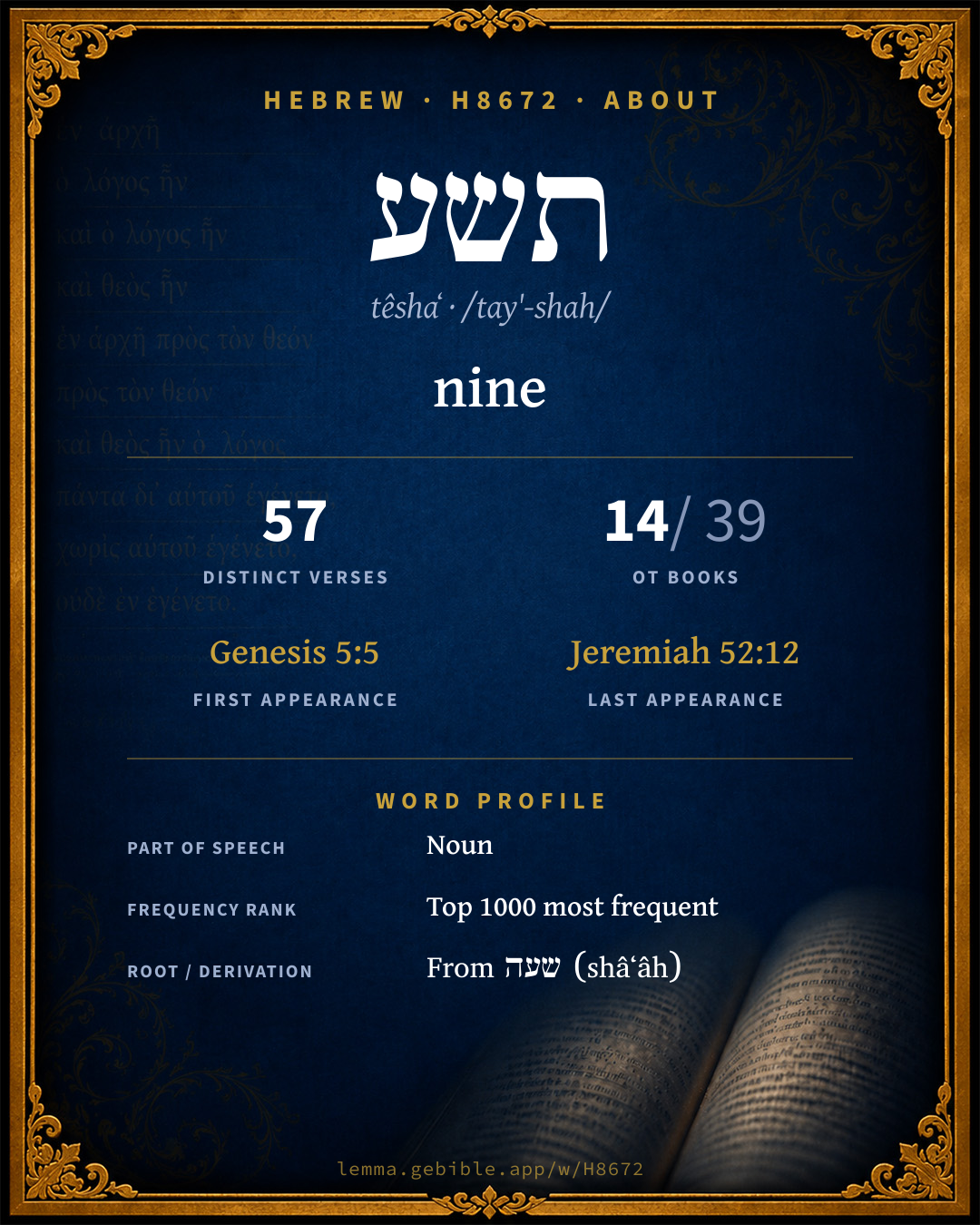
תֵּ֫שַׁע
nine
‘nine’ is one of 4 main senses fuller range ↓
Full lexicon entry — Brown-Driver-Briggs (BDB)
From Brown-Driver-Briggs (BDB)
Where this word appears
See every Absolute-state word in the Hebrew Bible →
Grammar key — what these labels mean
Part of speech
- Adjective
- A word that describes or qualifies a noun.
State
- Absolute
- The independent form of a noun, not bound to a following word.
- Construct
- A noun bound to a following noun in a possessive / “of” relationship (the construct chain).
Gender
- Feminine
- Grammatically feminine.
- Masculine
- Grammatically masculine.
Number
- Singular
- One.
54 distinct verses where H8672 appears in the Absolute state, across 14 books. Filtered view — show all forms. Click any verse to open its interlinear word-by-word view. Verse text shown in the World English Bible for context — . Each verse’s Hebrew form is shown with its reference; the English is not keyword-highlighted, since the data carries no word-level English alignment. Use “Compare translations” on any verse to read it across multiple English versions. This concordance covers the Hebrew Bible; Septuagint (Greek Old Testament) occurrences are not indexed here.
Genesis 12 verses
- Genesis 5:5 תְּשַׁ֤ע adj Cardinal number fs All the days that Adam lived were nine hundred thirty years, then he died.
- Genesis 5:8 וּ/תְשַׁ֥ע conj + Adjective Cardinal number fs All the days of Seth were nine hundred twelve years, then he died.
- Genesis 5:11 וּ/תְשַׁ֥ע conj + Adjective Cardinal number fs All the days of Enosh were nine hundred five years, then he died.
- Genesis 5:14 וּ/תְשַׁ֥ע conj + Adjective Cardinal number fs and all the days of Kenan were nine hundred ten years, then he died.
- Genesis 5:20 וּ/תְשַׁ֥ע conj + Adjective Cardinal number fs All the days of Jared were nine hundred sixty-two years, then he died.
- Genesis 5:27 תֵּ֤שַׁע וּ/תְשַׁ֥ע adj Cardinal number fs conj + Adjective Cardinal number fs All the days of Methuselah were nine hundred sixty-nine years, then he died.
- Genesis 9:29 תְּשַׁ֤ע adj Cardinal number fs All the days of Noah were nine hundred fifty years, then he died.
- Genesis 11:19 תֵּ֥שַׁע adj Cardinal number fs Peleg lived after he became the father of Reu two hundred nine years, and became the father of sons and daughters.
- Genesis 11:24 תֵּ֥שַׁע adj Cardinal number fs Nahor lived twenty-nine years, and became the father of Terah.
- Genesis 11:25 תְּשַֽׁע adj Cardinal number fs Nahor lived after he became the father of Terah one hundred nineteen years, and became the father of sons and daughters.
- Genesis 17:1 וְ/תֵ֣שַׁע conj + Adjective Cardinal number fs When Abram was ninety-nine years old, Yahweh appeared to Abram, and said to him, "I am God Almighty. Walk before me, and be blameless.
- Genesis 17:24 וָ/תֵ֖שַׁע conj + Adjective Cardinal number fs Abraham was ninety-nine years old, when he was circumcised in the flesh of his foreskin.
Exodus 1 verse
Leviticus 2 verses
- Leviticus 23:32 בְּ/תִשְׁעָ֤ה prep + Adjective Cardinal number ms It shall be a Sabbath of solemn rest for you, and you shall deny yourselves. In the ninth day of the month at evening, from evening to evening, you shall keep your Sabbath."
- Leviticus 25:8 תֵּ֥שַׁע adj Cardinal number fs "'You shall count off seven Sabbaths of years, seven times seven years; and there shall be to you the days of seven Sabbaths of years, even forty-nine years.
Numbers 3 verses
- Numbers 1:23 תִּשְׁעָ֧ה adj Cardinal number ms those who were numbered of them, of the tribe of Simeon, were fifty-nine thousand three hundred.
- Numbers 2:13 תִּשְׁעָ֧ה adj Cardinal number ms His division, and those who were numbered of them, were fifty-nine thousand three hundred.
- Numbers 29:26 תִּשְׁעָ֖ה adj Cardinal number ms On the fifth day nine bulls, two rams, fourteen he-lambs a year old without blemish;
Deuteronomy 1 verse
Joshua 5 verses
- Joshua 15:32 וָ/תֵ֖שַׁע conj + Adjective Cardinal number fs and Lebaoth, and Shilhim, and Ain, and Rimmon: all the cities are twenty-nine, with their villages.
- Joshua 15:44 תֵּ֖שַׁע adj Cardinal number fs and Keilah, and Achzib, and Mareshah; nine cities with their villages.
- Joshua 15:54 תֵּ֖שַׁע adj Cardinal number fs and Humtah, and Kiriath Arba (the same is Hebron), and Zior; nine cities with their villages.
- Joshua 19:38 תְּשַֽׁע adj Cardinal number fs Iron, and Migdal-el, Horem, and Beth Anath, and Beth-shemesh; nineteen cities with their villages.
- Joshua 21:16 תֵּ֔שַׁע adj Cardinal number fs and Ain with its suburbs, and Juttah with its suburbs, [and] Beth-shemesh with its suburbs; nine cities out of those two tribes.
Judges 2 verses
- Judges 4:3 תְּשַׁ֨ע adj Cardinal number fs The children of Israel cried to Yahweh: for he had nine hundred chariots of iron; and twenty years he mightily oppressed the children of Israel.
- Judges 4:13 תְּשַׁ֤ע adj Cardinal number fs Sisera gathered together all his chariots, even nine hundred chariots of iron, and all the people who were with him, from Harosheth of the Gentiles, to the river Kishon.
2 Samuel 2 verses
- 2 Samuel 2:30 תִּשְׁעָֽה adj Cardinal number ms Joab returned from following Abner: and when he had gathered all the people together, there lacked of David's servants nineteen men and Asahel.
- 2 Samuel 24:8 תִשְׁעָ֧ה adj Cardinal number ms So when they had gone back and forth through all the land, they came to Jerusalem at the end of nine months and twenty days.
2 Kings 8 verses
- 2 Kings 14:2 וָ/תֵ֨שַׁע֙ conj + Adjective Cardinal number fs He was twenty-five years old when he began to reign; and he reigned twenty-nine years in Jerusalem: and his mother's name was Jehoaddin of Jerusalem.
- 2 Kings 15:13 וָ/תֵ֨שַׁע֙ conj + Adjective Cardinal number fs Shallum the son of Jabesh began to reign in the nine and thirtieth year of Uzziah king of Judah; and he reigned the space of a month in Samaria.
- 2 Kings 15:17 וָ/תֵ֨שַׁע֙ conj + Adjective Cardinal number fs In the nine and thirtieth year of Azariah king of Judah began Menahem the son of Gadi to reign over Israel, [and reigned] ten years in Samaria.
- 2 Kings 17:1 תֵּ֥שַׁע adj Cardinal number fs In the twelfth year of Ahaz king of Judah began Hoshea the son of Elah to reign in Samaria over Israel, [and reigned] nine years.
- 2 Kings 18:2 וָ/תֵ֨שַׁע֙ conj + Adjective Cardinal number fs He was twenty-five years old when he began to reign; and he reigned twenty-nine years in Jerusalem: and his mother's name was Abi the daughter of Zechariah.
- 2 Kings 18:10 תֵּ֗שַׁע adj Cardinal number fs At the end of three years they took it: in the sixth year of Hezekiah, which was the ninth year of Hoshea king of Israel, Samaria was taken.
- 2 Kings 25:3 בְּ/תִשְׁעָ֣ה prep + Adjective Cardinal number ms On the ninth day of the [fourth] month the famine was sore in the city, so that there was no bread for the people of the land.
- 2 Kings 25:8 תְּשַֽׁע adj Cardinal number fs Now in the fifth month, on the seventh day of the month, which was the nineteenth year of king Nebuchadnezzar, king of Babylon, came Nebuzaradan the captain of the guard, a servant of the king of Babylon, to Jerusalem.
1 Chronicles 4 verses
- 1 Chronicles 3:8 תִּשְׁעָֽה adj Cardinal number ms and Elishama, and Eliada, and Eliphelet, nine.
- 1 Chronicles 9:9 תְּשַׁ֥ע adj Cardinal number fs and their brothers, according to their generations, nine hundred fifty-six. All these men were heads of fathers' [houses] by their fathers' houses.
- 1 Chronicles 24:16 תִּשְׁעָ֣ה adj Cardinal number ms the nineteenth to Pethahiah, the twentieth to Jehezkel,
- 1 Chronicles 25:26 לְ/תִשְׁעָ֤ה prep + Adjective Cardinal number ms for the nineteenth to Mallothi, his sons and his brothers, twelve:
2 Chronicles 3 verses
- 2 Chronicles 16:12 וָ/תֵ֤שַׁע conj + Adjective Cardinal number fs In the thirty-ninth year of his reign Asa was diseased in his feet; his disease was exceeding great: yet in his disease he didn't seek Yahweh, but to the physicians.
- 2 Chronicles 25:1 וָ/תֵ֨שַׁע֙ conj + Adjective Cardinal number fs Amaziah was twenty-five years old when he began to reign; and he reigned twenty-nine years in Jerusalem: and his mother's name was Jehoaddan, of Jerusalem.
- 2 Chronicles 29:1 וָ/תֵ֨שַׁע֙ conj + Adjective Cardinal number fs Hezekiah began to reign when he was twenty-five years old; and he reigned twenty-nine years in Jerusalem: and his mother's name was Abijah, the daughter of Zechariah.
Ezra 4 verses
- Ezra 1:9 תִּשְׁעָ֥ה adj Cardinal number ms This is the number of them: thirty platters of gold, one thousand platters of silver, twenty-nine knives,
- Ezra 2:8 תְּשַׁ֥ע adj Cardinal number fs The children of Zattu, nine hundred forty-five.
- Ezra 2:36 תְּשַׁ֥ע adj Cardinal number fs The priests: the children of Jedaiah, of the house of Jeshua, nine hundred seventy-three.
- Ezra 2:42 וְ/תִשְׁעָֽה conj + Adjective Cardinal number ms The children of the porters: the children of Shallum, the children of Ater, the children of Talmon, the children of Akkub, the children of Hatita, the children of Shobai, in all one hundred thirty-nine.
Nehemiah 4 verses
- Nehemiah 7:38 תְּשַׁ֥ע adj Cardinal number fs The children of Senaah, three thousand nine hundred thirty.
- Nehemiah 7:39 תְּשַׁ֥ע adj Cardinal number fs The priests: The children of Jedaiah, of the house of Jeshua, nine hundred seventy-three.
- Nehemiah 11:1 וְ/תֵ֥שַׁע conj + Adjective Cardinal number fs The princes of the people lived in Jerusalem: the rest of the people also cast lots, to bring one of ten to dwell in Jerusalem the holy city, and nine parts in the [other] cities.
- Nehemiah 11:8 תְּשַׁ֥ע adj Cardinal number fs After him Gabbai, Sallai, nine hundred twenty-eight.
Jeremiah 3 verses
- Jeremiah 39:2 בְּ/תִשְׁעָ֣ה prep + Adjective Cardinal number ms in the eleventh year of Zedekiah, in the fourth month, the ninth day of the month, a breach was made in the city),
- Jeremiah 52:6 בְּ/תִשְׁעָ֣ה prep + Adjective Cardinal number ms In the fourth month, in the ninth day of the month, the famine was sore in the city, so that there was no bread for the people of the land.
- Jeremiah 52:12 תְּשַֽׁע adj Cardinal number fs Now in the fifth month, in the tenth day of the month, which was the nineteenth year of king Nebuchadrezzar, king of Babylon, came Nebuzaradan the captain of the guard, who stood before the king of Babylon, into Jerusalem:
About this entry
At a glance — auto-summarized from this page’s data, not written by a person. Every figure links to its source below. This summary describes the numbers; it doesn’t interpret them.
“nine” is the headline sense of the Hebrew noun תשע (têshaʻ). Carrying more than one sense, it rewards its full sense range. The Hebrew Bible uses it across 57 verses — moderately common. First canonically at Genesis 5:5, it enters the text early. It shares a root with שעה, משעי and שעה. The sections below give every sense, occurrence, and version rendering.
Gloss history
Strong's 1890 vs modern scholarship
About this word
Strong's H8672 catalogs a Hebrew word from the Hebrew Old Testament.
These counts are not copied from any lexicon or concordance. They are computed here, from the morphology-tagged Hebrew Old Testament. What Lemma adds →
- 57
- distinct verses
- The word appears in 57 distinct verses.
- 14 / 39
- OT books
- The word appears in 14 of 39 Old Testament books.
- #658
- by frequency
- Top 1000 most frequent Hebrew words (rank 658 of 8,640 Hebrew words by occurrence).
View all 57 occurrences in the concordance →
By section of the Old Testament
By traditional corpus
Conventional, traditional groupings — biblical authorship is debated, so this is a traditional corpus grouping, not an authorship claim. Each share is this word’s portion of its verses in that division of the Hebrew canon. Each figure is a share of the word’s 57 distinct verses.
- Prophets (Nevi'im) 22 verses · 39%
- Torah (Pentateuch) 20 verses · 35%
- Writings (Ketuvim) 15 verses · 26%
How translations render this word
Counts come from each version’s own published word-to-Strong’s tagging or interlinear alignment — an approximate guide to how each version renders this word, not a word-level alignment the data otherwise carries. Because each total is that version’s own tagged count, the per-version totals vary from one another and need not match the appearance or distinct-verse counts above. These counts may also differ from a printed concordance because Lemma counts each distinctly tagged rendering and does not collapse phrase taggings into a single head-word total. This is a fixed set of word-tagged versions (KJV, ASV, BSB, ULT) and does not change with the reading translation you choose elsewhere. Each version’s license is shown beside its name below (and on Sources).
- King James Version: Nine 37×, Were nine 7×, Ninth 5×
- American Standard Version: Nine 35×, Were nine 7×, Ninth 5×
- Berean Standard Bible: Nine 13×, Nineteenth 4×, Ninth 4×
- unfoldingWord Literal Text: Nine 11×, Years 10×, Were 7×
King James Version Public Domain
Renders H8672 across 57 tagged occurrences — most commonly:
Plus 4 renderings that appear only once — usually multi-word phrases or single function words the recovered tagging swept in, not distinct renderings. Not rendered by a distinct English word in 1 further occurrence.
American Standard Version Public Domain
Renders H8672 across 55 tagged occurrences — most commonly:
Plus 4 renderings that appear only once — usually multi-word phrases or single function words the recovered tagging swept in, not distinct renderings.
Berean Standard Bible Public Domain
Renders H8672 across 28 tagged occurrences — most commonly:
Plus 5 renderings that appear only once — usually multi-word phrases or single function words the recovered tagging swept in, not distinct renderings. Not rendered by a distinct English word in 30 further occurrences.
unfoldingWord Literal Text CC BY-SA 4.0
Renders H8672 across 45 tagged occurrences — most commonly:
Plus 11 renderings that appear only once — usually multi-word phrases or single function words the recovered tagging swept in, not distinct renderings. Not rendered by a distinct English word in 15 further occurrences.
Senses in the full BDB
What do BDB’s symbols mean?
BDB uses these scholarly abbreviations:
| Symbol | Meaning |
|---|---|
| 𝔊 | the Septuagint (the ancient Greek translation, LXX) |
| 𝔙 | the Vulgate (the Latin translation) |
| 𝔖 | the Syriac version (the Peshitta) |
| 𝔗 | the Targum (the Aramaic translation) |
| ψ | the Psalms |
| √ | root (the underlying root or stem) |
| ‖ | parallel passage (a synonymous or contrasted parallel) |
| † | the dagger: every passage where the word occurs is cited |
The 6 senses and sub-senses the full Brown-Driver-Briggs lexicon distinguishes for this word, in lexicon order (not ranked by frequency), with BDB’s own verbatim wording and sub-sense lettering. Shown in Hebrew script with BDB’s own scholarly abbreviations. The condensed entry is in the Lexicon Entry tab. See also the Forms in the corpus table below.
- 1. no other num.:
- a. before n.pl. תֵּ֫שַׁע אַמּוֹת Dt 3:11, ת׳ שָׁנִים 2 K 17:1 Gn 11:19, ת׳ הַיָּדוֹת Ne 11:1, תִּשְׁעָה חֳדָשִׁים 2 S 24:8, תִּשְׁעַת הַשְּׁבָטִים Jos 13:7 (JE?), cf.14:2 Nu 34:13 (both P); after n.pl. עָרִים תֵּ֫שַׁע Jos 15:44, 51; 21:16 (all P), פָּרִים תִּשְׁעָה Nu 29:26 (P); n. om. 1 Ch 3:8. e.g. Deuteronomy 3:11
- b. = ordin. בְּתִשְׁעָה לַחֹדֶשׁ 2 K 25:3 + 3 times on the ninth (day) of the month; שְׁנַת־תֵּשַׁע לְ 18:10 the ninth year of. e.g. 2 Kings 25:3
- 2. 9 + 10 = 19, c. n.f. תְּשַׁע־עֶשְׂרֵה שָׁנָה Gn 11:25, עָרִים תְּשַׁע־עֶשְׂרֵה Jos 19:38 (both P), as ordinal שְׁנַת תְּשַׁע־עֶשְׂרִים שָׁנָה לְ 2 K 25:8 ‖ Je 52:12; c. n.m. תִּשְׁעָה עָשָׂר אִישׂ 2 S 2:30, cf.(as ordin., גּוֹרָל om.) 1 Ch 24:16; 25:26. e.g. Genesis 11:25
- 3. 900 = תְּשַׁע מֵאוֹת Ju 4:3 + 14 times e.g. Judges 4:3
- 4. c. tens (20, 30, etc.): ת׳ foll. 2 K 14:2 + 10 times, precedes Gn 11:24 + 6 times, cf.Köii. 1. 215 ff. e.g. 2 Kings 14:2
Senses from the full Brown-Driver-Briggs lexicon (Brown, Driver, Briggs; Oxford 1906 — public domain), digitized via Sefaria, supplemented by the OpenScriptures HebrewLexicon (CC BY 4.0). Full attribution on Sources.
Word origin
n.m. et. f. a nine, nonad (NH = BH; Assyrian tišit (fem.), nine, tešû, ninth; Sab. תסעת nine, תסעי ninety HomChr 48; Liḥy. תסע DHMEpigr. Denkm. Ar. 52, Arabic تِسْعٌ, Ethiopic ትስዑ Aramaic תְּשַׁע, ܬܫܰܥ, Nab. Palm. תשע Lzb388, Mand. (א for ע; sometimes ע pref.) תשא, עשתא NöM 188, all nine);—m. c. n.f. abs. תֵּ֫שַׁע Dt 3:11 + 20 times, cstr. תְּשַׁע Ju 4:3 + 18 times; f. c. n.m. abs. תִּשְׁעָה 2 S 14:8 + 13 times, cstr. תִּשְׁעַת Jos 13:7 + 2 times (these include 9 + 10 = 19);—nine (Hex chiefly P);
— Brown-Driver-Briggs (Oxford 1906, public domain), digitized via Sefaria, supplemented by the OpenScriptures HebrewLexicon (CC BY 4.0). See Sources.
Derived from שעה (shâʻâh) (H8159) — to look.
Jastrow Dictionary
A second Hebrew/Aramaic lexicon for comparison, covering Aramaic and post-biblical (Talmudic, Targumic, Midrashic) usage that the biblical-Hebrew BDB does not. Matched by lemma rather than by Strong’s number, so a lemma may carry more than one Jastrow headword (shown separately below), and the entries cover usage well beyond the Bible.
תָּשַׁע
- (denom. of next w.) to divide by nine.—Part. pass. מְתוּשָּׁע; pl. מְתוּשָּׁעִים. Y. Shebi. I, 33ᵇ ובלבד שלא יפחות מחשבון מת׳ provided that there be no less than the quantity (of one Kikkar) divided by nine, i.e. that none of the nine trees yield less than one-ninth of a Kikkar.
תֵּשַׁע
- f., תִּשְׁעָה m. (b. h.) nine; ninth. Ber. 8ᵃ תְּשַׁע מאות וכ׳ nine-hundred and thirty modes of death &c. Taan. IV, 5 זמן … ת׳ nine days in the year were designated for the offering of wood (for the Temple) by priests and the people. Ib. 6 בת׳ באב on the ninth of Ab; a. v. fr.—תְּשַׁע עֶשְׂרֵה, תִּשְׁעָה עָשָׂר nineteen.—Pl. תִּשְׁעִים, תִּשְׁעִין ninety. Ab. V, 21, v. שׁוּחַ I. Gen. R. s. 47 בת ת׳ שנה at the age of ninety years. Lev. R. s. 16 וכ׳ (מתים) ת׳ ותשעה ninety-nine people die of … against one of &c.; a. fr.
תְּשַׁע
- Targ. Gen. V, 5. Targ. Num. I, 23. Targ. II Kings XXV, 3; a. fr.—Ber. 29ᵃ הני ת׳ דר"ה those nine benedictions in the New Year’s prayer; a. fr.—תְּשַׁע עֲשַׂר, תְּ׳ עַשְׂרֵי, תְּ׳ סְרֵי, contr. תְּשֵׁיסַר, תְּשֵׁסְרֵי nineteen. Targ. Gen. XI, 25 (Y. ed. Vien. שתסרי, corr. acc.). Targ. Josh. XIX, 38; a. e.—Ber. l. c. תמני סרי תקון תשסרי וכ׳ eighteen benedictions they introduced, nineteen they did not; a. e.—תְּשֵׁיסְרָאָה, תְּשֵׁסְ׳ the nineteenth. Targ. I Chr. XXIV, 16.
A Dictionary of the Targumim, the Talmud Babli and Yerushalmi, and the Midrashic Literature (Marcus Jastrow; London, Luzac, 1903) — Public Domain. Digitized via Sefaria. Digitized via Sefaria. Full attribution on Sources.
Forms in the corpus
The 28 distinct written forms H8672 takes in the Hebrew Bible, most frequent first — each parse links to that state’s occurrences in the concordance. Hebrew forms include their vowel points and cantillation, so a single lemma takes many written forms.
Same root — word family
Other BDB entries built from the same root as H8672, grouped by Strong’s listed origin. These share a root / origin per the lexicon — not necessarily a shared meaning. Each links to that word’s own entry.
Derives from
Shares the same root
Derived from this word
Proper names from this root
People and places named from this root — a name, not an additional meaning of the word.
Compare all same-root words → Showing 4 of 7 — not the complete family. 1 of the same-root words is a proper name (a person or place). They share a root, not necessarily a meaning.
Septuagint verse parallels
This word appears in 53 verses that also exist in the Greek Old Testament (Septuagint), out of the 57 Hebrew verses it occurs in. You can read those verses in Greek by switching the Old Testament edition to the Septuagint.
Read these verses in the Septuagint
- Genesis 5:5
- Exodus 38:24
- Leviticus 23:32
- Numbers 1:23
- Deuteronomy 3:11
- Joshua 13:7
- Judges 4:3
- 2 Samuel 2:30
- 2 Kings 14:2
- 1 Chronicles 3:8
- 2 Chronicles 16:12
- Ezra 1:9
This is a verse-level parallel only — the same verses exist in both the Hebrew and Greek Old Testaments. No word-level Hebrew↔Greek correspondence is claimed: the data carries no such alignment, so no Greek word is shown as this Hebrew word’s translation. Coverage is not total — the Septuagint omits the deuterocanon and renumbers the Psalms, so some Hebrew verses have no direct Greek parallel.