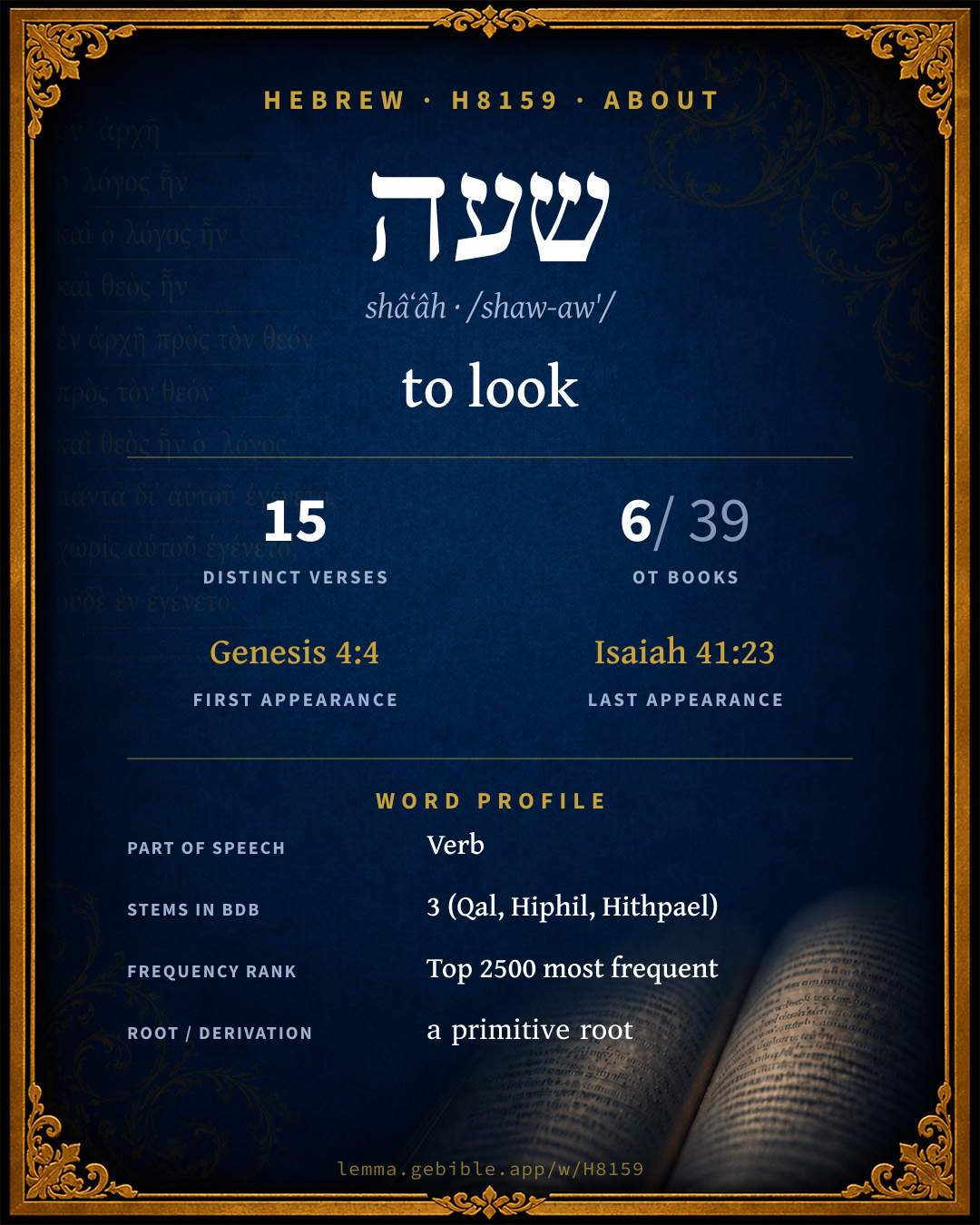
שָׁעָה
to look
‘to look’ is one of 4 main senses fuller range ↓
Full lexicon entry — Brown-Driver-Briggs (BDB)
From Brown-Driver-Briggs (BDB)
Where this word appears
See every Qal verb in the Hebrew Bible →
Grammar key — what these labels mean
Part of speech
- Verb
- An action or state-of-being word.
Stem
- Qal
- The basic, simple active stem — the plain form of the verb (“he wrote”).
- Hiphil
- The causative active stem (“he caused / brought about”).
Form
- Imperfect
- An incomplete, ongoing, or future action (“he will / would write”).
- Cohortative
- A first-person volitional form expressing wish or resolve (“let me / let us write”).
- Sequential Imperfect
- An imperfect with prefixed waw — the standard past-narrative form (waw-consecutive imperfect).
- Imperative
- A direct command (“write!”).
- Jussive
- A third- or second-person volitional form expressing wish or command (“let him write”).
- Perfect
- A completed action or state — Hebrew marks aspect (completeness) more than strict tense (“he wrote”).
Person
- 3rd Person
- The one spoken about (“he / she / it / they”).
- 1st Person
- The speaker (“I / we”).
- 2nd Person
- The one addressed (“you”).
Gender
- Masculine
- Grammatically masculine.
- Common
- Either gender — not distinguished for this form.
- Feminine
- Grammatically feminine.
Number
- Singular
- One.
- Plural
- More than one (in Hebrew, generally three or more).
Grammatical forms 14 distinct
- Verb, Qal, Imperfect, 3rd Person, Masculine, Singular 2 times (13%)
- Verb, Qal, Cohortative, 1st Person, Common, Plural 1 time (7%)
- Verb, Qal, Imperfect, 1st Person, Common, Singular 1 time (7%)
- Verb, Qal, Sequential Imperfect, 3rd Person, Masculine, Singular 1 time (7%)
- Verb, Hiphil, Imperative, 2nd Person, Masculine, Singular 1 time (7%)
- Verb, Qal, Imperfect, 2nd Person, Masculine, Singular 1 time (7%)
- Verb, Qal, Imperfect, 3rd Person, Feminine, Plural 1 time (7%)
- Verb, Qal, Imperfect, 3rd Person, Masculine, Plural 1 time (7%)
+6 more forms (6 occurrences)
Parsed forms decoded from the imported morphology (morphhb / Westminster Leningrad Codex — WLC text public domain, morphhb tagging CC BY 4.0), counted across 15 parsed occurrences — not distinct verses.
Every verse where H8159 appears — 15 distinct verses across 6 books. Click any verse to open its interlinear word-by-word view. Verse text shown in the World English Bible for context — . Each verse’s Hebrew form is shown with its reference; the English is not keyword-highlighted, since the data carries no word-level English alignment. Use “Compare translations” on any verse to read it across multiple English versions. This concordance covers the Hebrew Bible; Septuagint (Greek Old Testament) occurrences are not indexed here.
Genesis 2 verses
Exodus 1 verse
2 Samuel 1 verse
Job 2 verses
Psalms 2 verses
Isaiah 7 verses
- Isaiah 17:7 יִשְׁעֶ֥ה Qal impf 3ms In that day shall men look to their Maker, and their eyes shall have respect to the Holy One of Israel.
- Isaiah 17:8 יִשְׁעֶ֔ה Qal impf 3ms They shall not look to the altars, the work of their hands; neither shall they have respect to that which their fingers have made, either the Asherim, or the sun-images.
- Isaiah 22:4 שְׁע֥וּ Qal impv 2mp Therefore said I, Look away from me, I will weep bitterly; don't labor to comfort me for the destruction of the daughter of my people.
- Isaiah 31:1 שָׁעוּ֙ Qal pf 3cp Woe to those who go down to Egypt for help, and rely on horses, and trust in chariots because they are many, and in horsemen because they are very strong, but they don't look to the Holy One of Israel, neither seek Yahweh!
- Isaiah 32:3 תִשְׁעֶ֖ינָה Qal impf 3fp The eyes of those who see shall not be dim, and the ears of those who hear shall listen.
- Isaiah 41:10 תִּשְׁתָּ֖ע Qal juss 2ms Don't you be afraid, for I am with you; don't be dismayed, for I am your God; I will strengthen you; yes, I will help you; yes, I will uphold you with the right hand of my righteousness.
- Isaiah 41:23 וְ/נִשְׁתָּ֖עָה conj + Qal coh 1cp Declare the things that are to come hereafter, that we may know that you are gods: yes, do good, or do evil, that we may be dismayed, and see it together.
About this entry
At a glance — auto-summarized from this page’s data, not written by a person. Every figure links to its source below. This summary describes the numbers; it doesn’t interpret them.
שעה — transliterated shâʻâh — is a Hebrew verb carrying the sense “to look.” Debuting at Genesis 4:4, it then recurs through the corpus. The Hebrew Bible uses it across 15 verses — uncommon. More than a third of its appearances fall in Isaiah. Read the stem: it spans 3 stems, including Qal and Hiphil. See the sense tree, 15-verse concordance, and the renderings breakdown below.
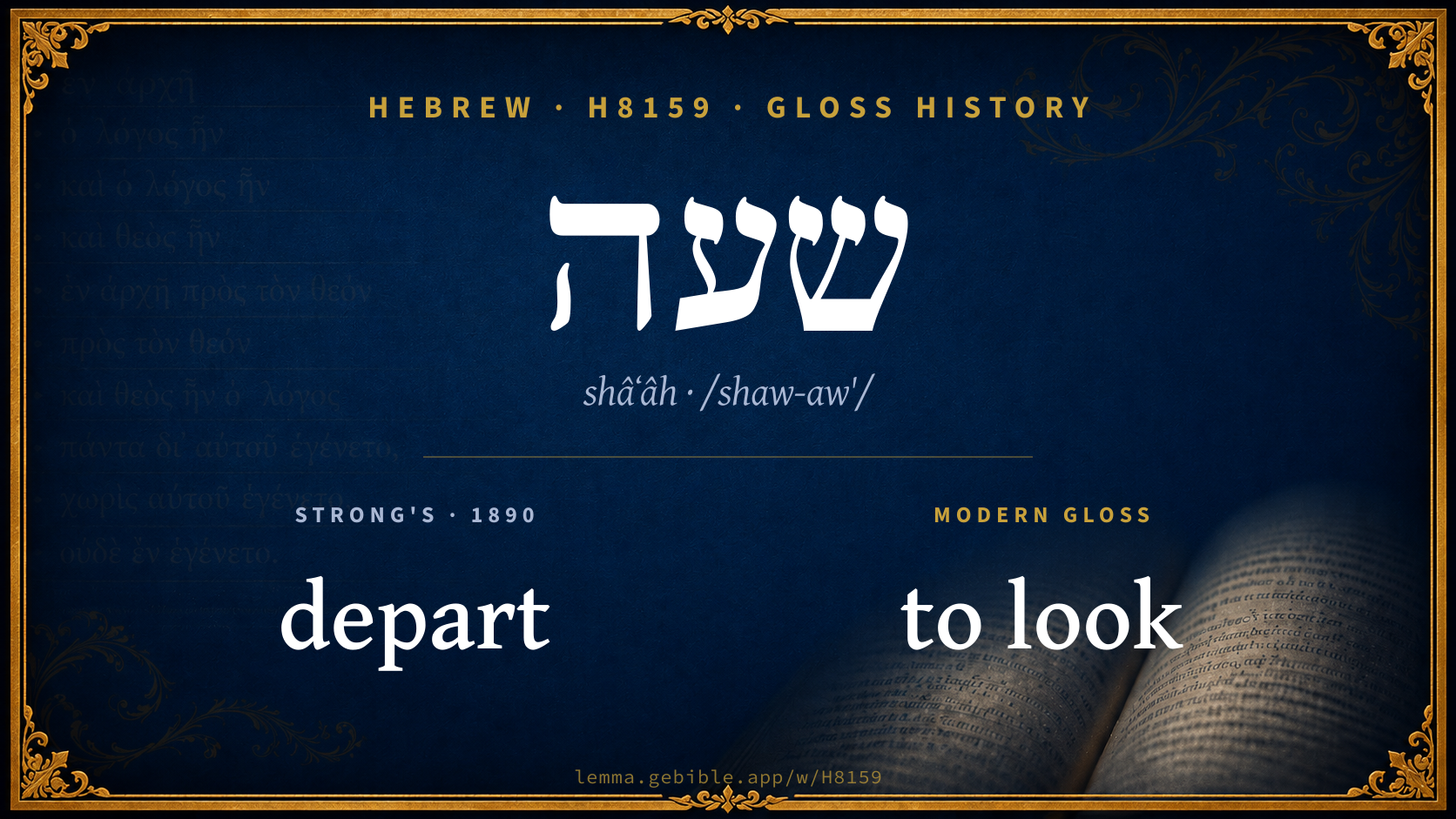
Gloss history
Strong's 1890 vs modern scholarship
About this word
Strong's H8159 catalogs a Hebrew word from the Hebrew Old Testament.
These counts are not copied from any lexicon or concordance. They are computed here, from the morphology-tagged Hebrew Old Testament. What Lemma adds →
- 15
- distinct verses
- The word appears in 15 distinct verses.
- 6 / 39
- OT books
- The word appears in 6 of 39 Old Testament books.
- #1,836
- by frequency
- Top 2500 most frequent Hebrew words (rank 1,836 of 8,640 Hebrew words by occurrence).
View all 15 occurrences in the concordance →
By section of the Old Testament
By traditional corpus
Conventional, traditional groupings — biblical authorship is debated, so this is a traditional corpus grouping, not an authorship claim. Each share is this word’s portion of its verses in that division of the Hebrew canon. Each figure is a share of the word’s 15 distinct verses.
- Prophets (Nevi'im) 8 verses · 53%
- Writings (Ketuvim) 4 verses · 27%
- Torah (Pentateuch) 3 verses · 20%
How translations render this word
Counts come from each version’s own published word-to-Strong’s tagging or interlinear alignment — an approximate guide to how each version renders this word, not a word-level alignment the data otherwise carries. Because each total is that version’s own tagged count, the per-version totals vary from one another and need not match the appearance or distinct-verse counts above. These counts may also differ from a printed concordance because Lemma counts each distinctly tagged rendering and does not collapse phrase taggings into a single head-word total. This is a fixed set of word-tagged versions (KJV, ASV, BSB, ULT) and does not change with the reading translation you choose elsewhere. Each version’s license is shown beside its name below (and on Sources).
- King James Version: Had respect 1×, He had not respect 1×, He shall not look 1×
- American Standard Version: Look 2×
- Berean Standard Bible: Look 2×, Look away 2×, Regard 2×
- unfoldingWord Literal Text: Look 6×, Favorably 2×, Gaze 2×
King James Version Public Domain
Renders H8159 across 15 tagged occurrences — most commonly:
Plus other, less common renderings.
American Standard Version Public Domain
Renders H8159 across 15 tagged occurrences — most commonly:
Plus 13 renderings that appear only once — usually multi-word phrases or single function words the recovered tagging swept in, not distinct renderings.
Berean Standard Bible Public Domain
Renders H8159 across 15 tagged occurrences — most commonly:
Plus 9 renderings that appear only once — usually multi-word phrases or single function words the recovered tagging swept in, not distinct renderings.
unfoldingWord Literal Text CC BY-SA 4.0
Renders H8159 across 25 tagged occurrences — most commonly:
Plus 15 renderings that appear only once — usually multi-word phrases or single function words the recovered tagging swept in, not distinct renderings.
Senses in the full BDB
Hebrew verbs can shift meaning by stem (binyan): Qal is the basic action, Niphal is often passive or reflexive, Piel often intensifies or makes it factitive, and Hiphil is typically causative. The senses below are grouped under the stem BDB assigns to each. This entry also uses Hithpael (reflexive or reciprocal).
What do BDB’s symbols mean?
BDB uses these scholarly abbreviations:
| Symbol | Meaning |
|---|---|
| 𝔊 | the Septuagint (the ancient Greek translation, LXX) |
| 𝔙 | the Vulgate (the Latin translation) |
| 𝔖 | the Syriac version (the Peshitta) |
| 𝔗 | the Targum (the Aramaic translation) |
| ψ | the Psalms |
| √ | root (the underlying root or stem) |
| ‖ | parallel passage (a synonymous or contrasted parallel) |
| † | the dagger: every passage where the word occurs is cited |
The 3 senses and sub-senses the full Brown-Driver-Briggs lexicon distinguishes for this word, in lexicon order (not ranked by frequency), with BDB’s own verbatim wording and sub-sense lettering. Shown in Hebrew script with BDB’s own scholarly abbreviations. The condensed entry is in the Lexicon Entry tab. See also the Forms in the corpus table below.
Qal
- Pf. 3 ms. שׁ׳ Gn 4:5, etc.; Impf. 3 ms. יִשְׁעֶה Is 17:7, 8, apoc. וַיִּ֫שַׁע Gn 4:4, 1 s. אֶשְׁעָה (Ges§ 751) ψ 119:117, etc.; Imv. ms. שְׁעֵה Jb 14:6; mpl. שְׁעוּ Is 22:4;—gaze at, regard (with favour), י׳ subj., c. אֶל Gn 4:4, 5 (J); c. מִן pers. = turn gaze away Is 22:4; Jb 7:19 Thes Ew Che, + prob. 10:20 (for יָשִׁית), c. מֵעַל pers. 14:6; man subj., regard God (with trust, devotion), c. עַל Is 17:7; 31:1; c. אֶל rei 17:8; c. בְּ of words, statutes, Ex 5:9 (J) ψ 119:117; abs. 3 fpl. תִּשְׁעֶינָה Is 32:3 shall not behold makes no sense, read prob. תְּשֹׁעֶינָה (√ I. שׁעע, Ew and most); 3 mpl. יִשְׁעוּ 2 S 22:42 they look (about) for help, ψ 18:42 יְשַׁזְּעוּ. e.g. Genesis 4:5
Hiphil
- Imv. ms. הָשַׁע מִמֶּנִּי ψ 39:14 cause thy gaze to turn away from me (see also √ I. שׁעע), Qal שְׁעֵה as Jb 14:6 (cf. 7:19; Is 22:4) Hup Bae Du Ges§ 75 gg. e.g. Psalms 39:14
Hithpael
- Impf. 2 ms. apoc. אַל־תִּשְׁתָּע Is 41:10 gaze not about (in anxiety, ‖ אַל־תִּירָא); 1 pl. וְנִשְׁתָּ֫עָה (Ges§ 75 l) v 23 let us look at each other (in rivalry, v. ראה Hithp.). e.g. Isaiah 41:10
Senses from the full Brown-Driver-Briggs lexicon (Brown, Driver, Briggs; Oxford 1906 — public domain), digitized via Sefaria, supplemented by the OpenScriptures HebrewLexicon (CC BY 4.0). Full attribution on Sources.
Word origin
vb. gaze (steadily, with interest, etc.) (Assyrian šeʾû, behold, look for, aim at);—
— Brown-Driver-Briggs (Oxford 1906, public domain), digitized via Sefaria, supplemented by the OpenScriptures HebrewLexicon (CC BY 4.0). See Sources.
Origin: a primitive root
Jastrow Dictionary
A second Hebrew/Aramaic lexicon for comparison, covering Aramaic and post-biblical (Talmudic, Targumic, Midrashic) usage that the biblical-Hebrew BDB does not. Matched by lemma rather than by Strong’s number, so a lemma may carry more than one Jastrow headword (shown separately below), and the entries cover usage well beyond the Bible.
שָׁעָה
- I, v. שעי
שָׁעָה II
- (Dan. IV, 16; preced., v. Del. Proleg. p. 39 sq.) moment, while; hour, esp. the twelfth portion of the day and of the night, varying according to the season. Tosef. Ber. I, 1, a. e., v. עוֹנָה I. Ber. 7ᵃ, v. רֶגַע. Ib. 7ᵇ, a. e. הש׳ משחקת, v. שָׂחַק. Lam. R. to III, 37 מש׳ שאמר וכ׳ from the moment that the Lord said &c. Ber. I, 1 מש׳ שהכהנים וכ׳ from the time of day when the priests go in &c. Pes. II, 1 כל ש׳ as long. Keth. 104ᵃ בש׳ שהצדיק וכ׳ when a righteous man is called away &c. Ib. בשְׁעַת פטירתו וכ׳ when Rabbi died &c. Ber. 64ᵃ הדוחק את הש׳, v. דָּחַק; נדחה מפני הש׳, v. דָּחָה. Sabb. 10ᵃ, a. e. מניחין … ועוסקין בחיי ש׳ they neglect the life everlasting, and busy themselves with the life of the hour (earthly affairs). Y. Taan. III, 67ᵃ (expl. יולדתך, Prov. XXIII, 25) שַׁעַתְךָ (or שַׁעְתְּךָ) thy hour (of birth). Cant. R. to I, 1, a. e. בשַׁעְתּוֹ in its due time, v. סֵפֶל; Num. R. s. 104 בין שעתו. Ex. R. s. 19, a. fr. לש׳ קלה, v. קַל II; a. v. fr.—הוראת ש׳, or ש׳ temporary, special legislation, opp. דורות. Yoma 69ᵇ. Men. 19ᵇ דורות מש׳, v. דּוֹר. Ib. 56ᵃ ש׳ מדורות וכ׳ we cannot derive the modes of a temporary act (e.g. the offerings of the princes, Num. VII, 12-83) from the laws concerning a permanent institution; a. fr.—Pl. שָׁעוֹת. Ber. 3ᵃ עד ארבע ש׳ to four hours (the fourth hour of the night). Pes. 58ᵃ שתי ש׳ ומחצה two hours and a half. Snh. V, 3 אחד אומר בשתי ש׳ וכ׳ if one witness testifies that the act under consideration was committed at the second hour of the day &c. Kel. XII, 4 אבן הש׳, v. אֶבֶן; a. v. fr. e.g. Daniel 4:16
שעי
- (b. h.)
- 1. (cmp. שָׁאָה, שָׁהָה) to dwell, linger, denom. שָׁעָה.
- 2. to look, care for, mind. Sifré Deut. 318 (ref. to Deut. XXXII, 17) אל תקרי לא שערום אלא לא שָׁעוּם וכ׳ read not lo s’ʿarum, but lo shaʿum (whom they did not regard); although they sacrificed and burnt incense to them, they were not afraid of them (with ref. to Gen. IV, 5); Yalk. ib. 945. e.g. Deuteronomy 32:17
A Dictionary of the Targumim, the Talmud Babli and Yerushalmi, and the Midrashic Literature (Marcus Jastrow; London, Luzac, 1903) — Public Domain. Digitized via Sefaria. Digitized via Sefaria. Full attribution on Sources.
Forms in the corpus
The 14 distinct written forms H8159 takes in the Hebrew Bible, most frequent first — each parse links to that stem’s occurrences in the concordance. Hebrew forms include their vowel points and cantillation, so a single lemma takes many written forms.
Same root — word family
Other BDB entries built from the same root as H8159, grouped by Strong’s listed origin. These share a root / origin per the lexicon — not necessarily a shared meaning. Each links to that word’s own entry.
Derived from this word
Proper names from this root
People and places named from this root — a name, not an additional meaning of the word.
Compare all same-root words → Showing 4 of 5 — not the complete family. 1 of the same-root words is a proper name (a person or place). They share a root, not necessarily a meaning.
Septuagint verse parallels
This word appears in 14 verses that also exist in the Greek Old Testament (Septuagint), out of the 15 Hebrew verses it occurs in. You can read those verses in Greek by switching the Old Testament edition to the Septuagint.
Read these verses in the Septuagint
This is a verse-level parallel only — the same verses exist in both the Hebrew and Greek Old Testaments. No word-level Hebrew↔Greek correspondence is claimed: the data carries no such alignment, so no Greek word is shown as this Hebrew word’s translation. Coverage is not total — the Septuagint omits the deuterocanon and renumbers the Psalms, so some Hebrew verses have no direct Greek parallel.