Joshua 19:38

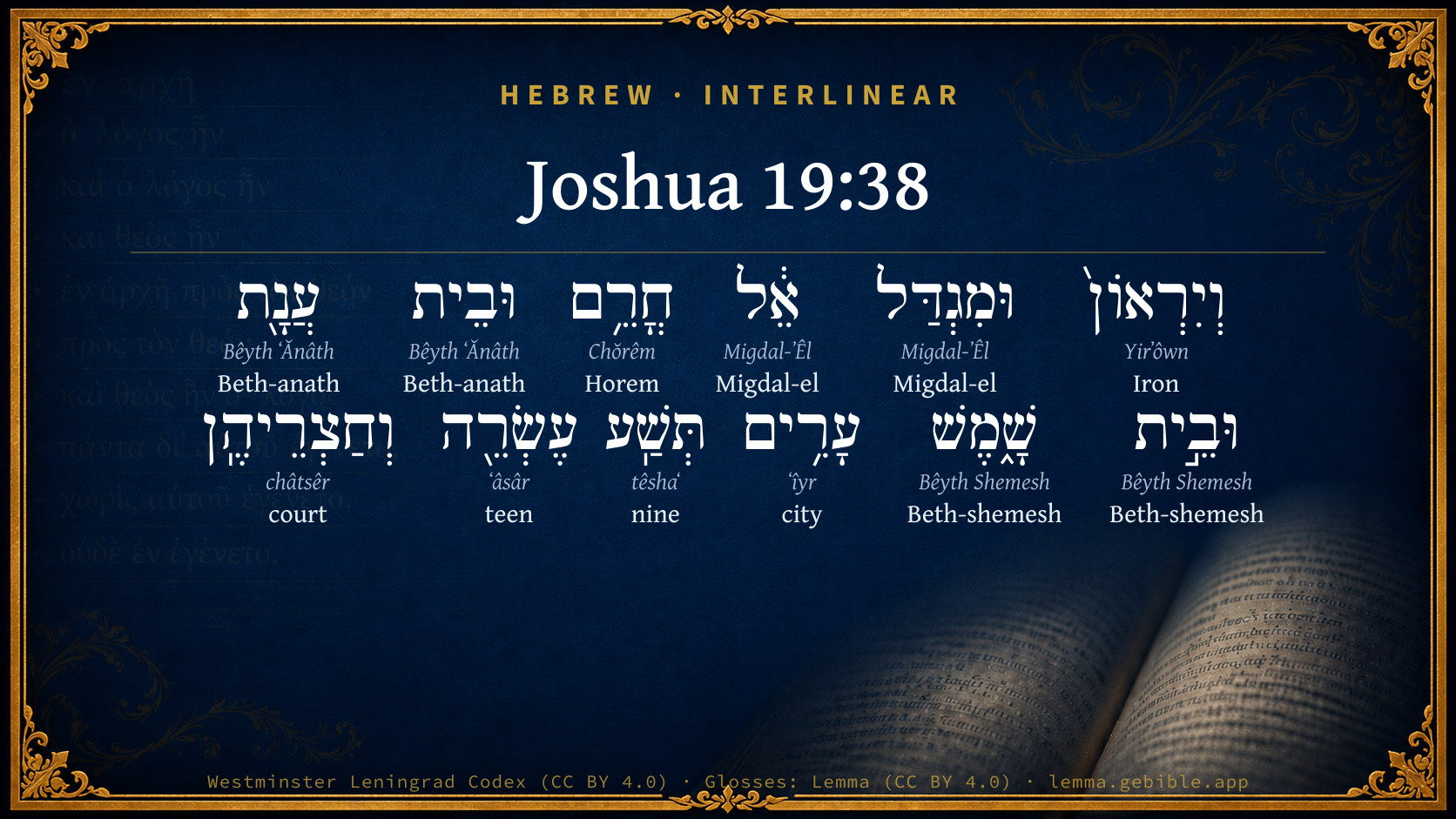
Hebrew (Westminster Leningrad Codex) Joshua 19:38 appears in the Hebrew Old Testament. The text above is from the Westminster Leningrad Codex. Each word links to its Strong’s number, a concise gloss, and parsing drawn from the Open Scriptures Hebrew Bible morphology. Click any word for its full Brown-Driver-Briggs (BDB) entry.
Download image
Cite this verse

Joshua 19:38 (World English Bible). Public Domain. Lemma interlinear Bible study tool, https://lemma.gebible.app/v/joshua/19/38.

Show BibTeX & RIS
BibTeX
RIS
English Translation
Iron, and Migdal-el, Horem, and Beth Anath, and Beth-shemesh; nineteen cities with their villages.
World English Bible · Public Domain
Highlights Full analysis ↓
Download a study sheet

One document with this verse’s original text, its word-by-word gloss line, the meaning frame, cross-references with their text, attributed commentary, and full source and license credits — printable, and it pastes into notes with its structure intact.

This verse Autodidact and up

Study sheet (.html) Plain text (.txt)

A passage Seminary Student

Up to 50 verses in one chapter. A passage sheet keeps up to 6 commentary sources and 12 cross-references per verse, in the order this page ranks them, and says so on the sheet whenever that leaves anything out. Ask for a single verse and you get the Autodidact verse sheet above.

Everything on this page stays free to read, with no account — the sheet is a download of what is already on screen, not access to it.

Want to remove ads? Support Godless Engineer
Compare translations 3

The same verse in 3 English versions, stacked beneath the original-language interlinear above. Click any original word for its lexicon entry.

Each is an independent rendering of the whole verse — the interlinear is not word-aligned to these translations.

Highlighted words mark where these versions differ — a whole-verse word diff, not a word-by-word alignment.

  • World English Bible Public Domain
    Iron, and Migdal-el, Horem, and Beth Anath, and Beth-shemesh; nineteen cities with their villages.
  • King James Version Public Domain
    And Iron, and Migdalel, Horem, and Bethanath, and Bethshemesh; nineteen cities with their villages.
  • unfoldingWord Literal Text CC BY-SA 4.0
    and Yiron and Migdal El, Horem and Beth Anath and Beth Shemesh: 19 cities and their villages.

unfoldingWord Literal Text — © unfoldingWord, licensed CC BY-SA 4.0. Word-aligned USFM3 via Door43 (git.door43.org/unfoldingWord/en_ult).

Versions to compare (up to 4)

3 of 4 selected

Show all 18 translations

Every available English version of this verse, each an independent rendering of the whole verse.

  • World English Bible Public Domain
    Iron, and Migdal-el, Horem, and Beth Anath, and Beth-shemesh; nineteen cities with their villages.
  • Berean Standard Bible Public Domain
    Iron, Migdal-el, Horem, Beth-anath, and Beth-shemesh. There were nineteen cities, along with their villages.
  • Majority Standard Bible Public Domain
    Iron, Migdal-el, Horem, Beth-anath, and Beth-shemesh. There were nineteen cities, along with their villages.
  • King James Version Public Domain
    And Iron, and Migdalel, Horem, and Bethanath, and Bethshemesh; nineteen cities with their villages.
  • American Standard Version (1901) Public Domain
    And Iron, and Migdal-el, Horem, and Beth-anath, and Beth-shemesh; nineteen cities with their villages.
  • Revised Version (1885) Public Domain
    And Iron, and Migdal-el, Horem, and Beth-anath, and Beth-shemesh; nineteen cities with their villages.
  • Geneva Bible (1599) Public Domain
    And Iron, and Migdal-el, Horem, and Beth-anah, and Beth-shemesh: nineteene cities with their villages.
  • Douay-Rheims (1899) Public Domain
    And Jeron and Magdalel, Herem, and Bethanath and Bethsames: nineteen cities, and their villages.
  • Young's Literal Translation Public Domain
    and Iron, and Migdal-El, Horem, and Beth-Anath, and Beth-Shemesh; nineteen cities and their villages.
  • Literal Standard Version CC BY-SA 4.0
    and Iron, and Migdal-El, Horem, and Beth-Anath, and Beth-Shemesh; nineteen cities and their villages.
  • Unlocked Literal Bible CC BY-SA 4.0
    There were also Yiron, Migdal El, Horem, Beth Anath, and Beth Shemesh. There were nineteen cities, including their villages.
  • unfoldingWord Literal Text CC BY-SA 4.0
    and Yiron and Migdal El, Horem and Beth Anath and Beth Shemesh: 19 cities and their villages.
  • Darby Bible Public Domain
    and Jiron, and Migdal-el, Horem, and Beth-anath, and Beth-shemesh: nineteen cities and their hamlets.
  • World Messianic Bible Public Domain
    Iron, Migdal El, Horem, Beth Anath, and Beth Shemesh; nineteen cities with their villages.
  • Webster's Bible Public Domain
    And Iron, and Migdal-el, Horem, and Beth-anath, and Beth-shemesh; nineteen cities with their villages.
  • Free Bible Version CC BY-SA 4.0
    Yiron, Migdal-el, Horem, Beth-anath, and Beth-shemesh—nineteen towns with their associated villages.
  • Bible in Basic English Public Domain
    And Iron and Migdal-el, Horem and Beth-anath and Beth-shemesh; nineteen towns with their unwalled places.
  • JPS Tanakh (1917) Public Domain
    and Iron, and Migdal-el, and Horem, and Beth-anath, and Beth-shemesh; nineteen cities with their villages.

Literal Standard Version (2020), Covenant Press — licensed CC BY-SA 4.0. Text via the HelloAO Bible API (eBible.org). Unlocked Literal Bible (unfoldingWord) — licensed CC BY-SA 4.0. Text via the HelloAO Bible API (eBible.org). unfoldingWord Literal Text — © unfoldingWord, licensed CC BY-SA 4.0. Word-aligned USFM3 via Door43 (git.door43.org/unfoldingWord/en_ult). Free Bible Version, Dr. Jonathan Gallagher — licensed CC BY-SA 4.0. Text via the HelloAO Bible API (eBible.org).

Word by word

More ways to search: Search by grammar → Find every occurrence → Compare this word →

Practice this passage: Drill this verse → Learn its vocabulary →

וְיִרְאוֹן֙
Yirʼôwn
H3375
“and · Iron”
Conjunction + Noun, Proper
Part of Speech
Conjunction + Noun
Type
Proper
Full BDB Definition

Origin: from H3372

TWOT: None

Iron = "fearing" - a city of Naphtali; site unknown
  1. וּמִגְדַּל Migdal-ʼÊl H4027 “and · Migdal-el” Conjunction + Noun, Proper
  2. אֵ֔ל Migdal-ʼÊl H4027 “Migdal-el” Noun, Proper
  3. חֳרֵ֥ם Chŏrêm H2765 “Horem” Noun, Proper
  4. וּבֵית Bêyth ʻĂnâth H1043 “and · Beth-anath” Conjunction + Noun, Proper
  5. עֲנָ֖ת Bêyth ʻĂnâth H1043 “Beth-anath” Noun, Proper
  6. וּבֵ֣ית Bêyth Shemesh H1053 “and · Beth-shemesh” Conjunction + Noun, Proper
  7. שָׁ֑מֶשׁ Bêyth Shemesh H1053 “Beth-shemesh” Noun, Proper
  8. עָרִ֥ים ʻîyr H5892 “cities” Noun, Common, Feminine, Plural, Absolute
  9. תְּשַֽׁע têshaʻ H8672 “nine” Adjective, Cardinal number, Feminine, Singular, Absolute
  10. עֶשְׂרֵ֖ה ʻâsâr H6240 “teen” Adjective, Cardinal number, Feminine, Singular, Absolute
  11. וְחַצְרֵיהֶֽן châtsêr H2691 “and · courts · their” Conjunction + Noun, Common, Both, Plural, Construct + Suffix, Personal, 3rd Person, Feminine, Plural

About this verse

These counts appear in no published source. They are computed here, from the morphology-tagged text and Lemma’s own curated glosses. What Lemma adds →

12
words
9
distinct lemmas
Historical
section

Notable vocabulary

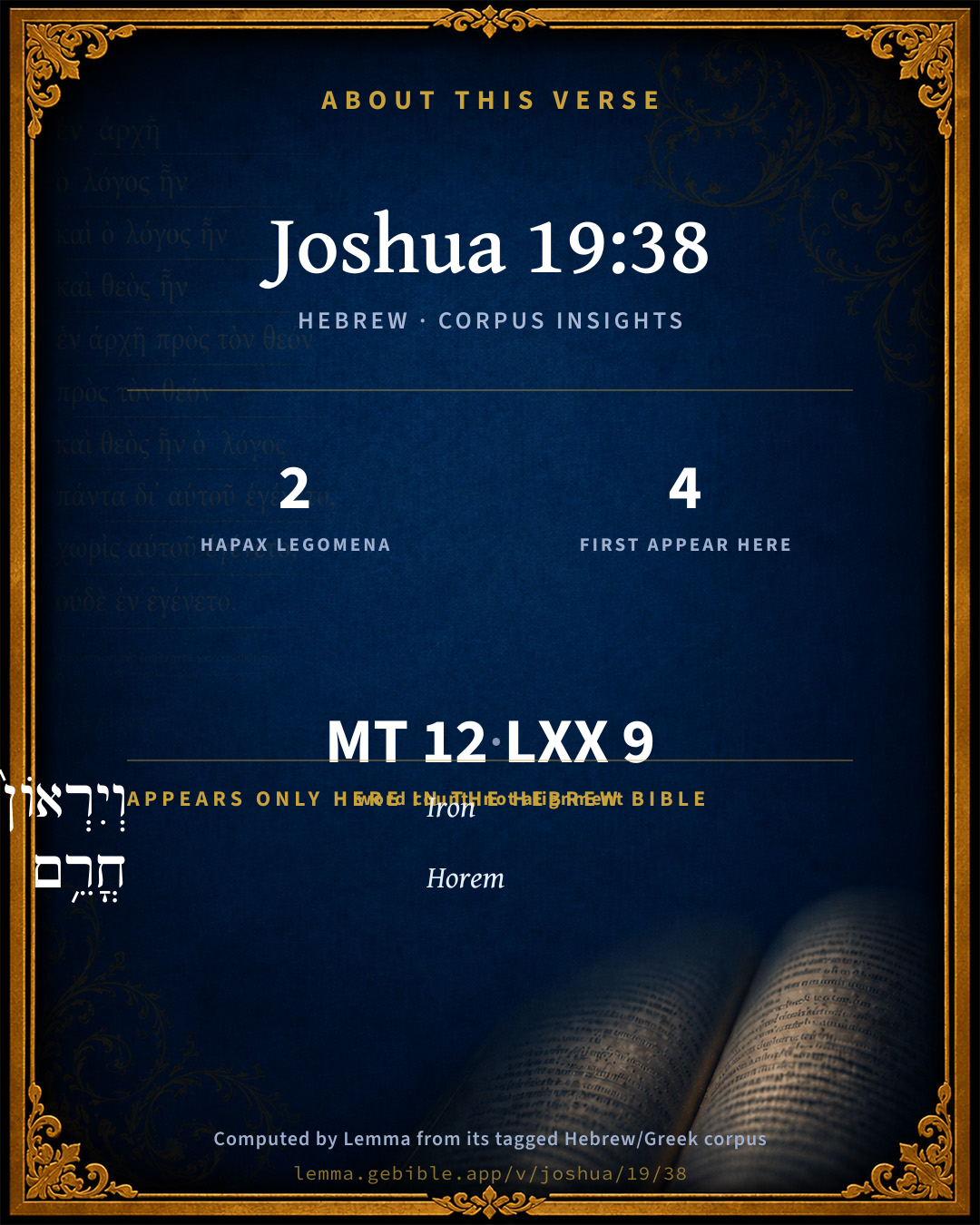
2 hapax legomena — words that appear only here in the entire Hebrew Bible:

  • וְיִרְאוֹן֙ Iron H3375
  • חֳרֵ֥ם Horem H2765

First appearance in Scripture

These words make their first canonical appearance in the Hebrew Bible here:

  • וְיִרְאוֹן֙ Iron H3375
  • וּמִגְדַּל Migdal-el H4027
  • חֳרֵ֥ם Horem H2765
  • וּבֵית Beth-anath H1043

Grammatical profile

  • 10 nouns
  • 2 adjectives

Repetition

Words recur within this verse — often emphatic in Hebrew:

  • וּמִגְדַּל Migdal-el H4027 ×2
  • וּבֵית Beth-anath H1043 ×2
  • וּבֵ֣ית Beth-shemesh H1053 ×2

Hebrew & Septuagint length

In English translation the verse runs 14 words from the Hebrew and 8 from the Septuagint (LXX English) — the Septuagint runs noticeably shorter here. See the side-by-side →

A rough comparison of the two English renderings, which tokenize alike — not a word-level alignment.

Word counts can differ between the Hebrew and the Greek without any difference in meaning — e.g. the Hebrew direct-object marker אֵת has no separate Greek word, and Greek often adds the article ὁ.

In the original languages it is 12 Hebrew tokens and 9 Greek tokens — but the two are counted differently (Hebrew bundles its prefixes and suffixes into one token; the Greek is in lemma form), so that isn’t a like-for-like length.

Hebrew and Greek witnesses Masoretic Hebrew ↔ Greek Septuagint

The same verse in the two great witnesses to the Old Testament, shown verse-for-verse.

Here the Septuagint runs noticeably shorter than the Hebrew — LXX2012 (modern English Septuagint) 8 words vs World English Bible 14. A rough length comparison of the two English translations, not a word-level alignment — read both below.

These are two independent witnesses, not word-aligned to each other, and the Septuagint is shown in lemma (dictionary) form.

Hebrew Joshua 19:38 Masoretic · Westminster Leningrad Codex

וְיִרְאוֹן֙ וּמִגְדַּל אֵ֔ל חֳרֵ֥ם וּבֵית עֲנָ֖ת וּבֵ֣ית שָׁ֑מֶשׁ עָרִ֥ים תְּשַֽׁע עֶשְׂרֵ֖ה וְחַצְרֵיהֶֽן

Iron, and Migdal-el, Horem, and Beth Anath, and Beth-shemesh; nineteen cities with their villages.

World English Bible · Public Domain

Greek LXX Joshua 19:38 Septuagint · lemma form

καί κερωε καί μεγαλα αριμ καί βαιθθαμε καί θεσσαμυς

and Keroe, and Megalaarim, and Baetthame, and Thessamys.

LXX2012 (modern English Septuagint) · Public Domain

Hebrew: Westminster Leningrad Codex (CC BY 4.0). Greek: Septuagint (public domain); English from LXX2012 (modern English Septuagint) (Public Domain). How the Septuagint differs from the Hebrew →

Targum (Aramaic paraphrase)

1

The Targum is the ancient Jewish Aramaic paraphrase of the Hebrew Scriptures — an interpretive translation, not the Hebrew text itself. Onkelos (literal) and Pseudo-Jonathan (expansive) render the Torah, and Jonathan the Prophets. Coverage is partial: where no permissively-licensed English translation exists for a verse, only the Aramaic is shown. This is verse-level text, not a word-by-word alignment to the Hebrew.

  1. Targum Jonathan Prophets (Joshua–Malachi)
    וְיִרְאוֹן וּמִגְדַל אֵל חָרֵם וּבֵית עֲנָת וּבֵית שֶׁמֶשׁ קִרְוִין תְּשַׁע עַשְׂרֵי וּפַצְחֵיהֶן:

    (no public-domain English translation for this verse)

    Targum Jonathan — Aramaic: “Mikraot Gedolot” (public domain). English: “Sefaria Community Translation” (CC0 1.0 (public-domain dedication)); “London "Chaldee Paraphrase," 1871” (public domain). Text via Sefaria.

Commentary

Notes on Joshua 19:38 from classic Christian and Jewish commentators (each source and its license shown beneath its notes). The classic Christian expositions comment on the surrounding passage and are grouped to its opening verse, so a note may address several verses; the Jewish commentaries on the Tanakh (Rashi and others) are per-verse, so they appear only where the commentator wrote on this verse.

Lemma curates 59 commentaries, every one of them public domain or Creative Commons licensed, each selected and text-cleaned for this edition rather than reprinted as found. About our sources →

Adam Clarke's Commentary

Verse 38. Nineteen cities] But if these cities be separately enumerated they amount to twenty-three; this is probably occasioned by reckoning frontier cities belonging to other tribes, which are only mentioned here as the boundaries of the tribe. See Clarke on Jos 19:30.

Adam Clarke's Commentary on the Bible (1810–1826) — public domain. Text from a community e-Sword/MySword module.

Ellicott's Commentary for English Readers

(38) Migdal-el and Horem are identified as Kh.-Mujeidil and Hârah on sheet 2, further north again; and Beth-anath as ‘Ainatha (sheet 4).

A Bible Commentary for English Readers, edited by Charles John Ellicott (1878–1897) — public domain. Text from a community e-Sword module.

The Cambridge Bible for Schools and Colleges

gen. ed. J. J. S. Perowne

38. Iron] has not been identified. Migdal-el has been by some supposed to be the Magdala of Mat_15:39, the place of which is now occupied by a miserable collection of hovels known as el-Mejdel, on the western side of the Lake of Gennesareth, and at the S. E. corner of the plain. Neither Horem, Beth-anath, nor Beth-shemesh has at present been identified.

The Cambridge Bible for Schools and Colleges (gen. ed. J. J. S. Perowne; Cambridge University Press, 1878–1918) — public domain. Text from a community e-Sword module.

John Gill's Exposition

This is the inheritance of the tribe of the children of Naphtali,.... Which Josephus (o) thus describes;"the country to the east, as far as Damascus the city, and upper Galilee, the Naphtalites took, unto Mount Lebanon, and the fountains of Jordan, which flow out of the mount, reaching the northern border of the city Arce:"

according to their families; which was divided among them, according to the number of their families:

the cities and their villages; before enumerated.

(o) Antiqu. l. 5. c. 1. sect. 22.

John Gill's Exposition of the Whole Bible (1746–1763) — public domain (CC PDM 1.0). Text via the HelloAO Bible API.

Haydock's Catholic Bible Commentary

Bethanath, "the house of poverty," is Betanea, 15 miles from Cæsarea. (Eusebius) --- Nineteen. Twenty-three places are mentioned. But some might only be villages, &c., chap. xv. 62.

George Leo Haydock (1774–1849), Haydock's Catholic Family Bible and Commentary, 1859 edition — public domain. Excludes Psalms (Douay-Rheims chapter numbering differs from Protestant) and Deuterocanonical books (Catholic canon only).

Matthew Poole's English Annotations

Nineteen cities: See Poole "Jos 19:15", See Poole "Jos 19:22", See Poole "Jos 19:30".

Matthew Poole's English Annotations on the Holy Bible (1683–1685) — public domain. Text from a community e-Sword/MySword module.

Whedon's Commentary on the Bible

Daniel D. Whedon

38. Iron is probably the modern Yaron, ten miles west of Lake Merom.

Migdal-el — The modern name Mejdel is the same as the Hebrew Migdal, and the Greek Magdala of the New Testament, chiefly known as the native town of Mary Magdalene. Magdala is a miserable little Moslem village on the western shore of the Sea of Galilee. [But Migdal-el seems from the grouping of these cities to have been, not near the Sea of Galilee, but in the north or northwest part of the tribe. Its location cannot at present be decided. Beth-shemesh cannot be the same as that in Jos_19:41 and Jos_15:10. Some have thought it might be Medjel-esh-shems, a few miles northeast of Cesarea Philippi, and a little north of Lake Phiala.]

Nineteen — Three names are wanting. See on Jos_15:32.

Daniel D. Whedon (gen. ed.), Commentary on the Old and New Testaments (1874–1909) — public domain. Text from a community e-Sword module.

The Pulpit Commentary

Migdal-el. The Magdala of the New Testament. It lay on the lake of Gennesareth. Beth-shemesh. A common name, derived from the worship of the sun. This is neither Beth-shemesh of Judah nor of Issachar (see ver. 22).

The Pulpit Commentary (1880–1919), ed. H.D.M. Spence-Jones & Joseph S. Exell — public domain. Text from a community e-Sword module.

unfoldingWord translationNotes

Door43 World Missions Community

Yiron ... Migdal El ... Horem ... Beth Anath

These are names of cities. (See: How to Translate Names)

This was the inheritance of the tribe of Naphtali

The land and cities that the tribe of Naphtali received are spoken of as if they were an inheritance that they received as a permanent possession. AT: "This was the land and the cities that the tribe of Naphtali received as an inheritance" (See: Metaphor)

translationWords

Beth Shemesh

tribe

Naphtali

clan

unfoldingWord translationNotes — © Distant Shores Media and the Door43 World Missions Community, licensed CC BY-SA 4.0. Source: git.door43.org/Door43/en_tn.

Lesson kit

Teaching starters — assembled from the data on this page, not authored interpretation. Every prompt links to the verse data it draws on. Edit before teaching.

Joshua, in the Historical, opens this verse with 12 words (9 distinct Hebrew lemmas). Its most distinctive word is Yirʼôwn (“Iron”). The Greek Septuagint runs shorter here. A historical commentator’s framing appears above. Read the whole chapter for the surrounding context.

Discussion questions

  1. What does “Iron” (Yirʼôwn) contribute to the verse as a whole?
  2. 2 words here appear nowhere else in the Hebrew Bible. Why might the author reach for such rare wording?
  3. 4 words make their first appearance in Scripture here. What does this debut establish?
  4. What does the repetition of “Migdal-el” (2× in this one verse) do in this verse?
  5. The Septuagint runs shorter here than the Hebrew. What might account for the difference?
  6. These translations render this verse differently. What is at stake in choosing one wording over another?
  7. Compare how Adam Clarke's Commentary and Ellicott's Commentary for English Readers read this verse. Where do they agree or differ?

Things to notice

  • 2 words in this verse appear nowhere else in the Hebrew Bible.
  • 4 words make their first canonical appearance in Scripture here.
  • This verse counts 12 Hebrew ↔ 9 Greek words.
  • These translations choose different wording for 14 words in this verse.
  • “Migdal-el” occurs 2× in this single verse.

Reading settings

Reading text

Shown beneath each verse's original-language words.

Old Testament
Old Testament edition

Read the OT as the Masoretic Hebrew (MT) or the Greek Septuagint (LXX).

English shown for the Greek Septuagint (in the Hebrew ↔ Greek comparison).

Comparing translations? Open the Compare panel on any verse page to stack up to four side by side.