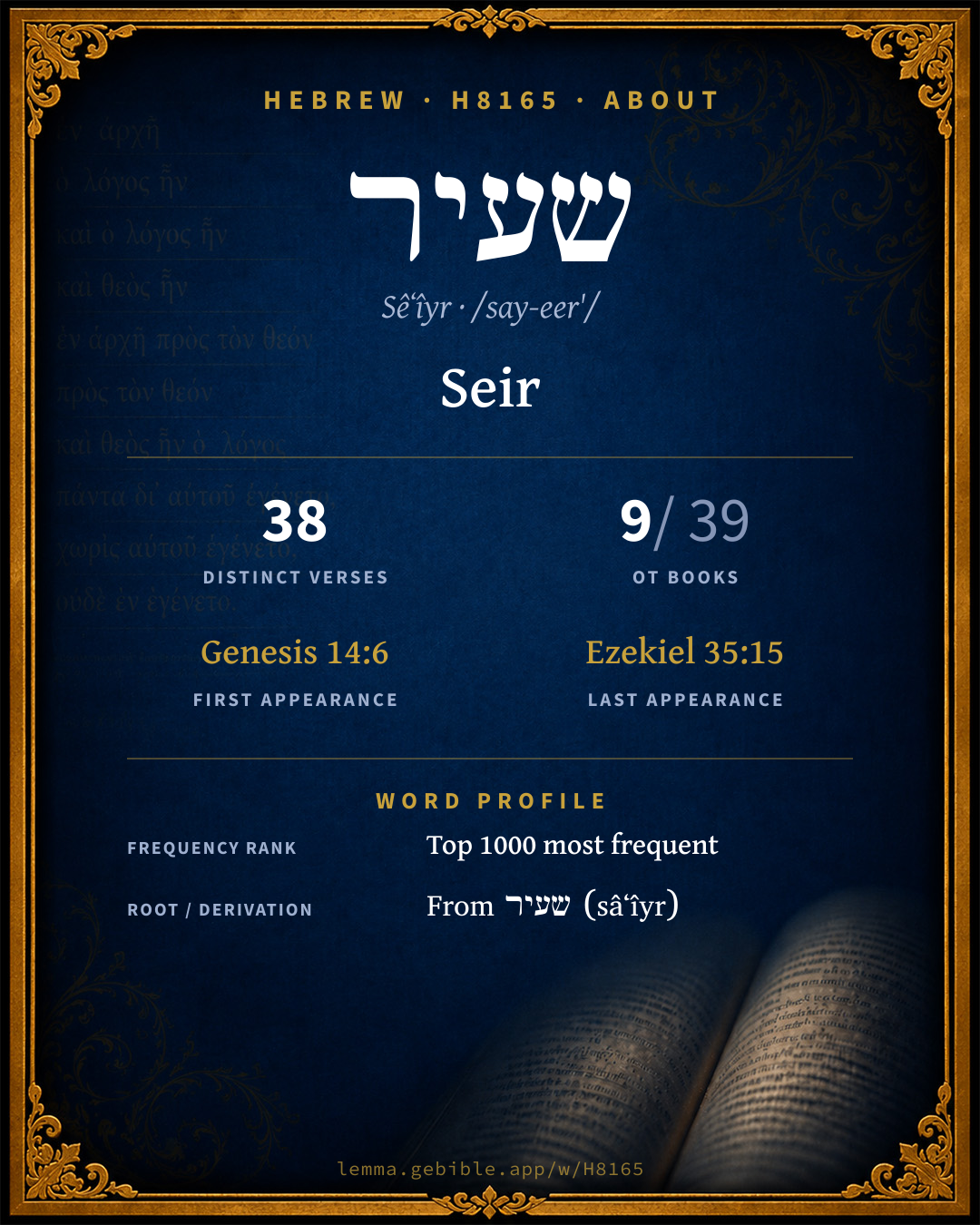
שֵׂעִיר
Seir
BDB lists 5 entries for ‘Seir’ fuller range ↓
Full lexicon entry — Brown-Driver-Briggs (BDB)
From Brown-Driver-Briggs (BDB)
Where this word appears
Grammar key — what these labels mean
Part of speech
- Noun
- A naming word — a person, place, thing, or idea.
Noun type
- Proper
- A name of a specific person, place, or people (e.g. Abraham, Zion, Israel).
Every verse where H8165 appears — 38 distinct verses across 9 books. Click any verse to open its interlinear word-by-word view. Verse text shown in the World English Bible for context — . Each verse’s Hebrew form is shown with its reference; the English is not keyword-highlighted, since the data carries no word-level English alignment. Use “Compare translations” on any verse to read it across multiple English versions. This concordance covers the Hebrew Bible; Septuagint (Greek Old Testament) occurrences are not indexed here.
Genesis 9 verses
- Genesis 14:6 שֵׂעִ֑יר n Proper and the Horites in their Mount Seir, to Elparan, which is by the wilderness.
- Genesis 32:3 שֵׂעִ֖יר n Proper Jacob sent messengers in front of him to Esau, his brother, to the land of Seir, the field of Edom.
- Genesis 33:14 שֵׂעִֽירָ/ה n Proper + sfx dem Please let my lord pass over before his servant: and I will lead on gently, according to the pace of the cattle that are before me and according to the pace of the children, until I come to my lord to Seir."
- Genesis 33:16 שֵׂעִֽירָ/ה n Proper + sfx dem So Esau returned that day on his way to Seir.
- Genesis 36:8 שֵׂעִ֔יר n Proper Esau lived in the hill country of Seir. Esau is Edom.
- Genesis 36:9 שֵׂעִֽיר n Proper This is the history of the generations of Esau the father of the Edomites in the hill country of Seir:
- Genesis 36:20 שֵׂעִיר֙ n Proper These are the sons of Seir the Horite, the inhabitants of the land: Lotan, Shobal, Zibeon, Anah,
- Genesis 36:21 שֵׂעִ֖יר n Proper Dishon, Ezer, and Dishan. These are the chiefs who came of the Horites, the children of Seir in the land of Edom.
- Genesis 36:30 שֵׂעִֽיר n Proper chief Dishon, chief Ezer, and chief Dishan: these are the chiefs who came of the Horites, according to their chiefs in the land of Seir.
Numbers 1 verse
Deuteronomy 10 verses
- Deuteronomy 1:2 שֵׂעִ֑יר n Proper It is eleven days' [journey] from Horeb by the way of Mount Seir to Kadesh-barnea.
- Deuteronomy 1:44 בְּ/שֵׂעִ֖יר prep + n Proper The Amorites, who lived in that hill-country, came out against you, and chased you, as bees do, and beat you down in Seir, even to Hormah.
- Deuteronomy 2:1 שֵׂעִ֖יר n Proper Then we turned, and took our journey into the wilderness by the way to the Red Sea, as Yahweh spoke to me; and we compassed Mount Seir many days.
- Deuteronomy 2:4 בְּ/שֵׂעִ֑יר prep + n Proper Command you the people, saying, You are to pass through the border of your brothers the children of Esau, who dwell in Seir; and they will be afraid of you: take good heed to yourselves therefore;
- Deuteronomy 2:5 שֵׂעִֽיר n Proper don't contend with them; for I will not give you of their land, no, not so much as for the sole of the foot to tread on; because I have given Mount Seir to Esau for a possession.
- Deuteronomy 2:8 בְּ/שֵׂעִ֔יר prep + n Proper So we passed by from our brothers the children of Esau, who dwell in Seir, from the way of the Arabah from Elath and from Ezion Geber. We turned and passed by the way of the wilderness of Moab.
- Deuteronomy 2:12 וּ/בְ/שֵׂעִ֞יר conj + prep + n Proper The Horites also lived in Seir before, but the children of Esau succeeded them; and they destroyed them from before them, and lived in their place; as Israel did to the land of his possession, which Yahweh gave to them.)
- Deuteronomy 2:22 בְּ/שֵׂעִ֑יר prep + n Proper as he did for the children of Esau, who dwell in Seir, when he destroyed the Horites from before them; and they succeeded them, and lived in their place even to this day:
- Deuteronomy 2:29 בְּ/שֵׂעִ֔יר prep + n Proper as the children of Esau who dwell in Seir, and the Moabites who dwell in Ar, did to me; until I shall pass over the Jordan into the land which Yahweh our God gives us.
- Deuteronomy 33:2 מִ/שֵּׂעִיר֙ prep + n Proper He said, Yahweh came from Sinai, Rose from Seir to them; He shined forth from Mount Paran, He came from the ten thousands of holy ones: At his right hand was a fiery law for them.
Joshua 4 verses
- Joshua 11:17 שֵׂעִ֔יר n Proper from Mount Halak, that goes up to Seir, even to Baal Gad in the valley of Lebanon under Mount Hermon: and all their kings he took, and struck them, and put them to death.
- Joshua 12:7 שֵׂעִ֑ירָ/ה n Proper + sfx dem These are the kings of the land whom Joshua and the children of Israel struck beyond the Jordan westward, from Baal Gad in the valley of Lebanon even to Mount Halak, that goes up to Seir; and Joshua gave it to the tribes of Israel for a possession according to their divisions;
- Joshua 15:10 שֵׂעִ֔יר n Proper and the border turned about from Baalah westward to Mount Seir, and passed along to the side of Mount Jearim on the north (the same is Chesalon), and went down to Beth-shemesh, and passed along by Timnah;
- Joshua 24:4 שֵׂעִיר֙ n Proper I gave to Isaac Jacob and Esau: and I gave to Esau Mount Seir, to possess it: and Jacob and his children went down into Egypt.
Judges 1 verse
1 Chronicles 2 verses
- 1 Chronicles 1:38 שֵׂעִ֔יר n Proper The sons of Seir: Lotan, and Shobal, and Zibeon, and Anah, and Dishon, and Ezer, and Dishan.
- 1 Chronicles 4:42 שֵׂעִ֔יר n Proper Some of them, even of the sons of Simeon, five hundred men, went to Mount Seir, having for their captains Pelatiah, and Neariah, and Rephaiah, and Uzziel, the sons of Ishi.
2 Chronicles 5 verses
- 2 Chronicles 20:10 שֵׂעִ֗יר n Proper Now, behold, the children of Ammon and Moab and Mount Seir, whom you would not let Israel invade, when they came out of the land of Egypt, but they turned aside from them, and didn't destroy them;
- 2 Chronicles 20:22 שֵׂעִ֛יר n Proper When they began to sing and to praise, Yahweh set liers-in-wait against the children of Ammon, Moab, and Mount Seir, who had come against Judah; and they were struck.
- 2 Chronicles 20:23 שֵׂעִ֖יר שֵׂעִ֔יר n Proper n Proper For the children of Ammon and Moab stood up against the inhabitants of Mount Seir, utterly to kill and destroy them: and when they had made an end of the inhabitants of Seir, everyone helped to destroy another.
- 2 Chronicles 25:11 שֵׂעִ֖יר n Proper Amaziah took courage, and led forth his people, and went to the Valley of Salt, and struck of the children of Seir ten thousand.
- 2 Chronicles 25:14 שֵׂעִ֔יר n Proper Now it happened, after that Amaziah was come from the slaughter of the Edomites, that he brought the gods of the children of Seir, and set them up to be his gods, and bowed down himself before them, and burned incense to them.
Isaiah 1 verse
Ezekiel 5 verses
- Ezekiel 25:8 וְ/שֵׂעִ֔יר conj + n Proper Thus says the Lord Yahweh: Because Moab and Seir say, Behold, the house of Judah is like all the nations;
- Ezekiel 35:2 שֵׂעִ֑יר n Proper Son of man, set your face against Mount Seir, and prophesy against it,
- Ezekiel 35:3 שֵׂעִ֑יר n Proper and tell it, Thus says the Lord Yahweh: Behold, I am against you, Mount Seir, and I will stretch out my hand against you, and I will make you a desolation and an astonishment.
- Ezekiel 35:7 שֵׂעִ֔יר n Proper Thus will I make Mount Seir an astonishment and a desolation; and I will cut off from it him who passes through and him who returns.
- Ezekiel 35:15 שֵׂעִיר֙ n Proper As you did rejoice over the inheritance of the house of Israel, because it was desolate, so will I do to you: you shall be desolate, Mount Seir, and all Edom, even all of it; and they shall know that I am Yahweh.
About this entry
At a glance — auto-summarized from this page’s data, not written by a person. Every figure links to its source below. This summary describes the numbers; it doesn’t interpret them.
שעיר (Sêʻîyr) is a Hebrew name most often rendered “Seir.” It first appears in Genesis 14:6. The Hebrew Bible uses it across 38 verses — moderately common. Deuteronomy dominates its distribution — 10 of 38 verses. For the data behind this summary, explore 38-verse concordance and the renderings breakdown below.
Gloss history
Strong's 1890 vs modern scholarship
About this word
Strong's H8165 catalogs a Hebrew word from the Hebrew Old Testament.
These counts are not copied from any lexicon or concordance. They are computed here, from the morphology-tagged Hebrew Old Testament. What Lemma adds →
- 38
- distinct verses
- The word appears in 38 distinct verses.
- 9 / 39
- OT books
- The word appears in 9 of 39 Old Testament books.
- #922
- by frequency
- Top 1000 most frequent Hebrew words (rank 922 of 8,640 Hebrew words by occurrence).
View all 38 occurrences in the concordance →
Most concentrated in
- Deuteronomy 10 verses 26%
- Genesis 9 verses 24%
- 2 Chronicles 5 verses 13%
By section of the Old Testament
By traditional corpus
Conventional, traditional groupings — biblical authorship is debated, so this is a traditional corpus grouping, not an authorship claim. Each share is this word’s portion of its verses in that division of the Hebrew canon. Each figure is a share of the word’s 38 distinct verses.
- Torah (Pentateuch) 20 verses · 53%
- Prophets (Nevi'im) 11 verses · 29%
- Writings (Ketuvim) 7 verses · 18%
How translations render this word
Counts come from each version’s own published word-to-Strong’s tagging or interlinear alignment — an approximate guide to how each version renders this word, not a word-level alignment the data otherwise carries. Because each total is that version’s own tagged count, the per-version totals vary from one another and need not match the appearance or distinct-verse counts above. These counts may also differ from a printed concordance because Lemma counts each distinctly tagged rendering and does not collapse phrase taggings into a single head-word total. This is a fixed set of word-tagged versions (KJV, ASV, BSB, ULT) and does not change with the reading translation you choose elsewhere. Each version’s license is shown beside its name below (and on Sources).
- King James Version: Seir 38×
- American Standard Version: Seir 37×
- Berean Standard Bible: Seir 36×, Toward seir 2×
- unfoldingWord Literal Text: Seir 39×
King James Version Public Domain
Renders H8165 across 39 tagged occurrences — most commonly:
Plus 1 rendering that appears only once — usually multi-word phrases or single function words the recovered tagging swept in, not distinct renderings.
American Standard Version Public Domain
Renders H8165 across 39 tagged occurrences — most commonly:
Plus 2 renderings that appear only once — usually multi-word phrases or single function words the recovered tagging swept in, not distinct renderings.
Berean Standard Bible Public Domain
Renders H8165 across 38 tagged occurrences — most commonly:
Not rendered by a distinct English word in 1 further occurrence.
unfoldingWord Literal Text CC BY-SA 4.0
Renders H8165 across 40 tagged occurrences — most commonly:
Plus 1 rendering that appears only once — usually multi-word phrases or single function words the recovered tagging swept in, not distinct renderings.
Senses in the full BDB
What do BDB’s symbols mean?
BDB uses these scholarly abbreviations:
| Symbol | Meaning |
|---|---|
| 𝔊 | the Septuagint (the ancient Greek translation, LXX) |
| 𝔙 | the Vulgate (the Latin translation) |
| 𝔖 | the Syriac version (the Peshitta) |
| 𝔗 | the Targum (the Aramaic translation) |
| ψ | the Psalms |
| √ | root (the underlying root or stem) |
| ‖ | parallel passage (a synonymous or contrasted parallel) |
| † | the dagger: every passage where the word occurs is cited |
The 6 senses and sub-senses the full Brown-Driver-Briggs lexicon distinguishes for this word, in lexicon order (not ranked by frequency), with BDB’s own verbatim wording and sub-sense lettering. Shown in Hebrew script with BDB’s own scholarly abbreviations. The condensed entry is in the Lexicon Entry tab. See also the Forms in the corpus table below.
- 1. Σηειρ:
- a. terr. land of Edom, S. of Dead Sea, אַ֫רְצָה שׂ׳ Gn 32:4 (J; ‖ שְׂדֵה אֱדוֹם), cf. 36:30 (P); שׂ׳ alone Ju 5:4 (poem; ‖ id.), Nu 24:18 (JE; ‖ אֱדוֹם), Dt 1:44; 2:4, 8, 12, 22, 29; 33:2 Jos 11:17 (D), Is 21:11 2 Ch 20:23b; c. ה loc. שֵׂעִ֫ירָה Gn 33:14, 16 (J), Jos 12:7 (D). e.g. Genesis 32:4
- b. specif. mont. E. of Arabah, הַר־שׂ׳ Jos 24:4 (E), Gn 36:8, 9 (P), Dt 1:2; 2:1, 5 Ez 35:2, 3, 7, 15 1 Ch 4:42; 2 Ch 20:10, 22, 23; cf. הַרֲרָם שׂ׳ Gn 14:6 (home of הַחֹרִי; on text v. BuhlEdom. 28 Gunk Gn). e.g. Joshua 24:4
- c. gent. Ez 25:8 = Edom [van d. H. שׁ׳]; but del. 𝔊B Hi Co Berthol Toy Krae. e.g. Ezekiel 25:8
- d. personif. as m. in בְּנֵי־שׂ׳ (v. חֹרִי p. 360; cf. Gn 14:6) Gn 36:20 = 1 Ch 1:38, Gn 36:21 (P; + בְּאֶרֶץ אֱדוֹם); = Edomites 2 Ch 25:11, 14 (‖ אֱדוֹמִים). e.g. Genesis 14:6
- 2. mont. in Judah, הַר־שׂ׳ Jos 15:10 (P), Ασσαρ, A Σηειρ, 𝔊L Σιειρ; Di BuhlG. 91 al. cp. hill-ruin Sâtrîs c. 9 miles W. of Jerus. (RobBR iii. 156). e.g. Joshua 15:10
Senses from the full Brown-Driver-Briggs lexicon (Brown, Driver, Briggs; Oxford 1906 — public domain), digitized via Sefaria, supplemented by the OpenScriptures HebrewLexicon (CC BY 4.0). Full attribution on Sources.
Word origin
n.pr. Sēʿîr (= שָׂעִיר goat? cf. GrayProp. N. 94; but note play in שֵׂעָר Gn 25:25, שָׂעִר 27:11, 23; NöZMG xl (1886), 165; Ency. Bib. ii. 1183 cp. n.pr. mont. الاشعر (the ‘hairy,’ i.e. ‘well-wooded,’ cf. شَعَارٌ trees), n.pr.gent. (orig.n.pr.loc.) أَلَاشْعَرُ; LagBN 92 thinks שׂ׳ orig.n.pr.m., but land much earlier in OT; perhaps = TelAm. land Šêri, ZimZA vi (1891), 257 JastrJBL xi (1892), 114 WklTelAm. 181, 26 BuhlEdom. 28 f.);—
— Brown-Driver-Briggs (Oxford 1906, public domain), digitized via Sefaria, supplemented by the OpenScriptures HebrewLexicon (CC BY 4.0). See Sources.
Derived from שעיר (sâʻîyr) (H8163) — goat.
Jastrow Dictionary
A second Hebrew/Aramaic lexicon for comparison, covering Aramaic and post-biblical (Talmudic, Targumic, Midrashic) usage that the biblical-Hebrew BDB does not. Matched by lemma rather than by Strong’s number, so a lemma may carry more than one Jastrow headword (shown separately below), and the entries cover usage well beyond the Bible.
שָׂעִיר
- 1. goat. Yoma VI, 2 ש׳ המשתלח, v. שָׁלַח. Ib. 7 פר וש׳ הנשרפין the bullock and the goat designated to be burnt. Zeb. V, 1; a. fr.—Pl. שְׂעִירִים, שְׂעִירִין. Ib. 2. Yoma VI, 1; a. fr.
- 2. demon. B. Bath. 25ᵃ, v. סָעַר II. Ber. 64ᵃ ש׳ בש׳ מיחלף goat and demon may interchange (both going by the name of saʿir).— Pl. as ab. Lev. R. s. 22, v. שֵׁד; a. e.
- 3. shower. Pl. as ab. Sifré Deut. 306 (ref. to Deut. XXXII, 2) מה ש׳ הללו וכ׳ as the showers come down on the plants &c.; Yalk. ib. 942, v. סָעַר II. e.g. Deuteronomy 32:2
- 4. hairy. Gen. R. s. 65.
שֵׂעִיר
- (b. h.) pr. n. Seir (Idumæa). Y. Taan. I, 64ᵃ top (ref. to Is. XXI, 11) אֵלִי קורא מפני ש׳ my God cries out on account of Seir (Rome, v. אֱדוֹם); ib. אלי איכן נזדווג לי מש׳ whence did my God come to join me? From Seir (Deut. XXXIII, 2). Sifré Deut. 343 כשעתיד … ליפרע מש׳ when the Lord shall punish Seir (Rome). Ber. 62ᵇ עד השתא … לש׳ וגמרת מילי דש׳ thou hast not yet gone to Seir (Rome), and hast already learned the things of Seir (indecent manners); Tam. 27ᵇ; a. fr. e.g. Isaiah 21:11
A Dictionary of the Targumim, the Talmud Babli and Yerushalmi, and the Midrashic Literature (Marcus Jastrow; London, Luzac, 1903) — Public Domain. Digitized via Sefaria. Digitized via Sefaria. Full attribution on Sources.
Forms in the corpus
The 16 distinct written forms H8165 takes in the Hebrew Bible, most frequent first — each parse links to that state’s occurrences in the concordance. Hebrew forms include their vowel points and cantillation, so a single lemma takes many written forms.
| Form | Parsing | Example | Uses |
|---|---|---|---|
| שֵׂעִ֔יר | Noun, Proper | Ezekiel 35:7 | 8 |
| שֵׂעִ֖יר | Noun, Proper | Deuteronomy 2:1 | 6 |
| שֵׂעִ֑יר | Noun, Proper | Deuteronomy 1:2 | 4 |
| שֵׂעִֽיר | Noun, Proper | Deuteronomy 2:5 | 3 |
| שֵׂעִיר֙ | Noun, Proper | Ezekiel 35:15 | 3 |
| בְּ/שֵׂעִ֑יר | Noun, Proper | Deuteronomy 2:4 | 2 |
| בְּ/שֵׂעִ֔יר | Noun, Proper | Deuteronomy 2:8 | 2 |
| מִ/שֵּׂעִיר֙ | Noun, Proper | Deuteronomy 33:2 | 2 |
| שֵׂעִֽירָ/ה | Noun, Proper | Genesis 33:14 | 2 |
| בְּ/שֵׂעִ֖יר | Noun, Proper | Deuteronomy 1:44 | 1 |
| וְ/שֵׂעִ֔יר | Noun, Proper | Ezekiel 25:8 | 1 |
| וּ/בְ/שֵׂעִ֞יר | Noun, Proper | Deuteronomy 2:12 | 1 |
| מִ/שֵּׂעִ֔יר | Noun, Proper | Isaiah 21:11 | 1 |
| שֵׂעִ֑ירָ/ה | Noun, Proper | Joshua 12:7 | 1 |
| שֵׂעִ֗יר | Noun, Proper | 2 Chronicles 20:10 | 1 |
| שֵׂעִ֛יר | Noun, Proper | 2 Chronicles 20:22 | 1 |
Same root — word family
Other BDB entries built from the same root as H8165, grouped by Strong’s listed origin. These share a root / origin per the lexicon — not necessarily a shared meaning. Each links to that word’s own entry.
Derives from
Shares the same root
Compare all same-root words → They share a root, not necessarily a meaning.
Bible dictionary
Public-domain dictionary articles matched to this entry by name (Seir). A biblical name can be shared by more than one person or place, so an article may treat several.
Easton's Bible Dictionary · M. G. Easton, 1897
Rough; hairy. (1.) A Horite; one of the "dukes" of Edom (Gen. 36:20-30).
(2.) The name of a mountainous region occupied by the Edomites, extending along the eastern side of the Arabah from the south-eastern extremity of the Dead Sea to near the Akabah, or the eastern branch of the Red Sea. It was originally occupied by the Horites (Gen. 14:6), who were afterwards driven out by the Edomites (Gen. 32:3; 33:14, 16). It was allotted to the descendants of Esau (Deut. 2:4, 22; Josh. 24:4; 2 Chr. 20:10; Isa. 21:11; Exek. 25:8).
(3.) A mountain range (not the Edomite range, Gen. 32:3) lying between the Wady Aly and the Wady Ghurab (Josh. 15:10).
Smith's Bible Dictionary · William Smith, 1863
(hairy, Shaggy),
+ We have both "land of Seir," (Genesis 32:3; 36:50) and "Mount Seir." (Genesis 14:6) It is the original name of the mountain range extending along the east side of the valley of Arabah, from the Dead Sea to the Elanitic, Golf. The Horites appear to have been the chief of the aboriginal inhabitants, (Genesis 36:20) but it was ever afterward the possession of the Edomites, the descendants of Esau. The Mount Seir of the: Bible extended much farther south than the modern province, as is shown by the words of (2:1-8) It had the Arabah on the west, vs. 1 and 8; it extended as far south as the head of the Gulf of Akabah, ver. 8; its eastern border ran along the base of the mountain range where the plateau of Arabia begins. Its northern, order is not so accurately determined. There is a line of "naked" white hills or cliffs which run across the great valley about eight miles south of the Dead Sea, the highest eminence being Mount Hor, which is 4800 feet high. + Mount Seir, an entirely different place from the foregoing; one of the landmarks on the north boundary of the territory of Judah. (Joshua 15:10) only. It lay westward of Kirjath-jearim, and between it and Beth-shemesh. If Kuriel el-Enab be the former and Ain-shems the latter of these two, then Mount Seir cannot fail to be the ridge which lies between the Wady Aly and the Wady Ghurab . In a pass of this ridge is the modern village of Seir.
Hitchcock's Bible Names Dictionary · Roswell D. Hitchcock, 1869
Seirath, hairy; goat; demon; tempest
Classic public-domain reference works; full attribution on Sources.
Septuagint verse parallels
This word appears in 38 verses that also exist in the Greek Old Testament (Septuagint), out of the 38 Hebrew verses it occurs in. You can read those verses in Greek by switching the Old Testament edition to the Septuagint.
Read these verses in the Septuagint
- Genesis 14:6
- Numbers 24:18
- Deuteronomy 1:2
- Joshua 11:17
- Judges 5:4
- 1 Chronicles 1:38
- 2 Chronicles 20:10
- Isaiah 21:11
- Ezekiel 25:8
This is a verse-level parallel only — the same verses exist in both the Hebrew and Greek Old Testaments. No word-level Hebrew↔Greek correspondence is claimed: the data carries no such alignment, so no Greek word is shown as this Hebrew word’s translation. Coverage is not total — the Septuagint omits the deuterocanon and renumbers the Psalms, so some Hebrew verses have no direct Greek parallel.