Genesis 36:30

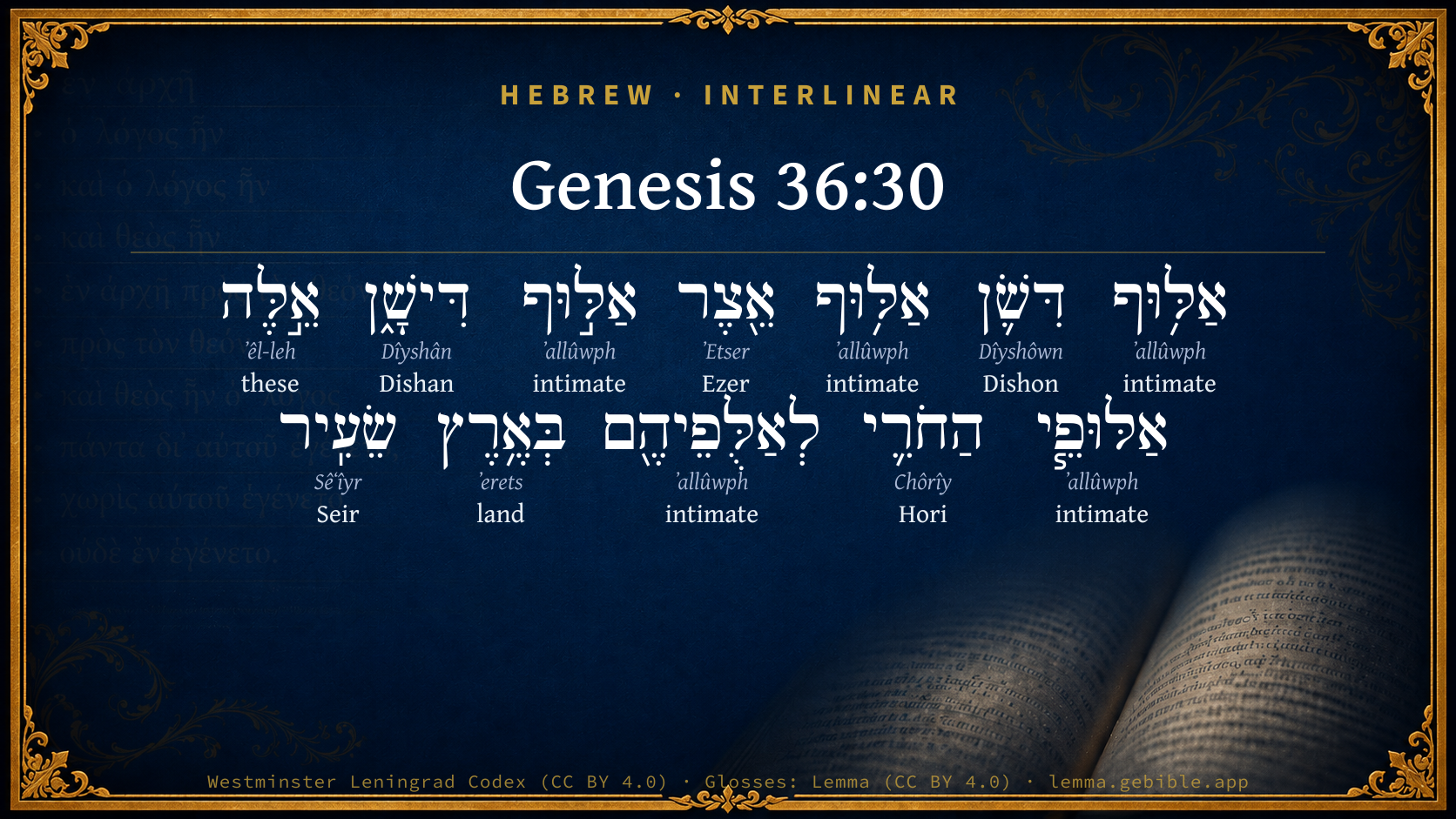
Hebrew (Westminster Leningrad Codex) Genesis 36:30 appears in the Hebrew Old Testament. The text above is from the Westminster Leningrad Codex. Each word links to its Strong’s number, a concise gloss, and parsing drawn from the Open Scriptures Hebrew Bible morphology. Click any word for its full Brown-Driver-Briggs (BDB) entry.
Download image
Cite this verse

Genesis 36:30 (World English Bible). Public Domain. Lemma interlinear Bible study tool, https://lemma.gebible.app/v/genesis/36/30.

Show BibTeX & RIS
BibTeX
RIS
English Translation
chief Dishon, chief Ezer, and chief Dishan: these are the chiefs who came of the Horites, according to their chiefs in the land of Seir.
World English Bible · Public Domain
Download a study sheet

One document with this verse’s original text, its word-by-word gloss line, the meaning frame, cross-references with their text, attributed commentary, and full source and license credits — printable, and it pastes into notes with its structure intact.

This verse Autodidact and up

Study sheet (.html) Plain text (.txt)

A passage Seminary Student

Up to 50 verses in one chapter. A passage sheet keeps up to 6 commentary sources and 12 cross-references per verse, in the order this page ranks them, and says so on the sheet whenever that leaves anything out. Ask for a single verse and you get the Autodidact verse sheet above.

Everything on this page stays free to read, with no account — the sheet is a download of what is already on screen, not access to it.

Want to remove ads? Support Godless Engineer
Compare translations 3

The same verse in 3 English versions, stacked beneath the original-language interlinear above. Click any original word for its lexicon entry.

Each is an independent rendering of the whole verse — the interlinear is not word-aligned to these translations.

Highlighted words mark where these versions differ — a whole-verse word diff, not a word-by-word alignment.

  • World English Bible Public Domain
    chief Dishon, chief Ezer, and chief Dishan: these are the chiefs who came of the Horites, according to their chiefs in the land of Seir.
  • King James Version Public Domain
    Duke Dishon, duke Ezer, duke Dishan: these are the dukes that came of Hori, among their dukes in the land of Seir.
  • unfoldingWord Literal Text CC BY-SA 4.0
    Chief Dishon, Chief Ezer, Chief Dishan. Those the chiefs of the Horites, according to their clans in the land of Seir. The Kings and Chiefs of Edom 36:31-43 1 Chronicles 1:43-54

unfoldingWord Literal Text — © unfoldingWord, licensed CC BY-SA 4.0. Word-aligned USFM3 via Door43 (git.door43.org/unfoldingWord/en_ult).

Versions to compare (up to 4)

3 of 4 selected

Show all 18 translations

Every available English version of this verse, each an independent rendering of the whole verse.

  • World English Bible Public Domain
    chief Dishon, chief Ezer, and chief Dishan: these are the chiefs who came of the Horites, according to their chiefs in the land of Seir.
  • Berean Standard Bible Public Domain
    Dishon, Ezer, and Dishan. They are the chiefs of the Horites, according to their divisions in the land of Seir.
  • Majority Standard Bible Public Domain
    Dishon, Ezer, and Dishan. They are the chiefs of the Horites, according to their divisions in the land of Seir.
  • King James Version Public Domain
    Duke Dishon, duke Ezer, duke Dishan: these are the dukes that came of Hori, among their dukes in the land of Seir.
  • American Standard Version (1901) Public Domain
    chief Dishon, chief Ezer, chief Dishan: these are the chiefs that came of the Horites, according to their chiefs in the land of Seir.
  • Revised Version (1885) Public Domain
    duke Dishon, duke Ezer, duke Dishan: these are the dukes that came of the Horites, according to their dukes in the land of Seir.
  • Geneva Bible (1599) Public Domain
    Duke Dishon, Duke Ezer, Duke Dishan: these bee the Dukes of the Horites, after their Dukedomes in the land of Seir.
  • Douay-Rheims (1899) Public Domain
    Duke Dison, duke Eser, duke Disan: these were dukes of the Horrites that ruled in the land of Seir.
  • Young's Literal Translation Public Domain
    chief Dishon, chief Ezer, chief Dishan: these `are' chiefs of the Horite in reference to their chiefs in the land of Seir.
  • Literal Standard Version CC BY-SA 4.0
    Chief Dishon, Chief Ezer, Chief Dishan: these [are] chiefs of the Horite in reference to their chiefs in the land of Seir.
  • Unlocked Literal Bible CC BY-SA 4.0
    Dishon, Ezer, Dishan: These were clans of the Horites, according to their clan lists in the land of Seir.
  • unfoldingWord Literal Text CC BY-SA 4.0
    Chief Dishon, Chief Ezer, Chief Dishan. Those the chiefs of the Horites, according to their clans in the land of Seir. The Kings and Chiefs of Edom 36:31-43 1 Chronicles 1:43-54
  • Darby Bible Public Domain
    chief Dishon, chief Ezer, chief Dishan. These are the chiefs of the Horites, according to their chiefs in the land of Seir.
  • World Messianic Bible Public Domain
    chief Dishon, chief Ezer, and chief Dishan. These are the chiefs who came of the Horites, according to their chiefs in the land of Seir.
  • Webster's Bible Public Domain
    Duke Dishon, duke Ezer, duke Dishan; these are the dukes, descendants of Hori, among their dukes in the land of Seir.
  • Free Bible Version CC BY-SA 4.0
    Dishon, Ezer, and Dishan. They were the tribal leaders of the Horites listed according to their tribes in the country of Seir.
  • Bible in Basic English Public Domain
    Dishon, Ezer, and Dishan. Such were the Horite chiefs in their order in the land of Seir.
  • JPS Tanakh (1917) Public Domain
    the chief of Dishon, the chief of Ezer, the chief of Dishan. These are the chiefs that came of the Horites, according to their chiefs in the land of Seir.

Literal Standard Version (2020), Covenant Press — licensed CC BY-SA 4.0. Text via the HelloAO Bible API (eBible.org). Unlocked Literal Bible (unfoldingWord) — licensed CC BY-SA 4.0. Text via the HelloAO Bible API (eBible.org). unfoldingWord Literal Text — © unfoldingWord, licensed CC BY-SA 4.0. Word-aligned USFM3 via Door43 (git.door43.org/unfoldingWord/en_ult). Free Bible Version, Dr. Jonathan Gallagher — licensed CC BY-SA 4.0. Text via the HelloAO Bible API (eBible.org).

Word by word

More ways to search: Search by grammar → Find every occurrence → Compare this word →

Practice this passage: Drill this verse → Learn its vocabulary →

הַחֹרִ֛י
Chôrîy
H2753
“the · Hori”
Particle, Definite Article + Noun, Gentilic, Masculine, Singular, Absolute
Part of Speech
Particle + Noun
Type
Gentilic
Gender
Masculine
Number
Singular
State
Absolute
Full BDB Definition

Origin: the same as H2752

TWOT: None

Hori = "cave dweller" - a Horite, son of Lotan, the son of Seir - a Simeonite, father of Shaphat
  1. אַלּ֥וּף ʼallûwph H441 “intimate” Noun, Common, Masculine, Singular, Absolute
  2. דִּשֹׁ֛ן Dîyshôwn H1787 “Dishon” Noun, Proper
  3. אַלּ֥וּף ʼallûwph H441 “intimate” Noun, Common, Masculine, Singular, Absolute
  4. אֵ֖צֶר ʼEtser H687 “Ezer” Noun, Proper
  5. אַלּ֣וּף ʼallûwph H441 “intimate” Noun, Common, Masculine, Singular, Absolute
  6. דִּישָׁ֑ן Dîyshân H1789 “Dishan” Noun, Proper
  7. אֵ֣לֶּה ʼêl-leh H428 “these” Pronoun, Demonstrative, Common, Plural
  8. אַלּוּפֵ֧י ʼallûwph H441 “intimates of” Noun, Common, Masculine, Plural, Construct
  9. לְאַלֻּפֵיהֶ֖ם ʼallûwph H441 “to/for · intimates · their” Preposition + Noun, Common, Masculine, Plural, Construct + Suffix, Personal, 3rd Person, Masculine, Plural
  10. בְּאֶ֥רֶץ ʼerets H776 “in/at · land of” Preposition + Noun, Common, Both, Singular, Construct
  11. שֵׂעִֽיר Sêʻîyr H8165 “Seir” Noun, Proper

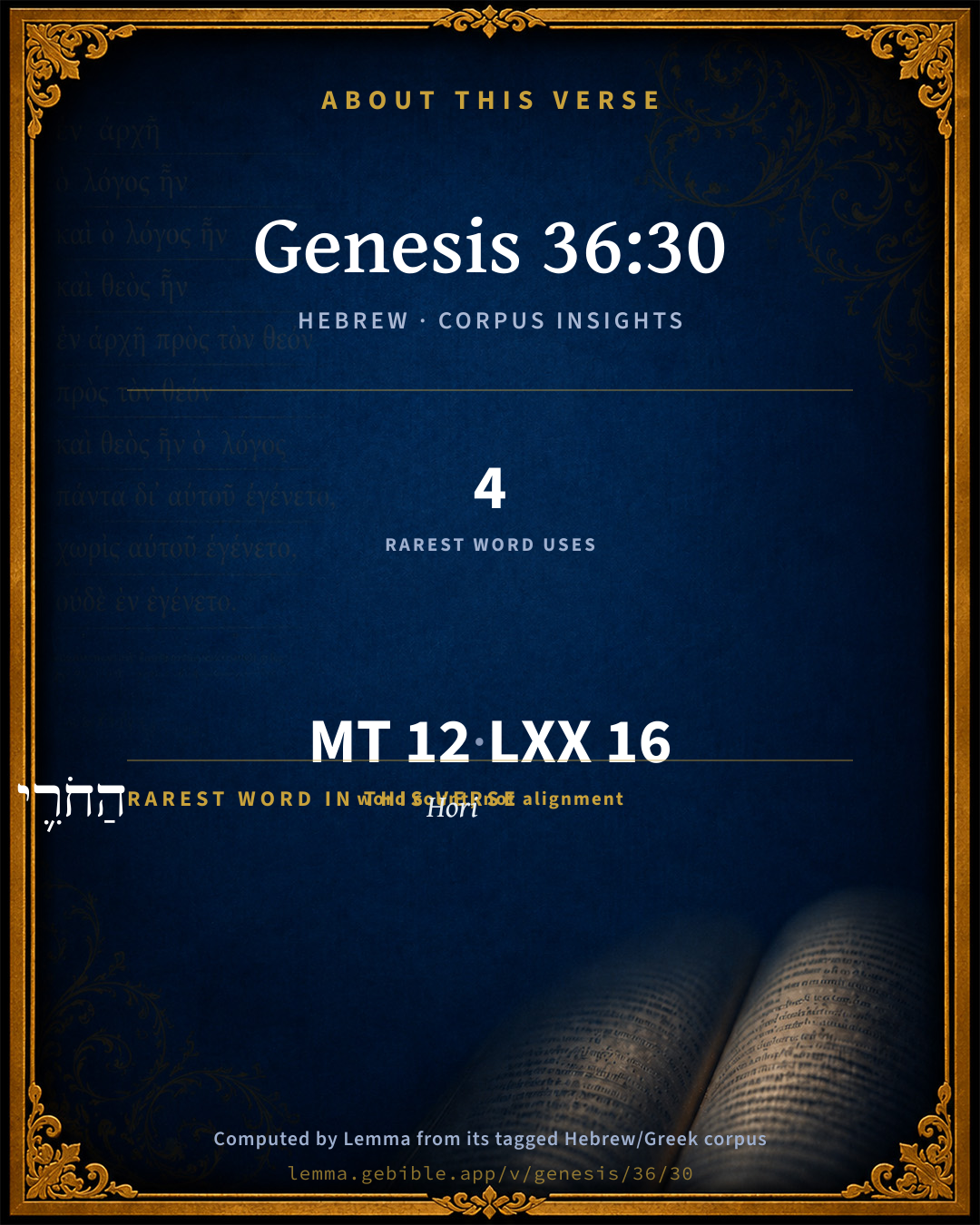
About this verse

These counts appear in no published source. They are computed here, from the morphology-tagged text and Lemma’s own curated glosses. What Lemma adds →

12
words
8
distinct lemmas
Pentateuch
section

Notable vocabulary

The rarest word here is הַחֹרִ֛י Hori H2753 — appearing just 4 times in the whole Hebrew Bible.

Shared distinctive vocabulary

הַחֹרִ֛י Hori H2753 occurs in 4 verses of the Hebrew Bible. Also found in:

Grammatical profile

  • 11 nouns
  • 1 pronoun

Repetition

A word recurs within this verse — often emphatic in Hebrew:

  • אַלּ֥וּף intimate H441 ×5

Hebrew & Septuagint length

In English translation the verse runs 25 words from the Hebrew and 20 from the Septuagint (LXX English) — closely comparable.

A rough comparison of the two English renderings, which tokenize alike — not a word-level alignment.

Word counts can differ between the Hebrew and the Greek without any difference in meaning — e.g. the Hebrew direct-object marker אֵת has no separate Greek word, and Greek often adds the article ὁ.

In the original languages it is 12 Hebrew tokens and 16 Greek tokens — but the two are counted differently (Hebrew bundles its prefixes and suffixes into one token; the Greek is in lemma form), so that isn’t a like-for-like length.

Cross-references

4

Topical passages linked to Genesis 36:30 in the Treasury of Scripture Knowledge — connected by theme and wording, ordered by reader-vote popularity; previews shown in the World English Bible.

  • 2 Kings 11:19 He took the captains over hundreds, and the Carites, and the guard, and all the people of the land; and they brought down the king from the house of Yahweh, and came by the way of the gate of the guard to the king's house. He sat on the throne of the kings.
  • Isaiah 23:15 It shall come to pass in that day, that Tyre shall be forgotten seventy years, according to the days of one king: after the end of seventy years it shall be to Tyre as in the song of the prostitute.
  • Daniel 7:17 These great animals, which are four, are four kings, who shall arise out of the earth.
  • Daniel 7:23 Thus he said, The fourth animal shall be a fourth kingdom on earth, which shall be diverse from all the kingdoms, and shall devour the whole earth, and shall tread it down, and break it in pieces.

Cross-references courtesy of OpenBible.info (CC BY 4.0).

Hebrew and Greek witnesses Masoretic Hebrew ↔ Greek Septuagint

The same verse in the two great witnesses to the Old Testament, shown verse-for-verse.

These are two independent witnesses, not word-aligned to each other, and the Septuagint is shown in lemma (dictionary) form.

Hebrew Genesis 36:30 Masoretic · Westminster Leningrad Codex

אַלּ֥וּף דִּשֹׁ֛ן אַלּ֥וּף אֵ֖צֶר אַלּ֣וּף דִּישָׁ֑ן אֵ֣לֶּה אַלּוּפֵ֧י הַחֹרִ֛י לְאַלֻּפֵיהֶ֖ם בְּאֶ֥רֶץ שֵׂעִֽיר

chief Dishon, chief Ezer, and chief Dishan: these are the chiefs who came of the Horites, according to their chiefs in the land of Seir.

World English Bible · Public Domain

Greek LXX Genesis 36:30 Septuagint · lemma form

ἡγεμών δησων ἡγεμών ασαρ ἡγεμών ρισων οὗτος ἡγεμών χορρι ἐν ὁ ἡγεμονία αὐτός ἐν γῆ εδωμ

chief Deson, chief Asar, chief Rison. These are the chiefs of Chorri, in their principalities in the land of Edom.

LXX2012 (modern English Septuagint) · Public Domain

On this verse, The Cambridge Bible for Schools and Colleges discusses the Septuagint’s reading. Read the note in Commentary ↓

Hebrew: Westminster Leningrad Codex (CC BY 4.0). Greek: Septuagint (public domain); English from LXX2012 (modern English Septuagint) (Public Domain). How the Septuagint differs from the Hebrew →

Targum (Aramaic paraphrase)

2

The Targum is the ancient Jewish Aramaic paraphrase of the Hebrew Scriptures — an interpretive translation, not the Hebrew text itself. Onkelos (literal) and Pseudo-Jonathan (expansive) render the Torah, and Jonathan the Prophets. Coverage is partial: where no permissively-licensed English translation exists for a verse, only the Aramaic is shown. This is verse-level text, not a word-by-word alignment to the Hebrew.

  1. Targum Onkelos Torah (Genesis–Deuteronomy)
    רַבָּא דִּשֹׁן רַבָּא אֵצֶר רַבָּא דִישָׁן אִלֵּין רַבְרְבֵי חוֹרָאָה לְרַבְרְבָנֵיהוֹן בְּאַרְעָא דְשֵׂעִיר

    (no public-domain English translation for this verse)

    Targum Onkelos — Aramaic: “Onkelos Genesis” (public domain); “Onkelos Exodus” (public domain); “Onkelos Leviticus” (public domain); “Onkelos Numbers” (public domain); “Onkelos Deuteronomy” (public domain). English: “Sefaria Community Translation” (CC0 1.0 (public-domain dedication)); “J.W. Etheridge. The Targums of Onkelos and Jonathan Ben Uzziel on the Pentateuch. London: Longmans, Green, 1862” (public domain). Text via Sefaria.

  2. Targum Pseudo-Jonathan Torah (Genesis–Deuteronomy)
    רַבָּא דִשׁוֹן רַבָּא אֵצֶר רַבָּא דִישָׁן אִלֵין רַבְרְבֵי גִנוּסַיָא לְרַבְרְבָנֵיהוֹם דִמְדוֹרְהוֹם מִן קַדְמַת דְנָא בְּאַרְעָא דְגַבְלָא

    Rabba Dishon, Rabba Etser, Rabba Dishan: these are the chieftains of the families, according to their principalities, whose habitation was of old in the land of Gabla.

    Targum Pseudo-Jonathan — Aramaic: “Targum Jonathan on Genesis” (public domain); “Targum Jonathan on Exodus” (public domain); “Targum Jonathan on Leviticus” (public domain); “Targum Jonathan on Numbers” (public domain); “Targum Jonathan on Deuteronomy” (public domain). English: “The Targum of Jonathan ben Uzziel, trans. J. W. Etheridge, London, 1862” (public domain). Text via Sefaria.

Commentary

Notes on Genesis 36:30 from classic Christian and Jewish commentators (each source and its license shown beneath its notes). The classic Christian expositions comment on the surrounding passage and are grouped to its opening verse, so a note may address several verses; the Jewish commentaries on the Tanakh (Rashi and others) are per-verse, so they appear only where the commentator wrote on this verse.

Lemma curates 59 commentaries, every one of them public domain or Creative Commons licensed, each selected and text-cleaned for this edition rather than reprinted as found. About our sources →

The Cambridge Bible for Schools and Colleges

gen. ed. J. J. S. Perowne

30. according to their dukes] Rather, “according to their clans.” So LXX, ἐν ταῖς ἡγεμονίαις.

The Cambridge Bible for Schools and Colleges (gen. ed. J. J. S. Perowne; Cambridge University Press, 1878–1918) — public domain. Text from a community e-Sword module.

John Gill's Exposition

And Husham died,.... As is thought, about A. M. 2219, above forty years after the death of Abraham, as computed by the above writer:

and Hadad the son of Bedad (who smote Midian in the field of Moab) reigned in his stead: who he or his father were we have no other account, nor of this warlike action of his; probably the Midianites came out to invade him, hearing of which, he went out against them, and met with him in the fields of Moab, which were near to Midian, and fought them and conquered them: Jarchi says, the Midianites came out to make war against the Moabites, and the king of Edom went out to help the Moabites, and hence, he says, we learn, that Midian and Moab were near each other; and in the days of Balaam they made peace, that they might combine against Israel: this battle is supposed to be fought in the twelfth year of his reign; and it is thought to be in his reign that Esau came with his family and dwelt in Seir (l); though some place it later, either in the following reign, or in that of his successors (m):

and the name of his city was Avith: where it was is not certain.

(l) Bedford's Scripture Chronology, p. 343, 349. (m) Universal History, vol. 2. p. 170.

John Gill's Exposition of the Whole Bible (1746–1763) — public domain (CC PDM 1.0). Text via the HelloAO Bible API.

Haydock's Catholic Bible Commentary

Seir, contemporary with the princes of Esau, in another town or region. (Calmet)

George Leo Haydock (1774–1849), Haydock's Catholic Family Bible and Commentary, 1859 edition — public domain. Excludes Psalms (Douay-Rheims chapter numbering differs from Protestant) and Deuterocanonical books (Catholic canon only).

Matthew Poole's English Annotations

Among other dukes which were in that country. Or, according to their dukedoms or principalities; the word duke being here put for dukedom as the word king is put for kingdom, Isa 23:15; Dan 7:17.

Matthew Poole's English Annotations on the Holy Bible (1683–1685) — public domain. Text from a community e-Sword/MySword module.

Keil & Delitzsch

C. F. Keil & F. Delitzsch

"These are the princes of the Horites according to their princes," i.e., as their princes were individually named in the land of Seir. ל in enumerations indicates the relation of the individual to the whole, and of the whole to the individual.

Keil & Delitzsch — Biblical Commentary on the Old Testament (1861–1891) — public domain (CC PDM 1.0). Text via the HelloAO Bible API. (Old Testament only.)

Lesson kit

Teaching starters — assembled from the data on this page, not authored interpretation. Every prompt links to the verse data it draws on. Edit before teaching.

Genesis, in the Pentateuch, opens this verse with 12 words (8 distinct Hebrew lemmas). Its most distinctive word is Chôrîy (“Hori”). A historical commentator’s framing appears above. Read the whole chapter for the surrounding context.

Discussion questions

  1. The word Chôrîy carries the sense “Hori.” How does it shape the verse?
  2. Genesis 36:22 shares the word «Hori» with this verse. How do the two illuminate each other?
  3. “intimate” occurs 5× in this one verse. What is the effect of the repetition?
  4. The translations on this page render this verse differently — a whole-verse word diff, not a word-by-word alignment. What might account for the different wordings?
  5. Reading how The Cambridge Bible for Schools and Colleges and John Gill's Exposition read this verse, where do the two commentators agree and where do they part?

Things to notice

Reading settings

Reading text

Shown beneath each verse's original-language words.

Old Testament
Old Testament edition

Read the OT as the Masoretic Hebrew (MT) or the Greek Septuagint (LXX).

English shown for the Greek Septuagint (in the Hebrew ↔ Greek comparison).

Comparing translations? Open the Compare panel on any verse page to stack up to four side by side.