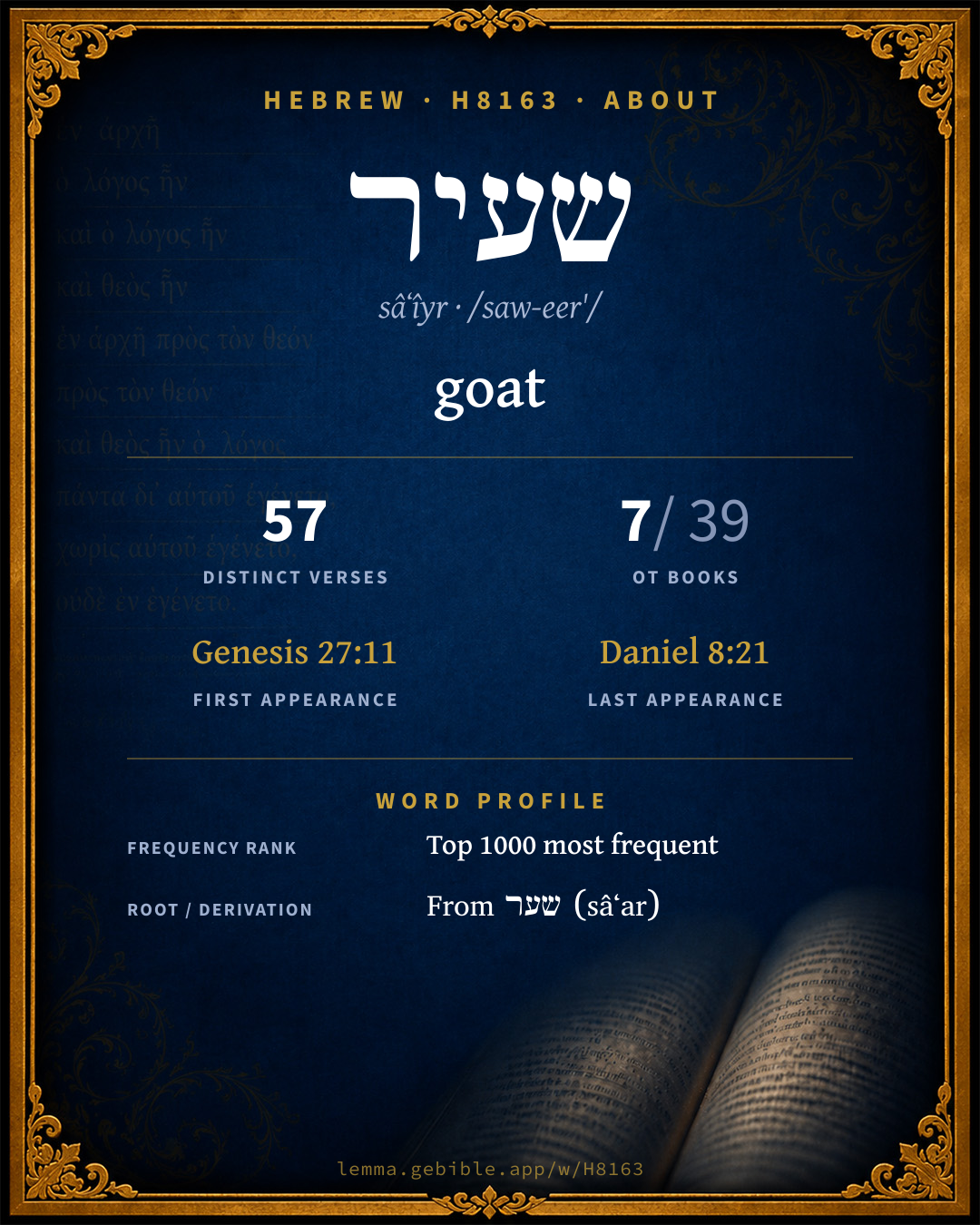
שָׂעִיר
goat
‘goat’ is one of 2 main senses fuller range ↓
Full lexicon entry — Brown-Driver-Briggs (BDB)
From Brown-Driver-Briggs (BDB)
Where this word appears
See every Construct-state word in the Hebrew Bible →
Grammar key — what these labels mean
Part of speech
- Noun
- A naming word — a person, place, thing, or idea.
- Adjective
- A word that describes or qualifies a noun.
Noun type
- Common
- A common noun — a general class of person, place, or thing (“king,” “city,” “water”), not a specific name.
State
- Construct
- A noun bound to a following noun in a possessive / “of” relationship (the construct chain).
- Absolute
- The independent form of a noun, not bound to a following word.
Gender
- Masculine
- Grammatically masculine.
- Feminine
- Grammatically feminine.
Number
- Singular
- One.
- Plural
- More than one (in Hebrew, generally three or more).
Grammatical forms
- Noun, Common, Masculine, Singular, Construct 37 times (63%)
- Noun, Common, Masculine, Singular, Absolute 11 times (19%)
- Noun, Common, Masculine, Plural, Absolute 5 times (8%)
- Noun, Common, Masculine, Plural, Construct 3 times (5%)
- Adjective, Adjective, Masculine, Singular, Absolute 2 times (3%)
- Adjective, Adjective, Feminine, Plural, Absolute 1 time (2%)
Parsed forms decoded from the imported morphology (morphhb / Westminster Leningrad Codex — WLC text public domain, morphhb tagging CC BY 4.0), counted across 59 parsed occurrences — not distinct verses.
Every verse where H8163 appears — 57 distinct verses across 7 books. Click any verse to open its interlinear word-by-word view. Verse text shown in the World English Bible for context — . Each verse’s Hebrew form is shown with its reference; the English is not keyword-highlighted, since the data carries no word-level English alignment. Use “Compare translations” on any verse to read it across multiple English versions. This concordance covers the Hebrew Bible; Septuagint (Greek Old Testament) occurrences are not indexed here.
Genesis 3 verses
- Genesis 27:11 שָׂעִ֔ר adj Adjective ms Jacob said to Rebekah his mother, "Behold, Esau my brother is a hairy man, and I am a smooth man.
- Genesis 27:23 שְׂעִרֹ֑ת adj Adjective fp He didn't recognize him, because his hands were hairy, like his brother, Esau's hands. So he blessed him.
- Genesis 37:31 שְׂעִ֣יר n c ms cs They took Joseph's coat, and killed a male goat, and dipped the coat in the blood.
Leviticus 19 verses
- Leviticus 4:23 שְׂעִ֥יר n c ms cs if his sin, in which he has sinned, is made known to him, he shall bring as his offering a goat, a male without blemish.
- Leviticus 4:24 הַ/שָּׂעִ֔יר ptcl def.art + n c ms He shall lay his hand on the head of the goat, and kill it in the place where they kill the burnt offering before Yahweh. It is a sin offering.
- Leviticus 9:3 שְׂעִיר n c ms cs You shall speak to the children of Israel, saying, 'Take a male goat for a sin offering; and a calf and a lamb, both a year old, without blemish, for a burnt offering;
- Leviticus 9:15 שְׂעִ֤יר n c ms cs He presented the people's offering, and took the goat of the sin offering which was for the people, and killed it, and offered it for sin, like the first.
- Leviticus 10:16 שְׂעִ֣יר n c ms cs Moses diligently inquired about the goat of the sin offering, and, behold, it was burned: and he was angry with Eleazar and with Ithamar, the sons of Aaron who were left, saying,
- Leviticus 16:5 שְׂעִירֵ֥י n c mp cs He shall take from the congregation of the children of Israel two male goats for a sin offering, and one ram for a burnt offering
- Leviticus 16:7 הַ/שְּׂעִירִ֑ם ptcl def.art + n c mp He shall take the two goats, and set them before Yahweh at the door of the Tent of Meeting.
- Leviticus 16:8 הַ/שְּׂעִירִ֖ם ptcl def.art + n c mp Aaron shall cast lots for the two goats; one lot for Yahweh, and the other lot for the scapegoat.
- Leviticus 16:9 הַ/שָּׂעִ֔יר ptcl def.art + n c ms Aaron shall present the goat on which the lot fell for Yahweh, and offer him for a sin offering.
- Leviticus 16:10 וְ/הַ/שָּׂעִ֗יר conj + ptcl def.art + n c ms But the goat, on which the lot fell for the scapegoat, shall be presented alive before Yahweh, to make atonement for him, to send him away for the scapegoat into the wilderness.
- Leviticus 16:15 שְׂעִ֤יר n c ms cs "Then he shall kill the goat of the sin offering, that is for the people, and bring his blood within the veil, and do with his blood as he did with the blood of the bull, and sprinkle it on the mercy seat, and before the mercy seat:
- Leviticus 16:18 הַ/שָּׂעִ֔יר ptcl def.art + n c ms "He shall go out to the altar that is before Yahweh and make atonement for it, and shall take some of the bull's blood, and some of the goat's blood, and put it on the horns of the altar round about.
- Leviticus 16:20 הַ/שָּׂעִ֥יר ptcl def.art + n c ms "When he has made an end of atoning for the Holy Place, the Tent of Meeting, and the altar, he shall present the live goat.
- Leviticus 16:21 הַ/שָּׂעִיר֮ הַ/שָּׂעִ֔יר ptcl def.art + n c ms ptcl def.art + n c ms Aaron shall lay both his hands on the head of the live goat, and confess over him all the iniquities of the children of Israel, and all their transgressions, even all their sins; and he shall put them on the head of the goat, and shall send him away into the wilderness by the hand of a man who is in readiness.
- Leviticus 16:22 הַ/שָּׂעִ֥יר הַ/שָּׂעִ֖יר ptcl def.art + n c ms ptcl def.art + n c ms The goat shall carry all their iniquities on himself to a solitary land, and he shall let the goat go in the wilderness.
- Leviticus 16:26 הַ/שָּׂעִיר֙ ptcl def.art + n c ms "He who lets the goat go for the scapegoat shall wash his clothes, and bathe his flesh in water, and afterward he shall come into the camp.
- Leviticus 16:27 שְׂעִ֣יר n c ms cs The bull for the sin offering, and the goat for the sin offering, whose blood was brought in to make atonement in the Holy Place, shall be carried forth outside the camp; and they shall burn their skins, their flesh, and their dung with fire.
- Leviticus 17:7 לַ/שְּׂעִירִ֕ם prep det + n c mp They shall no more sacrifice their sacrifices to the goat idols, after which they play the prostitute. This shall be a statute forever to them throughout their generations.'
- Leviticus 23:19 שְׂעִיר n c ms cs You shall offer one male goat for a sin offering, and two male lambs a year old for a sacrifice of peace offerings.
Numbers 27 verses
- Numbers 7:16 שְׂעִיר n c ms cs one male goat for a sin offering;
- Numbers 7:22 שְׂעִיר n c ms cs one male goat for a sin offering;
- Numbers 7:28 שְׂעִיר n c ms cs one male goat for a sin offering;
- Numbers 7:34 שְׂעִיר n c ms cs one male goat for a sin offering;
- Numbers 7:40 שְׂעִיר n c ms cs one male goat for a sin offering;
- Numbers 7:46 שְׂעִיר n c ms cs one male goat for a sin offering;
- Numbers 7:52 שְׂעִיר n c ms cs one male goat for a sin offering;
- Numbers 7:58 שְׂעִיר n c ms cs one male goat for a sin offering;
- Numbers 7:64 שְׂעִיר n c ms cs one male goat for a sin offering;
- Numbers 7:70 שְׂעִיר n c ms cs one male goat for a sin offering;
- Numbers 7:76 שְׂעִיר n c ms cs one male goat for a sin offering;
- Numbers 7:82 שְׂעִיר n c ms cs one male goat for a sin offering;
- Numbers 7:87 וּ/שְׂעִירֵ֥י conj + n c mp cs all the oxen for the burnt offering twelve bulls, the rams twelve, the male lambs a year old twelve, and their meal offering; and the male goats for a sin offering twelve;
- Numbers 15:24 וּ/שְׂעִיר conj + n c ms cs then it shall be, if it be done unwittingly, without the knowledge of the congregation, that all the congregation shall offer one young bull for a burnt offering, for a sweet savor to Yahweh, with the meal-offering of it, and the drink-offering of it, according to the ordinance, and one male goat for a sin-offering.
- Numbers 28:15 וּ/שְׂעִ֨יר conj + n c ms cs One male goat for a sin-offering to Yahweh; it shall be offered besides the continual burnt offering, and the drink-offering of it.
- Numbers 28:22 וּ/שְׂעִ֥יר conj + n c ms cs and one male goat for a sin-offering, to make atonement for you.
- Numbers 28:30 שְׂעִ֥יר n c ms cs one male goat, to make atonement for you.
- Numbers 29:5 וּ/שְׂעִיר conj + n c ms cs and one male goat for a sin-offering, to make atonement for you;
- Numbers 29:11 שְׂעִיר n c ms cs one male goat for a sin-offering; besides the sin-offering of atonement, and the continual burnt offering, and the meal-offering of it, and their drink-offerings.
- Numbers 29:16 וּ/שְׂעִיר conj + n c ms cs and one male goat for a sin-offering, besides the continual burnt offering, the meal-offering of it, and the drink-offering of it.
- Numbers 29:19 וּ/שְׂעִיר conj + n c ms cs and one male goat for a sin-offering; besides the continual burnt offering, and the meal-offering of it, and their drink-offerings.
- Numbers 29:22 וּ/שְׂעִ֥יר conj + n c ms cs and one male goat for a sin-offering; besides the continual burnt offering, and the meal-offering of it, and the drink-offering of it.
- Numbers 29:25 וּ/שְׂעִיר conj + n c ms cs and one male goat for a sin-offering; besides the continual burnt offering, the meal-offering of it, and the drink-offering of it.
- Numbers 29:28 וּ/שְׂעִ֥יר conj + n c ms cs and one male goat for a sin-offering, besides the continual burnt offering, and the meal-offering of it, and the drink-offering of it.
- Numbers 29:31 וּ/שְׂעִ֥יר conj + n c ms cs and one male goat for a sin-offering; besides the continual burnt offering, the meal-offering of it, and the drink-offerings of it.
- Numbers 29:34 וּ/שְׂעִ֥יר conj + n c ms cs and one male goat for a sin-offering; besides the continual burnt offering, the meal-offering of it, and the drink-offering of it.
- Numbers 29:38 וּ/שְׂעִ֥יר conj + n c ms cs and one male goat for a sin-offering, besides the continual burnt offering, and the meal-offering of it, and the drink-offering of it.
2 Chronicles 2 verses
- 2 Chronicles 11:15 וְ/לַ/שְּׂעִירִ֑ים conj + prep det + n c mp and he appointed him priests for the high places, and for the male goats, and for the calves which he had made.
- 2 Chronicles 29:23 שְׂעִירֵ֣י n c mp cs They brought near the male goats for the sin-offering before the king and the assembly; and they laid their hands on them:
Isaiah 2 verses
- Isaiah 13:21 וּ/שְׂעִירִ֖ים conj + n c mp But wild animals of the desert shall lie there; and their houses shall be full of doleful creatures; and ostriches shall dwell there, and wild goats shall dance there.
- Isaiah 34:14 וְ/שָׂעִ֖יר conj + n c ms The wild animals of the desert shall meet with the wolves, and the wild goat shall cry to his fellow; yes, the night-monster shall settle there, and shall find her a place of rest.
Ezekiel 3 verses
- Ezekiel 43:22 שְׂעִיר n c ms cs On the second day you shall offer a male goat without blemish for a sin-offering; and they shall cleanse the altar, as they did cleanse it with the bull.
- Ezekiel 43:25 שְׂעִיר n c ms cs Seven days shall you prepare every day a goat for a sin-offering: they shall also prepare a young bull, and a ram out of the flock, without blemish.
- Ezekiel 45:23 שְׂעִ֥יר n c ms cs The seven days of the feast he shall prepare a burnt offering to Yahweh, seven bulls and seven rams without blemish daily the seven days; and a male goat daily for a sin-offering.
Daniel 1 verse
About this entry
At a glance — auto-summarized from this page’s data, not written by a person. Every figure links to its source below. This summary describes the numbers; it doesn’t interpret them.
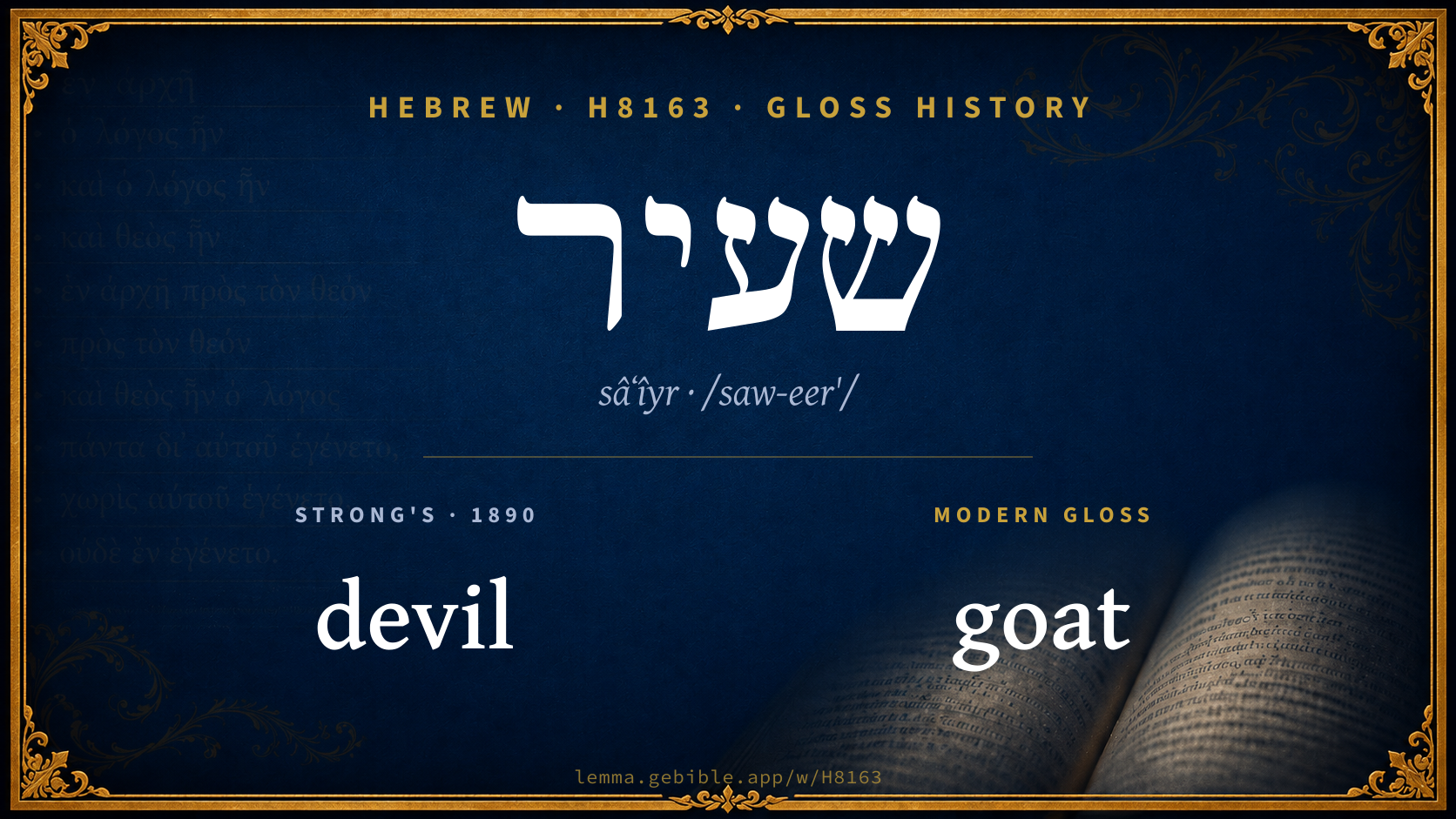
The Hebrew word שעיר centers on the idea of “goat.” Where the King James Version says “kid,” newer translations reach for “male goat” (Berean Standard Bible) and “buck of” (unfoldingWord Literal Text); the renderings breakdown has the detail. The Hebrew Bible uses it across 57 verses — moderately common. Numbers dominates its distribution — 27 of 57 verses. Lexicons map it across 2 senses. Dig into 57-verse concordance and the renderings breakdown below.
Gloss history
Strong's 1890 vs modern scholarship
About this word
Strong's H8163 catalogs a Hebrew word from the Hebrew Old Testament.
These counts are not copied from any lexicon or concordance. They are computed here, from the morphology-tagged Hebrew Old Testament. What Lemma adds →
- 57
- distinct verses
- The word appears in 57 distinct verses.
- 7 / 39
- OT books
- The word appears in 7 of 39 Old Testament books.
- #647
- by frequency
- Top 1000 most frequent Hebrew words (rank 647 of 8,640 Hebrew words by occurrence).
View all 57 occurrences in the concordance →
By section of the Old Testament
By traditional corpus
Conventional, traditional groupings — biblical authorship is debated, so this is a traditional corpus grouping, not an authorship claim. Each share is this word’s portion of its verses in that division of the Hebrew canon. Each figure is a share of the word’s 57 distinct verses.
- Torah (Pentateuch) 49 verses · 86%
- Prophets (Nevi'im) 5 verses · 9%
- Writings (Ketuvim) 3 verses · 5%
How translations render this word
Counts come from each version’s own published word-to-Strong’s tagging or interlinear alignment — an approximate guide to how each version renders this word, not a word-level alignment the data otherwise carries. Because each total is that version’s own tagged count, the per-version totals vary from one another and need not match the appearance or distinct-verse counts above. These counts may also differ from a printed concordance because Lemma counts each distinctly tagged rendering and does not collapse phrase taggings into a single head-word total. This is a fixed set of word-tagged versions (KJV, ASV, BSB, ULT) and does not change with the reading translation you choose elsewhere. Each version’s license is shown beside its name below (and on Sources).
BDB lists this Strong’s number as 2 distinct words (homographs). Each count above pools all of them and is not split by sense — see the Senses section below. A low-frequency rendering may belong to a different one of those words, not the primary meaning.
- King James Version†: Kid 25×, Goat 21×, Devils 2×
- American Standard Version†: Goat 16×, Male 12×, He 11×
- Berean Standard Bible†: Male goat 32×, Goat 10×, Goats 3×
- unfoldingWord Literal Text†: Buck of 22×, And 13×, Goat 9×
King James Version Public Domain
Renders H8163 across 59† tagged occurrences — most commonly:
Plus 7 renderings that appear only once — usually multi-word phrases or single function words the recovered tagging swept in, not distinct renderings.
American Standard Version Public Domain
Renders H8163 across 58† tagged occurrences — most commonly:
Plus 10 renderings that appear only once — usually multi-word phrases or single function words the recovered tagging swept in, not distinct renderings.
Berean Standard Bible Public Domain
Renders H8163 across 58† tagged occurrences — most commonly:
Plus 9 renderings that appear only once — usually multi-word phrases or single function words the recovered tagging swept in, not distinct renderings. Not rendered by a distinct English word in 1 further occurrence.
unfoldingWord Literal Text CC BY-SA 4.0
Renders H8163 across 76† tagged occurrences — most commonly:
Plus 8 renderings that appear only once — usually multi-word phrases or single function words the recovered tagging swept in, not distinct renderings.
Senses in BDB
The 2 senses BDB distinguishes for this word, in lexicon order (not ranked by frequency or importance). The full entry — with sub-senses — is in the Lexicon Entry tab.
- hairy (adjective)
- he-goat, buck (noun masculine)
Word origin
I. n.m.Nu 15:24 he-goat, buck (hairy one; NH id.);—abs. שׂ׳ Lv 4:24 +, cstr. שְׂעִיר Nu 7:16 +; pl. שְׂעִירִם Lv 16:7, 8; cstr. שְׂעִירֵי v 5 Nu 7:87;—he-goat, usually שְׂעִיר(־)עִזִּים buck of goats (v. עֵז p. 777): Gn 37:31 (J), Ez 43:22; 45:23 Lv 4:23; 9:3; 23:19 + 20 times Nu (all P); שְׂעִירֵי ע׳ Lv 16:5 Nu 7:87 (P); שׂ׳ alone = he-goat Lv 4:24 + 11 times Lv 16 (P); שְׂעִיר (הַ)חַטָּאת he-goat for sin-offering Ez 43:25 Lv 9:15 + 9 times Lv Nu; שְׂעִירֵי הַח׳ 2 Ch 29:23; in Dn 8:21 הַשּׂ׳ is prob. gloss to הַצָּפִיר (cf. Dr).
II. n.m. satyr, demon (with he-goat’s form, or feet; NH id.; cf. BaudStud. i. 136 ff.; hairy demons WeSkizzen iii. 135; Heid. 152 RSSem 113, 423; 2nd ed. 120, 441); abs. שׂ׳ Is 34:14 inhabiting desolate ruins, so pl. שְׂעִירִים 13:21; name for idols 2 Ch 11:15 and (שְׂעִרִם) Lv 17:7 (H); prob. also בָּמוֹת הַשּׂ׳ 2 K 23:8 (MT הַשְּׁעָרִים) HoffmZAW ii (1882), 175 SS Kmp Klo Kit Benz Bur.
— Brown-Driver-Briggs (Oxford 1906, public domain), digitized via Sefaria, supplemented by the OpenScriptures HebrewLexicon (CC BY 4.0). See Sources.
Derived from שער (sâʻar) (H8175) — to dread.
Jastrow Dictionary
A second Hebrew/Aramaic lexicon for comparison, covering Aramaic and post-biblical (Talmudic, Targumic, Midrashic) usage that the biblical-Hebrew BDB does not. Matched by lemma rather than by Strong’s number, so a lemma may carry more than one Jastrow headword (shown separately below), and the entries cover usage well beyond the Bible.
שָׂעִיר
- 1. goat. Yoma VI, 2 ש׳ המשתלח, v. שָׁלַח. Ib. 7 פר וש׳ הנשרפין the bullock and the goat designated to be burnt. Zeb. V, 1; a. fr.—Pl. שְׂעִירִים, שְׂעִירִין. Ib. 2. Yoma VI, 1; a. fr.
- 2. demon. B. Bath. 25ᵃ, v. סָעַר II. Ber. 64ᵃ ש׳ בש׳ מיחלף goat and demon may interchange (both going by the name of saʿir).— Pl. as ab. Lev. R. s. 22, v. שֵׁד; a. e.
- 3. shower. Pl. as ab. Sifré Deut. 306 (ref. to Deut. XXXII, 2) מה ש׳ הללו וכ׳ as the showers come down on the plants &c.; Yalk. ib. 942, v. סָעַר II. e.g. Deuteronomy 32:2
- 4. hairy. Gen. R. s. 65.
שֵׂעִיר
- (b. h.) pr. n. Seir (Idumæa). Y. Taan. I, 64ᵃ top (ref. to Is. XXI, 11) אֵלִי קורא מפני ש׳ my God cries out on account of Seir (Rome, v. אֱדוֹם); ib. אלי איכן נזדווג לי מש׳ whence did my God come to join me? From Seir (Deut. XXXIII, 2). Sifré Deut. 343 כשעתיד … ליפרע מש׳ when the Lord shall punish Seir (Rome). Ber. 62ᵇ עד השתא … לש׳ וגמרת מילי דש׳ thou hast not yet gone to Seir (Rome), and hast already learned the things of Seir (indecent manners); Tam. 27ᵇ; a. fr. e.g. Isaiah 21:11
A Dictionary of the Targumim, the Talmud Babli and Yerushalmi, and the Midrashic Literature (Marcus Jastrow; London, Luzac, 1903) — Public Domain. Digitized via Sefaria. Digitized via Sefaria. Full attribution on Sources.
Forms in the corpus
The 24 distinct written forms H8163 takes in the Hebrew Bible, most frequent first — each parse links to that state’s occurrences in the concordance. Hebrew forms include their vowel points and cantillation, so a single lemma takes many written forms.
Same root — word family
Other BDB entries built from the same root as H8163, grouped by Strong’s listed origin. These share a root / origin per the lexicon — not necessarily a shared meaning. Each links to that word’s own entry.
Derives from
Shares the same root
Derived from this word
Proper names from this root
People and places named from this root — a name, not an additional meaning of the word.
Compare all same-root words → Showing 4 of 8 — not the complete family. 1 of the same-root words is a proper name (a person or place). They share a root, not necessarily a meaning.
Septuagint verse parallels
This word appears in 57 verses that also exist in the Greek Old Testament (Septuagint), out of the 57 Hebrew verses it occurs in. You can read those verses in Greek by switching the Old Testament edition to the Septuagint.
Read these verses in the Septuagint
This is a verse-level parallel only — the same verses exist in both the Hebrew and Greek Old Testaments. No word-level Hebrew↔Greek correspondence is claimed: the data carries no such alignment, so no Greek word is shown as this Hebrew word’s translation. Coverage is not total — the Septuagint omits the deuterocanon and renumbers the Psalms, so some Hebrew verses have no direct Greek parallel.