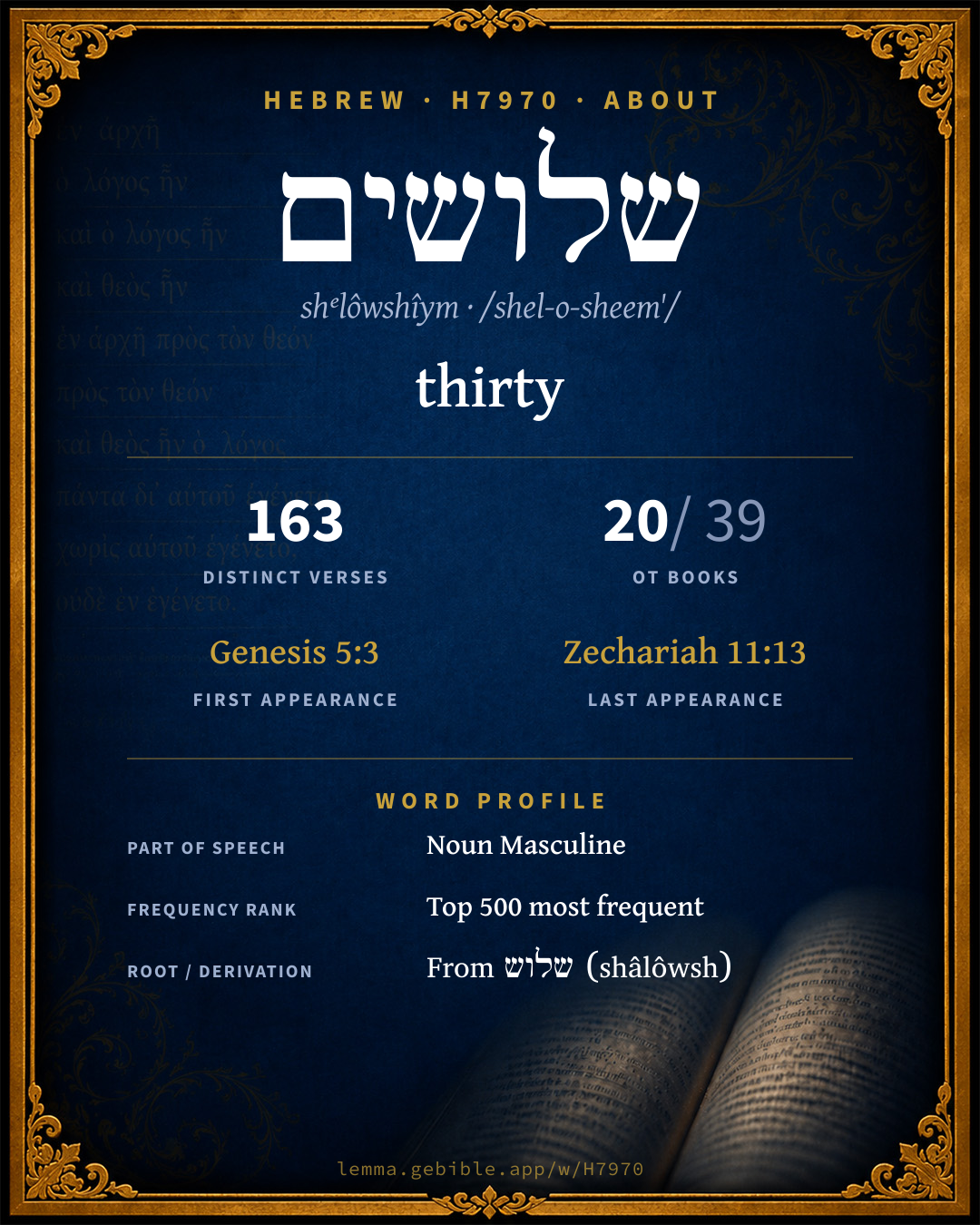
שְׁלֹשִׁים
thirty
Full lexicon entry — Brown-Driver-Briggs (BDB)
From Brown-Driver-Briggs (BDB)
Where this word appears
Grammar key — what these labels mean
Part of speech
- Adjective
- A word that describes or qualifies a noun.
State
- Absolute
- The independent form of a noun, not bound to a following word.
Gender
- Both
- Attested as both masculine and feminine.
Number
- Plural
- More than one (in Hebrew, generally three or more).
Every verse where H7970 appears in the Book of Ezra — 7 distinct verses. Click any verse to open its interlinear word-by-word view. Verse text shown in the World English Bible for context — . Each verse’s Hebrew form is shown with its reference; the English is not keyword-highlighted, since the data carries no word-level English alignment. Use “Compare translations” on any verse to read it across multiple English versions. This concordance covers the Hebrew Bible; Septuagint (Greek Old Testament) occurrences are not indexed here.
Ezra
- Ezra 1:9 שְׁלֹשִׁ֗ים adj Cardinal number bp This is the number of them: thirty platters of gold, one thousand platters of silver, twenty-nine knives,
- Ezra 1:10 שְׁלֹשִׁ֔ים adj Cardinal number bp thirty bowls of gold, silver bowls of a second sort four hundred and ten, and other vessels one thousand.
- Ezra 2:35 וּ/שְׁלֹשִֽׁים conj + Adjective Cardinal number bp The children of Senaah, three thousand six hundred thirty.
- Ezra 2:42 שְׁלֹשִׁ֥ים adj Cardinal number bp The children of the porters: the children of Shallum, the children of Ater, the children of Talmon, the children of Akkub, the children of Hatita, the children of Shobai, in all one hundred thirty-nine.
- Ezra 2:65 שְׁלֹשִׁ֣ים adj Cardinal number bp besides their men-servants and their maid-servants, of whom there were seven thousand three hundred thirty-seven: and they had two hundred singing men and singing women.
- Ezra 2:66 שְׁלֹשִׁ֣ים adj Cardinal number bp Their horses were seven hundred thirty-six; their mules, two hundred forty-five;
- Ezra 2:67 שְׁלֹשִׁ֣ים adj Cardinal number bp their camels, four hundred thirty-five; [their] donkeys, six thousand seven hundred and twenty.
About this entry
At a glance — auto-summarized from this page’s data, not written by a person. Every figure links to its source below. This summary describes the numbers; it doesn’t interpret them.
The Hebrew noun שלושים centers on the idea of “thirty.” Debuting at Genesis 5:3, it then recurs through the corpus. Spanning 163 verses in 20 books, it ranks among the common words of the Hebrew Bible. Sharing its root, it stands alongside שלוש, שליש and שלישי. For the data behind this summary, explore the sense tree and the renderings breakdown below.
Gloss history
Strong's 1890 vs modern scholarship
About this word
Strong's H7970 catalogs a Hebrew word from the Hebrew Old Testament.
These counts are not copied from any lexicon or concordance. They are computed here, from the morphology-tagged Hebrew Old Testament. What Lemma adds →
- 163
- distinct verses
- The word appears in 163 distinct verses.
- 20 / 39
- OT books
- The word appears in 20 of 39 Old Testament books.
- #268
- by frequency
- Top 500 most frequent Hebrew words (rank 268 of 8,640 Hebrew words by occurrence).
View all 163 occurrences in the concordance →
By section of the Old Testament
By traditional corpus
Conventional, traditional groupings — biblical authorship is debated, so this is a traditional corpus grouping, not an authorship claim. Each share is this word’s portion of its verses in that division of the Hebrew canon. Each figure is a share of the word’s 163 distinct verses.
- Torah (Pentateuch) 67 verses · 41%
- Prophets (Nevi'im) 54 verses · 33%
- Writings (Ketuvim) 42 verses · 26%
How translations render this word
Counts come from each version’s own published word-to-Strong’s tagging or interlinear alignment — an approximate guide to how each version renders this word, not a word-level alignment the data otherwise carries. Because each total is that version’s own tagged count, the per-version totals vary from one another and need not match the appearance or distinct-verse counts above. These counts may also differ from a printed concordance because Lemma counts each distinctly tagged rendering and does not collapse phrase taggings into a single head-word total. This is a fixed set of word-tagged versions (KJV, ASV, BSB, ULT) and does not change with the reading translation you choose elsewhere. Each version’s license is shown beside its name below (and on Sources).
- King James Version: Thirty 122×, Was thirty 10×, Thirtieth 8×
- American Standard Version: Thirty 114×, Was thirty 9×, Thirtieth 8×
- Berean Standard Bible: Thirty 48×, Hundred and thirty 12×, Thirty-three 5×
- unfoldingWord Literal Text: Thirty 20×, And 16×, Were 13×
King James Version Public Domain
Renders H7970 across 173 tagged occurrences — most commonly:
Plus 12 renderings that appear only once — usually multi-word phrases or single function words the recovered tagging swept in, not distinct renderings. Not rendered by a distinct English word in 2 further occurrences.
American Standard Version Public Domain
Renders H7970 across 173 tagged occurrences — most commonly:
Plus 18 renderings that appear only once — usually multi-word phrases or single function words the recovered tagging swept in, not distinct renderings.
Berean Standard Bible Public Domain
Renders H7970 across 120 tagged occurrences — most commonly:
Plus other, less common renderings. Plus 23 renderings that appear only once — usually multi-word phrases or single function words the recovered tagging swept in, not distinct renderings. Not rendered by a distinct English word in 54 further occurrences.
unfoldingWord Literal Text CC BY-SA 4.0
Renders H7970 across 83 tagged occurrences — most commonly:
Plus 11 renderings that appear only once — usually multi-word phrases or single function words the recovered tagging swept in, not distinct renderings. Not rendered by a distinct English word in 94 further occurrences.
Senses in the full BDB
What do BDB’s symbols mean?
BDB uses these scholarly abbreviations:
| Symbol | Meaning |
|---|---|
| 𝔊 | the Septuagint (the ancient Greek translation, LXX) |
| 𝔙 | the Vulgate (the Latin translation) |
| 𝔖 | the Syriac version (the Peshitta) |
| 𝔗 | the Targum (the Aramaic translation) |
| ψ | the Psalms |
| √ | root (the underlying root or stem) |
| ‖ | parallel passage (a synonymous or contrasted parallel) |
| † | the dagger: every passage where the word occurs is cited |
The 2 senses and sub-senses the full Brown-Driver-Briggs lexicon distinguishes for this word, in lexicon order (not ranked by frequency), with BDB’s own verbatim wording and sub-sense lettering. Shown in Hebrew script with BDB’s own scholarly abbreviations. The condensed entry is in the Lexicon Entry tab. See also the Forms in the corpus table below.
- 1. bef. n. sg.
- 2. as ordin.
Senses from the full Brown-Driver-Briggs lexicon (Brown, Driver, Briggs; Oxford 1906 — public domain), digitized via Sefaria, supplemented by the OpenScriptures HebrewLexicon (CC BY 4.0). Full attribution on Sources.
Word origin
שְׁלֹשִׁים (very seldom שְׁלוֹשִׁים, שְׁלֹשִׁם ) 174 n.indecl. thirty
— Brown-Driver-Briggs (Oxford 1906, public domain), digitized via Sefaria, supplemented by the OpenScriptures HebrewLexicon (CC BY 4.0). See Sources.
Derived from שלוש (shâlôwsh) (H7969) — three.
Forms in the corpus
The 38 distinct written forms H7970 takes in the Hebrew Bible, most frequent first — each parse links to that state’s occurrences in the concordance. Hebrew forms include their vowel points and cantillation, so a single lemma takes many written forms.
| Form | Parsing | Example | Uses |
|---|---|---|---|
| שְׁלֹשִׁ֣ים | Adjective, Cardinal number, Both, Plural, Absolute | Deuteronomy 34:8 | 41 |
| שְׁלֹשִׁ֥ים | Adjective, Cardinal number, Both, Plural, Absolute | Daniel 12:12 | 30 |
| שְׁלֹשִׁ֤ים | Adjective, Cardinal number, Both, Plural, Absolute | Genesis 5:3 | 16 |
| וּ/שְׁלֹשִׁ֖ים | Adjective, Cardinal number, Both, Plural, Absolute | Ezekiel 46:22 | 13 |
| וּ/שְׁלֹשִׁ֛ים | Adjective, Cardinal number, Both, Plural, Absolute | Exodus 6:16 | 10 |
| וּ/שְׁלֹשִׁ֥ים | Adjective, Cardinal number, Both, Plural, Absolute | Genesis 6:15 | 7 |
| שְׁלֹשִׁ֨ים | Adjective, Cardinal number, Both, Plural, Absolute | 1 Kings 16:23 | 7 |
| וּ/שְׁלֹשִֽׁים | Adjective, Cardinal number, Both, Plural, Absolute | Ezra 2:35 | 6 |
| וּ/שְׁלֹשִׁ֣ים | Adjective, Cardinal number, Both, Plural, Absolute | Ezekiel 41:6 | 4 |
| וּ/שְׁלֹשִׁ֤ים | Adjective, Cardinal number, Both, Plural, Absolute | 1 Chronicles 3:4 | 4 |
| בִ/שְׁלֹשִׁ֨ים | Adjective, Cardinal number, Both, Plural, Absolute | 2 Kings 25:27 | 2 |
| ה/שלושים | Adjective, Cardinal number, Both, Plural, Absolute | 1 Chronicles 11:11 | 2 |
| וּ/שְׁלֹשִׁ֨ים | Adjective, Cardinal number, Both, Plural, Absolute | 1 Chronicles 19:7 | 2 |
| כִּ/שְׁלֹשִׁ֥ים | Adjective, Cardinal number, Both, Plural, Absolute | 1 Samuel 9:22 | 2 |
| שְׁלֹשִׁ֑ים | Adjective, Cardinal number, Both, Plural, Absolute | Genesis 18:30 | 2 |
| שְׁלֹשִֽׁים | Adjective, Cardinal number, Both, Plural, Absolute | Genesis 18:30 | 2 |
| שְׁלֹשִׁים֙ | Adjective, Cardinal number, Both, Plural, Absolute | Exodus 26:8 | 2 |
| שלשים | Adjective, Cardinal number, Both, Plural, Absolute | 2 Samuel 23:13 | 2 |
| בִּ/שְׁלֹשִׁ֣ים | Adjective, Cardinal number, Both, Plural, Absolute | Ezekiel 1:1 | 1 |
| בַּ/שְּׁלֹשִׁ֑ים | Adjective, Cardinal number, Both, Plural, Absolute | 2 Samuel 23:24 | 1 |
| הַ/שְּׁלֹשִׁ֑ים | Adjective, Cardinal number, Both, Plural, Absolute | 1 Chronicles 27:6 | 1 |
| הַ/שְּׁלֹשִׁ֖ים | Adjective, Cardinal number, Both, Plural, Absolute | 1 Chronicles 27:6 | 1 |
| הַ/שְּׁלֹשִׁ֣ים | Adjective, Cardinal number, Both, Plural, Absolute | 2 Samuel 23:23 | 1 |
| הַ/שְּׁלוֹשִׁ֗ים | Adjective, Cardinal number, Both, Plural, Absolute | 1 Chronicles 11:25 | 1 |
| הַ/שְּׁלוֹשִׁ֨ים | Adjective, Cardinal number, Both, Plural, Absolute | 1 Chronicles 11:15 | 1 |
| הַ/שָּׁלִישִׁים֒ | Adjective, Cardinal number, Both, Plural, Absolute | 1 Chronicles 12:18 | 1 |
| וּ/שְׁלֹשִׁ֑ים | Adjective, Cardinal number, Both, Plural, Absolute | 1 Kings 20:15 | 1 |
| וּ/שְׁלֹשִׁים֙ | Adjective, Cardinal number, Both, Plural, Absolute | Judges 12:14 | 1 |
| כִּ/שְׁלֹשִׁ֣ים | Adjective, Cardinal number, Both, Plural, Absolute | Judges 20:39 | 1 |
| כִּ/שְׁלֹשִׁ֤ים | Adjective, Cardinal number, Both, Plural, Absolute | Joshua 7:5 | 1 |
| מֵ/הַ/שְּׁלֹשִׁ֣ים | Adjective, Cardinal number, Both, Plural, Absolute | 2 Samuel 23:13 | 1 |
| שְׁלֹשִׁ֔ים | Adjective, Cardinal number, Both, Plural, Absolute | Ezra 1:10 | 1 |
| שְׁלֹשִׁ֖ים | Adjective, Cardinal number, Both, Plural, Absolute | Nehemiah 7:70 | 1 |
| שְׁלֹשִׁ֗ים | Adjective, Cardinal number, Both, Plural, Absolute | Ezra 1:9 | 1 |
| שְׁלֹשִׁים֩ | Adjective, Cardinal number, Both, Plural, Absolute | 2 Chronicles 20:31 | 1 |
| שְׁלוֹשִׁ֥ים | Adjective, Cardinal number, Both, Plural, Absolute | Esther 4:11 | 1 |
| שְׁלוֹשִׁ֨ים | Adjective, Cardinal number, Both, Plural, Absolute | 2 Chronicles 16:12 | 1 |
| שְׁלוֹשִֽׁים | Adjective, Cardinal number, Both, Plural, Absolute | 1 Chronicles 11:42 | 1 |
Same root — word family
Other BDB entries built from the same root as H7970, grouped by Strong’s listed origin. These share a root / origin per the lexicon — not necessarily a shared meaning. Each links to that word’s own entry.
Derives from
Shares the same root
Compare all same-root words → Showing 4 of 5 — not the complete family. They share a root, not necessarily a meaning.
Septuagint verse parallels
This word appears in 153 verses that also exist in the Greek Old Testament (Septuagint), out of the 163 Hebrew verses it occurs in. You can read those verses in Greek by switching the Old Testament edition to the Septuagint.
Read these verses in the Septuagint
- Genesis 5:3
- Exodus 6:16
- Leviticus 12:4
- Numbers 1:35
- Deuteronomy 2:14
- Joshua 7:5
- Judges 10:4
- 1 Samuel 4:10
- 2 Samuel 5:4
- 1 Kings 2:11
- 2 Kings 8:17
- 1 Chronicles 3:4
This is a verse-level parallel only — the same verses exist in both the Hebrew and Greek Old Testaments. No word-level Hebrew↔Greek correspondence is claimed: the data carries no such alignment, so no Greek word is shown as this Hebrew word’s translation. Coverage is not total — the Septuagint omits the deuterocanon and renumbers the Psalms, so some Hebrew verses have no direct Greek parallel.