
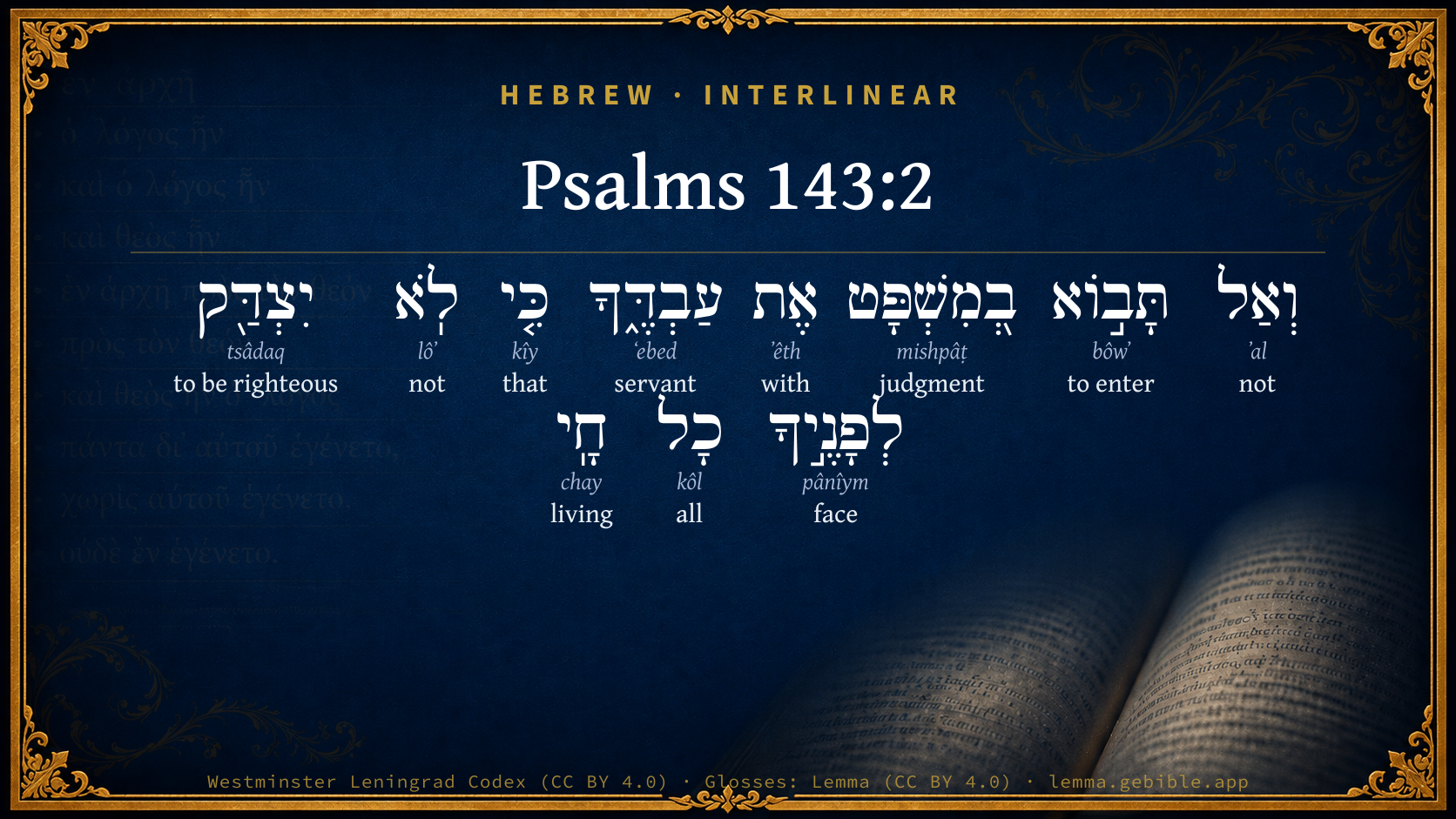
Psalms 143:2

Hebrew (Westminster Leningrad Codex) Psalms 143:2 appears in the Hebrew Old Testament. The text above is from the Westminster Leningrad Codex. Each word links to its Strong’s number, a concise gloss, and parsing drawn from the Open Scriptures Hebrew Bible morphology. Click any word for its full Brown-Driver-Briggs (BDB) entry.
Download image
Cite this verse

Psalms 143:2 (World English Bible). Public Domain. Lemma interlinear Bible study tool, https://lemma.gebible.app/v/psalms/143/2.

Show BibTeX & RIS
BibTeX
RIS
English Translation
Don't enter into judgment with your servant, For in your sight no man living is righteous.
World English Bible · Public Domain
Download a study sheet

One document with this verse’s original text, its word-by-word gloss line, the meaning frame, cross-references with their text, attributed commentary, and full source and license credits — printable, and it pastes into notes with its structure intact.

This verse Autodidact and up

Study sheet (.html) Plain text (.txt)

A passage Seminary Student

Up to 50 verses in one chapter. A passage sheet keeps up to 6 commentary sources and 12 cross-references per verse, in the order this page ranks them, and says so on the sheet whenever that leaves anything out. Ask for a single verse and you get the Autodidact verse sheet above.

Everything on this page stays free to read, with no account — the sheet is a download of what is already on screen, not access to it.

Want to remove ads? Support Godless Engineer
Compare translations 3

The same verse in 3 English versions, stacked beneath the original-language interlinear above. Click any original word for its lexicon entry.

Each is an independent rendering of the whole verse — the interlinear is not word-aligned to these translations.

Highlighted words mark where these versions differ — a whole-verse word diff, not a word-by-word alignment.

  • World English Bible Public Domain
    Don't enter into judgment with your servant, For in your sight no man living is righteous.
  • King James Version Public Domain
    And enter not into judgment with thy servant: for in thy sight shall no man living be justified.
  • unfoldingWord Literal Text CC BY-SA 4.0
    And do not enter into judgment with your servant, for everyone living is not righteous to your face.

unfoldingWord Literal Text — © unfoldingWord, licensed CC BY-SA 4.0. Word-aligned USFM3 via Door43 (git.door43.org/unfoldingWord/en_ult).

Versions to compare (up to 4)

3 of 4 selected

Show all 18 translations

Every available English version of this verse, each an independent rendering of the whole verse.

  • World English Bible Public Domain
    Don't enter into judgment with your servant, For in your sight no man living is righteous.
  • Berean Standard Bible Public Domain
    Do not bring Your servant into judgment, for no one alive is righteous before You.
  • Majority Standard Bible Public Domain
    Do not bring Your servant into judgment, for no one alive is righteous before You.
  • King James Version Public Domain
    And enter not into judgment with thy servant: for in thy sight shall no man living be justified.
  • American Standard Version (1901) Public Domain
    And enter not into judgment with thy servant; For in thy sight no man living is righteous.
  • Revised Version (1885) Public Domain
    And enter not into judgment with thy servant; for in thy sight shall no man living be justified.
  • Geneva Bible (1599) Public Domain
    (And enter not into iudgement with thy seruant: for in thy sight shall none that liueth, be iustified)
  • Douay-Rheims (1899) Public Domain
    I cried to the Lord with my voice: with my voice I made supplication to the Lord.
  • Young's Literal Translation Public Domain
    And enter not into judgment with Thy servant, For no one living is justified before Thee.
  • Literal Standard Version CC BY-SA 4.0
    And do not enter into judgment with Your servant, || For no one living is justified before You.
  • Unlocked Literal Bible CC BY-SA 4.0
    Do not enter into judgment with your servant, for in your sight no one is righteous.
  • unfoldingWord Literal Text CC BY-SA 4.0
    And do not enter into judgment with your servant, for everyone living is not righteous to your face.
  • Darby Bible Public Domain
    And enter not into judgment with thy servant; for in thy sight no man living shall be justified.
  • World Messianic Bible Public Domain
    Don’t enter into judgment with your servant, for in your sight no man living is righteous.
  • Webster's Bible Public Domain
    And enter not into judgment with thy servant: for in thy sight shall no man living be justified.
  • Free Bible Version CC BY-SA 4.0
    Please don't place me, your servant, on trial, because nobody is innocent in your sight.
  • Bible in Basic English Public Domain
    Let not your servant come before you to be judged; for no man living is upright in your eyes.
  • JPS Tanakh (1917) Public Domain
    And enter not into judgment with Thy servant; for in Thy sight shall no man living be justified.

Literal Standard Version (2020), Covenant Press — licensed CC BY-SA 4.0. Text via the HelloAO Bible API (eBible.org). Unlocked Literal Bible (unfoldingWord) — licensed CC BY-SA 4.0. Text via the HelloAO Bible API (eBible.org). unfoldingWord Literal Text — © unfoldingWord, licensed CC BY-SA 4.0. Word-aligned USFM3 via Door43 (git.door43.org/unfoldingWord/en_ult). Free Bible Version, Dr. Jonathan Gallagher — licensed CC BY-SA 4.0. Text via the HelloAO Bible API (eBible.org).

Word by word

More ways to search: Search by grammar → Find every occurrence → Compare this word →

Practice this passage: Drill this verse → Learn its vocabulary →

יִצְדַּ֖ק
tsâdaq
H6663
“to be righteous”
Verb, Qal, Imperfect, 3rd Person, Masculine, Singular
Part of Speech
Verb
Stem
Qal
Form
Imperfect
Person
3rd Person
Gender
Masculine
Number
Singular
Full BDB Definition

Origin: a primitive root

TWOT: 1879

to be just, be righteous - (Qal) - to have a just cause, be in the right - to be justified - to be just (of God) - to be just, be righteous (in conduct and character) - (Niphal) to be put or made right, be justified - (Piel) justify, make to appear righteous, make someone righteous - (Hiphil) - to do or bring justice (in administering law) - to declare righteous, justify - to justify, vindicate the cause of, save - to make righteous, turn to righteousness - (Hithpael) to justify oneself
  1. וְאַל ʼal H408 “and · not” Conjunction + Particle, Negative
  2. תָּב֣וֹא bôwʼ H935 “to enter” Verb, Qal, Jussive, 2nd Person, Masculine, Singular
  3. בְ֭מִשְׁפָּט mishpâṭ H4941 “in/at · judgment” Preposition + Noun, Common, Masculine, Singular, Absolute
  4. אֶת ʼêth H854 “with” Preposition
  5. עַבְדֶּ֑ךָ ʻebed H5650 “servant · your” Noun, Common, Masculine, Singular, Construct + Suffix, Personal, 2nd Person, Masculine, Singular
  6. כִּ֤י kîy H3588 “that” Conjunction
  7. לֹֽא lôʼ H3808 “not” Particle, Negative
  8. לְפָנֶ֣יךָ pânîym H6440 “to/for · face(s) · your” Preposition + Noun, Common, Both, Plural, Construct + Suffix, Personal, 2nd Person, Masculine, Singular
  9. כָל kôl H3605 “all of” Noun, Common, Masculine, Singular, Construct
  10. חָֽי chay H2416 “living” Adjective, Adjective, Masculine, Singular, Absolute

About this verse

These counts appear in no published source. They are computed here, from the morphology-tagged text and Lemma’s own curated glosses. What Lemma adds →

11
words
11
distinct lemmas
Wisdom
section

Shared distinctive vocabulary

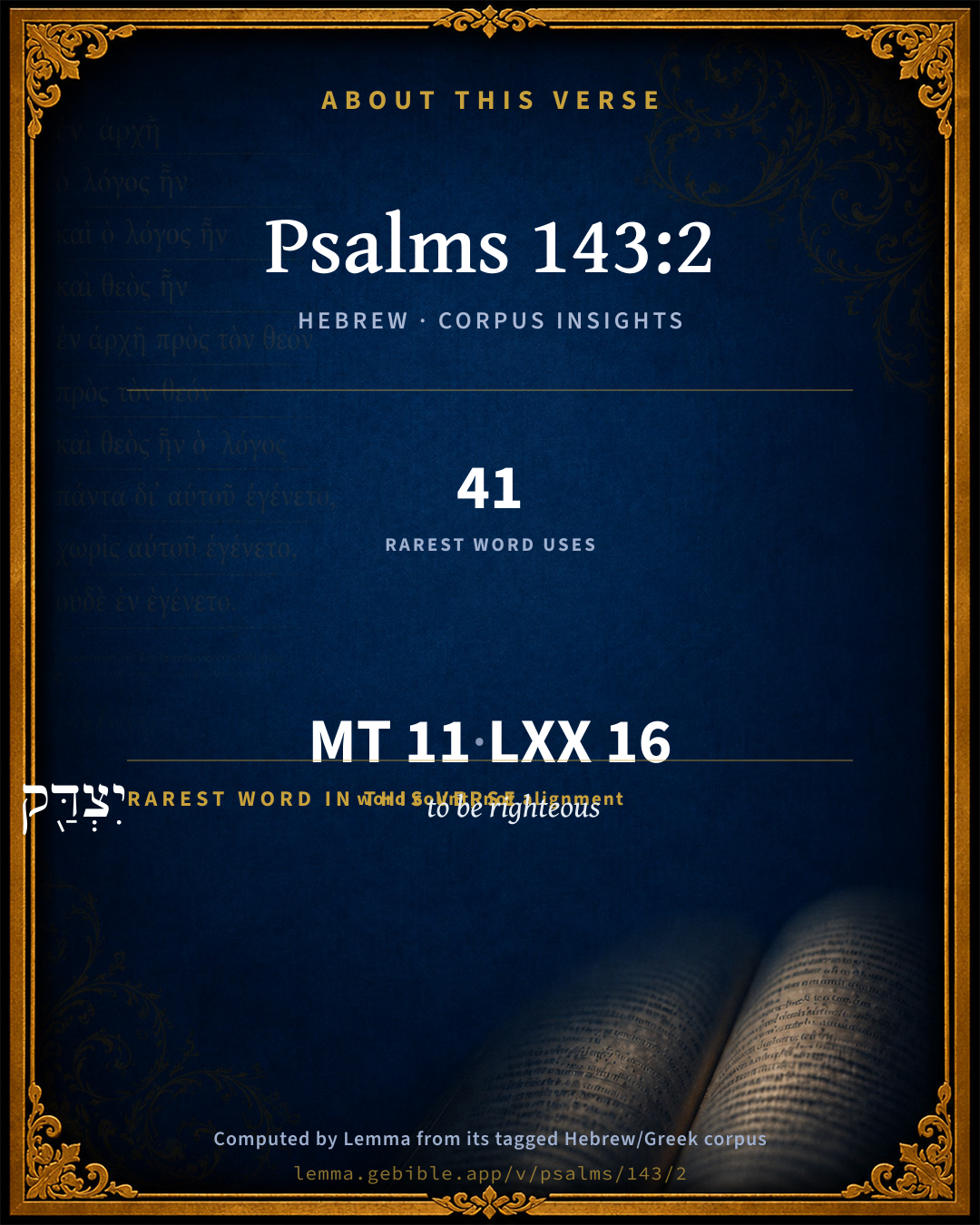
יִצְדַּ֖ק to be righteous H6663 occurs in 40 verses of the Hebrew Bible. Also found in:

Grammatical profile

  • 2 verbs
  • 4 nouns
  • 1 adjective
  • 1 preposition
  • 1 conjunction
  • 2 particles

Verb forms

  • תָּב֣וֹא Qal · Jussive
  • יִצְדַּ֖ק Qal · Imperfect

Hebrew & Septuagint length

In English translation the verse runs 16 words from the Hebrew and 18 from the Septuagint (LXX English) — closely comparable.

A rough comparison of the two English renderings, which tokenize alike — not a word-level alignment.

Word counts can differ between the Hebrew and the Greek without any difference in meaning — e.g. the Hebrew direct-object marker אֵת has no separate Greek word, and Greek often adds the article ὁ.

In the original languages it is 11 Hebrew tokens and 16 Greek tokens — but the two are counted differently (Hebrew bundles its prefixes and suffixes into one token; the Greek is in lemma form), so that isn’t a like-for-like length.

Cross-references

12

Topical passages linked to Psalms 143:2 in the Treasury of Scripture Knowledge — connected by theme and wording, ordered by reader-vote popularity; previews shown in the World English Bible.

  • Ecclesiastes 7:20 Surely there is not a righteous man on earth, who does good and doesn't sin.
  • Job 25:4 How then can man be just with God? Or how can he who is born of a woman be clean?
  • Romans 3:20 Because by the works of the law, no flesh will be justified in his sight. For through the law comes the knowledge of sin.
  • Psalms 130:3 If you, Yah, kept a record of sins, Lord, who could stand?
  • 1 John 1:10 If we say that we haven't sinned, we make him a liar, and his word is not in us.
  • Job 14:3 Do you open your eyes on such a one, And bring me into judgment with you?
  • Job 15:14 What is man, that he should be clean? He who is born of a woman, that he should be righteous?
  • Galatians 2:16 yet knowing that a man is not justified by the works of the law but through the faith of Jesus Christ, even we believed in Christ Jesus, that we might be justified by faith in Christ, and not by the works of the law, because no flesh will be justified by the works of the law.
  • Exodus 34:7 keeping loving kindness for thousands, forgiving iniquity and disobedience and sin; and that will by no means clear the guilty, visiting the iniquity of the fathers on the children, and on the children's children, on the third and on the fourth generation."
  • 1 Kings 8:46 If they sin against you (for there is no man who doesn't sin), and you are angry with them, and deliver them to the enemy, so that they carry them away captive to the land of the enemy, far off or near;
  • Job 4:17 'Shall mortal man be more just than God? Shall a man be more pure than his Maker?
  • Job 9:2–3 "Truly I know that it is so, But how can man be just with God?

Cross-references courtesy of OpenBible.info (CC BY 4.0).

Hebrew and Greek witnesses Masoretic Hebrew ↔ Greek Septuagint

The same verse in the two great witnesses to the Old Testament, shown verse-for-verse.

You’re reading Greek Psalm 142 (Hebrew Psalm 143). The Septuagint counts the superscription, so verse numbers can differ from the Hebrew — chapter-level alignment, not verse-by-verse. Numbering follows Rahlfs.

These are two independent witnesses, not word-aligned to each other, and the Septuagint is shown in lemma (dictionary) form.

Hebrew Psalms 143:2 Masoretic · Westminster Leningrad Codex

וְאַל תָּב֣וֹא בְ֭מִשְׁפָּט אֶת עַבְדֶּ֑ךָ כִּ֤י לֹֽא יִצְדַּ֖ק לְפָנֶ֣יךָ כָל חָֽי

Don't enter into judgment with your servant, For in your sight no man living is righteous.

World English Bible · Public Domain

Greek LXX Greek Psalm 142:2 Septuagint · lemma form

καί μή εἰςἔρχομαι εἰς κρίσις μετά ὁ δοῦλος σύ ὅτι οὐ δικαιόω ἐνώπιον σύ πᾶς ζάω

And enter not into judgment with your servant, for in your sight shall no man living be justified.

LXX2012 (modern English Septuagint) · Public Domain

On this verse, Ellicott's Commentary for English Readers discusses the Septuagint’s reading. Read the note in Commentary ↓

Hebrew: Westminster Leningrad Codex (CC BY 4.0). Greek: Septuagint (public domain); English from LXX2012 (modern English Septuagint) (Public Domain). How the Septuagint differs from the Hebrew →

Commentary

Notes on Psalms 143:2 from classic Christian and Jewish commentators (each source and its license shown beneath its notes). The classic Christian expositions comment on the surrounding passage and are grouped to its opening verse, so a note may address several verses; the Jewish commentaries on the Tanakh (Rashi and others) are per-verse, so they appear only where the commentator wrote on this verse.

Lemma curates 59 commentaries, every one of them public domain or Creative Commons licensed, each selected and text-cleaned for this edition rather than reprinted as found. About our sources →

Trapp's Complete Commentary

John Trapp

Psa 143:2 And enter not into judgment with thy servant: for in thy sight shall no man living be justified.

Ver. 2. And enter not into judgment with thy servant] This is insignis sententia, siqua usquam in sacris literis extat (saith Beza), an excellent sentence as any is in all the Bible, saying the same that St Paul doth, Rom 3:24, that justification is by faith alone, and not by works. David would not be dealt with in strictness of justice. Lord, go not to law with me, so some render it; go not into the judgment hall, so the Chaldee. All St Paul’s care was, that when he was sought for by God’s justice, he might be found in Christ, not having his own righteoushess which is of the law, &c., Php 3:9. The best lamb should be slaughtered, except the ram had been sacrificed, that Isaac might be saved. Woe to the life of man, saith an ancient, though never so commendable, if it should have judgment without mercy; if there be not an επιεικεια to moderate that ακριβοδικαιον, the severity of utmost right. We read of a certain Dutch divine, who being about to die, was full of fears and doubts. And when some said to him, You have been so active and faithful, why should you fear? Oh, said he, the judgment of man and the judgment of God are different. Sordet in conspectu Iudicis, &c.

John Trapp, A Commentary or Exposition upon All the Books of the Old and New Testament (1647–1656) — public domain. Text from a community e-Sword module.

J. A. Alexander on Psalms

Joseph Addison Alexander

2. (Psa 143:2) And enter not into judgment with thy servant, for just before thee is no one living. To enter into judgment is a forensic phrase meaning to go to law, to prosecute, to sue. See Job 9:32; Job 22:4. The verb in the last clause is not a passive meaning to be justified, but a neuter meaning to be just or innocent, to be in the right or on the right side of the controverted question. The acknowledgment in this verse has caused the psalm to be reckoned among the penitential psalms. The verse is often imitated or referred to elsewhere. See Job 9:2; Job 14:3; Job 15:14, Rom 3:20, etc.

Joseph Addison Alexander, The Psalms Translated and Explained (1850) — public domain. Text from a community e-Sword module.

Tyndale Open Study Notes

Tyndale Open Resources

143:2 All people are guilty before God (Rom 3:20-24).

Tyndale Open Study Notes — © Tyndale Open Resources, licensed CC BY-SA 4.0. Text via the HelloAO Bible API.

Geneva Bible (1599)

Geneva Bible translators

He know that his afflictions were God’s messengers to call him to repentance for his sins, though toward his enemies he was innocent, and that in God’s sight all men are sinners.

Geneva Bible (1599) marginal notes — public domain. Text via Bolls.life.

Adam Clarke's Commentary

Verse 2. Enter not into judgment] אל תבוא al tabo. Do not come into court, either as a Witness against me, or as a Judge, else I am ruined; for thou hast seen all my ways that they are evil, and thy justice requires thee to punish me. Nor can any soul that has ever lived be justified in the sight of thy justice and righteousness. Had I my desert from thee, I should have worse than even my unnatural son intends me. O what a relief is Jesus crucified to a soul in such circumstances!

Adam Clarke's Commentary on the Bible (1810–1826) — public domain. Text from a community e-Sword/MySword module.

John Calvin's Commentaries

2. And enter not into judgment, Walford thinks there is probably here a reference to the great transgression, the consequences of which followed David all his days. “As he would not fail to be reminded of it,” says that writer, “by the sorrows which had now come upon him, from Absalom’s misconduct, and as his purpose was, notwithstanding, to implore divine support and deliverance, he deprecates God’s righteous judgment, since if no man could be just with God, certainly he, who had so greatly transgressed, could have no claim to such a state. The consciousness of his guilt, though he had reason to believe it was forgiven, induced him thus to abase himself before God, when he was about to offer earnest entreaties for deliverance from dangers which threatened his dignity and life; while he still maintained his hope, that God looked upon him as his servant, whom he had pledged himself to protect.”

John Calvin's Commentaries (1540-1563) — public domain. Text from the Calvin Translation Society English edition (1840s-50s) via the Christian Classics Ethereal Library (ccel.org). Calvin's coverage is partial (roughly two-thirds of the Bible); uncommented books and verses are honest gaps, never fabricated. The 19th-century editor's footnotes and remarks are omitted so the notes are faithfully Calvin's own voice.

Ellicott's Commentary for English Readers

(2) And enter not.—The Divine justice has just been invoked, and now the appellant suddenly seems to deprecate it. These verses really sum up the apparent paradox of the Book of Job, as also the expressions recall that Book. (See Job_4:17; Job_9:2; Job_9:32; Job_14:3, seq., Job_15:14; Job_22:4, &c) In one breath Job frequently pours forth pathetic protestations of his innocence, and dread lest God should take him at his word and arraign him for trial. Man, in his desire to have his character vindicated before man, appeals to the just Judge, but instantly falls back with a guilty sense that before that tribunal none can stand:

“For merit lives from man to man,

And not from man, O Lord, to Thee.

Shall . . . be justified.—This follows the LXX. Better, is just.

A Bible Commentary for English Readers, edited by Charles John Ellicott (1878–1897) — public domain. Text from a community e-Sword module.

The Cambridge Bible for Schools and Colleges

gen. ed. J. J. S. Perowne

2. enter not into judgment with thy servant] Do not put me on my trial and pass sentence on me according to my deserts. For the phrase cp. Job_9:32; Job_14:3; Isa_3:14.

Thy servant is not a mere formal expression of humility: it denotes ‘one who is devoted to Thy service,’ and this relation is the ground of his plea. Cp. Psa_143:12.

be justified] Rather, be righteous. Cp. Psa_130:3, and many passages in Job, where the truth of man’s unholiness in the sight of God is emphasised, e.g. Job_4:17; Job_9:2; Job_15:14; Job_25:4. St Paul quotes this passage freely in Rom_3:20, Gal_2:16, substituting πᾶσα σὰρξ, ‘all flesh,’ for πᾶς ζῶν.

The Cambridge Bible for Schools and Colleges (gen. ed. J. J. S. Perowne; Cambridge University Press, 1878–1918) — public domain. Text from a community e-Sword module.

John Gill's Exposition

And enter not into judgment with thy servant,.... The house of judgment, as the Targum, or court of judicature; God is a Judge, and there is and will be a judgment, universal, righteous, and eternal; and there is a day fixed for it, and a judgment seat before which all must stand, and a law according to which all must be judged; but the psalmist knew he was but a man, and could not contend with God; and a sinful creature, and could not answer him for one of a thousand faults committed by him; and though his servant, yet an unprofitable one; his nature, his heart, his thoughts, words, and actions, would not bear examining, nor stand the test of the holy law of God; nor was he able to answer the demands of divine justice in his own person; and therefore pleads for pardon and acceptance through Christ and his righteousness, and entreats that God would not proceed against him in a judicial way, now nor hereafter;

for in thy sight shall no man living be justified; in a legal sense, so as to be acquitted in open court, and not condemned; that is, by the deeds of the law, as the apostle explains it, Rom 3:20; by obedience to it, by a man's own works of righteousness; because these are imperfect, are opposed to the grace of God, and would disannul the death of Christ, and encourage boasting; and much less in the sight of God; for, however men may be justified hereby in their own sight, and before men, in their esteem and account, yet not before God, the omniscient God; who sees not as man sees, and judges not according to the outward appearance, and is perfectly holy and strictly just; and none but the righteousness of Christ can make men righteous, or justify them before him; and this can and does, and presents men unblamable and irreprovable in his sight.

John Gill's Exposition of the Whole Bible (1746–1763) — public domain (CC PDM 1.0). Text via the HelloAO Bible API.

Albert Barnes' Notes on the Bible

And enter not into judgment with thy servant - Do not deal with me on the ground of justice as toward “thee;” do not mark my own offences against thee, when I plead that justice may be done as between me and my fellow-men. While I plead that thou wouldst judge righteously between me and them, I am conscious that I could not claim thy needed interposition on the ground of any righteousness toward thee. There I must confess that I am a sinner; there I can rely only on mercy; there I could not hope to be justified.

For in thy sight - As before thee; in thy presence; by thee.

Shall no man living - No one of the race, no matter what his rank, his outward conduct, his gentleness, his amiableness, his kindness; no matter how just and upright he may be toward his fellow-men.

Be justified - Be regarded as righteous; be acquitted from blame; be held to be innocent. The meaning is, “I do not come before thee and plead for thy favor on the ground of any claim on thee, for I am conscious that I am a sinner, and that my only hope is in thy mercy.” See the notes at Rom 3:20. Compare Job 4:17; Job 9:2, Job 9:20; Job 15:14-16; Job 25:4-6. This is a great and momentous truth in regard to man; it is the foundation of the necessity for a plan of salvation through an atonement - for some way in which man “may” properly be regarded and treated as righteous. Assuredly every man, conscious of what he is in himself, may and should fervently pray that God “would” not enter into judgment with him; that he would not mark his offences; that he would not judge him as strict justice would demand. Our hope is in the “mercy,” not in the “justice” of God.

Albert Barnes' Notes on the Bible (1834–1885) — public domain. Text from a community e-Sword/MySword module.

Matthew Poole's English Annotations

But when I appeal to thy righteousness, I do it only with respect to mine enemies, whose cause as well as their persons is worse than mine, but not in reference to thee, as if I could absolutely justify myself upon a severe trial at the tribunal of thy justice; for if thou shouldst rigorously examine all the passages of my heart and life, I dread the thoughts and consequences of it.

Be justified, to wit, upon terms of strict justice, without thy indulgence and infinite mercy.

Matthew Poole's English Annotations on the Holy Bible (1683–1685) — public domain. Text from a community e-Sword/MySword module.

The Treasury of David

Charles H. Spurgeon

Ver. 2. And enter not into judgment with thy servant. He had entreated for audience at the mercy seat, but he has no wish to appear before the judgment seat. Though clear before men, he could not claim innocence before God. Even though he knew himself to be the Lord's servant, yet he did not claim perfection, or plead merit; for even as a servant he was unprofitable. If such be the humble cry of a servant, what ought to be the pleading of a sinner? For in thy sight shall no man living be justified. None can stand before God upon the footing of the law. God's sight is piercing and discriminating; the slightest flaw is seen and judged; and therefore pretence and profession cannot avail where that glance reads all the secrets of the soul. In this verse David told out the doctrine of universal condemnation by the law long before Paul had taken his pen to write the same truth. To this day it stands true even to the same extent as in David's day: no man living even at this moment may dare to present himself for trial before the throne of the Great King on the footing of the law. This foolish age has produced specimens of n pride so rank that men have dared to claim perfection in the flesh; but these vain glorious boasters are no exception to the rule here laid down: they are but men, and poor specimens of men. When their lives are examined they are frequently found to be more faulty than the humble penitents before whom they vaunt their superiority.

Ver. 2. Enter not into judgment with thy servant. The Divine justice has just been invoked in the first verse; and now the appellant suddenly seems to deprecate it. These verses really sum up the apparent paradox of the Book of Job (see Job 4:17 9:2, 32 14:3 Job 15:14 22:4, etc.). In one breath Job frequently pours forth pathetic protestations of his innocence, and a dread lest God should take him at his word, and arraign him for trial. The godly man, in his desire to have his character vindicated before man, appeals to the just Judge, but instantly falls back with a guilty sense that before his tribunal none can stand:

"For merit lives from man to man,

And not from man, O Lord, to thee." A. S. Aglen.

Ver. 2. He doth not pray absolutely that God "would not enter into judgment with him", for this were to forego his government of the world; but that he would not do so on account of his own duties and obedience. But if so be these duties and obedience did answer, in any sense or way, what is required of us as a righteousness unto justification, there was no reason why he should deprecate a trial by them, or upon them. John Owen.

Ver. 2. He doth not say, "with an enemy, a rebel, a traitor, an impenitent sinner"; but "with thy servant", one that is devoted to thy fear, one that is consecrated to thy service, one that is really and indeed "wholly thine, as much and as fully as he can be." As if he had said, "Lord, if the holiest, purest, best of men should come and stand before thee in judgment, or plead with thee, they must needs be cast in their cause. `If thou, Lord, shouldest mark iniquities, ' alas! `O Lord, who shall stand?'"Ps 130:3. Thomas Lye (1621-1684), in "The Morning Exercises."

Ver. 2. Enter not into judgment with thy servant, for thou hast already entered into judgment with thy Son, and laid upon him the iniquity of us all. "Enter not into judgment with thy servant", for thy servant enters into judgment with himself; and "if we will judge ourselves we shall not be judged." Matthew Henry.

Ver. 2. Not the proudest philosopher among the Gentiles, nor the most precise Pharisee among the Jews; we may go yet further and say, not the holiest saint that ever lived, can stand righteous before that bar. God hath nailed that door up, that none can for ever enter by a law righteousness into life and happiness. This way to heaven is like the northern passage to the Indies, whoever attempts it is sure to be frozen up before he gets half way thither. William Gurnall.

Ver. 2. Enter not into judgment, etc. Some years ago I visited a poor young woman dying with consumption. She was a stranger in our town, and had been there a few weeks before, some time in her girlhood, and had attended my Sabbath school class. What did I find was her only stay, and hope, and comfort in the view of the dark valley of the shadow of death, which was drawing down upon her? One verse of a psalm she had learned at the class, and never forgot. She repeated it with clasped hands, piercing eyes, and thin voice trembling from her white lips.

"Thy servant also bring thou not

In judgment to be tried:

Because no living man can be

In thy sight justify'd."

No sinner can endure sight of thee, O God, if he tries to be self justified. James Comper Gray, in "The Biblical Museum", 1879.

Ver. 2. Enter not into judgment with thy servant. We read of a certain Dutch divine, who being to die, was full of fears and doubts. And when some said to him, "You have been so active and faithful, why should you fear?" Oh, said he, the judgment of man and the judgment of God are different. John Trapp.

Ver. 2. Enter not into judgment. A metaphor taken from the course pursued by those who seek to recover the very utmost to which they are entitled by strict legal process. Compare Job 22:4-5. In a similar sense we are commanded to pray to God that he will forgive us our debts. Daniel Cresswell.

Ver. 2. There is probably here a tacit reference to the great transgression, the consequences of which followed David all his days. William Walford.

Ver. 2. Thy servant. A servant is one who obeys the will of another...There were these four ways in which one might come to be a servantby birth, by purchase, by conquest, and by voluntary engagement. Some were servants in one of the ways, and some in another. There were servants who were born in the master's house, servants who were bought with the master's money, servants who were the captives of his sword and bow, and servants who had freely engaged themselves to do his work...In the case of the believer there is something that is peculiar and remarkable. He is God's servant by birth. But he is morehe is God's servant by purchase. And that is not all: he is God's servant by conquest. Yes, and by voluntary engagement too. He is the servant of God, not in some one of the four ways, but in all of them together. Andrew Gray (1805-1861), in "Gospel Contrasts and Parallels."

Ver. 2. Not only the worst of my sins, but the best of my duties speak me a child of Adam. William Beveridge.

Ver. 2. So far from being able to answer for my sins, I cannot answer even for my righteousness. Bernard of Clairvaux, 1091-1153.

Ver. 2. A young man once said to me: "I do not think I am a sinner." I asked him if he would be willing his mother or sister should know all he had done, or said, or thought, all his motions and all his desires. After a moment he said: "No, indeed, I should not like to have them know; no, not for the world." "Then can you dare to say, in the presence of a holy God, who knows every thought of your heart, `I do not commit sin'?" John B. Gough, in "Sunlight and Shadow", 1881.

Ver. 2.

1. Who he is. "Thy servant."

2. What he knows. "In thy sight shall no man living be justified."

3. What he asks. "Enter not into judgment."

Psalms 143:3*

Charles H. Spurgeon's The Treasury of David (1869–1885) — public domain. Psalms only. Text from a community e-Sword/MySword module.

Whedon's Commentary on the Bible

Daniel D. Whedon

2. Enter not into judgment—A bitter element in David’s trouble with Absalom, which does not appear in his matters with Saul, is his own guilt. David had so sinned, and in such various ways, that pardon must be his first relief. This gives the psalm a peculiarly human quality, for most of our troubles, certainly our worst ones, are woven in with misdeeds: and who is free from misdeeds?

Daniel D. Whedon (gen. ed.), Commentary on the Old and New Testaments (1874–1909) — public domain. Text from a community e-Sword module.

The Pulpit Commentary

And enter not into judgment with thy servant. The psalmist, having touched the point of abstract justice, shrinks from pressing it. He knows that he is not "righteous before God," and that his life and conduct "cannot endure the severity of God"s judgment" (Art. XII). He therefore "deprecates a strictly retributive treatment" (Cheyne). For in thy sight shall no man living be justified. (comp. Psa_130:3; and see also Job_4:17-19 Job_9:2 Job_15:14 Job_25:4)

Prayer cannot be based on man"s rights.

The prayer of a being who had kept his rights can be. We are able to conceive that the prayers of the Lord Jesus Christ were acceptable to God when presented on the ground of his own right to be heard. He never prayed in any other name than his own.

I MAN HAS, IN A SENSE, LOST HIS RIGHTS. It is necessary to deal with this point carefully. Things are virtually lost when they are undervalued, put aside, and unused. They remain, but are as treasures left in the lumber-room, while the house is filled with other interests. Man has rights in God, rights of prayer, by virtue of his very being and primary relations with God. And these he can never absolutely lose. They are part of him part of his necessary being. But he may undervalue them, and put them out of consideration, so that they may be virtually lost. He has, therefore, as a practical fact, no rights to plead in prayer. He cannot plead his creation; for he has come to neglect or defy his Creator. He cannot plead his sonship; for he is not offering the obedience of a son. He cannot plead the Divine promises; for he is not meeting the conditions on which the promises depend.

II MAN HAS, IN FACT, PUT HIS WRONGS IN PLACE OF HIS RIGHTS. And man"s wrong is his willfulness. The dependent being has tried to force himself into independence. The son has become a self-willed prodigal. And now, if man wants to pray, he cannot do it without carrying his wrong into the presence of God; and, whether he knows it or not, that wrong is the pica which alone God can hear. The thoughtful man feels this; it is the fact for every man. "If I regard iniquity in my heart, the Lord will not hear me." God would hear a man"s prayers if the man had his rights. He cannot hear when a man only brings his wrongs.

III MAN MUST, IN ORDER TO PRAY ACCEPTABLY, HAVE HIS RIGHTS RESTORED TO HIM. That is, restored to active power and use. It is an important and suggestive aspect of the redemptive work of Christ, that it is the mastery of man"s self-willed wrong, and the recovery, into active power, of man"s natural rights. Christ is making men what God meant them to be, and what he is; and such men may base prayer on their rights. R.T.

The Pulpit Commentary (1880–1919), ed. H.D.M. Spence-Jones & Joseph S. Exell — public domain. Text from a community e-Sword module.

John Wesley's Explanatory Notes

Justified - Upon terms of strict justice.

John Wesley, Explanatory Notes Upon the Whole Bible (1754–1765) — public domain. Text via the GEBible commentary corpus.

Lesson kit

Teaching starters — assembled from the data on this page, not authored interpretation. Every prompt links to the verse data it draws on. Edit before teaching.

Psalms, in the Wisdom, opens this verse with 11 words (11 distinct Hebrew lemmas). Its most distinctive word is tsâdaq (“to be righteous”). A historical commentator’s framing appears above. Read the whole chapter for the surrounding context.

Discussion questions

  1. The word tsâdaq carries the sense “to be righteous.” How does it shape the verse?
  2. Genesis 38:26 shares the word «to be righteous» with this verse. How do the two illuminate each other?
  3. These translations render this verse differently; the difference is in the English rendering, not the original. What questions does that raise?
  4. The verb «תָּב֣וֹא» is Qal Jussive. How does its form color the action?
  5. Reading how Trapp's Complete Commentary and J. A. Alexander on Psalms read this verse, where do the two commentators agree and where do they part?

Things to notice

Reading settings

Reading text

Shown beneath each verse's original-language words.

Old Testament
Old Testament edition

Read the OT as the Masoretic Hebrew (MT) or the Greek Septuagint (LXX).

English shown for the Greek Septuagint (in the Hebrew ↔ Greek comparison).

Comparing translations? Open the Compare panel on any verse page to stack up to four side by side.