
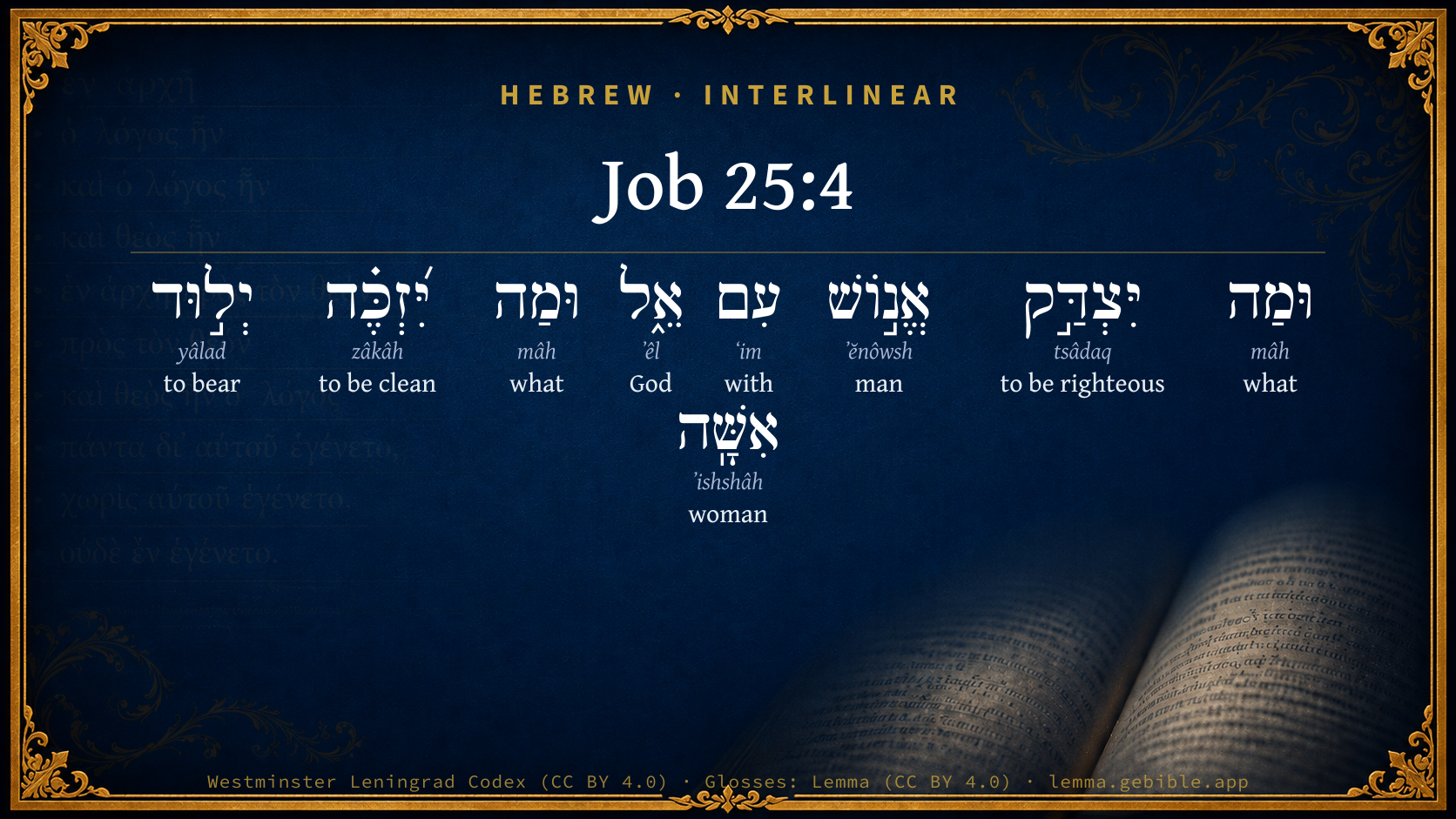
Job 25:4

Hebrew (Westminster Leningrad Codex) Job 25:4 appears in the Hebrew Old Testament. The text above is from the Westminster Leningrad Codex. Each word links to its Strong’s number, a concise gloss, and parsing drawn from the Open Scriptures Hebrew Bible morphology. Click any word for its full Brown-Driver-Briggs (BDB) entry.
Download image
Cite this verse

Job 25:4 (World English Bible). Public Domain. Lemma interlinear Bible study tool, https://lemma.gebible.app/v/job/25/4.

Show BibTeX & RIS
BibTeX
RIS
English Translation
How then can man be just with God? Or how can he who is born of a woman be clean?
World English Bible · Public Domain
Download a study sheet

One document with this verse’s original text, its word-by-word gloss line, the meaning frame, cross-references with their text, attributed commentary, and full source and license credits — printable, and it pastes into notes with its structure intact.

This verse Autodidact and up

Study sheet (.html) Plain text (.txt)

A passage Seminary Student

Up to 50 verses in one chapter. A passage sheet keeps up to 6 commentary sources and 12 cross-references per verse, in the order this page ranks them, and says so on the sheet whenever that leaves anything out. Ask for a single verse and you get the Autodidact verse sheet above.

Everything on this page stays free to read, with no account — the sheet is a download of what is already on screen, not access to it.

Want to remove ads? Support Godless Engineer
Compare translations 3

The same verse in 3 English versions, stacked beneath the original-language interlinear above. Click any original word for its lexicon entry.

Each is an independent rendering of the whole verse — the interlinear is not word-aligned to these translations.

Highlighted words mark where these versions differ — a whole-verse word diff, not a word-by-word alignment.

  • World English Bible Public Domain
    How then can man be just with God? Or how can he who is born of a woman be clean?
  • King James Version Public Domain
    How then can man be justified with God? or how can he be clean that is born of a woman?
  • unfoldingWord Literal Text CC BY-SA 4.0
    So how will a man be righteous with God? Or how will one born of a woman be pure?

unfoldingWord Literal Text — © unfoldingWord, licensed CC BY-SA 4.0. Word-aligned USFM3 via Door43 (git.door43.org/unfoldingWord/en_ult).

Versions to compare (up to 4)

3 of 4 selected

Show all 18 translations

Every available English version of this verse, each an independent rendering of the whole verse.

  • World English Bible Public Domain
    How then can man be just with God? Or how can he who is born of a woman be clean?
  • Berean Standard Bible Public Domain
    How then can a man be just before God? How can one born of woman be pure?
  • Majority Standard Bible Public Domain
    How then can a man be just before God? How can one born of woman be pure?
  • King James Version Public Domain
    How then can man be justified with God? or how can he be clean that is born of a woman?
  • American Standard Version (1901) Public Domain
    How then can man be just with God? Or how can he be clean that is born of a woman?
  • Revised Version (1885) Public Domain
    How then can man be just with God? or how can he be clean that is born of a woman?
  • Geneva Bible (1599) Public Domain
    And howe may a man be iustified with God? or how can he be cleane, that is borne of woman?
  • Douay-Rheims (1899) Public Domain
    Can man be justified compared with God, or he that is born of a woman appear clean?
  • Young's Literal Translation Public Domain
    And what? is man righteous with God? And what? is he pure -- born of a woman?
  • Literal Standard Version CC BY-SA 4.0
    And what? Is man righteous with God? And what? Is he pure—born of a woman?
  • Unlocked Literal Bible CC BY-SA 4.0
    How then can man be righteous with God? How can he who is born of a woman be clean, acceptable to him?
  • unfoldingWord Literal Text CC BY-SA 4.0
    So how will a man be righteous with God? Or how will one born of a woman be pure?
  • Darby Bible Public Domain
    And how should man be just with ùGod? Or how should he be clean that is born of a woman?
  • World Messianic Bible Public Domain
    How then can man be just with God? Or how can he who is born of a woman be clean?
  • Webster's Bible Public Domain
    How then can man be justified with God? or how can he be clean that is born of a woman?
  • Free Bible Version CC BY-SA 4.0
    How can a human being be right before God? Can anyone born of woman be pure?
  • Bible in Basic English Public Domain
    How then is it possible for man to be upright before God? or how may he be clean who is a son of woman?
  • JPS Tanakh (1917) Public Domain
    How then can man be just with God? Or how can he be clean that is born of a woman?

Literal Standard Version (2020), Covenant Press — licensed CC BY-SA 4.0. Text via the HelloAO Bible API (eBible.org). Unlocked Literal Bible (unfoldingWord) — licensed CC BY-SA 4.0. Text via the HelloAO Bible API (eBible.org). unfoldingWord Literal Text — © unfoldingWord, licensed CC BY-SA 4.0. Word-aligned USFM3 via Door43 (git.door43.org/unfoldingWord/en_ult). Free Bible Version, Dr. Jonathan Gallagher — licensed CC BY-SA 4.0. Text via the HelloAO Bible API (eBible.org).

Word by word

More ways to search: Search by grammar → Find every occurrence → Compare this word →

Practice this passage: Drill this verse → Learn its vocabulary →

About this verse

These counts appear in no published source. They are computed here, from the morphology-tagged text and Lemma’s own curated glosses. What Lemma adds →

9
words
8
distinct lemmas
Wisdom
section

Notable vocabulary

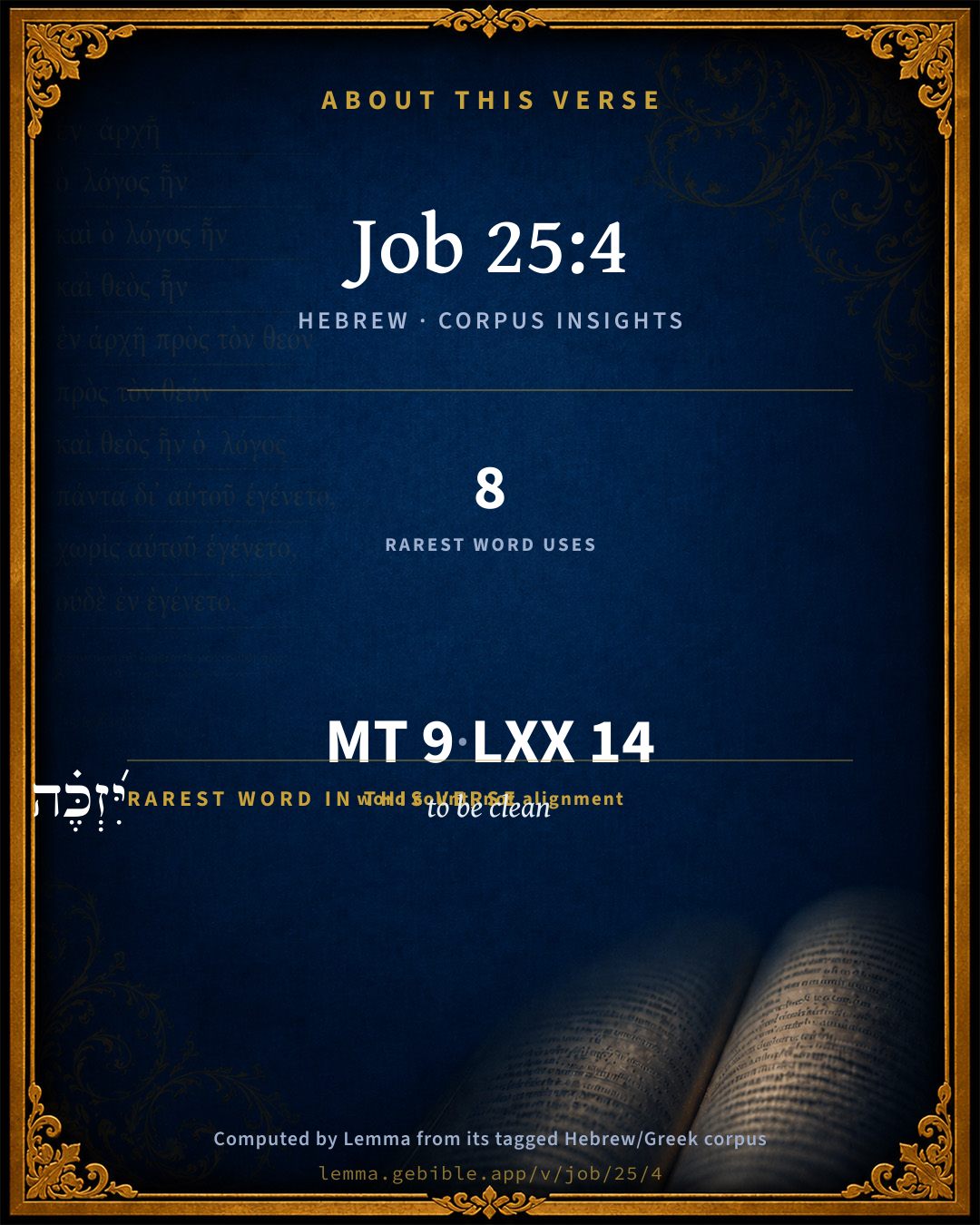
The rarest word here is יִּ֝זְכֶּ֗ה to be clean H2135 — appearing just 8 times in the whole Hebrew Bible.

Shared distinctive vocabulary

יִּ֝זְכֶּ֗ה to be clean H2135 occurs in 8 verses of the Hebrew Bible. Also found in:

Grammatical profile

  • 3 verbs
  • 3 nouns
  • 1 preposition
  • 2 particles

Verb forms

  • יִּצְדַּ֣ק Qal · Imperfect
  • יִּ֝זְכֶּ֗ה Qal · Imperfect
  • יְל֣וּד Qal · Participle Passive

Repetition

A word recurs within this verse — often emphatic in Hebrew:

  • וּמַה what H4100 ×2

Hebrew & Septuagint length

In English translation the verse runs 20 words from the Hebrew and 21 from the Septuagint (LXX English) — closely comparable.

A rough comparison of the two English renderings, which tokenize alike — not a word-level alignment.

Word counts can differ between the Hebrew and the Greek without any difference in meaning — e.g. the Hebrew direct-object marker אֵת has no separate Greek word, and Greek often adds the article ὁ.

In the original languages it is 9 Hebrew tokens and 14 Greek tokens — but the two are counted differently (Hebrew bundles its prefixes and suffixes into one token; the Greek is in lemma form), so that isn’t a like-for-like length.

Cross-references

14

Topical passages linked to Job 25:4 in the Treasury of Scripture Knowledge — connected by theme and wording, ordered by reader-vote popularity; previews shown in the World English Bible.

  • Romans 5:1 Being therefore justified by faith, we have peace with God through our Lord Jesus Christ;
  • Psalms 130:3 If you, Yah, kept a record of sins, Lord, who could stand?
  • Job 4:17–19 'Shall mortal man be more just than God? Shall a man be more pure than his Maker?
  • Job 9:2 "Truly I know that it is so, But how can man be just with God?
  • Job 15:14–16 What is man, that he should be clean? He who is born of a woman, that he should be righteous?
  • Psalms 143:2 Don't enter into judgment with your servant, For in your sight no man living is righteous.
  • Psalms 51:5 Behold, I was brought forth in iniquity. In sin my mother conceived me.
  • Revelation 1:5 and from Jesus Christ, the faithful witness, the firstborn of the dead, and the ruler of the kings of the earth. To him who loves us, and washed us from our sins by his blood;
  • Job 14:3–4 Do you open your eyes on such a one, And bring me into judgment with you?
  • Zechariah 13:1 "In that day there will be a spring opened to the house of David and to the inhabitants of Jerusalem, for sin and for uncleanness.
  • 1 John 1:9 If we confess our sins, he is faithful and righteous to forgive us the sins, and to cleanse us from all unrighteousness.
  • Romans 3:19–20 Now we know that whatever things the law says, it speaks to those who are under the law, that every mouth may be closed, and all the world may be brought under the judgment of God.
  • 1 Corinthians 6:11 Such were some of you, but you were washed. But you were sanctified. But you were justified in the name of the Lord Jesus, and in the Spirit of our God.
  • Ephesians 2:3 among whom we also all once lived in the lust of our flesh, doing the desires of the flesh and of the mind, and were by nature children of wrath, even as the rest.

Cross-references courtesy of OpenBible.info (CC BY 4.0).

Hebrew and Greek witnesses Masoretic Hebrew ↔ Greek Septuagint

The same verse in the two great witnesses to the Old Testament, shown verse-for-verse.

These are two independent witnesses, not word-aligned to each other, and the Septuagint is shown in lemma (dictionary) form.

Hebrew Job 25:4 Masoretic · Westminster Leningrad Codex

וּמַה יִּצְדַּ֣ק אֱנ֣וֹשׁ עִם אֵ֑ל וּמַה יִּ֝זְכֶּ֗ה יְל֣וּד אִשָּֽׁה

How then can man be just with God? Or how can he who is born of a woman be clean?

World English Bible · Public Domain

Greek LXX Job 25:4 Septuagint · lemma form

πῶς γάρ εἰμί δίκαιος βροτός ἔναντι κύριος ἤ τίς ἄν ἀποκαθαρίζω ἑαυτοῦ γεννητός γυνή

For how shall a mortal be just before the Lord? or who that is born of a woman shall purify himself?

LXX2012 (modern English Septuagint) · Public Domain

Hebrew: Westminster Leningrad Codex (CC BY 4.0). Greek: Septuagint (public domain); English from LXX2012 (modern English Septuagint) (Public Domain). How the Septuagint differs from the Hebrew →

Commentary

Notes on Job 25:4 from classic Christian and Jewish commentators (each source and its license shown beneath its notes). The classic Christian expositions comment on the surrounding passage and are grouped to its opening verse, so a note may address several verses; the Jewish commentaries on the Tanakh (Rashi and others) are per-verse, so they appear only where the commentator wrote on this verse.

Lemma curates 59 commentaries, every one of them public domain or Creative Commons licensed, each selected and text-cleaned for this edition rather than reprinted as found. About our sources →

Trapp's Complete Commentary

John Trapp

Job 25:4 How then can man be justified with God? or how can he be clean [that is] born of a woman?

Ver. 4. How then can man be justified with God?] Homo frivolus, so the Tygurines translate. How can frivolous man, sorry man, morbis mortique obnoxius, man subject to diseases and death; how can such a man, so mortal and miserable, a mass of mortalities, a map of miseries, a very mixture and compound of dirt and sin, be justified with God? How can he be perfect within himself without the gift of grace, without an advocate with the Father, Jesus Christ the Just One, who alone is the propitiation for our sins, 1Jn 2:2 Rom 3:25, who is made unto us of God, wisdom, righteousness, &c.? 1Co 1:30.

Or how can he be clean that is born of a woman?] And therefore born in sin and under a curse, the sign whereof appears in the woman’s bearing and bringing forth, Gen 3:6. Our whole nativity is impure. Hence in the law it is commanded, that the woman should be unclean seven days, that the child should be circumcised on the eighth day; and that the mother should remain three and thirty days in the blood of her purification, Lev 12:4. For by nature we are all children of wrath; and that which is born of the flesh is flesh. Neither can any one bring a clean thing out of an unclean, Job 14:4. {See Trapp on "Job 14:4"} Surely as a slave begetteth a slave, so doth a sinner beget a sinner. Hence we are loathsome to God, as a toad is to us, because poison is in the nature of it. Infantes ergo non sunt insontes, Infants are not innocents, though we commonly call them so, because free from actual sin, they having not yet "sinned after the similitude of Adam’s transgression," as the apostle expresseth it, Rom 5:14. But. the first sheet or blanket wherein they are covered is woven of sin, shame, blood, and filth, as may be seen Eze 16:4; Eze 16:6. This should teach us modesty and lowly mindedness.

Unde superbit homo cuius conceptio turpis?

Whence with the man overcome whose conception is shameful.

John Trapp, A Commentary or Exposition upon All the Books of the Old and New Testament (1647–1656) — public domain. Text from a community e-Sword module.

The Biblical Illustrator

Joseph S. Exell

Job_25:4

How then can man be Justified with God?

On justification

I. What justification is. The being accounted righteous though we are not so. When brought into a justified state we are treated as if we were altogether righteous. Whose is this righteousness? Whence is it derived? Not from ourselves or any remaining excellence in human nature. We must be accounted righteous, and justified with God, by other merits than our own. It is to the grace of our Lord Jesus Christ that we are indebted.

II. How a man cannot be justified.

1. Not by repentance.

2. Not by amendment of life.

3. Not by our sincerity.

4. Not by any works whatever of our own.

III. How alone he can be justified. We are accounted righteous before God only for the merit of our Lord and Saviour Jesus Christ by faith, and not for our own works or deservings. Why does faith alone, faith without works, justify us? Because faith is the only medium by which we can receive Christ.

IV. Why a man can be justified in no other way than the way in which he is justified.

1. It is Gods determination that no flesh shall glory in His sight.

2. God has determined that His Son alone shall be exalted in the justification of a sinner.

3. It is Gods determination to magnify His name and word above all the philosophy and traditions of men.

4. It is a merciful Gods gracious determination to afford grounds of the most abundant consolation to the humbled and believing sinner. (W. Mudge, B. A.)

An all-important question

I. The all-important question which our text proposes. How can man be justified with God? It is a matter of some consequence to stand well with our brethren, to bear what is called a good character before our fellow men; but to stand right with God is a point on which our heaven depends.

II. The difficulties it suggests.

1. The extreme holiness of God. The text says that there is not in any of the shining orbs of heaven, there is not to God the beauty that we see. So it is also with respect to moral excellency and spiritual perfection. Characters that we call shining actions that we count pure, exalted, are not in His eyes what they are in ours. In this Book it is said God chargeth His angels with folly, and the heavens are not clean in His sight. How can man be justified before that God who is so pure, so holy, so requiring--who sees dimness in the moon, imperfection in the stars, folly in His saints?

2. Then another difficulty is the extreme unholiness of man, his miserable baseness and corruption. Man is here called a worm. It is the very proverb in our lips for weakness and for helplessness; a thing that every foot may crush. But look at the place--the dunghill--where the worm is found. Look at its vile habits and propensities. It is the emblem of spiritual baseness and corruption. Man is spiritually vile in the sight of the most holy God. Put the two statements of the text together. God so holy that the very moon and stars have no glory in His eyes. Man so polluted that the filthy worm which crawls upon the dunghill is considered a just emblem of his case and character. Then how can man be justified with God?

III. The only way in which so difficult a question can be answered. The Gospel supplies it. In Christ alone is the question entirely satisfied. The answer is ready--by coming unto Jesus; by casting the whole soul upon the Saviours merits; by ceasing from that hopeless work of endeavouring to establish our own righteousness, and by submitting ourselves unfeignedly to that which Christ hath wrought for us. Are we doing this? Are we making Christ the Lord our Righteousness, by looking only unto Him for recommendation in the sight of God? (A. Roberts, M. A.)

Justification

1. The natural man builds his hope of justification at the day of final reckoning on the law. The moral law contains the sum of our duty toward God and toward man. If the law give life, it can do so only to those who fulfil it in all its requirements. The law is exceeding broad. We stop not to inquire whether it is possible for human strength to fulfil the law even in its letter, but we ask you to reflect whether you have fulfilled it in its spiritual extent. Many, finding that they cannot be justified by a law thus spiritual in its nature and extensive in its requirements, go about to establish a righteousness of their own upon a ground just as untenable. They conceive that a law of such perfection is fitted only to perfect, sinless creatures; and that to beings imperfect, and in their nature now inherently and habitually sinful, it must relax its strictness, and lower its requisitions, and accept of sincere, instead of complete obedience. But this is absurd as well as unscriptural. Do the laws of human governments vary with the endless variety of their subjects whose social relations they are appointed to direct? The laws of heaven cannot stoop, because they are founded upon the immutable basis of their truth and rectitude.

2. Repentance is the next ground to which the sinner betakes himself in the persuasion that though the law of itself cannot give life, yet with this addition it may do so. But is there anything in repentance, when considered by itself, which can really form a ground of hope to the violator of the law? To the eye of reason, apart altogether from revelation, there certainly is not. The law is broken, and sorrow for its breach no more repairs the evil, than sorrow for an injury done to a fellow mortal actually repairs that injury. Repentance does nothing of itself to repair the breach which has been made by transgression. Our repentance, so far from annulling law, can only be regarded as a testimony, on our part of the justice of the Lawgiver in demanding that atonement which blood only can supply. The sinner has no ground in revelation for supposing that repentance of itself can atone for transgression.

3. A vague dependence on the mercy of God. Can anything be conceived more impious or evidently delusive than such a hope as is here entertained? What idea must they form of the character of God when they can derive from it an excuse for past and a motive for future wickedness? Has God no attributes but those of mercy and goodness, or are the other parts of His character negatived by these?

4. The true answer is given by Jehovah. We are justified freely by His grace through the redemption that is in Christ Jesus. Christ is the fountain of all our hopes. By the perfect obedience of His life He has magnified and even honoured the law, which had been dishonoured by mans transgression; He has satisfied its justice by the death of the Cross. (J. Glasson.)

Man contending with God

Bildad in this place doth not speak of justification in that strict Gospel sense as it imports the pronouncing of a man righteous for the sake of Christ, or as if he supposed Job looked to be pronounced righteous for his own sake. Bildad speaks of justification here, as to some particular act; as for instance, if any man will contend with God, as if God had done him some wrong, or had afflicted him more than there was need, is he able to make the plea good, and give proof of it before the throne of God? There is a four-fold understanding of that phrase, with God.

1. If any man shall presume to refer himself to the judgment of God, shall he be justified? In this sense it is possible for a man to be justified with God; and thus Job was justified by God at last against the opinions and censures of his three friends.

2. To be justified with God is as much as this. If man come near to, or set himself in the presence of God, shall he be justified? Man usually looks upon himself at a distance from God; he looks upon himself in his own light, and so thinks himself righteous; but when he looks upon himself in the light of God, or as one that is near to God, will not all his spots and blemishes then appear?

3. Can man be justified with God? That is, if man compare himself with God, can he be justified? One may compare himself with another, and be justified. But how can man be just or righteous compared with God, in comparison of whom all our righteousness is unrighteous, and our very cleanness filthy?

4. To be justified with God is against God. That is, if man strive or contend with God, in anything, as if God were too hard and severe towards him, either by withholding good from him, or bringing evil upon him, can man be justified in this contention? Will God be found to have done him any wrong? Taking the words in a general sense, observe that man hath nothing of his own to justify him before God. There are two things considerable in man. His sin, and his righteousness. All grant man cannot be justified by or for his sins; nor can he at all be justified in or for his own righteousness. And that upon a two-fold ground.

(1) Because the best of his righteousness is imperfect; and no imperfect thing can be a ground of justification and acceptance with God.

(2) All the righteousness wrought by man is a due debt. How can we acquit ourselves from the evil we have done by any good which we do, seeing all the good we do we ought to have done, though we had never done any evil? When we trove done our best we may be ashamed of our doings, we do so poorly. There is, however, a two-fold justification. The justification of a man in reference to some particular act, or in his cause. And the justification of a man in his person. When Job said, I know that I shall be justified, his meaning was, I shall be justified in this case, in this business. I shall not be east as a hypocrite (for he always stood upon, and stiffly maintained his integrity); or I know I shall be justified in this opinion which I constantly maintain; that a righteous man may be greatly afflicted by God, while in the meantime He spareth the unrighteous and the sinner. A man may have much to justify himself by before God, as to a controversy between him and man; for he hath nothing at all to justify himself by, as to his state before God. (Joseph Caryl.)

Accusations silenced

The Jews have a legend that Satan accuses men day and night the whole year round, except on the day of atonement, and then he is utterly silenced. The legend becomes fact in the atonement of Christ. This silences the accuser ever, for it is God that justifieth, and who can condemn? They (the saints) overcome by the blood of the Lamb.

The Biblical Illustrator, edited by Joseph S. Exell (c. 1880s–1900s) — public domain. Text from a community e-Sword module.

Joseph Benson's Commentary

Job 25:4. How then can man be justified with God? — That is, before God’s tribunal, to which thou dost so boldly appeal. Thou mayest plead thy cause with thy fellow-worms, as we are, and expect to be justified; but wo to thee, if the great God undertake to plead his cause against thee: how severely and certainly wouldest thou be condemned! The word used for man here, אנושׁ, enosh, signifies miserable man, which supposes him to be sinful; and that such a creature should quarrel with that dominion of God to which the sinless, and happy, and glorious angels willingly submit, is absurd and impious.

Joseph Benson's Commentary on the Old and New Testaments (1811–1818) — public domain. Text from a community e-Sword module.

Tyndale Open Study Notes

Tyndale Open Resources

25:4 Eliphaz had said that it is nearly impossible to be innocent or pure (4:17-19; 15:14-16), and then only after suffering (22:21-23). Bildad claimed that only the totally blameless could hope to be pure (8:20).

Tyndale Open Study Notes — © Tyndale Open Resources, licensed CC BY-SA 4.0. Text via the HelloAO Bible API.

Geneva Bible (1599)

Geneva Bible translators

That is, be just in respect of God?

Geneva Bible (1599) marginal notes — public domain. Text via Bolls.life.

Jamieson, Fausset & Brown

Robert Jamieson, A. R. Fausset & David Brown

(Job 4:17-18; Job 14:4; Job 15:14).

Jamieson, Fausset & Brown — Commentary Critical and Explanatory on the Whole Bible (1871) — public domain (CC PDM 1.0). Text via the HelloAO Bible API.

Adam Clarke's Commentary

Verse 4. How then can man be justified?] Or, ונה umah, With what, shall a man be justified with God? Though this is no conclusion from Bildad's premises, yet the question is of the highest importance to man. Neither Bildad nor any of his fellows could answer it; the doctrine of redemption through the blood of the cross was then known only through types and shadows. We who live in the Gospel dispensation, can readily answer the question, With what shall miserable man (אנוש enosh) be justified with God.? - Ans. By bringing forward, by faith, to the throne of the Divine justice, the sacrificial offering of the Lord Jesus Christ; and confiding absolutely in it, as being a full, sufficient, and complete atonement and sacrifice for his sins, and for the salvation of a lost world.

How, or with what (ומה umah) shall he be clean that is born of a woman? - Ans. By receiving that grace or heavenly influence communicated by the power and energy of the eternal Spirit applying to the heart the efficacy of that blood which cleanses from all unrighteousness. This, and this only, is the way in which a sinner, when truly penitent, can be justified before God: and in which a believer, convinced of indwelling sin, can be sanctified and cleansed from all unrighteousness. This is the only means of justification and sanctification, without which there can be no glorification. And these two great works, which constitute the whole of salvation, have been procured for a lost world by the incarnation, passion, death, and resurrection of the Lord Jesus Christ, who was delivered for our offences, and rose again for our justification; to whom be glory and dominion now and for evermore, Amen!

Adam Clarke's Commentary on the Bible (1810–1826) — public domain. Text from a community e-Sword/MySword module.

The Cambridge Bible for Schools and Colleges

gen. ed. J. J. S. Perowne

4–5. Such is the Majesty and the universal power of God. How then should a man be righteous before Him?

be justified with God] i. e. be just or righteous before God; comp. Job_4:17 seq., Job_14:1, Job_15:14.

The Cambridge Bible for Schools and Colleges (gen. ed. J. J. S. Perowne; Cambridge University Press, 1878–1918) — public domain. Text from a community e-Sword module.

John Gill's Exposition

How then can man be justified with God? Since he sees all his ways and works, his secret as well as open sins; either be more just than he, as Eliphaz expresses it, Job 4:17; which no man in his senses will say; or just as he is, and upon a level with him, or in comparison of him, or before him, and in his sight: and this is what Job himself denies, Job 9:2; for however righteous a man may be in his own sight, or in the sight of others, he cannot of himself be justified in the sight of God; nor can any be justified with him by his own righteousness, because the best righteousness of man is imperfect; and, if Bildad thought this was the sentiment of Job, he mistook him; for, what he meant by coming to the seat of God, and ordering his cause before him, Job 23:2; to which Bildad seems to refer, and being judged by him, when he doubted not but he should be acquitted, was no other than the justification of his cause, and not of his person before God; or that he should be cleared of the imputation of hypocrisy, and of being the sinner and wicked man, and guilty of very bad things, though secret and private, for which he was afflicted; for otherwise Job knew full well that he could not be justified with God by his own personal righteousness, for he knew himself to be a sinner, and owns it; nor did he think himself perfect, and his righteousness a complete one; and therefore he expected not to be justified by it; he knew his living Redeemer, and believed in him for righteousness, and expected the justification of his person, and his acceptance with God, only by him; and in this way there are many that are justified with God secretly, "in foro Dei", in the court of God, and in his sight, who always beholds his people as righteous in Christ, and openly, "in foro conscientiae", in the court of conscience, when they believe in him; and who will be publicly justified, and declared righteous, at the day of judgment:

or how can he be clean that is born of a woman? which suggests a doctrine that Job as firmly believed as Bildad did, that all men are unclean by natural generation, or as they are born into the world; their ancestors being such, the more immediate, and the more remote, which may be traced back to the first man and woman, Job 14:4; so that as no man is clean and pure as God is, or in comparison of him, or in his sight; they can neither be naturally clean, nor so of themselves, by any means or methods they can make use of; but then they may be, as many are, clean by the blood of Christ, and grace of God, through which his people are cleansed from all their sins, and all their iniquities, and are without spot before the throne and in the sight of God.

John Gill's Exposition of the Whole Bible (1746–1763) — public domain (CC PDM 1.0). Text via the HelloAO Bible API.

Albert Barnes' Notes on the Bible

How then can man be justified with God? - see Job 4:17-18; Job 15:15-16. Instead of meeting the facts to which Job had appealed, all that Bildad could now do was to repeat what had been said before. It shows that he felt himself unable to dispose of the argument, and yet that he was not willing to confess that he was vanquished.

Or how can he be clean? - This sentiment had been expressed by Job himself, Job 14:4. Perhaps Bildad meant now to adopt it as undoubted truth, and to throw it back upon Job as worthy of his special attention. It has no bearing on the arguments which Job had advanced, and is utterly irrelevant except as Bildad supposed that the course of argument maintained by Job implied that he supposed himself to be pure.

Albert Barnes' Notes on the Bible (1834–1885) — public domain. Text from a community e-Sword/MySword module.

Haydock's Catholic Bible Commentary

Clean. Job had used a similar expression, as well as Eliphaz, chap. iv. 17., and xiv. 4., and xv. 15. The holy man did not assert that he was free from sin, but only that God did not punish him (Calmet) so dreadfully (Haydock) on that account, and that he has just reasons for afflicting his servants, if it were only to manifest his own power and glory. (Calmet)

George Leo Haydock (1774–1849), Haydock's Catholic Family Bible and Commentary, 1859 edition — public domain. Excludes Psalms (Douay-Rheims chapter numbering differs from Protestant) and Deuterocanonical books (Catholic canon only).

Matthew Poole's English Annotations

Man: the word signifies man that is miserable, which supposeth him to be sinful; and that such a creature should quarrel with that dominion of God, to which the sinless, and happy, and glorious angels willingly submit, is most absurd and impious.

With God i.e. before God’s tribunal, to which thou dost so boldly appeal. Thou mayst plead thy cause with thy fellow worms, as we are, and expect to be justified; but woe to thee if the great God undertake to plead his cause against thee! how severely and certainly wouldst thou then be condemned!

That is born of a woman, to wit, after the ordinary course; for otherwise Christ was born of a woman, but in a singular manner. This birth is alleged as an evidence of man’s filthiness, Job 14:4; 15:14; Psa 51:5, and of his liableness to God’s curse and wrath, Gen 3:16; Eph 2:2, and consequently of his condemnation, opposite to the justification here mentioned, and confidently expected by Job in this contest.

Matthew Poole's English Annotations on the Holy Bible (1683–1685) — public domain. Text from a community e-Sword/MySword module.

Whedon's Commentary on the Bible

Daniel D. Whedon

4. Justified with God — Just with God. Same word as in Job_4:17; Job_9:2. Sin and corruption are no more inseparable in the human heart than justification and regeneration in the divine scheme. No false religion, not even enlightened Buddhism, can answer the momentous questions of Bildad. “What is the use of platted hair, O fool? What of the raiment of goat-skins? Within thee there is ravening, but the outside thou makest clean.” — BUDDHA, Path of Virtue, section 394. Clean… born of a woman — Crates used to say that it was impossible to find a man who had not fallen, just as every pomegranate had a bad grain in it. (Diogenes Laertius, vi, s.v.)

Daniel D. Whedon (gen. ed.), Commentary on the Old and New Testaments (1874–1909) — public domain. Text from a community e-Sword module.

The Pulpit Commentary

How then can man be justified with God? If God"s creatures have no brightness of their own, and, when they shine, shine only with a reflected radiance, then certainly can no man be justified by his own merits. "All have sinned, and come short of the glory of God". (Rom_3:23) Or how can he be clean that is born of a woman! (comp. Job_14:4, "Who shall bring a clean thing out of an unclean? Not one;" and the comment ad loc. )

HOMILIES BY R. GREEN Ver. 4. Condemnation.

If, in the course of Job"s replies to his friends, he has sought to exculpate himself from all blame, and to aver his righteousness in the sight of God, he is now answered by a brief speech of his friend, "How can man be justified in the sight of God?" True, Job holdeth fast his integrity; true, he may be free from the accusations brought against him by his friends, who are unable in any other way to explain his suffering lot; yet, although he is so far clear, he shares the deep humiliation which attaches to all, of standing before the Divine throne a condemned criminal. He is unjust. Alas! the very "stars are not pure in his sight; how much less man, that is a worm?" This condemnation and inability of man to justify himself

I PUTS AN END TO ALL BOASTFUL SELF-CONFIDENCE BEFORE GOD. How shall the condemned and sinful even enter into controversy with the Most High? How shall the frail child of earth earth-born and earthly contend with God. Not Job only, but every one, must be silenced in presence of this truth, which has its witness in each man"s breast.

II IS A CAUSE FOR PENITENT HUMILIATION BEFORE GOD. Truly the place of man sinful man is the dust. How shall the unclean dare to draw nigh unto the Holy One? Human feebleness and imperfectness should be sufficient to put men as in the dust; but if sinfulness, if a sense of condemnation before God, be added to this, how much greater cause for self-abasement is there? In penitence man has ground of hope, for the Lord lifteth up the meek; but in presumed self-justification he can only meet with confusion.

III IS A REASON FOR THE EAGER EMBRACE OF THE MERCY OF GOD IN CHRIST. Whither shall a sinner fly? Where is true safety for him? In the revelation of the mercy of God to the penitent sinner there is an assured hope. This graciousness on the part of the Most High holds out the utmost encouragement to the self-condemned to return; while the inability to justify himself is in itself the highest reason why the gracious overture of God should receive from man an eager response.

IV IS A HIGH MOTIVE TO STRICTNESS OF LIFE. With how much carefulness and lowliness and effort ought not he to live who by his very nature is so prone to err! "The son of man, which is a worm," ought to seek to order his course before God with the utmost lowliness and care. A pensioner upon the Divine bounty, a criminal at the Divine bar, he has no warrant for rude self-assumption, but has need to seek, in patient, humble effort, to avoid deeper condemnation. R.G.

The Pulpit Commentary (1880–1919), ed. H.D.M. Spence-Jones & Joseph S. Exell — public domain. Text from a community e-Sword module.

John Wesley's Explanatory Notes

Man - The word signifies man that is miserable, which supposes him to be sinful; and shall such a creature quarrel with that dominion of God, to which the sinless, and happy, and glorious angels submit? God - Before God's tribunal, to which thou dost so boldly appeal.

John Wesley, Explanatory Notes Upon the Whole Bible (1754–1765) — public domain. Text via the GEBible commentary corpus.

unfoldingWord translationNotes

Door43 World Missions Community

Connecting Statement:

Bildad continues speaking.

How then can man ... God? How can he who is born ... him?

These two questions are used together to emphasize that it is impossible for a man to be good enough before God. (See: Parallelism and Rhetorical Question)

How then can man be righteous with God?

The implicit reaction is that he cannot. AT: "A man can never be righteous before God." (See: Rhetorical Question)

How can he who is born ... acceptable to him?

The implicit reaction is that he cannot. AT: "He who is born of a woman cannot be clean or acceptable to him." (See: Rhetorical Question)

he who is born of a woman

This idiom includes everyone. AT: "any person" (See: Idiom)

See

The word "See" here adds emphasis to what follows. AT: "Indeed"

the moon has no brightness to him

The abstract noun "brightness" can be stated as an adjective. AT: "the moon is not bright enough for God" (See: Abstract Nouns)

the stars are not pure in his sight

Here "pure" means "perfect." AT: "he does not think even the stars are perfect"

How much less man ... a son of man, who is a worm

These two lines say the same thing and are used together to emphasize that man is not perfect. (See: Parallelism)

who is a worm

Bildad states that human beings are as worthless as worms. AT: "who is as worthless as a worm" (See: Metaphor)

a son of man

This is another way of referring to a person. AT: "a person" (See: Metonymy)

translationWords

righteous

God

clean

pure

unfoldingWord translationNotes — © Distant Shores Media and the Door43 World Missions Community, licensed CC BY-SA 4.0. Source: git.door43.org/Door43/en_tn.

Rashi

Rabbi Shlomo Yitzchaki (Rashi)

How then can man be just... that you said (23:10), “He has tested me that I will emerge like gold.”

Rashi on the Tanakh — English translations: “The Judaica Press complete Tanach with Rashi, translated by A. J. Rosenberg” (CC BY 4.0); “Pentateuch with Rashi's commentary by M. Rosenbaum and A.M. Silbermann, 1929-1934” (public domain); “The Metsudah Tanach series, Lakewood, N.J” (CC BY 4.0); and “The Book of Joshua, Metsudah Publications, 1997” (CC BY 4.0). Text via Sefaria.

Lesson kit

Teaching starters — assembled from the data on this page, not authored interpretation. Every prompt links to the verse data it draws on. Edit before teaching.

Job, in the Wisdom, opens this verse with 9 words (8 distinct Hebrew lemmas). Its most distinctive word is zâkâh (“to be clean”). A historical commentator’s framing appears above. Read the whole chapter for the surrounding context.

Discussion questions

  1. How does “to be clean” (zâkâh) shape what this verse is saying?
  2. Job 15:14 shares the word «to be clean» with this verse. How do the two illuminate each other?
  3. “what” occurs 2× in this one verse. What is the effect of the repetition?
  4. These translations render this verse differently; the difference is in the English rendering, not the original. What questions does that raise?
  5. The verb «יִּצְדַּ֣ק» is Qal Imperfect. How does its form color the action?
  6. Reading how Trapp's Complete Commentary and The Biblical Illustrator read this verse, where do the two commentators agree and where do they part?

Things to notice

Reading settings

Reading text

Shown beneath each verse's original-language words.

Old Testament
Old Testament edition

Read the OT as the Masoretic Hebrew (MT) or the Greek Septuagint (LXX).

English shown for the Greek Septuagint (in the Hebrew ↔ Greek comparison).

Comparing translations? Open the Compare panel on any verse page to stack up to four side by side.