
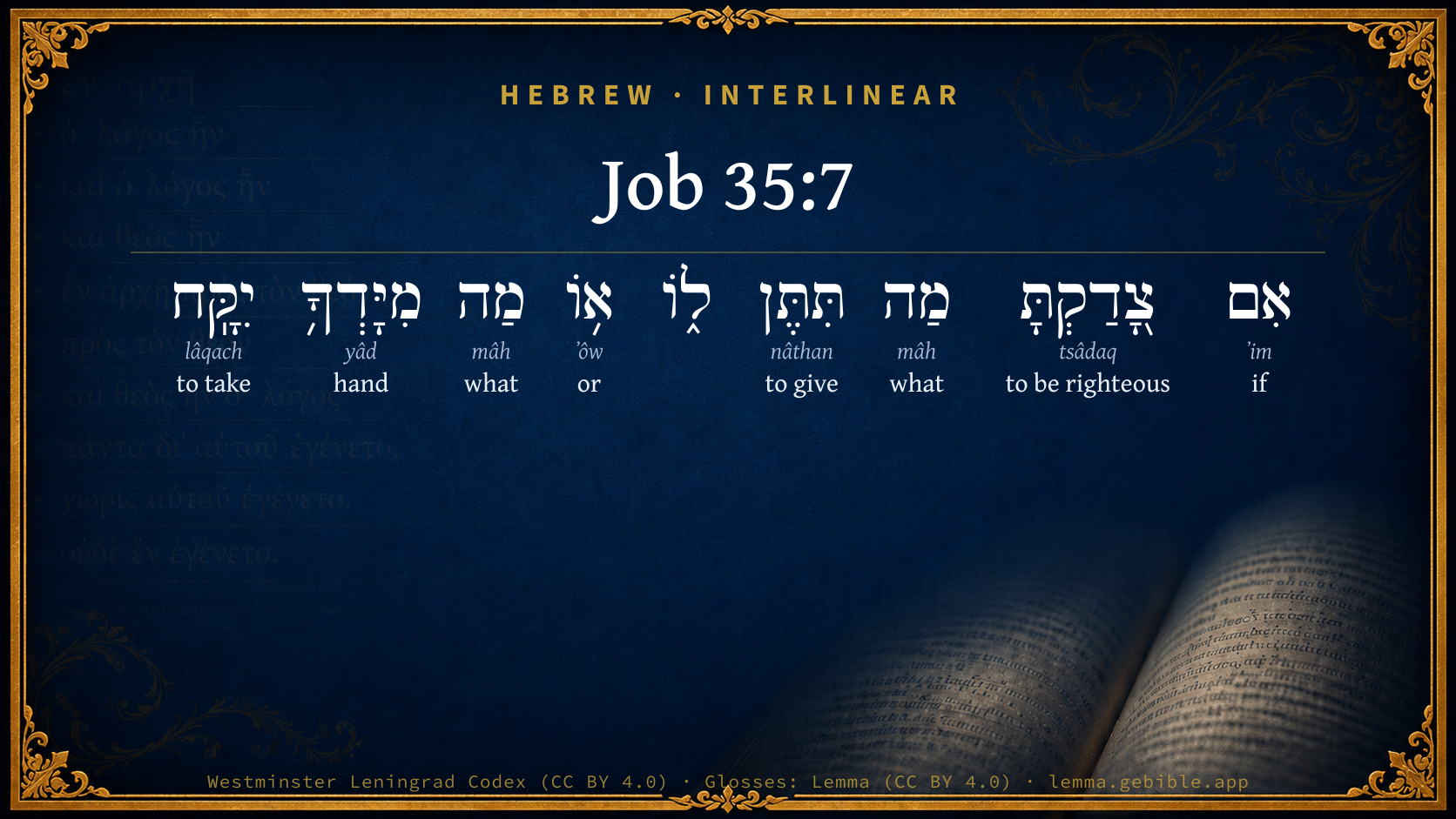
Job 35:7

Hebrew (Westminster Leningrad Codex) Job 35:7 appears in the Hebrew Old Testament. The text above is from the Westminster Leningrad Codex. Each word links to its Strong’s number, a concise gloss, and parsing drawn from the Open Scriptures Hebrew Bible morphology. Click any word for its full Brown-Driver-Briggs (BDB) entry.
Download image
Cite this verse

Job 35:7 (World English Bible). Public Domain. Lemma interlinear Bible study tool, https://lemma.gebible.app/v/job/35/7.

Show BibTeX & RIS
BibTeX
RIS
English Translation
If you are righteous, what do you give him? Or what does he receive from your hand?
World English Bible · Public Domain
Download a study sheet

One document with this verse’s original text, its word-by-word gloss line, the meaning frame, cross-references with their text, attributed commentary, and full source and license credits — printable, and it pastes into notes with its structure intact.

This verse Autodidact and up

Study sheet (.html) Plain text (.txt)

A passage Seminary Student

Up to 50 verses in one chapter. A passage sheet keeps up to 6 commentary sources and 12 cross-references per verse, in the order this page ranks them, and says so on the sheet whenever that leaves anything out. Ask for a single verse and you get the Autodidact verse sheet above.

Everything on this page stays free to read, with no account — the sheet is a download of what is already on screen, not access to it.

Want to remove ads? Support Godless Engineer
Compare translations 3

The same verse in 3 English versions, stacked beneath the original-language interlinear above. Click any original word for its lexicon entry.

Each is an independent rendering of the whole verse — the interlinear is not word-aligned to these translations.

Highlighted words mark where these versions differ — a whole-verse word diff, not a word-by-word alignment.

  • World English Bible Public Domain
    If you are righteous, what do you give him? Or what does he receive from your hand?
  • King James Version Public Domain
    If thou be righteous, what givest thou him? or what receiveth he of thine hand?
  • unfoldingWord Literal Text CC BY-SA 4.0
    If you are righteous, what do you give to him, or what does he receive from your hand?

unfoldingWord Literal Text — © unfoldingWord, licensed CC BY-SA 4.0. Word-aligned USFM3 via Door43 (git.door43.org/unfoldingWord/en_ult).

Versions to compare (up to 4)

3 of 4 selected

Show all 18 translations

Every available English version of this verse, each an independent rendering of the whole verse.

  • World English Bible Public Domain
    If you are righteous, what do you give him? Or what does he receive from your hand?
  • Berean Standard Bible Public Domain
    If you are righteous, what do you give Him, or what does He receive from your hand?
  • Majority Standard Bible Public Domain
    If you are righteous, what do you give Him, or what does He receive from your hand?
  • King James Version Public Domain
    If thou be righteous, what givest thou him? or what receiveth he of thine hand?
  • American Standard Version (1901) Public Domain
    If thou be righteous, what givest thou him? Or what receiveth he of thy hand?
  • Revised Version (1885) Public Domain
    If thou be righteous, what givest thou him? or what receiveth he of thine hand?
  • Geneva Bible (1599) Public Domain
    If thou be righteous, what giuest thou vnto him? or what receiueth he at thine hand?
  • Douay-Rheims (1899) Public Domain
    And if thou do justly, what shalt thou give him, or what shall he receive of thy hand?
  • Young's Literal Translation Public Domain
    If thou hast been righteous, What dost thou give to Him? Or what from thy hand doth He receive?
  • Literal Standard Version CC BY-SA 4.0
    If you have been righteous, || What do you give to Him? Or what does He receive from your hand?
  • Unlocked Literal Bible CC BY-SA 4.0
    If you are righteous, what can you give to him? What will he receive from your hand?
  • unfoldingWord Literal Text CC BY-SA 4.0
    If you are righteous, what do you give to him, or what does he receive from your hand?
  • Darby Bible Public Domain
    If thou be righteous, what givest thou to him? or what doth he receive of thy hand?
  • World Messianic Bible Public Domain
    If you are righteous, what do you give him? Or what does he receive from your hand?
  • Webster's Bible Public Domain
    If thou art righteous, what givest thou to him? or what receiveth he from thy hand?
  • Free Bible Version CC BY-SA 4.0
    If you do what's right, what good are you doing for him?
  • Bible in Basic English Public Domain
    If you are upright, what do you give to him? or what does he take from your hand?
  • JPS Tanakh (1917) Public Domain
    If thou be righteous, what givest thou Him? Or what receiveth He of thy hand?

Literal Standard Version (2020), Covenant Press — licensed CC BY-SA 4.0. Text via the HelloAO Bible API (eBible.org). Unlocked Literal Bible (unfoldingWord) — licensed CC BY-SA 4.0. Text via the HelloAO Bible API (eBible.org). unfoldingWord Literal Text — © unfoldingWord, licensed CC BY-SA 4.0. Word-aligned USFM3 via Door43 (git.door43.org/unfoldingWord/en_ult). Free Bible Version, Dr. Jonathan Gallagher — licensed CC BY-SA 4.0. Text via the HelloAO Bible API (eBible.org).

Word by word

More ways to search: Search by grammar → Find every occurrence → Compare this word →

Practice this passage: Drill this verse → Learn its vocabulary →

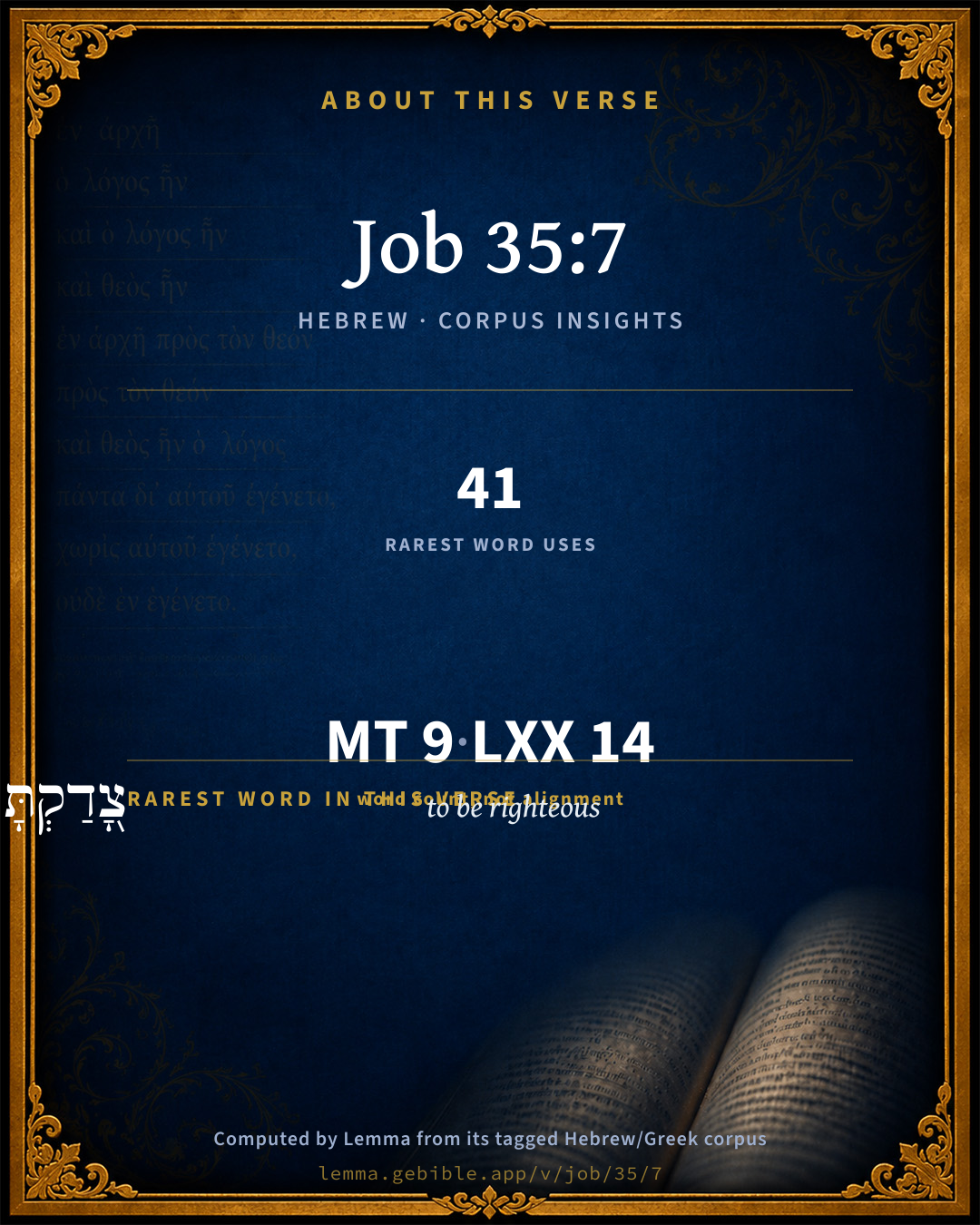
צָ֭דַקְתָּ
tsâdaq
H6663
“to be righteous”
Verb, Qal, Perfect, 2nd Person, Masculine, Singular
Part of Speech
Verb
Stem
Qal
Form
Perfect
Person
2nd Person
Gender
Masculine
Number
Singular
Full BDB Definition

Origin: a primitive root

TWOT: 1879

to be just, be righteous - (Qal) - to have a just cause, be in the right - to be justified - to be just (of God) - to be just, be righteous (in conduct and character) - (Niphal) to be put or made right, be justified - (Piel) justify, make to appear righteous, make someone righteous - (Hiphil) - to do or bring justice (in administering law) - to declare righteous, justify - to justify, vindicate the cause of, save - to make righteous, turn to righteousness - (Hithpael) to justify oneself
  1. אִם ʼim H518 “if” Conjunction
  2. מַה mâh H4100 “what” Particle, Interrogative
  3. תִּתֶּן nâthan H5414 “to give” Verb, Qal, Imperfect, 2nd Person, Masculine, Singular
  4. א֥וֹ ʼôw H176 “or” Conjunction
  5. מַה mâh H4100 “what” Particle, Interrogative
  6. מִיָּדְךָ֥ yâd H3027 “from · hand · your” Preposition + Noun, Common, Both, Singular, Construct + Suffix, Personal, 2nd Person, Masculine, Singular
  7. יִקָּֽח lâqach H3947 “to take” Verb, Qal, Imperfect, 3rd Person, Masculine, Singular

About this verse

These counts appear in no published source. They are computed here, from the morphology-tagged text and Lemma’s own curated glosses. What Lemma adds →

9
words
7
distinct lemmas
Wisdom
section

Shared distinctive vocabulary

צָ֭דַקְתָּ to be righteous H6663 occurs in 40 verses of the Hebrew Bible. Also found in:

Grammatical profile

  • 3 verbs
  • 1 noun
  • 1 preposition
  • 2 conjunctions
  • 2 particles

Verb forms

  • צָ֭דַקְתָּ Qal · Perfect
  • תִּתֶּן Qal · Imperfect
  • יִקָּֽח Qal · Imperfect

Repetition

A word recurs within this verse — often emphatic in Hebrew:

Hebrew & Septuagint length

In English translation the verse runs 17 words from the Hebrew and 18 from the Septuagint (LXX English) — closely comparable.

A rough comparison of the two English renderings, which tokenize alike — not a word-level alignment.

Word counts can differ between the Hebrew and the Greek without any difference in meaning — e.g. the Hebrew direct-object marker אֵת has no separate Greek word, and Greek often adds the article ὁ.

In the original languages it is 9 Hebrew tokens and 14 Greek tokens — but the two are counted differently (Hebrew bundles its prefixes and suffixes into one token; the Greek is in lemma form), so that isn’t a like-for-like length.

Cross-references

6

Topical passages linked to Job 35:7 in the Treasury of Scripture Knowledge — connected by theme and wording, ordered by reader-vote popularity; previews shown in the World English Bible.

  • Job 22:2–3 "Can a man be profitable to God? Surely he who is wise is profitable to himself.
  • Psalms 16:2 My soul, you have said to Yahweh, "You are my Lord. Apart from you I have no good thing."
  • Proverbs 9:12 If you are wise, you are wise for yourself. If you mock, you alone will bear it.
  • Luke 17:10 Even so you also, when you have done all the things that are commanded you, say, 'We are unworthy servants. We have done our duty.'"
  • Romans 11:35 "Or who has first given to him, And it will be repaid to him again?"
  • 1 Chronicles 29:14 But who am I, and what is my people, that we should be able to offer so willingly as this? For all things come of you, and of your own have we given you.

Cross-references courtesy of OpenBible.info (CC BY 4.0).

Hebrew and Greek witnesses Masoretic Hebrew ↔ Greek Septuagint

The same verse in the two great witnesses to the Old Testament, shown verse-for-verse.

These are two independent witnesses, not word-aligned to each other, and the Septuagint is shown in lemma (dictionary) form.

Hebrew Job 35:7 Masoretic · Westminster Leningrad Codex

אִם צָ֭דַקְתָּ מַה תִּתֶּן ל֑וֹ א֥וֹ מַה מִיָּדְךָ֥ יִקָּֽח

If you are righteous, what do you give him? Or what does he receive from your hand?

World English Bible · Public Domain

Greek LXX Job 35:7 Septuagint · lemma form

ἐπεί δέ οὖν δίκαιος εἰμί τίς δίδωμι αὐτός ἤ τίς ἐκ χείρ σύ λαμβάνω

And suppose you are righteous, what will you give him? or what shall he receive of your hand?

LXX2012 (modern English Septuagint) · Public Domain

Hebrew: Westminster Leningrad Codex (CC BY 4.0). Greek: Septuagint (public domain); English from LXX2012 (modern English Septuagint) (Public Domain). How the Septuagint differs from the Hebrew →

Commentary

Notes on Job 35:7 from classic Christian and Jewish commentators (each source and its license shown beneath its notes). The classic Christian expositions comment on the surrounding passage and are grouped to its opening verse, so a note may address several verses; the Jewish commentaries on the Tanakh (Rashi and others) are per-verse, so they appear only where the commentator wrote on this verse.

Lemma curates 59 commentaries, every one of them public domain or Creative Commons licensed, each selected and text-cleaned for this edition rather than reprinted as found. About our sources →

Trapp's Complete Commentary

John Trapp

Job 35:7 If thou be righteous, what givest thou him? or what receiveth he of thine hand?

Ver. 7. If thou be righteous, what givest thou him?] Nothing, since he is self sufficient, and independent. He needeth us not, neither doth our righteousness reach him, Psa 16:2. The Pharisees dreamed of an over-doing of the law, and making God beholden to them. The Papists also, those modern Pharisees, talk of works of supererogation, and of merit of congruity, and merit of condignity. But these are mere fictions, chimaeras, absurd doctrines, such as Elihu never heard of. "He that doeth righteousness is righteous," 1Jn 3:7, but he addeth nothing thereby to God, let him do his utmost. Indeed who so offereth praise glorifieth God, Psa 50:23, so he is pleased to account it, and call it; but his glory is, as himself is, eternal, infinite, immense. The sun would shine in its own brightness though all the world were blind, and should wilfully wink: so here. God accepts not our presents, but to return them us back with interest, as the rain ascends in thin vapours, but comes down again in thick showers.

Or what receiveth he of thine hand?] If anything, it is of his own, as David thankfully acknowledgeth, 1Ch 29:14, and besides that, our sweetest incense smelleth strong of the hand that offereth it.

John Trapp, A Commentary or Exposition upon All the Books of the Old and New Testament (1647–1656) — public domain. Text from a community e-Sword module.

Jamieson, Fausset & Brown

Robert Jamieson, A. R. Fausset & David Brown

(Psa 16:2; Pro 9:12; Luk 17:10).

Jamieson, Fausset & Brown — Commentary Critical and Explanatory on the Whole Bible (1871) — public domain (CC PDM 1.0). Text via the HelloAO Bible API.

John Gill's Exposition

By reason of the multitude of oppressions, they make the oppressed to cry,.... Which is either an illustration by an instance of what is before said, that wickedness hurts men, as particularly oppression does, which makes then cry; or this refers to something new, to another complaint of Job, or an undue expression of his. Elihu undertakes to answer; that men cry unto God, as he himself had, but are not heard and answered; the place or places referred to may be Job 24:12. To which Elihu replies, by granting that men oppressed cry because of their oppression, and are not heard; for which reasons may be given, as in the following verses. The poor are often oppressed by the rich, whose wealth gives them power, and that they abuse; and the weak and feeble by the mighty; and their oppressions are many, there is a multitude of them: men in power and authority have various ways of oppressing others, who like the Israelites cry by reason of them, and are made to cry by their oppressors;

they cry out by reason of the arm of the mighty; which falls with weight, and lies heavy upon them, and crushes them; meaning the power they have, and which they abuse to the injury of them; nor are they able to help themselves or deliver themselves out of their hands, they being mighty, if not in body, yet through wealth; and by means of that authority over them which gives it them: now on account of the pressure upon them, they cry, not to God, but to men: and if they cry to God, it is in a murmuring and complaining way, through impatience under their burden, through envy at the riches and power of others, in a passionate manner, in a revengeful spirit, calling and seeking for vengeance on their oppressors; not in an humble penitent manner, acknowledging their sins, and owning their unworthiness to be heard and regarded, and submitting all to the will of God: for which reasons they are not heard, their cries and, prayers being reckoned no other than howlings, Hos 7:14.

Next: Job Chapter 36

John Gill's Exposition of the Whole Bible (1746–1763) — public domain (CC PDM 1.0). Text via the HelloAO Bible API.

Albert Barnes' Notes on the Bible

If thou be righteous, what givest thou him? - The same sentiment substantially as in the previous verses. It is, that God is supreme and independent. He does not desire such benefits from the services of his friends and is not so dependent on them; as to be induced to interpose in their favor, in any way beyond what is strictly proper. It is to be presumed, therefore, that he will deal with them according to what is right, and as it is right that they should experience proofs of his favor, it followed that there “would be” advantage in serving him, and in being delivered from sin; that it “would be” better to be holy than to lead a life of transgression. This reasoning seems to be somewhat abstract, but it is correct, and is as sound now as it was in the time of Elihu. There is no reason why God should not treat people according to their character. He is not so under obligations to his friends, and has not such cause to dread his foes; he does not derive so much benefit from the one, or receive such injury from the other, that he is under any inducement to swerve from strict justice; and it follows, therefore, that where there ought to be reward there will be, where there ought to be punishment there will be, and consequently that there is an advantage in being righteous.

Albert Barnes' Notes on the Bible (1834–1885) — public domain. Text from a community e-Sword/MySword module.

Matthew Poole's English Annotations

He gaineth nothing by it, nor can indeed receive any good from thee, because all thy good comes from him. And therefore thou hast no reason to boast of nor to upbraid God with thy piety, which is much to thy advantage, but nothing to his.

Matthew Poole's English Annotations on the Holy Bible (1683–1685) — public domain. Text from a community e-Sword/MySword module.

The Pulpit Commentary

If thou be righteous, what givest thou him? By parity of reasoning, as our sins do not injure God, so our righteousness cannot benefit him. As David says, "My goodness extendeth not to thee". (Psa_16:2) Or what receiveth he of thine hand? All things being already God"s, we can but give him of his own. We cannot really add to his possessions, or to his glory, or to his felicity. We cannot, as some have supposed they could ("Religions of the Ancient World," pp. 143, 144), lay him under an obligation.

The Pulpit Commentary (1880–1919), ed. H.D.M. Spence-Jones & Joseph S. Exell — public domain. Text from a community e-Sword module.

Lesson kit

Teaching starters — assembled from the data on this page, not authored interpretation. Every prompt links to the verse data it draws on. Edit before teaching.

Job, in the Wisdom, opens this verse with 9 words (7 distinct Hebrew lemmas). Its most distinctive word is tsâdaq (“to be righteous”). A historical commentator’s framing appears above. Read the whole chapter for the surrounding context.

Discussion questions

  1. What does “to be righteous” (tsâdaq) contribute to the verse as a whole?
  2. Genesis 38:26 shares the word «to be righteous» with this verse. How do the two illuminate each other?
  3. “what” occurs 2× in this one verse. What is the effect of the repetition?
  4. The translations on this page render this verse differently — a whole-verse word diff, not a word-by-word alignment. What might account for the different wordings?
  5. The verb «צָ֭דַקְתָּ» is Qal Perfect. How does its form color the action?
  6. Reading how Trapp's Complete Commentary and Jamieson, Fausset & Brown read this verse, where do the two commentators agree and where do they part?

Things to notice

Reading settings

Reading text

Shown beneath each verse's original-language words.

Old Testament
Old Testament edition

Read the OT as the Masoretic Hebrew (MT) or the Greek Septuagint (LXX).

English shown for the Greek Septuagint (in the Hebrew ↔ Greek comparison).

Comparing translations? Open the Compare panel on any verse page to stack up to four side by side.