
Jeremiah 3:11

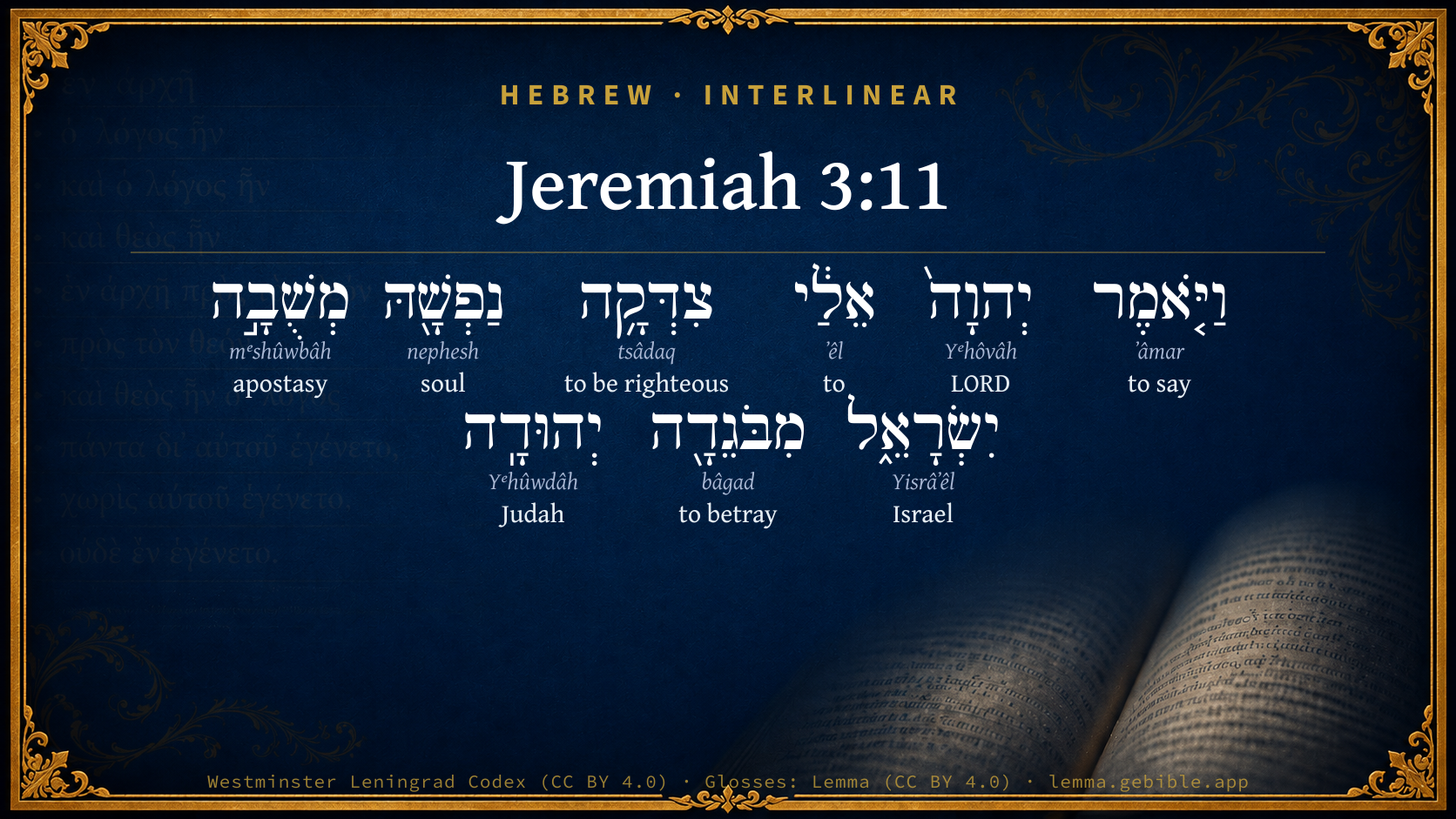
Hebrew (Westminster Leningrad Codex) Jeremiah 3:11 appears in the Hebrew Old Testament. The text above is from the Westminster Leningrad Codex. Each word links to its Strong’s number, a concise gloss, and parsing drawn from the Open Scriptures Hebrew Bible morphology. Click any word for its full Brown-Driver-Briggs (BDB) entry.
Download image
Cite this verse

Jeremiah 3:11 (World English Bible). Public Domain. Lemma interlinear Bible study tool, https://lemma.gebible.app/v/jeremiah/3/11.

Show BibTeX & RIS
BibTeX
RIS
English Translation
Yahweh said to me, Backsliding Israel has shown herself more righteous than treacherous Judah.
World English Bible · Public Domain
Download a study sheet

One document with this verse’s original text, its word-by-word gloss line, the meaning frame, cross-references with their text, attributed commentary, and full source and license credits — printable, and it pastes into notes with its structure intact.

This verse Autodidact and up

Study sheet (.html) Plain text (.txt)

A passage Seminary Student

Up to 50 verses in one chapter. A passage sheet keeps up to 6 commentary sources and 12 cross-references per verse, in the order this page ranks them, and says so on the sheet whenever that leaves anything out. Ask for a single verse and you get the Autodidact verse sheet above.

Everything on this page stays free to read, with no account — the sheet is a download of what is already on screen, not access to it.

Want to remove ads? Support Godless Engineer
Compare translations 3

The same verse in 3 English versions, stacked beneath the original-language interlinear above. Click any original word for its lexicon entry.

Each is an independent rendering of the whole verse — the interlinear is not word-aligned to these translations.

Highlighted words mark where these versions differ — a whole-verse word diff, not a word-by-word alignment.

  • World English Bible Public Domain
    Yahweh said to me, Backsliding Israel has shown herself more righteous than treacherous Judah.
  • King James Version Public Domain
    And the LORD said unto me, The backsliding Israel hath justified herself more than treacherous Judah.
  • unfoldingWord Literal Text CC BY-SA 4.0
    Then Yahweh said to me, “Apostate Israel has shown her spirit to be more righteous than treacherously acting Judah!

unfoldingWord Literal Text — © unfoldingWord, licensed CC BY-SA 4.0. Word-aligned USFM3 via Door43 (git.door43.org/unfoldingWord/en_ult).

Versions to compare (up to 4)

3 of 4 selected

Show all 18 translations

Every available English version of this verse, each an independent rendering of the whole verse.

  • World English Bible Public Domain
    Yahweh said to me, Backsliding Israel has shown herself more righteous than treacherous Judah.
  • Berean Standard Bible Public Domain
    And the LORD said to me, “Faithless Israel has shown herself more righteous than unfaithful Judah.
  • Majority Standard Bible Public Domain
    And the LORD said to me, “Faithless Israel has shown herself more righteous than unfaithful Judah.
  • King James Version Public Domain
    And the LORD said unto me, The backsliding Israel hath justified herself more than treacherous Judah.
  • American Standard Version (1901) Public Domain
    And Jehovah said unto me, Backsliding Israel hath showed herself more righteous than treacherous Judah.
  • Revised Version (1885) Public Domain
    And the LORD said unto me, Backsliding Israel hath shewn herself more righteous than treacherous Judah.
  • Geneva Bible (1599) Public Domain
    And the Lord said vnto me, The rebellious Israel hath iustified her selfe more then the rebellious Iudah.
  • Douay-Rheims (1899) Public Domain
    And the Lord said to me: The rebellious Israel hath justified her soul, in comparison of the treacherous Juda.
  • Young's Literal Translation Public Domain
    And Jehovah saith unto me: `Justified herself hath backsliding Israel, More than treacherous Judah.
  • Literal Standard Version CC BY-SA 4.0
    And YHWH says to me: “Backsliding Israel has justified herself, || More than treacherous Judah.
  • Unlocked Literal Bible CC BY-SA 4.0
    Then Yahweh said to me, “Faithless Israel has been more righteous than faithless Judah!
  • unfoldingWord Literal Text CC BY-SA 4.0
    Then Yahweh said to me, “Apostate Israel has shown her spirit to be more righteous than treacherously acting Judah!
  • Darby Bible Public Domain
    And Jehovah said unto me, Backsliding Israel hath shewn herself more just than treacherous Judah.
  • World Messianic Bible Public Domain
    The LORD said to me, “Backsliding Israel has shown herself more righteous than treacherous Judah.
  • Webster's Bible Public Domain
    And the LORD said to me, The backsliding Israel hath justified herself more than treacherous Judah.
  • Free Bible Version CC BY-SA 4.0
    The Lord told me, Unfaithful Israel showed that she wasn't as guilty as unfaithful Judah.
  • Bible in Basic English Public Domain
    And the Lord said to me, Israel in her turning away is seen to be more upright than false Judah.
  • JPS Tanakh (1917) Public Domain
    even the LORD said unto me — backsliding Israel hath proved herself more righteous than treacherous Judah.

Literal Standard Version (2020), Covenant Press — licensed CC BY-SA 4.0. Text via the HelloAO Bible API (eBible.org). Unlocked Literal Bible (unfoldingWord) — licensed CC BY-SA 4.0. Text via the HelloAO Bible API (eBible.org). unfoldingWord Literal Text — © unfoldingWord, licensed CC BY-SA 4.0. Word-aligned USFM3 via Door43 (git.door43.org/unfoldingWord/en_ult). Free Bible Version, Dr. Jonathan Gallagher — licensed CC BY-SA 4.0. Text via the HelloAO Bible API (eBible.org).

Word by word

More ways to search: Search by grammar → Find every occurrence → Compare this word →

Practice this passage: Drill this verse → Learn its vocabulary →

About this verse

These counts appear in no published source. They are computed here, from the morphology-tagged text and Lemma’s own curated glosses. What Lemma adds →

9
words
9
distinct lemmas
Prophets
section

Notable vocabulary

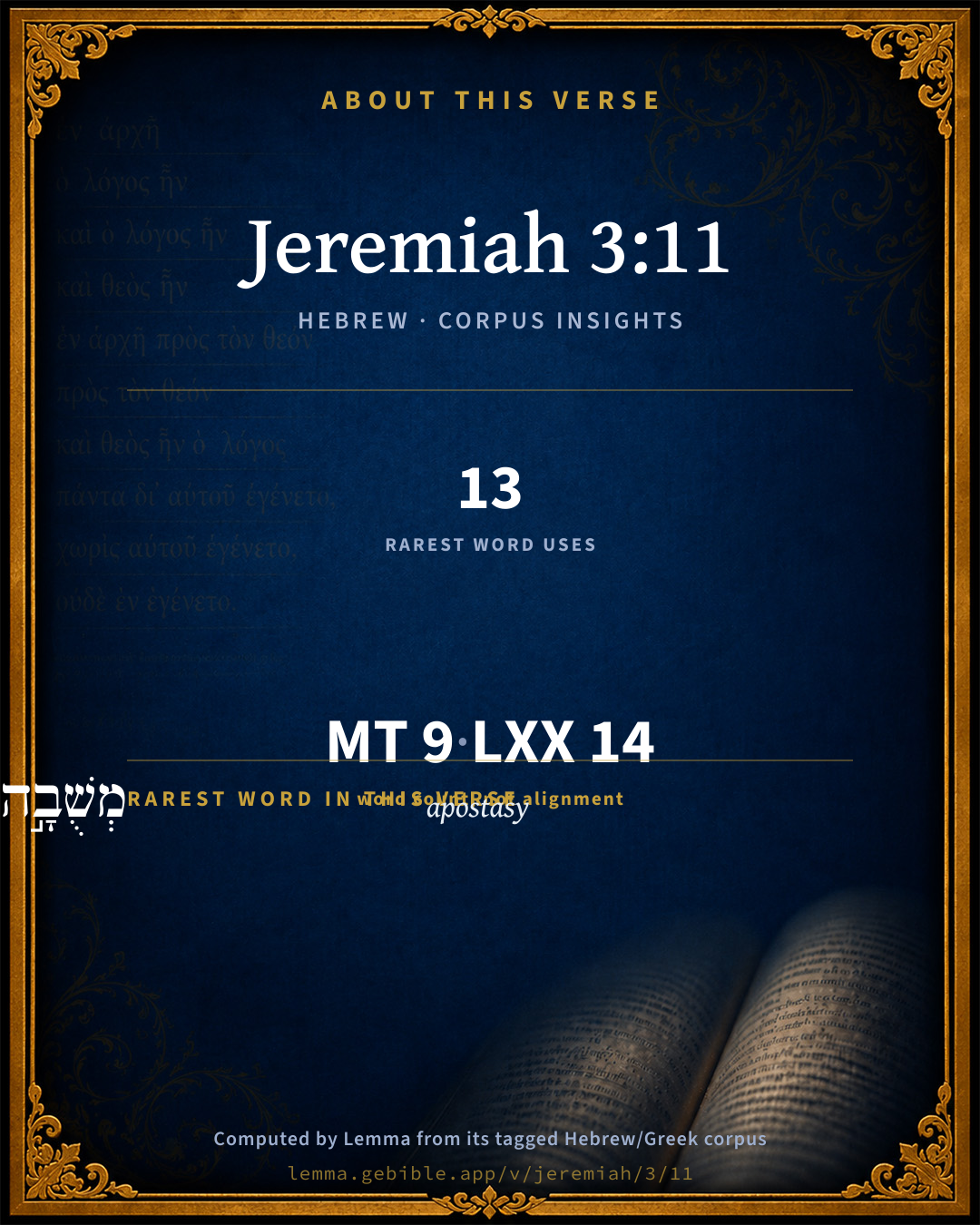
The rarest word here is מְשֻׁבָ֣ה apostasy H4878 — appearing just 13 times in the whole Hebrew Bible.

Shared distinctive vocabulary

מְשֻׁבָ֣ה apostasy H4878 occurs in 12 verses of the Hebrew Bible. Also found in:

Grammatical profile

  • 3 verbs
  • 5 nouns
  • 1 preposition

Verb forms

  • וַיֹּ֤אמֶר Qal · Sequential Imperfect
  • צִדְּקָ֥ה Piel · Perfect
  • מִבֹּגֵדָ֖ה Qal · Participle Active

Hebrew & Septuagint length

In the original languages it is 9 Hebrew tokens and 14 Greek tokens — but the two are counted differently (Hebrew bundles its prefixes and suffixes into one token; the Greek is in lemma form), so that isn’t a like-for-like length.

Cross-references

7

Topical passages linked to Jeremiah 3:11 in the Treasury of Scripture Knowledge — connected by theme and wording, ordered by reader-vote popularity; previews shown in the World English Bible.

  • Ezekiel 16:51–52 Neither has Samaria committed half of your sins; but you have multiplied your abominations more than they, and have justified your sisters by all your abominations which you have done.
  • Ezekiel 23:11 Her sister Oholibah saw this, yet was she more corrupt in her doting than she, and in her prostitution which were more than the prostitution of her sister.
  • Hosea 11:7 My people are determined to turn from me. Though they call to the Most High, He certainly won't exalt them.
  • Ezekiel 16:47 Yet have you not walked in their ways, nor done after their abominations; but, as [if that were] a very little [thing], you were more corrupt than they in all your ways.
  • Hosea 4:16 For Israel has behaved extremely stubbornly, like a stubborn heifer. Then how will Yahweh feed them like a lamb in a meadow.
  • Jeremiah 3:8 I saw, when, for this very cause that backsliding Israel had committed adultery, I had put her away and given her a bill of divorce, yet treacherous Judah, her sister, didn't fear; but she also went and played the prostitute.
  • Jeremiah 3:22 Return, you backsliding children, I will heal your backsliding. Behold, we are come to you; for you are Yahweh our God.

Cross-references courtesy of OpenBible.info (CC BY 4.0).

Hebrew and Greek witnesses Masoretic Hebrew ↔ Greek Septuagint

The same verse in the two great witnesses to the Old Testament, shown verse-for-verse.

These are two independent witnesses, not word-aligned to each other, and the Septuagint is shown in lemma (dictionary) form.

Hebrew Jeremiah 3:11 Masoretic · Westminster Leningrad Codex

וַיֹּ֤אמֶר יְהוָה֙ אֵלַ֔י צִדְּקָ֥ה נַפְשָׁ֖הּ מְשֻׁבָ֣ה יִשְׂרָאֵ֑ל מִבֹּגֵדָ֖ה יְהוּדָֽה

Yahweh said to me, Backsliding Israel has shown herself more righteous than treacherous Judah.

World English Bible · Public Domain

Greek LXX Structure differs

In the Septuagint, Jeremiah is about an eighth shorter than the Hebrew and arranges its material differently — the Oracles Against the Nations (Hebrew chapters 46–51) appear in the middle of the Greek book, after 25:13. Because the chapter and verse boundaries do not line up, a verse-for-verse comparison with the Hebrew is not shown.

A verse-for-verse comparison isn’t shown here because the chapters and verses don’t line up. Switch to the LXX edition with the MT / LXX toggle above to read the Greek directly.

On this verse, Joseph Benson's Commentary discusses the Septuagint’s reading. Read the note in Commentary ↓

Hebrew: Westminster Leningrad Codex (CC BY 4.0). Greek: Septuagint (public domain); English from a public-domain English Septuagint. How the Septuagint differs from the Hebrew →

Targum (Aramaic paraphrase)

1

The Targum is the ancient Jewish Aramaic paraphrase of the Hebrew Scriptures — an interpretive translation, not the Hebrew text itself. Onkelos (literal) and Pseudo-Jonathan (expansive) render the Torah, and Jonathan the Prophets. Coverage is partial: where no permissively-licensed English translation exists for a verse, only the Aramaic is shown. This is verse-level text, not a word-by-word alignment to the Hebrew.

  1. Targum Jonathan Prophets (Joshua–Malachi)
    וַאֲמַר יְיָ לִי זַכִּיאוּ נַפְשֵׁיהוֹן דְמִתְחַסְנִין לְמֵיסַב לְפוּלְחָנִי דְבֵית יִשְׂרָאֵל מִמְשַׁקְרַיָא דְבֵית יְהוּדָה:

    (no public-domain English translation for this verse)

    Targum Jonathan — Aramaic: “Mikraot Gedolot” (public domain). English: “Sefaria Community Translation” (CC0 1.0 (public-domain dedication)); “London "Chaldee Paraphrase," 1871” (public domain). Text via Sefaria.

Commentary

Notes on Jeremiah 3:11 from classic Christian and Jewish commentators (each source and its license shown beneath its notes). The classic Christian expositions comment on the surrounding passage and are grouped to its opening verse, so a note may address several verses; the Jewish commentaries on the Tanakh (Rashi and others) are per-verse, so they appear only where the commentator wrote on this verse.

Lemma curates 59 commentaries, every one of them public domain or Creative Commons licensed, each selected and text-cleaned for this edition rather than reprinted as found. About our sources →

Trapp's Complete Commentary

John Trapp

Jer 3:11 And the LORD said unto me, The backsliding Israel hath justified herself more than treacherous Judah.

Ver. 11. The backsliding Israel hath justified herself.] That is, she is less guilty and faulty of the two; because Judah sinned against more means and mercies, and because she received not instruction by her sister’s destruction; therefore shall she feel what she feared not at a distance; therefore shall she taste of Israel’s rod because she would not hear it; she that would not tremble at her sister’s divorce, must herself be divorced, and be judged as "women that break wedlock," {Eze 16:38} "bearing her own shame for her sins that she had committed, more abominable than theirs." {Eze 16:52}

John Trapp, A Commentary or Exposition upon All the Books of the Old and New Testament (1647–1656) — public domain. Text from a community e-Sword module.

Joseph Benson's Commentary

Jer 3:11. And the Lord said unto me, &c. — The case of these sister kingdoms is here compared, and judgment given upon the comparison. Israel hath justified herself more than Judah — Hebrew, צדקה נפשׁה, hath justified her soul: so the LXX. εδικαιωσε την ψυχην, and the Vulgate. The meaning is, that of the two, Judah was the more guilty, because, though Israel’s sins were more numerous, and their idolatry had continued longer, yet in Judah that and other sins were more heinous, because Judah had sinned against greater light, and would not take warning by that desolation which God had brought upon the whole kingdom of Israel. Observe, reader, this comparative justification stood Israel in little stead. It will little avail us to say we are not so bad as others, when yet we are not really good ourselves. And God’s judgments upon others, if they be not the means of our reformation, will help to aggravate our destruction. The Prophet Ezekiel makes the same comparison between Jerusalem and Samaria, that Jeremiah here makes between Judah and Israel, nay, and between Jerusalem and Sodom, and Jerusalem is represented as being the worst of the three. See Eze 23:11; and Eze 16:48.

Joseph Benson's Commentary on the Old and New Testaments (1811–1818) — public domain. Text from a community e-Sword module.

Whedon's Commentary on the Bible

Daniel D. Whedon

THE CALL TO RETURN, Jer_3:11-18.

11. Hath justified herself — Israel is less guilty than Judah, because she had less light. To be false is accounted worse than to be apostate. Honest idolatry is less offensive than hypocritical orthodoxy. To lose truth out of the intellect is sad enough; but to lose it out of the conscience and heart is still worse.

Daniel D. Whedon (gen. ed.), Commentary on the Old and New Testaments (1874–1909) — public domain. Text from a community e-Sword module.

Keil & Delitzsch

C. F. Keil & F. Delitzsch

Israel's return, pardon, and blessedness. - Jer 3:11. "And Jahveh said to me, The backsliding one, Israel, is justified more than the faithless one, Judah. Jer 3:12. Go and proclaim these words towards the north, and say, Turn, thou backsliding one, Israel, saith Jahveh; I will not look darkly on you, for I am gracious, saith Jahveh; I will not always be wrathful. Jer 3:13. Only acknowledge thy guilt, for from Jahveh thy God art thou fallen away, and hither and thither hast thou wandered to strangers under every green tree, but to my voice ye have not hearkened, saith Jahveh. Jer 3:14. Return, backsliding sons, saith Jahveh; for I have wedded you to me, and will take you, one out of a city and two out of a race, and will bring you to Zion; Jer 3:15. And will give you shepherds according to my heart, and they will feed you with knowledge ad wisdom. Jer 3:16. And it comes to pass, when ye increase and are fruitful in the land, in those days, saith Jahveh, they will no more say, 'The ark of the covenant of Jahveh;' and it will no more come to mind, and ye will not longer remember it or miss it, and it shall not be made again. Jer 3:17. In that time they shall call Jerusalem the throne of Jahveh; and to it all peoples shall gather themselves, because the name of Jahveh is at Jerusalem: and no longer shall they walk after the stubbornness of their evil heart. Jer 3:18. In those days shall the house of Judah go along with the house of Israel, and together out of the land of midnight shall they come into the land which I have given for an inheritance unto your fathers." In Jer 3:11, from the comparison of the faithless Judah with the backsliding Israel, is drawn the conclusion: Israel stands forth more righteous than Judah. The same is said in other words by Eze 16:51.; cf. (Ezek.) Jer 23:11. צדק in Piel is to show to be righteous, to justify. נפשׁהּ, her soul, i.e., herself. Israel appears more righteous than Judah, not because the apostasy and idolatry of the Israelites was less than that of the people of Judah; in this they are put on the same footing in Jer 3:6-10; in the like fashion both have played the harlot, i.e., stained themselves with idolatry (while by a rhetorical amplification the apostasy of Judah is in Jer 3:9 represented as not greater than that of Israel). But it is inasmuch as, in the first place, Judah had the warning example of Israel before its eyes, but would not be persuaded to repentance by Israel's punishment; then again, Judah had more notable pledges than the ten tribes of divine grace, especially in the temple with its divinely-ordained cultus, in the Levitical priesthood, and in its race of kings chosen by God. Hence its fall into idolatry called more loudly for punishment than did that of the ten tribes; for these, after their disruption from Judah and the Davidic dynasty, had neither a lawful cultus, lawful priests, nor a divinely-ordained kingship. If, then, in spite of these privileges, Judah sank as far into idolatry as Israel, its offence was greater and more grievous than that of the ten tribes; and it was surely yet more deserving of punishment than Israel, if it was resolved neither to be brought to reflection nor moved to repentance from its evil ways by the judgment that had fallen upon Israel, and if, on the contrary, it returned to God only outwardly and took the opus operatum of the temple-service for genuine conversion. For "the measure of guilt is proportioned to the measure of grace." Yet will not the Lord utterly cast off His people, Jer 3:12. He summons to repentance the Israelites who had now long been living in exile; and to them, the backsliding sons, who confess their sin and return to Him, He offers restoration to the full favours of the covenant and to rich blessings, and this in order to humble Judah and to provoke it to jealousy. The call to repentance which the prophet is in Jer 3:12 to proclaim towards the region of midnight, concerns the ten tribes living in Assyrian exile. צפנה, towards midnight, i.e., into the northern provinces of the Assyrian empire the tribes had been carried away (Kg2 17:6; Kg2 18:11). שׁוּבה, return, sc. to thy God. Notwithstanding that the subject which follows, משׁבה, is fem., we have the masculine form here used ad sensum, because the faithless Israel is the people of the ten tribes. לא אפּיל פּני, I will not lower my countenance, is explained by Gen 4:5; Job 29:24, and means to look darkly, frowningly, as outward expression of anger; and this without our needing to take פּני for כּעסי as Kimchi does. For I am חסיד, gracious; cf. Exo 34:6. As to אטּור, see on Jer 3:5.

Keil & Delitzsch — Biblical Commentary on the Old Testament (1861–1891) — public domain (CC PDM 1.0). Text via the HelloAO Bible API. (Old Testament only.)

Tyndale Open Study Notes

Tyndale Open Resources

3:11–4:2 The Lord appealed to Israel to repent, return, and be reconciled to him (contrast 2:1–3:10). Israel had sinned and had received its punishment. Now the people of Judah were sinning even more brazenly than their northern kin, and they ignored the lesson the Lord had taught Israel (Ezek 16:51-52). But it was still not too late to repent and become the blessing to the nations (Jer 4:1-2) that God intended them to be (Gen 12:3).

Tyndale Open Study Notes — © Tyndale Open Resources, licensed CC BY-SA 4.0. Text via the HelloAO Bible API.

Geneva Bible (1599)

Geneva Bible translators

Israel hath not declared herself so wicked as Judah, which yet hath had more admonitions and examples to call her to repentance.

Geneva Bible (1599) marginal notes — public domain. Text via Bolls.life.

Jamieson, Fausset & Brown

Robert Jamieson, A. R. Fausset & David Brown

justified herself--has been made to appear almost just (that is, comparatively innocent) by the surpassing guilt of Judah, who adds hypocrisy and treachery to her sin; and who had the example of Israel to warn her, but in vain (compare Eze 16:51; Eze 23:11).

more than--in comparison with.

Jamieson, Fausset & Brown — Commentary Critical and Explanatory on the Whole Bible (1871) — public domain (CC PDM 1.0). Text via the HelloAO Bible API.

Adam Clarke's Commentary

Verse 11. Backsliding Israel hath justified herself more] She was less offensive in my eyes, and more excusable, than treacherous Judah. So it is said, Lu 18:14, the humbled publican went down to his house justified rather than the boasting Pharisee. The one was more to be pitied than the other, and more likely to receive the mercy of God.

Adam Clarke's Commentary on the Bible (1810–1826) — public domain. Text from a community e-Sword/MySword module.

John Calvin's Commentaries

We now see more clearly for what purpose Jeremiah compared the ten tribes with the kingdom of Judah; it was done in order to shew that the Jews, who wished to be deemed far more holy than others, were yet more perfidious and deserved a heavier punishment, because they acted so deceitfully with God.

It may be here asked, why he pronounces the Jews worse than the Israelites, while they still continued in a sort of middle state of things. We indeed know that the kingdom of Judah was become so corrupt, that hardly any religion remained there; yet the temple was still standing and the priesthood still existed at Jerusalem. But the Prophet condemns the Jews more than the Israelites for other reasons, even because they ought to have become wise through the calamities of others, and they ought to have been confirmed in true religion when they saw their brethren falling away from the pure worship of God: these things they ought to have maturely considered. It was this supine sottishness that rendered them worse than all their brethren, and also their pride, the chief cause of their condemnation, for they boasted that they remained perfect, while the ten tribes had become degenerated. These were the reasons why he says that Israel, though a perfidious woman, was yet more righteous than her sister Judah.

The language indeed is not to be strictly taken when it is said, that she justified her soul; for God does not here excuse the Israelites, nor does he free or absolve them from guilt, (for he had severely punished them;) but this way of speaking is commonly used by the prophets; — Sodom was righteous in comparison with Jerusalem; and Tyre and Sidon were just when compared with the Jews. (Ezekiel 16:47, 48.) Justified then has she her soul, even the treacherous or the apostate Israel, in comparison with the perfidious Judah; that is, for the reasons which I have stated. The obstinacy of the Jews was greater and less excusable: the external worship of God, which they had retained, ought to have been a bridle to check them; and they had also seen how severe a judge God had been towards the ten tribes; but the judgments of God they despised, and derived no benefit from them.

John Calvin's Commentaries (1540-1563) — public domain. Text from the Calvin Translation Society English edition (1840s-50s) via the Christian Classics Ethereal Library (ccel.org). Calvin's coverage is partial (roughly two-thirds of the Bible); uncommented books and verses are honest gaps, never fabricated. The 19th-century editor's footnotes and remarks are omitted so the notes are faithfully Calvin's own voice.

Ellicott's Commentary for English Readers

(11) Hath justified herself.—Literally, hath justified her soul, has put in a better plea in her defence. The renegade was better than the traitress. Even open rebellion was better than hypocrisy, as the publicans and sinners in the Gospel story were better than the Pharisees (Mat_21:31).

A Bible Commentary for English Readers, edited by Charles John Ellicott (1878–1897) — public domain. Text from a community e-Sword module.

The Cambridge Bible for Schools and Colleges

gen. ed. J. J. S. Perowne

11–13. In spite of (i) greater privileges, (a) succession of kings of the same family, (b) the Temple, (c) Levites; (ii) the warning example of Israel, Judah has proved faithless and hypocritical as well (Jer_3:4). Therefore the prophet is bidden to look toward the North (Assyria) whither the captives had been led. Upon sincere acknowledgment of sin pardon will ensue.

The Cambridge Bible for Schools and Colleges (gen. ed. J. J. S. Perowne; Cambridge University Press, 1878–1918) — public domain. Text from a community e-Sword module.

John Gill's Exposition

And the Lord said unto me,.... To the Prophet Jeremiah, as in Jer 3:6 and at or about the same time:

the backsliding Israel hath justified herself more than treacherous Judah; that is, was comparatively more righteous; of the two she appeared the most righteous; though neither of them could vindicate their conduct, or justify themselves before God; see Luk 18:14. Judah was most to blame, because that after Israel committed idolatry, and was carried captive, she took no warning by it, but fell into the same sin; and in Manasseh's time committed greater idolatries, and more wickedness, than ever Israel did; and more than even the Amorites themselves, and other Heathen nations, had done, Kg2 21:6 and though a reformation was made in Josiah's time, it was only feignedly, it was not cordial and hearty; and therefore she is all along here charged with perfidy and treachery.

John Gill's Exposition of the Whole Bible (1746–1763) — public domain (CC PDM 1.0). Text via the HelloAO Bible API.

Albert Barnes' Notes on the Bible

Hath justified herself - Judah had had the benefit of the warning given by Israel’s example. Both abandon Yahweh’s service for idolatry, but Israel is simply “apostate,” Judah is also false.

The verse is important,

(1) as accounting for the destruction of Jerusalem so soon after the pious reign of Josiah. Manasseh’s crimes had defiled the land, but it was by rejecting the reforms of Josiah that the people finally profaned it, and sealed their doom:

(2) As showing that it is not by the acts of its government that a nation stands or falls. Ahaz and Manasseh lent the weight of their influence to the cause of idolatry: Hezekiah and Josiah to the cause of truth. But the nation had to determine which should prevail. Excepting a remnant it embraced idolatry, and brought upon itself ruin: in the remnant the nation again revived Jer 24:5, Jer 24:7.

Albert Barnes' Notes on the Bible (1834–1885) — public domain. Text from a community e-Sword/MySword module.

Haydock's Catholic Bible Commentary

Soul, and appeared comparatively innocent, ver. 6., and Ezechiel xvi. 51. (St. Jerome) --- Yet neither of them was excusable. (Worthington)

George Leo Haydock (1774–1849), Haydock's Catholic Family Bible and Commentary, 1859 edition — public domain. Excludes Psalms (Douay-Rheims chapter numbering differs from Protestant) and Deuterocanonical books (Catholic canon only).

Matthew Poole's English Annotations

Was less vile, hath more to say for herself; Judah’s sin being greatly aggravated compared with Israel, Eze 16:51; 23:11. See Luk 18:14. For though Israel’s sins were more, and their idolatry continued, yet in Judah it was more heinous,

1. Because of their unruly headstrongness, that broke the reins and restraint which their external worship ought to have had upon them.

2. Because of their stupid security in not being warned by the judgments that they had seen befall Israel for the very same things.

3. Because of their intolerable pride, boasting that their state was still unshaken.

4. Because of their gross perfidiousness in making promises, and breaking them, which Israel did not, because she brought not herself under such solemn and frequent obligations: see Jer 3:7. Lastly, Because they were a great deal more zealous in their idolatries than Israel was, viz. under Manasseh, when they slew all the prophets of the Lord.

Matthew Poole's English Annotations on the Holy Bible (1683–1685) — public domain. Text from a community e-Sword/MySword module.

The Pulpit Commentary

It is very noteworthy that Jeremiah should have still so warm a feeling for the exiles of the northern kingdom (more than a hundred years after the great catastrophe). Hath justified herself. "To justify" can mean "to show one"s self righteous," as well as "to make one"s self righteous," just as "to sanctify" can mean, "to show one"s self holy", (Isa_8:13) as well as "to make one"s self holy." In spite of Israel"s apostasy, she has shown herself less worthy of punishment than Judah, who has had before her the warning lesson of Israel"s example, and who has been guilty of the most hateful of all sins, hypocrisy (comp. ver. 7).

The comparative advantages of Judah and Israel; professors and non-professors.

I LET JUDAH AND ISRAEL BE TAKEN AS REPRESENTING RESPECTIVELY PROFESSORS OF RELIGION AND THOSE WHO MAKE NO SUCH PROFESSION. Judah did make such profession, but Israel stood aloof, neither worshipping at the temple nor joining in the appointed feasts.

II OBSERVE THAT ISRAEL IS SAID TO HAVE "JUSTIFIED HERSELF MORE," ETC. (Ver. 11)

1. This was true, for a sterner sentence went out against Judah than against Israel.

(1) A more infamous name is given to her than to Israel; she is called "Treacherous.

(2) And her punishment was more severe. Israel had long been prepared to mingle more or less readily with other nations. An assimilating process had been going on for many generations, religiously, socially, and politically. Hence they were looked upon much as the Pharisees of our Lord"s day looked upon the publicans and sinners whom he so graciously welcomed. And we find that, as a fact, they soon became merged into the nations whither they had been carried away captive. They had no such memories, no such antipathies as the people of Judah, and hence their exile must have been more tolerable. The piteous psalms, which bewail the hard lot of the captive, came not from them, but from the exiles of Judah. It was they who "by the rivers of Babylon sat down and wept as they remembered Zion." The iron entered into their soul as it could hardly have done in the case of Israel. And the like facts (1) and (2) are seen in the case of unworthy professors of religion. See our Lord"s holy hate, hear his scathing words of scorn and doom, in regard to the hypocrites of his day. And the world, too, looks on them with a contempt it keeps for none other. And they suffer as none other can. If the grace of God be still in them, who can describe the remorse, the self-abasement, the shame, with which they view the punishment that has come upon them?

2. And the reasons wherefore it was less tolerable for Judah than for Israel were:

(1) Judah"s privileges were so much greater.

(2) Her warnings had been more numerous, more plain, more arousing, more prolonged (cf. the history and previous verses).

(3) Her inducements to loyal obedience were stronger. Hence her sin brought the greater doom, "And the Lord said," etc. (ver. 11). And these are the reasons greater privileges, louder warnings, more powerful inducements to obedience which, when they are all disregarded and set at naught, compel, yea, create a scourge for the fallen Church, such as they who have never made any such profession can never feel. Therefore

III INQUIRE WHAT IS THE JUST CONCLUSION THAT SHOULD BE DRAWN FROM THE FACT NOW OBSERVED.

1. Is it this: that it is better to be Israel than Judah; to stand aloof from all profession of religion than to make such profession?

(1) No; for it was better to be Judah than Israel. There were possibilities, and these generally realized, of greater blessedness in Judah than could be attained in Israel. Compare the histories of the kingdoms of Judah and Israel, and see if the brightest and most numerous examples of sanctity, as well as the greatest displays of God"s favor, to say naught of the joy of his appointed worship, were not in Judah rather than in Israel. And so in like manner we affirm that it is better to be the avowed disciple of Christ, notwithstanding the possibility of a more terrible fall, than to be numbered with the crowd of those who neither possess nor profess any regard for God. For larger blessing, in the form of increased moral resemblance to God, of joy in God, and of greater security from the power of sin, these certainly belong to those who are as Judah rather than to those who are as Israel. All God"s favor is open to them as it is not to those in whom God"s fear does not dwell.

(2) And again, No; for we do not reason in such manner in regard to other thing. True, "He that is down need fear no fall;" but we do not, on the strength of that dismal proverb, begin immediately to prefer the lot of the fallen one to that of him who, by God"s providence, is set on high and stands Upright. The rich man does not hasten to make himself poor that he may be free from the fear of becoming so. Nor does the man who is blessed with vigorous health desire the condition of the invalid because in that condition there can be no fear of loss of health. Then why should the far less blessed lot of Israel, and of those outside the professed Church of God whom Israel represents, be preferred to the better and brighter lot of Judah and of God"s Church, though a fall terrible and sad is possible here which could not be there?

(3) And it would be right still to prefer the lot of Judah, even if Israel had been simply let alone by God. If God had sent no punishment to Israel, it would have been better to be Judah, with the possession of God"s favor, although the possession involved the possibility of its loss, than to have been without that favor at all. But when we see that the judgment of God came upon Israel as well as upon Judah, then much more, notwithstanding the sad fact declared in this ver. 11, was it better to have been Judah than Israel. And so, were there no judgment on the world, and God"s anger came only on a fallen Church, better even then to be of the Church than of the world. But when we know that there is a judgment of the world as well as of the Church, that sin has no immunity anywhere, then, though sin in the Church be worse than sin in the world, still let me be there where the favor, the joy, and the grace of God are, and not where they can never come.

2. But the true lesson of what we have been considering is, "Let him that thinketh he standeth take heed lest he fall." Judah, and the Church of God whom Judah represents, need to remember that, notwithstanding their high position of privilege, corruption and sin may lay hold upon them, and should that happen, their sin and their doom will be the most terrible of all (cf. Epistle to Church at Laodicea). Therefore hearken to our Lord"s words, "Watch and pray. C.

The Pulpit Commentary (1880–1919), ed. H.D.M. Spence-Jones & Joseph S. Exell — public domain. Text from a community e-Sword module.

unfoldingWord translationNotes

Door43 World Missions Community

Faithless Israel has been more righteous than faithless Judah!

By calling Israel "more righteous" than Judah, God emphasizes that Judah is very guilty. AT: "Israel has been unfaithful to me, but Judah is even more guilty than Israel"

this is Yahweh's declaration

Yahweh speaks of himself by name to express the certainty of what he is declaring. See how you translated this in Jeremiah 1:8. AT: "this is what Yahweh has declared" or "this is what I, Yahweh, have declared" (See: First, Second, or Third Person)

Go and proclaim these words to the north

Here the north represents the people of Israel who had been taken north to Assyria. AT: "Go and proclaim these words to the people of Israel" (See: Metonymy)

translationWords

righteous

word

faithful

unfoldingWord translationNotes — © Distant Shores Media and the Door43 World Missions Community, licensed CC BY-SA 4.0. Source: git.door43.org/Door43/en_tn.

Rashi

Rabbi Shlomo Yitzchaki (Rashi)

has proved herself more righteous She has been cleared and she has freed herself from an unfavorable verdict, for she had no one to learn from.

Rashi on the Tanakh — English translations: “The Judaica Press complete Tanach with Rashi, translated by A. J. Rosenberg” (CC BY 4.0); “Pentateuch with Rashi's commentary by M. Rosenbaum and A.M. Silbermann, 1929-1934” (public domain); “The Metsudah Tanach series, Lakewood, N.J” (CC BY 4.0); and “The Book of Joshua, Metsudah Publications, 1997” (CC BY 4.0). Text via Sefaria.

Lesson kit

Teaching starters — assembled from the data on this page, not authored interpretation. Every prompt links to the verse data it draws on. Edit before teaching.

Jeremiah, in the Prophets, opens this verse with 9 words (9 distinct Hebrew lemmas). Its most distinctive word is mᵉshûwbâh (“apostasy”). A historical commentator’s framing appears above. Read the whole chapter for the surrounding context.

Discussion questions

  1. How does “apostasy” (mᵉshûwbâh) shape what this verse is saying?
  2. Proverbs 1:32 shares the word «apostasy» with this verse. How do the two illuminate each other?
  3. The translations on this page render this verse differently — a whole-verse word diff, not a word-by-word alignment. What might account for the different wordings?
  4. The verb «וַיֹּ֤אמֶר» is Qal Sequential Imperfect. How does its form color the action?
  5. Reading how Trapp's Complete Commentary and Joseph Benson's Commentary read this verse, where do the two commentators agree and where do they part?

Things to notice

Reading settings

Reading text

Shown beneath each verse's original-language words.

Old Testament
Old Testament edition

Read the OT as the Masoretic Hebrew (MT) or the Greek Septuagint (LXX).

English shown for the Greek Septuagint (in the Hebrew ↔ Greek comparison).

Comparing translations? Open the Compare panel on any verse page to stack up to four side by side.