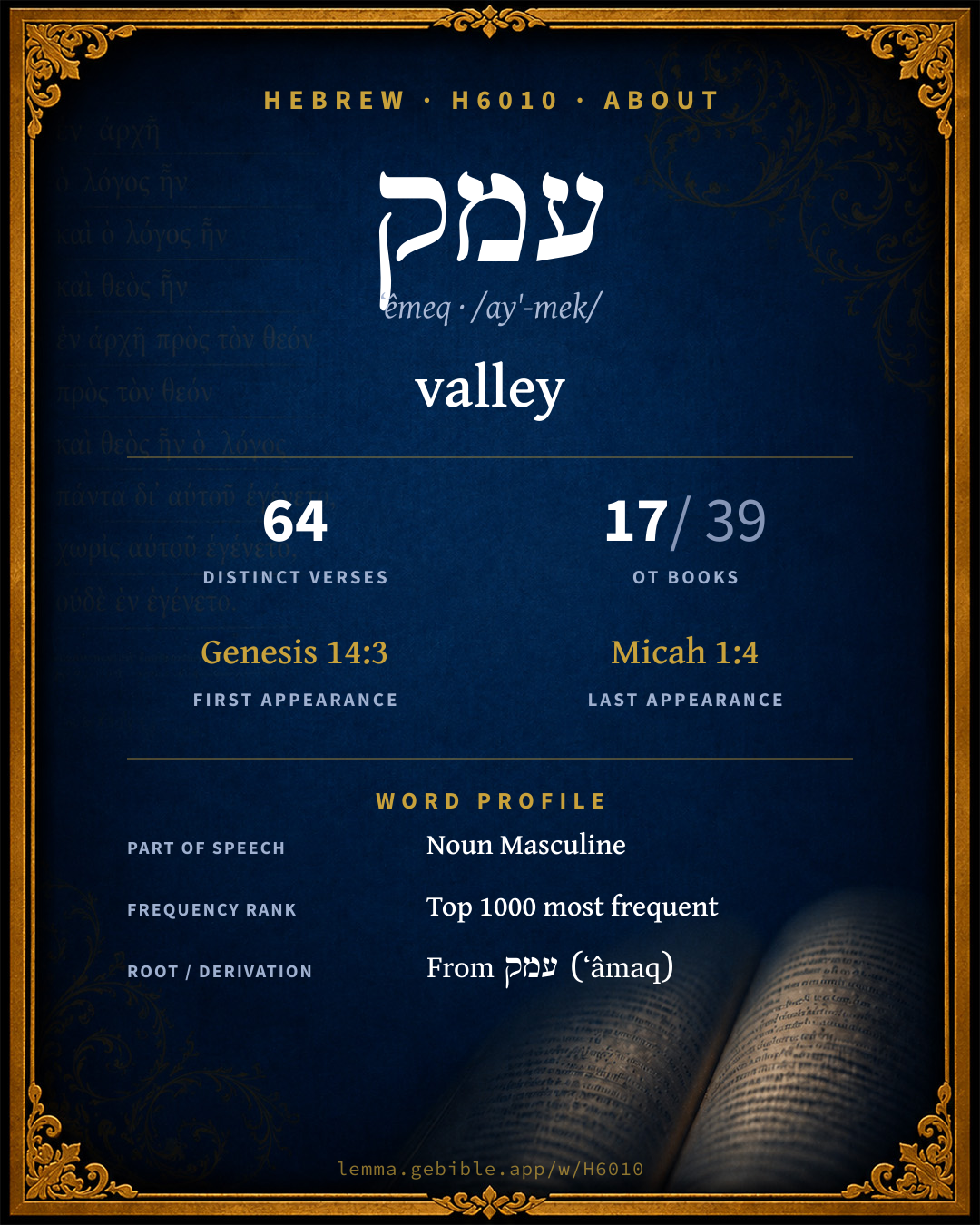
עֵ֫מֶק
valley
Full lexicon entry — Brown-Driver-Briggs (BDB)
From Brown-Driver-Briggs (BDB)
Where this word appears
See every Absolute-state word in the Hebrew Bible →
Grammar key — what these labels mean
Part of speech
- Noun
- A naming word — a person, place, thing, or idea.
Noun type
- Common
- A common noun — a general class of person, place, or thing (“king,” “city,” “water”), not a specific name.
State
- Construct
- A noun bound to a following noun in a possessive / “of” relationship (the construct chain).
- Absolute
- The independent form of a noun, not bound to a following word.
Gender
- Masculine
- Grammatically masculine.
Number
- Singular
- One.
- Plural
- More than one (in Hebrew, generally three or more).
2 verses where H6010 appears in the Construct state in the Book of Jeremiah. Filtered view — show all forms. Click any verse to open its interlinear word-by-word view. Verse text shown in the World English Bible for context — . Each verse’s Hebrew form is shown with its reference; the English is not keyword-highlighted, since the data carries no word-level English alignment. Use “Compare translations” on any verse to read it across multiple English versions. This concordance covers the Hebrew Bible; Septuagint (Greek Old Testament) occurrences are not indexed here.
Jeremiah
- Jeremiah 47:5 עִמְקָ֑/ם n c ms cs + sfx pers 3mp Baldness is come on Gaza; Ashkelon is brought to nothing, the remnant of their valley: how long will you cut yourself?
- Jeremiah 49:4 בָּֽ/עֲמָקִ֔ים עִמְקֵ֔/ךְ prep det + n c mp n c ms cs + sfx pers 2fs Why glory you in the valleys, your flowing valley, backsliding daughter? who trusted in her treasures, [saying], Who shall come to me?
About this entry
At a glance — auto-summarized from this page’s data, not written by a person. Every figure links to its source below. This summary describes the numbers; it doesn’t interpret them.
“valley” is the headline sense of the Hebrew noun עמק (ʻêmeq). Where the King James Version says “valley,” newer translations reach for “valley of” (unfoldingWord Literal Text); the renderings breakdown has the detail. The Hebrew Bible uses it across 64 verses — moderately common. First canonically at Genesis 14:3, it enters the text early. It shares a root with עמק, מעמק and עמק. See the sense tree, 64-verse concordance, and the renderings breakdown below.
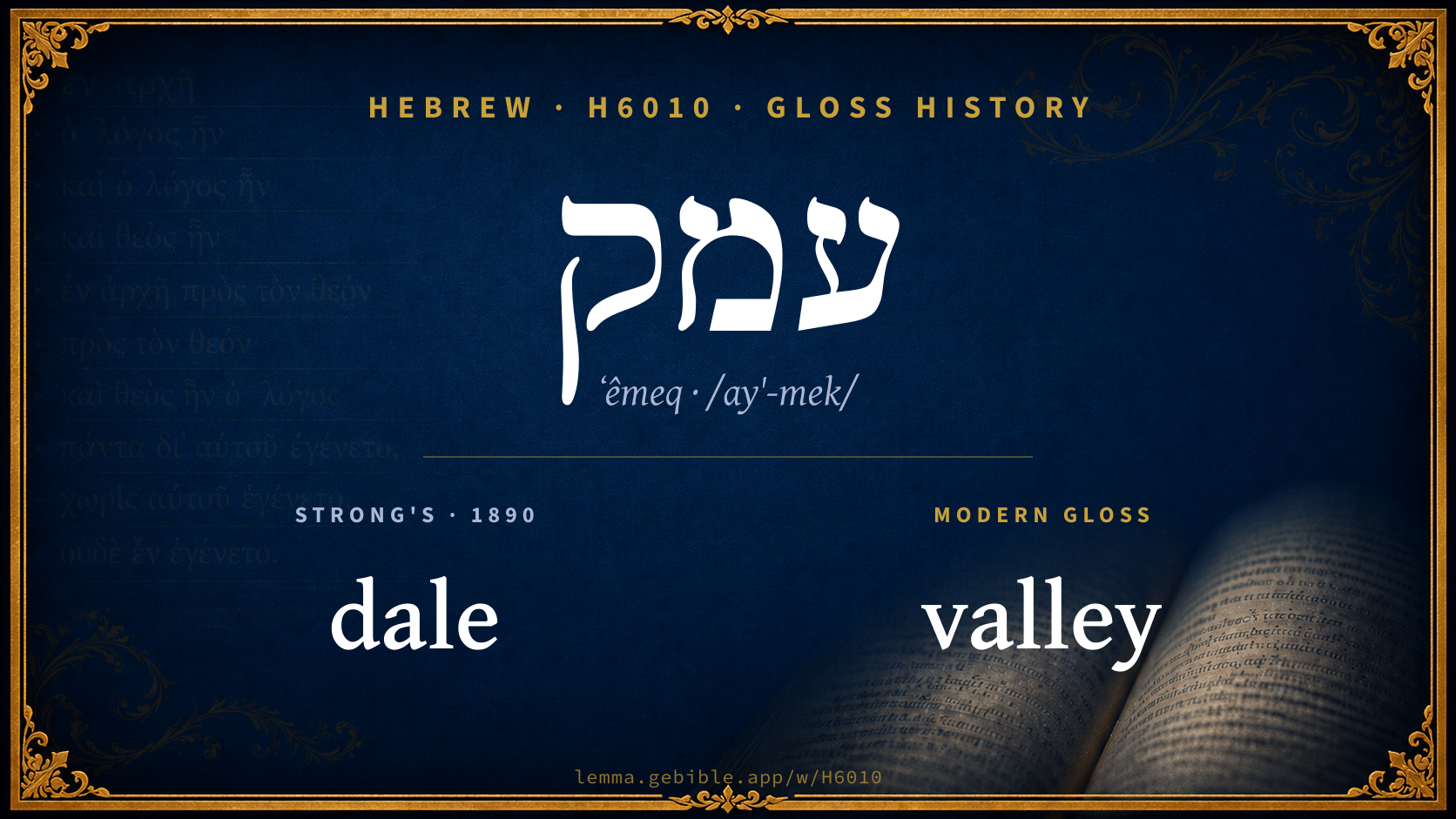
Gloss history
Strong's 1890 vs modern scholarship
About this word
Strong's H6010 catalogs a Hebrew word from the Hebrew Old Testament.
These counts are not copied from any lexicon or concordance. They are computed here, from the morphology-tagged Hebrew Old Testament. What Lemma adds →
- 64
- distinct verses
- The word appears in 64 distinct verses.
- 17 / 39
- OT books
- The word appears in 17 of 39 Old Testament books.
- #575
- by frequency
- Top 1000 most frequent Hebrew words (rank 575 of 8,640 Hebrew words by occurrence).
View all 64 occurrences in the concordance →
Most concentrated in
- Joshua 11 verses 17%
- Judges 8 verses 13%
- 1 Chronicles 6 verses 9%
By section of the Old Testament
By traditional corpus
Conventional, traditional groupings — biblical authorship is debated, so this is a traditional corpus grouping, not an authorship claim. Each share is this word’s portion of its verses in that division of the Hebrew canon. Each figure is a share of the word’s 64 distinct verses.
- Prophets (Nevi'im) 44 verses · 69%
- Writings (Ketuvim) 14 verses · 22%
- Torah (Pentateuch) 6 verses · 9%
How translations render this word
Counts come from each version’s own published word-to-Strong’s tagging or interlinear alignment — an approximate guide to how each version renders this word, not a word-level alignment the data otherwise carries. Because each total is that version’s own tagged count, the per-version totals vary from one another and need not match the appearance or distinct-verse counts above. These counts may also differ from a printed concordance because Lemma counts each distinctly tagged rendering and does not collapse phrase taggings into a single head-word total. This is a fixed set of word-tagged versions (KJV, ASV, BSB, ULT) and does not change with the reading translation you choose elsewhere. Each version’s license is shown beside its name below (and on Sources).
- King James Version: Valley 39×, Valleys 5×, Themselves in the valley 4×
- American Standard Version: Valley 32×, Vale 4×, Valleys 4×
- Berean Standard Bible: Valley 49×, Valleys 10×
- unfoldingWord Literal Text: Valley of 27×, Valley 21×, Valleys 8×
King James Version Public Domain
Renders H6010 across 69 tagged occurrences — most commonly:
Plus 13 renderings that appear only once — usually multi-word phrases or single function words the recovered tagging swept in, not distinct renderings.
American Standard Version Public Domain
Renders H6010 across 69 tagged occurrences — most commonly:
Plus 26 renderings that appear only once — usually multi-word phrases or single function words the recovered tagging swept in, not distinct renderings.
Berean Standard Bible Public Domain
Renders H6010 across 68 tagged occurrences — most commonly:
Plus 9 renderings that appear only once — usually multi-word phrases or single function words the recovered tagging swept in, not distinct renderings. Not rendered by a distinct English word in 1 further occurrence.
unfoldingWord Literal Text CC BY-SA 4.0
Renders H6010 across 68 tagged occurrences — most commonly:
Plus 8 renderings that appear only once — usually multi-word phrases or single function words the recovered tagging swept in, not distinct renderings.
Senses in BDB
The 1 sense BDB distinguishes for this word, in lexicon order (not ranked by frequency or importance). The full entry — with sub-senses — is in the Lexicon Entry tab.
- valley, vale, lowland, open country
Word origin
n.m. Mi 1:4 vale (proposes deepening, depth, v. GASmGeogr. 384f. 654f.; cf. בִּקְעָה, גַּיְא, נַחַל);—ע׳ abs. Jos 8:13 +, cstr. Gn 14:17 +; sf. עִמְקֵךְ Je 49:4, עִמְקָם 47:5 (but v. infr.); pl. עֲמָקִים Mi 1:4, sf. עֲמָקַיִךְ Is 22:7;—vale, valley, lowland, opp. הֶהָרִים Mi 1:4, amid mts., e.g. about Jerus. Is 22:7; Je 31:40, so perhaps ע׳ שָׁוֵה Gn 14:17 = ע׳ הַמֶּלֶךְ v 17; 2 S 18:18, cf. ע׳ חֶבְרוֹן Gn 37:14 (J), ע׳ בְּגִבְעוֹן Is 28:21; Jos 8:13 (JE), ע׳ הָאֵלָה 1 S 17:2, 19; 21:10 (perhaps Wady es-Sant, in Shephelah, W. of Bethlehem, GASmGeogr. 226); ע׳ אֲשֶׁר לְבֵית רְחוֹב Ju 18:28 in extreme north; in Moab Je 48:8 (‖ [opp.?] מִישׁוֹר); or wider, e.g. Ju 5:15 (scene of Sisera’s defeat; read perhaps ע׳ also for עֲמָלֵק v 14 GFM), ע׳ יִזְרְעֶ֑אל Ju 6:33; Ho 1:5; Jos 17:16 (JE), cf. Ju 7:1, 8, 12; 1 S 31:7 = 1 Ch 10:7, these all perhaps narrow ends of plain (cf. GASml.c.), but v. 1 K 20:28 (opp. הֶהָרִים; ‖ מִישׁוֹר v 23; = open country, cf. Aphek v 26); of Jordan-valley Jos 13:19, 27 (P); of Philistine plain (opp. הָהָר) Ju 1:19, 34; fit for chariots, so also אֶרֶץ הָע׳ Jos 17:16 (P), cf. Jb 39:21; ישֶׁבֶת הָע׳ Je 21:13, cf. Nu 14:25 (v. Gie Di); cultivated 1 S 6:13; Je 49:4(×2) Jb 39:10, fertile 1 Ch 27:29 ψ 65:14; Ct 2:1; v. also אַיָּלוֹן, בָּכָא, בְּרָכָה, ii. חָרוּץ, יְהוֹשָׁפָט, סֻכּוֹת, עָכוֹר, קְצִיץ, רְפָאִים, שִׂדִּים; בֵּית הָע׳ v. p. 112a.—For עִמְקָם Je 47:5 read עֲנָקִם Anakim 𝔊 Thes Hi Gf Gie Co Rothst; so also (more dub.) 1 Ch 12:16 (van d. H. v 15) Gf Gie, where otherwise הָע׳ = people of valleys.
— Brown-Driver-Briggs (Oxford 1906, public domain), digitized via Sefaria, supplemented by the OpenScriptures HebrewLexicon (CC BY 4.0). See Sources.
Derived from עמק (ʻâmaq) (H6009) — to be deep.
Jastrow Dictionary
A second Hebrew/Aramaic lexicon for comparison, covering Aramaic and post-biblical (Talmudic, Targumic, Midrashic) usage that the biblical-Hebrew BDB does not. Matched by lemma rather than by Strong’s number, so a lemma may carry more than one Jastrow headword (shown separately below), and the entries cover usage well beyond the Bible.
עָמַק
- (b. h.) to be depressed, deep.
- 1. to deepen. Ex. R. s. 1 הֶעֱמִיקוּ עצה וכ׳ they laid deep plans that the Lord etc.
- 2. to grow deeper. Yalk. Is. 302 (play on תפתה, Is. XXX, 33) אף היא מתפתה … ומרחבת ומַעֲמֶקֶת it (Gehenna) likewise extends every day and becomes wider and deeper.—[Cant. R. to IV, 4 והיה מעמקו some ed., v. עָקַם.] e.g. Isaiah 30:33
עֹמֶק
- , v. עוֹמֶק
עֵמֶק
- preced. wds.)
- 1. valley. Shebi. IX, 2 גליל העליון … והע׳ Upper Galilee, Lower Galilee, and the (Galilean) valley; תחום טבריא הע׳ the district of Tiberias is the valley (of Galilee). Tosef. ib. VII, 10 ההר והע׳ והשפלה the mountain land, the valley, and the lowland. Ib. אוכלין מבהר על שבע׳ (in the Sabbatical year) you may eat the mountain fruits as long as the same kind is still to be had in the valleys. Ib. הר והורו ע׳ ועִמְקוֹ וכ׳ mountain land and an elevation on it, a valley and a depression in it, lowland and a lower plain in it (are respectively subject to the same laws); Y. ib. X, 38ᵈ bot. (corr. acc.). Ib. מלוד עד הים ע׳ from Lydda to the sea is the valley (of Judæa), v. שְׁפֵלָה; a. fr.—Pl. עֲמָקִים. Ib. סימן לע׳ תמרים the presence of palms indicates valleys; Tosef. l. c. סימן לע׳ דקלים.
- 2. pr. n. pl. ʿEmeḳ, in the district of Tyre. Tosef. Shebi. IV, 9 (Y. Dem. II, 22ᵈ top אמון).
A Dictionary of the Targumim, the Talmud Babli and Yerushalmi, and the Midrashic Literature (Marcus Jastrow; London, Luzac, 1903) — Public Domain. Digitized via Sefaria. Digitized via Sefaria. Full attribution on Sources.
Forms in the corpus
The 38 distinct written forms H6010 takes in the Hebrew Bible, most frequent first — each parse links to that state’s occurrences in the concordance. Hebrew forms include their vowel points and cantillation, so a single lemma takes many written forms.
Same root — word family
Other BDB entries built from the same root as H6010, grouped by Strong’s listed origin. These share a root / origin per the lexicon — not necessarily a shared meaning. Each links to that word’s own entry.
Derives from
Shares the same root
Proper names from this root
People and places named from this root — a name, not an additional meaning of the word.
Compare all same-root words → Showing 4 of 7 — not the complete family. 1 of the same-root words is a proper name (a person or place). They share a root, not necessarily a meaning.
Septuagint verse parallels
This word appears in 61 verses that also exist in the Greek Old Testament (Septuagint), out of the 64 Hebrew verses it occurs in. You can read those verses in Greek by switching the Old Testament edition to the Septuagint.
Read these verses in the Septuagint
- Genesis 14:3
- Numbers 14:25
- Joshua 7:24
- Judges 1:19
- 1 Samuel 6:13
- 2 Samuel 5:18
- 1 Kings 20:28
- 1 Chronicles 10:7
- 2 Chronicles 20:26
- Job 39:10
- Psalms 60:6
- Song of Solomon 2:1
This is a verse-level parallel only — the same verses exist in both the Hebrew and Greek Old Testaments. No word-level Hebrew↔Greek correspondence is claimed: the data carries no such alignment, so no Greek word is shown as this Hebrew word’s translation. Coverage is not total — the Septuagint omits the deuterocanon and renumbers the Psalms, so some Hebrew verses have no direct Greek parallel.