
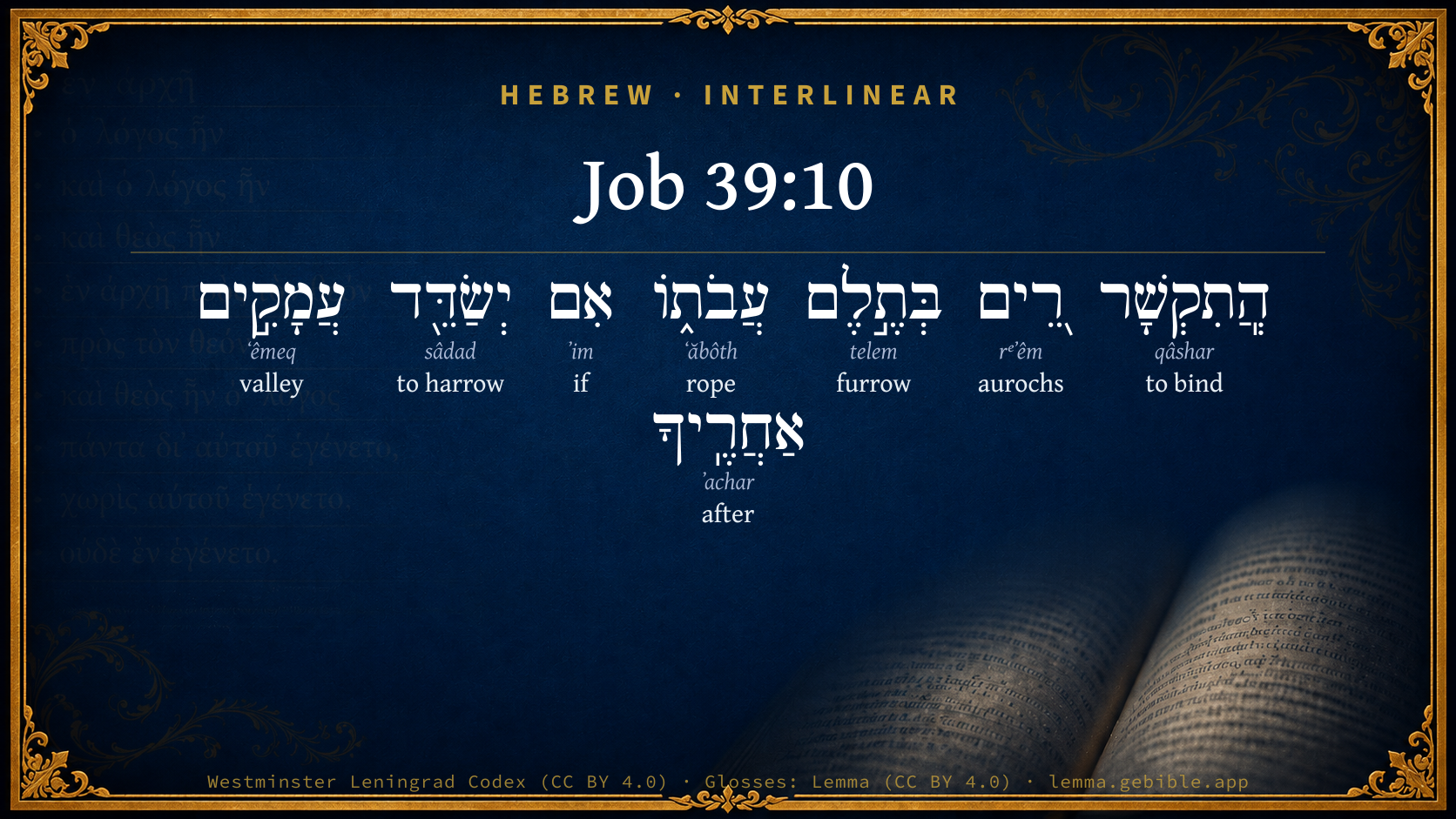
Job 39:10

Hebrew (Westminster Leningrad Codex) Job 39:10 appears in the Hebrew Old Testament. The text above is from the Westminster Leningrad Codex. Each word links to its Strong’s number, a concise gloss, and parsing drawn from the Open Scriptures Hebrew Bible morphology. Click any word for its full Brown-Driver-Briggs (BDB) entry.
Download image
Cite this verse

Job 39:10 (World English Bible). Public Domain. Lemma interlinear Bible study tool, https://lemma.gebible.app/v/job/39/10.

Show BibTeX & RIS
BibTeX
RIS
English Translation
Can you hold the wild ox in the furrow with his harness? Or will he till the valleys after you?
World English Bible · Public Domain
Highlights
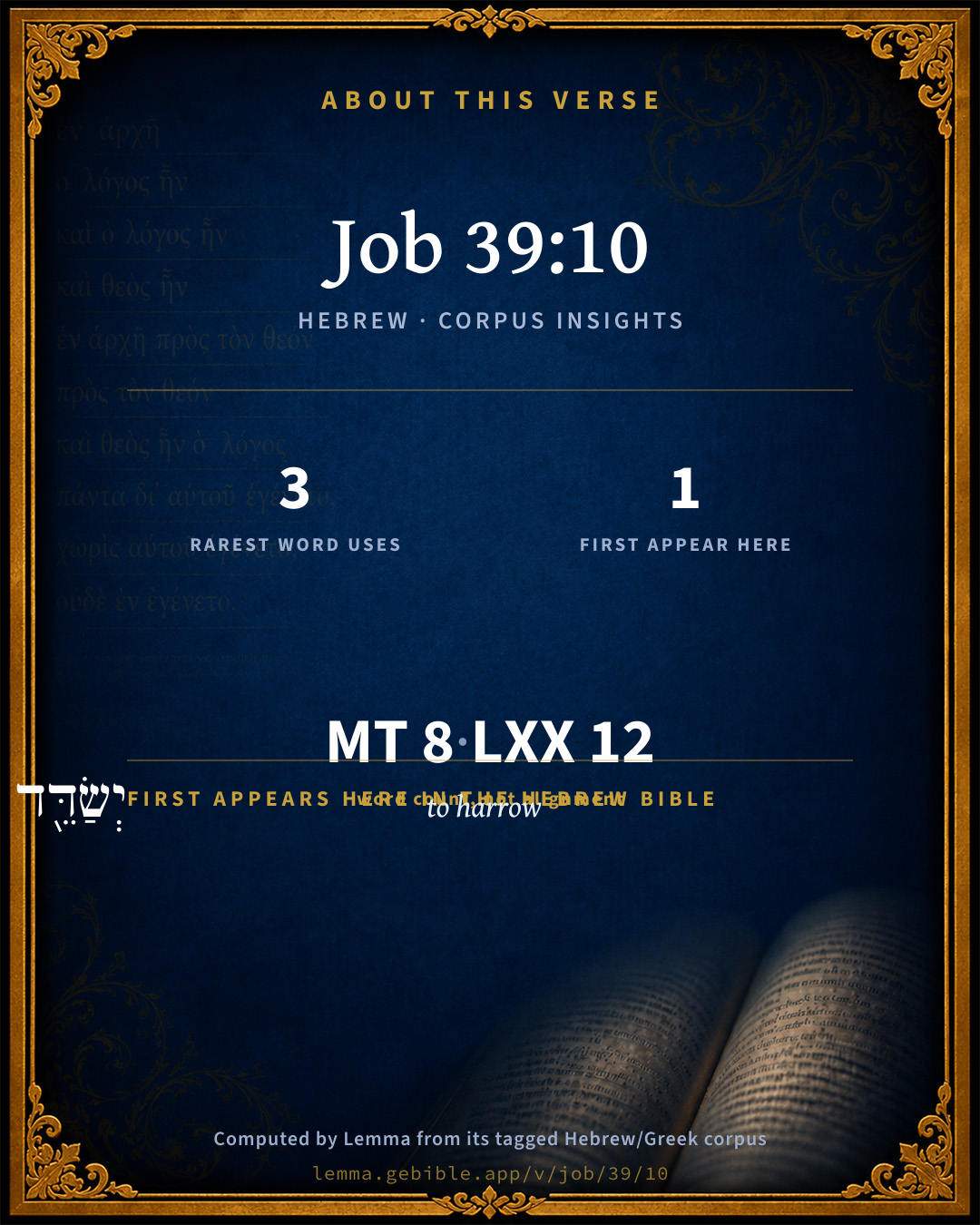
  • 1 first appearance in the Hebrew Bible
Full analysis ↓
Download a study sheet

One document with this verse’s original text, its word-by-word gloss line, the meaning frame, cross-references with their text, attributed commentary, and full source and license credits — printable, and it pastes into notes with its structure intact.

This verse Autodidact and up

Study sheet (.html) Plain text (.txt)

A passage Seminary Student

Up to 50 verses in one chapter. A passage sheet keeps up to 6 commentary sources and 12 cross-references per verse, in the order this page ranks them, and says so on the sheet whenever that leaves anything out. Ask for a single verse and you get the Autodidact verse sheet above.

Everything on this page stays free to read, with no account — the sheet is a download of what is already on screen, not access to it.

Want to remove ads? Support Godless Engineer
Compare translations 3

The same verse in 3 English versions, stacked beneath the original-language interlinear above. Click any original word for its lexicon entry.

Each is an independent rendering of the whole verse — the interlinear is not word-aligned to these translations.

Highlighted words mark where these versions differ — a whole-verse word diff, not a word-by-word alignment.

  • World English Bible Public Domain
    Can you hold the wild ox in the furrow with his harness? Or will he till the valleys after you?
  • King James Version Public Domain
    Canst thou bind the unicorn with his band in the furrow? or will he harrow the valleys after thee?
  • unfoldingWord Literal Text CC BY-SA 4.0
    Will you bind a wild ox in a furrow its rope? If it will harrow the valleys after you?

unfoldingWord Literal Text — © unfoldingWord, licensed CC BY-SA 4.0. Word-aligned USFM3 via Door43 (git.door43.org/unfoldingWord/en_ult).

Versions to compare (up to 4)

3 of 4 selected

Show all 18 translations

Every available English version of this verse, each an independent rendering of the whole verse.

  • World English Bible Public Domain
    Can you hold the wild ox in the furrow with his harness? Or will he till the valleys after you?
  • Berean Standard Bible Public Domain
    Can you hold him to the furrow with a harness? Will he plow the valleys behind you?
  • Majority Standard Bible Public Domain
    Can you hold him to the furrow with a harness? Will he plow the valleys behind you?
  • King James Version Public Domain
    Canst thou bind the unicorn with his band in the furrow? or will he harrow the valleys after thee?
  • American Standard Version (1901) Public Domain
    Canst thou bind the wild-ox with his band in the furrow? Or will he harrow the valleys after thee?
  • Revised Version (1885) Public Domain
    Canst thou bind the wild-ox with his band in the furrow? or will he harrow the valleys after thee?
  • Geneva Bible (1599) Public Domain
    He derideth the multitude of the citie: he heareth not the crie of the driuer.
  • Douay-Rheims (1899) Public Domain
    Canst thou bind the rhinoceros with thy thong to plough, or will he break the clods of the valleys after thee?
  • Young's Literal Translation Public Domain
    Dost thou bind a Reem in a furrow `with' his thick band? Doth he harrow valleys after thee?
  • Literal Standard Version CC BY-SA 4.0
    Do you bind a wild ox in a furrow [with] his thick band? Does he harrow valleys after you?
  • Unlocked Literal Bible CC BY-SA 4.0
    Can you use ropes to hold the wild ox in the furrows? Will he harrow the valleys as he follows after you?
  • unfoldingWord Literal Text CC BY-SA 4.0
    Will you bind a wild ox in a furrow its rope? If it will harrow the valleys after you?
  • Darby Bible Public Domain
    Canst thou bind the buffalo with his cord in the furrow? or will he harrow the valleys after thee?
  • World Messianic Bible Public Domain
    Can you hold the wild ox in the furrow with his harness? Or will he till the valleys after you?
  • Webster's Bible Public Domain
    \\39:7\\He scorneth the multitude of the city, neither regardeth he the crying of the driver.
  • Free Bible Version CC BY-SA 4.0
    Can you tie a wild ox to a plow? Can you make it till your fields for you?
  • Bible in Basic English Public Domain
    He makes sport of the noise of the town; the voice of the driver does not come to his ears;
  • JPS Tanakh (1917) Public Domain
    Canst thou bind the wild-ox with his band in the furrow? Or will he harrow the valleys after thee?

Literal Standard Version (2020), Covenant Press — licensed CC BY-SA 4.0. Text via the HelloAO Bible API (eBible.org). Unlocked Literal Bible (unfoldingWord) — licensed CC BY-SA 4.0. Text via the HelloAO Bible API (eBible.org). unfoldingWord Literal Text — © unfoldingWord, licensed CC BY-SA 4.0. Word-aligned USFM3 via Door43 (git.door43.org/unfoldingWord/en_ult). Free Bible Version, Dr. Jonathan Gallagher — licensed CC BY-SA 4.0. Text via the HelloAO Bible API (eBible.org).

Word by word

More ways to search: Search by grammar → Find every occurrence → Compare this word →

Practice this passage: Drill this verse → Learn its vocabulary →

About this verse

These counts appear in no published source. They are computed here, from the morphology-tagged text and Lemma’s own curated glosses. What Lemma adds →

8
words
8
distinct lemmas
Wisdom
section

Notable vocabulary

The rarest word here is יְשַׂדֵּ֖ד to harrow H7702 — appearing just 3 times in the whole Hebrew Bible.

First appearance in Scripture

This word makes its first canonical appearance in the Hebrew Bible here:

  • יְשַׂדֵּ֖ד to harrow H7702

Shared distinctive vocabulary

יְשַׂדֵּ֖ד to harrow H7702 occurs in 3 verses of the Hebrew Bible. Also found in:

Grammatical profile

  • 2 verbs
  • 4 nouns
  • 1 preposition
  • 1 conjunction

Verb forms

  • הֲֽתִקְשָׁר Qal · Imperfect
  • יְשַׂדֵּ֖ד Piel · Imperfect

Hebrew & Septuagint length

In English translation the verse runs 20 words from the Hebrew and 18 from the Septuagint (LXX English) — closely comparable.

A rough comparison of the two English renderings, which tokenize alike — not a word-level alignment.

Word counts can differ between the Hebrew and the Greek without any difference in meaning — e.g. the Hebrew direct-object marker אֵת has no separate Greek word, and Greek often adds the article ὁ.

In the original languages it is 8 Hebrew tokens and 12 Greek tokens — but the two are counted differently (Hebrew bundles its prefixes and suffixes into one token; the Greek is in lemma form), so that isn’t a like-for-like length.

Cross-references

7

Topical passages linked to Job 39:10 in the Treasury of Scripture Knowledge — connected by theme and wording, ordered by reader-vote popularity; previews shown in the World English Bible.

  • Job 1:14 that there came a messenger to Job, and said, "The oxen were plowing, and the donkeys feeding beside them,
  • Job 39:5 "Who has set the wild donkey free? Or who has loosened the bonds of the swift donkey,
  • Job 39:7 He scorns the tumult of the city, Neither hears he the shouting of the driver.
  • Job 41:5 Will you play with him as with a bird? Or will you bind him for your girls?
  • Psalms 129:3 The plowers plowed on my back. They made their furrows long.
  • Hosea 10:10–11 When it is my desire, I will chastise them; And the nations will be gathered against them, When they are bound to their two transgressions.
  • Micah 1:13 Harness the chariot to the swift steed, inhabitant of Lachish. She was the beginning of sin to the daughter of Zion; For the transgressions of Israel were found in you.

Cross-references courtesy of OpenBible.info (CC BY 4.0).

Hebrew and Greek witnesses Masoretic Hebrew ↔ Greek Septuagint

The same verse in the two great witnesses to the Old Testament, shown verse-for-verse.

These are two independent witnesses, not word-aligned to each other, and the Septuagint is shown in lemma (dictionary) form.

Hebrew Job 39:10 Masoretic · Westminster Leningrad Codex

הֲֽתִקְשָׁר רֵ֭ים בְּתֶ֣לֶם עֲבֹת֑וֹ אִם יְשַׂדֵּ֖ד עֲמָקִ֣ים אַחֲרֶֽיךָ

Can you hold the wild ox in the furrow with his harness? Or will he till the valleys after you?

World English Bible · Public Domain

Greek LXX Job 39:10 Septuagint · lemma form

δέω δέ ἐν ἱμάς ζυγός αὐτός ἤ ἕλκω σύ αὖλαξ ἐν πεδίον

And will you bind his yoke with thongs, or will he plow furrows for you in the plain?

LXX2012 (modern English Septuagint) · Public Domain

Hebrew: Westminster Leningrad Codex (CC BY 4.0). Greek: Septuagint (public domain); English from LXX2012 (modern English Septuagint) (Public Domain). How the Septuagint differs from the Hebrew →

Commentary

Notes on Job 39:10 from classic Christian and Jewish commentators (each source and its license shown beneath its notes). The classic Christian expositions comment on the surrounding passage and are grouped to its opening verse, so a note may address several verses; the Jewish commentaries on the Tanakh (Rashi and others) are per-verse, so they appear only where the commentator wrote on this verse.

Lemma curates 59 commentaries, every one of them public domain or Creative Commons licensed, each selected and text-cleaned for this edition rather than reprinted as found. About our sources →

Trapp's Complete Commentary

John Trapp

Job 39:10 Canst thou bind the unicorn with his band in the furrow? or will he harrow the valleys after thee?

Ver. 10. Canst thou bind the unicorn? &c.] To keep him in order, and to hold him hard to his work, that he may lay the furrows even? Canst thou tether or gear him, like a horse? Or wilt he be brought to drive or lead a plough or harrow? No such matter. Before the Fall all creatures would gladly have served man. Sed rebellis facta est, quia homo numini, creatura homini (August.).

John Trapp, A Commentary or Exposition upon All the Books of the Old and New Testament (1647–1656) — public domain. Text from a community e-Sword module.

The Biblical Illustrator

Joseph S. Exell

Job_39:10

Will he harrow the valleys after thee?

Will he harrow the valleys after thee

What more humiliating proof have we of the depravity of the human heart, than the arrogant assumption of deciding on Gods plans, and censuring His providential government, when we are so entirely ignorant of the most simple and ordinary occurrences in Nature? This was the error into which Job had fallen. Harrowing so tears and disturbs the ground, that it has, from the earliest ages, been considered as a fit emblem of very heavy and complicated trial. Here it suggests the necessity and benefits of frequent adversity.

1. The human heart, naturally haughty, requires much to reduce it, and break it into subjection to Christ; events adverse to our wishes, and which cross our inclinations, graciously effect this useful purpose. As the ground is torn and reduced by the harrow, so adversities administered by the Almighty lower the haughty temper and subdue the unhallowed dispositions of His people.

2. By this method of tillage the surface of the earth is smoothed and rendered level. Our minds are brought into an orderly and submissive state by trials of extraordinary severity and pressure. So ruffled and rugged are our tempers that, for our own sakes, this chaos must be brought to order, this confusion into regularity. The unequality of a ploughed field is too feeble a representation of this state of mind.

3. Adverse providences occasion the good seed of the Word to be covered and hidden in our hearts, as the grain literally is covered from injury, and concealed from the birds, by the process of harrowing. An analogy may be traced between the field sown and yet unharrowed, and the mind stored with moral and even religious instruction, but undisciplined by trial.

4. The resemblance between the usefulness of harrowing, to collect the dead weeds, and cleanse the land of old roots, and the good effects of holy trouble, to detach those many moral weeds and those pernicious roots of evil which yet remain in our hearts. (W. Clayton.)

The Biblical Illustrator, edited by Joseph S. Exell (c. 1880s–1900s) — public domain. Text from a community e-Sword module.

Joseph Benson's Commentary

Job 39:10-11. Canst thou bind the unicorn in the furrow? — That is, in thy furrowed field, or to, or for the furrow? that is, to make furrows, or to plough, for which work cattle are usually bound together, that they may be directed by the husbandmen, and may make right furrows. Will he harrow the valleys — The low grounds; after thee? — Under thy conduct, following thee step by step? Wilt thou trust him — Namely, for the doing of these works; because his strength is great? — Because he is very able to do them. Wilt thou, by thy power, make him willing, or force him to put forth his strength in thy service? Wilt thou leave thy labour — Thy work of ploughing and harrowing; or the fruit of thy labour, namely, the fruits of the earth, procured by God’s blessing upon thy industry, to him? — Wilt thou leave them to him to be brought home into thy barns? as the next verse explains it.

Joseph Benson's Commentary on the Old and New Testaments (1811–1818) — public domain. Text from a community e-Sword module.

Jamieson, Fausset & Brown

Robert Jamieson, A. R. Fausset & David Brown

his band--fastened to the horns, as its chief strength lies in the head and shoulders.

after thee--obedient to thee; willing to follow, instead of being goaded on before thee.

Jamieson, Fausset & Brown — Commentary Critical and Explanatory on the Whole Bible (1871) — public domain (CC PDM 1.0). Text via the HelloAO Bible API.

Adam Clarke's Commentary

Verse 10. Canst thou bind the unicorn - in the furrow?] He will not plough, nor draw in the yoke with another? nor canst thou use him singly, to harrow the ground.

Adam Clarke's Commentary on the Bible (1810–1826) — public domain. Text from a community e-Sword/MySword module.

John Gill's Exposition

Canst thou bind the unicorn with his band in the furrow?.... Put the yoke and harness upon him, and fasten it to the plough to draw it, that he may make furrows with it in the field, or plough up the ground as the tame ox does? thou canst not;

or will he harrow the valleys after thee? draw the harrow which is used after ploughing to break the clods, and make the land smooth and even? he will not: valleys are particularly mentioned, because arable land is usually in them; see Psa 65:13.

John Gill's Exposition of the Whole Bible (1746–1763) — public domain (CC PDM 1.0). Text via the HelloAO Bible API.

Albert Barnes' Notes on the Bible

Canst thou bind the unicorn with his band in the furrow? - That is, with the common traces or cords which are employed in binding oxen to the plow.

Or will he harrow the valleys after thee? - The word “valleys” here is used to denote such ground as was capable of being plowed or harrowed. Hills and mountains could not thus be cultivated, though the spade was in common use in planting the vine there, and even in preparing them for seed, Isa 7:25. The phrase “after thee” indicates that the custom of driving cattle in harrowing then was the same as that practiced now with oxen, when the person who employs them goes in advance of them. It shows that they were entirely under subjection, and it is here implied that the ראם re'êm could not be thus tamed.

Albert Barnes' Notes on the Bible (1834–1885) — public domain. Text from a community e-Sword/MySword module.

Haydock's Catholic Bible Commentary

Valleys, or furrows. Can he be made to harrow?

George Leo Haydock (1774–1849), Haydock's Catholic Family Bible and Commentary, 1859 edition — public domain. Excludes Psalms (Douay-Rheims chapter numbering differs from Protestant) and Deuterocanonical books (Catholic canon only).

Matthew Poole's English Annotations

In the furrow, i.e. in thy furrowed field, by a metonymy. Or, to or for (as the prefix beth is oft used, as Gen 11:4; Lev 16:22; Job 24:5)

the furrow, i.e. to make furrows, or to plough; for which work cattle use to be bound together, that they may be directed by the husbandman, and may make right furrows.

The valleys, to wit, the low grounds, which are most proper for and most employed in the work of ploughing.

After thee; under thy conduct, following thee step by step.

Matthew Poole's English Annotations on the Holy Bible (1683–1685) — public domain. Text from a community e-Sword/MySword module.

Whedon's Commentary on the Bible

Daniel D. Whedon

10. With his band in the furrow — Literally, on the furrow of his cord: the sense of which is, according to Furst, “Canst thou bind the reem so that his draw-line is upon the ridge?” the left rope being always on the ridge of the bed in making the furrow. The telem, תלם, Arabic, tilem, here rendered furrow, was, according to the explanation of the Turkish Kamus, “the ditch-like crack which the iron of the ploughman tears in the field,” an explanation which Delitzsch approves; but this does not well accord with the use of the same word in Job_31:38, and Hos_10:4. The pictorial representations on the monuments show that the ancient Egyptians bound their oxen to the plough by a cord fastened around the horns and tied to the yoke and the handle. See note on Job_1:14.

Daniel D. Whedon (gen. ed.), Commentary on the Old and New Testaments (1874–1909) — public domain. Text from a community e-Sword module.

The Pulpit Commentary

Canst thou bind the unicorn with his band in the furrow? That is, "as thou bindest the ox?" Canst thou make him plough for thee? Or will he harrow the valleys after thee? Another common employment of oxen.

The Pulpit Commentary (1880–1919), ed. H.D.M. Spence-Jones & Joseph S. Exell — public domain. Text from a community e-Sword module.

Rashi

Rabbi Shlomo Yitzchaki (Rashi)

to a furrow with his rope (Or did you tie a wild ox because of the furrow of your ox?) rope Heb. עבתו, a rope with which they tie [oxen] to the furrows of the plow.

will he harrow, prepare the field.

Rashi on the Tanakh — English translations: “The Judaica Press complete Tanach with Rashi, translated by A. J. Rosenberg” (CC BY 4.0); “Pentateuch with Rashi's commentary by M. Rosenbaum and A.M. Silbermann, 1929-1934” (public domain); “The Metsudah Tanach series, Lakewood, N.J” (CC BY 4.0); and “The Book of Joshua, Metsudah Publications, 1997” (CC BY 4.0). Text via Sefaria.

Lesson kit

Teaching starters — assembled from the data on this page, not authored interpretation. Every prompt links to the verse data it draws on. Edit before teaching.

Job, in the Wisdom, opens this verse with 8 words (8 distinct Hebrew lemmas). Its most distinctive word is sâdad (“to harrow”). A historical commentator’s framing appears above. Read the whole chapter for the surrounding context.

Discussion questions

  1. The word sâdad carries the sense “to harrow.” How does it shape the verse?
  2. The word “to harrow” first appears here in Scripture. What is being introduced at this debut?
  3. Isaiah 28:24 shares the word «to harrow» with this verse. How do the two illuminate each other?
  4. The translations on this page render this verse differently — a whole-verse word diff, not a word-by-word alignment. What might account for the different wordings?
  5. The verb «הֲֽתִקְשָׁר» is Qal Imperfect. How does its form color the action?
  6. Reading how Trapp's Complete Commentary and The Biblical Illustrator read this verse, where do the two commentators agree and where do they part?

Things to notice

Reading settings

Reading text

Shown beneath each verse's original-language words.

Old Testament
Old Testament edition

Read the OT as the Masoretic Hebrew (MT) or the Greek Septuagint (LXX).

English shown for the Greek Septuagint (in the Hebrew ↔ Greek comparison).

Comparing translations? Open the Compare panel on any verse page to stack up to four side by side.