
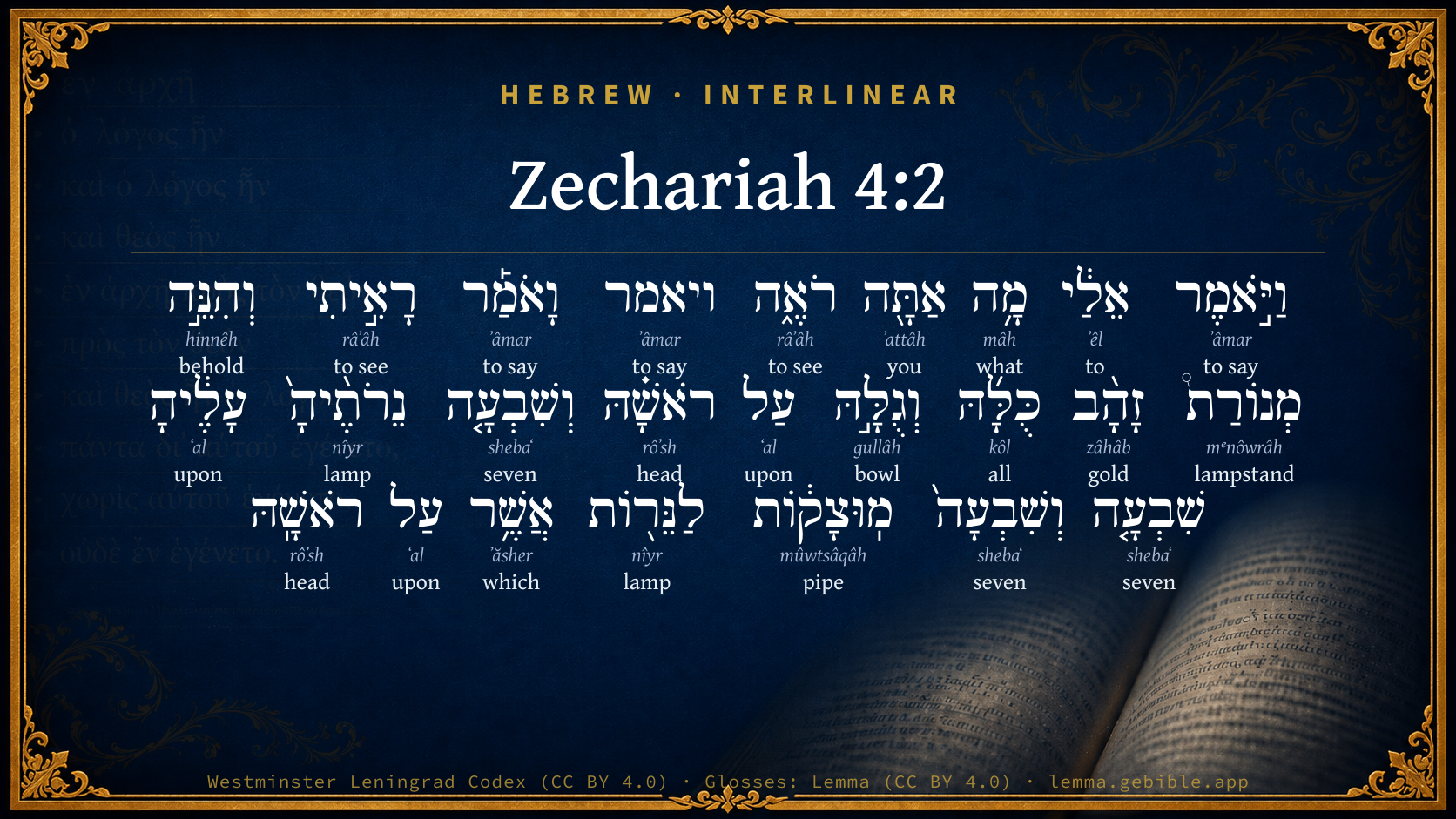
Zechariah 4:2

Hebrew (Westminster Leningrad Codex) Zechariah 4:2 appears in the Hebrew Old Testament. The text above is from the Westminster Leningrad Codex. Each word links to its Strong’s number, a concise gloss, and parsing drawn from the Open Scriptures Hebrew Bible morphology. Click any word for its full Brown-Driver-Briggs (BDB) entry.
Download image
Cite this verse

Zechariah 4:2 (World English Bible). Public Domain. Lemma interlinear Bible study tool, https://lemma.gebible.app/v/zechariah/4/2.

Show BibTeX & RIS
BibTeX
RIS
English Translation
He said to me, "What do you see?" I said, "I have seen, and, behold, a lampstand all of gold, with its bowl on the top of it, and its seven lamps thereon; there are seven pipes to each of the lamps, which are on the top of it;
World English Bible · Public Domain
Download a study sheet

One document with this verse’s original text, its word-by-word gloss line, the meaning frame, cross-references with their text, attributed commentary, and full source and license credits — printable, and it pastes into notes with its structure intact.

This verse Autodidact and up

Study sheet (.html) Plain text (.txt)

A passage Seminary Student

Up to 50 verses in one chapter. A passage sheet keeps up to 6 commentary sources and 12 cross-references per verse, in the order this page ranks them, and says so on the sheet whenever that leaves anything out. Ask for a single verse and you get the Autodidact verse sheet above.

Everything on this page stays free to read, with no account — the sheet is a download of what is already on screen, not access to it.

Want to remove ads? Support Godless Engineer
Compare translations 3

The same verse in 3 English versions, stacked beneath the original-language interlinear above. Click any original word for its lexicon entry.

Each is an independent rendering of the whole verse — the interlinear is not word-aligned to these translations.

Highlighted words mark where these versions differ — a whole-verse word diff, not a word-by-word alignment.

  • World English Bible Public Domain
    He said to me, "What do you see?" I said, "I have seen, and, behold, a lampstand all of gold, with its bowl on the top of it, and its seven lamps thereon; there are seven pipes to each of the lamps, which are on the top of it;
  • King James Version Public Domain
    And said unto me, What seest thou? And I said, I have looked, and behold a candlestick all of gold, with a bowl upon the top of it, and his seven lamps thereon, and seven pipes to the seven lamps, which are upon the top thereof:
  • unfoldingWord Literal Text CC BY-SA 4.0
    And he said to me, “What are you seeing?” And I said, “I have seen, and behold, a lampstand of gold, all of it, and its bowl on its top, and seven lamps on it, seven and seven tubes for the lamps that on its top.

unfoldingWord Literal Text — © unfoldingWord, licensed CC BY-SA 4.0. Word-aligned USFM3 via Door43 (git.door43.org/unfoldingWord/en_ult).

Versions to compare (up to 4)

3 of 4 selected

Show all 18 translations

Every available English version of this verse, each an independent rendering of the whole verse.

  • World English Bible Public Domain
    He said to me, "What do you see?" I said, "I have seen, and, behold, a lampstand all of gold, with its bowl on the top of it, and its seven lamps thereon; there are seven pipes to each of the lamps, which are on the top of it;
  • Berean Standard Bible Public Domain
    “What do you see?” he asked. “I see a solid gold lampstand,” I replied, “with a bowl at the top and seven lamps on it, with seven spouts to the lamps.
  • Majority Standard Bible Public Domain
    “What do you see?” he asked. “I see a solid gold lampstand,” I replied, “with a bowl at the top and seven lamps on it, with seven spouts to the lamps.
  • King James Version Public Domain
    And said unto me, What seest thou? And I said, I have looked, and behold a candlestick all of gold, with a bowl upon the top of it, and his seven lamps thereon, and seven pipes to the seven lamps, which are upon the top thereof:
  • American Standard Version (1901) Public Domain
    And he said unto me, What seest thou? And I said, I have seen, and, behold, a candlestick all of gold, with its bowl upon the top of it, and its seven lamps thereon; there are seven pipes to each of the lamps, which are upon the top thereof;
  • Revised Version (1885) Public Domain
    And he said unto me, What seest thou? And I said, I have seen, and behold, a candlestick all of gold, with its bowl upon the top of it, and its seven lamps thereon; there are seven pipes to each of the lamps, which are upon the top thereof:
  • Geneva Bible (1599) Public Domain
    And saide vnto me, What seest thou? And I said, I haue looked, and beholde, a candlesticke all of gold with a bowle vpon the toppe of it, and his seuen lampes therein, and seuen pipes to the lampes, which were vpon the toppe thereof.
  • Douay-Rheims (1899) Public Domain
    And he said to me: What seest thou? And I said: I have looked, and behold a candlestick all of gold, and its lamp upon the top of it: and the seven lights thereof upon it: and seven funnels for the lights that were upon the top thereof.
  • Young's Literal Translation Public Domain
    and he saith unto me, `What art thou seeing?' And I say, `I have looked, and lo, a candlestick of gold -- all of it, and its bowl `is' on its top, and its seven lamps `are' upon it, and twice seven pipes `are' to the lights that `are' on its top,
  • Literal Standard Version CC BY-SA 4.0
    and he says to me, “What are you seeing?” And I say, “I have looked, and behold, a lampstand of gold—all of it, and its bowl [is] on its top, and its seven lamps [are] on it, and twice seven pipes [are] to the lights that [are] on its top,
  • Unlocked Literal Bible CC BY-SA 4.0
    He said to me, “What do you see?” I said, “I see a lampstand made entirely of gold, with a bowl on its top. It has seven lamps on it and seven lamp wicks at the top of each lamp.
  • unfoldingWord Literal Text CC BY-SA 4.0
    And he said to me, “What are you seeing?” And I said, “I have seen, and behold, a lampstand of gold, all of it, and its bowl on its top, and seven lamps on it, seven and seven tubes for the lamps that on its top.
  • Darby Bible Public Domain
    And he said unto me, What seest thou? And I said, I see, and behold, a lamp-stand all of gold, with a bowl upon the top of it, and its seven lamps thereon, seven [lamps] and seven pipes to the lamps, which are upon the top thereof;
  • World Messianic Bible Public Domain
    He said to me, “What do you see?” I said, “I have seen, and behold, a lamp stand all of gold, with its bowl on the top of it, and its seven lamps on it; there are seven pipes to each of the lamps which are on the top of it;
  • Webster's Bible Public Domain
    And said to me, What seest thou? And I said, I have looked, and behold a candlestick: all of gold, with a bowl upon the top of it, and its seven lamps, and seven pipes to the seven lamps, which were upon the top of it.
  • Free Bible Version CC BY-SA 4.0
    “What do you see?” he asked me. “I see a lampstand made of solid gold with a bowl at its top having seven lamps on it, each with seven lips.
  • Bible in Basic English Public Domain
    And he said to me, What do you see? And I said, I see a light-support, made all of gold, with its cup on the top of it and seven lights on it; and there are seven pipes to every one of the lights which are on the top of it;
  • JPS Tanakh (1917) Public Domain
    And he said unto me: 'What seest thou?' And I said: 'I have seen, and behold a candlestick all of gold, with a bowl upon the top of it, and its seven lamps thereon; there are seven pipes, yea, seven, to the lamps, which are upon the top thereof;

Literal Standard Version (2020), Covenant Press — licensed CC BY-SA 4.0. Text via the HelloAO Bible API (eBible.org). Unlocked Literal Bible (unfoldingWord) — licensed CC BY-SA 4.0. Text via the HelloAO Bible API (eBible.org). unfoldingWord Literal Text — © unfoldingWord, licensed CC BY-SA 4.0. Word-aligned USFM3 via Door43 (git.door43.org/unfoldingWord/en_ult). Free Bible Version, Dr. Jonathan Gallagher — licensed CC BY-SA 4.0. Text via the HelloAO Bible API (eBible.org).

Word by word

More ways to search: Search by grammar → Find every occurrence → Compare this word →

Practice this passage: Drill this verse → Learn its vocabulary →

מֽוּצָק֔וֹת
mûwtsâqâh
H4166
“pipes”
Noun, Common, Feminine, Plural, Absolute
Part of Speech
Noun
Type
Common
Gender
Feminine
Number
Plural
State
Absolute
Full BDB Definition

Origin: from H3332

TWOT: 897c

pipe - a casting
  1. וַיֹּ֣אמֶר ʼâmar H559 “and · to say” Conjunction + Verb, Qal, Sequential Imperfect, 3rd Person, Masculine, Singular
  2. אֵלַ֔י ʼêl H413 “to · me” Preposition + Suffix, Personal, 1st Person, Common, Singular
  3. מָ֥ה mâh H4100 “what” Particle, Interrogative
  4. אַתָּ֖ה ʼattâh H859 “you” Pronoun, Personal, 2nd Person, Masculine, Singular
  5. רֹאֶ֑ה râʼâh H7200 “seeing” Verb, Qal, Participle Active, Masculine, Singular, Absolute
  6. ויאמר ʼâmar H559 “and · to say” Conjunction + Verb, Qal, Sequential Imperfect, 3rd Person, Masculine, Singular
  7. וָאֹמַ֡ר ʼâmar H559 “and · to say” Conjunction + Verb, Qal, Sequential Imperfect, 1st Person, Common, Singular
  8. רָאִ֣יתִי râʼâh H7200 “to see” Verb, Qal, Perfect, 1st Person, Common, Singular
  9. וְהִנֵּ֣ה hinnêh H2009 “and · behold” Conjunction + Particle, Demonstrative
  10. מְנוֹרַת֩ mᵉnôwrâh H4501 “lampstand of” Noun, Common, Feminine, Singular, Construct
  11. זָהָ֨ב zâhâb H2091 “gold” Noun, Common, Masculine, Singular, Absolute
  12. כֻּלָּ֜הּ kôl H3605 “all · her” Noun, Common, Masculine, Singular, Construct + Suffix, Personal, 3rd Person, Feminine, Singular
  13. וְגֻלָּ֣הּ gullâh H1543 “and · bowl” Conjunction + Noun, Common, Feminine, Singular, Absolute
  14. עַל ʻal H5921 “upon” Preposition
  15. רֹאשָׁ֗הּ rôʼsh H7218 “head · her” Noun, Common, Masculine, Singular, Construct + Suffix, Personal, 3rd Person, Feminine, Singular
  16. וְשִׁבְעָ֤ה shebaʻ H7651 “and · seven” Conjunction + Adjective, Cardinal number, Masculine, Singular, Absolute
  17. נֵרֹתֶ֨יהָ֙ nîyr H5216 “lamps · her” Noun, Common, Masculine, Plural, Construct + Suffix, Personal, 3rd Person, Feminine, Singular
  18. עָלֶ֔יהָ ʻal H5921 “upon · her” Preposition + Suffix, Personal, 3rd Person, Feminine, Singular
  19. שִׁבְעָ֤ה shebaʻ H7651 “seven” Adjective, Cardinal number, Masculine, Singular, Absolute
  20. וְשִׁבְעָה֙ shebaʻ H7651 “and · seven” Conjunction + Adjective, Cardinal number, Masculine, Singular, Absolute
  21. לַנֵּר֖וֹת nîyr H5216 “to/for the · lamps” Preposition, Determined + Noun, Common, Masculine, Plural, Absolute
  22. אֲשֶׁ֥ר ʼăsher H834 “which” Particle, Relative
  23. עַל ʻal H5921 “upon” Preposition
  24. רֹאשָֽׁהּ rôʼsh H7218 “head · her” Noun, Common, Masculine, Singular, Construct + Suffix, Personal, 3rd Person, Feminine, Singular

About this verse

These counts appear in no published source. They are computed here, from the morphology-tagged text and Lemma’s own curated glosses. What Lemma adds →

25
words
16
distinct lemmas
Prophets
section

Notable vocabulary

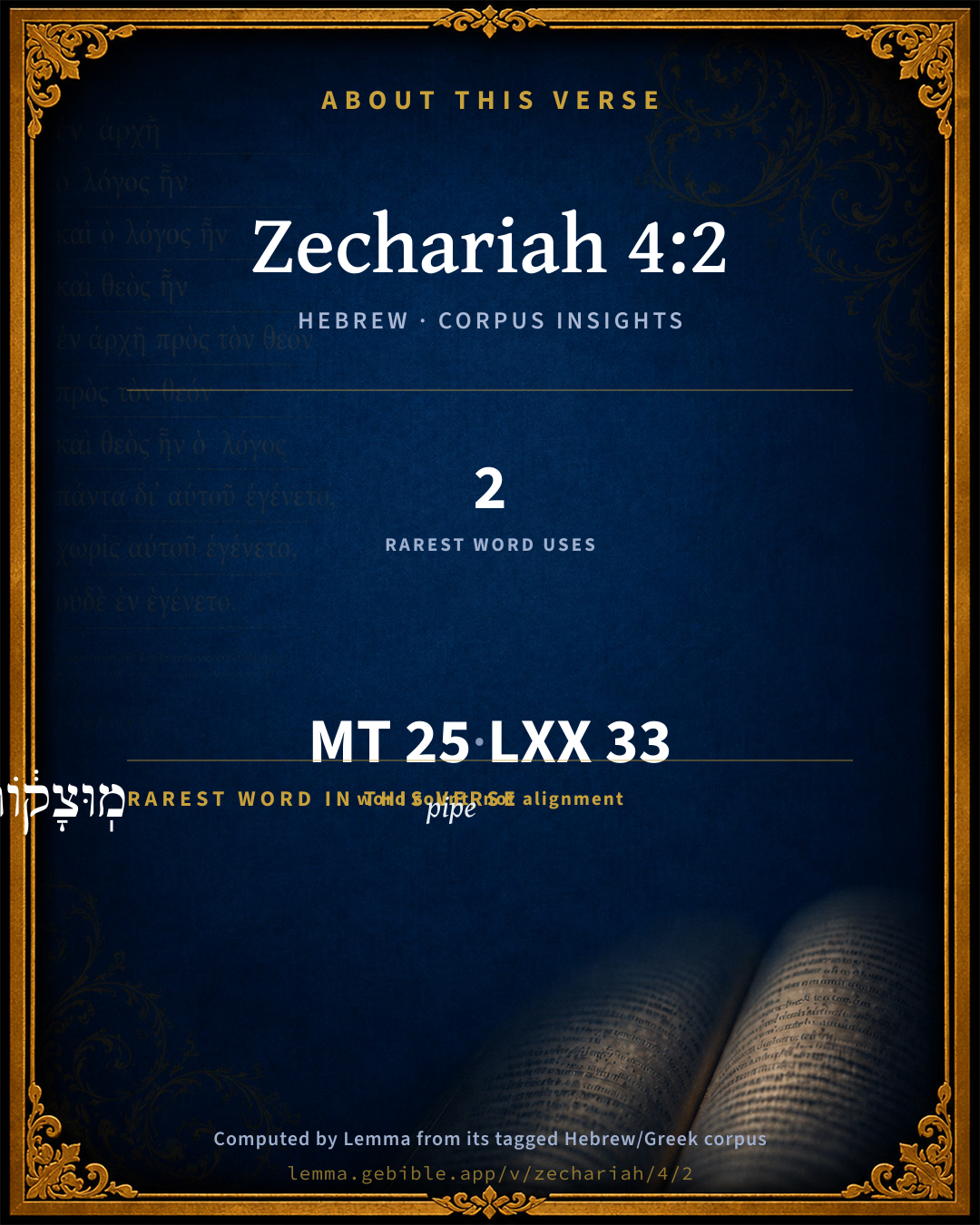
The rarest word here is מֽוּצָק֔וֹת pipe H4166 — appearing just 2 times in the whole Hebrew Bible.

Shared distinctive vocabulary

מֽוּצָק֔וֹת pipe H4166 occurs in 2 verses of the Hebrew Bible. Also found in:

Grammatical profile

  • 5 verbs
  • 9 nouns
  • 3 adjectives
  • 1 pronoun
  • 4 prepositions
  • 3 particles

Verb forms

  • וַיֹּ֣אמֶר Qal · Sequential Imperfect
  • רֹאֶ֑ה Qal · Participle Active
  • ויאמר Qal · Sequential Imperfect
  • וָאֹמַ֡ר Qal · Sequential Imperfect
  • רָאִ֣יתִי Qal · Perfect

Repetition

Words recur within this verse — often emphatic in Hebrew:

  • וַיֹּ֣אמֶר to say H559 ×3
  • עַל upon H5921 ×3
  • וְשִׁבְעָ֤ה seven H7651 ×3
  • רֹאֶ֑ה to see H7200 ×2
  • רֹאשָׁ֗הּ head H7218 ×2
  • נֵרֹתֶ֨יהָ֙ lamp H5216 ×2

Hebrew & Septuagint length

In English translation the verse runs 49 words from the Hebrew and 40 from the Septuagint (LXX English) — closely comparable.

A rough comparison of the two English renderings, which tokenize alike — not a word-level alignment.

Word counts can differ between the Hebrew and the Greek without any difference in meaning — e.g. the Hebrew direct-object marker אֵת has no separate Greek word, and Greek often adds the article ὁ.

In the original languages it is 25 Hebrew tokens and 33 Greek tokens — but the two are counted differently (Hebrew bundles its prefixes and suffixes into one token; the Greek is in lemma form), so that isn’t a like-for-like length.

Cross-references

15

Topical passages linked to Zechariah 4:2 in the Treasury of Scripture Knowledge — connected by theme and wording, ordered by reader-vote popularity; previews shown in the World English Bible.

  • Revelation 4:5 Out of the throne proceed lightnings, sounds, and thunders. There were seven lamps of fire burning before his throne, which are the seven Spirits of God.
  • Revelation 1:12 I turned to see the voice that spoke with me. Having turned, I saw seven golden lampstands.
  • Matthew 5:14–16 You are the light of the world. A city located on a hill can't be hidden.
  • Exodus 25:31–38 "You shall make a lampstand of pure gold. Of hammered work shall the lampstand be made, even its base, its shaft, its cups, its buds, and its flowers, shall be of one piece with it.
  • Jeremiah 52:19 The cups, and the fire pans, and the basins, and the pots, and the lampstands, and the spoons, and the bowls-that which was of gold, in gold, and that which was of silver, in silver,-the captain of the guard took away.
  • Zechariah 5:2 He said to me, "What do you see?" I answered, "I see a flying scroll; its length is twenty cubits, and its breadth ten cubits."
  • Exodus 37:17–24 He made the lampstand of pure gold. He made the lampstand of beaten work. Its base, its shaft, its cups, its buds, and its flowers were of one piece with it.
  • Exodus 40:24–25 He put the lampstand in the tent of meeting, opposite the table, on the side of the tent southward.
  • 1 Kings 7:49–50 and the lampstands, five on the right side, and five on the left, before the oracle, of pure gold; and the flowers, and the lamps, and the tongs, of gold;
  • 1 Chronicles 28:15 by weight also for the lampstands of gold, and for the lamps of it, of gold, by weight for every lampstand and for the lamps of it; and for the lampstands of silver, [silver] by weight for [every] lampstand and for the lamps of it, according to the use of every lampstand;
  • 2 Chronicles 4:7 He made the ten lampstands of gold according to the ordinance concerning them; and he set them in the temple, five on the right hand, and five on the left.
  • 2 Chronicles 4:20–22 and the lampstands with their lamps, to burn according to the ordinance before the oracle, of pure gold;
  • 2 Chronicles 13:11 and they burn to Yahweh every morning and every evening burnt offerings and sweet incense: the show bread also [set they] in order on the pure table; and the lampstand of gold with the lamps of it, to burn every evening: for we keep the charge of Yahweh our God; but you have forsaken him.
  • Jeremiah 1:11–13 Moreover the word of Yahweh came to me, saying, Jeremiah, what see you? I said, I see a rod of an almond tree.
  • Revelation 1:20–2:1 the mystery of the seven stars which you saw in my right hand, and the seven golden lampstands. The seven stars are the angels of the seven assemblies. The seven lampstands are seven assemblies.

Cross-references courtesy of OpenBible.info (CC BY 4.0).

Hebrew and Greek witnesses Masoretic Hebrew ↔ Greek Septuagint

The same verse in the two great witnesses to the Old Testament, shown verse-for-verse.

These are two independent witnesses, not word-aligned to each other, and the Septuagint is shown in lemma (dictionary) form.

Hebrew Zechariah 4:2 Masoretic · Westminster Leningrad Codex

וַיֹּ֣אמֶר אֵלַ֔י מָ֥ה אַתָּ֖ה רֹאֶ֑ה ויאמר וָאֹמַ֡ר רָאִ֣יתִי וְהִנֵּ֣ה מְנוֹרַת֩ זָהָ֨ב כֻּלָּ֜הּ וְגֻלָּ֣הּ עַל רֹאשָׁ֗הּ וְשִׁבְעָ֤ה נֵרֹתֶ֨יהָ֙ עָלֶ֔יהָ שִׁבְעָ֤ה וְשִׁבְעָה֙ מֽוּצָק֔וֹת לַנֵּר֖וֹת אֲשֶׁ֥ר עַל רֹאשָֽׁהּ

He said to me, "What do you see?" I said, "I have seen, and, behold, a lampstand all of gold, with its bowl on the top of it, and its seven lamps thereon; there are seven pipes to each of the lamps, which are on the top of it;

World English Bible · Public Domain

Greek LXX Zechariah 4:2 Septuagint · lemma form

καί εἶπον πρός ἐγώ τίς σύ βλέπω καί εἶπον ὁράω καί ἰδού λυχνία χρυσοῦς ὅλος καί ὁ λαμπάδιον ἐπάνω αὐτός καί ἑπτά λύχνος ἐπάνω αὐτός καί ἑπτά ἐπαρυστρίς ὁ λύχνος ὁ ἐπάνω αὐτός

And he said to me, What see you? And I said, I have seen, and behold a candlestick all of gold, and its bowl upon it, and seven lamps upon it, and seven oil funnels to the lamps upon it:

LXX2012 (modern English Septuagint) · Public Domain

On this verse, Ellicott's Commentary for English Readers discusses the Septuagint’s reading. Read the note in Commentary ↓

Hebrew: Westminster Leningrad Codex (CC BY 4.0). Greek: Septuagint (public domain); English from LXX2012 (modern English Septuagint) (Public Domain). How the Septuagint differs from the Hebrew →

Targum (Aramaic paraphrase)

1

The Targum is the ancient Jewish Aramaic paraphrase of the Hebrew Scriptures — an interpretive translation, not the Hebrew text itself. Onkelos (literal) and Pseudo-Jonathan (expansive) render the Torah, and Jonathan the Prophets. Coverage is partial: where no permissively-licensed English translation exists for a verse, only the Aramaic is shown. This is verse-level text, not a word-by-word alignment to the Hebrew.

  1. Targum Jonathan Prophets (Joshua–Malachi)
    וַאֲמַר לִי מַה אַתְּ חָזֵי וַאֲמָרֵית חֲזֵיתִי וְהָא מְנַרְתָּא דְדַהֲבָא כֻלָהּ וְגוּלְתָהּ עַל רֵישָׁא וְשַׁבְעָא בוֹצִינָהָא דַעֲלָהּ שַׁבְעָא וְשַׁבְעָא דִמְרִיקִין מִנְהוֹן מִשְׁחָא לְבוֹצִינַיָא דְעַל רֵישָׁהּ:

    (no public-domain English translation for this verse)

    Targum Jonathan — Aramaic: “Mikraot Gedolot” (public domain). English: “Sefaria Community Translation” (CC0 1.0 (public-domain dedication)); “London "Chaldee Paraphrase," 1871” (public domain). Text via Sefaria.

Commentary

Notes on Zechariah 4:2 from classic Christian and Jewish commentators (each source and its license shown beneath its notes). The classic Christian expositions comment on the surrounding passage and are grouped to its opening verse, so a note may address several verses; the Jewish commentaries on the Tanakh (Rashi and others) are per-verse, so they appear only where the commentator wrote on this verse.

Lemma curates 59 commentaries, every one of them public domain or Creative Commons licensed, each selected and text-cleaned for this edition rather than reprinted as found. About our sources →

Trapp's Complete Commentary

John Trapp

Zec 4:2 And said unto me, What seest thou? And I said, I have looked, and behold a candlestick all [of] gold, with a bowl upon the top of it, and his seven lamps thereon, and seven pipes to the seven lamps, which [are] upon the top thereof:

Ver. 2. What seest thou?] The sight was already in sight; but the prophet had not seen it, or noted it, if the angel had not stirred him up to it. If the Lord give us not sight as well as light, if he enlighten not both organ and object too, if he shine not into our hearts to give us the light of the knowledge of himself in the face of Jesus Christ, 2Co 4:5, seeing we shall see, but not perceive; with Hagar, we shall not be able to discern the fountain that is just before us.

I have looked] Carefully viewed the sight. It is expected ut acti agamus; that having a talent of grace we trade with it; that our will, which at first conversion was merely passive, should be afterward active; that we, which once were darkness, but now are light in the Lord, shall walk as children of light, Eph 5:8.

Behold a candlestick] That is, the Church, as Rev 1:20.

All of gold] Pure gold as the candlestick in the tabernacle, Exo 25:31, which is therefore called the pure candlestick, Lev 24:4 Exo 31:8, noting out the Church’s purity in doctrine and manners. Chrysostom, that golden preacher, testifieth of some saints in his time, that they were puriores caelo, purer than the visible heaven. "Her Nazarites were purer than the driven snow, whiter than milk, ruddier than rubies, their polishing was of sapphire," Lam 4:7.

With a bowl] Heb. gullah, an oil glass or oil cruse; a hollow round vessel, quod pariter Latine recte gulam appellas, saith a Lapide; which you may not unfitly call a gullet, or throat; for as the throat receiveth the food and transmitteth it to the stomach, so did this vessel receive the oil to be transmitted to the lamps. It figured Christ, in whom it pleased the Father that all fulness should dwell, Col 1:19, for the Church’s use, Joh 1:16; Joh 3:34.

And his seven lamps thereon] Signifying the manifold graces and diversity of gifts in the Church by the same Spirit of Christ, 1Co 12:4; 1Co 12:6 "For of his fulness we all receive grace for grace," Joh 1:16.

And seven pipes to the seven lamps] Heb. seven and seven, that is, seven, I say seven, by the figure anadiplosis, a repetition of the same word, saith Sanetius. This is a better gloss than that of those that say the Hebrew text is corrupted; as having two sevens for one. These seven pipes you must imagine to be in the bottom of the bowl, to distribute the oil to each lamp; the grace of Jesus Christ to each Christian, that he may shine as a lamp or luminary in the world, holding forth the word of life, Php 2:15-16, as the hand doth the torch, or the watch tower the light, and so the haven, to weather beaten mariners.

John Trapp, A Commentary or Exposition upon All the Books of the Old and New Testament (1647–1656) — public domain. Text from a community e-Sword module.

Tyndale Open Study Notes

Tyndale Open Resources

4:2-3 gold lampstand: The golden menorah of the Tabernacle (Exod 25:31) was duplicated in the new Temple as a symbol of God’s purity and holiness and the light of his revelation. • The two olive trees represent the offices of priest and king in Israel; they are emblems for Jeshua and Zerubbabel. The golden oil (see also Zech 4:12-14) represents God’s Holy Spirit.

Tyndale Open Study Notes — © Tyndale Open Resources, licensed CC BY-SA 4.0. Text via the HelloAO Bible API.

Geneva Bible (1599)

Geneva Bible translators

Which was ever in the midst of the Temple, signifying that the graces of God’s spirit should shine there in most abundance, and in all perfection.

Which conveyed the oil that dropped from the trees into the lamps, so that the light never failed: and this vision was to confirm the faithful that God had sufficient power in himself to continue his graces, and to bring his promise to pass though he had no help of man.

Geneva Bible (1599) marginal notes — public domain. Text via Bolls.life.

Jamieson, Fausset & Brown

Robert Jamieson, A. R. Fausset & David Brown

candlestick--symbolizing the Jewish theocracy; and ultimately, the Church of which the Jewish portion is to be the head: the light-bearer (so the original is of "lights," Mat 5:14, Mat 5:16; Phi 2:15) to the world.

all . . . gold--all pure in doctrine and practice, precious and indestructible; such is the true ideal of the Church; such she shall be (Psa 45:13).

bowl upon the top--In the candlestick of the tabernacle the plural is used, bowls (Exo. 25:1-31:18). The Hebrew implies that it was the fountain of supply of oil to the lamps. Christ at the head ("on the top") of the Church is the true fountain, of whose fulness of the Spirit all we receive grace (Joh 1:16).

his seven lamps--united in one stem; so in Exo 25:32. But in Rev 1:12 the seven candlesticks are separate. The Gentile churches will not realize their unity till the Jewish Church as the stem unites all the lamps in one candlestick (Rom 11:16-24). The "seven lamps," in Rev 4:5, are the "seven Spirits of God."

seven pipes--feeding tubes, seven apiece from the "bowl" to each lamp (see Margin) [MAURER and CALVIN]; literally, "seven and seven": forty-nine in all. The greater the number of oil-feeding pipes, the brighter the light of the lamps. The explanation in Zac 4:6 is, that man's power by itself can neither retard nor advance God's work, that the real motive-power is God's Spirit. The seven times seven imply the manifold modes by which the Spirit's grace is imparted to the Church in her manifold work of enlightening the world.

Jamieson, Fausset & Brown — Commentary Critical and Explanatory on the Whole Bible (1871) — public domain (CC PDM 1.0). Text via the HelloAO Bible API.

Adam Clarke's Commentary

Verse 2. A candlestick all of gold] This candlestick is formed in some measure after that of the sanctuary, Ex 25:31-32: but in that of the sanctuary there was no bowl, nor seven pipes, nor seven lamps, nor the two olive trees. The two olive trees were to supply the bowl with oil; the bowl was to communicate the oil to the seven pipes; and the seven pipes were to supply the seven lamps. In general, the candlestick, its bowl, pipes, lamps, and olive trees, are emblems of the pure service of God, and the grace and salvation to be enjoyed by his true worshippers. The candlestick may, however, represent the whole Jewish state, ecclesiastical and civil; the oil, producing the light, the grace and mercy of God; and the two olive trees, the source of infinite love, whence that grace proceeds. The pipes may signify all means of grace; and the seven lamps, the perfection and abundance of the light and salvation provided. Some may take them in the following way: -

1. The olive trees, the Divine goodness, yield the oil from the olive berry, which is its fruit.

2. From each comes a pipe to convey the oil to the bowl.

3. This oil is collected in the bowl, which is supposed to represent Jesus, the great Mediator, through whom alone all grace and mercy descend to man.

4. The seven pipes, the various means of grace-reading, hearing, prayer, sacraments, &c.-through which Christ dispenses his grace and blessing to his followers.

5. The seven lamps-the Spirit of God in its plentitude of graces, gifts, and light, dispensed to the Christian Church.

Adam Clarke's Commentary on the Bible (1810–1826) — public domain. Text from a community e-Sword/MySword module.

John Calvin's Commentaries

The Prophet was also reminded to be attentive to the vision — What seest thou? Then there was presented to him a sight which we have described; but the Prophet by seeing could have seen nothing, had he not been instructed by the Angel. We must also observe, that this tardiness of the Prophet is useful to us; for we hence more surely conclude, that nothing was represented without a design; but that the whole was introduced for his benefit, though he overlooked, as with closed eyes, what God showed to him by the Angel. We then conclude that there was nothing done by chance, but that the Prophet was really under a divine guidance, so that he might learn what he was afterwards faithfully to deliver to others.

The vision is then narrated — that a candlestick of God was shown to him. The substance of the candlestick was intended to set forth a mystery. It is indeed true that gold is corruptible; but as we cannot otherwise understand what exceeds the things of the world, the Lord, under the figure of gold, and silver, and precious stones, sets forth those things which are celestial, and which surpass in value the earth and the world. It was for this purpose that God commanded a candlestick to be made of gold for him, not that he needed earthly wealth or riches, or was pleased with them as men are, whose eyes are captivated by the sight of gold and silver. We indeed know that all these things are counted as nothing before God; but regard was had in these symbols to this — that they might know that something sublime and exalted was to be understood whenever they looked on the golden candlestick. Hence by the gold the Prophet must have learnt, that what was here set forth was not worthless or mean, but unusual and of great importance.

He afterwards says that there was a vessel, or some render it a pot; but it was a round vessel, and it was on the top of the candlestick; for the lamps burned on the very summit of the candlestick. Now there was a pot or bowl; and here there was a little difference between the candlestick of the temple and that of which the Prophet speaks now; for in the candlestick of the temple there were many pots or bowls, but here the Prophet says that there was but one; and also that there were seven pourers or postings; for by this term we may understand the very act of pouring, as well as the instruments themselves. But it is better to refer this to the pourers, which distilled the oil continually, that the wick might not become dry, but gather always new strength. He says that there were seven pourers to the lamps on the top; and also that there were two olive-trees, which supplied new abundance, so that the oil was always flowing.

John Calvin's Commentaries (1540-1563) — public domain. Text from the Calvin Translation Society English edition (1840s-50s) via the Christian Classics Ethereal Library (ccel.org). Calvin's coverage is partial (roughly two-thirds of the Bible); uncommented books and verses are honest gaps, never fabricated. The 19th-century editor's footnotes and remarks are omitted so the notes are faithfully Calvin's own voice.

Ellicott's Commentary for English Readers

(2) This visionary candlestick differed in four points from the original of the Tabernacle and Solomon’s Temple—viz., in having “a bowl,” “pipes,” and “olive trees” each side of it, and “two golden spouts.”

With a bowl upon the top of it.—This is better than the marg., her bowl—i.e., its bowl—because this was one (a) of the points of difference between the visionary candlestick and its original. But the “seven lamps,” on the other hand, were in agreement with the original; therefore the prophet says, “and his seven,” i.e., its seven lamps, viz., the seven lamps proper to it. So, again, when he comes to the next point of difference, (b) the pipes, he does not say “his pipes,” nor does he (Zec_4:3) say (c) “his two olive-trees.”

Seven pipes.—Better, seven pipes apiece. There were, then, forty-nine pipes, but as the candlestick is only visionary, we need not trouble ourselves about the difficulties of its construction. The number seven in the original candlestick was, perhaps, mystical, in which case the forty-nine pipes in the vision would be so too. At any rate, it would seem that a great number of pipes is mentioned to indicate the unlimited nature of the supply of oil: “My strength is sufficient for thee.” The distributive use of the numerals in this passage has been much disputed, but we have, we think, satisfactorily established it in our Hebrew Student’s Commentary, in loc. The only other admissible interpretation is that of Koehler—viz., that the number is “seven and seven,” not “fourteen,” because one group of seven lamps was for supplying the lamps from the reservoir, and the other group of seven to connect the seven lamps. The English version follows LXX., Syriac, and Vulg., in omitting the first word “seven.” Hitzig cancels the numeral before “its lamps,” and renders “and its lamps upon it were seven, and there were seven pipes to the lamps,” &c. But all such emendations are arbitrary and unnecessary. Pressel thinks that “seven” is repeated on account of its importance, as corresponding to “the seven eyes of the Lord;” he renders “seven was the number of its lamps above the same—seven—and seven the number of its pipes.”

A Bible Commentary for English Readers, edited by Charles John Ellicott (1878–1897) — public domain. Text from a community e-Sword module.

The Cambridge Bible for Schools and Colleges

gen. ed. J. J. S. Perowne

2. I have looked] Rather, I have seen, the word being the same as in the Angel’s question, What seest thou?

A candlestick all of gold] The word here used for candlestick (though not restricted to that, 2Ki_4:10) is always used of the candlestick in the Tabernacle. That too, like this, was “all of gold.” Exo_25:31. “It has been calculated to have been worth £5,076, exclusive of workmanship.” Dict. of Bible, Art. Candlestick. In Solomon’s Temple there were ten candlesticks (1Ki_7:49; 2Ch_4:7; comp. Jer_52:19), either in addition to, or instead of, the one in the Tabernacle. In Zerubbabel’s Temple one candlestick only again was seen, as we learn from this passage and 1Ma_1:23; 1Ma_4:49; as well as from the sculpture on the Arch of Titus.

a bowl] Rather, its bowl, or reservoir. The candlestick in the Tabernacle had no bowl of this kind. The “bowls” which it had (Exo_25:31; Exo_25:33-34; Exo_37:17; Exo_37:19-20;—quite a different Heb. word from that here used, and rendered cups in R. V.) were ornaments like scallop-shells, or the calix of a flower, on the shaft and branches of the candlestick. The lamps were trimmed daily by the priests (Exo_27:21). “They were each supplied with cotton and half a log of the purest olive-oil (about two wine-glasses) which was sufficient to keep them burning during a long night.” Dict. of Bible. The use of the same word as here for the bowl of a hanging lamp, suspended from the ceiling by a “silver cord,” the giving way of which causes the lamp to fall to the ground and be shattered, Ecc_12:6, has led some to think that the lamp in Zechariah’s vision was hanging also. This, however, is improbable. The addition of the bowl to the holy candlestick has its obvious meaning: “not by might, nor by power, but by my spirit,” Zec_4:6. No human agency is now needed. The bowl yields a ceaseless supply of oil.

seven pipes to the seven lamps] This has been variously interpreted to mean either one, two, or seven pipes connecting each lamp with the oil-bowl. The most natural interpretation of our present Hebrew text is, that each lamp of the candlestick was connected by seven pipes with the bowl which fed it with oil, and that the large and perfect number of pipes is intended to symbolise the plentifulness of the supply. There are seven pipes to each of the lamps. R. V.

The Cambridge Bible for Schools and Colleges (gen. ed. J. J. S. Perowne; Cambridge University Press, 1878–1918) — public domain. Text from a community e-Sword module.

John Gill's Exposition

And said unto me, What seest thou?.... That is, after he was awake, and had looked about him:

And I said, I have looked, and behold a candlestick all of gold; such an one as was in the tabernacle of Moses, only with this difference; that had no bowl on the top, nor seven pipes to it, nor two olive trees on each side of it, with two pipes to them, Exo 25:31 such a candlestick was never in being, only in vision; and is an emblem of the church of Christ, into which the light of the Gospel is put by Christ, and held forth by it, and especially by its ministers; see Rev 1:12 for the light put into this candlestick, the church, is not the light of nature or reason, which is "the candle of the Lord searching into the inward parts" of man; by which he may discern somewhat the being and perfections of God in his works, and of moral good and evil; but it is too dim to direct and guide him in the affair of salvation: nor the law of Moses, said to be a light, and a lamp; by which men might come to the knowledge of sin, but not of a Saviour from it: but the light of the glorious Gospel of Christ, which was like a candle lighted up in the evening of the Jewish dispensation, and placed in the Christian church; and gave light, not only to the saints in Judea, but in all parts of the world, whither it has been carried; for this candlestick is portable, and has been removed from place to place; and wherever it is set, it gives light, and removes the darkness of error, infidelity, and immorality; and is useful to direct the saints in their walk and conversation, and render them more capable of working with delight and pleasure; and will blaze out more brightly in the end of the world, when it is about to be no more; and by the light of it lost sinners, like the lost piece of silver, are looked up, strayed ones are brought back, and backsliders restored; hypocrites and formalists, heretics and false teachers, and their doctrines, are discovered and detected; and saints are enlightened, comforted, and directed: and this candlestick being "all of gold" may denote the value of it; the true church of Christ, and the real members of it, are highly esteemed by Christ; the precious sons of Zion are comparable to fine gold, jewels, and precious stones; they are the excellent in the earth, in whom is his delight: and likewise its brightness and purity, splendour and glory; its members being possessed of the gifts and graces of the Spirit, of the pure and glorious doctrines of the Gospel, and exercising holy discipline, and living holy lives and conversations: and also the duration of it, which will be to the end of the world, the gates of hell not being able to prevail against it; and which is continued, not by might or power of man, but by the Spirit of the Lord, and his grace, which is sufficient for it, and with which it is supplied; not by any natural or artificial means, but by a wonderful and uncommon manner; signified by oil not pressed from the olive by the help of man, but flowing from two olive trees, on both sides the candlestick, of itself, freely, and constantly. This candlestick may primarily respect, and may be an emblem of, the then present state of the Jewish church, when this vision was seen; and point at how it was raised up, restored, and preserved; but has a further view to the church of God, under the Gospel dispensation, unto the end of the world:

with a bowl upon the top of it; an oil vessel, or cruet, round, and large enough to hold the oil, which supplied it, and each of its lamps, whereby its light was maintained and continued; and this may intend, either the fulness of grace in Christ, which is as "a fountain", as the word (l) here used signifies, Jos 15:19 to supply his church and people; and from whence they have the oil of grace in measure, which is in him without measure, whereby their lamps are filled, and their lights are kept burning; and who is fitly placed as the Head of the church for this purpose, as this bowl was upon the top of the candlestick: or rather, since this "bowl" is but a measure, though it may be a large one it may signify that large portion of gifts and grace which is communicated to the church in all ages, and abides in it, and is severally divided to the ministers and members of it, for its profit and edification; to one one gift, to another another; to some greater, and others less; and all for mutual good; and which are given forth from Christ and his Spirit; who, as Capellus thinks, may be meant by the two olive trees, who of themselves, without pressing, having all fulness of grace in them without measure, freely and liberally impart it; and keep filling the bowl, so that there is constantly a supply of the Spirit, and grace for the church and people of Christ in all ages; according to Isa 59:21 "my Spirit that is upon thee, and my words which I have put in thy mouth, shall not depart out of thy mouth, nor out of the mouth of thy seed, nor out of the mouth of thy seed's seed saith the Lord, from henceforth, and for ever". Cocceius thinks the merit of Christ is meant by this bowl or cup, by which he obtained the promise of the Spirit:

and his seven lamps thereon; on the candlestick; such a number of lamps were on the candlestick in the tabernacle, Exo 25:37 and may design the many members of the church bearing the lamps of profession; or rather the ministers of the Gospel, who are the lights of the world, and bright and burning ones, that hold forth the word of life both in doctrine and conversation; unless the gifts and graces of the Spirit, qualifying them for such work, should be meant; see Rev 4:5 but rather ministers themselves are designed, who are called lights and lamps, Mat 5:14 and the number seven, being a number of perfection, may denote a fulness and sufficiency of Gospel ministers, which Christ furnishes his church with, and will do unto the end of the world; he having a perfection of gifts in his hands for them, to fit them for his service; just as these are called the "seven pillars" of Wisdom's house, Pro 9:1. Cocceius thinks by these seven lamps are intended the seven churches, or the seven states of the church under several periods in the Gospel dispensation; the same with the seven churches of Asia, and the seven golden candlesticks, in the midst of which Christ was seen by John, Rev 1:4,

and seven pipes to the seven lamps which were upon the top thereof; these pipes, infusers or funnels, were at the bottom of the bowl, in which were so many holes, that let out the oil into them, by which it was carried to the lamps; a pipe to every lamp. In the Hebrew text it is, "seven and seven pipes" (m); that is, fourteen, two to every lamp; which Fortunatus Scacchus (n) thinks, they being joined to one another, the one put in the neck of the other, were for the better cleansing and purifying of the oil from any dregs that might be in it. Jarchi is of opinion there were seven to every lamp, in all forty nine, but without any foundation: by these are meant, not the seven sacraments, as say the Papists; but either the various gifts of the Spirit, fitting ministers for their service; or the various means they make use of to learn the mind of Christ in the Scriptures, to know the Gospel, and more of it, that they may hold it forth to others; such as reading, meditation, and prayer.

(l) "fons", Pembellus; "scaturigo", Sanctius. (m) "septem et septem", Pagninus, Montanus, Calvin, Piscator. (n) Sacrer. Elaeochrism. Myrothec. l. 1. c. 10. p. 53.

John Gill's Exposition of the Whole Bible (1746–1763) — public domain (CC PDM 1.0). Text via the HelloAO Bible API.

Albert Barnes' Notes on the Bible

And I said, I have looked and behold a candlestick all of gold - The candlestick is the seven-branched candlestick of the tabernacle Exo 25:31, but with variations purposely introduced to symbolize the fuller and more constant supply of the oil, itself the symbol of God’s Holy Spirit, who:

“Enables with perpetual light

The dullness of our blinded sight.”

The first variation is “her bowl on the top of the candlestick,” containing the oil; then (as dependent on this) the pipes to derive the oil into each lamp, “seven several pipes to the seven lamps,” that is, seven to each; and the two olive trees on either side of the bowl, whose extreme and fine branches poured through two golden pipes the golden oil into the bowl which supplied the lamp. The multiplied conduits imply the large and perfect supply of oil unceasingly supplied, the seven being symbolic of perfection or of the reconciling of God (symbolized by 3) unto the world (symbolized by 4, its four quarters); the spontaneous flow of the golden oil from the olive trees symbolizes the free gift of God.

Albert Barnes' Notes on the Bible (1834–1885) — public domain. Text from a community e-Sword/MySword module.

Haydock's Catholic Bible Commentary

A candlestick, &c. The temple of God that was then in building; and in a more sublime sense, the Church of Christ. (Challoner) --- Some, with the Jews, apply this to the synagogue: but most explain it of the Church, the lamp denoting Christ, and the seven lights all his pastors; the two olives, Enoch and Elias, Apocalypse xi. (Worthington) --- The angel explains the latter of Jesus and Zorobabel, ver. 14. The lights are the same with the angels, (ver. 10) and eyes, (chap. iii. 9.) subservient to these great men. Perhaps no candlestick of this description ever existed, though it alludes to that of Moses in some respects, Exodus xxxvii. (Calmet) --- Lamp. Hebrew gullah, (Haydock) a round vessel for oil. (Menochius) --- It was filled from the two olive-trees, and supplied the seven lights by tubes. (Haydock)

George Leo Haydock (1774–1849), Haydock's Catholic Family Bible and Commentary, 1859 edition — public domain. Excludes Psalms (Douay-Rheims chapter numbering differs from Protestant) and Deuterocanonical books (Catholic canon only).

Matthew Poole's English Annotations

What seest thou? what dost thou discern, of that thou didst before, half asleep half awake, see, but didst not observe?

I have looked; since awakened and roused, I have very diligently viewed and observed, and I see.

A candlestick: by God’s appointment there was a candlestick to be made, as an utensil and ornament of the temple, Exo 25:31.

All of gold; so was the candlestick to be for the temple, all of pure gold, Exo 37:17.

A bowl, or basin, or round and large oil cruet, capable of so much oil as would suffice to feed all the lamps in the candlestick.

Upon the top of it; on the highest part of the candlestick, on the top of the candlestick on the top of the shaft, or on the head of the candlestick.

Seven lamps; either so many, because the temple candlestick had just so many, or because of some perfection supposed to be in this septenary number.

Seven pipes; one pipe to each lamp, the mouth of which pipe joined to the bowl or basin, and received oil from it; the other end of the pipe fastened to the lamp conveyed oil into the lamp.

To the seven lamps; so each of the seven lamps had a pipe reaching from it to the bowl or basin.

On the top thereof: these lamps were so set as to stand somewhat higher than the body of the candlestick.

Matthew Poole's English Annotations on the Holy Bible (1683–1685) — public domain. Text from a community e-Sword/MySword module.

The Pulpit Commentary

What seest thou? The angel does not show the vision to the prophet, but makes him describe it, and then explains its import. This vision of the candlestick, with its seven lamps fed by two olive trees, signifies that the work of rebuilding the temple, and preparing the way for the Church of the true Israel, was to be accomplished by relying, not on human resources, but on Divine aid. Thus were Zerubbabel and his people roused to perseverance and energy in their good work, of which the final success is assured. I have looked; ewraka (Septuagint), "I have seen." A candlestick all of gold. The candelabrum as described differs in some particulars from that in the tabernacle, though the same word, menorath, is used in both cases. (Exo_25:31 Exo_37:17, etc.) In Solomon"s temple there were ten candelabra, (1Ki_7:49) which were carried away to Babylon when Jerusalem was taken. (Jer_52:19) The single candelabrum of Zerubbabel"s temple is mentioned in RAPC 1Ma 1:21 4:49, 50. The one sculptured on the arch of Titus may be a truthful representation of that in Herod"s temple, but probably is not the same as that in the second edifice (comp. Josephus, "Ant.," 14:4, 4). The candelabrum in the vision differed from the original one in three particulars: it had a central reservoir; it had also seven pipes; and it was supplied with oil by two olive trees. With a (its) howl upon the top of it. The "bowl" (gullah) is a reservoir for oil placed at the top of the candelabrum; and from it tubes led the oil for the supply of the lamps. In the tabernacle each lamp was separate, and trimmed and filled by the ministering priests; the mystic lamps needed no human agency to keep them supplied. They were fed by the "bowl." The word is translated in the Septuagint, lampadion : in the Vulgate, lampas; hence some have supposed that, besides the seven lamps, there was another large light in the centre; but the Greek and Latin rendering is mistaken, the word meaning "a fountain", (Jos_15:19) or "a ball", (1Ki_7:41) or "a round bowl". (Ecc_12:6) And seven pipes to the seven lamps, which are upon the top thereof. The Hebrew is, literally rendered, seven and seven pipes to the lamps which are upon its top. The LXX translates, Kai epta eparustridev toiv lucnoiv toiv epanw authv , "And seven vessels for the lamps which are upon it;" so the Vulgate, Septem infusoria lucernis, quae erant super caput ejus. These versions imply that there was one supply pipe to each of the lamps, which seems most natural. In this case, the first "seven" in the text must be an interpolation. Commentators who regard the present reading as correct have taken various ways in explaining it. Some multiply the number into itself, and make the pipes forty-nine; but this is unwarranted by Hebrew usage (Henderson). Others add the numbers together, making fourteen; but here again the copulative vau, which implies diversity, is an objection. The Revised Version has, "There are seven pipes to each of the lamps, taking the words distributively; but the number of tubes seems here to be unnecessarily large. Dr. Wright considers that there were two pipes to each lamp, one set connecting each to the central bowl, and one connecting the several lamps together. One, however, does not see of what particular use the second set is. Dr. Wright, p. 84, gives a drawing of the candelabrum with its appurtenances, according to his notion of the vision. The Authorized Version seems to give the correct idea of the passage, whether we arrive at it by rejecting the first "seven," or by considering that it is repeated for emphasis" sake, as Cornelius Lapide and Pressel think: "Seven are the lamps upon it seven, I say, and seven the pipes." Take it as we may, the point is that the oil is well and copiously supplied to the several lights.

On seeing.

The question, "What seest thou?" suggests

I THE SLUMBER OF THE SOUL. (Ver. 1) Want of consciousness and activity. Delusions, (Isa_29:7) Peril. (Mar_13:36)

II THE AWAKENING OF THE SOUL. (Ver. 1) "The angel" may be taken to illustrate the various ministries employed by God to quicken and rouse his people. Providence. Loss of health, property, friends, and such like incidents. Word of the truth. Law and gospel. The Spirit of Christ. (1Ki_19:11, 12Joh_16:8-13 Rev_1:10-20)

III THE GLORIOUS THINGS REVEALED TO THE AWAKENED SOUL. The question. Mark:

1. The time. When the soul was awakened; not before. (Isa_1:4 Luk_9:32)

2. The purpose. To stimulate activity. "I have looked." Must use our own faculties.

3. The reset. Manifold things revealed. As we are, so will our sight be. Press thee question, "What seest thou?" In nature. "O lady, we receive but what we give, And in our lives alone does nature live. (Coleridge)

4. Human life. Life all confused and dark, a maze without a plan, or the hand of God. Holy Scriptures. God. Truth. Immortality. Christ. We see Jesus". F. (Heb_2:9)

The Pulpit Commentary (1880–1919), ed. H.D.M. Spence-Jones & Joseph S. Exell — public domain. Text from a community e-Sword module.

John Wesley's Explanatory Notes

With a bowl - Or basin. His seven lamps - The temple candlestick had just so many. And seven pipes - So each of the lamps had a pipe reaching from it to the bowl. On the top - These lamps were so set, as to stand somewhat higher than the body of the candlestick.

John Wesley, Explanatory Notes Upon the Whole Bible (1754–1765) — public domain. Text via the GEBible commentary corpus.

Scofield Reference Notes

C. I. Scofield

And I said

The vision of the candlestick and olive trees (lit. trees of oil) is, as we know, from Rev 11:3-12 a prophecy to be fulfilled in the last days of the present age. That which marks the ministry of the "two witnesses" Rev 11:3; Rev 11:4 is power. (Cf Zec 4:6). In measure this power would rest upon Zerubbabel, who, having begun the restoration temple of Zechariah’s time, would finish it (Zec 4:9) laying the "headstone" amid the shoutings of the people. The whole scene forms a precursive fulfilment of the ministry of the two witnesses of Revelation 11. and of the coming of the true "headstone," Prince Messiah, of whom prince Zerubbabel is a type. Oil is a uniform symbol of the Spirit. (See Scofield "Act 2:4"). Joshua and Zerubbabel were doubtless the two olive trees for that day, as the two witnesses of Revelation 11. may, in turn, but point to Christ as Priest-King in the kingdom- age. Zec 6:12; Zec 6:13.

The Scofield Reference Bible (1917 edition), notes by C. I. Scofield — public domain. Text from a community e-Sword module.

Rashi

Rabbi Shlomo Yitzchaki (Rashi)

with its oil - bowl on top of it as in (Josh. 15:19): “The upper springs”. This is an expression for a spring, [hence] a sort of large round bowl.

and its seven lamps A type of vessel into which oil and wicks are inserted.

seven tubes each Seven small tubes come to every lamp, for the oil flows from the bowl through those tubes into each lamp.

Rashi on the Tanakh — English translations: “The Judaica Press complete Tanach with Rashi, translated by A. J. Rosenberg” (CC BY 4.0); “Pentateuch with Rashi's commentary by M. Rosenbaum and A.M. Silbermann, 1929-1934” (public domain); “The Metsudah Tanach series, Lakewood, N.J” (CC BY 4.0); and “The Book of Joshua, Metsudah Publications, 1997” (CC BY 4.0). Text via Sefaria.

Lesson kit

Teaching starters — assembled from the data on this page, not authored interpretation. Every prompt links to the verse data it draws on. Edit before teaching.

Zechariah, in the Prophets, opens this verse with 25 words (16 distinct Hebrew lemmas). Its most distinctive word is mûwtsâqâh (“pipe”). A historical commentator’s framing appears above. Read the whole chapter for the surrounding context.

Discussion questions

  1. What does “pipe” (mûwtsâqâh) contribute to the verse as a whole?
  2. How does 2 Chronicles 4:3, which shares the word «pipe», read alongside this verse?
  3. What does the repetition of “to say” (3× in this one verse) do in this verse?
  4. These translations render this verse differently. What is at stake in choosing one wording over another?
  5. «וַיֹּ֣אמֶר» is a Qal Sequential Imperfect verb. How does that grammatical form shape the action described?
  6. Compare how Trapp's Complete Commentary and Tyndale Open Study Notes read this verse. Where do they agree or differ?

Things to notice

Reading settings

Reading text

Shown beneath each verse's original-language words.

Old Testament
Old Testament edition

Read the OT as the Masoretic Hebrew (MT) or the Greek Septuagint (LXX).

English shown for the Greek Septuagint (in the Hebrew ↔ Greek comparison).

Comparing translations? Open the Compare panel on any verse page to stack up to four side by side.