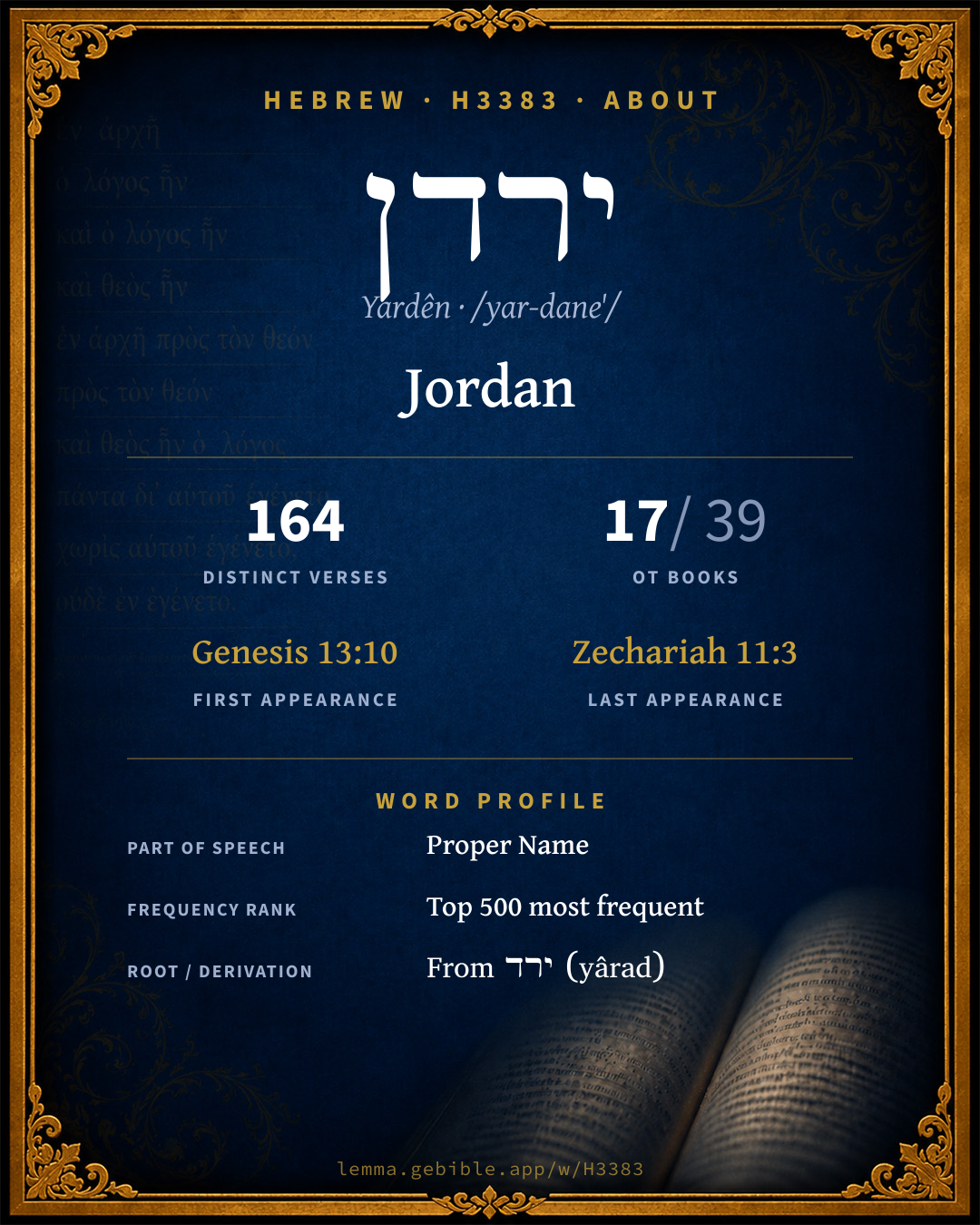
יַרְדֵּן
Jordan
BDB lists 2 entries for ‘Jordan’ fuller range ↓
Full lexicon entry — Brown-Driver-Briggs (BDB)
From Brown-Driver-Briggs (BDB)
Where this word appears
Grammar key — what these labels mean
Part of speech
- Noun
- A naming word — a person, place, thing, or idea.
Noun type
- Proper
- A name of a specific person, place, or people (e.g. Abraham, Zion, Israel).
Every verse where H3383 appears in the Book of 1 Kings — 4 distinct verses. Click any verse to open its interlinear word-by-word view. Verse text shown in the World English Bible for context — . Each verse’s Hebrew form is shown with its reference; the English is not keyword-highlighted, since the data carries no word-level English alignment. Use “Compare translations” on any verse to read it across multiple English versions. This concordance covers the Hebrew Bible; Septuagint (Greek Old Testament) occurrences are not indexed here.
1 Kings
- 1 Kings 2:8 הַ/יַּרְדֵּ֔ן ptcl def.art + n Proper Behold, there is with you Shimei the son of Gera, the Benjamite, of Bahurim, who cursed me with a grievous curse in the day when I went to Mahanaim; but he came down to meet me at the Jordan, and I swore to him by Yahweh, saying, I will not put you to death with the sword.
- 1 Kings 7:46 הַ/יַּרְדֵּן֙ ptcl def.art + n Proper In the plain of the Jordan did the king cast them, in the clay ground between Succoth and Zarethan.
- 1 Kings 17:3 הַ/יַּרְדֵּֽן ptcl def.art + n Proper Get you hence, and turn you eastward, and hide yourself by the brook Cherith, that is before the Jordan.
- 1 Kings 17:5 הַ/יַּרְדֵּֽן ptcl def.art + n Proper So he went and did according to the word of Yahweh; for he went and lived by the brook Cherith, that is before the Jordan.
About this entry
At a glance — auto-summarized from this page’s data, not written by a person. Every figure links to its source below. This summary describes the numbers; it doesn’t interpret them.
The Hebrew name ירדן centers on the idea of “Jordan.” Debuting at Genesis 13:10, it then recurs through the corpus. Spanning 164 verses in 17 books, it ranks among the common words of the Hebrew Bible. Joshua dominates its distribution — 58 of 164 verses. Dig into 164-verse concordance and the renderings breakdown below.
Gloss history
Strong's 1890 vs modern scholarship
About this word
Strong's H3383 catalogs a Hebrew word from the Hebrew Old Testament.
These counts are not copied from any lexicon or concordance. They are computed here, from the morphology-tagged Hebrew Old Testament. What Lemma adds →
- 164
- distinct verses
- The word appears in 164 distinct verses.
- 17 / 39
- OT books
- The word appears in 17 of 39 Old Testament books.
- #255
- by frequency
- Top 500 most frequent Hebrew words (rank 255 of 8,640 Hebrew words by occurrence).
View all 164 occurrences in the concordance →
Most concentrated in
- Joshua 58 verses 35%
- Deuteronomy 26 verses 16%
- Numbers 20 verses 12%
By section of the Old Testament
By traditional corpus
Conventional, traditional groupings — biblical authorship is debated, so this is a traditional corpus grouping, not an authorship claim. Each share is this word’s portion of its verses in that division of the Hebrew canon. Each figure is a share of the word’s 164 distinct verses.
- Prophets (Nevi'im) 103 verses · 63%
- Torah (Pentateuch) 51 verses · 31%
- Writings (Ketuvim) 10 verses · 6%
How translations render this word
Counts come from each version’s own published word-to-Strong’s tagging or interlinear alignment — an approximate guide to how each version renders this word, not a word-level alignment the data otherwise carries. Because each total is that version’s own tagged count, the per-version totals vary from one another and need not match the appearance or distinct-verse counts above. These counts may also differ from a printed concordance because Lemma counts each distinctly tagged rendering and does not collapse phrase taggings into a single head-word total. This is a fixed set of word-tagged versions (KJV, ASV, BSB, ULT) and does not change with the reading translation you choose elsewhere. Each version’s license is shown beside its name below (and on Sources).
- King James Version: Jordan 172×, Over jordan 2×
- American Standard Version: Jordan 154×, Over the jordan 2×, Ye pass over the jordan 2×
- Berean Standard Bible: Jordan 166×, Near the jordan 3×, Along the jordan 2×
- unfoldingWord Literal Text: Jordan 176×
King James Version Public Domain
Renders H3383 across 182 tagged occurrences — most commonly:
Plus 8 renderings that appear only once — usually multi-word phrases or single function words the recovered tagging swept in, not distinct renderings.
American Standard Version Public Domain
Renders H3383 across 181 tagged occurrences — most commonly:
Plus 23 renderings that appear only once — usually multi-word phrases or single function words the recovered tagging swept in, not distinct renderings.
Berean Standard Bible Public Domain
Renders H3383 across 177 tagged occurrences — most commonly:
Plus 4 renderings that appear only once — usually multi-word phrases or single function words the recovered tagging swept in, not distinct renderings. Not rendered by a distinct English word in 5 further occurrences.
unfoldingWord Literal Text CC BY-SA 4.0
Renders H3383 across 180 tagged occurrences — most commonly:
Plus 4 renderings that appear only once — usually multi-word phrases or single function words the recovered tagging swept in, not distinct renderings.
Senses in BDB
The 2 senses BDB distinguishes for this word, in lexicon order (not ranked by frequency or importance). The full entry — with sub-senses — is in the Lexicon Entry tab.
- Jordan = "descender"
- the river of Palestine running from the roots of Anti-Lebanon to the Dead Sea a distance of approx 200 miles (320…
Word origin
n.pr.fl. Jordan (according to Rel Ol§ 215 c, from ירד with ֵן for orig. ַן, cf. 𝔊 ὁ Ιορδανης; = river as flowing downward, descending, then of particular stream as river κατʼ ἐξοχήν. See also Sta§ 294e (ֵן for ֶן, but name according to Sta non-Hebr.))—abs. always הַיַּר׳ in prose Gn 13:10 + 162 times; c. ה loc. הַיַּרְדֵּ֫נָה Ju 8:4 + 3 times; יַרְדֵּן only ψ 42:7 Jb 40:23; cstr. יַרְדֵּן Nu 26:3 + 11 times Nu Jos + 1 Ch 6:63;—the river of Palestine: in all periods, chiefly Hex (122 times: Gn 5 times J; Nu 20 times P, 1 times JE; Dt 26 times; Jos 24 times JE, 20 times D, 16 times P), Ju (12 times), and S (18 times); in K 13 times; Ch 7 times; elsewhere 10 times;—הַיַּרְדֵּן הַזֶּה Gn 32:11 (J), Dt 3:27; 31:2 Jos 1:2, 11; 4:22 (all D); בְּעֵבֶר הַיַּרְדֵּן Gn 50:10, 11 (J), Jos 7:7; 24:8 (both JE), + 20 times D + Ju 5:17; 10:8 1 S 31:7; P has also מֵעֵבֶר הַיַּרְדֵּן Nu 32:19, and מֵע׳ לַיַּרְדֵּן v 19, 32; 35:14 Jos 14:3, also Jos 17:5 (JE), 18:7 (D), Ju 7:25 1 Ch 12:37; 26:30; in P peculiarly יַרְדֵּן יְרֵחוֹ the Jordan of (at) Jericho, with עַל Nu 26:3, 63; 31:12; 33:48, 50; 35:1; 36:13, with מֵעֵבֶר לְ Nu 22:1; 34:15 Jos 13:32; 20:8 (= 1 Ch 6:63), with מִן Jos 16:1 (E?); עֵבֶר הַיַּרְדֵּן Is 8:23 Dt 4:49 Jos 13:27 (P); see sub עבר; מֵי הַיַּרְדֵּן Jos 3:13(×2); 4:18, 23 (all JE), 3:8; 5:1 (both D); מֵימֵי הַיַּרְדֵּן 4:7 (JE); גְּאוֹן הַיַּר׳ Je 12:5; 49:19; 50:44 Zc 11:3 (v. גאון p. 145 a, supr.); שְׂפַת הַיּר׳ 2 K 2:13; יוֹשֵׁב עַל־הַיָּם וְעַל יַד הַיַּרְדֵּן Nu 13:29 (JE; elsewhere in Nu, P); כִּכַּר הַיַּרְדֵּן the circle of Jordan, i.e. the plain about Jericho Gn 13:10, 11 (J), 1 K 7:46 2 Ch 4:17; מַעְבְּרוֹת הַיַּר׳ Ju 3:28; 12:5, 6 fords of the Jordan; אֶל־גְּלִילוֹת הַיַּרְדֵּן אֶל־עֵבֶר בְּנֵי יִשְׂרָאֵל Jos 22:11, cf. v 10 (both P; v. גלילות supr. p. 165); אֶרֶץ יַרְדֵּן ψ 42:7 (without art. only here and in foll.); יָגִיחַ יַרְדֵּן אֶל־פִּיהוּ Jb 40:23 a Jordan bursteth forth into his mouth.
— Brown-Driver-Briggs (Oxford 1906, public domain), digitized via Sefaria, supplemented by the OpenScriptures HebrewLexicon (CC BY 4.0). See Sources.
Derived from ירד (yârad) (H3381) — to go down.
Jastrow Dictionary
A second Hebrew/Aramaic lexicon for comparison, covering Aramaic and post-biblical (Talmudic, Targumic, Midrashic) usage that the biblical-Hebrew BDB does not. Matched by lemma rather than by Strong’s number, so a lemma may carry more than one Jastrow headword (shown separately below), and the entries cover usage well beyond the Bible.
יַרְדֵּן
- (b. h.) pr. n. Jordan, the river of Palestine. Tosef. Bekh. VII, 4; Bekh. 55ᵃ, v. יֶרַח; a. fr.—Y. Sabb. IV, end, 7ᵃ עריבת הי׳; Bab. Sabb. 83ᵇ ספינת הי׳ Jordan boats which are loaded on dry land and let down into the river.—כיפת הי׳, v. כֵּיפָה.
A Dictionary of the Targumim, the Talmud Babli and Yerushalmi, and the Midrashic Literature (Marcus Jastrow; London, Luzac, 1903) — Public Domain. Digitized via Sefaria. Digitized via Sefaria. Full attribution on Sources.
Forms in the corpus
The 37 distinct written forms H3383 takes in the Hebrew Bible, most frequent first — each parse links to that state’s occurrences in the concordance. Hebrew forms include their vowel points and cantillation, so a single lemma takes many written forms.
| Form | Parsing | Example | Uses |
|---|---|---|---|
| הַ/יַּרְדֵּ֔ן | Noun, Proper | Deuteronomy 2:29 | 32 |
| הַ/יַּרְדֵּ֑ן | Noun, Proper | Deuteronomy 1:1 | 24 |
| הַ/יַּרְדֵּֽן | Noun, Proper | Genesis 50:11 | 22 |
| הַ/יַּרְדֵּ֖ן | Noun, Proper | Deuteronomy 1:5 | 20 |
| הַ/יַּרְדֵּן֙ | Noun, Proper | Deuteronomy 4:49 | 14 |
| הַ/יַּרְדֵּ֗ן | Noun, Proper | Deuteronomy 11:30 | 7 |
| הַ/יַּרְדֵּן֒ | Noun, Proper | Deuteronomy 12:10 | 7 |
| יַרְדֵּ֥ן | Noun, Proper | Numbers 26:3 | 7 |
| הַ/יַּרְדֵּ֛ן | Noun, Proper | Deuteronomy 4:26 | 5 |
| הַ/יַּרְדֵּ֔נָ/ה | Noun, Proper | 2 Kings 2:6 | 3 |
| הַ/יַּרְדֵּ֜ן | Noun, Proper | Deuteronomy 4:46 | 3 |
| הַ/יַּרְדֵּ֣ן | Noun, Proper | Genesis 32:10 | 3 |
| הַ/יַּרְדֵּן֮ | Noun, Proper | Jeremiah 49:19 | 3 |
| לְ/יַרְדֵּ֥ן | Noun, Proper | Joshua 13:32 | 3 |
| לַ/יַּרְדֵּֽן | Noun, Proper | Joshua 17:5 | 3 |
| בַּ/יַּרְדֵּ֔ן | Noun, Proper | 2 Kings 5:10 | 2 |
| בַּ/יַּרְדֵּֽן | Noun, Proper | 2 Samuel 19:18 | 2 |
| הַ/יַּרְדֵּ֥ן | Noun, Proper | Deuteronomy 3:27 | 2 |
| הַ֝/יַּרְדֵּ֗ן | Noun, Proper | Psalms 114:3 | 2 |
| לַ/יַּרְדֵּ֖ן | Noun, Proper | 1 Chronicles 26:30 | 2 |
| ב/ירדן | Noun, Proper | 2 Samuel 19:31 | 1 |
| בַּ/יַּרְדֵּ֖ן | Noun, Proper | Joshua 3:8 | 1 |
| בַּ/יַּרְדֵּן֙ | Noun, Proper | 2 Kings 5:14 | 1 |
| הַ/יַּרְדֵּ֑נָ/ה | Noun, Proper | Judges 8:4 | 1 |
| הַ/יַּרְדֵּ֞ן | Noun, Proper | Numbers 32:29 | 1 |
| וְ/הַ/יַּרְדֵּ֗ן | Noun, Proper | Joshua 3:15 | 1 |
| וְ/הַ/יַּרְדֵּ֣ן | Noun, Proper | Deuteronomy 3:17 | 1 |
| וְ/הַ/יַּרְדֵּ֥ן | Noun, Proper | Joshua 18:20 | 1 |
| יַרְדֵּ֑ן | Noun, Proper | Psalms 42:6 | 1 |
| יַרְדֵּ֣ן | Noun, Proper | Job 40:23 | 1 |
| לְ/יַרְדֵּ֣ן | Noun, Proper | 1 Chronicles 6:78 | 1 |
| לְ/יַרְדֵּ֤ן | Noun, Proper | Joshua 20:8 | 1 |
| לַ/יַּרְדֵּ֑ן | Noun, Proper | Joshua 14:3 | 1 |
| לַ/יַּרְדֵּ֔ן | Noun, Proper | Numbers 35:14 | 1 |
| לַ/יַּרְדֵּן֙ | Noun, Proper | Joshua 18:7 | 1 |
| לַ֠/יַּרְדֵּן | Noun, Proper | 1 Chronicles 12:37 | 1 |
| מִ/יַּרְדֵּ֣ן | Noun, Proper | Joshua 16:1 | 1 |
Same root — word family
Other BDB entries built from the same root as H3383, grouped by Strong’s listed origin. These share a root / origin per the lexicon — not necessarily a shared meaning. Each links to that word’s own entry.
Derives from
Shares the same root
Proper names from this root
People and places named from this root — a name, not an additional meaning of the word.
Compare all same-root words → Showing 4 of 5 — not the complete family. 2 of the same-root words are proper names (people or places). They share a root, not necessarily a meaning.
Bible dictionary
Public-domain dictionary articles matched to this entry by name (Jordan). A biblical name can be shared by more than one person or place, so an article may treat several.
Easton's Bible Dictionary · M. G. Easton, 1897
Heb. Yarden, "the descender;" Arab. Nahr-esh-Sheriah, "the watering-place" the chief river of Palestine. It flows from north to south down a deep valley in the centre of the country. The name descender is significant of the fact that there is along its whole course a descent to its banks; or it may simply denote the rapidity with which it "descends" to the Dead Sea.
It originates in the snows of Hermon, which feed its perennial fountains. Two sources are generally spoken of. (1.) From the western base of a hill on which once stood the city of Dan, the northern border-city of Palestine, there gushes forth a considerable fountain called the Leddan, which is the largest fountain in Syria and the principal source of the Jordan. (2.) Beside the ruins of Banias, the ancient Caesarea Philippi and the yet more ancient Panium, is a lofty cliff of limestone, at the base of which is a fountain. This is the other source of the Jordan, and has always been regarded by the Jews as its true source. It rushes down to the plain in a foaming torrent, and joins the Leddan about 5 miles south of Dan (Tell-el-Kady). (3.) But besides these two historical fountains there is a third, called the Hasbany, which rises in the bottom of a valley at the western base of Hermon, 12 miles north of Tell-el-Kady. It joins the main stream about a mile below the junction of the Leddan and the Banias. The river thus formed is at this point about 45 feet wide, and flows in a channel from 12 to 20 feet below the plain. After this it flows, "with a swift current and a much-twisted course," through a marshy plain for some 6 miles, when it falls into the Lake Huleh, "the waters of Merom" (q.v.).
During this part of its course the Jordan has descended about 1,100 feet. At Banias it is 1,080 feet above sea-level. Flowing from the southern extremity of Lake Huleh, here almost on a level with the sea, it flows for 2 miles "through a waste of islets and papyrus," and then for 9 miles through a narrow gorge in a foaming torrent onward to the Sea of Galilee (q.v.).
"In the whole valley of the Jordan from the Lake Huleh to the Sea of Galilee there is not a single settled inhabitant. Along the whole eastern bank of the river and the lakes, from the base of Hermon to the ravine of Hieromax, a region of great fertility, 30 miles long by 7 or 8 wide, there are only some three inhabited villages. The western bank is almost as desolate. Ruins are numerous enough. Every mile or two is an old site of town or village, now well nigh hid beneath a dense jungle of thorns and thistles. The words of Scripture here recur to us with peculiar force: I will make your cities waste, and bring your sanctuaries unto desolation...And I will bring the land into desolation: and your enemies which dwell therein shall be astonished at it...And your land shall be desolate, and your cities waste. Then shall the land enjoy her sabbaths, as long as it lieth desolate' (Lev. 26:31-34).", Dr. Porter's Handbook.
From the Sea of Galilee, at the level of 682 feet below the Mediterranean, the river flows through a long, low plain called "the region of Jordan" (Matt. 3:5), and by the modern Arabs the Ghor, or "sunken plain." This section is properly the Jordan of Scripture. Down through the midst of the "plain of Jordan" there winds a ravine varying in breadth from 200 yards to half a mile, and in depth from 40 to 150 feet. Through it the Jordan flows in a rapid, rugged, tortuous course down to the Dead Sea. The whole distance from the southern extremity of the Sea of Galilee to the Dead Sea is in a straight line about 65 miles, but following the windings of the river about 200 miles, during which it falls 618 feet. The total length of the Jordan from Banias is about 104 miles in a straight line, during which it falls 2,380 feet.
There are two considerable affluents which enter the river between the Sea of Galilee and the Dead Sea, both from the east. (1.) The Wady Mandhur, called the Yarmuk by the Rabbins and the Hieromax by the Greeks. It formed the boundary between Bashan and Gilead. It drains the plateau of the Hauran. (2.) The Jabbok or Wady Zerka, formerly the northern boundary of Ammon. It enters the Jordan about 20 miles north of Jericho.
The first historical notice of the Jordan is in the account of the separation of Abraham and Lot (Gen. 13:10). "Lot beheld the plain of Jordan as the garden of the Lord." Jacob crossed and recrossed "this Jordan" (32:10). The Israelites passed over it as "on dry ground" (Josh. 3:17; Ps. 114:3). Twice afterwards its waters were miraculously divided at the same spot by Elijah and Elisha (2 Kings 2:8, 14).
The Jordan is mentioned in the Old Testament about one hundred and eighty times, and in the New Testament fifteen times. The chief events in gospel history connected with it are (1) John the Baptist's ministry, when "there went out to him Jerusalem, and all Judaea, and were baptized of him in Jordan" (Matt. 3:6). (2.) Jesus also "was baptized of John in Jordan" (Mark 1:9).
Smith's Bible Dictionary · William Smith, 1863
(the descender), the one river of Palestine, has a course of little more than 200 miles, from the roots of Anti-Lebanon to the head of the Dead Sea. (136 miles in a straight line.--Schaff.) It is the river of the "great plain" of Palestine--the "descender," if not "the river of God" in the book of Psalms, at least that of his chosen people throughout their history. There were fords over against Jericho, to which point the men of Jericho pursued the spies. (Joshua 2:7) comp. Judg 3:28 Higher up where the fords or passages of Bethbarah, where Gideon lay in wait for the Midianites, (Judges 7:24) and where the men of Gilead slew the Ephraimites. ch. (Judges 12:6) These fords undoubtedly witnessed the first recorded passage of the Jordan in the Old Testament. (Genesis 32:10) Jordan was next crossed, over against Jericho, by Joshua. (Joshua 4:12,13) From their vicinity to Jerusalem the lower fords were much used. David, it is probable, passed over them in one instance to fight the Syrians. (2 Samuel 10:17; 17:22) Thus there were two customary places at which the Jordan was fordable; and it must have been at one of these, if not at both, that baptism was afterward administered by St. John and by the disciples of our Lord. Where our Lord was baptized is not stated expressly, but it was probably at the upper ford. These fords were rendered so much more precious in those days from two circumstances. First, it does not appear that there were then any bridges thrown over or boats regularly established on the Jordan; and secondly, because "Jordan overflowed all his banks all the time of harvest." (Joshua 3:15) The channel or bed of the river became brimful, so that the level of the water and of the banks was then the same. (Dr. Selah Merrill, in his book "Galilee in the Time of Christ" (1881), says, "Near Tarichaea, just below the point where the Jordan leaves the lake (of Galilee), there was (in Christ's time) a splendid bridge across the river, supported by ten piers."--ED.) The last feature which remains to be noticed in the scriptural account of the Jordan is its frequent mention as a boundary: "over Jordan," "this" and "the other side," or "beyond Jordan," were expressions as familiar to the Israelites as "across the water," "this" and "the other side of the Channel" are to English ears. In one sense indeed, that is, in so far as it was the eastern boundary of the land of Canaan, it was the eastern boundary of the promised land. (Numbers 34:12) The Jordan rises from several sources near Panium (Banias), and passes through the lakes of Merom (Huleh) and Gennesaret. The two principal features in its course are its descent and its windings. From its fountain heads to the Dead Sea it rushes down one continuous inclined plane, only broken by a series of rapids or precipitous falls. Between the Lake of Gennesaret and the Dead Sea there are 27 rapids. The depression of the Lake of Gennesaret below the level of the Mediterranean is 653 feet, and that of the Dead Sea 1316 feet. (The whole descent from its source to the Dead Sea is 3000 feet. Its width varies form 45 to 180 feet, and it is from 3 to 12 feet deep. -Schaff.) Its sinuosity is not so remarkable in the upper part of its course. The only tributaries to the Jordan below Gennesaret are the Yarmuk (Hieromax) and the Zerka (Jabbok). Not a single city ever crowned the banks of the Jordan. Still Bethshan and Jericho to the west, Gerasa, Pella and Gadara to the east of it were important cities, and caused a good deal of traffic between the two opposite banks. The physical features of the Ghor, through which the Jordan flows, are treated of under Palestina And Palestine.
Hitchcock's Bible Names Dictionary · Roswell D. Hitchcock, 1869
the river of judgment
Classic public-domain reference works; full attribution on Sources.
Septuagint verse parallels
This word appears in 160 verses that also exist in the Greek Old Testament (Septuagint), out of the 164 Hebrew verses it occurs in. You can read those verses in Greek by switching the Old Testament edition to the Septuagint.
Read these verses in the Septuagint
- Genesis 13:10
- Numbers 13:29
- Deuteronomy 1:1
- Joshua 1:2
- Judges 3:28
- 1 Samuel 13:7
- 2 Samuel 2:29
- 1 Kings 2:8
- 2 Kings 2:6
- 1 Chronicles 12:15
- 2 Chronicles 4:17
- Job 40:23
This is a verse-level parallel only — the same verses exist in both the Hebrew and Greek Old Testaments. No word-level Hebrew↔Greek correspondence is claimed: the data carries no such alignment, so no Greek word is shown as this Hebrew word’s translation. Coverage is not total — the Septuagint omits the deuterocanon and renumbers the Psalms, so some Hebrew verses have no direct Greek parallel.