Numbers 35:14

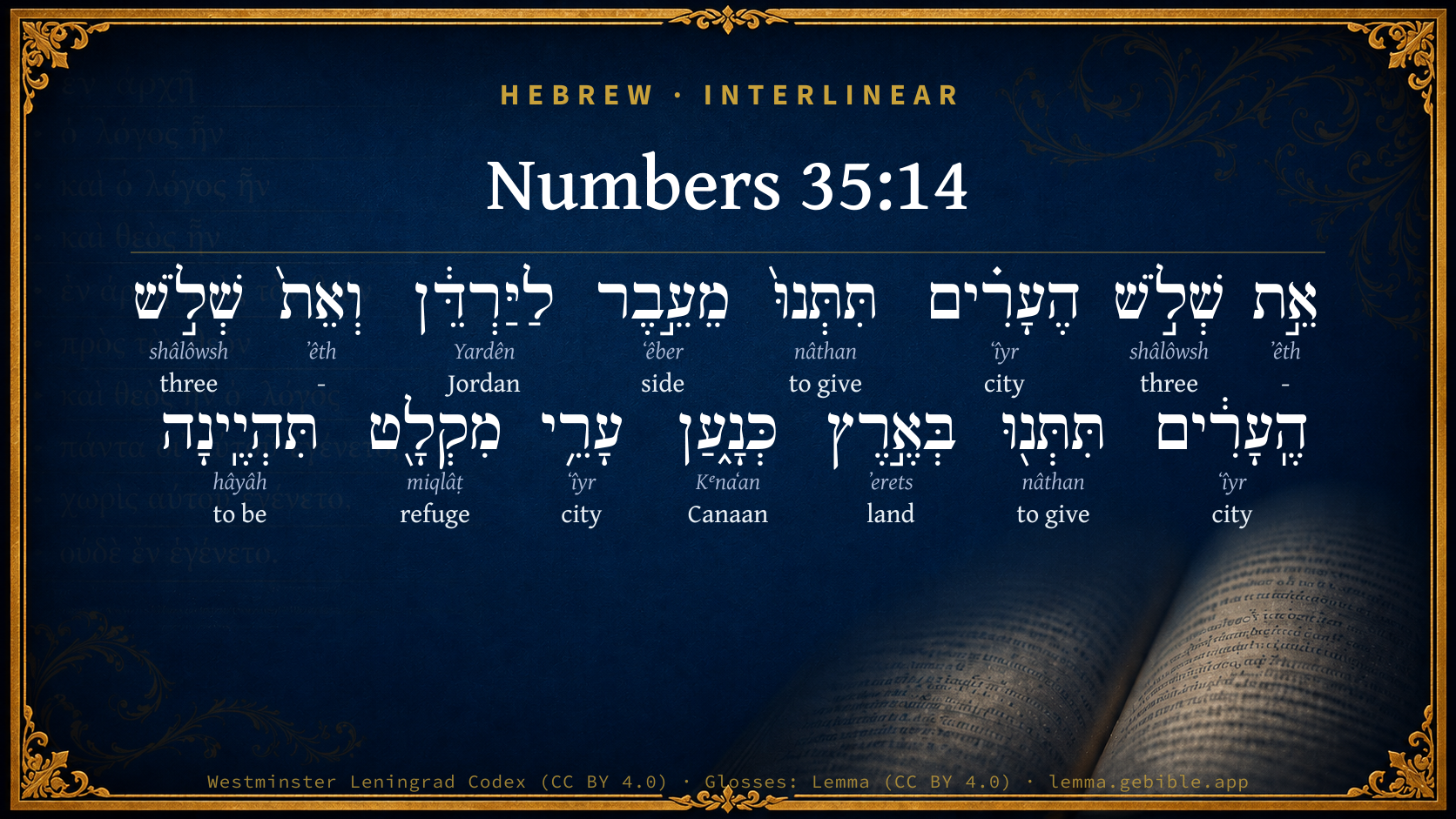
Hebrew (Westminster Leningrad Codex) Numbers 35:14 appears in the Hebrew Old Testament. The text above is from the Westminster Leningrad Codex. Each word links to its Strong’s number, a concise gloss, and parsing drawn from the Open Scriptures Hebrew Bible morphology. Click any word for its full Brown-Driver-Briggs (BDB) entry.
Download image
Cite this verse

Numbers 35:14 (World English Bible). Public Domain. Lemma interlinear Bible study tool, https://lemma.gebible.app/v/numbers/35/14.

Show BibTeX & RIS
BibTeX
RIS
English Translation
You shall give three cities beyond the Jordan, and three cities shall you give in the land of Canaan; they shall be cities of refuge.
World English Bible · Public Domain
Download a study sheet

One document with this verse’s original text, its word-by-word gloss line, the meaning frame, cross-references with their text, attributed commentary, and full source and license credits — printable, and it pastes into notes with its structure intact.

This verse Autodidact and up

Study sheet (.html) Plain text (.txt)

A passage Seminary Student

Up to 50 verses in one chapter. A passage sheet keeps up to 6 commentary sources and 12 cross-references per verse, in the order this page ranks them, and says so on the sheet whenever that leaves anything out. Ask for a single verse and you get the Autodidact verse sheet above.

Everything on this page stays free to read, with no account — the sheet is a download of what is already on screen, not access to it.

Want to remove ads? Support Godless Engineer
Compare translations 3

The same verse in 3 English versions, stacked beneath the original-language interlinear above. Click any original word for its lexicon entry.

Each is an independent rendering of the whole verse — the interlinear is not word-aligned to these translations.

Highlighted words mark where these versions differ — a whole-verse word diff, not a word-by-word alignment.

  • World English Bible Public Domain
    You shall give three cities beyond the Jordan, and three cities shall you give in the land of Canaan; they shall be cities of refuge.
  • King James Version Public Domain
    Ye shall give three cities on this side Jordan, and three cities shall ye give in the land of Canaan, which shall be cities of refuge.
  • unfoldingWord Literal Text CC BY-SA 4.0
    You shall give three cities from beyond the Jordan, and you shall give three cities in the land of Canaan. They shall be cities of refuge.

unfoldingWord Literal Text — © unfoldingWord, licensed CC BY-SA 4.0. Word-aligned USFM3 via Door43 (git.door43.org/unfoldingWord/en_ult).

Versions to compare (up to 4)

3 of 4 selected

Show all 18 translations

Every available English version of this verse, each an independent rendering of the whole verse.

  • World English Bible Public Domain
    You shall give three cities beyond the Jordan, and three cities shall you give in the land of Canaan; they shall be cities of refuge.
  • Berean Standard Bible Public Domain
    Select three cities across the Jordan and three in the land of Canaan as cities of refuge.
  • Majority Standard Bible Public Domain
    Select three cities across the Jordan and three in the land of Canaan as cities of refuge.
  • King James Version Public Domain
    Ye shall give three cities on this side Jordan, and three cities shall ye give in the land of Canaan, which shall be cities of refuge.
  • American Standard Version (1901) Public Domain
    Ye shall give three cities beyond the Jordan, and three cities shall ye give in the land of Canaan; they shall be cities of refuge.
  • Revised Version (1885) Public Domain
    Ye shall give three cities beyond Jordan, and three cities shall ye give in the land of Canaan; they shall be cities of refuge.
  • Geneva Bible (1599) Public Domain
    Ye shall appoint three on this side Iorden, and ye shall appoint three cities in the lande of Canaan which shalbe cities of refuge.
  • Douay-Rheims (1899) Public Domain
    Three shall be beyond the Jordan, and three in the land of Chanaan,
  • Young's Literal Translation Public Domain
    the three of the cities ye give beyond the Jordan, and the three of the cities ye give in the land of Canaan; cities of refuge they are.
  • Literal Standard Version CC BY-SA 4.0
    three of the cities you give from beyond the Jordan, and three of the cities you give in the land of Canaan; they are cities of refuge.
  • Unlocked Literal Bible CC BY-SA 4.0
    You must provide three cities beyond the Jordan and three in the land of Canaan. They will be cities of refuge.
  • unfoldingWord Literal Text CC BY-SA 4.0
    You shall give three cities from beyond the Jordan, and you shall give three cities in the land of Canaan. They shall be cities of refuge.
  • Darby Bible Public Domain
    Three cities shall ye give on this side of the Jordan, and three cities shall ye give in the land of Canaan; they shall be cities of refuge.
  • World Messianic Bible Public Domain
    You shall give three cities beyond the Jordan, and you shall give three cities in the land of Canaan. They shall be cities of refuge.
  • Webster's Bible Public Domain
    Ye shall give three cities on this side of Jordan, and three cities shall ye give in the land of Canaan, which shall be cities of refuge.
  • Free Bible Version CC BY-SA 4.0
    Choose three cities on the other side of the Jordan and three in Canaan as cities of refuge.
  • Bible in Basic English Public Domain
    Three on the other side of Jordan and three in the land of Canaan, to be safe places for flight.
  • JPS Tanakh (1917) Public Domain
    Ye shall give three cities beyond the Jordan, and three cities shall ye give in the land of Canaan; they shall be cities of refuge.

Literal Standard Version (2020), Covenant Press — licensed CC BY-SA 4.0. Text via the HelloAO Bible API (eBible.org). Unlocked Literal Bible (unfoldingWord) — licensed CC BY-SA 4.0. Text via the HelloAO Bible API (eBible.org). unfoldingWord Literal Text — © unfoldingWord, licensed CC BY-SA 4.0. Word-aligned USFM3 via Door43 (git.door43.org/unfoldingWord/en_ult). Free Bible Version, Dr. Jonathan Gallagher — licensed CC BY-SA 4.0. Text via the HelloAO Bible API (eBible.org).

Word by word

More ways to search: Search by grammar → Find every occurrence → Compare this word →

Practice this passage: Drill this verse → Learn its vocabulary →

מִקְלָ֖ט
miqlâṭ
H4733
“refuge”
Noun, Common, Masculine, Singular, Absolute
Part of Speech
Noun
Type
Common
Gender
Masculine
Number
Singular
State
Absolute
Full BDB Definition

Origin: from H7038 in the sense of taking in

TWOT: 2026a

refuge, asylum
  1. אֵ֣ת ʼêth H853 “-” Particle, Direct Object
  2. שְׁלֹ֣שׁ shâlôwsh H7969 “three” Adjective, Cardinal number, Feminine, Singular, Absolute
  3. הֶעָרִ֗ים ʻîyr H5892 “the · cities” Particle, Definite Article + Noun, Common, Feminine, Plural, Absolute
  4. תִּתְּנוּ֙ nâthan H5414 “to give” Verb, Qal, Imperfect, 2nd Person, Masculine, Plural
  5. מֵעֵ֣בֶר ʻêber H5676 “from · side” Preposition + Noun, Common, Masculine, Singular, Absolute
  6. לַיַּרְדֵּ֔ן Yardên H3383 “to/for the · Jordan” Preposition, Determined + Noun, Proper
  7. וְאֵת֙ ʼêth H853 “and · -” Conjunction + Particle, Direct Object
  8. שְׁלֹ֣שׁ shâlôwsh H7969 “three” Adjective, Cardinal number, Feminine, Singular, Absolute
  9. הֶֽעָרִ֔ים ʻîyr H5892 “the · cities” Particle, Definite Article + Noun, Common, Feminine, Plural, Absolute
  10. תִּתְּנ֖וּ nâthan H5414 “to give” Verb, Qal, Imperfect, 2nd Person, Masculine, Plural
  11. בְּאֶ֣רֶץ ʼerets H776 “in/at · land of” Preposition + Noun, Common, Both, Singular, Construct
  12. כְּנָ֑עַן Kᵉnaʻan H3667 “Canaan” Noun, Proper
  13. עָרֵ֥י ʻîyr H5892 “cities of” Noun, Common, Feminine, Plural, Construct
  14. תִּהְיֶֽינָה hâyâh H1961 “to be” Verb, Qal, Imperfect, 3rd Person, Feminine, Plural

About this verse

These counts appear in no published source. They are computed here, from the morphology-tagged text and Lemma’s own curated glosses. What Lemma adds →

15
words
10
distinct lemmas
Pentateuch
section

Notable vocabulary

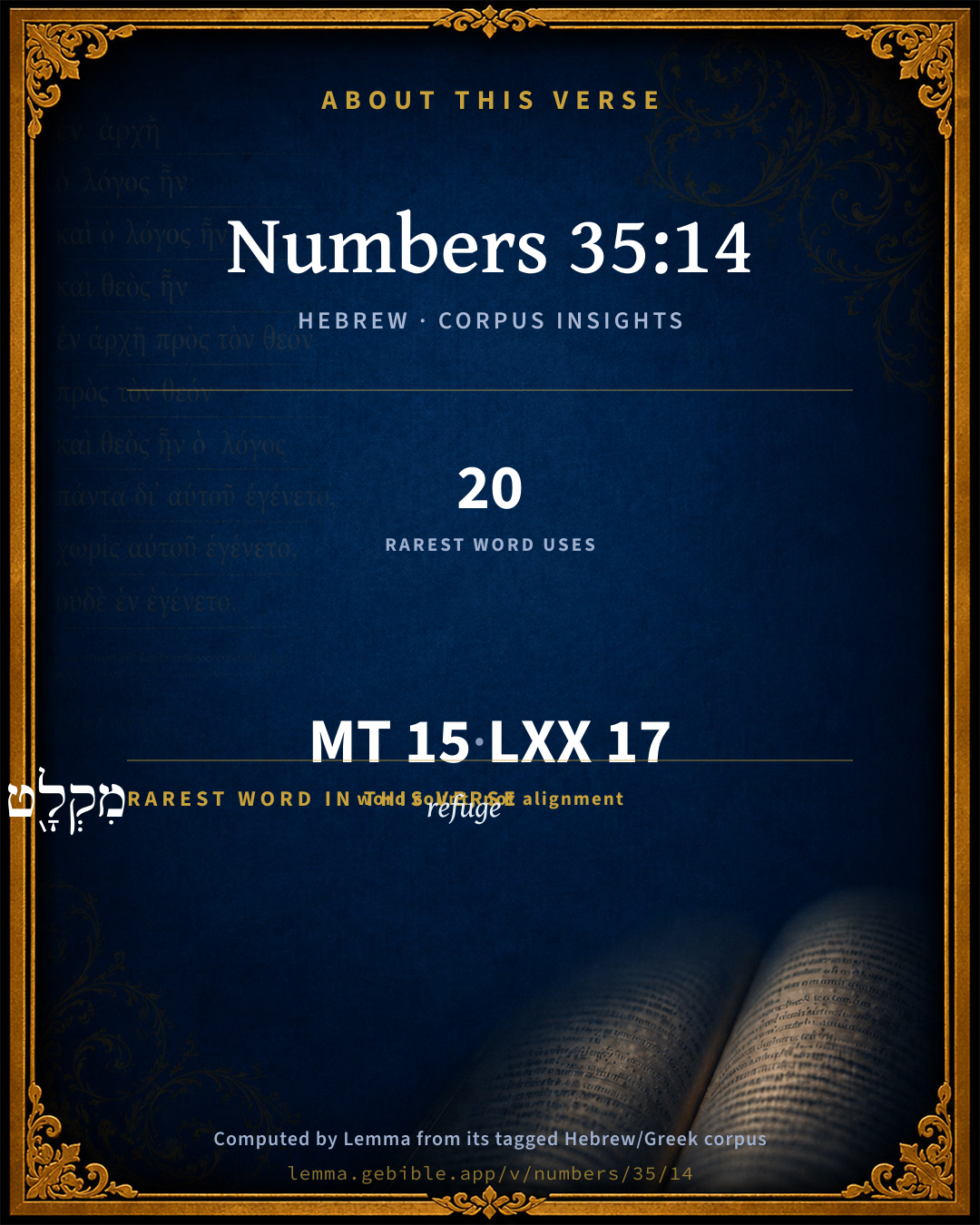
The rarest word here is מִקְלָ֖ט refuge H4733 — appearing just 20 times in the whole Hebrew Bible.

Shared distinctive vocabulary

מִקְלָ֖ט refuge H4733 occurs in 20 verses of the Hebrew Bible. Also found in:

Grammatical profile

  • 3 verbs
  • 8 nouns
  • 2 adjectives
  • 2 particles

Verb forms

  • תִּתְּנוּ֙ Qal · Imperfect
  • תִּתְּנ֖וּ Qal · Imperfect
  • תִּהְיֶֽינָה Qal · Imperfect

Repetition

Words recur within this verse — often emphatic in Hebrew:

  • הֶעָרִ֗ים city H5892 ×3
  • שְׁלֹ֣שׁ three H7969 ×2
  • תִּתְּנוּ֙ to give H5414 ×2

Hebrew & Septuagint length

In English translation the verse runs 25 words from the Hebrew and 22 from the Septuagint (LXX English) — closely comparable.

A rough comparison of the two English renderings, which tokenize alike — not a word-level alignment.

Word counts can differ between the Hebrew and the Greek without any difference in meaning — e.g. the Hebrew direct-object marker אֵת has no separate Greek word, and Greek often adds the article ὁ.

In the original languages it is 15 Hebrew tokens and 17 Greek tokens — but the two are counted differently (Hebrew bundles its prefixes and suffixes into one token; the Greek is in lemma form), so that isn’t a like-for-like length.

Cross-references

3

Topical passages linked to Numbers 35:14 in the Treasury of Scripture Knowledge — connected by theme and wording, ordered by reader-vote popularity; previews shown in the World English Bible.

  • Deuteronomy 4:41–43 Then Moses set apart three cities beyond the Jordan toward the sunrise;
  • Deuteronomy 19:8–10 If Yahweh your God enlarge your border, as he has sworn to your fathers, and give you all the land which he promised to give to your fathers;
  • Joshua 20:7–9 They set apart Kedesh in Galilee in the hill-country of Naphtali, and Shechem in the hill-country of Ephraim, and Kiriath Arba (the same is Hebron) in the hill-country of Judah.

Cross-references courtesy of OpenBible.info (CC BY 4.0).

Hebrew and Greek witnesses Masoretic Hebrew ↔ Greek Septuagint

The same verse in the two great witnesses to the Old Testament, shown verse-for-verse.

These are two independent witnesses, not word-aligned to each other, and the Septuagint is shown in lemma (dictionary) form.

Hebrew Numbers 35:14 Masoretic · Westminster Leningrad Codex

אֵ֣ת שְׁלֹ֣שׁ הֶעָרִ֗ים תִּתְּנוּ֙ מֵעֵ֣בֶר לַיַּרְדֵּ֔ן וְאֵת֙ שְׁלֹ֣שׁ הֶֽעָרִ֔ים תִּתְּנ֖וּ בְּאֶ֣רֶץ כְּנָ֑עַן עָרֵ֥י מִקְלָ֖ט תִּהְיֶֽינָה

You shall give three cities beyond the Jordan, and three cities shall you give in the land of Canaan; they shall be cities of refuge.

World English Bible · Public Domain

Greek LXX Numbers 35:14 Septuagint · lemma form

ὁ τρεῖς πόλις δίδωμι ἐν ὁ πέραν ὁ ἰορδάνης καί ὁ τρεῖς πόλις δίδωμι ἐν γῆ χανααν

You⌃ shall assign three cities on the other side of Jordan, and you⌃ shall assign three cities in the land of Chanaan.

LXX2012 (modern English Septuagint) · Public Domain

Hebrew: Westminster Leningrad Codex (CC BY 4.0). Greek: Septuagint (public domain); English from LXX2012 (modern English Septuagint) (Public Domain). How the Septuagint differs from the Hebrew →

Targum (Aramaic paraphrase)

2

The Targum is the ancient Jewish Aramaic paraphrase of the Hebrew Scriptures — an interpretive translation, not the Hebrew text itself. Onkelos (literal) and Pseudo-Jonathan (expansive) render the Torah, and Jonathan the Prophets. Coverage is partial: where no permissively-licensed English translation exists for a verse, only the Aramaic is shown. This is verse-level text, not a word-by-word alignment to the Hebrew.

  1. Targum Onkelos Torah (Genesis–Deuteronomy)
    יָת תְּלַת קִרְוַיָא תִתְּנוּן מֵעִבְרָא לְיַרְדְנָא וְיָת תְּלַת קִרְוַיָא תִתְּנוּן בְּאַרְעָא דִכְנָעַן קִרְוֵי שֵׁזָבוּתָא יֶהֶוְיָן

    (no public-domain English translation for this verse)

    Targum Onkelos — Aramaic: “Onkelos Genesis” (public domain); “Onkelos Exodus” (public domain); “Onkelos Leviticus” (public domain); “Onkelos Numbers” (public domain); “Onkelos Deuteronomy” (public domain). English: “Sefaria Community Translation” (CC0 1.0 (public-domain dedication)); “J.W. Etheridge. The Targums of Onkelos and Jonathan Ben Uzziel on the Pentateuch. London: Longmans, Green, 1862” (public domain). Text via Sefaria.

  2. Targum Pseudo-Jonathan Torah (Genesis–Deuteronomy)
    יַת תְּלַת קִרְוַיָא תִתְּנוּן מֵעִבְרָא לְיוֹרְדְנָא וְיַת תְּלַת קִרְוַיָא תִתְּנוּן בְּאַרְעָא דִכְנָעַן קִרְוִין קַלְטַן תֶּהֱוְיַן

    three you shall appoint beyond Jordan, and three in the land of Kenaan; cities of refuge shall they be.

    Targum Pseudo-Jonathan — Aramaic: “Targum Jonathan on Genesis” (public domain); “Targum Jonathan on Exodus” (public domain); “Targum Jonathan on Leviticus” (public domain); “Targum Jonathan on Numbers” (public domain); “Targum Jonathan on Deuteronomy” (public domain). English: “The Targum of Jonathan ben Uzziel, trans. J. W. Etheridge, London, 1862” (public domain). Text via Sefaria.

Commentary

Notes on Numbers 35:14 from classic Christian and Jewish commentators (each source and its license shown beneath its notes). The classic Christian expositions comment on the surrounding passage and are grouped to its opening verse, so a note may address several verses; the Jewish commentaries on the Tanakh (Rashi and others) are per-verse, so they appear only where the commentator wrote on this verse.

Lemma curates 59 commentaries, every one of them public domain or Creative Commons licensed, each selected and text-cleaned for this edition rather than reprinted as found. About our sources →

Joseph Benson's Commentary

Num 35:14-16. On this side Jordan — Because that land was as long as Canaan, though not so broad; and besides, these might be convenient for many of them that lived in Canaan. If he smite him — Wittingly and wilfully, though not with premeditated malice. He shall be put to death — Yea, though he had fled into the city of refuge.

Joseph Benson's Commentary on the Old and New Testaments (1811–1818) — public domain. Text from a community e-Sword module.

Geneva Bible (1599)

Geneva Bible translators

Among the Reubenites, Gadites, and half the tribe of Manasseh, Deut. 4:41.

Geneva Bible (1599) marginal notes — public domain. Text via Bolls.life.

Ellicott's Commentary for English Readers

(14) Ye shall give three cities on this side Jordan.—The meaning of the Hebrew word which is here rendered “on this side” is determined by the words “in the land of Canaan,” which describe the position of the three cities on the west of the Jordan. Otherwise the Hebrew word is applicable equally to the cities on the east and to those on the west of the Jordan. Moses himself appointed the three cities on the east of the Jordan—viz., Bezer, in the country of the Reubenites; Ramoth in Gilead, in the country of the Gadites; and Golan in Bashan, in the country of the Manassites (Deu_4:43). The three cities on the west of the Jordan were not appointed until the land had been allotted amongst the nine tribes and a half (Jos_20:7), when the original appointment of Moses in regard to the three cities on the east of the Jordan was confirmed (Jos_20:8). It is supposed that the six cities were so selected that no one should be above thirty miles from the nearest city of refuge.

A Bible Commentary for English Readers, edited by Charles John Ellicott (1878–1897) — public domain. Text from a community e-Sword module.

The Cambridge Bible for Schools and Colleges

gen. ed. J. J. S. Perowne

14. In Joshua 20 the cities were selected as follows: on the E . of Jordan, Bezer in the south, Ramoth in Gilead, and Golan in Bashan; on the W. of Jordan, Kiriath-arba (= Hebron) in the south of Judah, Shechem in the hill country of Ephraim, and Kedesh in Naphtali. Thus the south, centre and north on both sides of the river were provided for.

The Cambridge Bible for Schools and Colleges (gen. ed. J. J. S. Perowne; Cambridge University Press, 1878–1918) — public domain. Text from a community e-Sword module.

John Gill's Exposition

Ye shall give three cites on this side Jordan,.... Which were Bezer in the wilderness, out of the tribe of Reuben; and Ramoth in Gilead, out of the tribe of Gad; and Golan in Bashan, out of the tribe of Manasseh, Jos 20:8,

and three cities shall ye give in the land of Canaan: which were Kadesh in Galilee, in Mount Naphtali; Shechem in Mount Ephraim; and Kirjatharba, or Hebron, in the mountain of Judah, Jos 20:7.

which shall be cities of refuge; the three on the other side Jordan, the Jews say, were separated by Moses, and the three in the land of Canaan by Joshua, but not one of them was a refuge until they were all separated (m): it may seem strange that there should be as many in the two tribes and a half on the other side Jordan, as in the nine tribes and a half in the land of Canaan; let it be observed, what the Jewish writers, say (n), Moses separated three cities beyond Jordan, and opposite them Joshua separated three in the land of Canaan; and they were like two rows in a vineyard, Hebron in Judea was opposite Bezer in the wilderness; Shechem in Mount Ephraim was opposite Ramoth in Gilead; Kadesh in Mount Naphtali was opposite Golan in Bashan; and the three were so disposed, that there was as much space from the south (of the land of Israel) to Hebron as from Hebron to Shechem; and as much from Hebron to Shechem as from Shechem to Kadesh; and as much from Shechem to Kadesh as from Kadesh to the north beyond Jordan; and it should be known that the land of the tribes beyond Jordan extended in length as far as the land of Canaan, and was equal to it, running along it; so that those in the land of Canaan could soon and easily get over Jordan to the cities of refuge there, if there was occasion; besides, there is a direction given, that if their coast should be enlarged, they were to add three cities more in the land of Canaan, Deu 19:8, hence the Jews have a notion, that in the days of the Messiah those three cities will be added (o); but the Messiah is come already, and is the antitype of them all.

(m) Misn. Maccot, c. 2. sect. 4. Maimon. Hilchot Rotzeach, c. 8. sect. 2. 3. & in Pirke, c. 4. sect. 2. & Jarchi in loc. (n) T. Bab. Maccot, fol. 9. 2. (o) Maimon. Rotzeach, c. 8. sect. 4.

John Gill's Exposition of the Whole Bible (1746–1763) — public domain (CC PDM 1.0). Text via the HelloAO Bible API.

Matthew Poole's English Annotations

On this side Jordan; because that land was as long as Canaan, though not so broad, and besides these might be convenient for many of them that lived in Canaan.

Matthew Poole's English Annotations on the Holy Bible (1683–1685) — public domain. Text from a community e-Sword/MySword module.

Whedon's Commentary on the Bible

Daniel D. Whedon

14. Three cities on this side Jordan — The cities of refuge east of the Jordan were Bezer in the south, Ramoth in Gilead, and Golan in Bashan. Jos_20:8, note.

Three cities… in… Canaan — These were Kedesh in Galilee Shechem (Nablous) in Mount Ephraim, and Hebron in Judah. Jos_20:7, note. An inspection of the map will show how admirably these cities were distributed for the accomplishment of their purpose. These were all Levitical or priests’ cities, because the administration of justice is germane to religion, being its natural fruitage. Jehovah also had a peculiar ownership in these cities, which rendered them eminently fitting for refuge to those who were in trouble.

Daniel D. Whedon (gen. ed.), Commentary on the Old and New Testaments (1874–1909) — public domain. Text from a community e-Sword module.

The Pulpit Commentary

Ye shall give three cities on this side Jordan. According to Deu_4:41-43. Moses himself severed these three cities, Bezer of the Reubenites, Ramoth of the Gadites, and Golan of the Manassites. Those verses, however, seem to be an evident interpolation where they stand, and are hardly consistent with previous statements if taken literally. It is tolerably clear that the two tribes had only formed temporally settlements hitherto, and that their boundaries were not defined as yet; also that the Levitical cities (to which the cities of refuge were to belong) were not separated until after the conquest. It is likely that Deu_4:41-43 is a fragment, the real meaning el which is that Moses ordered the severance of three cities on that side Jordan as cities of refuge, for which purposes the three cities mentioned were afterwards selected.

The Pulpit Commentary (1880–1919), ed. H.D.M. Spence-Jones & Joseph S. Exell — public domain. Text from a community e-Sword module.

John Wesley's Explanatory Notes

On this side Jordan - Because that land was as long as Canaan, though not so broad, and besides these might be convenient for many of them that lived in Canaan.

John Wesley, Explanatory Notes Upon the Whole Bible (1754–1765) — public domain. Text via the GEBible commentary corpus.

unfoldingWord translationNotes

Door43 World Missions Community

General Information:

Yahweh continues telling Moses what the people must do.

translationWords

Jordan River

Israel

alien

unfoldingWord translationNotes — © Distant Shores Media and the Door43 World Missions Community, licensed CC BY-SA 4.0. Source: git.door43.org/Door43/en_tn.

Rashi

Rabbi Shlomo Yitzchaki (Rashi)

את שלש הערים וגו׳ THE THREE CITIES [YE SHALL GIVE ON THIS SIDE OF THE JORDAN etc.] — Although in the land of Canaan there were nine tribes and here (on the east side of the Jordan) there were only two and a half, it (Scripture) gives them (the latter) the same number of cities of refuge, because in Gilead (on the east side) murderers were more numerous, as it is written, (Hosea 6:8): “Gilead is a city of them that work iniquity, it is covered with footprints of blood” (Makkot 9b; cf. Sifrei Bamidbar 160:2).

Rashi on the Tanakh — English translations: “The Judaica Press complete Tanach with Rashi, translated by A. J. Rosenberg” (CC BY 4.0); “Pentateuch with Rashi's commentary by M. Rosenbaum and A.M. Silbermann, 1929-1934” (public domain); “The Metsudah Tanach series, Lakewood, N.J” (CC BY 4.0); and “The Book of Joshua, Metsudah Publications, 1997” (CC BY 4.0). Text via Sefaria.

Ramban (Nachmanides)

Rabbi Moshe ben Nachman (Ramban / Nachmanides)

YE SHALL GIVE THREE CITIES BEYOND THE JORDAN. “And even though in the land of Canaan there were nine tribes, and here [on the east side of the Jordan] there were only two [and a half], Scripture gave them an equal number of cities of refuge, because in Gilead [on the east side of the Jordan] murderers were numerous, as it is written, Gilead is a city of wrong-doers; it is covered with footprints of blood.” This is Rashi’s language, based on the words of our Rabbis. Now even though the [cities of] refuge were only for those who killed in error [and these murderers of Gilead killed deliberately], they would kill in treachery and make themselves appear as if they had done it in error, and therefore it was necessary to increase [proportionately] the number of their cities of refuge, in order to be able to take in all of them, since one could not tell who had killed deliberately. If so, [we must say that] the Holy One, blessed be He, commanded this on account of the future [since He knew that murderers in Gilead would be numerous], similar to that which it says [of the future generations], and this people will rise up, and go astray. Or perhaps the Rabbis will say that the climate of the land of Gilead was conducive to producing murderers since it became a nation. But I wonder! For in the opinion of our Rabbis, of blessed memory, the [cities mentioned in the] verse which says, and beside them [i.e., apart from the six cities of refuge], ye shall give [to the Levites] forty and two cities, were all commanded as cities of refuge, and thus there were thirty-six of them in the land of Canaan, and six beyond the Jordan, which, as clearly stated in Joshua Chapter 21 (see Note 68), were in the land of Canaan, we must now deduct the three main cities of refuge, leaving us a total of thirty-five additional cities of the Levites in the land of Canaan – and consequently a total of seven such additional cities for beyond the Jordan to complete the total of forty-two — we must perforce understand Ramban’s language in speaking of thirty-six cities for the land of Canaan and six for beyond the Jordan as based on the theory mentioned above in the text that the factor of appraised value was also taken into consideration, and hence the seven cities on the eastern side of the Jordan were regarded as six, thus leaving a total of thirty-six for the land of Canaan. and they all offered protection, in the opinion of our Rabbis, of blessed memory! Thus the cities of refuge throughout the Land of Israel were [distributed] justly and equally, for each of the [twelve] tribes received four cities of refuge. He also counted the tribe of Menasheh in the land of Canaan, because the majority of it was there [thus the nine tribes in the land of Canaan together with Menasheh were given thirty-six cities of refuge, i.e., those which constituted the cities of the Levites, plus the original three cities of refuge, making a total of thirty-nine]. Perhaps in [the proportion of] the [six] appointed cities G-d increased [the number of these cities] beyond the Jordan, in honor of Moses, so that he would set aside half of that number [since he could not enter the land of Canaan], but in their totality [of forty-eight cities] they were all divided up by measure and according to proportion [each tribe receiving four cities].According to the simple meaning of Scripture, it appears to me that the land on the [east] side of the Jordan was very large, for it contained [the kingdom of] the two great Amorite kings [Sihon and Og], about whose might the verses speak in superlative terms, and [this kingdom became] even greater when Ammon and Moab became a legitimate [conquest for Israel] through them [i.e., through Sihon and Og who captured the lands of Ammon and Moab, and from whom Israel subsequently took them by the right of conquest], whereas the kings of the land of Canaan were merely kings of cities, and every ruler of a city was called a “king,” as you see [from the verse]: the king of Jerusalem, one; the king of Hebron, one, Verses 9 and 16. although between them [these two cities] there is a distance of [only] half a day’s walk. Similarly the Sages mention that between Beth-el and Ai is a distance of [only] four miles, and yet each of these cities had its own king., Verses 9 and 16. It is possible that it was the custom in those generations to call every ruler of a city “king,” or perhaps [this was only in the Land of Israel] in honor of the Land of Israel, as our Rabbis, of blessed memory, explained. In any case, they were not kings of countries, but only kings of particular cities. And thus it is written, [And Adoni-bezek said], ‘Threescore and ten kings, having their thumbs and their great toes cut off, gathered food under my table.’ Thus the land on the [east] side of the Jordan was a very large land, and required three cities of refuge just as the whole of the Land of Israel on the [west] side of the Jordan did, and only these six cities offered refuge [to unwitting murderers], and the forty-two cities [set aside] were for the open lands of the Levites and not for refuge.

Ramban (Nachmanides) on the Tanakh — English translation: “Commentary on the Torah by Ramban (Nachmanides). Translated and annotated by Charles B. Chavel. New York, Shilo Pub. House, 1971-1976” (CC BY 4.0). Text via Sefaria.

Lesson kit

Teaching starters — assembled from the data on this page, not authored interpretation. Every prompt links to the verse data it draws on. Edit before teaching.

Numbers, in the Pentateuch, opens this verse with 15 words (10 distinct Hebrew lemmas). Its most distinctive word is miqlâṭ (“refuge”). A historical commentator’s framing appears above. Read the whole chapter for the surrounding context.

Discussion questions

  1. What does “refuge” (miqlâṭ) contribute to the verse as a whole?
  2. How does Numbers 35:6, which shares the word «refuge», read alongside this verse?
  3. What does the repetition of “city” (3× in this one verse) do in this verse?
  4. These translations render this verse differently; the difference is in the English rendering, not the original. What questions does that raise?
  5. «תִּתְּנוּ֙» is a Qal Imperfect verb. How does that grammatical form shape the action described?
  6. Compare how Joseph Benson's Commentary and Geneva Bible (1599) read this verse. Where do they agree or differ?

Things to notice

Reading settings

Reading text

Shown beneath each verse's original-language words.

Old Testament
Old Testament edition

Read the OT as the Masoretic Hebrew (MT) or the Greek Septuagint (LXX).

English shown for the Greek Septuagint (in the Hebrew ↔ Greek comparison).

Comparing translations? Open the Compare panel on any verse page to stack up to four side by side.