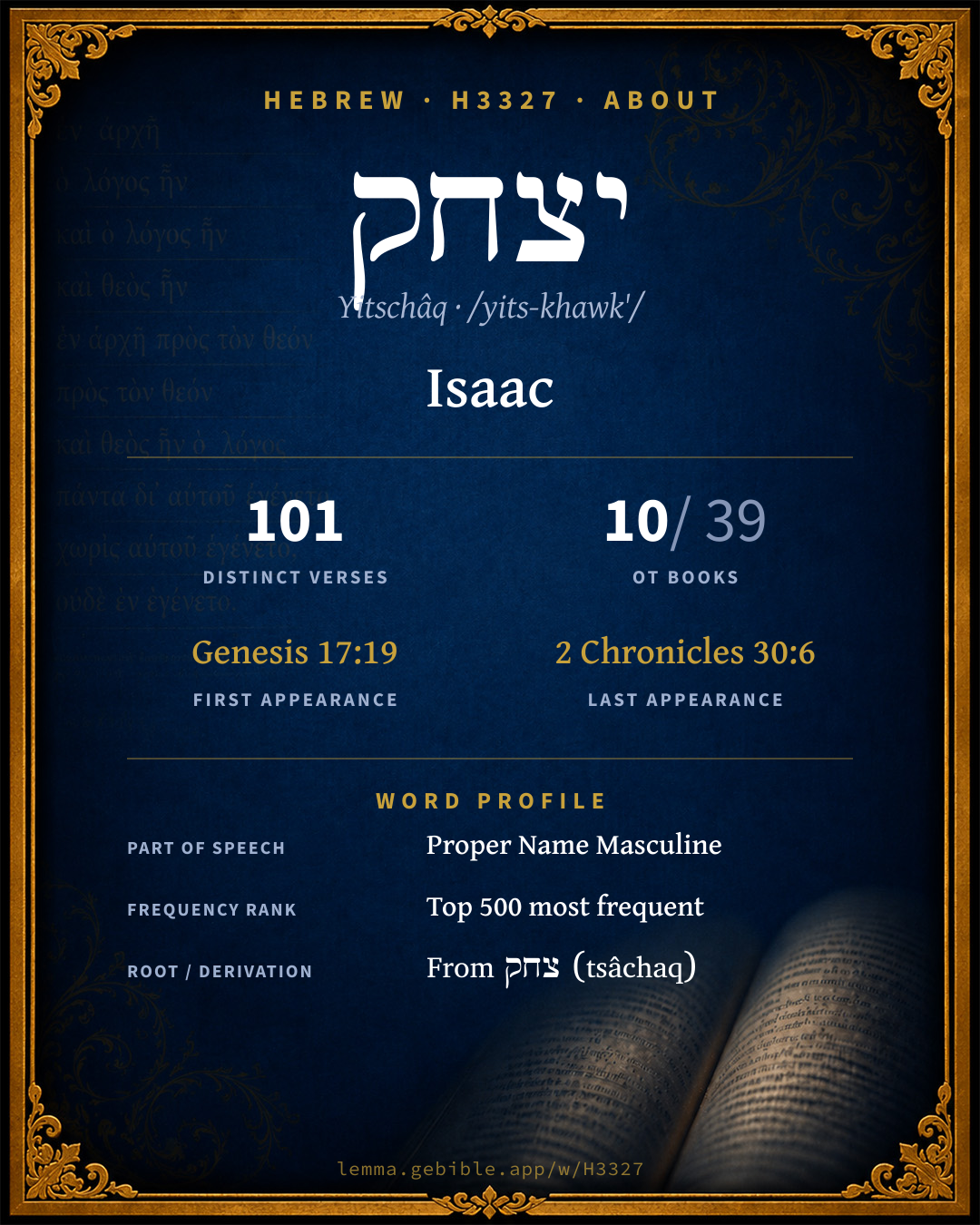
יִצְחָק
Isaac
BDB lists 2 entries for ‘Isaac’ fuller range ↓
Full lexicon entry — Brown-Driver-Briggs (BDB)
From Brown-Driver-Briggs (BDB)
Where this word appears
Grammar key — what these labels mean
Part of speech
- Noun
- A naming word — a person, place, thing, or idea.
Noun type
- Proper
- A name of a specific person, place, or people (e.g. Abraham, Zion, Israel).
Every verse where H3327 appears in the Book of Joshua — 2 distinct verses. Click any verse to open its interlinear word-by-word view. Verse text shown in the World English Bible for context — . Each verse’s Hebrew form is shown with its reference; the English is not keyword-highlighted, since the data carries no word-level English alignment. Use “Compare translations” on any verse to read it across multiple English versions. This concordance covers the Hebrew Bible; Septuagint (Greek Old Testament) occurrences are not indexed here.
Joshua
- Joshua 24:3 יִצְחָֽק n Proper I took your father Abraham from beyond the River, and led him throughout all the land of Canaan, and multiplied his seed, and gave him Isaac.
- Joshua 24:4 לְ/יִצְחָ֔ק prep + n Proper I gave to Isaac Jacob and Esau: and I gave to Esau Mount Seir, to possess it: and Jacob and his children went down into Egypt.
About this entry
At a glance — auto-summarized from this page’s data, not written by a person. Every figure links to its source below. This summary describes the numbers; it doesn’t interpret them.
“Isaac” is the headline sense of the Hebrew name יצחק (Yitschâq). It clusters heavily in Genesis, which alone accounts for 73% of its uses. It turns up in 101 verses across 10 books, a common footprint. First canonically at Genesis 17:19, it enters the text early. The sections below give every occurrence and version rendering.
Gloss history
Strong's 1890 vs modern scholarship
About this word
Strong's H3327 catalogs a Hebrew word from the Hebrew Old Testament.
These counts are not copied from any lexicon or concordance. They are computed here, from the morphology-tagged Hebrew Old Testament. What Lemma adds →
- 101
- distinct verses
- The word appears in 101 distinct verses.
- 10 / 39
- OT books
- The word appears in 10 of 39 Old Testament books.
- #401
- by frequency
- Top 500 most frequent Hebrew words (rank 401 of 8,640 Hebrew words by occurrence).
View all 101 occurrences in the concordance →
Most concentrated in
- Genesis 74 verses 73%
- Exodus 9 verses 9%
- Deuteronomy 7 verses 7%
By section of the Old Testament
By traditional corpus
Conventional, traditional groupings — biblical authorship is debated, so this is a traditional corpus grouping, not an authorship claim. Each share is this word’s portion of its verses in that division of the Hebrew canon. Each figure is a share of the word’s 101 distinct verses.
- Torah (Pentateuch) 92 verses · 91%
- Writings (Ketuvim) 5 verses · 5%
- Prophets (Nevi'im) 4 verses · 4%
How translations render this word
Counts come from each version’s own published word-to-Strong’s tagging or interlinear alignment — an approximate guide to how each version renders this word, not a word-level alignment the data otherwise carries. Because each total is that version’s own tagged count, the per-version totals vary from one another and need not match the appearance or distinct-verse counts above. These counts may also differ from a printed concordance because Lemma counts each distinctly tagged rendering and does not collapse phrase taggings into a single head-word total. This is a fixed set of word-tagged versions (KJV, ASV, BSB, ULT) and does not change with the reading translation you choose elsewhere. Each version’s license is shown beside its name below (and on Sources).
BDB lists this Strong’s number as 2 distinct words (homographs). Each count above pools all of them and is not split by sense — see the Senses section below. A low-frequency rendering may belong to a different one of those words, not the primary meaning.
- King James Version†: Isaac 100×, Isaac's 4×
- American Standard Version†: Isaac 98×, Him 2×
- Berean Standard Bible†: Isaac 96×, Isaac’s 3×, Now isaac 2×
- unfoldingWord Literal Text†: Isaac 106×
King James Version Public Domain
Renders H3327 across 108† tagged occurrences — most commonly:
Plus 4 renderings that appear only once — usually multi-word phrases or single function words the recovered tagging swept in, not distinct renderings.
American Standard Version Public Domain
Renders H3327 across 108† tagged occurrences — most commonly:
Plus 8 renderings that appear only once — usually multi-word phrases or single function words the recovered tagging swept in, not distinct renderings.
Berean Standard Bible Public Domain
Renders H3327 across 106† tagged occurrences — most commonly:
Plus 5 renderings that appear only once — usually multi-word phrases or single function words the recovered tagging swept in, not distinct renderings. Not rendered by a distinct English word in 2 further occurrences.
unfoldingWord Literal Text CC BY-SA 4.0
Renders H3327 across 108† tagged occurrences — most commonly:
Plus 2 renderings that appear only once — usually multi-word phrases or single function words the recovered tagging swept in, not distinct renderings.
Senses in BDB
The 2 senses BDB distinguishes for this word, in lexicon order (not ranked by frequency or importance). The full entry — with sub-senses — is in the Lexicon Entry tab.
- Isaac = "he laughs"
- son of Abraham by Sarah his wife and father of Jacob and Esau
Word origin
n.pr.m. Ισαακ: Isaac, son of Abr. and Sarah (he laugheth, cf. play upon name Gn 18:12 f. (J), 21:6 (E), 17:17, 19 (P); 26:8 (J));—יִצְּחָק Gn 21:3, 4, 5 (E) +, 24:62, 63, 67 (J) +, 17:19, 21 (P) +, (80 times Gn, 9 times Ex, 7 times Dt), Lv 26:42; Nu 32:11; Jos 24:3, 4; 1 K 18:36; 2 Ch 13:23; 1 Ch 1:28, 34(×2); 16:16; 29:18; 2 Ch 30:6; †יִשְׂחָק Je 33:26 ψ 105:9, and (= Israel) בָּמוֹת יִשְׂחָק Am 7:9, בֵּית יִשְׂחָק v 16.
— Brown-Driver-Briggs (Oxford 1906, public domain), digitized via Sefaria, supplemented by the OpenScriptures HebrewLexicon (CC BY 4.0). See Sources.
Derived from צחק (tsâchaq) (H6711) — to laugh.
Jastrow Dictionary
A second Hebrew/Aramaic lexicon for comparison, covering Aramaic and post-biblical (Talmudic, Targumic, Midrashic) usage that the biblical-Hebrew BDB does not. Matched by lemma rather than by Strong’s number, so a lemma may carry more than one Jastrow headword (shown separately below), and the entries cover usage well beyond the Bible.
יִצְחָק
- (b. h.) pr. n. m. Isaac,
- 1. son of Abraham. Ber. 26ᵇ; Num. R. s. 2 י׳ קבע וכ׳ I. introduced the afternoon prayer (Minḥah). Gen. R. s. 19; a. v. fr.—R. Hash. 16ᵃ, a. fr. עקידת י׳ the intended offering up of Isaac.—אפרו של י׳, v. אֵפֶר.
- 2. R. I., a. Tannai. Succ. 25ᵇ; Sifré Num. 68. Macc. 13ᵇ; a. fr. (v. Fr. Darkhé Mish. p. 203).—3) name of many Amoraim, esp. a) R. I. Roba or Rabbah (the Elder). Y. Maas. Sh. V, beg. 55ᵈ. Y. Ber. V, 9ᵇ bot. Bab. Ber. 33ᵇ ר׳ י׳ בר אבדימי; a. fr.—b) mate of R. Imi. Y. Kil. III, beg. 28ᶜ; a. fr.—Taan. 5ᵇ; Meg. 15ᵃ; a. fr.—c) R. I. of Magdala. B. Mets. 25ᵃ. Sabb. 139ᵃ. Yoma 81ᵇ.—4) I. Saḥora (the merchant). Y. Ber. IV, 7ᶜ bot.; Y. Taan.; IV, 67ᶜ bot.—V. Fr. M’bo, p. 105ᵇ sq.
A Dictionary of the Targumim, the Talmud Babli and Yerushalmi, and the Midrashic Literature (Marcus Jastrow; London, Luzac, 1903) — Public Domain. Digitized via Sefaria. Digitized via Sefaria. Full attribution on Sources.
Forms in the corpus
The 27 distinct written forms H3327 takes in the Hebrew Bible, most frequent first — each parse links to that state’s occurrences in the concordance. Hebrew forms include their vowel points and cantillation, so a single lemma takes many written forms.
| Form | Parsing | Example | Uses |
|---|---|---|---|
| יִצְחָ֣ק | Noun, Proper | Genesis 21:4 | 12 |
| יִצְחָ֔ק | Noun, Proper | Genesis 22:2 | 11 |
| יִצְחָ֑ק | Noun, Proper | Genesis 17:19 | 9 |
| יִצְחָ֥ק | Noun, Proper | Exodus 2:24 | 9 |
| יִצְחָ֖ק | Noun, Proper | Exodus 3:6 | 8 |
| יִצְחָֽק | Noun, Proper | Genesis 21:3 | 7 |
| יִצְחָק֙ | Noun, Proper | Genesis 25:20 | 7 |
| לְ/יִצְחָ֖ק | Noun, Proper | Deuteronomy 9:5 | 7 |
| יִצְחָ֛ק | Noun, Proper | Exodus 3:15 | 6 |
| יִצְחָ֤ק | Noun, Proper | Genesis 25:6 | 5 |
| יִצְחָ֜ק | Noun, Proper | Genesis 22:7 | 4 |
| לְ/יִצְחָ֤ק | Noun, Proper | Deuteronomy 1:8 | 3 |
| לְ/יִצְחָֽק | Noun, Proper | Genesis 24:4 | 3 |
| יִצְחָק֮ | Noun, Proper | Genesis 27:30 | 2 |
| לְ/יִצְחָ֔ק | Noun, Proper | Genesis 24:14 | 2 |
| לְ/יִצְחָ֥ק | Noun, Proper | Deuteronomy 6:10 | 2 |
| בְ/יִצְחָ֔ק | Noun, Proper | Genesis 21:12 | 1 |
| וְ/יִצְחָ֑ק | Noun, Proper | Genesis 48:16 | 1 |
| וְ/יִצְחָ֔ק | Noun, Proper | Genesis 48:15 | 1 |
| וְ/יִצְחָ֛ק | Noun, Proper | Genesis 25:26 | 1 |
| וְ/יִצְחָֽק | Noun, Proper | Genesis 35:27 | 1 |
| וְ/יִצְחָק֙ | Noun, Proper | Genesis 24:62 | 1 |
| וּ/לְ/יִצְחָ֖ק | Noun, Proper | Genesis 35:12 | 1 |
| יִצְחָ֗ק | Noun, Proper | Genesis 24:67 | 1 |
| לְ/יִצְחָ֑ק | Noun, Proper | Genesis 24:66 | 1 |
| לְ/יִצְחָ֗ק | Noun, Proper | Genesis 26:9 | 1 |
| לְ/יִצְחָ֨ק | Noun, Proper | Exodus 32:13 | 1 |
Same root — word family
Other BDB entries built from the same root as H3327, grouped by Strong’s listed origin. These share a root / origin per the lexicon — not necessarily a shared meaning. Each links to that word’s own entry.
Derives from
Shares the same root
Proper names from this root
People and places named from this root — a name, not an additional meaning of the word.
Compare all same-root words → 1 of the same-root words is a proper name (a person or place). They share a root, not necessarily a meaning.
Bible dictionary
Public-domain dictionary articles matched to this entry by name (Isaac). A biblical name can be shared by more than one person or place, so an article may treat several.
Easton's Bible Dictionary · M. G. Easton, 1897
Laughter. (1) Israel, or the kingdom of the ten tribes (Amos 7:9, 16).
(2.) The only son of Abraham by Sarah. He was the longest lived of the three patriarchs (Gen. 21:1-3). He was circumcised when eight days old (4-7); and when he was probably two years old a great feast was held in connection with his being weaned.
The next memorable event in his life is that connected with the command of God given to Abraham to offer him up as a sacrifice on a mountain in the land of Moriah (Gen. 22). (See ABRAHAM.) When he was forty years of age Rebekah was chosen for his wife (Gen. 24). After the death and burial of his father he took up his residence at Beer-lahai-roi (25:7-11), where his two sons, Esau and Jacob, were born (21-26), the former of whom seems to have been his favourite son (27, 28).
In consequence of a famine (Gen. 26:1) Isaac went to Gerar, where he practised deception as to his relation to Rebekah, imitating the conduct of his father in Egypt (12:12-20) and in Gerar (20:2). The Philistine king rebuked him for his prevarication.
After sojourning for some time in the land of the Philistines, he returned to Beersheba, where God gave him fresh assurance of covenant blessing, and where Abimelech entered into a covenant of peace with him.
The next chief event in his life was the blessing of his sons (Gen. 27:1). He died at Mamre, "being old and full of days" (35:27-29), one hundred and eighty years old, and was buried in the cave of Machpelah.
In the New Testament reference is made to his having been "offered up" by his father (Heb. 11:17; James 2:21), and to his blessing his sons (Heb. 11:20). As the child of promise, he is contrasted with Ishmael (Rom. 9:7, 10; Gal. 4:28; Heb. 11:18).
Isaac is "at once a counterpart of his father in simple devoutness and purity of life, and a contrast in his passive weakness of character, which in part, at least, may have sprung from his relations to his mother and wife. After the expulsion of Ishmael and Hagar, Isaac had no competitor, and grew up in the shade of Sarah's tent, moulded into feminine softness by habitual submission to her strong, loving will." His life was so quiet and uneventful that it was spent "within the circle of a few miles; so guileless that he let Jacob overreach him rather than disbelieve his assurance; so tender that his mother's death was the poignant sorrow of years; so patient and gentle that peace with his neighbours was dearer than even such a coveted possession as a well of living water dug by his own men; so grandly obedient that he put his life at his father's disposal; so firm in his reliance on God that his greatest concern through life was to honour the divine promise given to his race.", Geikie's Hours, etc.
Smith's Bible Dictionary · William Smith, 1863
(laughter), the son whom Sara bore to Abraham, in the hundredth year of his age, at Gerar. (B.C. 1897.) In his infancy he became the object of Ishmael's jealousy; and in his youth the victim, in intention, of Abraham's great sacrificial act of faith. When forty years old he married Rebekah his cousin, by whom, when he was sixty, he had two sons, Esau and Jacob. Driven by famine to Gerar, he acquired great wealth by his flocks but was repeatedly dispossessed by the Philistines of the wells which he sunk at convenient stations. After the deceit by which Jacob acquired his father's blessing Isaac sent his son to seek a wife in Padan-aram; and all that we know of him during the last forty-three years of his life in that he saw that God, with a large and prosperous family, return to him at Hebron. (Genesis 36:27) before he died there, at the age of 180 years. He was buried by his two sons in the cave of Machpelah. In the New Testament reference is made to the offering of Isaac (Hebrews 11:17; James 2:21) and to his blessing his sons. (Hebrews 11:20) In (Galatians 4:28-31) he is contrasted with Ishmael. In reference to the offering up of Isaac by Abraham, the primary doctrine taught are those of sacrifice and substitution, as the means appointed by God for taking away sin; and, as co-ordinate with these, the need of the obedience of faith, on the part of man, to receive the benefit. (Hebrews 11:17) The animal which God provided and Abraham offered was in the whole history of sacrifice the recognized type of "the Lamb of God, that taketh away the sins of the world." Isaac is the type of humanity itself, devoted to death for sin.
Hitchcock's Bible Names Dictionary · Roswell D. Hitchcock, 1869
laughter
Classic public-domain reference works; full attribution on Sources.
Septuagint verse parallels
This word appears in 101 verses that also exist in the Greek Old Testament (Septuagint), out of the 101 Hebrew verses it occurs in. You can read those verses in Greek by switching the Old Testament edition to the Septuagint.
Read these verses in the Septuagint
- Genesis 17:19
- Exodus 2:24
- Leviticus 26:42
- Numbers 32:11
- Deuteronomy 1:8
- Joshua 24:3
- 1 Kings 18:36
- 2 Kings 13:23
- 1 Chronicles 1:28
- 2 Chronicles 30:6
This is a verse-level parallel only — the same verses exist in both the Hebrew and Greek Old Testaments. No word-level Hebrew↔Greek correspondence is claimed: the data carries no such alignment, so no Greek word is shown as this Hebrew word’s translation. Coverage is not total — the Septuagint omits the deuterocanon and renumbers the Psalms, so some Hebrew verses have no direct Greek parallel.