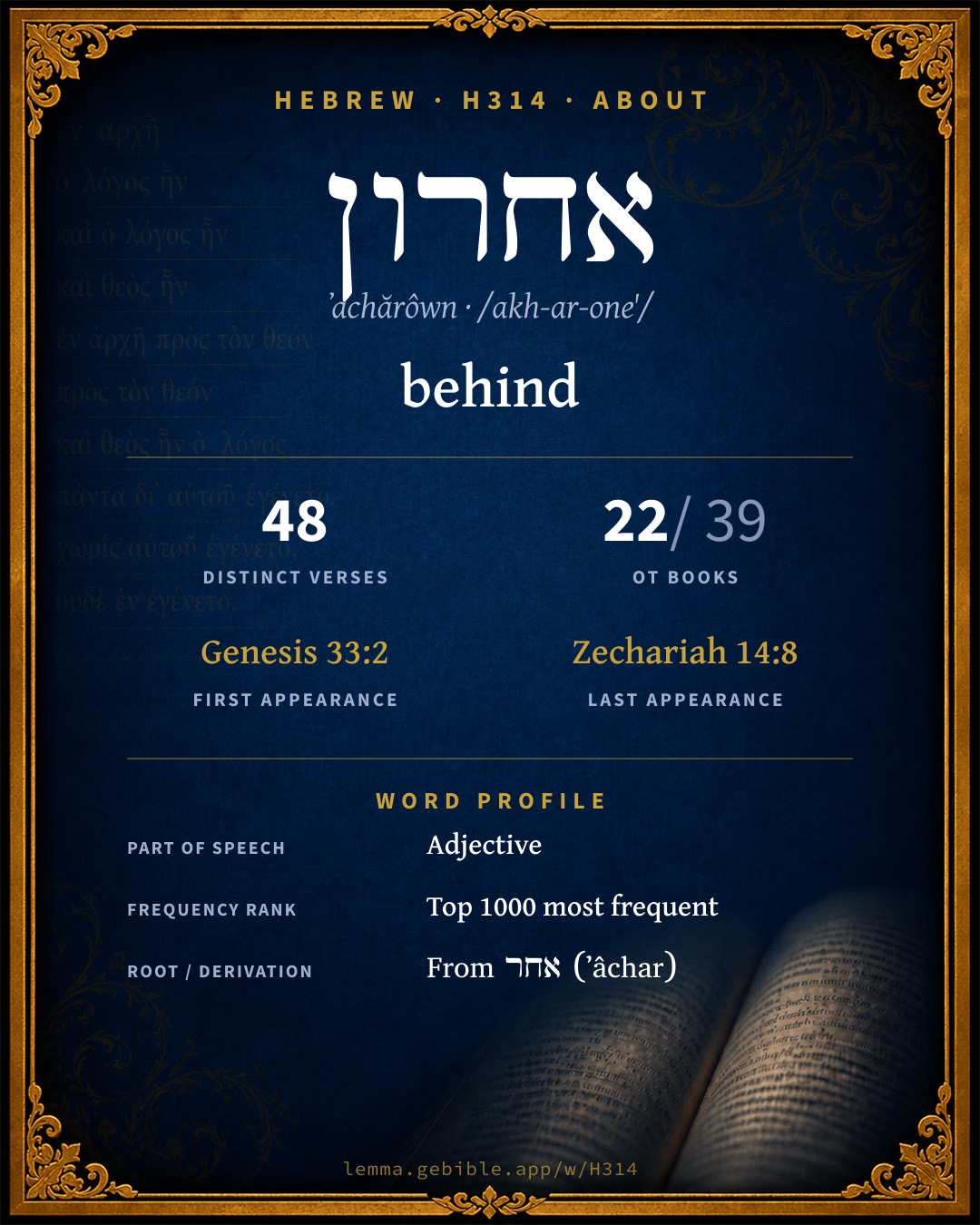
אַחֲרוֹן
behind
also: following, subsequent, western fuller range ↓
Full lexicon entry — Brown-Driver-Briggs (BDB)
From Brown-Driver-Briggs (BDB)
Where this word appears
Grammar key — what these labels mean
Part of speech
- Adjective
- A word that describes or qualifies a noun.
State
- Absolute
- The independent form of a noun, not bound to a following word.
Gender
- Masculine
- Grammatically masculine.
- Feminine
- Grammatically feminine.
Number
- Singular
- One.
- Plural
- More than one (in Hebrew, generally three or more).
Grammatical forms
- Adjective, Adjective, Masculine, Singular, Absolute 22 times (43%)
- Adjective, Adjective, Masculine, Plural, Absolute 20 times (39%)
- Adjective, Adjective, Feminine, Singular, Absolute 9 times (18%)
Parsed forms decoded from the imported morphology (morphhb / Westminster Leningrad Codex — WLC text public domain, morphhb tagging CC BY 4.0), counted across 51 parsed occurrences — not distinct verses.
Every verse where H314 appears — 48 distinct verses across 22 books. Click any verse to open its interlinear word-by-word view. Verse text shown in the World English Bible for context — . Each verse’s Hebrew form is shown with its reference; the English is not keyword-highlighted, since the data carries no word-level English alignment. Use “Compare translations” on any verse to read it across multiple English versions. This concordance covers the Hebrew Bible; Septuagint (Greek Old Testament) occurrences are not indexed here.
Genesis 1 verse
Exodus 1 verse
Numbers 1 verse
Deuteronomy 6 verses
- Deuteronomy 11:24 הָֽ/אַחֲר֔וֹן ptcl def.art + Adjective Adjective ms Every place whereon the sole of your foot shall tread shall be yours: from the wilderness, and Lebanon, from the river, the river Euphrates, even to the hinder sea shall be your border.
- Deuteronomy 13:9 בָּ/אַחֲרֹנָֽה prep det + Adjective Adjective fs but you shall surely kill him; your hand shall be first on him to put him to death, and afterwards the hand of all the people.
- Deuteronomy 17:7 בָּ/אַחֲרֹנָ֑ה prep det + Adjective Adjective fs The hand of the witnesses shall be first on him to put him to death, and afterward the hand of all the people. So you shall put away the evil from the midst of you.
- Deuteronomy 24:3 הָ/אַחֲרוֹן֒ הָ/אַחֲר֔וֹן ptcl def.art + Adjective Adjective ms ptcl def.art + Adjective Adjective ms If the latter husband hate her, and write her a bill of divorce, and give it in her hand, and send her out of his house; or if the latter husband die, who took her to be his wife;
- Deuteronomy 29:22 הָֽ/אַחֲר֗וֹן ptcl def.art + Adjective Adjective ms The generation to come, your children who shall rise up after you, and the foreigner who shall come from a far land, shall say, when they see the plagues of that land, and the sicknesses with which Yahweh has made it sick;
- Deuteronomy 34:2 הָ/אַחֲרֽוֹן ptcl def.art + Adjective Adjective ms and all Naphtali, and the land of Ephraim and Manasseh, and all the land of Judah, to the hinder sea,
Ruth 1 verse
1 Samuel 1 verse
2 Samuel 4 verses
- 2 Samuel 2:26 בָּ/אַחֲרוֹנָ֑ה prep det + Adjective Adjective fs Then Abner called to Joab, and said, "Shall the sword devour forever? Don't you know that it will be bitterness in the latter end? How long shall it be then, before you bid the people return from following their brothers?"
- 2 Samuel 19:11 אַֽחֲרֹנִ֔ים adj Adjective mp King David sent to Zadok and to Abiathar the priests, saying, Speak to the elders of Judah, saying, Why are you the last to bring the king back to his house? seeing the speech of all Israel is come to the king, [to bring him] to his house.
- 2 Samuel 19:12 אַחֲרֹנִ֖ים adj Adjective mp You are my brothers, you are my bone and my flesh: why then are you the last to bring back the king?
- 2 Samuel 23:1 הָ/אַֽחֲרֹנִ֑ים ptcl def.art + Adjective Adjective mp Now these are the last words of David. David the son of Jesse says, The man who was raised on high says, The anointed of the God of Jacob, The sweet psalmist of Israel:
1 Kings 1 verse
1 Chronicles 2 verses
- 1 Chronicles 23:27 הָ/אַ֣חֲרֹנִ֔ים ptcl def.art + Adjective Adjective mp For by the last words of David the sons of Levi were numbered, from twenty years old and upward.
- 1 Chronicles 29:29 וְ/הָ/אֲחרֹנִ֑ים conj + ptcl def.art + Adjective Adjective mp Now the acts of David the king, first and last, behold, they are written in the history of Samuel the seer, and in the history of Nathan the prophet, and in the history of Gad the seer,
2 Chronicles 8 verses
- 2 Chronicles 9:29 וְ/הָ/אֲחֲרוֹנִ֑ים conj + ptcl def.art + Adjective Adjective mp Now the rest of the acts of Solomon, first and last, aren't they written in the history of Nathan the prophet, and in the prophecy of Ahijah the Shilonite, and in the visions of Iddo the seer concerning Jeroboam the son of Nebat?
- 2 Chronicles 12:15 וְ/הָ/אֲ֣חַרוֹנִ֔ים conj + ptcl def.art + Adjective Adjective mp Now the acts of Rehoboam, first and last, aren't they written in the histories of Shemaiah the prophet and of Iddo the seer, after the manner of genealogies? There were wars between Rehoboam and Jeroboam continually.
- 2 Chronicles 16:11 וְ/הָ/אַחֲרוֹנִ֑ים conj + ptcl def.art + Adjective Adjective mp Behold, the acts of Asa, first and last, behold, they are written in the book of the kings of Judah and Israel.
- 2 Chronicles 20:34 וְ/הָ/אַחֲרֹנִ֑ים conj + ptcl def.art + Adjective Adjective mp Now the rest of the acts of Jehoshaphat, first and last, behold, they are written in the history of Jehu the son of Hanani, which is inserted in the book of the kings of Israel.
- 2 Chronicles 25:26 וְ/הָ/אַחֲרוֹנִ֑ים conj + ptcl def.art + Adjective Adjective mp Now the rest of the acts of Amaziah, first and last, behold, aren't they written in the book of the kings of Judah and Israel?
- 2 Chronicles 26:22 וְ/הָ/אֲחֲרֹנִ֑ים conj + ptcl def.art + Adjective Adjective mp Now the rest of the acts of Uzziah, first and last, did Isaiah the prophet, the son of Amoz, write.
- 2 Chronicles 28:26 וְ/הָ/אַחֲרוֹנִ֑ים conj + ptcl def.art + Adjective Adjective mp Now the rest of his acts, and all his ways, first and last, behold, they are written in the book of the kings of Judah and Israel.
- 2 Chronicles 35:27 וְ/הָ/אַחֲרֹנִ֑ים conj + ptcl def.art + Adjective Adjective mp and his acts, first and last, behold, they are written in the book of the kings of Israel and Judah.
Ezra 1 verse
Nehemiah 1 verse
Job 2 verses
Psalms 4 verses
- Psalms 48:13 אַחֲרֽוֹן adj Adjective ms Mark well her bulwarks. Consider her palaces, That you may tell it to the next generation.
- Psalms 78:4 אַחֲר֗וֹן adj Adjective ms We will not hide them from their children, Telling to the generation to come the praises of Yahweh, His strength, and his wondrous works that he has done.
- Psalms 78:6 אַ֭חֲרוֹן adj Adjective ms That the generation to come might know, even the children who should be born; Who should arise and tell their children,
- Psalms 102:18 אַחֲר֑וֹן adj Adjective ms This will be written for the generation to come. A people which will be created will praise Yah.
Proverbs 1 verse
Ecclesiastes 2 verses
- Ecclesiastes 1:11 לָ/אַחֲרֹנִ֜ים לָ/אַחֲרֹנָֽה prep det + Adjective Adjective mp prep det + Adjective Adjective fs There is no memory of the former; neither shall there be any memory of the latter that are to come, among those that shall come after.
- Ecclesiastes 4:16 הָ/אַחֲרוֹנִ֖ים ptcl def.art + Adjective Adjective mp There was no end of all the people, even of all them over whom he was--yet those who come after shall not rejoice in him. Surely this also is vanity and a chasing after wind.
Isaiah 5 verses
- Isaiah 9:1 וְ/הָ/אַחֲר֖וֹן conj + ptcl def.art + Adjective Adjective ms But there shall be no gloom to her who was in anguish. In the former time he brought into contempt the land of Zebulun and the land of Naphtali; but in the latter time has he made it glorious, by the way of the sea, beyond the Jordan, Galilee of the nations.
- Isaiah 30:8 אַחֲר֔וֹן adj Adjective ms Now go, write it before them on a tablet, and inscribe it in a book, that it may be for the time to come forever and ever.
- Isaiah 41:4 אַחֲרֹנִ֖ים adj Adjective mp Who has worked and done it, calling the generations from the beginning? I, Yahweh, the first, and with the last, I am he.
- Isaiah 44:6 אַחֲר֔וֹן adj Adjective ms Thus says Yahweh, the King of Israel, and his Redeemer, Yahweh of Hosts: I am the first, and I am the last; and besides me there is no God.
- Isaiah 48:12 אַחֲרֽוֹן adj Adjective ms Listen to me, O Jacob, and Israel my called: I am he; I am the first, I also am the last.
Jeremiah 1 verse
Daniel 2 verses
- Daniel 8:3 בָּ/אַחֲרֹנָֽה prep det + Adjective Adjective fs Then I lifted up my eyes, and saw, and, behold, there stood before the river a ram which had two horns: and the two horns were high; but one was higher than the other, and the higher came up last.
- Daniel 11:29 וְ/כָ/אַחֲרֹנָֽה conj + prep det + Adjective Adjective fs At the time appointed he shall return, and come into the south; but it shall not be in the latter time as it was in the former.
Joel 1 verse
Haggai 1 verse
Zechariah 1 verse
About this entry
At a glance — auto-summarized from this page’s data, not written by a person. Every figure links to its source below. This summary describes the numbers; it doesn’t interpret them.
אחרון (ʼachărôwn) is a Hebrew adjective most often rendered “behind.” It first appears in Genesis 33:2. The Hebrew Bible uses it across 48 verses — moderately common. Beyond its headline sense, its full sense range takes in “following”, “subsequent”, and “western”. Sharing its root, it stands alongside אחר, אחר and אחר. For the data behind this summary, explore the sense tree and the renderings breakdown below.
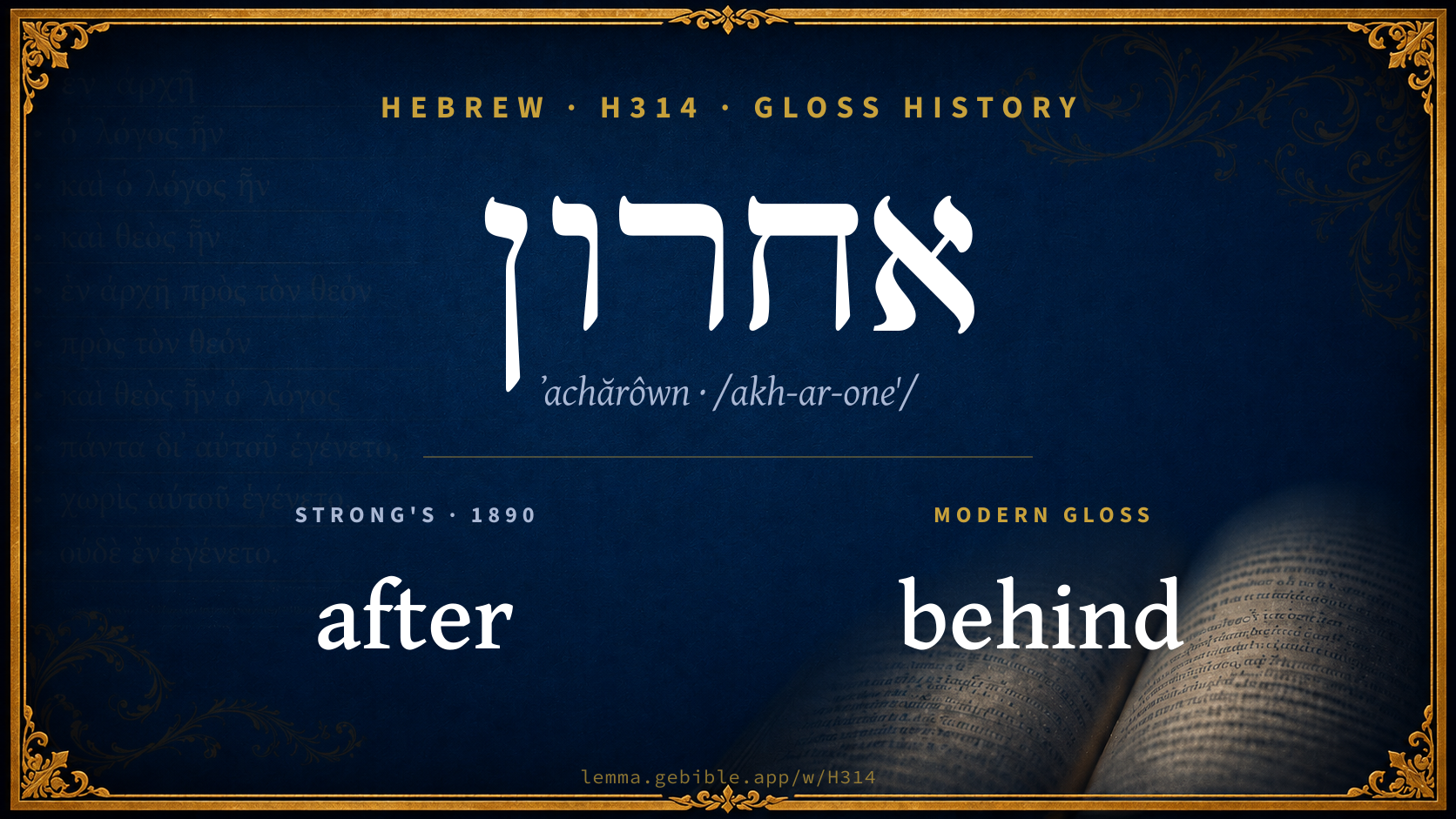
Gloss history
Strong's 1890 vs modern scholarship
About this word
Strong's H314 catalogs a Hebrew word from the Hebrew Old Testament.
These counts are not copied from any lexicon or concordance. They are computed here, from the morphology-tagged Hebrew Old Testament. What Lemma adds →
- 48
- distinct verses
- The word appears in 48 distinct verses.
- 22 / 39
- OT books
- The word appears in 22 of 39 Old Testament books.
- #723
- by frequency
- Top 1000 most frequent Hebrew words (rank 723 of 8,640 Hebrew words by occurrence).
View all 48 occurrences in the concordance →
Most concentrated in
- 2 Chronicles 8 verses 17%
- Deuteronomy 6 verses 13%
- Isaiah 5 verses 10%
By section of the Old Testament
By traditional corpus
Conventional, traditional groupings — biblical authorship is debated, so this is a traditional corpus grouping, not an authorship claim. Each share is this word’s portion of its verses in that division of the Hebrew canon. Each figure is a share of the word’s 48 distinct verses.
- Writings (Ketuvim) 24 verses · 50%
- Prophets (Nevi'im) 15 verses · 31%
- Torah (Pentateuch) 9 verses · 19%
How translations render this word
Counts come from each version’s own published word-to-Strong’s tagging or interlinear alignment — an approximate guide to how each version renders this word, not a word-level alignment the data otherwise carries. Because each total is that version’s own tagged count, the per-version totals vary from one another and need not match the appearance or distinct-verse counts above. These counts may also differ from a printed concordance because Lemma counts each distinctly tagged rendering and does not collapse phrase taggings into a single head-word total. This is a fixed set of word-tagged versions (KJV, ASV, BSB, ULT) and does not change with the reading translation you choose elsewhere. Each version’s license is shown beside its name below (and on Sources).
- King James Version: Last 15×, Come 6×, Latter 4×
- American Standard Version: Last 14×, Come 6×, Latter 4×
- Berean Standard Bible: Last 10×, End 8×, Come 5×
- unfoldingWord Literal Text: Last 12×, Last things 8×, Latter 7×
King James Version Public Domain
Renders H314 across 51 tagged occurrences — most commonly:
Plus 20 renderings that appear only once — usually multi-word phrases or single function words the recovered tagging swept in, not distinct renderings.
American Standard Version Public Domain
Renders H314 across 51 tagged occurrences — most commonly:
Plus 21 renderings that appear only once — usually multi-word phrases or single function words the recovered tagging swept in, not distinct renderings.
Berean Standard Bible Public Domain
Renders H314 across 49 tagged occurrences — most commonly:
Plus 15 renderings that appear only once — usually multi-word phrases or single function words the recovered tagging swept in, not distinct renderings. Not rendered by a distinct English word in 2 further occurrences.
unfoldingWord Literal Text CC BY-SA 4.0
Renders H314 across 55 tagged occurrences — most commonly:
Plus 14 renderings that appear only once — usually multi-word phrases or single function words the recovered tagging swept in, not distinct renderings.
Senses in the full BDB
What do BDB’s symbols mean?
BDB uses these scholarly abbreviations:
| Symbol | Meaning |
|---|---|
| 𝔊 | the Septuagint (the ancient Greek translation, LXX) |
| 𝔙 | the Vulgate (the Latin translation) |
| 𝔖 | the Syriac version (the Peshitta) |
| 𝔗 | the Targum (the Aramaic translation) |
| ψ | the Psalms |
| √ | root (the underlying root or stem) |
| ‖ | parallel passage (a synonymous or contrasted parallel) |
| † | the dagger: every passage where the word occurs is cited |
The 2 senses and sub-senses the full Brown-Driver-Briggs lexicon distinguishes for this word, in lexicon order (not ranked by frequency), with BDB’s own verbatim wording and sub-sense lettering. Shown in Hebrew script with BDB’s own scholarly abbreviations. The condensed entry is in the Lexicon Entry tab. See also the Forms in the corpus table below.
- a. of place, behind, hindermost Gn 33:2(×2); הַיָּם הָאַחֲרוֹן the hinder (= the Western) sea (i.e. the Mediterranean: opp. הַיָּם הַקַּדְמוֹנִי the front sea = the Dead Sea, the Semites, in defining the quarters of the heavens, turning naturally to the East, cf. קֶדֶם of the East, יָמִין, תֵּימָן of the South, above sv. אָחוֹר d. and Assyrian mat aḫarru ‘the Western land,’ of Phœnicia & Palestine) †Dt 11:24; 34:2 Jo 2:20 Zc 14:8; Jb 18:20 poet. אַחֲרֹנִים Ew Hi Di De the dwellers in the West (opp. קַדְמוֹנִים). More commonly e.g. Genesis 33:2
- b. of time, latter or last (according to context) Ex 4:8 Dt 24:3 2 S 19:12 Is 8:23, of God Is 44:6 (‖ רִאשׁוֹן) 48:12 (do.) cf. 41:4; in genl. subsequent (vaguely), יוֹם א׳ = time to come †Is 30:8 Pr 31:25 (but Ne 8:18 הַיּוֹם הָאַ׳ = the last day), (הַ)דּוֹר (הָ)אַ׳ the following generation †Dt 29:21 ψ 48:14; 78:4, 6; 102:19, (הָ)אַחֲרֹנִים they that come after Jb 18:20 (GesSchl) Ec 1:11; 4:16, but Is 41:4 the last, Jb 19:25 וְאַחֲרוֹן עַל־עָפָר יָקוּם and as one coming after (me) (and so able to establish my innocence when I am dead) will he (גֹּֽאֲלִי my Vindicator) arise upon the dust.—The fem. is used adverbially (cf. רִאשֹׁנָה) = afterwards or at the last (acc. to context): (α) absol. †Dan 11:29; (β,) בָּאַחֲרוֹנָה (opp. בָּרִאשֹׁנָה) †Dt 13:10; 17:7 1 S 29:2 2 S 2:26 1 K 17:13 Dn 8:3; (γ) לָאַ׳ †Nu 2:31 (P) Ec 1:11. e.g. Exodus 4:8
Senses from the full Brown-Driver-Briggs lexicon (Brown, Driver, Briggs; Oxford 1906 — public domain), digitized via Sefaria, supplemented by the OpenScriptures HebrewLexicon (CC BY 4.0). Full attribution on Sources.
Word origin
f. אַחֲרוֹנָה, pl. אַחֲרֹנִים (also אַחֲרוֹנִים), adj. from אַחַר, coming after or behind (as a compar. or superl., according to the context); hence
— Brown-Driver-Briggs (Oxford 1906, public domain), digitized via Sefaria, supplemented by the OpenScriptures HebrewLexicon (CC BY 4.0). See Sources.
Derived from אחר (ʼâchar) (H309) — to delay.
Jastrow Dictionary
A second Hebrew/Aramaic lexicon for comparison, covering Aramaic and post-biblical (Talmudic, Targumic, Midrashic) usage that the biblical-Hebrew BDB does not. Matched by lemma rather than by Strong’s number, so a lemma may carry more than one Jastrow headword (shown separately below), and the entries cover usage well beyond the Bible.
אַחֲרוֹן
- , אַחֲרוֹנָה f. (אַחֲרוֹנִית f. noun) other, next, last. Meg. 21ᵇ; a. fr. א׳ the last of those called up to read from the Torah.—Pl. אַחֲרוֹנִים m., אַחֲרוֹנוֹת f.—מים א׳ the washing of hands after meals before grace, opp. מים ראשונים washihg before meals. Ber. 53ᵇ; a. fr.—דורות א׳ or only אחרונים the latter (present) generation, opp. ראשונים ancients. Yoma 9ᵇ; a. fr.—Ber. 13ᵃ צרות א׳ וכ׳ the latter (present) troubles bring the former into oblivion.—(ברכות) א׳ the three last sections in the Prayer of Benedictions. Ibid. 34ᵃ; a. fr.—Erub. 53ᵇ אַחְרוֹנִית second wife; v. אַהֲרוֹנִית.—בָּאַחֲרוֹנָה (adv.) last. B. Kam. 8ᵃ; a. e.
A Dictionary of the Targumim, the Talmud Babli and Yerushalmi, and the Midrashic Literature (Marcus Jastrow; London, Luzac, 1903) — Public Domain. Digitized via Sefaria. Digitized via Sefaria. Full attribution on Sources.
Forms in the corpus
The 40 distinct written forms H314 takes in the Hebrew Bible, most frequent first — each parse links to that state’s occurrences in the concordance. Hebrew forms include their vowel points and cantillation, so a single lemma takes many written forms.
| Form | Parsing | Example | Uses |
|---|---|---|---|
| אַחֲרֽוֹן | Adjective, Adjective, Masculine, Singular, Absolute | Isaiah 48:12 | 3 |
| בָּ/אַחֲרֹנָֽה | Adjective, Adjective, Feminine, Singular, Absolute | Daniel 8:3 | 3 |
| וְ/הָ/אַחֲרוֹנִ֑ים | Adjective, Adjective, Masculine, Plural, Absolute | 2 Chronicles 16:11 | 3 |
| אַחֲר֔וֹן | Adjective, Adjective, Masculine, Singular, Absolute | Isaiah 30:8 | 2 |
| אַחֲרֹנִ֖ים | Adjective, Adjective, Masculine, Plural, Absolute | 2 Samuel 19:12 | 2 |
| הָ/אַחֲר֑וֹן | Adjective, Adjective, Masculine, Singular, Absolute | Nehemiah 8:18 | 2 |
| הָ/אַחֲרֽוֹן | Adjective, Adjective, Masculine, Singular, Absolute | Deuteronomy 34:2 | 2 |
| וְ/הָ/אַחֲרֹנִ֑ים | Adjective, Adjective, Masculine, Plural, Absolute | 2 Chronicles 20:34 | 2 |
| אַ֭חֲרוֹן | Adjective, Adjective, Masculine, Singular, Absolute | Psalms 78:6 | 1 |
| אַֽחֲרֹנִ֔ים | Adjective, Adjective, Masculine, Plural, Absolute | 2 Samuel 19:11 | 1 |
| אַחֲר֑וֹן | Adjective, Adjective, Masculine, Singular, Absolute | Psalms 102:18 | 1 |
| אַחֲר֗וֹן | Adjective, Adjective, Masculine, Singular, Absolute | Psalms 78:4 | 1 |
| אַחֲרֹנִ֑ים | Adjective, Adjective, Masculine, Plural, Absolute | Job 18:20 | 1 |
| אַחֲרֹנִ֔ים | Adjective, Adjective, Masculine, Plural, Absolute | Genesis 33:2 | 1 |
| אַחֲרֹנִֽים | Adjective, Adjective, Masculine, Plural, Absolute | Genesis 33:2 | 1 |
| אַחֲרֹנִים֒ | Adjective, Adjective, Masculine, Plural, Absolute | Ezra 8:13 | 1 |
| בָּ/אַחֲרֹנָ֑ה | Adjective, Adjective, Feminine, Singular, Absolute | Deuteronomy 17:7 | 1 |
| בָּ/אַחֲרֹנָ֖ה | Adjective, Adjective, Feminine, Singular, Absolute | 1 Samuel 29:2 | 1 |
| בָּ/אַחֲרוֹנָ֑ה | Adjective, Adjective, Feminine, Singular, Absolute | 2 Samuel 2:26 | 1 |
| הָ/אַ֣חֲרֹנִ֔ים | Adjective, Adjective, Masculine, Plural, Absolute | 1 Chronicles 23:27 | 1 |
| הָ/אַֽחֲר֑וֹן | Adjective, Adjective, Masculine, Singular, Absolute | Joel 2:20 | 1 |
| הָ/אַֽחֲרֹנִ֑ים | Adjective, Adjective, Masculine, Plural, Absolute | 2 Samuel 23:1 | 1 |
| הָ/אַֽחֲרוֹן֙ | Adjective, Adjective, Masculine, Singular, Absolute | Haggai 2:9 | 1 |
| הָ/אַחֲר֔וֹן | Adjective, Adjective, Masculine, Singular, Absolute | Deuteronomy 24:3 | 1 |
| הָ/אַחֲר֖וֹן | Adjective, Adjective, Masculine, Singular, Absolute | Ruth 3:10 | 1 |
| הָ/אַחֲרוֹן֒ | Adjective, Adjective, Masculine, Singular, Absolute | Deuteronomy 24:3 | 1 |
| הָ/אַחֲרוֹן֙ | Adjective, Adjective, Masculine, Singular, Absolute | Jeremiah 50:17 | 1 |
| הָ/אַחֲרוֹנִ֖ים | Adjective, Adjective, Masculine, Plural, Absolute | Ecclesiastes 4:16 | 1 |
| הָֽ/אַחֲר֔וֹן | Adjective, Adjective, Masculine, Singular, Absolute | Deuteronomy 11:24 | 1 |
| הָֽ/אַחֲר֗וֹן | Adjective, Adjective, Masculine, Singular, Absolute | Deuteronomy 29:22 | 1 |
| וְ/הָ/אֲ֣חַרוֹנִ֔ים | Adjective, Adjective, Masculine, Plural, Absolute | 2 Chronicles 12:15 | 1 |
| וְ/הָ/אֲחֲרֹנִ֑ים | Adjective, Adjective, Masculine, Plural, Absolute | 2 Chronicles 26:22 | 1 |
| וְ/הָ/אֲחֲרוֹנִ֑ים | Adjective, Adjective, Masculine, Plural, Absolute | 2 Chronicles 9:29 | 1 |
| וְ/הָ/אֲחרֹנִ֑ים | Adjective, Adjective, Masculine, Plural, Absolute | 1 Chronicles 29:29 | 1 |
| וְ/הָ/אַחֲר֖וֹן | Adjective, Adjective, Masculine, Singular, Absolute | Isaiah 9:1 | 1 |
| וְ/כָ/אַחֲרֹנָֽה | Adjective, Adjective, Feminine, Singular, Absolute | Daniel 11:29 | 1 |
| וְ֝/אַחֲר֗וֹן | Adjective, Adjective, Masculine, Singular, Absolute | Job 19:25 | 1 |
| לָ/אַחֲרֹנִ֜ים | Adjective, Adjective, Masculine, Plural, Absolute | Ecclesiastes 1:11 | 1 |
| לָ/אַחֲרֹנָ֥ה | Adjective, Adjective, Feminine, Singular, Absolute | Numbers 2:31 | 1 |
| לָ/אַחֲרֹנָֽה | Adjective, Adjective, Feminine, Singular, Absolute | Ecclesiastes 1:11 | 1 |
Same root — word family
Other BDB entries built from the same root as H314, grouped by Strong’s listed origin. These share a root / origin per the lexicon — not necessarily a shared meaning. Each links to that word’s own entry.
Derives from
Shares the same root
Compare all same-root words → Showing 4 of 5 — not the complete family. They share a root, not necessarily a meaning.
Septuagint verse parallels
This word appears in 46 verses that also exist in the Greek Old Testament (Septuagint), out of the 48 Hebrew verses it occurs in. You can read those verses in Greek by switching the Old Testament edition to the Septuagint.
Read these verses in the Septuagint
- Genesis 33:2
- Exodus 4:8
- Numbers 2:31
- Deuteronomy 11:24
- Ruth 3:10
- 1 Samuel 29:2
- 2 Samuel 2:26
- 1 Kings 17:13
- 1 Chronicles 23:27
- 2 Chronicles 9:29
- Ezra 8:13
- Job 18:20
This is a verse-level parallel only — the same verses exist in both the Hebrew and Greek Old Testaments. No word-level Hebrew↔Greek correspondence is claimed: the data carries no such alignment, so no Greek word is shown as this Hebrew word’s translation. Coverage is not total — the Septuagint omits the deuterocanon and renumbers the Psalms, so some Hebrew verses have no direct Greek parallel.