Ezekiel 36:21

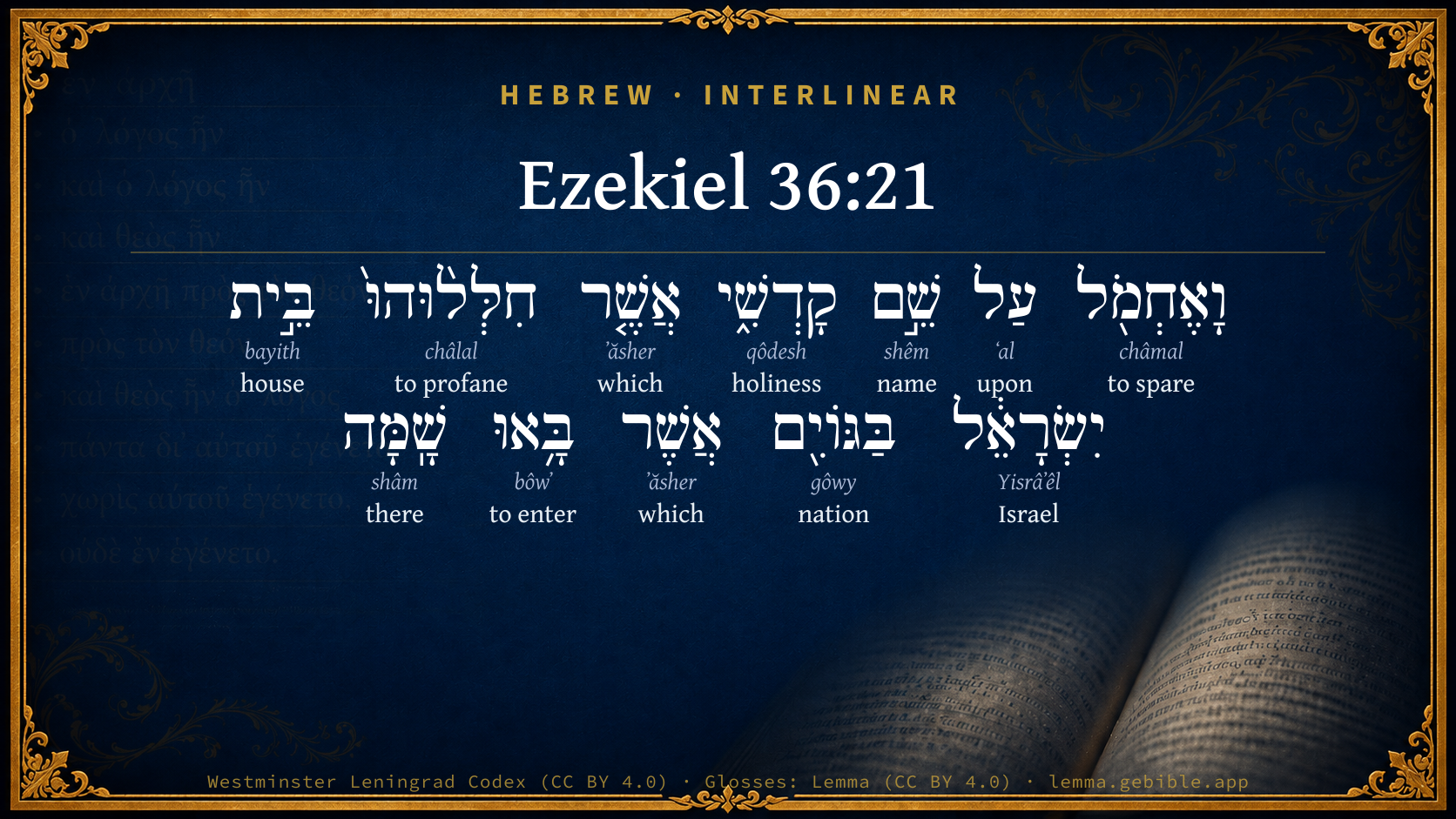
Hebrew (Westminster Leningrad Codex) Ezekiel 36:21 appears in the Hebrew Old Testament. The text above is from the Westminster Leningrad Codex. Each word links to its Strong’s number, a concise gloss, and parsing drawn from the Open Scriptures Hebrew Bible morphology. Click any word for its full Brown-Driver-Briggs (BDB) entry.
Download image
Cite this verse

Ezekiel 36:21 (World English Bible). Public Domain. Lemma interlinear Bible study tool, https://lemma.gebible.app/v/ezekiel/36/21.

Show BibTeX & RIS
BibTeX
RIS
English Translation
But I had regard for my holy name, which the house of Israel had profaned among the nations, where they went.
World English Bible · Public Domain
Download a study sheet

One document with this verse’s original text, its word-by-word gloss line, the meaning frame, cross-references with their text, attributed commentary, and full source and license credits — printable, and it pastes into notes with its structure intact.

This verse Autodidact and up

Study sheet (.html) Plain text (.txt)

A passage Seminary Student

Up to 50 verses in one chapter. A passage sheet keeps up to 6 commentary sources and 12 cross-references per verse, in the order this page ranks them, and says so on the sheet whenever that leaves anything out. Ask for a single verse and you get the Autodidact verse sheet above.

Everything on this page stays free to read, with no account — the sheet is a download of what is already on screen, not access to it.

Want to remove ads? Support Godless Engineer
Compare translations 3

The same verse in 3 English versions, stacked beneath the original-language interlinear above. Click any original word for its lexicon entry.

Each is an independent rendering of the whole verse — the interlinear is not word-aligned to these translations.

Highlighted words mark where these versions differ — a whole-verse word diff, not a word-by-word alignment.

  • World English Bible Public Domain
    But I had regard for my holy name, which the house of Israel had profaned among the nations, where they went.
  • King James Version Public Domain
    But I had pity for mine holy name, which the house of Israel had profaned among the heathen, whither they went.
  • unfoldingWord Literal Text CC BY-SA 4.0
    But I had compassion for my holy name that the house of Israel had defiled among the nations, when they went there.

unfoldingWord Literal Text — © unfoldingWord, licensed CC BY-SA 4.0. Word-aligned USFM3 via Door43 (git.door43.org/unfoldingWord/en_ult).

Versions to compare (up to 4)

3 of 4 selected

Show all 18 translations

Every available English version of this verse, each an independent rendering of the whole verse.

  • World English Bible Public Domain
    But I had regard for my holy name, which the house of Israel had profaned among the nations, where they went.
  • Berean Standard Bible Public Domain
    But I had concern for My holy name, which the house of Israel had profaned among the nations to which they had gone.
  • Majority Standard Bible Public Domain
    But I had concern for My holy name, which the house of Israel had profaned among the nations to which they had gone.
  • King James Version Public Domain
    But I had pity for mine holy name, which the house of Israel had profaned among the heathen, whither they went.
  • American Standard Version (1901) Public Domain
    But I had regard for my holy name, which the house of Israel had profaned among the nations, whither they went.
  • Revised Version (1885) Public Domain
    But I had pity for mine holy name, which the house of Israel had profaned among the nations, whither they went.
  • Geneva Bible (1599) Public Domain
    But I fauoured mine holy Name which the house of Israel had polluted among the heathen, whither they went.
  • Douay-Rheims (1899) Public Domain
    And I have regarded my own holy name, which the house of Israel hath profaned among the nations to which they went in.
  • Young's Literal Translation Public Domain
    And I have pity on My holy name, That the house of Israel have polluted among nations whither they have gone in.
  • Literal Standard Version CC BY-SA 4.0
    And I have pity on My holy Name, || That the house of Israel has defiled || Among the nations to where they have gone in.
  • Unlocked Literal Bible CC BY-SA 4.0
    But I had compassion for my holy name that the house of Israel had defiled among the nations, when they went there.
  • unfoldingWord Literal Text CC BY-SA 4.0
    But I had compassion for my holy name that the house of Israel had defiled among the nations, when they went there.
  • Darby Bible Public Domain
    But I had pity for my holy name, which the house of Israel had profaned among the nations whither they went.
  • World Messianic Bible Public Domain
    But I had respect for my holy name, which the house of Israel had profaned among the nations where they went.
  • Webster's Bible Public Domain
    But I had pity for my holy name, which the house of Israel had profaned among the heathen, whither they went.
  • Free Bible Version CC BY-SA 4.0
    So I had to take care of my reputation for holiness which the people of Israel had ruined among the nations where they'd gone.
  • Bible in Basic English Public Domain
    But I had pity for my holy name which the children of Israel had made unclean wherever they went.
  • JPS Tanakh (1917) Public Domain
    But I had pity for My holy name, which the house of Israel had profaned among the nations, whither they came.

Literal Standard Version (2020), Covenant Press — licensed CC BY-SA 4.0. Text via the HelloAO Bible API (eBible.org). Unlocked Literal Bible (unfoldingWord) — licensed CC BY-SA 4.0. Text via the HelloAO Bible API (eBible.org). unfoldingWord Literal Text — © unfoldingWord, licensed CC BY-SA 4.0. Word-aligned USFM3 via Door43 (git.door43.org/unfoldingWord/en_ult). Free Bible Version, Dr. Jonathan Gallagher — licensed CC BY-SA 4.0. Text via the HelloAO Bible API (eBible.org).

Word by word

More ways to search: Search by grammar → Find every occurrence → Compare this word →

Practice this passage: Drill this verse → Learn its vocabulary →

וָאֶחְמֹ֖ל
châmal
H2550
“and · to spare”
Conjunction + Verb, Qal, Sequential Imperfect, 1st Person, Common, Singular
Part of Speech
Conjunction + Verb
Stem
Qal
Form
Sequential Imperfect
Person
1st Person
Gender
Common
Number
Singular
Full BDB Definition

Origin: a primitive root

TWOT: TWOT- 676

(Qal) to spare, pity, have compassion on
  1. עַל ʻal H5921 “upon” Preposition
  2. שֵׁ֣ם shêm H8034 “name of” Noun, Common, Masculine, Singular, Construct
  3. קָדְשִׁ֑י qôdesh H6944 “holiness · my” Noun, Common, Masculine, Singular, Construct + Suffix, Personal, 1st Person, Common, Singular
  4. אֲשֶׁ֤ר ʼăsher H834 “which” Particle, Relative
  5. חִלְּל֨וּהוּ֙ châlal H2490 “to profane · him” Verb, Piel, Perfect, 3rd Person, Common, Plural + Suffix, Personal, 3rd Person, Masculine, Singular
  6. בֵּ֣ית bayith H1004 “house of” Noun, Common, Masculine, Singular, Construct
  7. יִשְׂרָאֵ֔ל Yisrâʼêl H3478 “Israel” Noun, Proper
  8. בַּגּוֹיִ֖ם gôwy H1471 “in/at the · nations” Preposition, Determined + Noun, Common, Masculine, Plural, Absolute
  9. אֲשֶׁר ʼăsher H834 “which” Particle, Relative
  10. בָּ֥אוּ bôwʼ H935 “to enter” Verb, Qal, Perfect, 3rd Person, Common, Plural
  11. שָֽׁמָּה shâm H8033 “there · toward” Adverb + Suffix, Demonstrative

About this verse

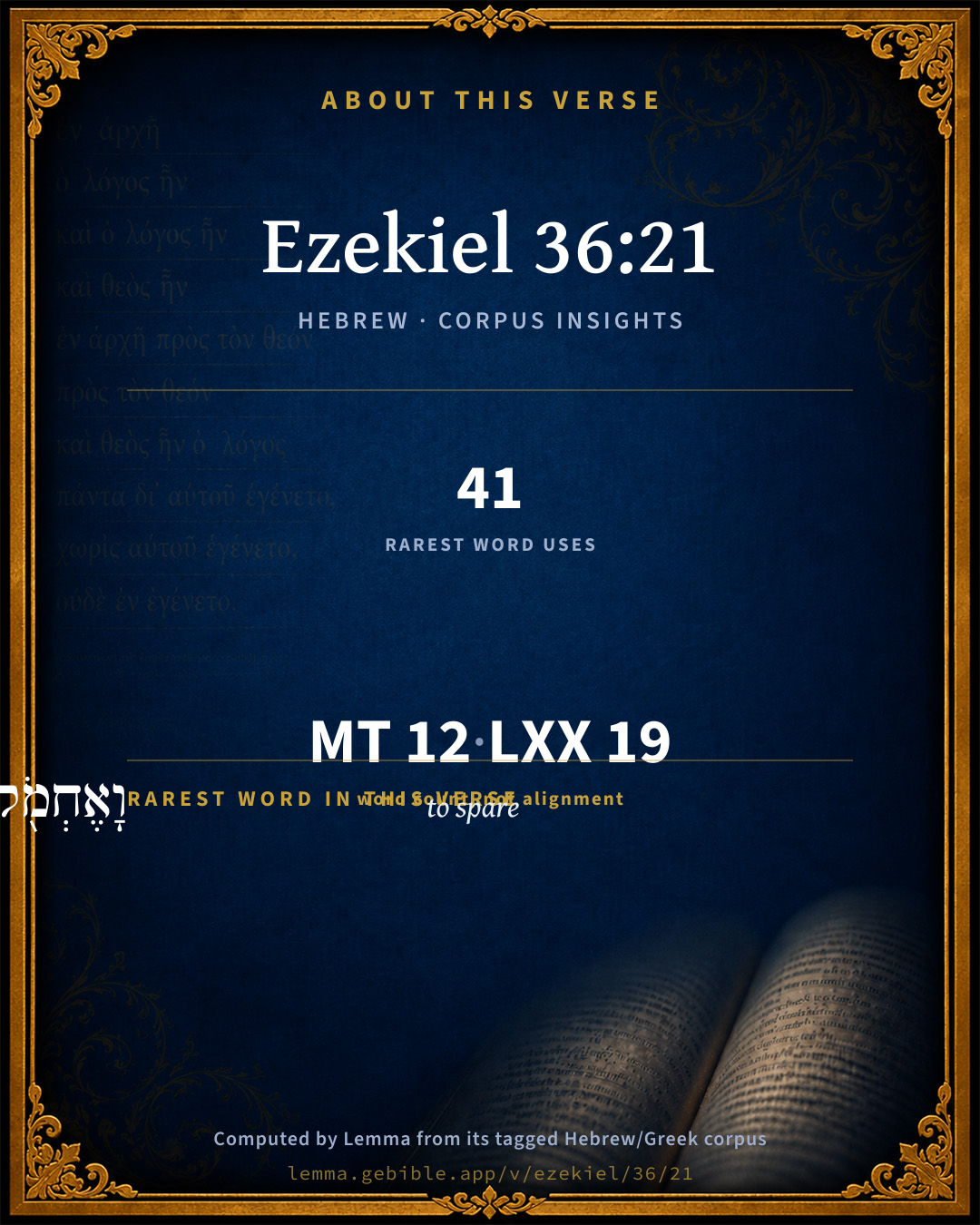
These counts appear in no published source. They are computed here, from the morphology-tagged text and Lemma’s own curated glosses. What Lemma adds →

12
words
11
distinct lemmas
Prophets
section

Shared distinctive vocabulary

וָאֶחְמֹ֖ל to spare H2550 occurs in 40 verses of the Hebrew Bible. Also found in:

Grammatical profile

  • 3 verbs
  • 5 nouns
  • 1 preposition
  • 1 adverb
  • 2 particles

Verb forms

  • וָאֶחְמֹ֖ל Qal · Sequential Imperfect
  • חִלְּל֨וּהוּ֙ Piel · Perfect
  • בָּ֥אוּ Qal · Perfect

Repetition

A word recurs within this verse — often emphatic in Hebrew:

  • אֲשֶׁ֤ר which H834 ×2

Hebrew & Septuagint length

In English translation the verse runs 21 words from the Hebrew and 24 from the Septuagint (LXX English) — closely comparable.

A rough comparison of the two English renderings, which tokenize alike — not a word-level alignment.

Word counts can differ between the Hebrew and the Greek without any difference in meaning — e.g. the Hebrew direct-object marker אֵת has no separate Greek word, and Greek often adds the article ὁ.

In the original languages it is 12 Hebrew tokens and 19 Greek tokens — but the two are counted differently (Hebrew bundles its prefixes and suffixes into one token; the Greek is in lemma form), so that isn’t a like-for-like length.

Cross-references

7

Topical passages linked to Ezekiel 36:21 in the Treasury of Scripture Knowledge — connected by theme and wording, ordered by reader-vote popularity; previews shown in the World English Bible.

  • Psalms 74:18 Remember this, that the enemy has mocked you, Yahweh. Foolish people have blasphemed your name.
  • Isaiah 48:9 For my name's sake will I defer my anger, and for my praise will I refrain for you, that I not cut you off.
  • Ezekiel 20:9 But I worked for my name's sake, that it should not be profaned in the sight of the nations, among which they were, in whose sight I made myself known to them, in bringing them forth out of the land of Egypt.
  • Deuteronomy 32:26–27 I said, I would scatter them afar, I would make the memory of them to cease from among men;
  • Isaiah 37:35 For I will defend this city to save it, for my own sake, and for my servant David's sake.
  • Ezekiel 20:14 But I worked for my name's sake, that it should not be profaned in the sight of the nations, in whose sight I brought them out.
  • Ezekiel 20:22 Nevertheless I withdrew my hand, and worked for my name's sake, that it should not be profaned in the sight of the nations, in whose sight I brought them forth.

Cross-references courtesy of OpenBible.info (CC BY 4.0).

Hebrew and Greek witnesses Masoretic Hebrew ↔ Greek Septuagint

The same verse in the two great witnesses to the Old Testament, shown verse-for-verse.

These are two independent witnesses, not word-aligned to each other, and the Septuagint is shown in lemma (dictionary) form.

Hebrew Ezekiel 36:21 Masoretic · Westminster Leningrad Codex

וָאֶחְמֹ֖ל עַל שֵׁ֣ם קָדְשִׁ֑י אֲשֶׁ֤ר חִלְּל֨וּהוּ֙ בֵּ֣ית יִשְׂרָאֵ֔ל בַּגּוֹיִ֖ם אֲשֶׁר בָּ֥אוּ שָֽׁמָּה

But I had regard for my holy name, which the house of Israel had profaned among the nations, where they went.

World English Bible · Public Domain

Greek LXX Ezekiel 36:21 Septuagint · lemma form

καί φείδομαι αὐτός διά ὁ ὄνομα ἐγώ ὁ ἅγιος ὅς βεβηλόω οἶκος ἰσραήλ ἐν ὁ ἔθνος ὅς εἰςἔρχομαι ἐκεῖ

But I spared them for the sake of my holy name, which the house of Israel profaned among the nations, among whom they went.

LXX2012 (modern English Septuagint) · Public Domain

On this verse, The Pulpit Commentary discusses the Septuagint’s reading. Read the note in Commentary ↓

Hebrew: Westminster Leningrad Codex (CC BY 4.0). Greek: Septuagint (public domain); English from LXX2012 (modern English Septuagint) (Public Domain). How the Septuagint differs from the Hebrew →

Targum (Aramaic paraphrase)

1

The Targum is the ancient Jewish Aramaic paraphrase of the Hebrew Scriptures — an interpretive translation, not the Hebrew text itself. Onkelos (literal) and Pseudo-Jonathan (expansive) render the Torah, and Jonathan the Prophets. Coverage is partial: where no permissively-licensed English translation exists for a verse, only the Aramaic is shown. This is verse-level text, not a word-by-word alignment to the Hebrew.

  1. Targum Jonathan Prophets (Joshua–Malachi)
    וְחָסֵית עַל שְׁמָא דְקוּדְשִׁי דְאָחִילוּהִי בֵּית יִשְׂרָאֵל בֵּינַי עַמְמַיָא דְאִתְגְלִיאוּ לְתַמָן:

    (no public-domain English translation for this verse)

    Targum Jonathan — Aramaic: “Mikraot Gedolot” (public domain). English: “Sefaria Community Translation” (CC0 1.0 (public-domain dedication)); “London "Chaldee Paraphrase," 1871” (public domain). Text via Sefaria.

Commentary

Notes on Ezekiel 36:21 from classic Christian and Jewish commentators (each source and its license shown beneath its notes). The classic Christian expositions comment on the surrounding passage and are grouped to its opening verse, so a note may address several verses; the Jewish commentaries on the Tanakh (Rashi and others) are per-verse, so they appear only where the commentator wrote on this verse.

Lemma curates 59 commentaries, every one of them public domain or Creative Commons licensed, each selected and text-cleaned for this edition rather than reprinted as found. About our sources →

Trapp's Complete Commentary

John Trapp

Eze 36:21 But I had pity for mine holy name, which the house of Israel had profaned among the heathen, whither they went.

Ver. 21. But I had pity for my holy name.] So he hath still, or else it would be wide enough with us. Some render it, I spared, or tendered, mine holy name; and, to free it from those imputations, I freely forgave my people, and re-established them.

John Trapp, A Commentary or Exposition upon All the Books of the Old and New Testament (1647–1656) — public domain. Text from a community e-Sword module.

The Biblical Illustrator

Joseph S. Exell

Eze_36:21-24

I had pity for Mine holy name.

Gods motive in salvation

There is a land lying beneath a burning sky where the fields are seldom screened by a cloud, and almost never refreshed by a shower; and yet Egypt--for it is of it I speak--is as remarkable for the fertile character of its soil as for the hoar antiquity of its history. At least, it was so in days of old, when hungry nations were fed by its harvests, and its fields were the granaries of ancient Rome. Powers so prolific Egypt owed to the Nile; a river whose associations carry us upward to the beginning of all human history; on whose banks, in the tombs of forgotten kings, stand the proudest monuments of human vanity; the very name of which recalls some of the grandest scenes that have been acted on the stage of time. From the earliest ages the source of the Nile was regarded with intensest interest. Whence it sprung and how its annual flood was swelled were the subjects of eager but ungratified curiosity. One traveller after another had attempted to reach its cradle, and had failed or fallen in the enterprise; and when--travelling along its banks, from the shore where, by many months, it disgorged its waters into the sea, till its ample volume had shrunk into the narrowness of a mountain stream--our hardy countryman, boldly facing many dangers and difficulties, at length stood beside the long-sought fountain, this achievement won him an immortal reputation. How he enjoyed his triumph, as he sat down by the cradle of a river which had fed the millions of successive generations, and in days of famine long gone by had saved the race which gave a Redeemer to the world! Now, what this river, which turns barren sand into the richest soil, is to Egypt, the Gospel of Jesus Christ is to the world. And if it be interesting to trace the Nile to its mountain source, how much more interesting to explore the stream of eternal life, and trace it upward till we have reached its fountain. Bruce discovered, or thought he had discovered, the springs of Egypts river, among cloud-capped mountains, at an elevation of many thousand feet above the plains they watered. All great rivers, Unlike some great men who have been born in lowly circumstances, boast a lofty descent. It is after the traveller has left smiling valleys far beneath him, and toiling along rugged glens, and pressing through deep mountain gorges, at length reaches the chili shores of an icy sea, that he stands at the source of the Alpine river, which, cold as the snows that feed it, and a full-grown stream at its birth, rushes out from the caverns of the hollowed glacier. Yet such a river in the loftiness of its birth place is but an humble image of salvation. The stream of mercy flows from the throne of the Eternal; and here we seem to stand by its majestic and mysterious fountain; in contemplating the words of the text, we look upon its spring--I do this for Mine holy names sake.

I. Attend to the expression, My names sake. The name of God, as employed by the sacred writers, has many and most important meanings. In the 20th Psalm, for instance, it embraces all the attributes of the Godhead. The name of the God of Jacob defend thee; that is, when paraphrased, may His arms be around; may His wisdom guide thee; may His power support thee; the bounty of God supply thy wants; the mercy of God forgive thy sins; may the shield of heaven cover, and its precious blessings crown thy head. Again, in Mic_4:5, where it is said, We will walk in the name of the Lord, the expression assumes a new meaning, and indicates the laws, statutes, and commandments of God. Again in the blessed promise, In all places where I record My name I will come unto thee and I will bless thee, the expression bears yet another meaning: it stands for religious ordinances and worship, and rears, by the hand of faith, a holy temple out of the rudest edifice, changing into heaven-consecrated churches those rocky fastnesses and lonely moors where our fathers found their God in the dark days of old. Contenting ourselves with these illustrations of the various meanings of this expression in Scripture, I now remark that here the name of God comprehends everything that either directly or remotely affects the Divine honour and glory; whatever touches, to use the words of our Catechism, His titles, attributes, ordinances, word or works; or anything whereby God maketh Himself known.

II. We are to understand that the motive which moved God to save man was regard to his own glory. This doctrine, that God saves men for His own glory, is a grand, a very precious truth; yet it may be stated in a way which seems as offensive as it is really unscriptural. Have you never observed how concave mirrors magnify the features nearest to them into undue and monstrous proportions, and how common mirrors, that are ill-cast and of uneven surface, turn the most beautiful face into deformity? Well, there are some good men whose minds appear to be of such a cast and character. Neither seeing nor exhibiting the truths of the Bible in their proper harmony and proportions, they represent our Lord in this matter of salvation as affected by no motive whatever but a regard to His Fathers glory, and even God Himself as moved only by a regard to this end. Excluding from their view the pity and love of God, or reducing these into shrunken and small dimensions, they magnify one doctrine at the expense of another; and thereby weaken, if not annihilate, some of the most sacred and tender ties which bind the believer to His God. I know that we should approach so high a theme with the deepest reverence. It becomes us to speak on this subject, and on anything else that touches the secret movements of the Divine mind, with profound humility. Yet, reasoning from the form of the shadow to the nature of the object which projects it, from the image to that of which it is the reflection, from man to God, I venture to say, that it is with Him as with us, when we are moved to a single action by the influence of various motives. To borrow an example from the place I fill. The minister ascends the pulpit to preach; and, in preaching, if worthy of his office, he is affected by a variety of motives. Love to God, love to Jesus, love to sinners, love to saints, regard to Gods glory, and also to mans good--these, like the air, the water, the light, the heat, the electricity, the gravity, which act together in the process of vegetation, may all combine to form and inspire one sermon. They are present, not as conflicting but as concurring motives in the preachers breast. This difference, however, there is between us and a perfect God, that though--like the Rhone, which is formed of two rivers, the one turbid, the other pure as the blue sky above it--our motives are mixtures of good and evil, all the emotions of the Divine mind, and the influences that move God to action, are of the purest nature. Never, therefore, let us exalt this doctrine of the Divine glory at the expense of Divine love to sinners. His love to sinners is His mightiest, His heart-softening, as an old writer called it, His heart-breaking argument; and it were doing Him, His blessed Gospel and our own souls the greatest injustice if we should overlook the love that gives Divinity its name, which sent, in His Son, a Saviour from the Fathers bosom, and was eulogised by an apostle as possessed of a height and depth and breadth and length which passeth knowledge.

III. Observe that in saving man for His holy names sake, or for His own honour and glory, God exhibits the mercy, holiness, love, and other attributes of the Godhead. The truth is, that God saves man for much the same reasons as at first He created him. What moved God, then, to make man, or, when through the regions of empty space there was neither world rolling, nor sun shining, nor angel singing--when there was neither life nor death, nor birth nor burial, nor sight nor sound, no wave of ocean breaking, no wing of seraph moving--when God dwelt alone in silent, solemn, awful, but complacent solitude, what moved Him to make creatures at all, and with these bright worlds, suns, and systems, to garnish the vacant heavens, and people with its varied inhabitants a lonely universe? These are the deep things of God, and it becomes us with our finite and fallible minds to approach them modestly. Still, by turning the eye inward on ourselves, we may form some conception of the mind of God; even as a captive child, born and retained in a dark dungeon, may learn something of the sun from the beam that, streaming through a chink of the riven wall, travels the grey lonely floor; or even as, though I had never walked its pebbly shore, nor heard the voice of its thundering breakers, nor played in summer day with its swelling waves, I could form some feeble conception of the ocean from a lake, from a pool, or from this sparkling dew drop, which, born of the womb of night, and cradled in the bosom of a flower, lies waiting, like a soul under the Sun of Righteousness, to be exhaled to heaven. Look at man, then. Is he a poet or a philosopher, a man of mechanical genius or artistic skill, a statesman or a philanthropist, or, better than all, one in whose bosom glow the fires of piety? It matters not. We perceive that his happiness does not lie in indolence, but in the gratification of his tastes, the indulgence of his feelings, and the exercise of his faculties, whatever they be. Assume the same to be true of God, and the conception, while it exalts, endears our heavenly Father to us. Does it not present Him in this most winning and attractive aspect, that the very happiness of Godhead lies in the forthputting, along with other attributes, of His goodness, love, and mercy? The minnow plays in the shallow pool, and leviathan cleaves the depths of ocean; winged insects sport in the sunbeam, and winged angels sing before the throne; but whether we fix our attention on His least or greatest works, the whole fabric of creation seems to prove that Jehovah delights in the evolution of His powers, in the display of wisdom and love and goodness; and, just as it is to the delight which God enjoys in the exercise of these that we owe creation, with all its bounties, so is it to his delight in the exercise of pity, love, and mercy that we owe salvation, with all its blessings. Let us be both humble and thankful. Salvation is finished. Salvation is offered, freely offered. Shall it be rejected? Oh, take the good, and give God the glory. Say, He is the God of Salvation; and in His name we will set up our banners. (T. Guthrie, D. D.)

Man an object of Divine mercy

I. The doctrine that God is not moved to save man by any merit or worth in him is a truth of the highest importance to sinners. Like the rough and stern Baptist, it prepares the way for Christ. We must be emptied of self before we can be filled with grace; we must be stripped of our rags before we can be clothed with righteousness; we must be unclothed, that we may be clothed upon; wounded, that we may be healed; killed, that we may be made alive; buried in disgrace, that we may rise in holy glory.

1. To tell man that he has no merit is no doubt a humbling statement. It lays the loftiest, self-sufficient sinner in the dust. Yes, this doctrine, like death, is the true leveller. It puts all men on the same platform before a holy God. It sets crowned kings as low as beggars, honest men with rogues and thieves, and the strictest virtue, virtue which the breath of suspicion never sullied, alongside of base and brazen-faced iniquity. God pronounces our righteousness--observe, not our wickednesses, but our devotions, our charities, our costliest sacrifices, our most applauded services--to be filthy rags. Trust not therefore to them. What man in his senses would think of going to court in rags, in rags to wait upon a king? Nor think that the righteousness of the Cross was wrought to patch up these; to supplement, as some say, what is either defective or altogether awanting in our personal merits. Nor fancy, like some who would embrace a Saviour and yet keep their sins, that you may wear these rags beneath His righteousness. God says of every sinner whom Faith has conducted to Jesus, Take away the filthy garments from him, Behold I have caused thine iniquity to pass from thee, and I will clothe thee with change of raiment.

2. If this doctrine is humbling to human pride, it is full of encouragement to the lowly penitent. It lays me low in the dust, but it is to lift me up. It throws me on the ground, that, like Antaeus, the giant of fable, I may rise stronger than I fell.

II. It is as important for the saint as for the sinner to remember that he is not saved through personal merit, or for his own sake. When age has gnarled its bark and stiffened every fibre, if, turning that to the right hand which had grown to the left, or raising a bough to the skies which had drooped to the ground, you bend a branch in a new direction, it long retains a tendency to resume its old position. Even so, when God has laid His gracious hand upon us, and given this earthly soul a heavenward bent, how prone it is to start back again! Of this sad truth, David and Peter are memorable and dreadful examples. And who that has attempted to keep his heart with diligence has not felt, and mourned over the old tendency to be working out a righteousness of his own, to be pleased with himself, and, by taking some satisfaction in his own merits, to undervalue those of Christ? So was it with that godly man who, on one occasion--most rare achievement!--offered up a prayer without one wandering thought; and afterwards described it as the worst which he had ever offered, because, as he said, the devil made him proud of it. So was it also with the minister who, upon being told by one, more ready to praise the preacher than profit by the sermon, that he had delivered an excellent discourse, replied, You need not tell me that; Satan told me so before I left the pulpit. Ah! it were well for the best of us that we could say with Paul, We are not ignorant of his devices. Oh, it is needful for the holiest to remember that mans best works are bad at the best; and that, to use the words of Paul, it is not by works of righteousness that we have done, but according to His mercy He hath saved us, through the washing of regeneration, and the renewing of the Holy Ghost.

III. This doctrine, while it keeps the saint humble, will help to make him holy. Here no ornament to park or garden, stands a dwarfed, stunted, bark-bound tree. How am I to develop that stem into tall and graceful beauty, to clothe with blossoms these naked branches, and hang them, till they bend, with clustered fruit? You cannot make that tree grow upwards till you break the crust below, pulverise the hard subsoil, and give the roots room and way to strike deeper down; for the deeper the root, and the wider spread the fine filaments of its rootlets, the higher the tree lifts an umbrageous head to heaven, and throws out its hundred arms to catch, in dews, raindrops, and sunbeams, the blessings of the sky. The believer, in respect of character, a tree of righteousness of the Lords planting; in respect of strength, a cedar of Lebanon; in respect of fruitfulness, an olive; in respect of position, a palm tree planted in the courts of Gods house; in respect of full supplies of grace, a tree by the rivers of water, which yieldeth its fruit in its season, and whose leaf cloth not wither--offers this analogy between grace and nature, that as the tree grows best skyward that grows most downward, the lower the saint descends in humility the higher he rises in holiness. The soaring corresponds to the sinking. We have wondered at the lowliness of one who stood among his tallest compeers like Saul among the people; wondered to find him simple, gentle, generous, docile, humble as a little child, till we found that it was with great men as with great trees. What giant tree has not giant roots? When the tempest has blown over some monarch of the forest, and he lies in death stretched out at his full length upon the ground, on seeing the mighty roots that fed him, the strong cables that moored him to the soil, we cease to wonder at his noble stem, and the broad, leafy, lofty head he raised to heaven, defiant of storms. Even so, when death has struck down some distinguished saint, whose removal, like that of a great tree, leaves a vast gap below, and whom, brought down now, as it were, to our own level, we can measure better when he has fallen than when he stood, and when the funeral is over and his repositories are opened, and the secrets of his heart are unlocked and brought to light, ah! now, in the profound humility they reveal, in the spectacle of that honoured grey head laid so low in the dust before God, we see the great roots and strength of his lofty piety. (T. Guthrie, D. D.)

The conversion of Israel

1. The first point to be noticed, and the one most characteristic of Ezekiel, is the Divine motive for the redemption of Israel--Jehovahs regard for His own name. The name of God is that by which He is known amongst men. It is more than His honour or reputation, although that is included in it, according to Hebrew idiom; it is the expression of His character or His personality. To act for His names sake, therefore, is to act so that His true character may be more fully revealed, and so that mens thoughts of Him may more truly correspond to that which in Himself He is. What is meant to be excluded by the expression not for your sakes All that it necessarily implies is, not for any good that I find in you. It is a protest against the idea of Pharisaic self-righteousness that a man may have a legal claim upon God through his own merits. The truth here taught is, in theological language, the sovereignty of the Divine grace. A profound sense of human sinfulness will always throw the mind back on the idea of God as the one immovable ground of confidence in the ultimate redemption of the individual and the world. When the doctrine is pressed to the conclusion that God saves men in spite of themselves, and merely to display His power over them, it becomes false and pernicious, and, indeed, self-contradictory. But so long as we hold fast to the truth that God is love, and that the glory of God is the manifestation of His love, the doctrine of the Divine sovereignty only expresses the unchangeableness of that love and its final victory over the sin of the world.

2. The intellectual side of the conversion of Israel is the acceptance of that idea of God which to the prophet is summed up in the name of Jehovah. This is expressed in the standing formula which denotes the effect of all Gods dealings with men--They shall know that I am Jehovah. The prophet here regards conversion as a process wholly carried through by the operation of Jehovah on the mind of the people; and what we have next to consider is the steps by which this great end is accomplished. They are these two--forgiveness and regeneration.

3. The forgiveness of sins is denoted by the symbol of sprinkling with clean water. But it must not be supposed that this isolated figure is the only form in which the doctrine appears in Ezekiels exposition of the process of salvation. On the contrary, forgiveness is the fundamental assumption of the whole argument, and is present in every promise of future blessedness to the people. For the Old Testament idea of forgiveness is extremely simple, resting as it does on the analogy of forgiveness in human life. The spiritual fact which constitutes the essence of forgiveness is the change in Jehovahs disposition towards His people, which is manifested by the renewal of those indispensable conditions of national well-being which in His anger He had taken away. The restoration of Israel to its own land is thus not simply a token of forgiveness, but the act of forgiveness itself, and the only form in which the fact could be realised in the experience of the nation. In this sense the whole of Ezekiels predictions of the Messianic deliverance and the glories that follow it are one continuous promise of forgiveness, setting forth the truth that Jehovahs love to His people persists in spite of their sin, and works victoriously for their redemption and restoration to the full enjoyment of His favour. In urging individuals to prepare for the coming of the kingdom of God he makes repentance a necessary condition of entering it; but in describing the whole process of salvation as the work of God he makes contrition for sin the result of reflection on the goodness of Jehovah already experienced in the peaceful occupation of the land of Canaan.

4. The idea of regeneration is very prominent in Ezekiels teaching.

(1) The need for a radical change in the national character was impressed on him by the spectacle which he witnessed daily of evil tendencies and practices persisted in, in spite of the clearest demonstration that they were hateful to Jehovah and had been the cause of the nations calamities. And he does not ascribe this state of things merely to the influence of tradition and public opinion and evil example, but traces it to its source in the hardness and corruption of the individual nature. In exhorting individuals to repentance, Ezekiel calls on them to make themselves a new heart and a new spirit, meaning that their repentance must be genuine, extending to the inner motives and springs of action, and not be confined to outward signs of mourning. But in other connections the new heart and spirit is represented as a gift, the result of the operation of the Divine grace. Closely connected with this, perhaps only the same truth in another form, is the promise of the outpouring of the Spirit of God. The general expectation of a new supernatural power infused into the national life in the latter days is common in the prophets (Hos_14:5; Isa_32:15). But no earlier prophet presents the idea of the Spirit as a principle of regeneration with the precision and clearness which the doctrine assumes in the hands of Ezekiel. What in Hosea and Isaiah may be only a Divine influence, quickening and developing the flagging spiritual energies of the people, is here revealed as a creative power, the source of a new life, and the beginning of all that possesses moral or spiritual worth in the people of God.

5. Note the two-fold effect of these operations of Jehovahs grace in the religious and moral condition of the nation.

(1) A new readiness and power of obedience to the Divine commandments. Like the apostle, they will not only consent unto the law that it is good; but in virtue of the new Spirit of life given to them, they will be in a real sense free from the law, because the inward impulse of their own regenerate nature will lead them to fulfil it perfectly. Shame and self-loathing on account of past transgressions.

6. This outline of the prophets conception of salvation illustrates the truth of the remark that Ezekiel is the first dogmatic theologian. Although the final remedy for the sin of the world had not yet been revealed, the scheme of redemption disclosed to Ezekiel agrees with much of the teaching of the New Testament regarding the effects of the work of Christ on the individual. (John Skinner, M. A.)

The Biblical Illustrator, edited by Joseph S. Exell (c. 1880s–1900s) — public domain. Text from a community e-Sword module.

Joseph Benson's Commentary

Eze 36:21-23. But I had pity for my holy name — That is, as it is expressed Eze 20:9, I wrought for my name’s sake, that it should not be polluted, or brought into disgrace, among the heathen: I preserved, reformed, brought back my people from captivity, and re-established them in their own land, for the honour of my mercy, truth, and power. Say, I do not do this for your sakes, &c. — The promises I make in your favour are not owing to any desert of yours, but purely to vindicate my own honour. And I will sanctify my great name, &c. — I will give illustrious proofs of my power and goodness, and vindicate my honour from the reproaches with which it hath been blasphemed among the heathen, upon the occasion of your evil doings and your sufferings. And the heathen shall know that I am the Lord — The return of the Jews from the Babylonish captivity was taken notice of by the heathen as a signal instance of God’s providence toward them, as appears from Psa 126:2. And their general conversion, and future restoration to their own land, will be a much more remarkable proof of God’s fulfilling the promises made to their fathers; so that the heathen themselves will be compelled to observe and acknowledge it: see Eze 37:28. When I shall be sanctified in you before your eyes — When, by means of the wonderful power and goodness which I shall manifest in your restoration, they shall be convinced that I am indeed the living and true God.

Joseph Benson's Commentary on the Old and New Testaments (1811–1818) — public domain. Text from a community e-Sword module.

Tyndale Open Study Notes

Tyndale Open Resources

36:21-24 Out of concern for his own holiness, God sent Israel into exile. Concern for the honor of his holy name would lead him to gather them again to the land. Israel did not deserve this return from exile; it was simply a manifestation of the Lord’s holiness and power in the sight of the nations. Israel could not remain forever outside the land that God had sworn to give to Abraham and his descendants.

Tyndale Open Study Notes — © Tyndale Open Resources, licensed CC BY-SA 4.0. Text via the HelloAO Bible API.

Geneva Bible (1599)

Geneva Bible translators

And therefore would not suffer my Name to be had in contempt, as the heathen would have reproached me, if I had suffered my Church to perish.

Geneva Bible (1599) marginal notes — public domain. Text via Bolls.life.

Jamieson, Fausset & Brown

Robert Jamieson, A. R. Fausset & David Brown

I had pity for mine holy name--that is, I felt pity for it; God's own name, so dishonored, was the primary object of His pitying concern; then His people, secondarily, through His concern for it [FAIRBAIRN].

Jamieson, Fausset & Brown — Commentary Critical and Explanatory on the Whole Bible (1871) — public domain (CC PDM 1.0). Text via the HelloAO Bible API.

Ellicott's Commentary for English Readers

(21) Pity for mine holy name.—The meaning of this has been already explained in the Note on the previous verse; and in the following verses it is emphasised that God would restore His people, not for their sakes, but for His own.

A Bible Commentary for English Readers, edited by Charles John Ellicott (1878–1897) — public domain. Text from a community e-Sword module.

The Cambridge Bible for Schools and Colleges

gen. ed. J. J. S. Perowne

21. Cf. Eze_20:9; Eze_20:14.

The Cambridge Bible for Schools and Colleges (gen. ed. J. J. S. Perowne; Cambridge University Press, 1878–1918) — public domain. Text from a community e-Sword module.

John Gill's Exposition

But I had pity for my holy name,.... Had pity on the Jews for his name's sake, and not theirs; or he had a tender concern for his own honour and glory:

which the house of Israel had profaned among the Heathen, whither they went; and therefore was resolved to take a method for the glorifying of it, and that in a way of special grace and mercy to his people; See Gill on Eze 36:20.

John Gill's Exposition of the Whole Bible (1746–1763) — public domain (CC PDM 1.0). Text via the HelloAO Bible API.

Albert Barnes' Notes on the Bible

I had pity for mine holy name - Render it: I “had” a pitiful regard to “Mine Holy Name.”

Albert Barnes' Notes on the Bible (1834–1885) — public domain. Text from a community e-Sword/MySword module.

Matthew Poole's English Annotations

I had pity; I spared them, who in captivity continued to sin greatly against me, and for which sins I had just cause to cut them off; but I had pity.

For mine holy name; for my own sake, and for the glory of my name: had I destroyed them, the heathen would have concluded against my omnipotence and my truth. I preserved, I reduced, I re-established them for the honour of my mercy, truth, and power.

Matthew Poole's English Annotations on the Holy Bible (1683–1685) — public domain. Text from a community e-Sword/MySword module.

The Pulpit Commentary

I had pity for mille holy Name. Havernick, after the LXX, wrongly renders, "I spared (them, i.e. Israel) for my holy Name s sake; but the preposition for or "upon" following the verb usually marks the object upon which the action of the verb terminates. (see Eze_16:5) Gesenius translates, "I will be sparing of my holy Name;" i.e. I will care for its honor.

Vers. 21-24. God saving for his own Name"s sake.

I A PRINCIPLE OF DIVINE ACTION. We are here admitted to the secret council-chamber of heaven. The inner motive of God"s activity is revealed to us. He shows on what grounds he proceeds in redeeming man. Man is redeemed for the sake of God"s Name, and not on account of any human deserts and claims.

1. God"s faithfulness. A person"s good name is associated with his keeping his word. If a man has put his name to a document, he must not ignore its stipulations. A just person will swear to his own hurt and not change. Now, God is the type and pattern of all truth and fidelity. His eternal constancy lies at the root of the order of the universe. What he has promised he will do, because he is faithful. But he has promised redemption. (e.g . Eze_34:22-31) Therefore he will redeem his people, that he may redeem his word. Though it costs the sacrifice of his Son, nothing shall be wanting to a faithful execution of his promise.

1. God"s character. The name is supposed to express the nature. God is named after what he is. Now, God"s nature is essentially good and gracious. With the New Testament before us, we know that God"s best name is Love. (1Jn_4:8) Jesus Christ has taught us to concentrate our thoughts of God on his Fatherhood. God will act according to his Name, i.e. according to his nature. Love must characterize his conduct, and whatever he does he will do it "like as a father." His fatherly character will lead him to redeem and save, irrespective of desert, for sheer love and pity.

2. God"s glory. To get a name is to receive glory. When Christ is glorified he is said to receive "a Name which is above every name". (Php_2:9) God"s Name is his glory. Now, God is glorified in many ways, but in none so highly as in his saving the lost. The best song of heavenly praise is the hymn of redemption. (Rev_5:9) There is glory in creation; and the greatness, the order, the beauty, the life of the universe praise God. There is glory in Divine government; and the manner in which God rules all things and establishes righteousness displays his glory. But we know of no glory like that of God"s grace revealed at Calvary. This fact should help us to understand how God can ask for his own glory without being selfish. When men seek their own glory they usually do so at the expense of, or to the neglect of, others. But God"s glory shines out of his supreme self-sacrifice. This is the secret of the highest glory.

II ITS PRACTICAL CONSEQUENCES.

1. We can never hope to earn salvation. It is a gift of God, never a work or reward of man.

(1) This is a rebuke for pride.

(2) It also warns us against the folly of seeking to establish some claim with God by penance, works, or sacrifice.

Nothing in my hands I bring; Simply to thy cross I cling.

2. We need never despair of salvation. If it were given for our own sakes in any way, we might well torture ourselves with doubts as to whether we should merit it, nay, we had better give up all hope at once, for we could not earn it. But now the ground is shifted from ourselves to God. The question is not as to what is in us, but as to what is in him. The most unworthy, those who have made the worst failures in life, the weakest or the most sinful, may yet dare to hope for full and perfect salvation through the great grace of God, for his Name"s sake.

3. We have the highest reasons for joy and adoration. The redemption is offered to the worst sinners to all men, on their repenting and seeking the grace of God. Here is a glad fact and one to inspire eternal praise. Translating it into Christian language, we see that we are to rejoice and glory in salvation given to us through Christ; for Christ is "the Word", (Joh_1:1) i.e. the Name of God. God saves for the sake of his Name when he saves for Christ"s sake.

The Pulpit Commentary (1880–1919), ed. H.D.M. Spence-Jones & Joseph S. Exell — public domain. Text from a community e-Sword module.

John Wesley's Explanatory Notes

But I had pity - For these sins I had just cause to cut them off; but I had pity, for the glory of my name: had I destroyed them, the heathen would have concluded against my omnipotence, and my truth.

John Wesley, Explanatory Notes Upon the Whole Bible (1754–1765) — public domain. Text via the GEBible commentary corpus.

Lesson kit

Teaching starters — assembled from the data on this page, not authored interpretation. Every prompt links to the verse data it draws on. Edit before teaching.

Ezekiel, in the Prophets, opens this verse with 12 words (11 distinct Hebrew lemmas). Its most distinctive word is châmal (“to spare”). A historical commentator’s framing appears above. Read the whole chapter for the surrounding context.

Discussion questions

  1. How does “to spare” (châmal) shape what this verse is saying?
  2. How does Exodus 2:6, which shares the word «to spare», read alongside this verse?
  3. What does the repetition of “which” (2× in this one verse) do in this verse?
  4. These translations render this verse differently; the difference is in the English rendering, not the original. What questions does that raise?
  5. «וָאֶחְמֹ֖ל» is a Qal Sequential Imperfect verb. How does that grammatical form shape the action described?
  6. Compare how Trapp's Complete Commentary and The Biblical Illustrator read this verse. Where do they agree or differ?

Things to notice

Reading settings

Reading text

Shown beneath each verse's original-language words.

Old Testament
Old Testament edition

Read the OT as the Masoretic Hebrew (MT) or the Greek Septuagint (LXX).

English shown for the Greek Septuagint (in the Hebrew ↔ Greek comparison).

Comparing translations? Open the Compare panel on any verse page to stack up to four side by side.