
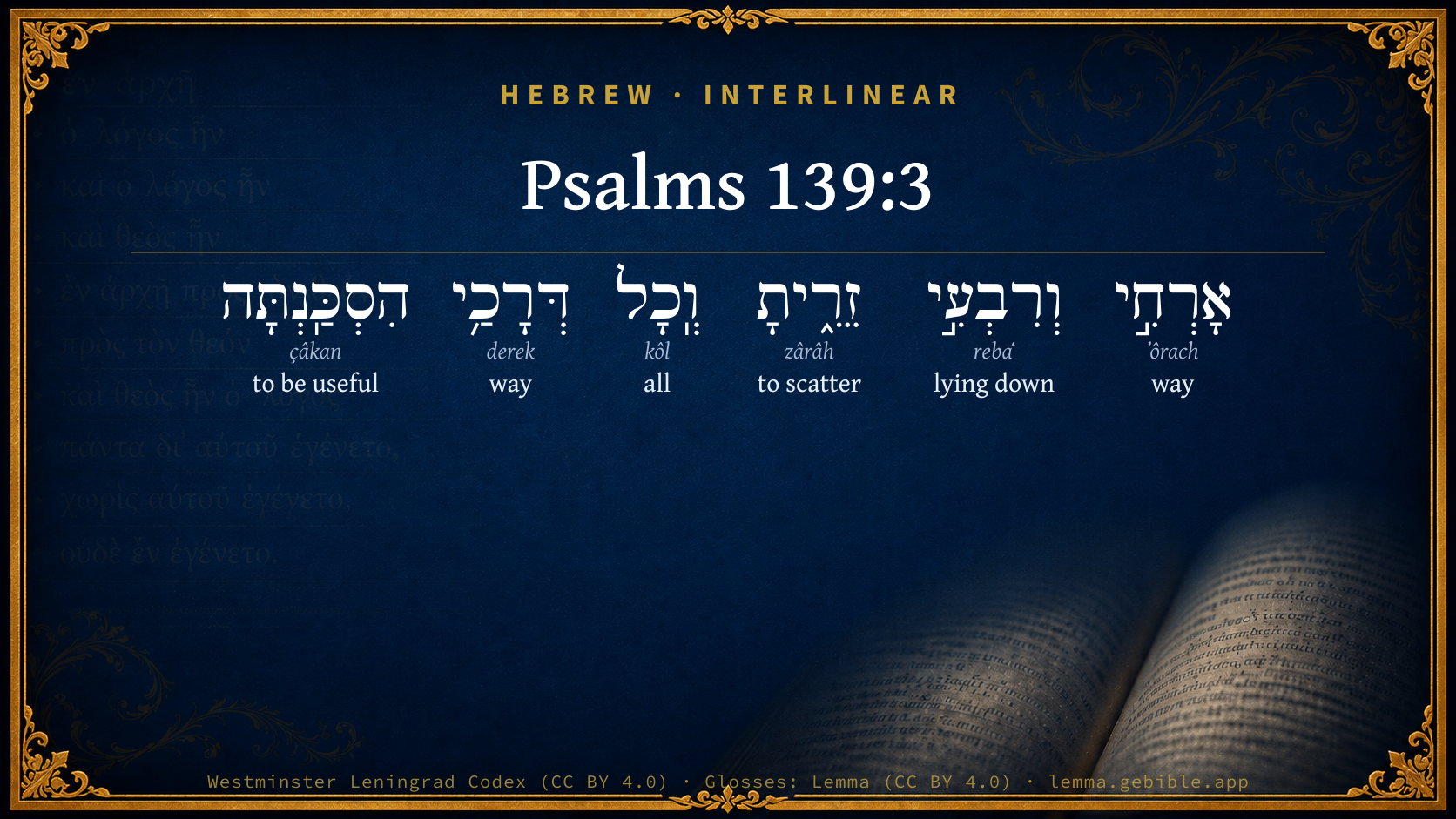
Psalms 139:3

Hebrew (Westminster Leningrad Codex) Psalms 139:3 appears in the Hebrew Old Testament. The text above is from the Westminster Leningrad Codex. Each word links to its Strong’s number, a concise gloss, and parsing drawn from the Open Scriptures Hebrew Bible morphology. Click any word for its full Brown-Driver-Briggs (BDB) entry.
Download image
Cite this verse

Psalms 139:3 (World English Bible). Public Domain. Lemma interlinear Bible study tool, https://lemma.gebible.app/v/psalms/139/3.

Show BibTeX & RIS
BibTeX
RIS
English Translation
You search out my path and my lying down, And are acquainted with all my ways.
World English Bible · Public Domain
Highlights
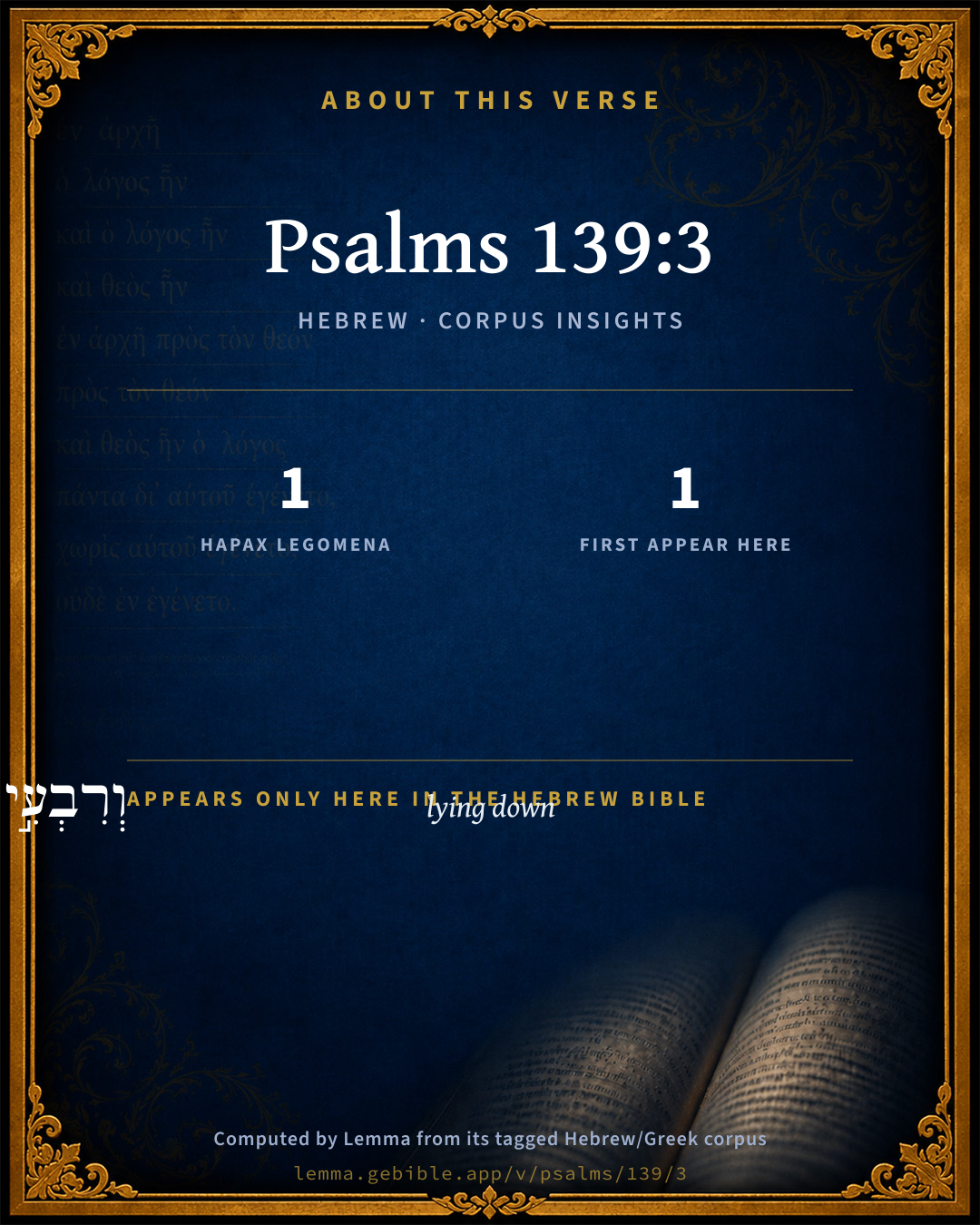
  • 1 hapax legomenon — only here in the Hebrew Bible
  • 1 first appearance in the Hebrew Bible
Full analysis ↓
Download a study sheet

One document with this verse’s original text, its word-by-word gloss line, the meaning frame, cross-references with their text, attributed commentary, and full source and license credits — printable, and it pastes into notes with its structure intact.

This verse Autodidact and up

Study sheet (.html) Plain text (.txt)

A passage Seminary Student

Up to 50 verses in one chapter. A passage sheet keeps up to 6 commentary sources and 12 cross-references per verse, in the order this page ranks them, and says so on the sheet whenever that leaves anything out. Ask for a single verse and you get the Autodidact verse sheet above.

Everything on this page stays free to read, with no account — the sheet is a download of what is already on screen, not access to it.

Want to remove ads? Support Godless Engineer
Compare translations 3

The same verse in 3 English versions, stacked beneath the original-language interlinear above. Click any original word for its lexicon entry.

Each is an independent rendering of the whole verse — the interlinear is not word-aligned to these translations.

Highlighted words mark where these versions differ — a whole-verse word diff, not a word-by-word alignment.

  • World English Bible Public Domain
    You search out my path and my lying down, And are acquainted with all my ways.
  • King James Version Public Domain
    Thou compassest my path and my lying down, and art acquainted with all my ways.
  • unfoldingWord Literal Text CC BY-SA 4.0
    My path and my lying down you have winnowed, and you are familiar with all of my ways.

unfoldingWord Literal Text — © unfoldingWord, licensed CC BY-SA 4.0. Word-aligned USFM3 via Door43 (git.door43.org/unfoldingWord/en_ult).

Versions to compare (up to 4)

3 of 4 selected

Show all 18 translations

Every available English version of this verse, each an independent rendering of the whole verse.

  • World English Bible Public Domain
    You search out my path and my lying down, And are acquainted with all my ways.
  • Berean Standard Bible Public Domain
    You search out my path and my lying down; You are aware of all my ways.
  • Majority Standard Bible Public Domain
    You search out my path and my lying down; You are aware of all my ways.
  • King James Version Public Domain
    Thou compassest my path and my lying down, and art acquainted with all my ways.
  • American Standard Version (1901) Public Domain
    Thou searchest out my path and my lying down, And art acquainted with all my ways.
  • Revised Version (1885) Public Domain
    Thou searchest out my path and my lying down, and art acquainted with all my ways.
  • Geneva Bible (1599) Public Domain
    Thou compassest my pathes, and my lying downe, and art accustomed to all my wayes.
  • Douay-Rheims (1899) Public Domain
    In what day soever I shall call upon thee, hear me: thou shall multiply strength in my soul.
  • Young's Literal Translation Public Domain
    My path and my couch Thou hast fanned, And `with' all my ways hast been acquainted.
  • Literal Standard Version CC BY-SA 4.0
    You have fanned my path and my lying down, || And have been acquainted [with] all my ways.
  • Unlocked Literal Bible CC BY-SA 4.0
    You observe my path and my lying down; you are familiar with all my ways.
  • unfoldingWord Literal Text CC BY-SA 4.0
    My path and my lying down you have winnowed, and you are familiar with all of my ways.
  • Darby Bible Public Domain
    Thou searchest out my path and my lying down, and art acquainted with all my ways;
  • World Messianic Bible Public Domain
    You search out my path and my lying down, and are acquainted with all my ways.
  • Webster's Bible Public Domain
    Thou compassest my path and my lying down, and art acquainted with all my ways.
  • Free Bible Version CC BY-SA 4.0
    You observe where I go and when I rest. You're familiar with everything I do.
  • Bible in Basic English Public Domain
    You keep watch over my steps and my sleep, and have knowledge of all my ways.
  • JPS Tanakh (1917) Public Domain
    Thou measurest my going about and my lying down, and art acquainted with all my ways.

Literal Standard Version (2020), Covenant Press — licensed CC BY-SA 4.0. Text via the HelloAO Bible API (eBible.org). Unlocked Literal Bible (unfoldingWord) — licensed CC BY-SA 4.0. Text via the HelloAO Bible API (eBible.org). unfoldingWord Literal Text — © unfoldingWord, licensed CC BY-SA 4.0. Word-aligned USFM3 via Door43 (git.door43.org/unfoldingWord/en_ult). Free Bible Version, Dr. Jonathan Gallagher — licensed CC BY-SA 4.0. Text via the HelloAO Bible API (eBible.org).

Word by word

More ways to search: Search by grammar → Find every occurrence → Compare this word →

Practice this passage: Drill this verse → Learn its vocabulary →

About this verse

These counts appear in no published source. They are computed here, from the morphology-tagged text and Lemma’s own curated glosses. What Lemma adds →

6
words
6
distinct lemmas
Wisdom
section

Notable vocabulary

1 hapax legomenon — a word that appears only here in the entire Hebrew Bible:

  • וְרִבְעִ֣י lying down H7252

First appearance in Scripture

This word makes its first canonical appearance in the Hebrew Bible here:

  • וְרִבְעִ֣י lying down H7252

Shared distinctive vocabulary

הִסְכַּֽנְתָּה to be useful H5532 occurs in 10 verses of the Hebrew Bible. Also found in:

Grammatical profile

  • 4 verbs
  • 2 nouns

Verb forms

  • אָרְחִ֣י Qal · Infinitive Construct
  • וְרִבְעִ֣י Qal · Infinitive Construct
  • זֵרִ֑יתָ Piel · Perfect
  • הִסְכַּֽנְתָּה Hiphil · Perfect

Hebrew & Septuagint length

In English translation the verse runs 16 words from the Hebrew and 14 from the Septuagint (LXX English) — closely comparable.

A rough comparison of the two English renderings, which tokenize alike — not a word-level alignment.

Word counts can differ between the Hebrew and the Greek without any difference in meaning — e.g. the Hebrew direct-object marker אֵת has no separate Greek word, and Greek often adds the article ὁ.

Cross-references

17

Topical passages linked to Psalms 139:3 in the Treasury of Scripture Knowledge — connected by theme and wording, ordered by reader-vote popularity; previews shown in the World English Bible.

  • Jeremiah 23:24 Can any hide himself in secret places so that I shall not see him? says Yahweh. Don't I fill heaven and earth? says Yahweh.
  • Job 31:4 Doesn't he see my ways, And number all my steps?
  • Genesis 28:10–17 Jacob went out from Beersheba, and went toward Haran.
  • Proverbs 5:20–21 For why should you, my son, be captivated with an adulteress? Why embrace the bosom of another?
  • 2 Samuel 11:27 When the mourning was past, David sent and took her home to his house, and she became his wife, and bore him a son. But the thing that David had done displeased Yahweh.
  • 2 Samuel 12:9–12 Why have you despised the word of Yahweh, to do that which is evil in his sight? You have struck Uriah the Hittite with the sword, and have taken his wife to be your wife, and have slain him with the sword of the children of Ammon.
  • Psalms 121:3–8 He will not allow your foot to be moved. He who keeps you will not slumber.
  • Psalms 139:18 If I would count them, they are more in number than the sand. When I wake up, I am still with you.
  • Ecclesiastes 12:14 For God will bring every work into judgment, with every hidden thing, whether it is good, or whether it is evil.
  • Job 14:16–17 But now you number my steps. Don't you watch over my sin?
  • Isaiah 29:15 Woe to those who hide deep their counsel from Yahweh, and whose works are in the dark, and who say, Who sees us? and who knows us?
  • John 6:70–71 Jesus answered them, "Didn't I choose you, the twelve, and one of you is a devil?"
  • Acts 5:3–4 But Peter said, "Ananias, why has Satan filled your heart to lie to the Holy Spirit, and to keep back part of the price of the land?
  • John 13:2 After supper, the devil having already put into the heart of Judas Iscariot, Simon's son, to betray him,
  • John 13:21 When Jesus had said this, he was troubled in spirit, and testified, "Most assuredly I tell you that one of you will betray me."
  • 2 Samuel 8:14 He put garrisons in Edom; throughout all Edom put he garrisons, and all the Edomites became servants to David. Yahweh gave victory to David wherever he went.
  • 2 Samuel 11:2–5 It happened at evening, that David arose from off his bed, and walked on the roof of the king's house: and from the roof he saw a woman bathing; and the woman was very beautiful to look on.

Cross-references courtesy of OpenBible.info (CC BY 4.0).

Hebrew and Greek witnesses Masoretic Hebrew ↔ Greek Septuagint

The same verse in the two great witnesses to the Old Testament, shown verse-for-verse.

You’re reading Greek Psalm 138 (Hebrew Psalm 139). The Septuagint counts the superscription, so verse numbers can differ from the Hebrew — chapter-level alignment, not verse-by-verse. Numbering follows Rahlfs.

These are two independent witnesses, not word-aligned to each other, and the Septuagint is shown in lemma (dictionary) form.

Hebrew Psalms 139:3 Masoretic · Westminster Leningrad Codex

אָרְחִ֣י וְרִבְעִ֣י זֵרִ֑יתָ וְֽכָל דְּרָכַ֥י הִסְכַּֽנְתָּה

You search out my path and my lying down, And are acquainted with all my ways.

World English Bible · Public Domain

Greek LXX Greek Psalm 138:3 Septuagint · lemma form

ὁ τρίβων ἐγώ καί ὁ σχοῖνος ἐγώ σύ ἐξιχνιάζω καί πᾶς ὁ ὁδός ἐγώ προὁράω

You have traced my path and my bed, and have foreseen all my ways.

LXX2012 (modern English Septuagint) · Public Domain

On this verse, Ellicott's Commentary for English Readers discusses the Septuagint’s reading. Read the note in Commentary ↓

Hebrew: Westminster Leningrad Codex (CC BY 4.0). Greek: Septuagint (public domain); English from LXX2012 (modern English Septuagint) (Public Domain). How the Septuagint differs from the Hebrew →

Commentary

Notes on Psalms 139:3 from classic Christian and Jewish commentators (each source and its license shown beneath its notes). The classic Christian expositions comment on the surrounding passage and are grouped to its opening verse, so a note may address several verses; the Jewish commentaries on the Tanakh (Rashi and others) are per-verse, so they appear only where the commentator wrote on this verse.

Lemma curates 59 commentaries, every one of them public domain or Creative Commons licensed, each selected and text-cleaned for this edition rather than reprinted as found. About our sources →

Trapp's Complete Commentary

John Trapp

Psa 139:3 Thou compassest my path and my lying down, and art acquainted [with] all my ways.

Ver. 3. Thou compassest my path] Or, Thou winnowest; if there be any chaff or trash, thou wilt make it fly; thou art at both ends of all my works and enterprises, both by day and by night, Perdius et pernox. Neither art thou only at my fingers’ ends, but at my tongue’s end too.

John Trapp, A Commentary or Exposition upon All the Books of the Old and New Testament (1647–1656) — public domain. Text from a community e-Sword module.

The Biblical Illustrator

Joseph S. Exell

Psa_139:3

Thou compassest my path and my lying down, and art acquainted with all my ways.

God knows and takes strict and accurate notice of all our ways

This is so, because--

I. God rules and governs men. But this could not be without such knowledge. And so at times He governs mens secret projects.

1. By discovering them, making them known to others.

2. By preventing them.

3. By turning them to other ends than men purposed (Isa_7:7; Gen_45:5).

II. He gives laws to regulate them.

III. He will judge them.

1. He does so in this life where He often gives foretaste of the future (Deu_29:18),

2. In the day of judgment (Luk_12:2).

IV. He is omniscient and omnipresent (Pro_15:3; Heb_4:13). Then--

1. Presumptuous sin is atheism.

2. Let secret sinners be afraid.

Such are those who sin in thought and desire only. God judges such, for they are the roots of sin. Spiritual wickedness is worst wickedness. And they are the product of the man himself, as his actions sometimes are not. And there are secret sins not only thought, but acted, only concealed from men (2Sa_12:12; Hab_2:11; Gen_4:10). God will judge them.

3. Let sincere-hearted Christians be comforted. The same sun-rising and break of day that terrifies the robber is a comfort to the honest traveller. Thou that, art sincere, God sees that sincerity in thee that others cannot discern; perhaps thou canst not fully discern it thyself. And He will exalt thee. (R. South, D. D.)

The record of our lives: -

I. That record is complete.

II. That record may be presented to our condemnation. Men are making efforts to recover the secrets of anothers brain. It is hard to conceive what the possibility means, as suggested by the results of rapid photography in the vitascope. It is not position that is presented, but action; even the change of face with change of thought. It is the publication of a partial set of records. Who could risk the scrutiny of their whole lives with such publicity?

III. But that record can be blotted out. A photographer can remove the sensitive salts in a bath. The picture then has no existence and cannot be exhibited; But we cannot trust our forgetfulness to do this, nor mans charity. But God in mercy has provided a cleansing flood. (W. J. Gregory.)

Gods winnowing

The word in the Hebrew original for compassest is winnowest. This calls up before the mind an image which helps to illustrate the meaning of the verse in a most interesting manner. The mere compassing of our path by God is an elementary, commonplace truth which requires no argument or proof. It is a truism which loses very much the power of truth through our familiarity with it. But when we substitute the winnowing of our path by Gods dealings with us, we have not in that case a commonplace fact, but a most suggestive and instructive metaphor. Harvest operations in the East are all carried on in the open air, for the weather at that time of the year is uniformly fine. When the corn is reaped it is not piled into stocks, or gathered into barns, as with us, but threshed on the spot, on some piece of rising ground, beaten hard and smooth, and exposed to the wind. The sheaves are heaped on this spot, arranged in a circle, and over them are driven rude, heavy sledges of wood, having their under-surface stuck full of sharp pieces of hard basalt. Oxen are yoked to these sledges, and a man stands on them to increase their pressure, while another man drives the oxen round and round upon the sheaves until they are mashed to pieces, the straw being broken and crushed, and the grains of corn separated from it. When the grain is all threshed out in this manner, the heaps of mixed corn and broken straw are tossed up before the breeze with a shovel; and then the grain, being heaviest, falls straight down, and the broken straw and chaff, being lighter, is carried by the wind, and forms a heap a little farther on. This explanation will make perfectly clear the allusion of the psalmist: Thou compassest, or winnowest, my path. It refers to the oxen going round and round on the sheaves laid on the threshing-floor, in order to separate the corn from the straw and chaff. In like manner, the psalmist, by a bold figure, represents God going round and round our path by His dealings with us in providence and grace, in order to purify our nature, and to separate the good from the evil. God humbles Himself to do for us the work which the oxen do for the corn. We are valuable to Him as the corn is to the husbandman. How patiently do the oxen plod on hour after hour, going their constant round, treading down the corn until their task is accomplished. And so how patiently and unweariedly does God compass your path with His providences and gracious dealings, till He has fulfilled in you the good pleasures of His goodness, and prepared you for being presented faultless before the presence of His glory with exceeding joy. Life to every one is a common round of continual beginnings and endings. Each day is a little circle returning where it began. Our range is as narrow as that of the ox that treadeth out the corn among the heap of sheaves. And all this is apt to become monotonous and wearisome. Some are so consumed by ennui that life has lost all relish for them; and some have grown so tired of pacing the irksome daily round that they have put an end to it by violent means. But surely it gives a new zest to life if we realize that all this constant doing of the same things, this constant going round and round the same little circle of daily duties, is not a treadmill penance, a profitless labour like weaving ropes of sand, but is designed to bring out and educate to the utmost perfection of which we are capable all that is best and most enduring in us. And surely it heightens the interest immeasurably to be assured that God has not merely ordained this long ago as part of His great providential plan for the world, but that He is daily and hourly superintending the process of our discipline and education by His personal presence, compassing our path, going round with us in the circle of lifes toils and duties, and causing all our experiences, by His blessing, to work together for our good. He will not go round on your sheaves with His heavy dispensations oftener than is required to separate the chaff from the wheat; and you may be certain that not one grain of good in you will be destroyed, not one element of lasting benefit will be injured--only the chaff will be blown away and the straw removed. (H. Macmillan, D. D.)

The Biblical Illustrator, edited by Joseph S. Exell (c. 1880s–1900s) — public domain. Text from a community e-Sword module.

J. A. Alexander on Psalms

Joseph Addison Alexander

3. (Psa 139:3) My path and my lair thou siftest, and with all my ways art acquainted. Path is here put for going, lair for lying, and these, like the terms of the preceding verse, for motion and rest, or the active and passive parts of human life. The poetical word lair is used to represent a Hebrew one, occurring only here, but the verbal root of which is used by Moses, Lev 18:23; Lev 20:16. The last verb means to be accustomed (Num 22:30), and then by a natural association, acquainted or familiar (Job 22:21). My ways, my condition and my conduct, what I do and what I suffer.

Joseph Addison Alexander, The Psalms Translated and Explained (1850) — public domain. Text from a community e-Sword module.

Tyndale Open Study Notes

Tyndale Open Resources

139:3-6 The Lord’s omniscience and omnipotence provide comfort to the godly, but they imprison the hearts of the wicked (2:3).

Tyndale Open Study Notes — © Tyndale Open Resources, licensed CC BY-SA 4.0. Text via the HelloAO Bible API.

Rashi

Rabbi Shlomo Yitzchaki (Rashi)

My going about and my lying down You encompassed My way, my lying down, and my dwelling You have encompassed with a wall, for I can do nothing without Your knowledge. You encompassed heb. זרית, an expression of (Exod. 25:24): “a gold crown (זר).” Menachem associated it in this manner (p. 82). Our Sages, however, interpreted it (Nid. 31a, Mid. Ps. 139:3) as referring to the droplet of [semen, transmitted in] sexual intercourse, from whose choicest part the fetus is formed, and the meaning of זֵרִיתָ (זורה) is an expression of winnowing the grain to purify it of the refuse it contains.

You are accustomed Heb. הִסכנתה, you are accustomed.

Rashi on the Tanakh — English translations: “The Judaica Press complete Tanach with Rashi, translated by A. J. Rosenberg” (CC BY 4.0); “Pentateuch with Rashi's commentary by M. Rosenbaum and A.M. Silbermann, 1929-1934” (public domain); “The Metsudah Tanach series, Lakewood, N.J” (CC BY 4.0); and “The Book of Joshua, Metsudah Publications, 1997” (CC BY 4.0). Text via Sefaria.

Geneva Bible (1599)

Geneva Bible translators

So that they are evidently known to thee.

Geneva Bible (1599) marginal notes — public domain. Text via Bolls.life.

Adam Clarke's Commentary

Verse 3. Thou compassest my path] זרית zeritha thou dost winnow, ventilate, or sift my path; and my lying down, רבעי ribi, my lair, my bed.

And art acquainted] Thou treasurest up. This is the import of sachan. Thou hast the whole number of my ways, and the steps I took in them.

Adam Clarke's Commentary on the Bible (1810–1826) — public domain. Text from a community e-Sword/MySword module.

Ellicott's Commentary for English Readers

(3) Compassest.—There is some obscurity about this word. The Hebrew verb means first to scatter, and is used of throwing corn about to winnow it (Isa_30:24; Jer_4:11; Rth_3:2). Hence by an easy metaphor it may mean to sift or search out. The LXX. and Theodotion, followed by the Vulg., have traced, investigated. Jerome has winnowed. The Authorised Version rendering appears to come from a mistaken etymology.

A most plausible suggestion connects the verb with zûr, to lodge, which makes a perfect parallelism with the verb to dwell, in the next clause. Literally,

About my path and bed thou art a guest,

In all my ways thou dwellest;

i.e., art as familiar with all my life as one inhabiting the same house could be.

My path.—Literally, my going.

A Bible Commentary for English Readers, edited by Charles John Ellicott (1878–1897) — public domain. Text from a community e-Sword module.

The Cambridge Bible for Schools and Colleges

gen. ed. J. J. S. Perowne

3. Thou compassest] Rather, Thou hast examined, lit. thou hast winnowed, or sifted, subjecting my life to the closest and most discriminating investigation.

my path] Rather, my walking, contrasted with my lying down. Cp. Pro_6:22.

The Cambridge Bible for Schools and Colleges (gen. ed. J. J. S. Perowne; Cambridge University Press, 1878–1918) — public domain. Text from a community e-Sword module.

John Gill's Exposition

For there is not a word in my tongue,.... Expressed by it or upon it, just ready to be spoken; or, as the Targum,

"when there is no word in my tongue:''

so Aben Ezra,

"before it was perfect in my tongue:''

before it is formed there; while it is in the mind, and not expressed, and even before that;

but, lo, O Lord, thou knowest it altogether; the whole of it, from whence it springs; the reason of it, what is designed, or the ends to be answered by it. The Lord knows the good words of his people, which they speak to him in prayer, even before and while they are speaking them; and what they say to one another in private conversation, Isa 65:24. See an instance of words known by Christ before spoken, in Luk 19:31.

John Gill's Exposition of the Whole Bible (1746–1763) — public domain (CC PDM 1.0). Text via the HelloAO Bible API.

Albert Barnes' Notes on the Bible

Thou compassest my path ... - Margin, “winnowest.” The Hebrew word - זרה zârâh - means properly “to scatter,” to cast loosely about - as the wind does dust; and then, to winnow - to wit, by throwing grain, when it is thrashed, up to the wind: Isa 30:24; Jer 4:11; Rth 3:2. Then it means “to winnow out;” that is, to winnow out all the chaff, and to leave all the grain - to save all that is valuable. So here it means that God, as it were, “sifted” him. Compare Isa 30:28; Amo 9:9; Luk 22:31. He scattered all that was chaff, or all that was valueless, and saw what there was that was real and substantial. When it is said that he did this in his “path and his lying down,” it is meant that he did it in every way; altogether; entirely.

And art acquainted with all my ways - All the paths that I tread; the whole course of my life. All that I do, in all places and at all times, is fully known to thee.

Albert Barnes' Notes on the Bible (1834–1885) — public domain. Text from a community e-Sword/MySword module.

Matthew Poole's English Annotations

Thou compassest my path; thou watchest me on every side, and therefore discernest every step which I take. It is a metaphor either from huntsmen watching all the motions and lurking-places of wild beasts, that they may catch them; or from soldiers besieging their enemies in a city, and setting watches round about them.

My lying down; me, when I lie down in my bed, where men oft contrive what they execute in the day time.

Matthew Poole's English Annotations on the Holy Bible (1683–1685) — public domain. Text from a community e-Sword/MySword module.

The Treasury of David

Charles H. Spurgeon

Ver. 3. Thou compassest my path and my lying down. My path and my pallet, my running and my resting, are alike within the circle of thine observation. Thou dost surround me even as the air continually surrounds all creatures that live. I am shut up within the wall of thy being; I am encircled within the bounds of thy knowledge. Waking or sleeping I am still observed of thee. I may leave thy path, but you never leave mine. I may sleep and forget thee, but thou dost never slumber, nor fall into oblivion concerning thy creature. The original signifies not only surrounding, but winnowing and sifting. The Lord judges our active life and our quiet life; he discriminates our action and our repose, and marks that in them which is good and also that which is evil. There is chaff in all our wheat, and the Lord divides them with unerring precision.

And art acquainted with all my ways. Thou art familiar with all I do; nothing is concealed from thee, nor surprising to thee, nor misunderstood by thee. Our paths may be habitual or accidental, open or secret, but with them all the Most Holy One is well acquainted. This should fill us with awe, so that we sin not; with courage, so that we fear not; with delight, so that we mourn not.

Ver. 3. Thou compassest my path and my lying down, etc. The words that I have read unto you, seem to be a metaphor, taken from soldiers surrounding the ways with an ambush, or placing scouts and spies in every corner, to discover the enemy in his march; "Thou compassest my path": thou hast (as it were) thy spies over me, wheresoever I go. By "path" is meant the outward actions and carriage of his ordinary conversation. By "lying down" is signified to us the private and close actions of his life; such as were attended only by darkness and solitude. In Ps 36:4, it is said of the wicked that "he deviseth mischief upon his bed", to denote not only his perverse diligence, but also his secrecy in it: and God is said to "hide his children in the secret of his pavilion", so that these places of rest and lying down are designed for secrecy and withdrawing. When a man retires into his chamber, he does in a manner, for a while, shut himself out of the world. And that this is the fine sense of that expression of lying down appears from the next words, "Thou art acquainted with all my ways"; where he collects in one word what he had before said in two; or, it may come in by way of entrance and deduction, from the former. As if he should say, Thou knowest what I do in my ordinary converse with men, and also how I behave myself when I am retired from them; therefore thou knowest all my actions, since a man's actions may be reduced either to his public or private deportment. By the other expression of "my ways" is here meant the total of a man's behaviour before God, whether in thoughts, words, or deeds, as is manifest by comparing this with other verses. Robert South.

Ver. 3. Thou compassest my path. This is a metaphor either from huntsmen watching all the motions and lurking places of wild beasts, that they may catch them; or from soldiers besieging their enemies in a city, and setting round about them. Matthew Pool.

Ver. 3. Thou compassest, or feignest, or wannest, my path; that is, discuss or try out to the utmost, even tracing the footsteps, as the Greek signifieth. Compare Job 31:4. Henry Ainsworth.

Ver. 3. Thou art acquainted with all my ways. God takes notice of every step we take, every right step, and every by step. He knows what rule we walk by, what end we walk toward, what company we walk with. Religious Tract Society's Commentary.

Ver. 3. Art acquainted, as by most familiar intercourse, as if thou hadst always lived with me Hebrew and thus become entirely familiar with my ways. Henry Cowles.

Ver. 3. The Psalmist mentions four modes of human existence; stationis, sessionis, itionis, cubationis; because man never stayeth long in one mood, but in every change the eyes of the Lord cease not to watch him. Geier.

Ver. 3. The encircling Presence, in our activities, meditations, secrecies, and movements.

Psalms 139:4*

Charles H. Spurgeon's The Treasury of David (1869–1885) — public domain. Psalms only. Text from a community e-Sword/MySword module.

Whedon's Commentary on the Bible

Daniel D. Whedon

3. Compassest—That is, to watch and guard. The word sometimes means to scatter by winnowing, as Jer_51:2. Thou winnowest my path, would denote a sifting out of evil, like chaff, that the way might be pure and safe; or, thou triest my path.

Daniel D. Whedon (gen. ed.), Commentary on the Old and New Testaments (1874–1909) — public domain. Text from a community e-Sword module.

The Pulpit Commentary

Thou compassest (rather, siftest) my path and my lying down; literally, my path and my couch the time of my activity and the time of my rest. And art acquainted with all my ways. (comp. Psa_119:168, "All my ways are before thee

The Pulpit Commentary (1880–1919), ed. H.D.M. Spence-Jones & Joseph S. Exell — public domain. Text from a community e-Sword module.

John Wesley's Explanatory Notes

Compassest - Thou discernest every step I take. It is a metaphor from soldiers besieging their enemies, and setting watches round about them.

John Wesley, Explanatory Notes Upon the Whole Bible (1754–1765) — public domain. Text via the GEBible commentary corpus.

unfoldingWord translationNotes

Door43 World Missions Community

my path and my lying down

Here "path" stands for one's behavior. "My path and my lying down" together represent everything about the psalmist. (See: Metaphor and Merism)

before there is a word on my tongue

Here "word on the tongue" represents speech. AT: "before I say anything" (See: Metaphor)

Behind me and before me you surround me

This expression refers to God's presence everywhere.

place your hand upon me

This expression refers to guidance and help. AT: "you guide and help me" (See: Metaphor)

too much for me

"too much for me to understand"

it is too high, and I cannot reach it

Being high and out of reach is an expression, in this case, about some knowledge that human beings cannot have. AT: "it is too difficult to understand" (See: Metaphor)

translationWords

word

hand

know

unfoldingWord translationNotes — © Distant Shores Media and the Door43 World Missions Community, licensed CC BY-SA 4.0. Source: git.door43.org/Door43/en_tn.

Lesson kit

Teaching starters — assembled from the data on this page, not authored interpretation. Every prompt links to the verse data it draws on. Edit before teaching.

Psalms, in the Wisdom, opens this verse with 6 words (6 distinct Hebrew lemmas). Its most distinctive word is rebaʻ (“lying down”). A historical commentator’s framing appears above. Read the whole chapter for the surrounding context.

Discussion questions

  1. How does “lying down” (rebaʻ) shape what this verse is saying?
  2. This verse holds 1 word here found nowhere else in the Hebrew Bible. What might the rare word draw attention to?
  3. The word “lying down” first appears here in Scripture. What is being introduced at this debut?
  4. Numbers 22:30 shares the word «to be useful» with this verse. How do the two illuminate each other?
  5. These translations render this verse differently. What is at stake in choosing one wording over another?
  6. The verb «אָרְחִ֣י» is Qal Infinitive Construct. How does its form color the action?
  7. Reading how Trapp's Complete Commentary and The Biblical Illustrator read this verse, where do the two commentators agree and where do they part?

Things to notice

  • 1 word in this verse appears nowhere else in the Hebrew Bible.
  • 1 word makes its first canonical appearance in Scripture here.
  • These translations choose different wording for 8 words in this verse.
  • 6 distinct Hebrew lemmas span 6 words in this verse.

Reading settings

Reading text

Shown beneath each verse's original-language words.

Old Testament
Old Testament edition

Read the OT as the Masoretic Hebrew (MT) or the Greek Septuagint (LXX).

English shown for the Greek Septuagint (in the Hebrew ↔ Greek comparison).

Comparing translations? Open the Compare panel on any verse page to stack up to four side by side.