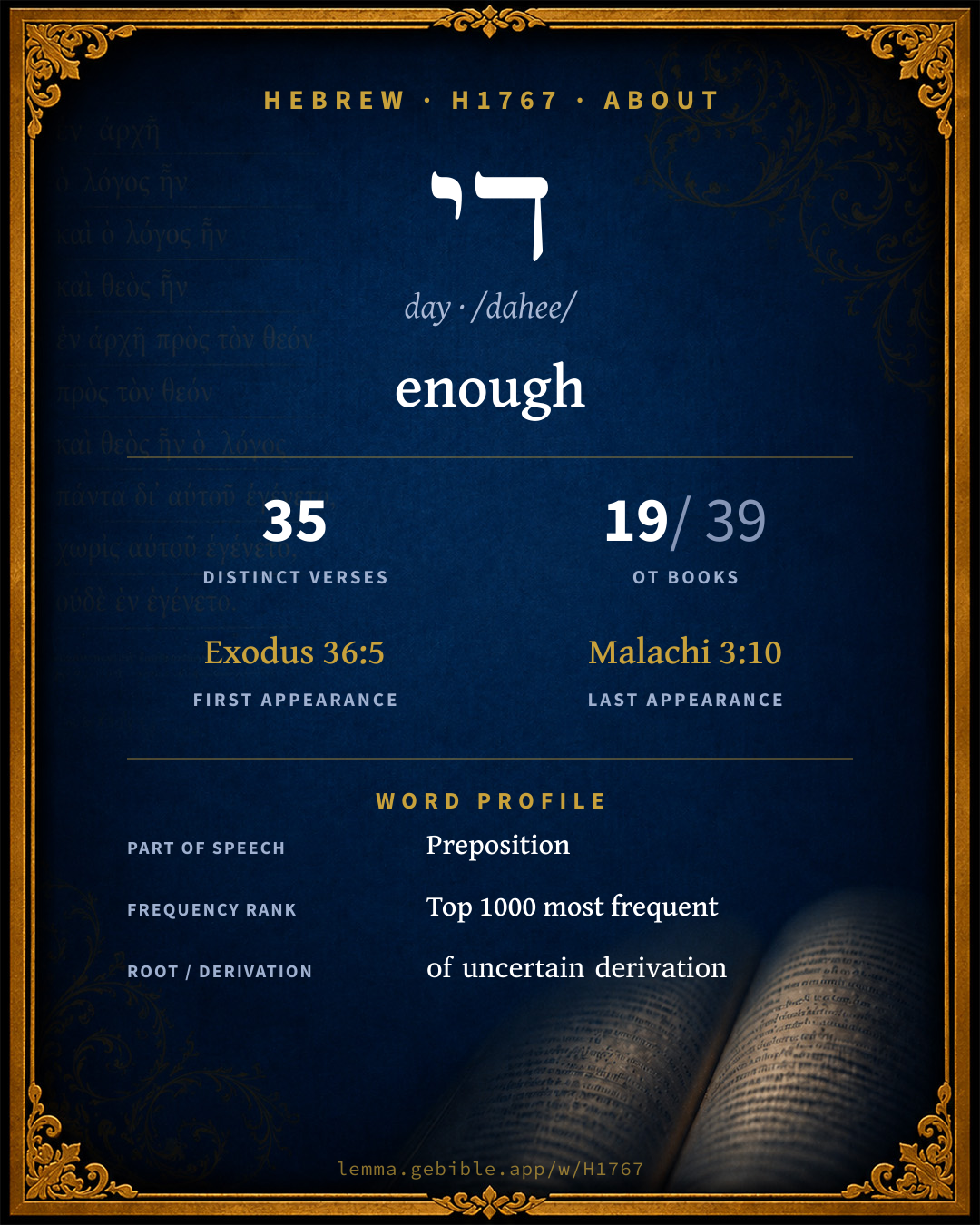
דַּי
enough
‘enough’ is one of 3 main senses fuller range ↓
Full lexicon entry — Brown-Driver-Briggs (BDB)
From Brown-Driver-Briggs (BDB)
Where this word appears
Grammar key — what these labels mean
Part of speech
- Noun
- A naming word — a person, place, thing, or idea.
Noun type
- Common
- A common noun — a general class of person, place, or thing (“king,” “city,” “water”), not a specific name.
State
- Construct
- A noun bound to a following noun in a possessive / “of” relationship (the construct chain).
- Absolute
- The independent form of a noun, not bound to a following word.
Gender
- Masculine
- Grammatically masculine.
Number
- Singular
- One.
Every verse where H1767 appears in the Book of Jeremiah — 5 distinct verses. Click any verse to open its interlinear word-by-word view. Verse text shown in the World English Bible for context — . Each verse’s Hebrew form is shown with its reference; the English is not keyword-highlighted, since the data carries no word-level English alignment. Use “Compare translations” on any verse to read it across multiple English versions. This concordance covers the Hebrew Bible; Septuagint (Greek Old Testament) occurrences are not indexed here.
Jeremiah
- Jeremiah 20:8 מִ/דֵּ֤י prep + n c ms cs For as often as I speak, I cry out; I cry, Violence and destruction! because the word of Yahweh is made a reproach to me, and a derision, all the day.
- Jeremiah 31:20 מִ/דֵּ֤י prep + n c ms cs Is Ephraim my dear son? is he a darling child? for as often as I speak against him, I do earnestly remember him still: therefore my heart yearns for him; I will surely have mercy on him, says Yahweh.
- Jeremiah 48:27 מִ/דֵּ֧י prep + n c ms cs For wasn't Israel a derision to you? was he found among thieves? for as often as you speak of him, you wag the head.
- Jeremiah 49:9 דַיָּֽ/ם n c ms cs + sfx pers 3mp If grape-gatherers came to you, would they not leave some gleaning grapes? if thieves by night, wouldn't they destroy until they had enough?
- Jeremiah 51:58 בְּ/דֵי בְּ/דֵי prep + n c ms cs prep + n c ms cs Thus says Yahweh of hosts: The broad walls of Babylon shall be utterly overthrown, and her high gates shall be burned with fire; and the peoples shall labor for vanity, and the nations for the fire; and they shall be weary.
About this entry
At a glance — auto-summarized from this page’s data, not written by a person. Every figure links to its source below. This summary describes the numbers; it doesn’t interpret them.
“enough” is the headline sense of the Hebrew preposition די (day). Its earliest occurrence is Exodus 36:5. The Hebrew Bible uses it across 35 verses — moderately common. Its meaning spans more than one sense — see its full sense range. The sections below give every sense, occurrence, and version rendering.
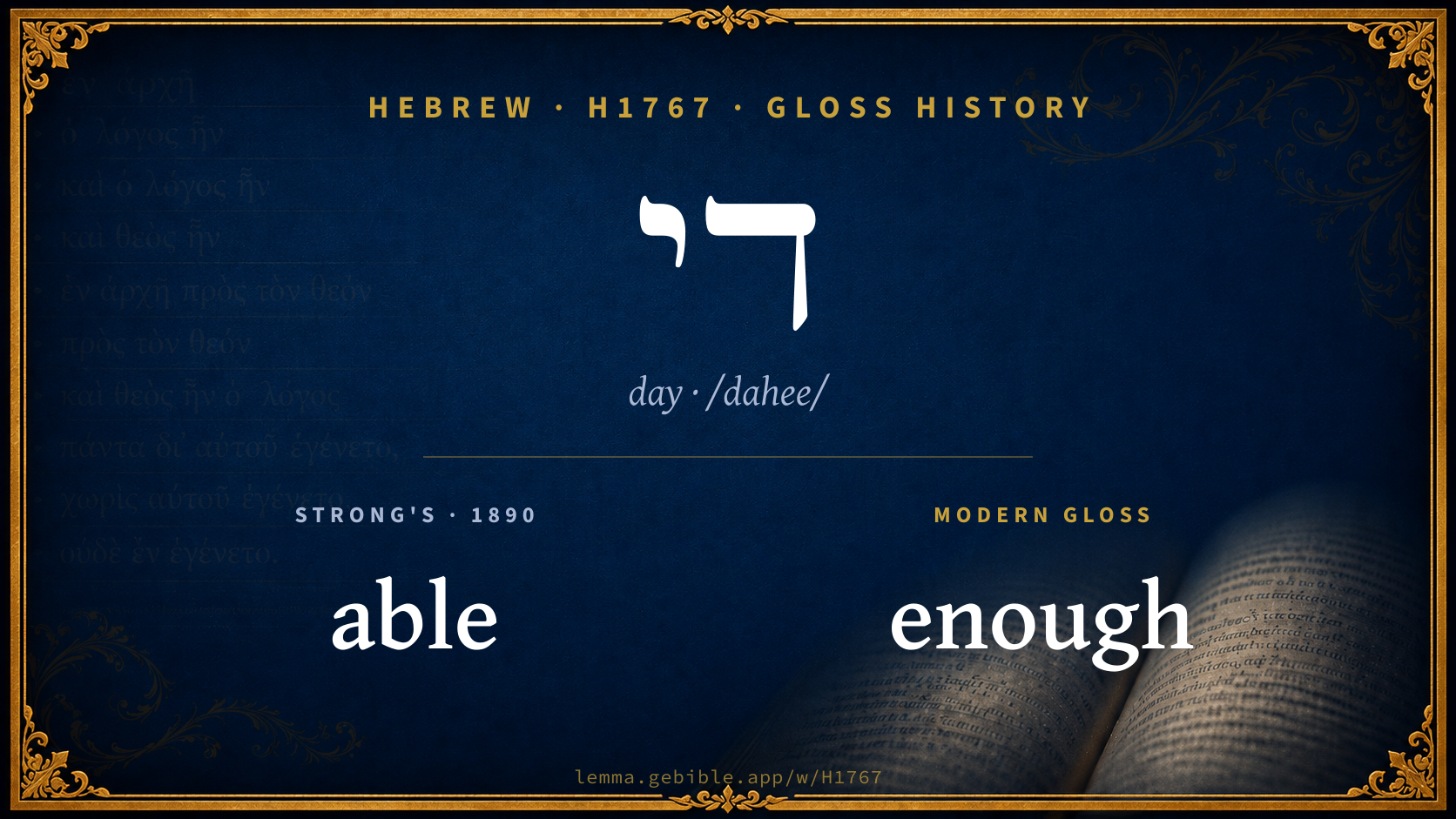
Gloss history
Strong's 1890 vs modern scholarship
About this word
Strong's H1767 catalogs a Hebrew word from the Hebrew Old Testament.
These counts are not copied from any lexicon or concordance. They are computed here, from the morphology-tagged Hebrew Old Testament. What Lemma adds →
- 35
- distinct verses
- The word appears in 35 distinct verses.
- 19 / 39
- OT books
- The word appears in 19 of 39 Old Testament books.
- #922
- by frequency
- Top 1000 most frequent Hebrew words (rank 922 of 8,640 Hebrew words by occurrence).
View all 35 occurrences in the concordance →
By section of the Old Testament
By traditional corpus
Conventional, traditional groupings — biblical authorship is debated, so this is a traditional corpus grouping, not an authorship claim. Each share is this word’s portion of its verses in that division of the Hebrew canon. Each figure is a share of the word’s 35 distinct verses.
- Prophets (Nevi'im) 19 verses · 54%
- Torah (Pentateuch) 8 verses · 23%
- Writings (Ketuvim) 8 verses · 23%
How translations render this word
Counts come from each version’s own published word-to-Strong’s tagging or interlinear alignment — an approximate guide to how each version renders this word, not a word-level alignment the data otherwise carries. Because each total is that version’s own tagged count, the per-version totals vary from one another and need not match the appearance or distinct-verse counts above. These counts may also differ from a printed concordance because Lemma counts each distinctly tagged rendering and does not collapse phrase taggings into a single head-word total. This is a fixed set of word-tagged versions (KJV, ASV, BSB, ULT) and does not change with the reading translation you choose elsewhere. Each version’s license is shown beside its name below (and on Sources).
- King James Version: From 4×, Since 3×, Be not able 2×
- American Standard Version: From 4×, Often 4×, Enough 2×
- Berean Standard Bible: Whenever 5×, Enough 3×, From 3×
- unfoldingWord Literal Text: Enough 10×, For 4×, Often as 4×
King James Version Public Domain
Renders H1767 across 36 tagged occurrences — most commonly:
Plus 21 renderings that appear only once — usually multi-word phrases or single function words the recovered tagging swept in, not distinct renderings. Not rendered by a distinct English word in 2 further occurrences.
American Standard Version Public Domain
Renders H1767 across 37 tagged occurrences — most commonly:
Plus 23 renderings that appear only once — usually multi-word phrases or single function words the recovered tagging swept in, not distinct renderings.
Berean Standard Bible Public Domain
Renders H1767 across 32 tagged occurrences — most commonly:
Plus 19 renderings that appear only once — usually multi-word phrases or single function words the recovered tagging swept in, not distinct renderings. Not rendered by a distinct English word in 5 further occurrences.
unfoldingWord Literal Text CC BY-SA 4.0
Renders H1767 across 42 tagged occurrences — most commonly:
Plus 15 renderings that appear only once — usually multi-word phrases or single function words the recovered tagging swept in, not distinct renderings.
Senses in the full BDB
What do BDB’s symbols mean?
BDB uses these scholarly abbreviations:
| Symbol | Meaning |
|---|---|
| 𝔊 | the Septuagint (the ancient Greek translation, LXX) |
| 𝔙 | the Vulgate (the Latin translation) |
| 𝔖 | the Syriac version (the Peshitta) |
| 𝔗 | the Targum (the Aramaic translation) |
| ψ | the Psalms |
| √ | root (the underlying root or stem) |
| ‖ | parallel passage (a synonymous or contrasted parallel) |
| † | the dagger: every passage where the word occurs is cited |
The 5 senses and sub-senses the full Brown-Driver-Briggs lexicon distinguishes for this word, in lexicon order (not ranked by frequency), with BDB’s own verbatim wording and sub-sense lettering. Shown in Hebrew script with BDB’s own scholarly abbreviations. The condensed entry is in the Lexicon Entry tab. See also the Forms in the corpus table below.
- 1. absol. thrice only Mal 3:10 I will pour you out a blessing עֵד־בְּלִי־דָֽי until there is not sufficiency, i.e. until my abundance can be exhausted, or, as this can never be, for ever (cf. ψ 72:7), Est 1:18 וּכְדַי בִּזָּיוֹן וָקָ֑צֶף and (there will be) as enough (i.e. in plenty) contempt and wrath, 2 Ch 30:3 לְמַדַּי = לְמַה־דַּי for what was sufficient. With a gen. of the person or thing for which anything suffices: Ex 36:5 מִדֵּי הָעֲבֹרָה (more) than enough for the work, Lv 5:7 and if his hand do not reach (if he do not command) דֵּי שֶׂה enough for (i.e. to buy) a lamb, 12:8; 25:28 דֵּי הָשִׁיב לוֹ enough for recovering it, Dt 15:8 דֵּי מַחְסֹרוֹ enough for his need, Is 40:16(×2). With suff. Pr 25:16 אֱכֹל דַּיּ֑ךָּ eat that which is sufficient for thee; דַּיָּם Ex 36:7 Je 49:9 Ob v 5. Once with gen. of the thing which is sufficient, Pr 27:27 דֵּי חֲלֵב עִזִּים enough of goats’ milk. e.g. Malachi 3:10
- 2. Combined with בְּ, כְּ, and especially מִן, דַּי (דֵּי) has a tendency to form compound prepositions, used idiomatically in certain applications:—
- a. בְּדֵי (a) for (the בְּ pretii) what suffices for: Na 2:13 the lion tare in pieces בְּדֵי גֹרוֹתָיו for the need of his whelps (‖ לְלִבְאֹתָיו; but? כְּדֵי, v. b); iron. Hb 2:13 Je 51:58 the peoples labour בְּדֵי־אֵשׁ for fire (only to satisfy the fire), and the nations weary themselves בְּדֵי־רִיק for what is empty. (β in the abundance of, i.e. as often as Job 39:25 בְּדֵי שׁוֹפָר in the abundance of the trumpet, i.e. as often as the trumpet sounds (מִדֵּי elsewhere in this sense). e.g. Nahum 2:13
- b. כְּדֵי according to the sufficiency, or abundance, of Lv 25:26 and find כְּדֵי גְאֻלָּתוֹ according to the sufficiency of his redemption, i.e. as much as it demands, Dt 25:2 Ne 5:8 כְּדֵי בָנוּ (st. c. before בְּ: Ges§ 130, 1) ‘quantum in nobis erat,’ after our ability, Ju 6:5 they came כְּדֵי אַרְבֶּה לָרֹב according to the abundance of the locust in multitude (for which כָּאַרְבֶּה לָרֹב would ordinarily be said: cf. 7:12). e.g. Leviticus 25:26
- c. מִדֵּי out of the abundance of, hence as often as;—(a) sq. inf. 1 S 1:7 מִדֵּי עֲלֹתָהּ = as often as she went up, 18:30 1 K 14:28 (= 2 Ch 12:11) 2 K 4:8 Is 28:19 מִדֵּי עָבְרוֹ as often as it passeth over, Je 31:20; (β) sq. subst., Je 48:27 מִדֵּי דְבָרֶיךָ בּוֹ as often as thy words (are) of him; and in the idiom. phrases מִדֵּי שָׁנָה בְּשָׁנָה = yearly (a combination of מִדֵּי שָׁנָה and שָׁנָה בְּשָׁנָה: v. sub שָׁנָה) 1 S 7:16 (v. Dr) Zc 14:16 2 Ch 24:5; and מִדֵּי חֹדֶשׁ בְּחָדְשׁוֹ Is 66:23 as often as month (comes) in its month (i.e. in its own time: חֹדֶשׁ made more precise by the add. of בְּחָדְשׁוֹ; cf. the phrase דְּבַר יוֹם בְּיוֹמוֹ): so מִדֵּי שַׁבָּת בְּשַׁבַּתּוֹ ib.; (γ) as conj., with the finite verb (אֲשֶׁר being understood: cf. בַּעֲבוּר etc.), Je 20:8 מִדֵּי אֲדַבֵּר as often as I speak. e.g. 1 Samuel 1:7
Senses from the full Brown-Driver-Briggs lexicon (Brown, Driver, Briggs; Oxford 1906 — public domain), digitized via Sefaria, supplemented by the OpenScriptures HebrewLexicon (CC BY 4.0). Full attribution on Sources.
Word origin
subst. sufficiency, enough (NH, but not known in other cogn. languages)—cstr. דֵּי, with sf. (v. infr.) דַּיֶּ֑ךָּ, דַּיָּם—
— Brown-Driver-Briggs (Oxford 1906, public domain), digitized via Sefaria, supplemented by the OpenScriptures HebrewLexicon (CC BY 4.0). See Sources.
Origin: of uncertain derivation
Jastrow Dictionary
A second Hebrew/Aramaic lexicon for comparison, covering Aramaic and post-biblical (Talmudic, Targumic, Midrashic) usage that the biblical-Hebrew BDB does not. Matched by lemma rather than by Strong’s number, so a lemma may carry more than one Jastrow headword (shown separately below), and the entries cover usage well beyond the Bible.
דְּ־
- a prefix, corresp. to h. שֶׁ־, of, who, which, that (quod). Targ. Gen. XXXI, 42. Ib. IX, 5; a. v. fr.—Ber. 2ᵃ זמן ק"ש דשכיבה the time of reading the Sh’ma of bed-time (Deut. VI, 7). Ib. ליתני דערבית וכ׳ let him first state that of (the law concerning) the evening prayer. Ib. הא קמ"ל דכפרה וכ׳ we are given to understand (by implication) that &c. Ib. ממאי דהאי וכ׳ whence is it proved that this uba &c.? Ib.ᵇ ואינהו דמחשכי וכ׳ and it was they who (as an exception) worked late and early; a. v. fr.—[This prefix is used for the formation of what may be named Difel nouns, as דְּבֵיתָא, דִּכְמָא &c., a. Dispeel nouns as דִּיסְקַרְתָּא &c.] e.g. Deuteronomy 6:7
דִּי
- 1. who, which, where, whom &c. Dan. IV, 5; a. fr.—Targ. Gen. XXIV, 27. Targ. Ps. LXXIII, 27; a. fr.—Mostly as prefix: דִּי־, דִּ־, דְּ־, v. דְּ־.—With personal pronouns דִּידִי, דִּילִי; דִּידָךְ, דִּידֵיךְ, דִּילָךְ, דִּילִיךְ; דִּידֵיה, דִּידָהּ, דִּילֵיה, דִּילָהּ; דִּידָן, דִּילָן; דִּידְכוֹן, דִּלְכוֹן, דִּידְכוּ, דִּידְכֶן; דִּידְהוֹן, דִּידְהוּ, דִּידְהִי mine, thine &c. Targ. O. Gen. XXXI, 16 דילנא (Y. די לנא). Targ. O. ib. XXXIII, 9; a. fr.—B. Bath. 4ᵇ דידי ודידיה הוא it is mine and his. Ib. עבד דידיה he made the ḥazith on his side, v. חָזִית. Ber. 2ᵇ בין השמשות דידך thy definition of ben hash-sh’mashoth. Tam. 32ᵃ דידי טבא מדידכו my advice is better than yours. Gitt. 84ᵇ דילכון your countryman (Rab Kahăna). B. Kam. 117ᵇ דילכון אמרי דילהון היא I believed (learning) was yours (the Palestineans’); but it is theirs (the Babylonians’); Succ. 44ᵃ דִּלְכוֹן, דִּלְהוֹן.—Ḥull. 42ᵇ תנא דידן the author or compiler of our Mishnah. Deut. R. s. 2 ר"י דידיה אמר R. J. said in his own name. Ab. Zar. 17ᵃ פליגא דידיה אדידיה there is a discrepancy between two opinions of his. Y. Ḥag. II, 78ᵃ top מן דידכֶן; Y. Snh. VI, 23ᶜ bot. מן דידכון one of yours. e.g. Daniel 4:5
- 2. that (quod). Dan. IV, 3; a. fr.—Y. Taan. IV, 67ᶜ bot. די תעניתא that it is a fast-day. e.g. Daniel 4:3
דִּי II
- = דְּאִי, for if. Y. R. Hasḥ. I, 56ᵇ, די לא כן. Also דִּילָא, דִּלָא for if not. Y. Ter. V, 43ᶜ; a. fr.—דִּילָכֵן, דִּלָכֵן for if not so. Y. Shebi. IV, 35ᵃ bot.; a. fr. V. דִּל.
דַּי
- sufficiency, plenty; constr. דֵּי enough for; דּיִּי enough for me, דַּיֶּיךָ enough for thee &c. Nidd. I, 1 דַּיָּין שעתן they have enough for the time being, i.e. the unclean condition, now discovered, has no retrospective effect, opp. מפְּקִידָה לפקידה. Pes. 8ᵇ דַּיֵּינוּ we should have been contented. Taan. 24ᵇ דַּיּוֹ בקב וכ׳ (Ms. M. דַּיי לו קב) he is contented with a Kab of &c. B. Kam. II, 5 (25ᵃ) דיו לבא מן הדין וכ׳ it is sufficient for the law which is derived by conclusion ad majus to be as strict as the law from which it is derived, i.e. you cannot go beyond the latter. B. Kam. ור"ט לית ליה דיו does R. T. not follow the principle of dayyo (that the derived law cannot go beyond the original)? והא דיו דאורייתא הוא is not the principle of dayyo biblical?—Gen. R. s. 21 דייך פפוס it is enough for thee, Papus, i.e. say no more; a. fr.—With prefix כְּדַי (v. כְּדָיי), constr. כְּדֵי as much as is required for, corresponding to, as conj. in order to. Maasr. V, 6 ומצא כ׳ מדתו and found a quantity corresponding to what he had measured into it (reasonably increased); יתר על כ׳ מדתו more than the reasonable quantity.—כ׳ דיבור or תוך כ׳ ד׳ as much, within as much, time as is needed for an utterance (e.g. a greeting, v. Y. Ber. I, 4ᵇ). B. Kam. 73ᵃ, a. fr. תוך כ׳ דיבור כדיבור דמי two statements following each other immediately are considered one. Ib. 73ᵇ תרי ת׳ כ׳ ד׳ there are two different intervals comprised under the expression tokh k’d’e dibbur. Snh. 31ᵇ bot. כ׳ לחלוק וכ׳ in order to give honor to &c. Ib. 32ᵃ bot. כ׳ שלא תנעול דלת וכ׳ in order not to make loans too difficult, v. דֶּלֶת; a. fr.
דִּי־
- (representing δις-, δύο) two, twice, cmp. דּוּ III.
A Dictionary of the Targumim, the Talmud Babli and Yerushalmi, and the Midrashic Literature (Marcus Jastrow; London, Luzac, 1903) — Public Domain. Digitized via Sefaria. Digitized via Sefaria. Full attribution on Sources.
Forms in the corpus
The 24 distinct written forms H1767 takes in the Hebrew Bible, most frequent first — each parse links to that state’s occurrences in the concordance. Hebrew forms include their vowel points and cantillation, so a single lemma takes many written forms.
Septuagint verse parallels
This word appears in 30 verses that also exist in the Greek Old Testament (Septuagint), out of the 35 Hebrew verses it occurs in. You can read those verses in Greek by switching the Old Testament edition to the Septuagint.
Read these verses in the Septuagint
- Exodus 36:5
- Leviticus 5:7
- Deuteronomy 15:8
- Judges 6:5
- 1 Samuel 1:7
- 2 Kings 4:8
- 2 Chronicles 12:11
- Esther 1:18
- Job 39:25
- Proverbs 25:16
- Isaiah 28:19
- Jeremiah 20:8
This is a verse-level parallel only — the same verses exist in both the Hebrew and Greek Old Testaments. No word-level Hebrew↔Greek correspondence is claimed: the data carries no such alignment, so no Greek word is shown as this Hebrew word’s translation. Coverage is not total — the Septuagint omits the deuterocanon and renumbers the Psalms, so some Hebrew verses have no direct Greek parallel.