Jeremiah 48:27

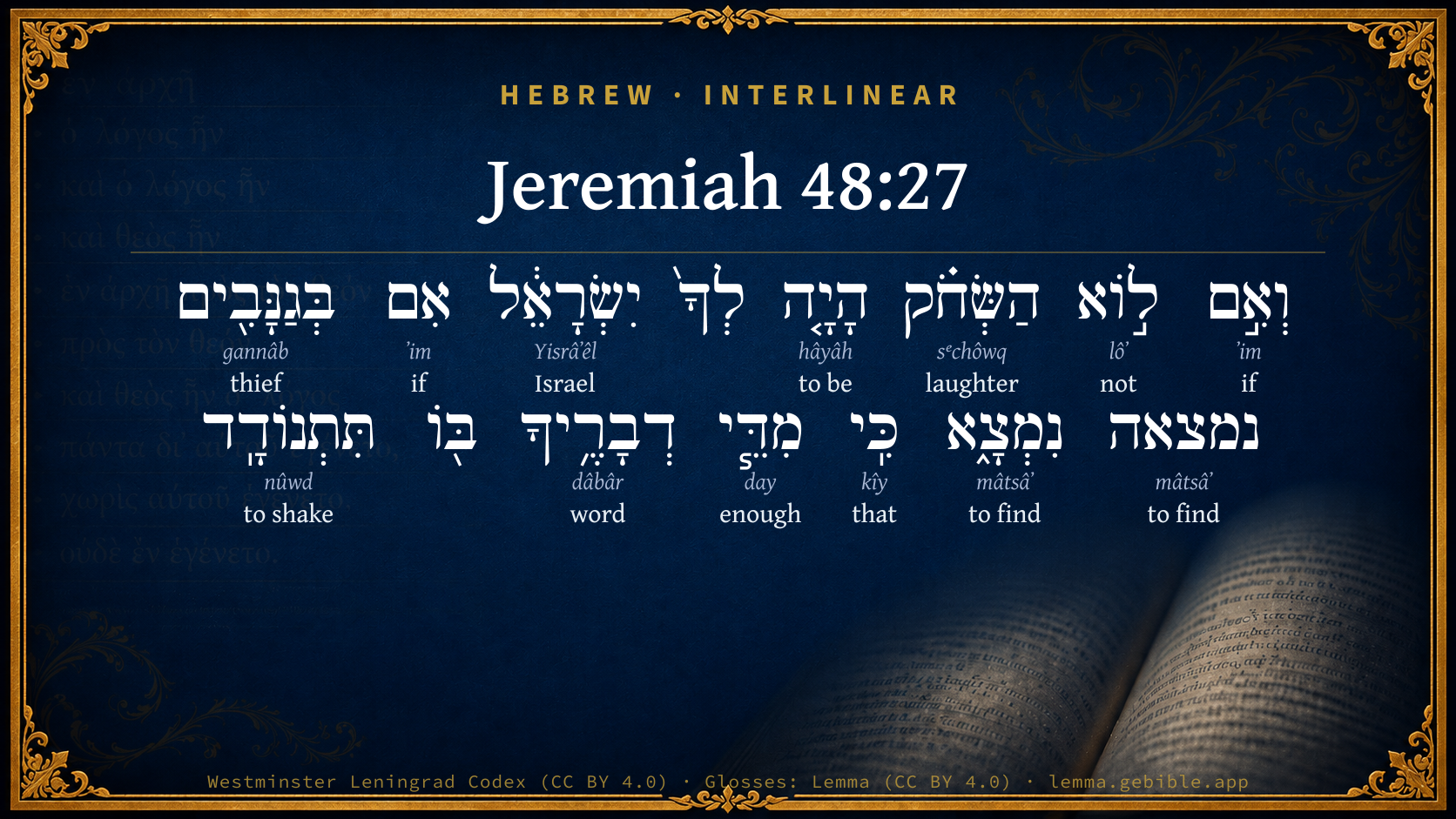
Hebrew (Westminster Leningrad Codex) Jeremiah 48:27 appears in the Hebrew Old Testament. The text above is from the Westminster Leningrad Codex. Each word links to its Strong’s number, a concise gloss, and parsing drawn from the Open Scriptures Hebrew Bible morphology. Click any word for its full Brown-Driver-Briggs (BDB) entry.
Download image
Cite this verse

Jeremiah 48:27 (World English Bible). Public Domain. Lemma interlinear Bible study tool, https://lemma.gebible.app/v/jeremiah/48/27.

Show BibTeX & RIS
BibTeX
RIS
English Translation
For wasn't Israel a derision to you? was he found among thieves? for as often as you speak of him, you wag the head.
World English Bible · Public Domain
Download a study sheet

One document with this verse’s original text, its word-by-word gloss line, the meaning frame, cross-references with their text, attributed commentary, and full source and license credits — printable, and it pastes into notes with its structure intact.

This verse Autodidact and up

Study sheet (.html) Plain text (.txt)

A passage Seminary Student

Up to 50 verses in one chapter. A passage sheet keeps up to 6 commentary sources and 12 cross-references per verse, in the order this page ranks them, and says so on the sheet whenever that leaves anything out. Ask for a single verse and you get the Autodidact verse sheet above.

Everything on this page stays free to read, with no account — the sheet is a download of what is already on screen, not access to it.

Want to remove ads? Support Godless Engineer
Compare translations 3

The same verse in 3 English versions, stacked beneath the original-language interlinear above. Click any original word for its lexicon entry.

Each is an independent rendering of the whole verse — the interlinear is not word-aligned to these translations.

Highlighted words mark where these versions differ — a whole-verse word diff, not a word-by-word alignment.

  • World English Bible Public Domain
    For wasn't Israel a derision to you? was he found among thieves? for as often as you speak of him, you wag the head.
  • King James Version Public Domain
    For was not Israel a derision unto thee? was he found among thieves? for since thou spakest of him, thou skippedst for joy.
  • unfoldingWord Literal Text CC BY-SA 4.0
    For did not Israel become an object for laughter to you? Was he found among thieves, so that you shook your head at him as often as you spoke about him?

unfoldingWord Literal Text — © unfoldingWord, licensed CC BY-SA 4.0. Word-aligned USFM3 via Door43 (git.door43.org/unfoldingWord/en_ult).

Versions to compare (up to 4)

3 of 4 selected

Show all 18 translations

Every available English version of this verse, each an independent rendering of the whole verse.

  • World English Bible Public Domain
    For wasn't Israel a derision to you? was he found among thieves? for as often as you speak of him, you wag the head.
  • Berean Standard Bible Public Domain
    Was not Israel your object of ridicule? Was he ever found among thieves? For whenever you speak of him you shake your head.
  • Majority Standard Bible Public Domain
    Was not Israel your object of ridicule? Was he ever found among thieves? For whenever you speak of him you shake your head.
  • King James Version Public Domain
    For was not Israel a derision unto thee? was he found among thieves? for since thou spakest of him, thou skippedst for joy.
  • American Standard Version (1901) Public Domain
    For was not Israel a derision unto thee? was he found among thieves? for as often as thou speakest of him, thou waggest the head.
  • Revised Version (1885) Public Domain
    For was not Israel a derision unto thee? was he found among thieves? for as often as thou speakest of him, thou waggest the head.
  • Geneva Bible (1599) Public Domain
    For diddest not thou deride Israel, as though he had bene found among theeues? for when thou speakest of him, thou art moued.
  • Douay-Rheims (1899) Public Domain
    For Israel hath been a derision unto thee: as though thou hadst found him amongst thieves: for thy words therefore, which thou hast spoken against him, thou shalt be led away captive.
  • Young's Literal Translation Public Domain
    And was not Israel the derision to thee? Among thieves was he found? For since thy words concerning him, Thou dost bemoan thyself.
  • Literal Standard Version CC BY-SA 4.0
    And was Israel not the derision to you? Was he found among thieves? For since your words concerning him, || You bemoan yourself.
  • Unlocked Literal Bible CC BY-SA 4.0
    For did not Israel become an object for laughter to you? Was he found among thieves, so that you shook your head at him as often as you spoke about him?
  • unfoldingWord Literal Text CC BY-SA 4.0
    For did not Israel become an object for laughter to you? Was he found among thieves, so that you shook your head at him as often as you spoke about him?
  • Darby Bible Public Domain
    For was not Israel a derision unto thee? Was he found among thieves, that as oft as thou didst speak of him, thou didst shake the head?
  • World Messianic Bible Public Domain
    For wasn’t Israel a derision to you? Was he found among thieves? For as often as you speak of him, you shake your head.
  • Webster's Bible Public Domain
    For was not Israel a derision to thee? was he found among thieves? for since thou hast spoken of him, thou hast leaped for joy.
  • Free Bible Version CC BY-SA 4.0
    Didn't you Moabites used to ridicule the Israelites? But they weren't ever found to be thieves, were they? Yet whenever you talk about them, you shake your heads in contempt.
  • Bible in Basic English Public Domain
    For did you not make sport of Israel? was he taken among thieves? for whenever you were talking about him, you were shaking your head over him.
  • JPS Tanakh (1917) Public Domain
    For was not Israel a derision unto thee? Was he found among thieves? For as often as thou speakest of him, thou waggest the head.

Literal Standard Version (2020), Covenant Press — licensed CC BY-SA 4.0. Text via the HelloAO Bible API (eBible.org). Unlocked Literal Bible (unfoldingWord) — licensed CC BY-SA 4.0. Text via the HelloAO Bible API (eBible.org). unfoldingWord Literal Text — © unfoldingWord, licensed CC BY-SA 4.0. Word-aligned USFM3 via Door43 (git.door43.org/unfoldingWord/en_ult). Free Bible Version, Dr. Jonathan Gallagher — licensed CC BY-SA 4.0. Text via the HelloAO Bible API (eBible.org).

Word by word

More ways to search: Search by grammar → Find every occurrence → Compare this word →

Practice this passage: Drill this verse → Learn its vocabulary →

הַשְּׂחֹ֗ק
sᵉchôwq
H7814
“the · laughter”
Particle, Definite Article + Noun, Common, Masculine, Singular, Absolute
Part of Speech
Particle + Noun
Type
Common
Gender
Masculine
Number
Singular
State
Absolute
Full BDB Definition

Origin: from H7832

TWOT: 1905d

laughter, laughing stock, mocking, derision - laughter - joyful - hollow - derision (of object) - sport
  1. וְאִ֣ם ʼim H518 “and · if” Conjunction + Conjunction
  2. ל֣וֹא lôʼ H3808 “not” Particle, Negative
  3. הָיָ֤ה hâyâh H1961 “to be” Verb, Qal, Perfect, 3rd Person, Masculine, Singular
  4. יִשְׂרָאֵ֔ל Yisrâʼêl H3478 “Israel” Noun, Proper
  5. אִם ʼim H518 “if” Conjunction
  6. בְּגַנָּבִ֖ים gannâb H1590 “in/at · thieves” Preposition + Noun, Common, Masculine, Plural, Absolute
  7. נמצאה mâtsâʼ H4672 “to find” Verb, Niphal, Perfect, 3rd Person, Feminine, Singular
  8. נִמְצָ֑א mâtsâʼ H4672 “to find” Verb, Niphal, Perfect, 3rd Person, Masculine, Singular
  9. כִּֽי kîy H3588 “that” Conjunction
  10. מִדֵּ֧י day H1767 “from · enough of” Preposition + Noun, Common, Masculine, Singular, Construct
  11. דְבָרֶ֥יךָ dâbâr H1697 “words · your” Noun, Common, Masculine, Plural, Construct + Suffix, Personal, 2nd Person, Masculine, Singular
  12. תִּתְנוֹדָֽד nûwd H5110 “to shake” Verb, Hithpolel, Imperfect, 2nd Person, Masculine, Singular

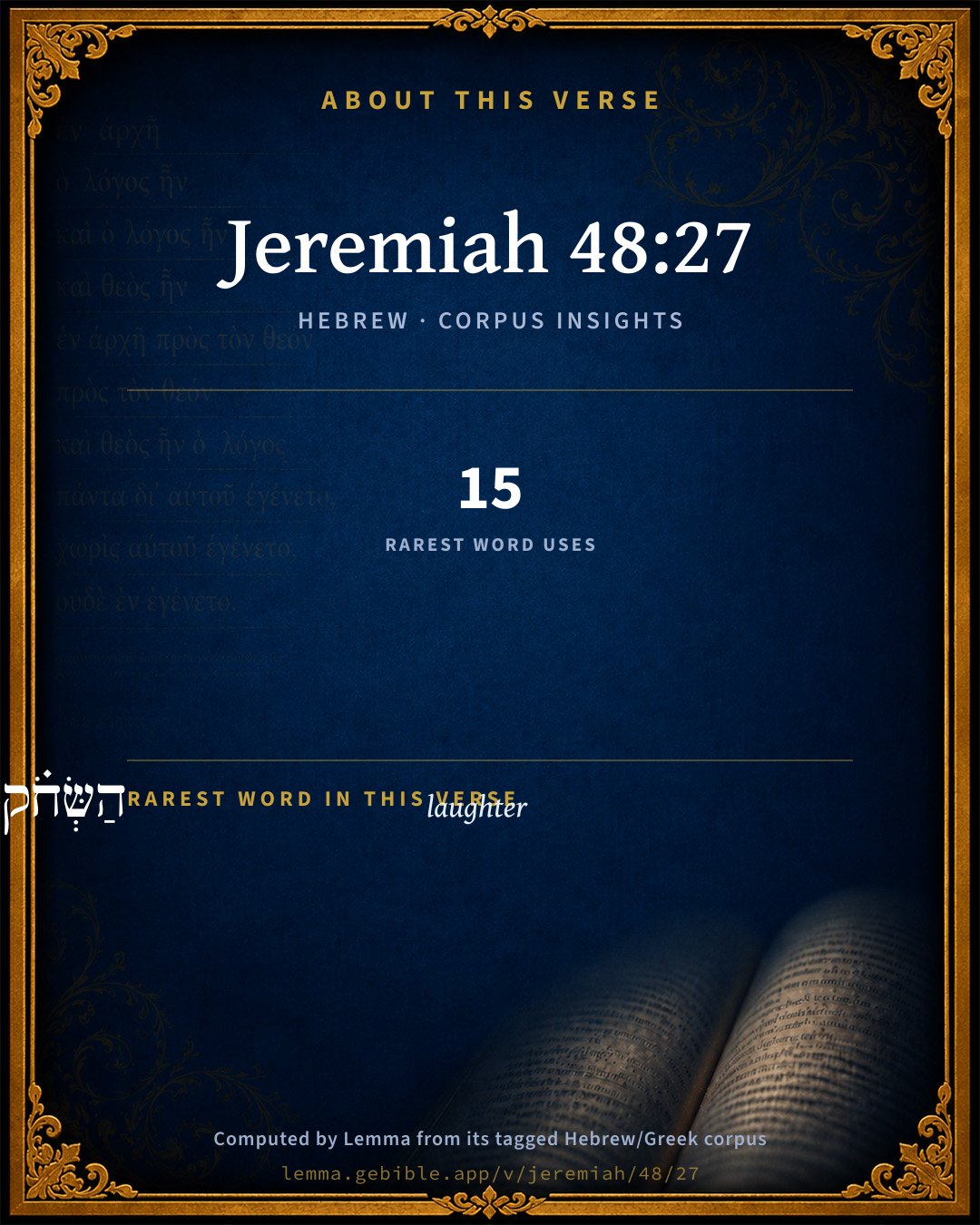
About this verse

These counts appear in no published source. They are computed here, from the morphology-tagged text and Lemma’s own curated glosses. What Lemma adds →

15
words
11
distinct lemmas
Prophets
section

Notable vocabulary

The rarest word here is הַשְּׂחֹ֗ק laughter H7814 — appearing just 15 times in the whole Hebrew Bible.

Shared distinctive vocabulary

הַשְּׂחֹ֗ק laughter H7814 occurs in 14 verses of the Hebrew Bible. Also found in:

Grammatical profile

  • 4 verbs
  • 5 nouns
  • 2 prepositions
  • 3 conjunctions
  • 1 particle

Verb forms

  • הָיָ֤ה Qal · Perfect
  • נמצאה Niphal · Perfect
  • נִמְצָ֑א Niphal · Perfect
  • תִּתְנוֹדָֽד Hithpolel · Imperfect

Repetition

Words recur within this verse — often emphatic in Hebrew:

  • נמצאה to find H4672 ×2
  • וְאִ֣ם if H518 ×2

Cross-references

19

Topical passages linked to Jeremiah 48:27 in the Treasury of Scripture Knowledge — connected by theme and wording, ordered by reader-vote popularity; previews shown in the World English Bible.

  • Jeremiah 2:26 As the thief is ashamed when he is found, so is the house of Israel ashamed; they, their kings, their princes, and their priests, and their prophets;
  • Micah 7:8–10 Don't rejoice against me, my enemy. When I fall, I will arise. When I sit in darkness, Yahweh will be a light to me.
  • Lamentations 2:15–17 All that pass by clap their hands at you; They hiss and wag their head at the daughter of Jerusalem, [saying], Is this the city that men called The perfection of beauty, The joy of the whole earth?
  • Ezekiel 25:8 Thus says the Lord Yahweh: Because Moab and Seir say, Behold, the house of Judah is like all the nations;
  • Zephaniah 2:8 I have heard the reproach of Moab, and the insults of the children of Ammon, with which they have reproached my people, and magnified themselves against their border.
  • Job 16:4 I also could speak as you do. If your soul were in my soul's place, I could join words together against you, And shake my head at you.
  • Psalms 44:13 You make us a reproach to our neighbors, A scoffing and a derision to those who are around us.
  • Psalms 79:4 We have become a reproach to our neighbors, A scoffing and derision to those who are around us.
  • Proverbs 24:17–18 Don't rejoice when your enemy falls. Don't let your heart be glad when he is overthrown;
  • Jeremiah 18:16 to make their land an astonishment, and a perpetual hissing; everyone who passes thereby shall be astonished, and shake his head.
  • Ezekiel 26:2–3 Son of man, because Tyre has said against Jerusalem, Aha, she is broken: the gate of the peoples; she is turned to me; I shall be replenished, now that she is laid waste:
  • Ezekiel 35:15 As you did rejoice over the inheritance of the house of Israel, because it was desolate, so will I do to you: you shall be desolate, Mount Seir, and all Edom, even all of it; and they shall know that I am Yahweh.
  • Ezekiel 36:2 Thus says the Lord Yahweh: Because the enemy has said against you, Aha! and, The ancient high places are ours in possession;
  • Ezekiel 36:4 therefore, you mountains of Israel, hear the word of the Lord Yahweh: Thus says the Lord Yahweh to the mountains and to the hills, to the watercourses and to the valleys, to the desolate wastes and to the cities that are forsaken, which are become a prey and derision to the residue of the nations that are round about;
  • Obadiah 1:12–13 But don't look down on your brother in the day of his disaster, and don't rejoice over the children of Judah in the day of their destruction. Don't speak proudly in the day of distress.
  • Zephaniah 2:10 This they will have for their pride, because they have reproached and magnified themselves against the people of Yahweh of Hosts.
  • Matthew 7:2 For with whatever judgment you judge, you will be judged; and with whatever measure you measure, it will be measured to you.
  • Matthew 26:55 In that hour Jesus said to the multitudes, "Have you come out as against a robber with swords and clubs to seize me? I sat daily in the temple teaching, and you didn't arrest me.
  • Matthew 27:38 Then there were two robbers crucified with him, one on his right hand and one on the left.

Cross-references courtesy of OpenBible.info (CC BY 4.0).

Hebrew and Greek witnesses Masoretic Hebrew ↔ Greek Septuagint

The same verse in the two great witnesses to the Old Testament, shown verse-for-verse.

These are two independent witnesses, not word-aligned to each other, and the Septuagint is shown in lemma (dictionary) form.

Hebrew Jeremiah 48:27 Masoretic · Westminster Leningrad Codex

וְאִ֣ם ל֣וֹא הַשְּׂחֹ֗ק הָיָ֤ה לְךָ֙ יִשְׂרָאֵ֔ל אִם בְּגַנָּבִ֖ים נמצאה נִמְצָ֑א כִּֽי מִדֵּ֧י דְבָרֶ֥יךָ בּ֖וֹ תִּתְנוֹדָֽד

For wasn't Israel a derision to you? was he found among thieves? for as often as you speak of him, you wag the head.

World English Bible · Public Domain

Greek LXX Structure differs

In the Septuagint, Jeremiah is about an eighth shorter than the Hebrew and arranges its material differently — the Oracles Against the Nations (Hebrew chapters 46–51) appear in the middle of the Greek book, after 25:13. Because the chapter and verse boundaries do not line up, a verse-for-verse comparison with the Hebrew is not shown.

A verse-for-verse comparison isn’t shown here because the chapters and verses don’t line up. Switch to the LXX edition with the MT / LXX toggle above to read the Greek directly.

On this verse, Haydock's Catholic Bible Commentary discusses the Septuagint’s reading. Read the note in Commentary ↓

Hebrew: Westminster Leningrad Codex (CC BY 4.0). Greek: Septuagint (public domain); English from a public-domain English Septuagint. How the Septuagint differs from the Hebrew →

Targum (Aramaic paraphrase)

1

The Targum is the ancient Jewish Aramaic paraphrase of the Hebrew Scriptures — an interpretive translation, not the Hebrew text itself. Onkelos (literal) and Pseudo-Jonathan (expansive) render the Torah, and Jonathan the Prophets. Coverage is partial: where no permissively-licensed English translation exists for a verse, only the Aramaic is shown. This is verse-level text, not a word-by-word alignment to the Hebrew.

  1. Targum Jonathan Prophets (Joshua–Malachi)
    וְעַל דַחֲדִיתוּן עַל תְּבִירֵיהּ דְיִשְׂרָאֵל בִּדְלָא חֲטוֹ לְכוֹן כְּאִלוּ בְּגַנָבִין אִשְׁתְּכָחוּ וְעַל דְאַסְגֵיתוּן עֲלֵיהוֹן פִּתְגָמִין בְּכֵן תְּטַלְטְלוּן:

    (no public-domain English translation for this verse)

    Targum Jonathan — Aramaic: “Mikraot Gedolot” (public domain). English: “Sefaria Community Translation” (CC0 1.0 (public-domain dedication)); “London "Chaldee Paraphrase," 1871” (public domain). Text via Sefaria.

Commentary

Notes on Jeremiah 48:27 from classic Christian and Jewish commentators (each source and its license shown beneath its notes). The classic Christian expositions comment on the surrounding passage and are grouped to its opening verse, so a note may address several verses; the Jewish commentaries on the Tanakh (Rashi and others) are per-verse, so they appear only where the commentator wrote on this verse.

Lemma curates 59 commentaries, every one of them public domain or Creative Commons licensed, each selected and text-cleaned for this edition rather than reprinted as found. About our sources →

Trapp's Complete Commentary

John Trapp

Jer 48:27 For was not Israel a derision unto thee? was he found among thieves? for since thou spakest of him, thou skippedst for joy.

Ver. 27. For was not Israel a derision unto thee?] sc., When he was carried captive by Shalmaneser, didst not thou make thyself merry in his misery, and compose comedies out of his tragedies?

Was he found among thieves?] Was he therefore obnoxious because religious? What reason hadst thou to shout after him, as one would do after a thief that is taken stealing?

Thou skippest for joy.] Thou shakest thyself, that is, thy head; or thou laughest till thou art ready to break thy midriff; {a}

“ Petulanti splene cachinnas. ”

{a} Impotentissime cachinnaris

John Trapp, A Commentary or Exposition upon All the Books of the Old and New Testament (1647–1656) — public domain. Text from a community e-Sword module.

Geneva Bible (1599)

Geneva Bible translators

Thou rejoicest to hear of his misery.

Geneva Bible (1599) marginal notes — public domain. Text via Bolls.life.

Jamieson, Fausset & Brown

Robert Jamieson, A. R. Fausset & David Brown

(Zep 2:8).

a derision--The Hebrew has the article: referring to Jer 48:26, "Was not Israel (the whole nation) the object of derision to thee?" Therefore, Moab is to suffer as formerly for its exultation over the calamity (Kg2 17:6) of the ten tribes under the Assyrian Shalmaneser (Isa. 15:1-16:14), so now for its exultation over the fall of Judah, under the Chaldean Nebuchadnezzar. God takes up His people's cause as His own (Oba 1:13-18).

was he . . . among thieves-- (Jer 2:26). Proverbial. What did Israel do to deserve such derision? Was he detected in theft, that thou didst so exult over him in speaking of him? Though guilty before God, Israel was guiltless towards thee.

since--"since ever" thou didst begin speaking of him.

skippedst for joy--at Israel's calamity [CALVIN]; or, "thou didst shake thy head" in "derision" [MAURER].

Jamieson, Fausset & Brown — Commentary Critical and Explanatory on the Whole Bible (1871) — public domain (CC PDM 1.0). Text via the HelloAO Bible API.

Adam Clarke's Commentary

Verse 27. Was not Israel a derision unto thee?] Didst thou not mock my people, and say their God was no better than the gods of other nations? See Eze 25:8.

Was he found among thieves?] Did the Israelites come to rob and plunder you? Why then mock them, and rejoice at their desolation, when their enemies prevailed over them? This the Lord particularly resents.

Adam Clarke's Commentary on the Bible (1810–1826) — public domain. Text from a community e-Sword/MySword module.

John Calvin's Commentaries

But the higher cause for the drunkenness mentioned here ought to be observed, even because Moab exalted himself against God. For after having spoken of the pride through which he exulted over God, he adds an explanation, Has not Israel been a derision to thee? See then how the Moabites acted proudly towards God, even because they treated his Church reproachfully. And this ought especially to be noticed; for God intimates by these words, that he is so connected with the faithful as to regard their cause as his own, as it is said elsewhere,

“He that toucheth you, toucheth the apple of my eye.” (Zechariah 2:8)

God then so takes the faithful under his own protection, that whatever injury is done to them, he counts it as done to him. This connection is well expressed by the Prophet, when he says, “The Moabites have raised themselves against God;” and at the same time he shews the way and manner, even because they exulted over the Israelites. Were any one to object and say, that the Moabites injured mortal men only and not God; the answer has already been given, even that God has so adopted his Church as to identify himself with it. Let us then know, that God, when he sees us suffering anything unjustly, regards the wrong as done to himself. As then the people of Israel had been a derision to the Moabites, the Prophet threatens them with a similar punishment for their pride.

And then he adds, Has he been found among thieves? It is, indeed, certain, that the people of Israel deserved very severe scourges, and that when they were subjected to so many adversities, a just reward was rendered to them for their iniquities. With regard to God this is certain; but with regard to the Moabites, the people of Israel were innocent; for these ungodly men could not object anything to the Israelites, for they were altogether like them, or even worse. God then compares here his chosen people with aliens, and says that the Israelites were not thieves. Under one thing he comprehends everything, as though he had said, “Of what wickedness have the Israelites been guilty, that you have thus become so enraged against them?” We hence see what the words of the Prophet mean, even that the Moabites were impelled by nothing but cruelty and pride, when they so basely raged against the Israelites, and so disdainfully oppressed them; for as I have already said, there was no cause why the Moabites should have been so hostile to the miserable people. Thus their crime was doubled, for they acted proudly towards God’s people, and they acted thus without a cause; for with regard to them, God’s people were innocent.

By saying that they were moved, or excited whenever they spoke of the Israelites, he intimates that they were carried away by malevolence, so as to wish all kinds of evil to the miserable, and then, as far as they could, to lay snares for them. As then they thus raged furiously against the Israelites, the Prophet includes everything of this kind in the word “moved,” or raised an uproar. It follows —

John Calvin's Commentaries (1540-1563) — public domain. Text from the Calvin Translation Society English edition (1840s-50s) via the Christian Classics Ethereal Library (ccel.org). Calvin's coverage is partial (roughly two-thirds of the Bible); uncommented books and verses are honest gaps, never fabricated. The 19th-century editor's footnotes and remarks are omitted so the notes are faithfully Calvin's own voice.

Ellicott's Commentary for English Readers

(27) Was not Israel a derision unto thee?—The “derision” had been shown at an earlier stage in the history of Judah (Zep_2:8; comp. Eze_25:6), but was, we may well believe, reproduced when the Moabites heard of the disasters that fell on Israel in the days of Josiah and his successors. The question that follows “Was he found among thieves?” implies an answer in the negative. Israel had not been among the lawless, aggressive nations, the robbers of the earth. Compare 2Sa_3:33, where the question, “Died Abner as a fool dieth?” implies that he had not deserved his death as guilty of any crime. By some critics, however, the Hebrew interrogative is taken as meaning “when,” and so involving the admission that Israel had been guilty of unjust invasion, and been led to that guilt by her alliance with the robber nations of the heathen.

Thou skippedst for joy.—The gesture described. like the wagging of the head of Jer_18:16, or the shrugging of the shoulders, is one of triumphant malice. The symbolism of Oriental gesture is, it may be noted, specially rich in expressions of this form of evil. (Comp. Isa_57:4; Psa_22:7.)

A Bible Commentary for English Readers, edited by Charles John Ellicott (1878–1897) — public domain. Text from a community e-Sword module.

The Cambridge Bible for Schools and Colleges

gen. ed. J. J. S. Perowne

27. was he found among thieves?] i.e. Thou couldst not, O Moab, have treated him with more contempt, hadst thou caught him in the act of stealing. Cp. Jer_2:26.

waggest the head] in scorn. Cp. Psa_64:8; Mat_27:39.

The Cambridge Bible for Schools and Colleges (gen. ed. J. J. S. Perowne; Cambridge University Press, 1878–1918) — public domain. Text from a community e-Sword module.

John Gill's Exposition

O ye that dwell in Moab, leave the cities, and dwell in the rock,.... Signifying hereby that they would not be in safety in their strongest and most fortified cities, which would be besieged by the enemy, and taken; and therefore are advised to leave them, and flee to the rocks and mountains, that if possible they might be safe there:

and be like the dove, that maketh her nest in the sides of the hole's mouth; which, for fear of birds of prey, makes her nest in the side of a hole, or cleft of a rock, that she and her young may be safe from them; and which being pursued by the hawk, flies into a hollow rock or cavern, as Homer (d) observes: but here it intends the place where it makes its nest; which is for the most part in deserts and rocky places, where great numbers of doves resort, and make their nests, as Diodorus Siculus (e) relates; and especially in the holes and clefts of rocks, to which the allusion is in Sol 2:14. The Targum is,

"and be as a dove that leaves her dove house, and comes down and dwells in the bottom of a pit,''

or ditch.

(d) Iliad. 21. v. 495. (e) Bibliothec. l. 2. p. 92.

John Gill's Exposition of the Whole Bible (1746–1763) — public domain (CC PDM 1.0). Text via the HelloAO Bible API.

Albert Barnes' Notes on the Bible

Was he found ... - Or, “was he found among thieves that so often as thou speakest of him” thou waggest thy head? - in contempt for a fallen enemy.

Albert Barnes' Notes on the Bible (1834–1885) — public domain. Text from a community e-Sword/MySword module.

Haydock's Catholic Bible Commentary

Thieves. Chap. ii. 26. (Calmet) --- Protestants, "was he found among thieves? for since thou speakest of him, thou skippest for joy." (Haydock) --- Chaldean agrees with the Vulgate, which is clearer. (Calmet) --- Septuagint, "hath he been found stealing from thee, since thou hast fought against him?" Grabe subjoins, "Thou shalt go into banishment.["] (Haydock) --- As Moab was related to Israel, his derision was the more criminal, and more grievously punished. (Worthington)

George Leo Haydock (1774–1849), Haydock's Catholic Family Bible and Commentary, 1859 edition — public domain. Excludes Psalms (Douay-Rheims chapter numbering differs from Protestant) and Deuterocanonical books (Catholic canon only).

Matthew Poole's English Annotations

For was not Israel a derision unto thee? it is an ill thing to mock at the miseries of others, especially such as we have some relation to; the Moabites were descended from Lot, who was nearly related to Abraham the father of the Jews, and ought not to have mocked at them, but to have pitied their neighbours and kindred: they either mocked at the ten tribes when they were carried into captivity by Shalmaneser, or at Judah captivated by the king of Babylon. God threateneth the Ammonites, Eze 25:6, and the Edomites, by Obadiah, for the same misdemeanour.

Was he found among thieves? why didst thou deal by Israel as men deal by thieves, when they are brought to shame? Ought not he to have been by thee accounted in a better rank than that of thieves?

For since thou spakest of him, thou skippedst for joy; instead of compassionating the Jews in their calamity, thou never spakest of them but with joy and triumph. Others make a quite other sense, viz. for those words against him thou thyself shalt wander. But the learned author of the English Annotations observes well, that the word in the form here used will not so well bear it, though the verb doth in its primary sense signify to wander.

Matthew Poole's English Annotations on the Holy Bible (1683–1685) — public domain. Text from a community e-Sword/MySword module.

Whedon's Commentary on the Bible

Daniel D. Whedon

27. Was he found among thieves — The second member of this verse should not be separated from the third, that as often as thou speakest of him thou waggest thine head.

Daniel D. Whedon (gen. ed.), Commentary on the Old and New Testaments (1874–1909) — public domain. Text from a community e-Sword module.

The Pulpit Commentary

Was he found among thieves? for, etc.; rather,... that, as often as thou speakest of him, thou waggest thy head. What giveth thee the right to show such scorn and insolent triumph towards Israel, as if he were one who had been arrested in the very act of robbery? (comp. Jer_2:26)

Touching the apple of God"s eye.

A father may chasten his son, but will be very wroth if he sees another man so dealing with him. No one may punish the child but the child"s father. Now, thus is it with the Lord and his people. He will, he dogs, punish them himself, but he allows none other to do so; or, if they presume to touch them, as Moab had done to Israel, then sure, if not swift, vengeance follows. Then is fulfilled the saying, "He that toucheth you toucheth the apple of mine eye". (Deu_32:10 Zec_2:8) Now, why is this? The case supposed of the father who, though he chastens his own son, is yet angry if another touch him, may help us to answer this question.

1. The child is under no obligation to the stranger. The father has right to claim all obedience from his child; not so another.

2. The child is not beloved by a stranger. Anger and revenge can alone impel the stranger to do the child harm. But these are the last motives, are never the motives, of the chastisements the father inflicts.

3. The child is unknown to the stranger or but little known. Such a one, therefore, even if he be not actuated by evil motives, cannot possibly deal wisely with one of whom and whose character, circumstances, and needs he is ignorant.

4. The child will get no good from chastisement by a stranger. A father"s chastisement, because of the father"s love, cannot but have a mighty moral influence upon the child for his good. "What son is he whom the father chasteneth not?" But what good could come, or ever did come, to Israel and Judah from the cruelties inflicted upon them by such. people as the Moabites, and of which the prophet here tells?

5. The child will very likely be dealt cruelly and injuriously with by a stranger. A father will chasten for his child"s profit; wisdom and love will guide him. True, the writer of the Epistle to the Hebrews says, "We have had fathers of our flesh who verily chastened us after their own pleasure. But we trust that his experience was a limited one, and that there were, and yet more that there are, but few lathers who "for their own pleasure" would chastise their children.

6. And the child, with all its guilt in the case of the Lord"s childrendeserves to suffer less than they who have presumed to punish him. Israel and Judah were guilty without doubt; but were Moab and Ammon, Babylon and the rest, less guilty? Had they nothing to answer for? Had they not far more? And so, whilst the sin of a child of God is sin indeed, yet it does not make him so heinous, so black, so repulsive, as the persistent, high-handed, never-repented-of sin of the godless, the profane, and the unbeliever. To see one who is chargeable with great sin punishing one whose sin is comparatively trivial; the man who had incurred the debt of ten thousand talents taking by the throat him whose debt was but a hundred pence; that is evidently a monstrous thing.

7. But chief of all, because God"s people are God"s children in Christ. We are identified with the well beloved Son. "Members of his body, his flesh and his bones, one with him." It is so, but it is not so with those who have never yielded themselves to God. Such surrender, which is faith, vitalizes the connection between us and God, and he becomes our Father, in a sense that he never was before. Conclusion. All history demonstrates the truth now insisted on, that "he that toucheth you," etc. Let us thank God that he will suffer none to chasten us but himself. Seek that such chastisement may be no longer necessary. Strive to do good to all, "especially to them that are of the household of faith," and tremble to do them harm. "Whosoever offendeth one of these little ones," said our Lord, "it were better for him that a millstone," etc. C.

The Pulpit Commentary (1880–1919), ed. H.D.M. Spence-Jones & Joseph S. Exell — public domain. Text from a community e-Sword module.

John Wesley's Explanatory Notes

Was he found - Why didst thou deal by Israel as men deal by thieves, when they are brought to shame?

John Wesley, Explanatory Notes Upon the Whole Bible (1754–1765) — public domain. Text via the GEBible commentary corpus.

Rashi

Rabbi Shlomo Yitzchaki (Rashi)

you shake your head Heb. תתנודד. You would shake your head and scoff at their destruction. Another interpretation: For because of your words about him, that you would sing about his destruction, you are going to wander (מתנודד) to go out into exile. And so did Jonathan render: Because you spoke many words about them, therefore you shall wander.

Rashi on the Tanakh — English translations: “The Judaica Press complete Tanach with Rashi, translated by A. J. Rosenberg” (CC BY 4.0); “Pentateuch with Rashi's commentary by M. Rosenbaum and A.M. Silbermann, 1929-1934” (public domain); “The Metsudah Tanach series, Lakewood, N.J” (CC BY 4.0); and “The Book of Joshua, Metsudah Publications, 1997” (CC BY 4.0). Text via Sefaria.

Lesson kit

Teaching starters — assembled from the data on this page, not authored interpretation. Every prompt links to the verse data it draws on. Edit before teaching.

Jeremiah, in the Prophets, opens this verse with 15 words (11 distinct Hebrew lemmas). Its most distinctive word is sᵉchôwq (“laughter”). A historical commentator’s framing appears above. Read the whole chapter for the surrounding context.

Discussion questions

  1. The word sᵉchôwq carries the sense “laughter.” How does it shape the verse?
  2. Job 8:21 shares the word «laughter» with this verse. How do the two illuminate each other?
  3. “to find” occurs 2× in this one verse. What is the effect of the repetition?
  4. The translations on this page render this verse differently — a whole-verse word diff, not a word-by-word alignment. What might account for the different wordings?
  5. The verb «הָיָ֤ה» is Qal Perfect. How does its form color the action?
  6. Reading how Trapp's Complete Commentary and Geneva Bible (1599) read this verse, where do the two commentators agree and where do they part?

Things to notice

Reading settings

Reading text

Shown beneath each verse's original-language words.

Old Testament
Old Testament edition

Read the OT as the Masoretic Hebrew (MT) or the Greek Septuagint (LXX).

English shown for the Greek Septuagint (in the Hebrew ↔ Greek comparison).

Comparing translations? Open the Compare panel on any verse page to stack up to four side by side.