Nahum 2:12

Hebrew (Westminster Leningrad Codex) Nahum 2:12 appears in the Hebrew Old Testament. The text above is from the Westminster Leningrad Codex. Each word links to its Strong’s number, a concise gloss, and parsing drawn from the Open Scriptures Hebrew Bible morphology. Click any word for its full Brown-Driver-Briggs (BDB) entry.
Download image
Cite this verse

Nahum 2:12 (World English Bible). Public Domain. Lemma interlinear Bible study tool, https://lemma.gebible.app/v/nahum/2/12.

Show BibTeX & RIS
BibTeX
RIS
English Translation
The lion tore in pieces enough for his cubs, and strangled for his lionesses, and filled his caves with the kill, and his dens with prey.
World English Bible · Public Domain
Download a study sheet

One document with this verse’s original text, its word-by-word gloss line, the meaning frame, cross-references with their text, attributed commentary, and full source and license credits — printable, and it pastes into notes with its structure intact.

This verse Autodidact and up

Study sheet (.html) Plain text (.txt)

A passage Seminary Student

Up to 50 verses in one chapter. A passage sheet keeps up to 6 commentary sources and 12 cross-references per verse, in the order this page ranks them, and says so on the sheet whenever that leaves anything out. Ask for a single verse and you get the Autodidact verse sheet above.

Everything on this page stays free to read, with no account — the sheet is a download of what is already on screen, not access to it.

Want to remove ads? Support Godless Engineer
Compare translations 3

The same verse in 3 English versions, stacked beneath the original-language interlinear above. Click any original word for its lexicon entry.

Each is an independent rendering of the whole verse — the interlinear is not word-aligned to these translations.

Highlighted words mark where these versions differ — a whole-verse word diff, not a word-by-word alignment.

  • World English Bible Public Domain
    The lion tore in pieces enough for his cubs, and strangled for his lionesses, and filled his caves with the kill, and his dens with prey.
  • King James Version Public Domain
    The lion did tear in pieces enough for his whelps, and strangled for his lionesses, and filled his holes with prey, and his dens with ravin.
  • unfoldingWord Literal Text CC BY-SA 4.0
    The lion, tearing enough for his cubs and strangling for his lionesses, he filled his caves with prey, his dens with torn carcasses.

unfoldingWord Literal Text — © unfoldingWord, licensed CC BY-SA 4.0. Word-aligned USFM3 via Door43 (git.door43.org/unfoldingWord/en_ult).

Versions to compare (up to 4)

3 of 4 selected

Show all 18 translations

Every available English version of this verse, each an independent rendering of the whole verse.

  • World English Bible Public Domain
    The lion tore in pieces enough for his cubs, and strangled for his lionesses, and filled his caves with the kill, and his dens with prey.
  • Berean Standard Bible Public Domain
    The lion mauled enough for its cubs and strangled prey for the lioness. It filled its dens with the kill, and its lairs with mauled prey.
  • Majority Standard Bible Public Domain
    The lion mauled enough for its cubs and strangled prey for the lioness. It filled its dens with the kill, and its lairs with mauled prey.
  • King James Version Public Domain
    The lion did tear in pieces enough for his whelps, and strangled for his lionesses, and filled his holes with prey, and his dens with ravin.
  • American Standard Version (1901) Public Domain
    The lion did tear in pieces enough for his whelps, and strangled for his lionesses, and filled his caves with prey, and his dens with ravin.
  • Revised Version (1885) Public Domain
    The lion did tear in pieces enough for his whelps, and strangled for his lionesses, and filled his caves with prey, and his dens with ravin.
  • Geneva Bible (1599) Public Domain
    The lyon did teare in pieces ynough for his whelpes, and woryed for his lyonesse, and filled his holes with praye, and his dennes with, spoyle.
  • Douay-Rheims (1899) Public Domain
    The lion caught enough for his whelps, and killed for his lionesses: and he filled his holes with prey, and his den with rapine.
  • Young's Literal Translation Public Domain
    The lion is tearing parts `for' his whelps, And is strangling for his lionesses, And he doth fill `with' prey his holes, And his habitations `with' rapine.
  • Literal Standard Version CC BY-SA 4.0
    The lion is tearing parts [for] his whelps, || And is strangling for his lionesses, || And he fills his holes [with] prey, || And his habitations [with] torn flesh.
  • Unlocked Literal Bible CC BY-SA 4.0
    The lion tore his victims to pieces for his cubs; he strangled victims for his lionesses, and filled his cave with victims, his dens with torn carcasses.
  • unfoldingWord Literal Text CC BY-SA 4.0
    The lion, tearing enough for his cubs and strangling for his lionesses, he filled his caves with prey, his dens with torn carcasses.
  • Darby Bible Public Domain
    The lion tore in pieces enough for his whelps, and strangled for his lionesses, and filled his holes with prey, and his dens with ravin.
  • World Messianic Bible Public Domain
    The lion tore in pieces enough for his cubs, and strangled prey for his lionesses, and filled his caves with the kill and his dens with prey.
  • Webster's Bible Public Domain
    \\2:11\\Where is the dwelling of the lions, and the feeding-place of the young lions, where the lion, even the old lion, walked, and the lion's whelp, and none made them afraid?
  • Free Bible Version CC BY-SA 4.0
    The lion tears apart meat for his cubs, and strangles prey for his lionesses. He fills his den with prey, his lair with carcasses.
  • Bible in Basic English Public Domain
    Where is the lions' hole, the place where the young lions got their food, where the lion and the she-lion were walking with their young, without cause for fear?
  • JPS Tanakh (1917) Public Domain
    (2-13) The lion did tear in pieces enough for his whelps, and strangled for his lionesses, and filled his caves with prey, and his dens with ravin.

Literal Standard Version (2020), Covenant Press — licensed CC BY-SA 4.0. Text via the HelloAO Bible API (eBible.org). Unlocked Literal Bible (unfoldingWord) — licensed CC BY-SA 4.0. Text via the HelloAO Bible API (eBible.org). unfoldingWord Literal Text — © unfoldingWord, licensed CC BY-SA 4.0. Word-aligned USFM3 via Door43 (git.door43.org/unfoldingWord/en_ult). Free Bible Version, Dr. Jonathan Gallagher — licensed CC BY-SA 4.0. Text via the HelloAO Bible API (eBible.org).

Word by word

More ways to search: Search by grammar → Find every occurrence → Compare this word →

Practice this passage: Drill this verse → Learn its vocabulary →

גֹֽרוֹתָ֔יו
gôwr
H1484
“whelps · his”
Noun, Common, Masculine, Plural, Construct + Suffix, Personal, 3rd Person, Masculine, Singular
Part of Speech
Noun
Type
Common
Gender
Masculine
Number
Plural
State
Construct
Full BDB Definition

Origin: a variation of H1482

TWOT: 331a

whelp
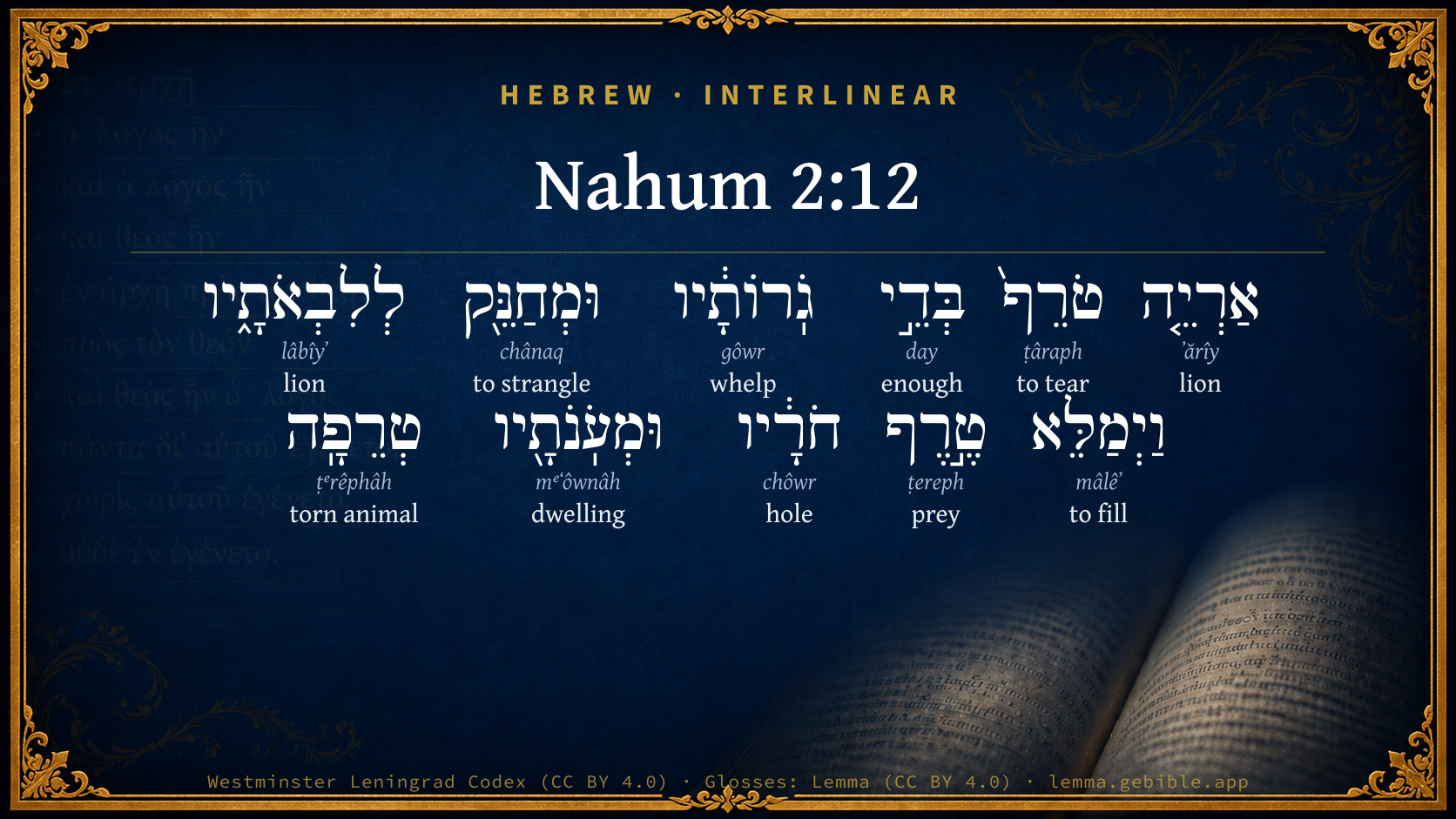
  1. אַרְיֵ֤ה ʼărîy H738 “lion” Noun, Common, Masculine, Singular, Absolute
  2. טֹרֵף֙ ṭâraph H2963 “tearing” Verb, Qal, Participle Active, Masculine, Singular, Absolute
  3. בְּדֵ֣י day H1767 “in/at · enough of” Preposition + Noun, Common, Masculine, Singular, Construct
  4. וּמְחַנֵּ֖ק chânaq H2614 “and · strangling” Conjunction + Verb, Piel, Participle Active, Masculine, Singular, Absolute
  5. לְלִבְאֹתָ֑יו lâbîyʼ H3833 “to/for · lions · his” Preposition + Noun, Common, Both, Plural, Construct + Suffix, Personal, 3rd Person, Masculine, Singular
  6. וַיְמַלֵּא mâlêʼ H4390 “and · to fill” Conjunction + Verb, Piel, Sequential Imperfect, 3rd Person, Masculine, Singular
  7. טֶ֣רֶף ṭereph H2964 “prey” Noun, Common, Masculine, Singular, Absolute
  8. חֹרָ֔יו chôwr H2356 “holes · his” Noun, Common, Masculine, Plural, Construct + Suffix, Personal, 3rd Person, Masculine, Singular
  9. וּמְעֹֽנֹתָ֖יו mᵉʻôwnâh H4585 “and · dwellings · his” Conjunction + Noun, Common, Both, Plural, Construct + Suffix, Personal, 3rd Person, Masculine, Singular
  10. טְרֵפָֽה ṭᵉrêphâh H2966 “torn animal” Noun, Common, Feminine, Singular, Absolute

About this verse

These counts appear in no published source. They are computed here, from the morphology-tagged text and Lemma’s own curated glosses. What Lemma adds →

11
words
11
distinct lemmas
Prophets
section

Notable vocabulary

The rarest word here is גֹֽרוֹתָ֔יו whelp H1484 — appearing just 2 times in the whole Hebrew Bible.

Shared distinctive vocabulary

גֹֽרוֹתָ֔יו whelp H1484 occurs in 2 verses of the Hebrew Bible. Also found in:

Grammatical profile

  • 3 verbs
  • 8 nouns

Verb forms

  • טֹרֵף֙ Qal · Participle Active
  • וּמְחַנֵּ֖ק Piel · Participle Active
  • וַיְמַלֵּא Piel · Sequential Imperfect

Hebrew & Septuagint length

In English translation the verse runs 26 words from the Hebrew and 25 from the Septuagint (LXX English) — closely comparable.

A rough comparison of the two English renderings, which tokenize alike — not a word-level alignment.

Word counts can differ between the Hebrew and the Greek without any difference in meaning — e.g. the Hebrew direct-object marker אֵת has no separate Greek word, and Greek often adds the article ὁ.

Cross-references

3

Topical passages linked to Nahum 2:12 in the Treasury of Scripture Knowledge — connected by theme and wording, ordered by reader-vote popularity; previews shown in the World English Bible.

  • Jeremiah 51:34 Nebuchadrezzar the king of Babylon has devoured me, he has crushed me, he has made me an empty vessel, he has, like a monster, swallowed me up, he has filled his maw with my delicacies; he has cast me out.
  • Psalms 17:12 He is like a lion that is greedy of his prey, As it were a young lion lurking in secret places.
  • Isaiah 10:6–14 I will send him against a profane nation, and against the people of my wrath will I give him a charge, to take the spoil, and to take the prey, and to tread them down like the mire of the streets.

Cross-references courtesy of OpenBible.info (CC BY 4.0).

Hebrew and Greek witnesses Masoretic Hebrew ↔ Greek Septuagint

The same verse in the two great witnesses to the Old Testament, shown verse-for-verse.

These are two independent witnesses, not word-aligned to each other, and the Septuagint is shown in lemma (dictionary) form.

Hebrew Nahum 2:12 Masoretic · Westminster Leningrad Codex

אַרְיֵ֤ה טֹרֵף֙ בְּדֵ֣י גֹֽרוֹתָ֔יו וּמְחַנֵּ֖ק לְלִבְאֹתָ֑יו וַיְמַלֵּא טֶ֣רֶף חֹרָ֔יו וּמְעֹֽנֹתָ֖יו טְרֵפָֽה

The lion tore in pieces enough for his cubs, and strangled for his lionesses, and filled his caves with the kill, and his dens with prey.

World English Bible · Public Domain

Greek LXX Nahum 2:12 Septuagint · lemma form

ποῦ εἰμί ὁ κατοικητήριον ὁ λέων καί ὁ νομή ὁ εἰμί ὁ σκύμνος ὅς πορεύομαι λέων ὁ εἰςἔρχομαι ἐκεῖ σκύμνος λέων καί οὐ εἰμί ὁ ἐκφοβέω

The lion seized enough prey for his whelps, and strangled for his young lions, and filled his lair with prey, and his dwelling-place with spoil.

LXX2012 (modern English Septuagint) · Public Domain

Hebrew: Westminster Leningrad Codex (CC BY 4.0). Greek: Septuagint (public domain); English from LXX2012 (modern English Septuagint) (Public Domain). How the Septuagint differs from the Hebrew →

Targum (Aramaic paraphrase)

1

The Targum is the ancient Jewish Aramaic paraphrase of the Hebrew Scriptures — an interpretive translation, not the Hebrew text itself. Onkelos (literal) and Pseudo-Jonathan (expansive) render the Torah, and Jonathan the Prophets. Coverage is partial: where no permissively-licensed English translation exists for a verse, only the Aramaic is shown. This is verse-level text, not a word-by-word alignment to the Hebrew.

  1. Targum Jonathan Prophets (Joshua–Malachi)
    אָן מְדוֹרֵי מַלְכַיָא וּבֵית מֵישְׁרֵי שִׁלְטוֹנַיָא אֲתַר דַהֲווֹ אָזְלִין מַלְכַיָא תַמָן בְּנֵיהוֹן שָׁבְקִין הָא כְאַרְיָה דְשָׁרֵי עַל צֵידֵיהּ לְרוֹחֲצָן וְלֵית דְמָנִיד:

    (no public-domain English translation for this verse)

    Targum Jonathan — Aramaic: “Mikraot Gedolot” (public domain). English: “Sefaria Community Translation” (CC0 1.0 (public-domain dedication)); “London "Chaldee Paraphrase," 1871” (public domain). Text via Sefaria.

Commentary

Notes on Nahum 2:12 from classic Christian and Jewish commentators (each source and its license shown beneath its notes). The classic Christian expositions comment on the surrounding passage and are grouped to its opening verse, so a note may address several verses; the Jewish commentaries on the Tanakh (Rashi and others) are per-verse, so they appear only where the commentator wrote on this verse.

Lemma curates 59 commentaries, every one of them public domain or Creative Commons licensed, each selected and text-cleaned for this edition rather than reprinted as found. About our sources →

Trapp's Complete Commentary

John Trapp

Nah 2:12 The lion did tear in pieces enough for his whelps, and strangled for his lionesses, and filled his holes with prey, and his dens with ravin.

Ver. 12. The lion did tear in pieces enough for his whelps] i.e. That which might have been enough and spare, but that they were unsatiable. So covetous they were and ravenous, that their posy might have been, Totus non sufficit orbis; their desire of more was enlarged as hell; greedy lions they were, that could never have enough, Isa 56:11. As a ship may be overladen with gold and silver, even unto sinking, and yet have compass and sides enough to hold ten times more; so the cormorants and covetous wretches of this world though they have enough to sink them, yet never have they enough to satisfy them.

And strangled for his lionesses] i.e. For his wives and concubines, by whom they were commanded, being captivarum suarum captivi, as Plutarch saith of the Persian kings; slaves to their she-slaves, whom they enriched and adorned with the spoils of the subdued nations. Cicero, in his fifth action against Verres, saith that the kings of Persia and Syria (think the same of Assyria), as they had many wives, so they would bestow upon them whole cities for their maintenance. Antiochus, King of Syria, gave two fair cities to his concubine, 2Ma 4:30. Antony gave all Egypt to Cleopatra. Henry II of France gave to Diana Valentina all the confiscation of goods made in the kingdom for cause of heresy, A.D. 1554, which caused the burning of many good people. Utinam hodie non essent leaenae, saith Calvin here: It were to be wished there were not today lionesses, that can of themselves strangle and devour; but we see that there are some women that exceed all men in impudence and cruelty. The queen mother, he meant, in all likelihood, as Beza did her cruel son, Charles IX, author of the massacre, in that verse of his, made upon that new star in Cassiopeia, 1572:

“ Tu vero Herodes sanguinolente time. ”

“Truly you are Herod by bloody fear.”

And filled his holes with prey, and his dens with ravin] His palaces with treasure, his coffers with cash, raked together by evil arts and oppressive practices. What else was the whole Assyrian empire but a great thievery? Alexander the Great was told to his teeth, that he was the greatest thief in the world. And was not Julius Caesar such another? who said, that for a kingdom’s sake right might be violated? and who robbed his country of her liberty for the satisfying of his unlawful desire of ruledom? But for whom all this? surely for those that never thanked them for anything, but fought for their spoil.

John Trapp, A Commentary or Exposition upon All the Books of the Old and New Testament (1647–1656) — public domain. Text from a community e-Sword module.

Jamieson, Fausset & Brown

Robert Jamieson, A. R. Fausset & David Brown

prey . . . ravin--different kinds of prey. Compare Isa 3:1, "the stay and the staff."

Jamieson, Fausset & Brown — Commentary Critical and Explanatory on the Whole Bible (1871) — public domain (CC PDM 1.0). Text via the HelloAO Bible API.

Adam Clarke's Commentary

Verse 12. The lion did tear] This verse gives us a striking picture of the manner in which the Assyrian conquests and depredations were carried on. How many people were spoiled to enrich his whelps - his sons, princes, and nobles! How many women were stripped and slain, whose spoils went to decorate his lionesses - his queen, concubines, and mistresses. And they had even more than they could assume; their holes and dens - treasure-houses, palaces, and wardrobes - were filled with ravin, the riches which they got by the plunder of towns, families, and individuals. This is a very fine allegory, and admirably well supported.

Adam Clarke's Commentary on the Bible (1810–1826) — public domain. Text from a community e-Sword/MySword module.

John Calvin's Commentaries

And filled has he with prey his dens and his recesses with ravin; it is the same word with a different termination, טרף, thereph, and טרפה, therephe

Now the repetition, made here by the Prophet, of lion, young lion, and lioness, was not without its use; for he meant by this number of words to set forth the extreme ferocity of the Assyrians, while they were dominant. He no doubt compares their kings, their counselors, and their chief men, to lions: and he calls their wives lionesses, and their children he calls young lions or whelps of lions. The sum of the whole is, that Nineveh had so degenerated in its opulence, that all in power were like ferocious wild beasts, destitute of every kind feeling. And I wish that this could have only been said of one city and of one monarchy! But here, as in a mirror, the Prophet represents to us what we at this day observe, and what has always and in all ages been observed in great empires; for here great power exists, there great licentiousness prevails; and when kings and their counselors become once habituated to plunder, there is no end of it; nay, a kind of fury is kindled in their hearts, that they seek nothings else but to devour and to tear in pieces to rend and to strangle. The Prophet indeed wished here to console both the Israelites and the Jews by showing, that the injustice of their enemies would not go unpunished: but at the same time he intended to show how great, even to the end of the world, would be the cruelty of those who would rule tyrannically: and as I have said, experience proves, that there are too many like the Ninevites. It is indeed unquestionable, that the Prophet does not without reason speak so often here of lions and lionesses.

Hence he says, “Come thither did the lion, the lioness, and the whelp of the lion.” He means that when justice was sought in that city, it was found to be the den of cruel beasts; for the king had put off all humanity, as well as his counselors; their wives were also like lionesses, and their children and domestics were as young lions or the whelps of lions. And cruelty creeps in, somewhat in this manner: When a king takes to himself too much liberty, his counselors follow him; and then every one follows the common example, as though every thing received as a custom was lawful. This is the representation which the Prophet in these words sets before us; and we with our own eyes see the same things. Then he adds, ‘The lion did tear what sufficed his whelps, and strangled for his lionesses; he filled with prey his dens and his recesses with plunder. He goes on with the same subject, — that the Assyrians heaped for themselves great wealth by unjust spoils, because they had no regard for what was right. The lion, he says, did tear for his whelps: as lions accustom their whelps to plunder, and when they are not grown enough, so as to be able to attack innocent animals, they provide a prey for them, and also bring some to the lionesses; so also, as the Prophet informs us, was the case at Nineveh; the habits of all men were formed for cruelty by the chief men and the magistrates. By the word בדי, bedi, sufficiency, he means not that the Ninevites are satisfied with their prey, for they were insatiable; but it rather refers to the abundance which they had. And he says, that the lion strangled for his lionesses: I wish there were no lionesses to devour at this day; but we see that there are some who surpass their husbands in boldness and cruelty. But the Prophet says here what is natural, — that the lion strangles the prey and gives it afterwards to his lionesses. He then adds, that the Ninevites were not satisfied with daily rapines, as many robbers live for the day; but he says, that their plunder was laid up in store. Hence they filled their secret places and dens with their booty and spoils. Still further, though the Prophet speaks not here so plainly, as we shall see he does in what follows, it is yet certain, that the reason is here given, why God visited the Ninevites with so severe a vengeance, and that was, because they had ceased to be like men, and had degenerated into savage beasts. It follows —

John Calvin's Commentaries (1540-1563) — public domain. Text from the Calvin Translation Society English edition (1840s-50s) via the Christian Classics Ethereal Library (ccel.org). Calvin's coverage is partial (roughly two-thirds of the Bible); uncommented books and verses are honest gaps, never fabricated. The 19th-century editor's footnotes and remarks are omitted so the notes are faithfully Calvin's own voice.

The Cambridge Bible for Schools and Colleges

gen. ed. J. J. S. Perowne

12. The lion did tear] Perhaps, the lion, which did tear, carrying on previous verse.

with ravin] i.e. torn carcases.

The Cambridge Bible for Schools and Colleges (gen. ed. J. J. S. Perowne; Cambridge University Press, 1878–1918) — public domain. Text from a community e-Sword module.

John Gill's Exposition

The lion did tear in pieces enough for his whelps,.... The metaphor is still continued; and the kings of Assyria are compared to lions that hunt for their prey, and, having found it, tear it in pieces, and carry home a sufficiency for their whelps. It is a notion that is advanced by some writers, as Herodotus (p), that the lioness, the strongest and boldest creature, brings forth but once in its life, and then but one; which Gellius (q) confutes by the testimonies of Homer and Aristotle; and it appears from the prophet here to be a false one, as well as from Eze 19:2 thus the Assyrians made war on other nations, and pillaged and plundered them, to enlarge their dominions, provide for their posterity, and enrich their children:

and strangled for his lionesses; that is, strangled other beasts, as the lion first does, when it seizes a creature, and then tears it in pieces, and brings it to the she lion in the den with its whelps. These "lionesses" design the wives and concubines of the kings of Assyria, among whom they parted the spoils of their neighbours. So the Targum,

"kings bring rapine to their wives, and a prey to their children;''

that is, riches, which they have taken from others by force and rapine: thus Cicero (r) observes of the kings of Persia and Syria, that they had many wives, and gave cities to them after this manner; this city for their headdress, this for the neck, and the other for the hair; the expenses of them:

and filled his holes with prey, and his dens with ravine; as the lion fills his dens and lurking holes with the prey he has seized and ravened; so the kings of Assyria filled their palaces, treasures, magazines, towers, cities, and towns, with the wealth and riches they took by force from other nations; as the Targum,

"and they filled their treasuries with rapine, and their palaces with spoil.''

(p) Thalia, sive l. 3. c. 108. (q) Noctes Atticae, l. 13. c. 7. (r) Orat. 8. in Verrem, l. 3. p. 509.

John Gill's Exposition of the Whole Bible (1746–1763) — public domain (CC PDM 1.0). Text via the HelloAO Bible API.

Matthew Poole's English Annotations

The prophet continues the metaphor; this lion is the king of Assyria.

Did tear in pieces; formerly did fall upon his neighbour nations, broke their strength, and robbed their treasuries and store-houses, and broke them in pieces.

For his whelps; the young brood of the Assyrian royal family.

Lionesses; queens, concubines, or ladies in the Assyrian court.

Filled his holes; his treasuries, magazines, and royal seats, called dens in a decorum to the speech he had used.

And his dens; ingeminating what was before spoken.

With ravin; spoils which his ravenous mind and hand could lay hold on; all was prey that he could take.

Matthew Poole's English Annotations on the Holy Bible (1683–1685) — public domain. Text from a community e-Sword/MySword module.

The Pulpit Commentary

The figure of the lieu is continued, and this verse, in loose apposition to the preceding, may be best explained by continuing the interrogation in thought Where is now the lion that used to tear in pieces, etc.? The lion did tear in pieces enough for his whelps. The Assyrian monarch provided for his children and dependents by plundering other nations. His lionesses may mean his wives and concubines. It was the custom both with the Persians and Assyrians to assign towns and provinces to their favourites. Xenophon ("Anab.," 1:4. 10) mentions certain villages as set apart for the girdle of Queen Parysatis. A Lapide quotes Cicero, "Verr.," 2:3. 33, "They say that the barbarian kings of the Persians and Syrians i.e. Assyrians are wont to have many wives, to whom they assign cities in this fashion this city is to provide a girdle for her waist, that a necklace, that again to dress her hair; and so they have whole nations, not only privy to their lusts, but also abettors of them". (see Arnold"s note on Thucydides, 1:138; temp. RAPC 2Ma 4:30)

The Pulpit Commentary (1880–1919), ed. H.D.M. Spence-Jones & Joseph S. Exell — public domain. Text from a community e-Sword module.

John Wesley's Explanatory Notes

Did tear - Formerly fell upon his neighbour nations. His lionesses - Queens, concubines, or ladies in the Assyrian court.

John Wesley, Explanatory Notes Upon the Whole Bible (1754–1765) — public domain. Text via the GEBible commentary corpus.

Rashi

Rabbi Shlomo Yitzchaki (Rashi)

Where is the lions’ den?—This is a lamentation over Nineveh, which was the dwellings of kings, hard and strong as lions.

where the grown lion and the old lion went—The place where the kings would go and leave their children there, like a lion that dwelt securely.

Rashi on the Tanakh — English translations: “The Judaica Press complete Tanach with Rashi, translated by A. J. Rosenberg” (CC BY 4.0); “Pentateuch with Rashi's commentary by M. Rosenbaum and A.M. Silbermann, 1929-1934” (public domain); “The Metsudah Tanach series, Lakewood, N.J” (CC BY 4.0); and “The Book of Joshua, Metsudah Publications, 1997” (CC BY 4.0). Text via Sefaria.

Lesson kit

Teaching starters — assembled from the data on this page, not authored interpretation. Every prompt links to the verse data it draws on. Edit before teaching.

Nahum, in the Prophets, opens this verse with 11 words (11 distinct Hebrew lemmas). Its most distinctive word is gôwr (“whelp”). A historical commentator’s framing appears above. Read the whole chapter for the surrounding context.

Discussion questions

  1. How does “whelp” (gôwr) shape what this verse is saying?
  2. Jeremiah 51:38 shares the word «whelp» with this verse. How do the two illuminate each other?
  3. These translations render this verse differently. What is at stake in choosing one wording over another?
  4. The verb «טֹרֵף֙» is Qal Participle Active. How does its form color the action?
  5. Reading how Trapp's Complete Commentary and Jamieson, Fausset & Brown read this verse, where do the two commentators agree and where do they part?

Things to notice

Reading settings

Reading text

Shown beneath each verse's original-language words.

Old Testament
Old Testament edition

Read the OT as the Masoretic Hebrew (MT) or the Greek Septuagint (LXX).

English shown for the Greek Septuagint (in the Hebrew ↔ Greek comparison).

Comparing translations? Open the Compare panel on any verse page to stack up to four side by side.