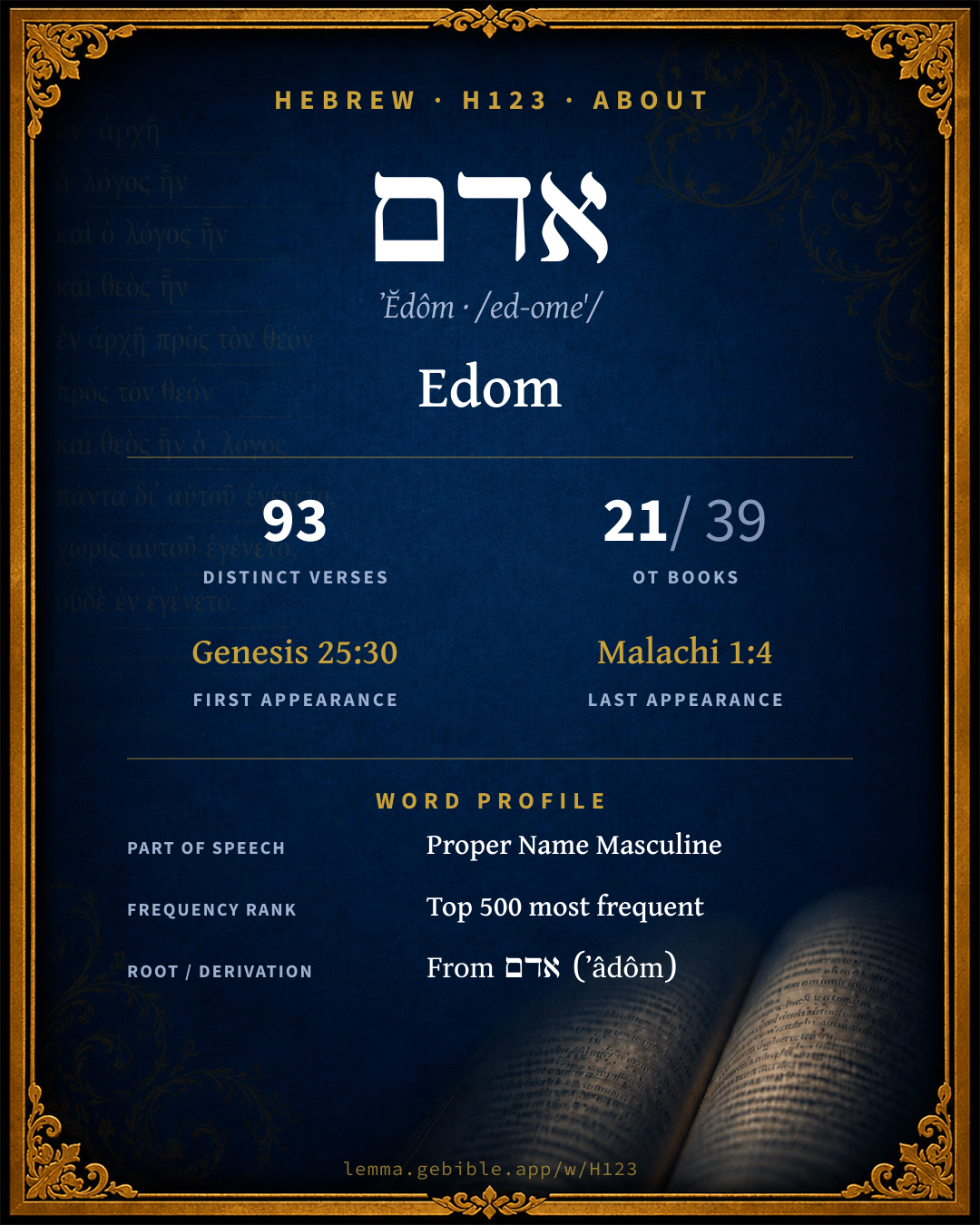
אֱדוֹם
Edom
BDB lists 4 entries for ‘Edom’ fuller range ↓
Full lexicon entry — Brown-Driver-Briggs (BDB)
From Brown-Driver-Briggs (BDB)
Where this word appears
Grammar key — what these labels mean
Part of speech
- Noun
- A naming word — a person, place, thing, or idea.
Noun type
- Proper
- A name of a specific person, place, or people (e.g. Abraham, Zion, Israel).
Every verse where H123 appears in the Book of 1 Kings — 5 distinct verses. Click any verse to open its interlinear word-by-word view. Verse text shown in the World English Bible for context — . Each verse’s Hebrew form is shown with its reference; the English is not keyword-highlighted, since the data carries no word-level English alignment. Use “Compare translations” on any verse to read it across multiple English versions. This concordance covers the Hebrew Bible; Septuagint (Greek Old Testament) occurrences are not indexed here.
1 Kings
- 1 Kings 9:26 אֱדֽוֹם n Proper King Solomon made a navy of ships in Ezion Geber, which is beside Eloth, on the shore of the Red Sea, in the land of Edom.
- 1 Kings 11:14 בֶּ/אֱדֽוֹם prep + n Proper Yahweh raised up an adversary to Solomon, Hadad the Edomite: he was of the king's seed in Edom.
- 1 Kings 11:15 אֱד֔וֹם בֶּ/אֱדֽוֹם n Proper prep + n Proper For it happened, when David was in Edom, and Joab the captain of the host was gone up to bury the slain, and had struck every male in Edom
- 1 Kings 11:16 בֶּ/אֱדֽוֹם prep + n Proper (for Joab and all Israel remained there six months, until he had cut off every male in Edom);
- 1 Kings 22:47 בֶּ/אֱד֖וֹם prep + n Proper There was no king in Edom: a deputy was king.
About this entry
At a glance — auto-summarized from this page’s data, not written by a person. Every figure links to its source below. This summary describes the numbers; it doesn’t interpret them.
אדם (ʼĔdôm) is a Hebrew name most often rendered “Edom.” It first appears in Genesis 25:30. The Hebrew Bible uses it across 93 verses — moderately common. For the data behind this summary, explore 93-verse concordance and the renderings breakdown below.
Gloss history
Strong's 1890 vs modern scholarship
About this word
Strong's H123 catalogs a Hebrew word from the Hebrew Old Testament.
These counts are not copied from any lexicon or concordance. They are computed here, from the morphology-tagged Hebrew Old Testament. What Lemma adds →
- 93
- distinct verses
- The word appears in 93 distinct verses.
- 21 / 39
- OT books
- The word appears in 21 of 39 Old Testament books.
- #425
- by frequency
- Top 500 most frequent Hebrew words (rank 425 of 8,640 Hebrew words by occurrence).
View all 93 occurrences in the concordance →
By section of the Old Testament
By traditional corpus
Conventional, traditional groupings — biblical authorship is debated, so this is a traditional corpus grouping, not an authorship claim. Each share is this word’s portion of its verses in that division of the Hebrew canon. Each figure is a share of the word’s 93 distinct verses.
- Prophets (Nevi'im) 49 verses · 53%
- Torah (Pentateuch) 22 verses · 24%
- Writings (Ketuvim) 22 verses · 24%
How translations render this word
Counts come from each version’s own published word-to-Strong’s tagging or interlinear alignment — an approximate guide to how each version renders this word, not a word-level alignment the data otherwise carries. Because each total is that version’s own tagged count, the per-version totals vary from one another and need not match the appearance or distinct-verse counts above. These counts may also differ from a printed concordance because Lemma counts each distinctly tagged rendering and does not collapse phrase taggings into a single head-word total. This is a fixed set of word-tagged versions (KJV, ASV, BSB, ULT) and does not change with the reading translation you choose elsewhere. Each version’s license is shown beside its name below (and on Sources).
- King James Version: Edom 72×, Edomites 8×, Is edom 4×
- American Standard Version: Edom 77×, Edomites 5×, Against edom 2×
- Berean Standard Bible: Edom 85×, Edomites 10×, Edom’s 2×
- unfoldingWord Literal Text: Edom 88×, Edomites 2×
King James Version Public Domain
Renders H123 across 100 tagged occurrences — most commonly:
Plus 8 renderings that appear only once — usually multi-word phrases or single function words the recovered tagging swept in, not distinct renderings.
American Standard Version Public Domain
Renders H123 across 99 tagged occurrences — most commonly:
Plus 9 renderings that appear only once — usually multi-word phrases or single function words the recovered tagging swept in, not distinct renderings.
Berean Standard Bible Public Domain
Renders H123 across 99 tagged occurrences — most commonly:
Plus 2 renderings that appear only once — usually multi-word phrases or single function words the recovered tagging swept in, not distinct renderings. Not rendered by a distinct English word in 1 further occurrence.
unfoldingWord Literal Text CC BY-SA 4.0
Renders H123 across 94 tagged occurrences — most commonly:
Plus 4 renderings that appear only once — usually multi-word phrases or single function words the recovered tagging swept in, not distinct renderings.
Senses in the full BDB
What do BDB’s symbols mean?
BDB uses these scholarly abbreviations:
| Symbol | Meaning |
|---|---|
| 𝔊 | the Septuagint (the ancient Greek translation, LXX) |
| 𝔙 | the Vulgate (the Latin translation) |
| 𝔖 | the Syriac version (the Peshitta) |
| 𝔗 | the Targum (the Aramaic translation) |
| ψ | the Psalms |
| √ | root (the underlying root or stem) |
| ‖ | parallel passage (a synonymous or contrasted parallel) |
| † | the dagger: every passage where the word occurs is cited |
The 3 senses and sub-senses the full Brown-Driver-Briggs lexicon distinguishes for this word, in lexicon order (not ranked by frequency), with BDB’s own verbatim wording and sub-sense lettering. Shown in Hebrew script with BDB’s own scholarly abbreviations. The condensed entry is in the Lexicon Entry tab. See also the Forms in the corpus table below.
- 1. Edom
- 2. coll. Edomites, Idumeans as descend. of Esau
- 3. land of Edom, Idumaea
Senses from the full Brown-Driver-Briggs lexicon (Brown, Driver, Briggs; Oxford 1906 — public domain), digitized via Sefaria, supplemented by the OpenScriptures HebrewLexicon (CC BY 4.0). Full attribution on Sources.
Word origin
אֱדוֹם († אֱדֹם Ez 25:11 ) n.pr.m.
— Brown-Driver-Briggs (Oxford 1906, public domain), digitized via Sefaria, supplemented by the OpenScriptures HebrewLexicon (CC BY 4.0). See Sources.
Derived from אדם (ʼâdôm) (H122) — red.
Jastrow Dictionary
A second Hebrew/Aramaic lexicon for comparison, covering Aramaic and post-biblical (Talmudic, Targumic, Midrashic) usage that the biblical-Hebrew BDB does not. Matched by lemma rather than by Strong’s number, so a lemma may carry more than one Jastrow headword (shown separately below), and the entries cover usage well beyond the Bible.
אֲדַם
- , v. הֲדַם. [v. Rabb. D. S. to Ab. Zar. 38ᵇ, Bets. 24ᵇ, note.]
אָדַם
- , v. דמם) [to be viscous, thick, dark] to be red, grow red.
- to redden, make red. Y. Sabb. VII, 10ᶜ top המְאַדֵּם אודם he who produces a red spot (congestion of blood, on a Sabbath).
- 1. (b. h.) (b. h.) to be, grow red. Num. R. s. 9 (p. 231ᵇ ed. Amst.) מַאֲדֶמֶת (היתה) if she was red-faced. Ḥull. 53ᵇ; a. fr.
- 2. to cause to blush, put to shame (usu. הלבין). Num. R. s. 4 (p. 218ᵈ ed. Amst.) (play on עובד אדום).—Part. מַאֲדִים the planet Mars. Sabb. 156ᵃ.—Part. Hof. מְאָדָּם, מְאוּדָּם. Y. Sabb. VII, 10ᶜ top מְאָדָּמִים dyed red.
אָדָם
- m. (b. h.) man, pr. n. m. Adam, frequ. א׳ הראשון (abbr. אה"ר). Gen. R. s. 17; a. fr.—ספרו של, ספרא דאה"ר אה"ר the (allegorical) book of Adam containing all generations and their leaders from beginning to resurrection, i.e. destinies of humanity. Ex. R. s. 40 beg. B. Mets. 85ᵇ bot.
אֲדָם
- (= דָּם, דְּמָא) blood. Targ. I Chron. XXII, 7; a. e.—Y. Maas. Sh. V, 56ᵈ top מגבלא אַדְמֵיה to mix its (the bird’s) blood. Git. 47ᵃ; v. חוּל II. Pl. אַדְמִין. Targ. I Chr. l. c.; a. e.
A Dictionary of the Targumim, the Talmud Babli and Yerushalmi, and the Midrashic Literature (Marcus Jastrow; London, Luzac, 1903) — Public Domain. Digitized via Sefaria. Digitized via Sefaria. Full attribution on Sources.
Forms in the corpus
The 30 distinct written forms H123 takes in the Hebrew Bible, most frequent first — each parse links to that state’s occurrences in the concordance. Hebrew forms include their vowel points and cantillation, so a single lemma takes many written forms.
| Form | Parsing | Example | Uses |
|---|---|---|---|
| אֱד֔וֹם | Noun, Proper | Amos 1:11 | 19 |
| אֱדֽוֹם | Noun, Proper | Genesis 25:30 | 17 |
| אֱד֖וֹם | Noun, Proper | Amos 2:1 | 7 |
| אֱדוֹם֙ | Noun, Proper | Amos 9:12 | 7 |
| אֱד֑וֹם | Noun, Proper | Genesis 36:9 | 6 |
| אֱד֗וֹם | Noun, Proper | Ezekiel 32:29 | 5 |
| אֱד֜וֹם | Noun, Proper | 2 Chronicles 21:10 | 5 |
| אֱד֣וֹם | Noun, Proper | Daniel 11:41 | 5 |
| אֱ֭דוֹם | Noun, Proper | Psalms 60:8 | 3 |
| בֶּ/אֱדֽוֹם | Noun, Proper | 1 Kings 11:14 | 3 |
| אֱד֤וֹם | Noun, Proper | 2 Kings 14:7 | 2 |
| וּ/בֶ/אֱד֜וֹם | Noun, Proper | 1 Samuel 14:47 | 2 |
| לֶ/אֱד֗וֹם | Noun, Proper | Jeremiah 49:7 | 2 |
| אֱד֛וֹם | Noun, Proper | Ezekiel 25:12 | 1 |
| אֱד֞וֹם | Noun, Proper | Jeremiah 9:26 | 1 |
| אֱד֥וֹם | Noun, Proper | Jeremiah 25:21 | 1 |
| אֱד֧וֹם | Noun, Proper | Joshua 15:1 | 1 |
| אֱד֨וֹם | Noun, Proper | Judges 11:17 | 1 |
| בֶ/אֱד֔וֹם | Noun, Proper | Ezekiel 25:14 | 1 |
| בֶּ/אֱד֔וֹם | Noun, Proper | Genesis 36:32 | 1 |
| בֶּ/אֱד֖וֹם | Noun, Proper | 1 Kings 22:47 | 1 |
| בֶּ/אֱד֗וֹם | Noun, Proper | Ezekiel 25:14 | 1 |
| בֶּ/אֱד֜וֹם | Noun, Proper | 2 Samuel 8:14 | 1 |
| בֶּֽ/אֱדוֹם֙ | Noun, Proper | 1 Chronicles 18:13 | 1 |
| וֶ/אֱד֕וֹם | Noun, Proper | Joel 3:19 | 1 |
| לֶ/אֱד֔וֹם | Noun, Proper | Amos 1:9 | 1 |
| לֶ/אֱדֽוֹם | Noun, Proper | Amos 1:6 | 1 |
| מֵ/אֱד֗וֹם | Noun, Proper | Isaiah 63:1 | 1 |
| מֵֽ/אֱד֔וֹם | Noun, Proper | Obadiah 1:8 | 1 |
| מֵֽ/אֱד֤וֹם | Noun, Proper | 1 Chronicles 18:11 | 1 |
Same root — word family
Other BDB entries built from the same root as H123, grouped by Strong’s listed origin. These share a root / origin per the lexicon — not necessarily a shared meaning. Each links to that word’s own entry.
Derives from
Proper names from this root
People and places named from this root — a name, not an additional meaning of the word.
Compare all same-root words → 2 of the same-root words are proper names (people or places). They share a root, not necessarily a meaning.
Bible dictionary
Public-domain dictionary articles matched to this entry by name (Edom). A biblical name can be shared by more than one person or place, so an article may treat several.
Easton's Bible Dictionary · M. G. Easton, 1897
(1.) The name of Esau (q.v.), Gen. 25:30, "Feed me, I pray thee, with that same red pottage [Heb. haadom, haadom, i.e., the red pottage, the red pottage'] ...Therefore was his name called Edom", i.e., Red.
(2.) Idumea (Isa. 34:5, 6; Ezek. 35:15). "The field of Edom" (Gen. 32:3), "the land of Edom" (Gen. 36:16), was mountainous (Obad. 1:8, 9, 19, 21). It was called the land, or "the mountain of Seir," the rough hills on the east side of the Arabah. It extended from the head of the Gulf of Akabah, the Elanitic gulf, to the foot of the Dead Sea (1 Kings 9:26), and contained, among other cities, the rock-hewn Sela (q.v.), generally known by the Greek name Petra (2 Kings 14:7). It is a wild and rugged region, traversed by fruitful valleys. Its old capital was Bozrah (Isa. 63:1). The early inhabitants of the land were Horites. They were destroyed by the Edomites (Deut. 2:12), between whom and the kings of Israel and Judah there was frequent war (2 Kings 8:20; 2 Chr. 28:17).
At the time of the Exodus they churlishly refused permission to the Israelites to pass through their land (Num. 20:14-21), and ever afterwards maintained an attitude of hostility toward them. They were conquered by David (2 Sam. 8:14; comp. 1 Kings 9:26), and afterwards by Amaziah (2 Chr. 25:11, 12). But they regained again their independence, and in later years, during the decline of the Jewish kingdom (2 Kings 16:6; R.V. marg., "Edomites"), made war against Israel. They took part with the Chaldeans when Nebuchadnezzar captured Jerusalem, and afterwards they invaded and held possession of the south of Palestine as far as Hebron. At length, however, Edom fell under the growing Chaldean power (Jer. 27:3, 6).
There are many prophecies concerning Edom (Isa. 34:5, 6; Jer. 49:7-18; Ezek. 25:13; 35:1-15; Joel 3:19; Amos 1:11; Obad.; Mal. 1:3, 4) which have been remarkably fulfilled. The present desolate condition of that land is a standing testimony to the inspiration of these prophecies. After an existence as a people for above seventeen hundred years, they have utterly disappeared, and their language even is forgotten for ever. In Petra, "where kings kept their court, and where nobles assembled, there no man dwells; it is given by lot to birds, and beasts, and reptiles."
The Edomites were Semites, closely related in blood and in language to the Israelites. They dispossessed the Horites of Mount Seir; though it is clear, from Gen. 36, that they afterwards intermarried with the conquered population. Edomite tribes settled also in the south of Judah, like the Kenizzites (Gen. 36:11), to whom Caleb and Othniel belonged (Josh. 15:17). The southern part of Edom was known as Teman.
Hitchcock's Bible Names Dictionary · Roswell D. Hitchcock, 1869
red, earthy; of blood
Classic public-domain reference works; full attribution on Sources.
Septuagint verse parallels
This word appears in 85 verses that also exist in the Greek Old Testament (Septuagint), out of the 93 Hebrew verses it occurs in. You can read those verses in Greek by switching the Old Testament edition to the Septuagint.
Read these verses in the Septuagint
- Genesis 25:30
- Exodus 15:15
- Numbers 20:14
- Joshua 15:1
- Judges 5:4
- 1 Samuel 14:47
- 2 Samuel 8:14
- 1 Kings 11:14
- 2 Kings 3:8
- 1 Chronicles 18:11
- 2 Chronicles 8:17
- Psalms 60:1
This is a verse-level parallel only — the same verses exist in both the Hebrew and Greek Old Testaments. No word-level Hebrew↔Greek correspondence is claimed: the data carries no such alignment, so no Greek word is shown as this Hebrew word’s translation. Coverage is not total — the Septuagint omits the deuterocanon and renumbers the Psalms, so some Hebrew verses have no direct Greek parallel.