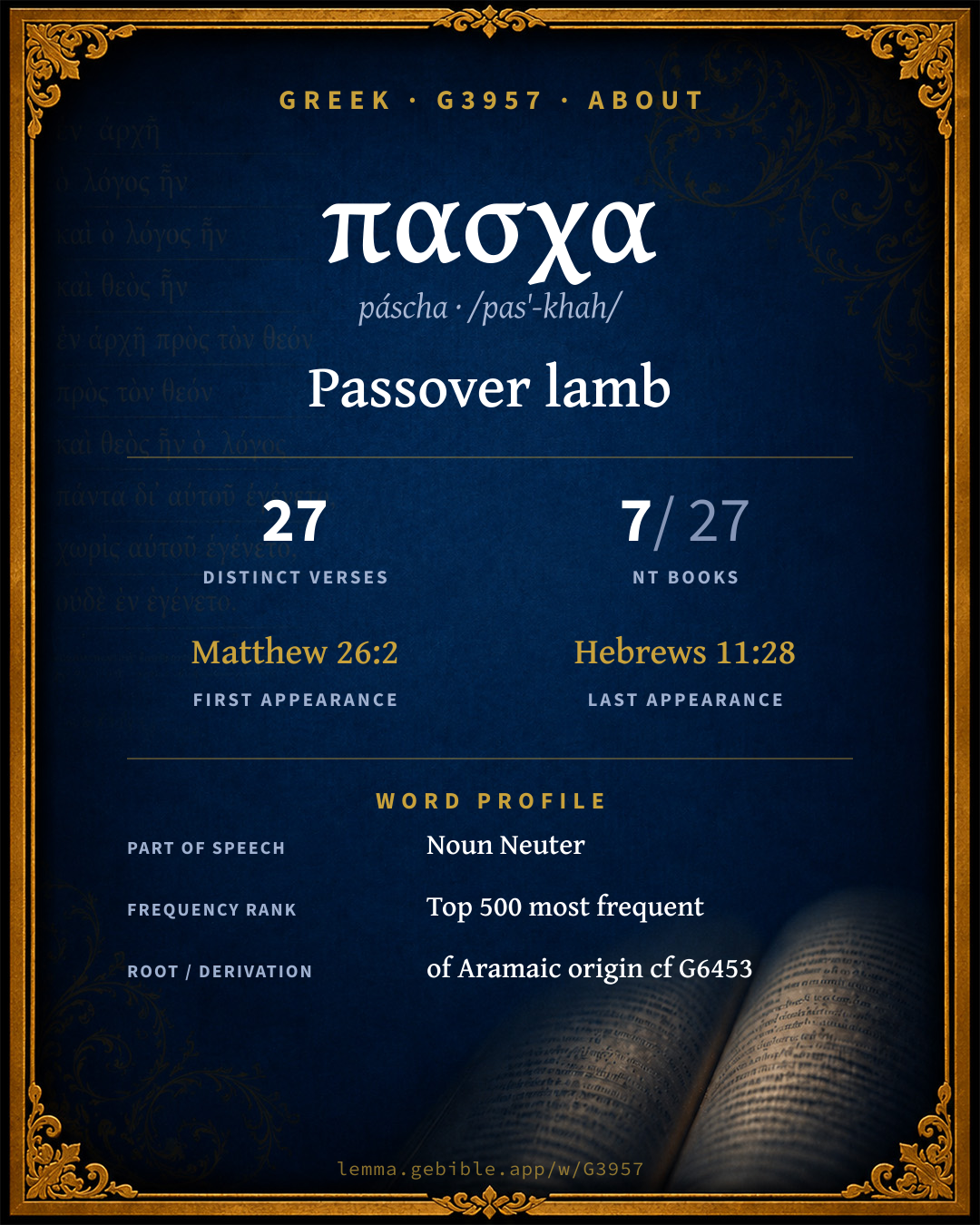
πάσχα
Passover lamb
Thayer's lists 4 entries for ‘Passover lamb’ fuller range ↓
Full lexicon entry — Thayer's Greek Lexicon
From Thayer's Greek Lexicon
Where this word appears
Grammar key — what these labels mean
Part of speech
- Aramaic transliteration
- An Aramaic word carried over into Greek letters (e.g. ἀββά).
Every verse where G3957 appears — 27 distinct verses across 7 books. Click any verse to open its interlinear word-by-word view. Verse text shown in the World English Bible for context — . Each verse’s Greek form is shown with its reference; the English is not keyword-highlighted, since the data carries no word-level English alignment. Use “Compare translations” on any verse to read it across multiple English versions. This concordance covers the Greek New Testament; Septuagint (Greek Old Testament) occurrences of this word are not indexed here.
Matthew 4 verses
- Matthew 26:2 πάσχα aram "You know that after two days the Passover is coming, and the Son of Man will be delivered up to be crucified."
- Matthew 26:17 πάσχα aram Now on the first day of unleavened bread, the disciples came to Jesus, saying to him, "Where do you want us to prepare for you to eat the Passover?"
- Matthew 26:18 πάσχα aram He said, "Go into the city to a certain person, and tell him, 'The Teacher says, "My time is at hand. I will keep the Passover at your house with my disciples."'"
- Matthew 26:19 πάσχα aram The disciples did as Jesus commanded them, and they prepared the Passover.
Mark 4 verses
- Mark 14:1 πάσχα aram It was now two days before the feast of the Passover and the unleavened bread, and the chief priests and the scribes sought how they might sieze him by deception, and kill him.
- Mark 14:12 πάσχα πάσχα aram aram On the first day of unleavened bread, when they sacrificed the Passover, his disciples asked him, "Where do you want us to go and make ready that you may eat the Passover?"
- Mark 14:14 πάσχα aram and wherever he enters in, tell the master of the house, 'The Teacher says, "Where is the guest room, where I may eat the Passover with my disciples?"'
- Mark 14:16 πάσχα aram His disciples went out, and came into the city, and found things as he had said to them, and they prepared the Passover.
Luke 7 verses
- Luke 2:41 πάσχα aram His parents went every year to Jerusalem at the feast of the Passover.
- Luke 22:1 πάσχα aram Now the feast of unleavened bread, which is called the Passover, drew near.
- Luke 22:7 πάσχα aram The day of unleavened bread came, on which the Passover must be sacrificed.
- Luke 22:8 πάσχα aram He sent Peter and John, saying, "Go and prepare the Passover for us, that we may eat."
- Luke 22:11 πάσχα aram Tell the master of the house, 'The Teacher says to you, "Where is the guest room, where I may eat the Passover with my disciples?"'
- Luke 22:13 πάσχα aram They went, found things as he had told them, and they prepared the Passover.
- Luke 22:15 πάσχα aram He said to them, "I have earnestly desired to eat this Passover with you before I suffer,
John 9 verses
- John 2:13 πάσχα aram The Passover of the Jews was at hand, and Jesus went up to Jerusalem.
- John 2:23 πάσχα aram Now when he was in Jerusalem at the Passover, during the feast, many believed in his name, observing his signs which he did.
- John 6:4 πάσχα aram Now the Passover, the feast of the Jews, was at hand.
- John 11:55 πάσχα πάσχα aram aram Now the Passover of the Jews was at hand. Many went up from the country to Jerusalem before the Passover, to purify themselves.
- John 12:1 πάσχα aram Then six days before the Passover, Jesus came to Bethany, where Lazarus was, who had been dead, whom he raised from the dead.
- John 13:1 πάσχα aram Now before the feast of the Passover, Jesus knowing that his time had come that he would depart from this world to the Father, having loved his own who were in the world, he loved them to the end.
- John 18:28 πάσχα aram They led Jesus therefore from Caiaphas into the Praetorium. It was early, and they themselves didn't enter into the Praetorium, that they might not be defiled, but might eat the Passover.
- John 18:39 πάσχα aram But you have a custom, that I should release someone to you at the Passover. Therefore do you want me to release to you the King of the Jews?"
- John 19:14 πάσχα aram Now it was the Preparation Day of the Passover, at about the sixth hour. He said to the Jews, "Behold, your King!"
Acts 1 verse
1 Corinthians 1 verse
Hebrews 1 verse
About this entry
At a glance — auto-summarized from this page’s data, not written by a person. Every figure links to its source below. This summary describes the numbers; it doesn’t interpret them.
“Passover lamb” is the headline sense of the Greek name πασχα (páscha). First canonically at Matthew 26:2, it enters the text early. It turns up in 27 verses across 7 books, a moderately common footprint. It concentrates in John, which alone accounts for 33% of its uses. See 27-verse concordance and the renderings breakdown below.
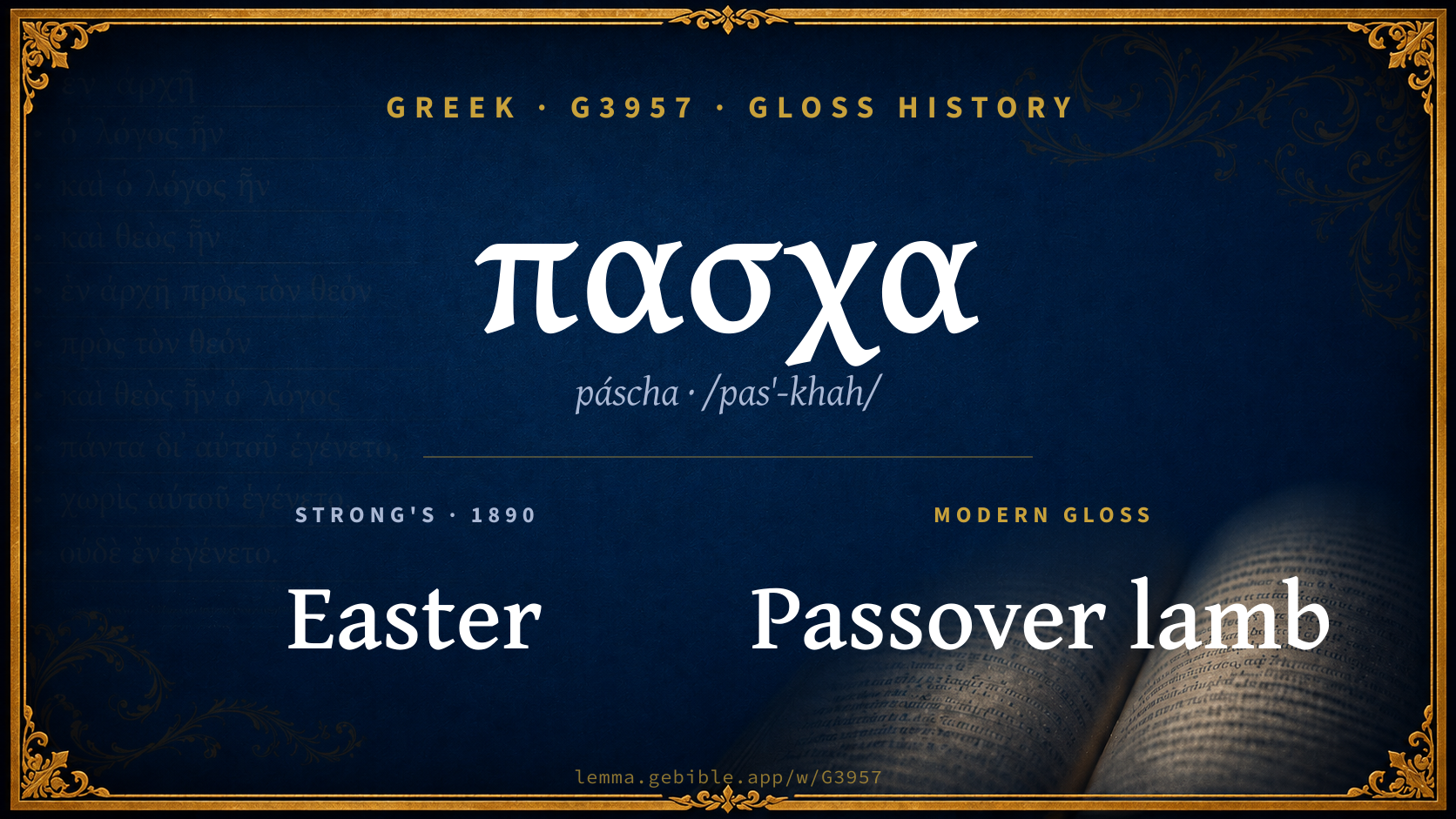
Gloss history
Strong's 1890 vs modern scholarship
About this word
Strong's G3957 catalogs a Greek word from the Greek New Testament.
These counts are not copied from any lexicon or concordance. They are computed here, from the morphology-tagged Greek New Testament. What Lemma adds →
- 27
- distinct verses
- The word appears in 27 distinct verses.
- 7 / 27
- NT books
- The word appears in 7 of 27 New Testament books.
- #471
- by frequency
- Top 500 most frequent Greek words (rank 471 of 5,347 Greek words by occurrence).
View all 27 occurrences in the concordance →
By section of the New Testament
By traditional corpus
Conventional, traditional groupings — biblical authorship is debated, so this is a traditional corpus grouping, not an authorship claim. Some books belong to more than one corpus (Luke is in both the Gospels and the Lukan corpus, and so on), so these shares overlap and need not total 100%. Each figure is a share of the word’s 27 distinct verses.
- Gospels 24 verses · 89%
- Johannine 9 verses · 33%
- Lukan (Luke–Acts) 8 verses · 30%
- Pauline corpus 1 verse · 4%
- Hebrews 1 verse · 4%
How translations render this word
Counts come from each version’s own published word-to-Strong’s tagging or interlinear alignment — an approximate guide to how each version renders this word, not a word-level alignment the data otherwise carries. Because each total is that version’s own tagged count, the per-version totals vary from one another and need not match the appearance or distinct-verse counts above. These counts may also differ from a printed concordance because Lemma counts each distinctly tagged rendering and does not collapse phrase taggings into a single head-word total. This is a fixed set of word-tagged versions (KJV, ASV, BSB, ULT) and does not change with the reading translation you choose elsewhere. Each version’s license is shown beside its name below (and on Sources).
- King James Version: Passover 26×, Feast of the passover 2×
- American Standard Version: Passover 28×
- Berean Standard Bible: Passover 26×, Passover lamb 3×
- unfoldingWord Literal Text: Passover 28×
King James Version Public Domain
Renders G3957 across 29 tagged occurrences — most commonly:
Plus 1 rendering that appears only once — usually multi-word phrases or single function words the recovered tagging swept in, not distinct renderings.
American Standard Version Public Domain
Renders G3957 across 29 tagged occurrences — most commonly:
Plus 1 rendering that appears only once — usually multi-word phrases or single function words the recovered tagging swept in, not distinct renderings.
Berean Standard Bible Public Domain
Renders G3957 across 29 tagged occurrences — most commonly:
unfoldingWord Literal Text CC BY-SA 4.0
Renders G3957 across 30 tagged occurrences — most commonly:
Plus 2 renderings that appear only once — usually multi-word phrases or single function words the recovered tagging swept in, not distinct renderings.
Senses in Thayer's
The 4 senses Thayer's distinguishes for this word, in lexicon order (not ranked by frequency or importance). The full entry — with sub-senses — is in the Lexicon Entry tab.
- the paschal sacrifice (which was accustomed to be offered for the people's deliverance of old from Egypt)
- the paschal lamb…
- the paschal supper
- the paschal feast, the feast of the Passover, extending from the 14th to the 20th day of the month Nisan
Word origin
Origin: of Aramaic origin cf G6453
Of Chaldee origin (compare [ H6453 ]); the Passover (the meal the day the festival or the special sacrifices connected with it): - Easter Passover.
— Strong’s Exhaustive Concordance (1890), public domain.
Septuagint usage
The same Greek word πασχα appears 29 times in the Greek Old Testament (Septuagint), across 28 verses in 8 books.
- 29
- LXX occurrences
- Tagged occurrences of this Greek word in the Septuagint.
- 28
- verses
- Distinct Septuagint verses containing this word.
- 8 / 39
- OT books
- The word appears in 8 of the 39 Old Testament books.
Sample Septuagint occurrences
- Exodus 12:11 πασχα
- Leviticus 23:5 πασχα
- Numbers 9:2 πασχα
- Deuteronomy 16:1 πασχα
- Joshua 5:10 πασχα
- 2 Kings 23:21 πασχα
- Ezra 6:19 πασχα
- Ezekiel 45:21 πασχα
Septuagint occurrences (same lexeme)
Every verse where the same Strong’s number (G3957) appears in the Greek Septuagint. Verse text shown in the World English Bible for context; the Greek form is the matched word — the English is not keyword-highlighted.
- Exodus 12:11 πασχα This is how you shall eat it: with your loins girded, your shoes on your feet, and your staff in your hand; and you shall eat it in haste: it is Yahweh's Passover.
- Exodus 12:21 πασχα Then Moses called for all the elders of Israel, and said to them, "Draw out, and take lambs according to your families, and kill the Passover.
- Exodus 12:27 πασχα that you shall say, 'It is the sacrifice of Yahweh's Passover, who passed over the houses of the children of Israel in Egypt, when he struck the Egyptians, and spared our houses.'" The people bowed their heads and worshiped.
- Exodus 12:43 πασχα Yahweh said to Moses and Aaron, "This is the ordinance of the Passover. There shall no foreigner eat of it,
- Exodus 12:48 πασχα When a stranger shall live as a foreigner with you, and will keep the Passover to Yahweh, let all his males be circumcised, and then let him come near and keep it; and he shall be as one who is born in the land: but no uncircumcised person shall eat of it.
- Exodus 34:25 πασχα "You shall not offer the blood of my sacrifice with leavened bread; neither shall the sacrifice of the feast of the Passover be left to the morning.
- Leviticus 23:5 πασχα In the first month, on the fourteenth day of the month in the evening, is Yahweh's Passover.
- Numbers 9:2 πασχα "Moreover let the children of Israel keep the Passover in its appointed season.
- Numbers 9:4 πασχα Moses spoke to the children of Israel, that they should keep the Passover.
- Numbers 9:6 πασχα There were certain men, who were unclean because of the dead body of a man, so that they could not keep the Passover on that day, and they came before Moses and before Aaron on that day.
- Numbers 9:10 πασχα "Say to the children of Israel, 'If any man of you or of your generations is unclean by reason of a dead body, or is on a journey far away, he shall still keep the Passover to Yahweh.
- Numbers 9:12 πασχα They shall leave none of it until the morning, nor break a bone of it. According to all the statute of the Passover they shall keep it.
- Numbers 9:13 πασχα But the man who is clean, and is not on a journey, and fails to keep the Passover, that soul shall be cut off from his people. Because he didn't offer the offering of Yahweh in its appointed season, that man shall bear his sin.
- Numbers 9:14 πασχα If a foreigner lives among you, and desires to keep the Passover to Yahweh; according to the statute of the Passover, and according to its ordinance, so shall he do. You shall have one statute, both for the foreigner, and for him who is born in the land.'"
- Numbers 28:16 πασχα In the first month, on the fourteenth day of the month, is Yahweh's Passover.
- Numbers 33:3 πασχα They traveled from Rameses in the first month, on the fifteenth day of the first month; on the next day after the Passover the children of Israel went out with a high hand in the sight of all the Egyptians,
- Deuteronomy 16:1 πασχα Observe the month of Abib, and keep the Passover to Yahweh your God; for in the month of Abib Yahweh your God brought you forth out of Egypt by night.
- Deuteronomy 16:2 πασχα You shall sacrifice the Passover to Yahweh your God, of the flock and the herd, in the place which Yahweh shall choose, to cause his name to dwell there.
- Deuteronomy 16:5 πασχα You may not sacrifice the Passover within any of your gates, which Yahweh your God gives you;
- Deuteronomy 16:6 πασχα but at the place which Yahweh your God shall choose, to cause his name to dwell in, there you shall sacrifice the Passover at even, at the going down of the sun, at the season that you came forth out of Egypt.
- Joshua 5:10 πασχα The children of Israel encamped in Gilgal; and they kept the Passover on the fourteenth day of the month at even in the plains of Jericho.
- 2 Kings 23:21 πασχα The king commanded all the people, saying, Keep the Passover to Yahweh your God, as it is written in this book of the covenant.
- 2 Kings 23:22 πασχα Surely there was not kept such a Passover from the days of the judges who judged Israel, nor in all the days of the kings of Israel, nor of the kings of Judah;
- 2 Kings 23:23 πασχα but in the eighteenth year of king Josiah was this Passover kept to Yahweh in Jerusalem.
- Ezra 6:19 πασχα The children of the captivity kept the Passover on the fourteenth [day] of the first month.
- Ezra 6:20 πασχα For the priests and the Levites had purified themselves together; all of them were pure: and they killed the Passover for all the children of the captivity, and for their brothers the priests, and for themselves.
- Ezra 6:21 πασχα The children of Israel who had come again out of the captivity, and all such as had separated themselves to them from the filthiness of the nations of the land, to seek Yahweh, the God of Israel, ate,
- Ezekiel 45:21 πασχα In the first [month], in the fourteenth day of the month, you shall have the Passover, a feast of seven days; unleavened bread shall be eaten.
These are occurrences of the same Greek lexeme (G3957) in the Septuagint — not a translation of any one Hebrew word. The store carries no word-level Hebrew↔Greek alignment, so no Hebrew original is asserted here. Counts come from the recovered LXX Strong's tagging — high-frequency vocabulary is well covered, while rare or late forms may be untagged — so they reflect tagged occurrences and may slightly undercount.