
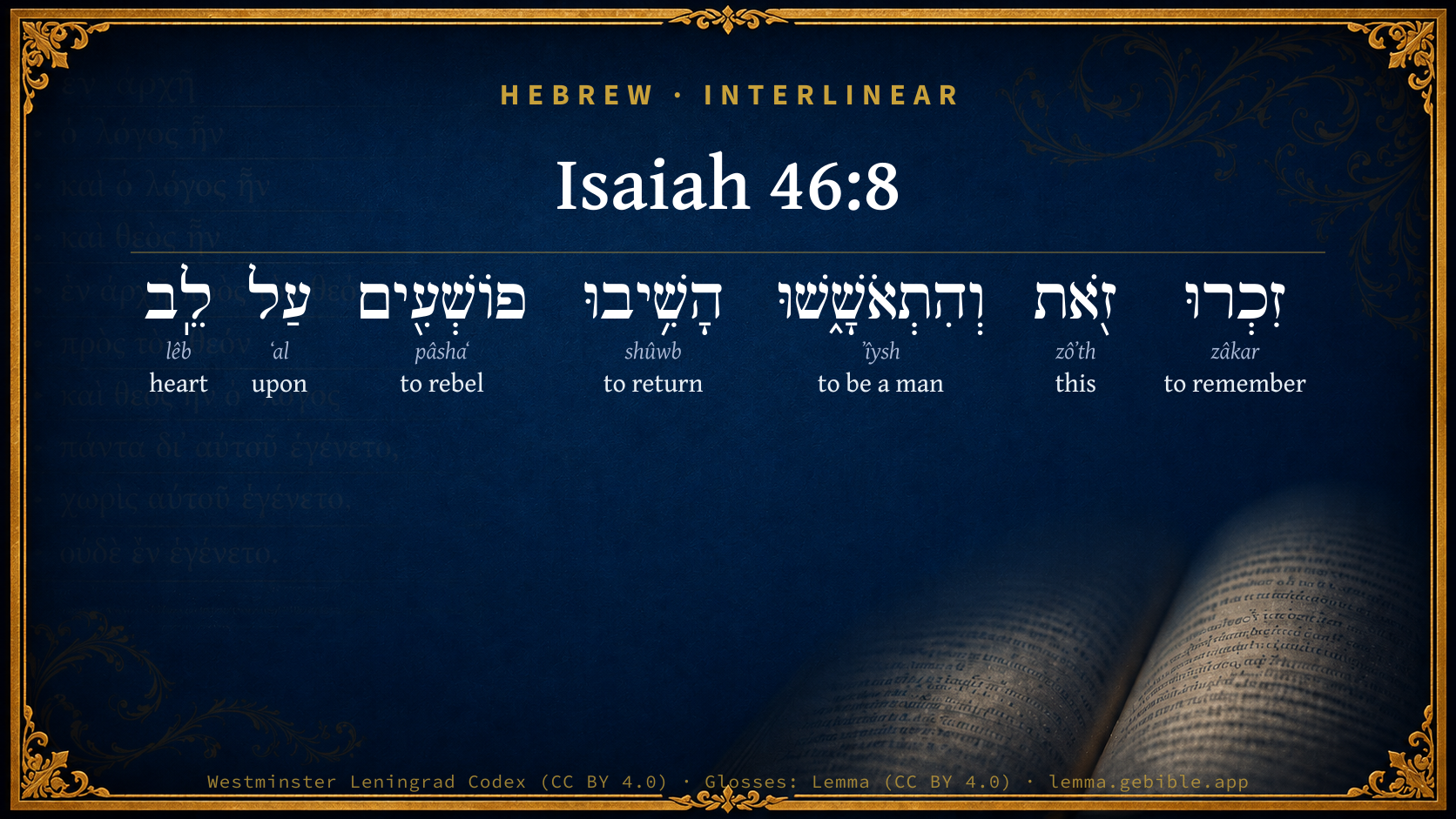
Isaiah 46:8

Hebrew (Westminster Leningrad Codex) Isaiah 46:8 appears in the Hebrew Old Testament. The text above is from the Westminster Leningrad Codex. Each word links to its Strong’s number, a concise gloss, and parsing drawn from the Open Scriptures Hebrew Bible morphology. Click any word for its full Brown-Driver-Briggs (BDB) entry.
Download image
Cite this verse

Isaiah 46:8 (World English Bible). Public Domain. Lemma interlinear Bible study tool, https://lemma.gebible.app/v/isaiah/46/8.

Show BibTeX & RIS
BibTeX
RIS
English Translation
Remember this, and show yourselves men; bring it again to mind, you transgressors.
World English Bible · Public Domain
Highlights
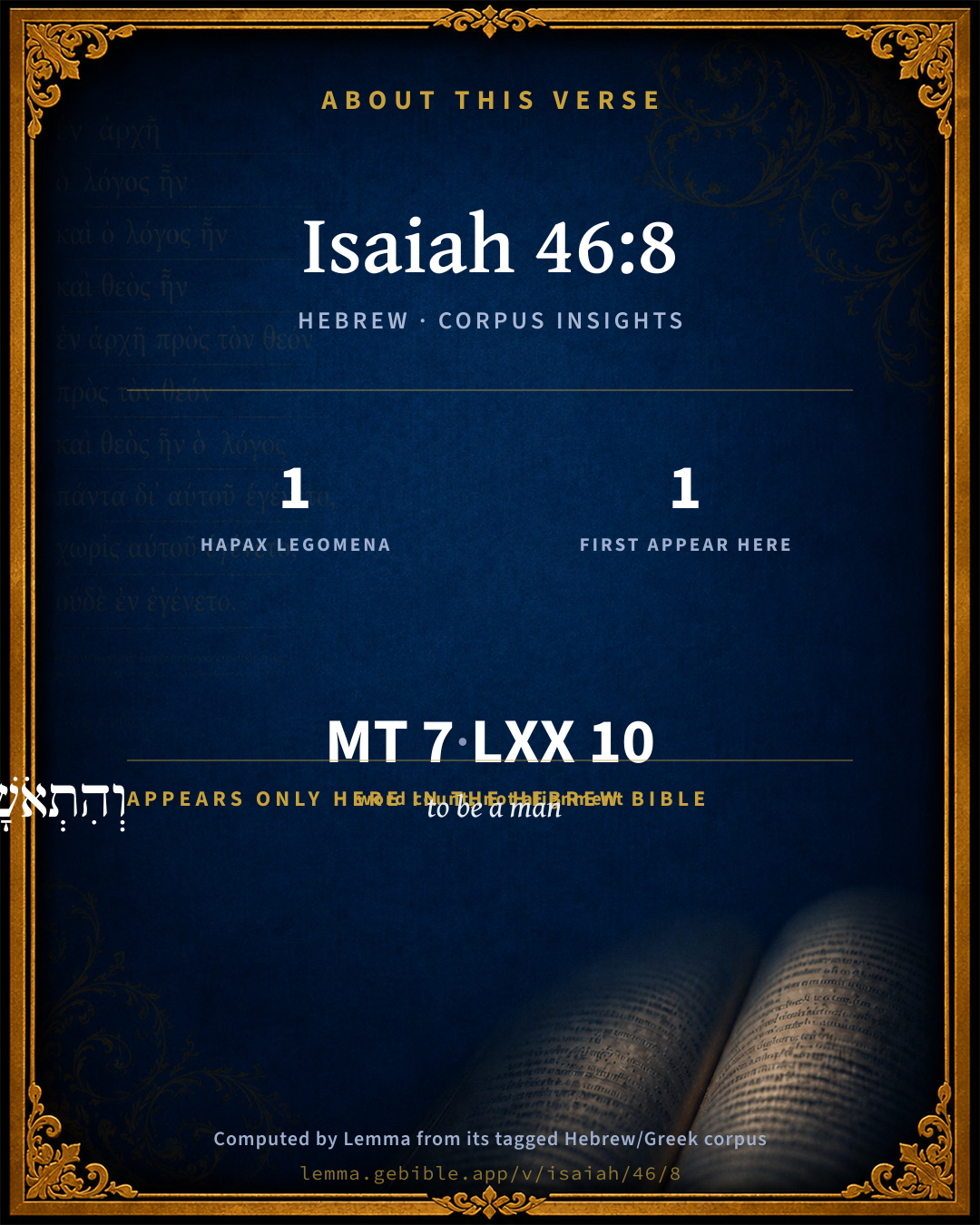
  • 1 hapax legomenon — only here in the Hebrew Bible
  • 1 first appearance in the Hebrew Bible
Full analysis ↓
Download a study sheet

One document with this verse’s original text, its word-by-word gloss line, the meaning frame, cross-references with their text, attributed commentary, and full source and license credits — printable, and it pastes into notes with its structure intact.

This verse Autodidact and up

Study sheet (.html) Plain text (.txt)

A passage Seminary Student

Up to 50 verses in one chapter. A passage sheet keeps up to 6 commentary sources and 12 cross-references per verse, in the order this page ranks them, and says so on the sheet whenever that leaves anything out. Ask for a single verse and you get the Autodidact verse sheet above.

Everything on this page stays free to read, with no account — the sheet is a download of what is already on screen, not access to it.

Want to remove ads? Support Godless Engineer
Compare translations 3

The same verse in 3 English versions, stacked beneath the original-language interlinear above. Click any original word for its lexicon entry.

Each is an independent rendering of the whole verse — the interlinear is not word-aligned to these translations.

Highlighted words mark where these versions differ — a whole-verse word diff, not a word-by-word alignment.

  • World English Bible Public Domain
    Remember this, and show yourselves men; bring it again to mind, you transgressors.
  • King James Version Public Domain
    Remember this, and shew yourselves men: bring it again to mind, O ye transgressors.
  • unfoldingWord Literal Text CC BY-SA 4.0
    “Remember this and establish yourselves; return, rebelling ones, to the heart!

unfoldingWord Literal Text — © unfoldingWord, licensed CC BY-SA 4.0. Word-aligned USFM3 via Door43 (git.door43.org/unfoldingWord/en_ult).

Versions to compare (up to 4)

3 of 4 selected

Show all 18 translations

Every available English version of this verse, each an independent rendering of the whole verse.

  • World English Bible Public Domain
    Remember this, and show yourselves men; bring it again to mind, you transgressors.
  • Berean Standard Bible Public Domain
    Remember this and be brave; take it to heart, you transgressors!
  • Majority Standard Bible Public Domain
    Remember this and be brave; take it to heart, you transgressors!
  • King James Version Public Domain
    Remember this, and shew yourselves men: bring it again to mind, O ye transgressors.
  • American Standard Version (1901) Public Domain
    Remember this, and show yourselves men; bring it again to mind, O ye transgressors.
  • Revised Version (1885) Public Domain
    Remember this, and shew yourselves men: bring it again to mind, O ye transgressors.
  • Geneva Bible (1599) Public Domain
    Remember this, and be ashamed: bring it againe to minde, O you transgressers.
  • Douay-Rheims (1899) Public Domain
    Remember this, and be ashamed: return, ye transgressors, to the heart.
  • Young's Literal Translation Public Domain
    Remember this, and shew yourselves men, Turn `it' back, O transgressors, to the heart.
  • Literal Standard Version CC BY-SA 4.0
    Remember this, and show yourselves men, || Turn [it] back, O transgressors, to the heart.
  • Unlocked Literal Bible CC BY-SA 4.0
    Think about these things; never ignore them, you rebels!
  • unfoldingWord Literal Text CC BY-SA 4.0
    “Remember this and establish yourselves; return, rebelling ones, to the heart!
  • Darby Bible Public Domain
    Remember this, and shew yourselves men; call it to mind, ye transgressors.
  • World Messianic Bible Public Domain
    “Remember this, and show yourselves men. Bring it to mind again, you transgressors.
  • Webster's Bible Public Domain
    Remember this, and show yourselves men: bring it again to mind, O ye transgressors.
  • Free Bible Version CC BY-SA 4.0
    Remember this, and act like men! Think about it, you rebels!
  • Bible in Basic English Public Domain
    Keep this in mind and be shamed; let it come back to your memory, you sinners.
  • JPS Tanakh (1917) Public Domain
    Remember this, and stand fast; bring it to mind, O ye transgressors.

Literal Standard Version (2020), Covenant Press — licensed CC BY-SA 4.0. Text via the HelloAO Bible API (eBible.org). Unlocked Literal Bible (unfoldingWord) — licensed CC BY-SA 4.0. Text via the HelloAO Bible API (eBible.org). unfoldingWord Literal Text — © unfoldingWord, licensed CC BY-SA 4.0. Word-aligned USFM3 via Door43 (git.door43.org/unfoldingWord/en_ult). Free Bible Version, Dr. Jonathan Gallagher — licensed CC BY-SA 4.0. Text via the HelloAO Bible API (eBible.org).

Word by word

More ways to search: Search by grammar → Find every occurrence → Compare this word →

Practice this passage: Drill this verse → Learn its vocabulary →

About this verse

These counts appear in no published source. They are computed here, from the morphology-tagged text and Lemma’s own curated glosses. What Lemma adds →

7
words
7
distinct lemmas
Prophets
section

Notable vocabulary

1 hapax legomenon — a word that appears only here in the entire Hebrew Bible:

  • וְהִתְאֹשָׁ֑שׁוּ to be a man H377

First appearance in Scripture

This word makes its first canonical appearance in the Hebrew Bible here:

  • וְהִתְאֹשָׁ֑שׁוּ to be a man H377

Shared distinctive vocabulary

פוֹשְׁעִ֖ים to rebel H6586 occurs in 37 verses of the Hebrew Bible. Also found in:

Grammatical profile

  • 4 verbs
  • 1 noun
  • 1 pronoun
  • 1 preposition

Verb forms

  • זִכְרוּ Qal · Imperative
  • וְהִתְאֹשָׁ֑שׁוּ Hithpolel · Imperative
  • הָשִׁ֥יבוּ Hiphil · Imperative
  • פוֹשְׁעִ֖ים Qal · Participle Active

Hebrew & Septuagint length

In English translation the verse runs 13 words from the Hebrew and 16 from the Septuagint (LXX English) — closely comparable.

A rough comparison of the two English renderings, which tokenize alike — not a word-level alignment.

Word counts can differ between the Hebrew and the Greek without any difference in meaning — e.g. the Hebrew direct-object marker אֵת has no separate Greek word, and Greek often adds the article ὁ.

In the original languages it is 7 Hebrew tokens and 10 Greek tokens — but the two are counted differently (Hebrew bundles its prefixes and suffixes into one token; the Greek is in lemma form), so that isn’t a like-for-like length.

Cross-references

12

Topical passages linked to Isaiah 46:8 in the Treasury of Scripture Knowledge — connected by theme and wording, ordered by reader-vote popularity; previews shown in the World English Bible.

  • Deuteronomy 32:29 Oh that they were wise, that they understood this, That they would consider their latter end!
  • Psalms 115:8 Those who make them will be like them; Yes, everyone who trusts in them.
  • Psalms 135:18 Those who make them will be like them; Yes, everyone who trusts in them.
  • Isaiah 44:18–21 They don't know, neither do they consider: for he has shut their eyes, that they can't see; and their hearts, that they can't understand.
  • Isaiah 47:7 You said, I shall be mistress forever; so that you did not lay these things to your heart, neither did remember the latter end of it.
  • Ezekiel 18:28 Because he considers, and turns away from all his transgressions that he has committed, he shall surely live, he shall not die.
  • Haggai 1:5 Now therefore this is what Yahweh of Hosts says: Consider your ways.
  • Haggai 1:7 This is what Yahweh of Hosts says: "Consider your ways.
  • Luke 15:17 But when he came to himself he said, 'How many hired servants of my father's have bread enough to spare, and I'm dying with hunger!
  • 1 Corinthians 14:20 Brothers, don't be children in thoughts, yet in malice be babies, but in thoughts be mature.
  • Jeremiah 10:8 But they are together brutish and foolish: the instruction of idols! it is but a stock.
  • Ephesians 5:14 Therefore he says, "Awake, you who sleep, and arise from the dead, and Christ will shine on you."

Cross-references courtesy of OpenBible.info (CC BY 4.0).

Hebrew and Greek witnesses Masoretic Hebrew ↔ Greek Septuagint

The same verse in the two great witnesses to the Old Testament, shown verse-for-verse.

These are two independent witnesses, not word-aligned to each other, and the Septuagint is shown in lemma (dictionary) form.

Hebrew Isaiah 46:8 Masoretic · Westminster Leningrad Codex

זִכְרוּ זֹ֖את וְהִתְאֹשָׁ֑שׁוּ הָשִׁ֥יבוּ פוֹשְׁעִ֖ים עַל לֵֽב

Remember this, and show yourselves men; bring it again to mind, you transgressors.

World English Bible · Public Domain

Greek LXX Isaiah 46:8 Septuagint · lemma form

μιμνήσκω οὗτος καί στενάζω μετανοέω ὁ πλανάω ἐπιστρέφω ὁ καρδία

Remember you⌃ these things, and groan: repent, you⌃ that have gone astray, return in your heart;

LXX2012 (modern English Septuagint) · Public Domain

On this verse, Adam Clarke's Commentary discusses the Septuagint’s reading. Read the note in Commentary ↓

Hebrew: Westminster Leningrad Codex (CC BY 4.0). Greek: Septuagint (public domain); English from LXX2012 (modern English Septuagint) (Public Domain). How the Septuagint differs from the Hebrew →

Targum (Aramaic paraphrase)

1

The Targum is the ancient Jewish Aramaic paraphrase of the Hebrew Scriptures — an interpretive translation, not the Hebrew text itself. Onkelos (literal) and Pseudo-Jonathan (expansive) render the Torah, and Jonathan the Prophets. Coverage is partial: where no permissively-licensed English translation exists for a verse, only the Aramaic is shown. This is verse-level text, not a word-by-word alignment to the Hebrew.

  1. Targum Jonathan Prophets (Joshua–Malachi)
    אַדְכָּרוּ דָא וְאִתַּקָפוּ וַאֲתִיבוּ מְרוֹדִין עַל לֵב:

    Remember this, and be ye strong; and bear it in mind, O rebels!

    Targum Jonathan — Aramaic: “Mikraot Gedolot” (public domain). English: “Sefaria Community Translation” (CC0 1.0 (public-domain dedication)); “London "Chaldee Paraphrase," 1871” (public domain). Text via Sefaria.

Commentary

Notes on Isaiah 46:8 from classic Christian and Jewish commentators (each source and its license shown beneath its notes). The classic Christian expositions comment on the surrounding passage and are grouped to its opening verse, so a note may address several verses; the Jewish commentaries on the Tanakh (Rashi and others) are per-verse, so they appear only where the commentator wrote on this verse.

Lemma curates 59 commentaries, every one of them public domain or Creative Commons licensed, each selected and text-cleaned for this edition rather than reprinted as found. About our sources →

Trapp's Complete Commentary

John Trapp

Isa 46:8 Remember this, and shew yourselves men: bring [it] again to mind, O ye transgressors.

Ver. 8. Remember this.] Suffer me not to press these things so oft upon you to no purpose.

And show yourselves men.] Roboramini, Fortify your hearts by the word of God and true reason, renewing your good resolutions oft against this senseless sin of idolatry.

Bring it again to mind.] Heb., Bring back to heart, turn short again upon yourselves, recognise your iniquities, and be humbled.

John Trapp, A Commentary or Exposition upon All the Books of the Old and New Testament (1647–1656) — public domain. Text from a community e-Sword module.

Tyndale Open Study Notes

Tyndale Open Resources

46:8-13 Many of the exiles would be completely discouraged and not believe the prediction of God’s rescue. God challenged this unbelief.

Tyndale Open Study Notes — © Tyndale Open Resources, licensed CC BY-SA 4.0. Text via the HelloAO Bible API.

Geneva Bible (1599)

Geneva Bible translators

Become wise, meaning, that all idolaters are without wit or sense, like mad men.

Geneva Bible (1599) marginal notes — public domain. Text via Bolls.life.

Jamieson, Fausset & Brown

Robert Jamieson, A. R. Fausset & David Brown

show yourselves men--Renounce the childishness of idolatry as shown in what precedes (Co1 14:20; Co1 16:13; Eph 4:14). In order to be manly we must be godly; for man was made "in the image of God," and only rises to his true dignity when joined to God; virtue is derived from the Latin vir, "a man."

bring . . . to mind--rather, "lay it to heart."

transgressors--addressed to the idolaters among the Jews.

Jamieson, Fausset & Brown — Commentary Critical and Explanatory on the Whole Bible (1871) — public domain (CC PDM 1.0). Text via the HelloAO Bible API.

Adam Clarke's Commentary

Verse 8. Show yourselves men] התאששו hithoshashu. This word is rather of doubtful derivation and signification. It occurs only in this place: and some of the ancient interpreters seem to have had something different in their copies. The Vulgate read התבששו hithbosheshu, take shame to yourselves; the Syriac התבוננו hithbonenu, consider with yourselves; the Septuagint στεναξετε perhaps התאבלו hithabbelu, groan or mourn, within yourselves. Several MSS. read התאוששו hithosheshu, but without any help to the sense.

Adam Clarke's Commentary on the Bible (1810–1826) — public domain. Text from a community e-Sword/MySword module.

Ellicott's Commentary for English Readers

(8) Shew yourselves men.—As elsewhere, the prophet’s challenge is couched in the language of irony. The worshippers of idols should at least have the courage of their convictions. A conjectural emendation gives the opposite meaning, Be ye deeply ashamed.

A Bible Commentary for English Readers, edited by Charles John Ellicott (1878–1897) — public domain. Text from a community e-Sword module.

The Cambridge Bible for Schools and Colleges

gen. ed. J. J. S. Perowne

8–11. An appeal to history and prophecy in proof of Jehovah’s divinity.

shew yourselves men] R.V. marg. renders “stand fast,” but neither sense is suitable in an address to “rebels.” The verb used (hith’ôshâshû) is unknown in Hebrew. The rendering of A.V. is based on a common view that it is a denominative from the word for “man” (’îsh), which is grammatically untenable; that of R.V. marg. connects it with a root found in Aramaic, Assyrian and Arabic, meaning to “be firm.” Of proposed emendations the easiest is Lagarde’s, “be ye ashamed” (hithbôshâshû, after Gen_2:25). Others, hithbônânû, “consider” (ch. Isa_43:18).

bring it again to mind] as ch. Isa_44:19.

O ye transgressors] Rather rebels (Isa_48:8, Isa_53:12, Isa_66:24). From ch. Isa_45:9 onwards there seems to be a growing sense of antagonism between the prophet and at least a section of his audience (see Isa_46:12 and on Isa_48:1-11).

The Cambridge Bible for Schools and Colleges (gen. ed. J. J. S. Perowne; Cambridge University Press, 1878–1918) — public domain. Text from a community e-Sword module.

John Gill's Exposition

Remember this,.... Or "these things", as the Syriac version, concerning the matter of which, and the manner in which idols are made; their impotency to move themselves, and their inability to help their votaries, and the difference between them and the true God:

and show yourselves men; and not brutes, as the makers and worshippers of images are, or show themselves as if they were; who unmanly themselves, and act contrary to the natural reason of mankind: or "be ye strong" (q); so the Targum and Jarchi; fortify yourselves against all temptations to idolatry, and against all the arguments and persuasions of idolaters; or "burn ye" (r) or "be ye inflamed", so Rabenu Hal and Joseph Kimchi; that is, blush and be ashamed at such sottishness and stupidity, as men when they are ashamed look as if their faces were inflamed; so the Vulgate Latin version renders it, "be ye confounded" (s); or the sense is, be fervent in spirit, be fired (t) with zeal for God and his glory, and with indignation against such gross idolatry:

bring it again to mind, O ye transgressors; of the law of God, in this instance of idolatry; meaning either the Babylonians, or rather the Jews, who had been drawn in by them to idolatrous practices; calling upon them to return to their senses; to use and exercise their reason; to recollect and reconsider things, and observe and repent of the folly and wickedness they had been guilty of.

(q) "roborat vos", Pagninus, Tigurine version; so Ben Melech interprets the word. (r) Ardete, "comburite vos", some in Vatablus. (s) "Confundamini", V. L. "et erubescite", Calvin. (t) "Incendimini sive corripimini zelo", Vitringa.

John Gill's Exposition of the Whole Bible (1746–1763) — public domain (CC PDM 1.0). Text via the HelloAO Bible API.

Albert Barnes' Notes on the Bible

Remember this - Bear in mind what is now said of the manner in which idols are made. This is addressed, doubtless, to the Jews, and is designed to keep them from idolatry.

And show yourselves men - Act as men; throw away the childish trifles of idolaters. The word used here (התאשׁשׁוּ hithe'oshâshû' occurs nowhere else in the Bible. It is according to Gesenius, derived from אישׁ 'ı̂ysh, “a man,” and means to act “as a man.” A similar word is used in 1Co 16:13 (ἀνδρίζεσθε andrizesthe, from ἀνήρ anēr, a man), and is correctly rendered there, ‘quit you like men.’ This Greek word often occurs in the Septuagint. It is used as a translation of אמץ 'âmats, in Jos 1:6-7, Jos 1:9, Jos 1:18; 1Ch 28:20; 2Ch 32:7; Neh 2:1; of גדל gâdal in Rth 1:12; of חזק châzaq, in Deu 31:6-7, Deu 31:23; Jos 10:25; 2Ki 2:12; 2Ki 12:8; 1Ch 28:20, and in several other places. Jerome renders the Hebrew word here, ‘Be confounded;’ the Septuagint, Στενάξατε Stenachate) - ‘Groan;’ the Syriac, ‘Consider,’ or understand. The meaning is, that they were to act as became people - not as children; as became those endowed with an immortal mind, and not as the brutes. So Kimchi renders it: ‘Be men, and not brutes, which neither consider nor understand.’

O ye transgressors - Ye who have violated the laws of God by the worship of idols. In the time of Manasseh, the Israelites were much addicted to idolatry, and probably this is to be regarded as addressed to them, and as designed to recall them from it to the worship of the true God.

Albert Barnes' Notes on the Bible (1834–1885) — public domain. Text from a community e-Sword/MySword module.

Haydock's Catholic Bible Commentary

Ashamed. Septuagint, "groan." Protestants, "shew yourselves men." (Haydock)

George Leo Haydock (1774–1849), Haydock's Catholic Family Bible and Commentary, 1859 edition — public domain. Excludes Psalms (Douay-Rheims chapter numbering differs from Protestant) and Deuterocanonical books (Catholic canon only).

Matthew Poole's English Annotations

Remember this, consider these things which I now speak, O ye Israelites,

and show yourselves men; act like reasonable creatures, and be not so brutish as to worship your own works; be so wise and courageous as to withstand all solicitation to idolatry.

Bring it again to mind; think of this again and again.

O ye transgressors; you who have been guilty of this foolish sin; and therefore are obliged to take the better heed that you do not relapse into it again.

Matthew Poole's English Annotations on the Holy Bible (1683–1685) — public domain. Text from a community e-Sword/MySword module.

Whedon's Commentary on the Bible

Daniel D. Whedon

8, 9. Remember this — The address is now, probably, to the Israelites. The impotence of idol gods was shown them in early days. See Deu_32:37-39.

Show yourselves men — That is, learn the lesson of the impotence of idol gods to give aid; learn to stand firm, and resist staunchly the whole idol system. Know and assert who your true deity is.

Daniel D. Whedon (gen. ed.), Commentary on the Old and New Testaments (1874–1909) — public domain. Text from a community e-Sword module.

The Pulpit Commentary

Remember this, and show yourselves men; or, remember this, and stand firm. Isaiah is addressing those who waver between true religion and idolatry. Hitherto they have not fallen away, but they are in danger of so doing. Remember, he says to them, or "bear in mind constantly the impotence of the idols, and the power of Jehovah, and then stand firm remain in your old faith do not be drawn over to so foolish a thing as idolatry." O ye transgressors. It is to be a "transgressor" even to contemplate the turning from Jehovah to idolatry. Israel has been already "called a transgressor from the beginning". (Isa_48:8)

God"s call to exercise right reason.

"Show yourselves men." This is the language of irony. Worshippers of idols should have the courage of their convictions. They should not be such children as to confound the spiritual God with dumb, senseless idols, who can neither counsel nor save. "Remember this, that has often been told you, what senseless, helpless things idols are, and show yourselves men men, and not brutes; men, and not babes. Act with reason, act with resolution, act for your own interest. Do a wise thing, do a brave thing, and scorn to disparage your own judgment, as you do when you worship idols" (Matthew Henry). The point presented for consideration is that God is served by the diligent and faithful use of our faculties, and not by crushing them.

I GOD IS BEST SERVED BY MAN AT HIS BEST. A very curious perversion of St. Paul"s glorying in his infirmities is the notion, which prevails in some quarters, that the more ignorant, weak, and foolish we are, the better we can serve God"s purposes. It is the universal truth that God works out his best purposes through the consecration of man"s best and most cultured powers to his service. It is only the exception of Divine grace that God is pleased sometimes to use man"s feebleness. Sometimes, indeed, it is so, that "out of the mouths of babes and sucklings God perfects praise;" and his so doing efficiently persuades us of the absolute sovereignty of Divine grace; but the normal law is that God shall be served by the best culture and the wisest use of just those powers and faculties which he has himself given us. Let babes be babes, and honour God with infant songs. Since we are men, it is the best-cultured and most fully matured manhood that we must lay upon his altar. When reproached by a mere sentimentalist that "God had no need of his learning," the cultured divine very wisely as well as smartly replied, "And he has as little need of your ignorance." We must be in every way the best possible for God, and this includes our mental best.

II MAN AT HIS BEST IS BUT A SERVANT OF GOD. This conviction will keep him in his place, whatsoever his attainments may be. It is the constantly observed fact that fulness of learning and a genuine humility go together hand-in-hand. It is a "little knowledge" that puffeth up, a "little culture" that nourishes self-will. The things we have in the household and family life, for daily use, need not be chipped, ugly, or inefficient things; they may be in the best shapes, and may be artistic in appearance, pleasant to the eye, without losing their practical usefulness. So we can be the truest, wisest, most cultured, most beautiful men and women, and yet keep in perfect simplicity the humility and the joy of our service. R.T.

The Pulpit Commentary (1880–1919), ed. H.D.M. Spence-Jones & Joseph S. Exell — public domain. Text from a community e-Sword module.

John Wesley's Explanatory Notes

Bring it - Think of this again and again, ye who have been guilty of this foolish sin.

John Wesley, Explanatory Notes Upon the Whole Bible (1754–1765) — public domain. Text via the GEBible commentary corpus.

Keil & Delitzsch

C. F. Keil & F. Delitzsch

The second admonition is addressed to those who would imitate the heathen. "Remember this, and become firm, take it to heart, ye rebellious ones! Remember the beginning from the olden time, that I am God, and none else: Deity, and absolutely none like me: proclaiming the issue from the beginning, and from ancient times what has not yet taken place, saying, My counsel shall stand, and all my good pleasure I carry out: calling a bird of prey from the east, the man of my counsel from a distant land: not only have I spoken, I also bring it; I have purposed it, I also execute it." The object to which "this" points back is the nothingness of idols and idolatry. The persons addressed are the פושׁעים (those apostatizing), but, as התאשׁשׁוּ shows, whether it mean ἀνδιρίζεσθε or κραταιοῦσθε (Co1 16:13), such as have not yet actually carried out their rebellion or apostasy, but waver between Jehovahism and heathenism, and are inclined to the latter. התאשׁשׁו is hardly a denom. hithpalel of אישׁ in the sense of "man yourselves," since אישׁ, whether it signifies a husband or a social being, or like אנושׁ, a frail or mortal being, is at any rate equivalent to אנשׁ, and therefore never shows the modification u. אשׁשׁ (אשׁה) signifies to be firm, strong, compact; in the piel (rabb.), to be well-grounded; nithpael, to be fortified, established; here hithpoel, "show yourselves firm" (Targ., Jer.: fundamini ne rursum subitus idololatriae vos turbo subvertat). That they may strengthen themselves in faith and fidelity, they are referred to the history of their nation; ראשׁנות are not prophecies given at an earlier time - a meaning which the priora only acquire in such a connection as Isa 43:9 - but former occurrences. They are to pass before their minds the earlier history, and indeed "from the olden time." "Remember:" zikhrū is connected with the accusative of the object of remembrance, and כּי points to its result. An earnest and thoughtful study of history would show them that Jehovah alone was El, the absolutely Mighty One, and 'Elōhı̄m, the Being who united in Himself all divine majesty by which reverence was evoked. The participles in Isa 46:10, Isa 46:11 are attached to the "I" of כּמוני. It is Jehovah, the Incomparable, who has now, as at other times from the very commencement of the new turn in history, predicted the issue of which it would lead, and miqqedem, i.e., long before, predicted things that have not yet occurred, and which therefore lit outside the sphere of human combination - another passage like Isa 41:26; Isa 45:21, etc., in which what is predicted in these prophecies lays claim to the character of a prediction of long standing, and not of one merely uttered a few years before. The ראשׁית, in which the ראשׁנות are already in progress (Isa 42:9), is to be regarded as the prophet's ideal present; for Jehovah not only foretells before the appearance of Cyrus what is to be expected of him, but declares that His determination must be realized, that He will bring to pass everything upon which His will is set, and summons the man upon the stage of history as the instrument of its accomplishment, so that He knew Cyrus before he himself had either consciousness or being (Isa 45:4-5). The east is Persis (Isa 41:2); and the distant land, the northern part of Media (as in Isa 13:5). Cyrus is called an eagle, or, strictly speaking, a bird of prey (‛ayit),

(Note: The resemblance to ἀετός (αἰετός) is merely accidental. This name for the eagle is traceable, like avid, to a root vâ, to move with the swiftness of the wind. This was shown by Passow, compare Kuhn's Zeitschrift, i. 29, where we also find at 10, 126 another but less probable derivation from a root i, to go (compare eva, a course).)

just as in Jer 49:22 and Eze 17:3 Nebuchadnezzar is called a nesher. According to Cyrop. vii. 1, 4, the campaign of Cyrus was ἀετὸς χρυσοῦς ἐπὶ δόρατος μακροῦ ἀνατεταμένος. Instead of עצתו אישׁ, the keri reads more clearly, though quite unnecessarily, (עצתי אישׁ (see e.g., Isa 44:26). The correlate אף (Isa 46:11), which is only attached to the second verb the second time, affirms that Jehovah does not only the one, but the other also. His word is made by Him into a deed, His idea into a reality. יצר is a word used particularly by Isaiah, to denote the ideal preformation of the future in the mind of God (cf., Isa 22:11; Isa 37:26). The feminine suffixes refer in a neuter sense to the theme of the prophecy - the overthrow of idolatrous Babel, upon which Cyrus comes down like an eagle, in the strength of Jehovah. So far we have the nota bene for those who are inclined to apostasy. They are to lay to heart the nothingness of the heathen gods, and, on the other hand, the self-manifestation of Jehovah from the olden time, that is to say, of the One God who is now foretelling and carrying out the destruction of the imperial city through the eagle from the east.

Keil & Delitzsch — Biblical Commentary on the Old Testament (1861–1891) — public domain (CC PDM 1.0). Text via the HelloAO Bible API. (Old Testament only.)

J. A. Alexander on Isaiah

Joseph Addison Alexander

“Remember this and show yourselves men; bring it home, ye apostates, to (your) mind (or heart).” By this some understand what follows; but it rather means what goes before, viz. the proof just given of the impotence of idols, the worshippers of which, whether Jews or Gentiles, are addressed in this verse as apostates or rebels against God.

Joseph Addison Alexander, The Prophecies of Isaiah (1846–1847; New York: Scribner, 1870–1878) — public domain. Text from a community e-Sword module.

Kretzmann's Popular Commentary

Paul E. Kretzmann

A Reproof of Israel’s Refusal to Believe the Divine Promises

v. 8. Remember this, keeping in mind what the Lord was now about to proclaim, and show yourselves men, renouncing the childishness of idolatry; bring it again to mind, O ye transgressors, those who were forgetting the covenant and forsaking the true God.

v. 9. Remember the former things of old, the miracles of God which happened in the earliest history of Israel, 43:18; for I am God, and there is none else; I am God, and there is none like Me, this point being made again over against the danger of idolatrous practices,

v. 10. declaring the end from the beginning and from ancient times the things that are not yet done, the foretelling of future events in the manner in which it was done by Jehovah being one of the chief proofs of His divinity, saying, My counsel shall stand, and I will do all My pleasure, namely, as now set forth:

v. 11. calling a ravenous bird, a falcon, eagle, or bird of prey, from the East, this being Cyrus himself, the man that executeth My counsel from a far country; yea, I have spoken it, I will also bring it to pass, actually setting his plan in motion; I have purposed it, I will also do it, so that it will he an accomplished fact. The unquestioned authority of the Lord is combined with his ability to carry out his plans, to realize His projects, something in which He differed most radically from the dead idols.

v. 12. Hearken unto Me, ye stout-hearted, those who were willingly hardening their hearts against the influence of the Lord, that are far from righteousness, who have excluded themselves from the salvation promised in the Lord’s covenant.

v. 13. I bring near My righteousness, the salvation of Israel; it shall not be far off, and My salvation shall not tarry, He would surely bring deliverance to those who believe in Him, to the everlasting disgrace of the reprobates, and I will place salvation in Zion for Israel, My glory. Salvation in Zion, glory and honor in Israel, in the midst of his Church, all of this sets forth the happy condition of the Messianic period.

Paul E. Kretzmann, Popular Commentary of the Bible (1921–1924) — public domain. Text from a community e-Sword module.

unfoldingWord translationNotes

Door43 World Missions Community

General Information:

Yahweh continues speaking to his people.

translationWords

rebel

God

unfoldingWord translationNotes — © Distant Shores Media and the Door43 World Missions Community, licensed CC BY-SA 4.0. Source: git.door43.org/Door43/en_tn.

Rashi

Rabbi Shlomo Yitzchaki (Rashi)

Remember this what I wish to say.

and strengthen yourselves Heb. וְהִתְאשָׁשׁוּ. Comp. (supra 16: 7) “For the walls (לַאֲשִׁישֵׁי) of Kir-hareseth.”

take to heart, you transgressors And what do I say to you to remember and to take to heart?

Rashi on the Tanakh — English translations: “The Judaica Press complete Tanach with Rashi, translated by A. J. Rosenberg” (CC BY 4.0); “Pentateuch with Rashi's commentary by M. Rosenbaum and A.M. Silbermann, 1929-1934” (public domain); “The Metsudah Tanach series, Lakewood, N.J” (CC BY 4.0); and “The Book of Joshua, Metsudah Publications, 1997” (CC BY 4.0). Text via Sefaria.

Ibn Ezra

Rabbi Abraham ibn Ezra

והתאששו According to some And be founded; comp. אשיותיה her foundations (Jer. 1. 15) and אושיא walls (Ezr. 4:12). R. Hai deriving it from אש fire explains והתאוששו be burnt. R. Saadiah derives it also from אֵשׁ, but explains it: be flamed; comp. this word was in mine heart as a burning fire (Jer. 20:9). Bring again to mind this thing.

Ibn Ezra on the Tanakh — English translations: “Sefaria Community Translation” (CC0 1.0 (public-domain dedication)); “Yalkut, Sifsei Chachomim Chumash, Metsudah Publications, 2009” (CC BY 4.0); and “Commentary of Ibn Ezra on Isaiah - trans. by M. Friedlander, 1873” (public domain). Text via Sefaria.

Lesson kit

Teaching starters — assembled from the data on this page, not authored interpretation. Every prompt links to the verse data it draws on. Edit before teaching.

Isaiah, in the Prophets, opens this verse with 7 words (7 distinct Hebrew lemmas). Its most distinctive word is ʼîysh (“to be a man”). A historical commentator’s framing appears above. Read the whole chapter for the surrounding context.

Discussion questions

  1. What does “to be a man” (ʼîysh) contribute to the verse as a whole?
  2. 1 word here appears nowhere else in the Hebrew Bible. Why might the author reach for such rare wording?
  3. This is the first place “to be a man” appears in Scripture (first appears here). What does its debut here establish?
  4. How does 1 Kings 8:50, which shares the word «to rebel», read alongside this verse?
  5. The translations on this page render this verse differently — a whole-verse word diff, not a word-by-word alignment. What might account for the different wordings?
  6. «זִכְרוּ» is a Qal Imperative verb. How does that grammatical form shape the action described?
  7. Compare how Trapp's Complete Commentary and Tyndale Open Study Notes read this verse. Where do they agree or differ?

Things to notice

Reading settings

Reading text

Shown beneath each verse's original-language words.

Old Testament
Old Testament edition

Read the OT as the Masoretic Hebrew (MT) or the Greek Septuagint (LXX).

English shown for the Greek Septuagint (in the Hebrew ↔ Greek comparison).

Comparing translations? Open the Compare panel on any verse page to stack up to four side by side.