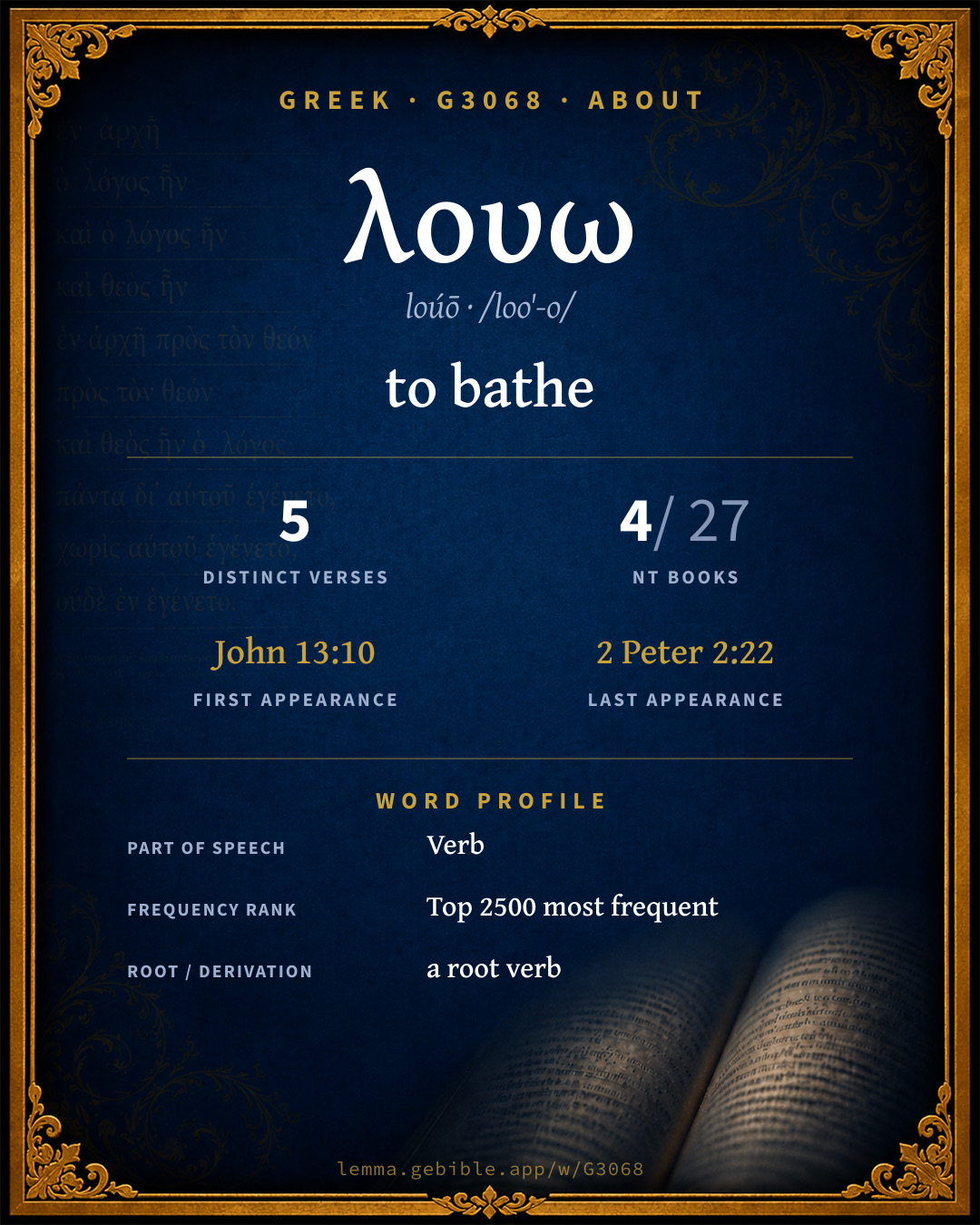
λούω
to bathe
‘to bathe’ is one of 2 main senses fuller range ↓
Full lexicon entry — Thayer's Greek Lexicon
From Thayer's Greek Lexicon
Where this word appears
Grammar key — what these labels mean
Part of speech
- Verb
- An action or state-of-being word.
Tense
- Aorist
- Action viewed as a simple whole, without regard to duration — often past (perfective aspect).
- Perfect
- A completed past action with continuing present results.
Voice
- Active
- The subject performs the action.
- Middle
- The subject acts on or for itself, or with special interest in the action.
- Passive
- The subject receives the action.
Mood
- Indicative
- States a fact or asks a factual question (the mood of reality).
- Participle
- A verbal adjective (“writing,” “having written”).
Case
- Nominative
- The case of the subject (and the predicate nominative).
Person
- 3rd person
- The one spoken about (“he / she / it / they”).
Gender
- Masculine
- Grammatically masculine.
- Feminine
- Grammatically feminine.
Number
- Singular
- One.
- Plural
- More than one.
Every verse where G3068 appears in the Book of John — 1 distinct verse. Click any verse to open its interlinear word-by-word view. Verse text shown in the World English Bible for context — . Each verse’s Greek form is shown with its reference; the English is not keyword-highlighted, since the data carries no word-level English alignment. Use “Compare translations” on any verse to read it across multiple English versions. This concordance covers the Greek New Testament; Septuagint (Greek Old Testament) occurrences of this word are not indexed here.
John
About this entry
At a glance — auto-summarized from this page’s data, not written by a person. Every figure links to its source below. This summary describes the numbers; it doesn’t interpret them.
The Greek verb λουω centers on the idea of “to bathe.” A scarce word — 5 verses in all of the Greek New Testament. Acts dominates its distribution — 2 of 5 verses. Its earliest occurrence is John 13:10. Thayer's distinguishes 2 senses for it. For the data behind this summary, explore the sense tree and the renderings breakdown below.
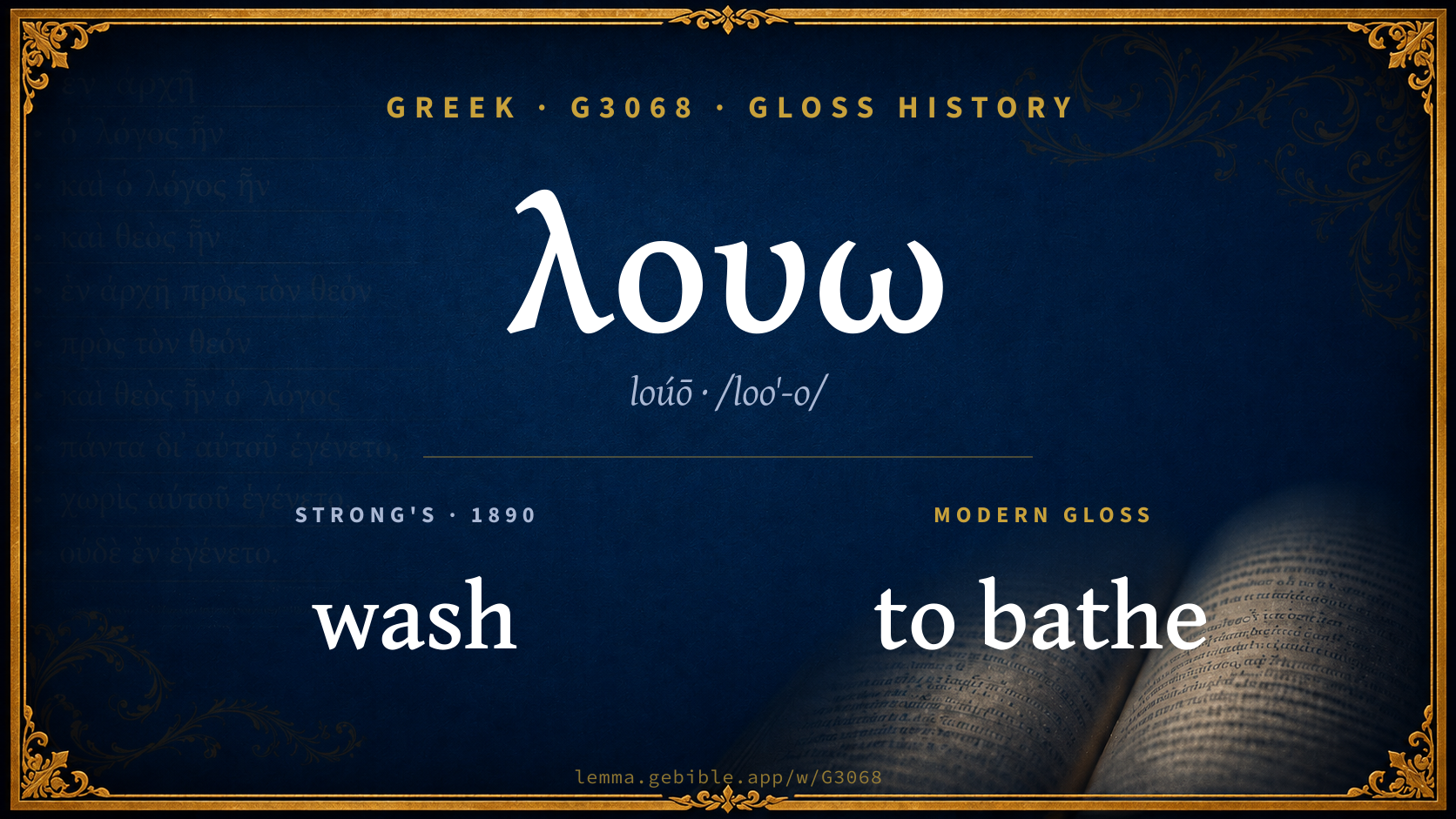
Gloss history
Strong's 1890 vs modern scholarship
About this word
Strong's G3068 catalogs a Greek word from the Greek New Testament.
These counts are not copied from any lexicon or concordance. They are computed here, from the morphology-tagged Greek New Testament. What Lemma adds →
- 5
- distinct verses
- The word appears in 5 distinct verses.
- 4 / 27
- NT books
- The word appears in 4 of 27 New Testament books.
- #1,648
- by frequency
- Top 2500 most frequent Greek words (rank 1,648 of 5,347 Greek words by occurrence).
View all 5 occurrences in the concordance →
By section of the New Testament
By traditional corpus
Conventional, traditional groupings — biblical authorship is debated, so this is a traditional corpus grouping, not an authorship claim. Some books belong to more than one corpus (Luke is in both the Gospels and the Lukan corpus, and so on), so these shares overlap and need not total 100%. Each figure is a share of the word’s 5 distinct verses.
- Lukan (Luke–Acts) 2 verses · 40%
- Gospels 1 verse · 20%
- Johannine 1 verse · 20%
- Hebrews 1 verse · 20%
- General (Catholic) Epistles 1 verse · 20%
How translations render this word
Counts come from each version’s own published word-to-Strong’s tagging or interlinear alignment — an approximate guide to how each version renders this word, not a word-level alignment the data otherwise carries. Because each total is that version’s own tagged count, the per-version totals vary from one another and need not match the appearance or distinct-verse counts above. These counts may also differ from a printed concordance because Lemma counts each distinctly tagged rendering and does not collapse phrase taggings into a single head-word total. This is a fixed set of word-tagged versions (KJV, ASV, BSB, ULT) and does not change with the reading translation you choose elsewhere. Each version’s license is shown beside its name below (and on Sources).
- King James Version: Washed 3×
- American Standard Version: Washed 2×
- Berean Standard Bible: Washed 2×
- unfoldingWord Literal Text: Has been washed 1×, Having been washed 1×, Having washed 1×
King James Version Public Domain
Renders G3068 across 6 tagged occurrences — most commonly:
Plus 3 renderings that appear only once — usually multi-word phrases or single function words the recovered tagging swept in, not distinct renderings.
American Standard Version Public Domain
Renders G3068 across 6 tagged occurrences — most commonly:
Plus 4 renderings that appear only once — usually multi-word phrases or single function words the recovered tagging swept in, not distinct renderings.
Berean Standard Bible Public Domain
Renders G3068 across 5 tagged occurrences — most commonly:
Plus 3 renderings that appear only once — usually multi-word phrases or single function words the recovered tagging swept in, not distinct renderings.
unfoldingWord Literal Text CC BY-SA 4.0
Renders G3068 across 6 tagged occurrences — most commonly:
Senses in Thayer's
The 2 senses Thayer's distinguishes for this word, in lexicon order (not ranked by frequency or importance). The full entry — with sub-senses — is in the Lexicon Entry tab.
- of a dead person
- washing to cleanse blood out of wounds
Word origin
Origin: a root verb
Forms in the corpus
The 5 distinct written forms G3068 takes in the Greek New Testament, most frequent first — each parse links to that tense’s occurrences in the concordance.
| Form | Parsing | Example | Uses |
|---|---|---|---|
| λελουμένος lelouménos | Verb, Perfect, Passive, Participle, Nominative, Singular, Masculine | John 13:10 | 1 |
| λελουσμένοι lelousménoi | Verb, Perfect, Passive, Participle, Nominative, Plural, Masculine | Hebrews 10:23 | 1 |
| λουσαμένη lousaménē | Verb, Aorist, Middle, Participle, Nominative, Singular, Feminine | 2 Peter 2:22 | 1 |
| λούσαντες loúsantes | Verb, Aorist, Active, Participle, Nominative, Plural, Masculine | Acts 9:37 | 1 |
| ἔλουσεν élousen | Verb, Aorist, Active, Indicative, 3rd person, Singular | Acts 16:33 | 1 |
Same root — word family
Other Thayer's entries built from the same root as G3068, grouped by Strong’s listed origin. These share a root / origin per the lexicon — not necessarily a shared meaning. Each links to that word’s own entry.
Derived from this word
Compare all same-root words → They share a root, not necessarily a meaning.
Septuagint usage
The same Greek word λουω appears 44 times in the Greek Old Testament (Septuagint), across 44 verses in 12 books.
- 44
- LXX occurrences
- Tagged occurrences of this Greek word in the Septuagint.
- 44
- verses
- Distinct Septuagint verses containing this word.
- 12 / 39
- OT books
- The word appears in 12 of the 39 Old Testament books.
Sample Septuagint occurrences
- Exodus 2:5 λούω
- Leviticus 8:6 λούω
- Numbers 19:7 λούω
- Deuteronomy 23:12 λούω
- Ruth 3:3 λούω
- 2 Samuel 11:2 λούω
- 1 Kings 20:19 λούω
- 2 Kings 5:10 λούω
- Psalms 6:7 λούω
- Song of Solomon 5:12 λούω
- Isaiah 1:16 λούω
- Ezekiel 16:4 λούω
Septuagint occurrences (same lexeme)
Every verse where the same Strong’s number (G3068) appears in the Greek Septuagint. Verse text shown in the World English Bible for context; the Greek form is the matched word — the English is not keyword-highlighted.
- Exodus 2:5 λούω Pharaoh's daughter came down to bathe at the river. Her maidens walked along by the riverside. She saw the basket among the reeds, and sent her handmaid to get it.
- Exodus 29:4 λούω You shall bring Aaron and his sons to the door of the tent of meeting, and shall wash them with water.
- Exodus 40:12 λούω You shall bring Aaron and his sons to the door of the tent of meeting, and shall wash them with water.
- Leviticus 8:6 λούω Moses brought Aaron and his sons, and washed them with water.
- Leviticus 11:40 λούω He who eats of its carcass shall wash his clothes, and be unclean until the evening. He also who carries its carcass shall wash his clothes, and be unclean until the evening.
- Leviticus 14:8 λούω "He who is to be cleansed shall wash his clothes, and shave off all his hair, and bathe himself in water; and he shall be clean. After that he shall come into the camp, but shall dwell outside his tent seven days.
- Leviticus 14:9 λούω It shall be on the seventh day, that he shall shave all his hair off his head and his beard and his eyebrows, even all his hair he shall shave off. He shall wash his clothes, and he shall bathe his body in water, then he shall be clean.
- Leviticus 15:5 λούω Whoever touches his bed shall wash his clothes, and bathe himself in water, and be unclean until the evening.
- Leviticus 15:6 λούω He who sits on anything whereon the man who has the discharge sat shall wash his clothes, and bathe himself in water, and be unclean until the evening.
- Leviticus 15:7 λούω "'He who touches the body of him who has the discharge shall wash his clothes, and bathe himself in water, and be unclean until the evening.
- Leviticus 15:8 λούω "'If he who has the discharge spits on him who is clean, then he shall wash his clothes, and bathe himself in water, and be unclean until the evening.
- Leviticus 15:10 λούω Whoever touches anything that was under him shall be unclean until the evening. He who carries those things shall wash his clothes, and bathe himself in water, and be unclean until the evening.
- Leviticus 15:11 λούω "'Whoever he who has the discharge touches, without having rinsed his hands in water, he shall wash his clothes, and bathe himself in water, and be unclean until the evening.
- Leviticus 15:13 λούω "'When he who has a discharge is cleansed of his discharge, then he shall count to himself seven days for his cleansing, and wash his clothes; and he shall bathe his flesh in running water, and shall be clean.
- Leviticus 15:16 λούω "'If any man has an emission of semen, then he shall bathe all his flesh in water, and be unclean until the evening.
- Leviticus 15:18 λούω If a man lies with a woman and there is an emission of semen, they shall both bathe themselves in water, and be unclean until the evening.
- Leviticus 15:21 λούω Whoever touches her bed shall wash his clothes, and bathe himself in water, and be unclean until the evening.
- Leviticus 15:22 λούω Whoever touches anything that she sits on shall wash his clothes, and bathe himself in water, and be unclean until the evening.
- Leviticus 15:27 λούω Whoever touches these things shall be unclean, and shall wash his clothes, and bathe himself in water, and be unclean until the evening.
- Leviticus 16:4 λούω He shall put on the holy linen coat, and he shall have the linen breeches on his body, and shall put on the linen sash, and he shall be dressed with the linen turban. They are the holy garments. He shall bathe his body in water, and put them on.
- Leviticus 16:24 λούω Then he shall bathe himself in water in a holy place, and put on his garments, and come out and offer his burnt offering and the burnt offering of the people, and make atonement for himself and for the people.
- Leviticus 16:26 λούω "He who lets the goat go for the scapegoat shall wash his clothes, and bathe his flesh in water, and afterward he shall come into the camp.
- Leviticus 16:28 λούω He who burns them shall wash his clothes, and bathe his flesh in water, and afterward he shall come into the camp.
- Leviticus 17:15 λούω "'Every person that eats what dies of itself, or that which is torn by animals, whether he is native-born or a foreigner, he shall wash his clothes, and bathe himself in water, and be unclean until the evening: then he shall be clean.
- Leviticus 17:16 λούω But if he doesn't wash them, or bathe his flesh, then he shall bear his iniquity.'"
- Leviticus 22:6 λούω the person that touches any such shall be unclean until the evening, and shall not eat of the holy things, unless he bathe his body in water.
- Numbers 19:7 λούω Then the priest shall wash his clothes, and he shall bathe his flesh in water, and afterward he shall come into the camp, and the priest shall be unclean until the even.
- Numbers 19:8 λούω He who burns her shall wash his clothes in water, and bathe his flesh in water, and shall be unclean until the even.
- Numbers 19:19 λούω and the clean person shall sprinkle on the unclean on the third day, and on the seventh day: and on the seventh day he shall purify him; and he shall wash his clothes, and bathe himself in water, and shall be clean at even.
- Deuteronomy 23:12 λούω You shall have a place also outside of the camp, where you shall go forth abroad:
- Ruth 3:3 λούω Wash yourself therefore, and anoint you, and put your clothing on you, and get you down to the threshing floor, but don't make yourself known to the man, until he shall have done eating and drinking.
- 2 Samuel 11:2 λούω It happened at evening, that David arose from off his bed, and walked on the roof of the king's house: and from the roof he saw a woman bathing; and the woman was very beautiful to look on.
- 2 Samuel 12:20 λούω Then David arose from the earth, and washed, and anointed himself, and changed his clothing; and he came into the house of Yahweh, and worshiped: then he came to his own house; and when he required, they set bread before him, and he ate.
- 1 Kings 20:19 λούω So these went out of the city, the young men of the princes of the provinces, and the army which followed them.
- 1 Kings 22:38 λούω They washed the chariot by the pool of Samaria; and the dogs licked up his blood (now the prostitutes washed themselves [there]); according to the word of Yahweh which he spoke.
- 2 Kings 5:10 λούω Elisha sent a messenger to him, saying, Go and wash in the Jordan seven times, and your flesh shall come again to you, and you shall be clean.
- 2 Kings 5:12 λούω Aren't Abanah and Pharpar, the rivers of Damascus, better than all the waters of Israel? may I not wash in them, and be clean? So he turned and went away in a rage.
- 2 Kings 5:13 λούω His servants came near, and spoke to him, and said, My father, if the prophet had bid you do some great thing, wouldn't you have done it? how much rather then, when he says to you, Wash, and be clean?
- Psalms 6:7 λούω My eye wastes away because of grief; It grows old because of all my adversaries.
- Song of Solomon 5:12 λούω His eyes are like doves beside the water brooks, Washed with milk, mounted like jewels.
- Isaiah 1:16 λούω Wash yourselves, make yourself clean. Put away the evil of your doings from before my eyes; Cease to do evil.
- Ezekiel 16:4 λούω As for your birth, in the day you were born your navel was not cut, neither were you washed in water to cleanse you; you weren't salted at all, nor swaddled at all.
- Ezekiel 16:9 λούω Then washed I you with water; yes, I thoroughly washed away your blood from you, and I anointed you with oil.
- Ezekiel 23:40 λούω Furthermore you have sent for men who come from far, to whom a messenger was sent, and, behold, they came; for whom you did wash yourself, paint your eyes, and deck yourself with ornaments,
These are occurrences of the same Greek lexeme (G3068) in the Septuagint — not a translation of any one Hebrew word. The store carries no word-level Hebrew↔Greek alignment, so no Hebrew original is asserted here. Counts come from the recovered LXX Strong's tagging — high-frequency vocabulary is well covered, while rare or late forms may be untagged — so they reflect tagged occurrences and may slightly undercount.