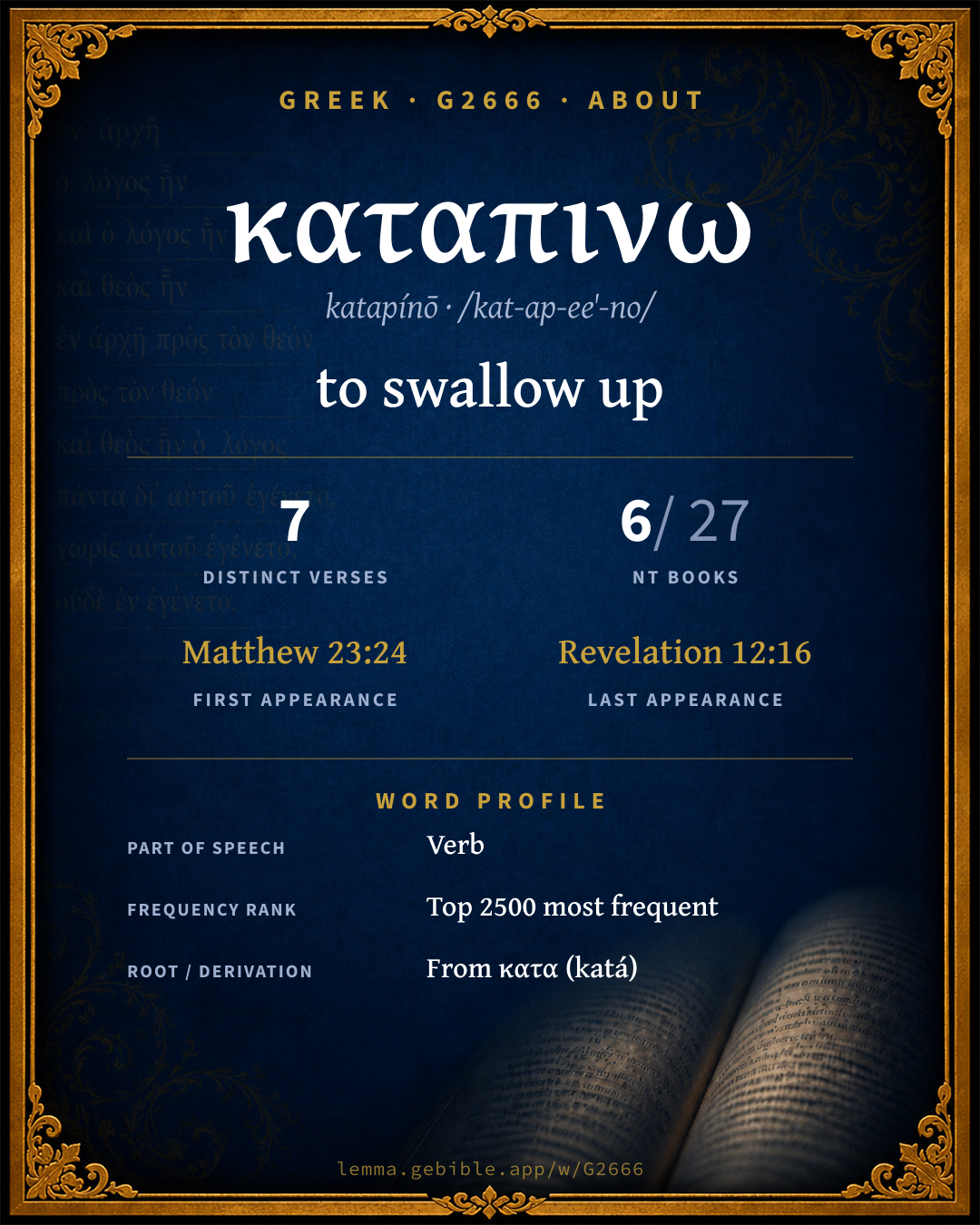
καταπίνω
to swallow up
‘to swallow up’ is one of 3 main senses fuller range ↓
Full lexicon entry — Thayer's Greek Lexicon
From Thayer's Greek Lexicon
Where this word appears
See every Aorist-tense verb in the Greek New Testament →
Grammar key — what these labels mean
Part of speech
- Verb
- An action or state-of-being word.
Tense
- Aorist
- Action viewed as a simple whole, without regard to duration — often past (perfective aspect).
- Present
- Ongoing or general action in present time (imperfective aspect).
Voice
- Passive
- The subject receives the action.
- Active
- The subject performs the action.
Mood
- Subjunctive
- Expresses probability, purpose, or possibility (the mood of contingency).
- Indicative
- States a fact or asks a factual question (the mood of reality).
- Infinitive
- A verbal noun (“to write”), unmarked for person or number.
- Participle
- A verbal adjective (“writing,” “having written”).
Case
- Nominative
- The case of the subject (and the predicate nominative).
Person
- 3rd person
- The one spoken about (“he / she / it / they”).
Gender
- Masculine
- Grammatically masculine.
Number
- Singular
- One.
- Plural
- More than one.
Grammatical forms
- Verb, Aorist, Passive, Subjunctive, 3rd person, Singular 2 times (29%)
- Verb, Aorist, Active, Indicative, 3rd person, Singular 1 time (14%)
- Verb, Aorist, Active, Infinitive 1 time (14%)
- Verb, Aorist, Passive, Indicative, 3rd person, Plural 1 time (14%)
- Verb, Aorist, Passive, Indicative, 3rd person, Singular 1 time (14%)
- Verb, Present, Active, Participle, Nominative, Plural, Masculine 1 time (14%)
Parsed forms decoded from the imported morphology (Robinson–Tischendorf, public domain), counted across 7 parsed occurrences — not distinct verses.
Every verse where G2666 appears — 7 distinct verses across 6 books. Click any verse to open its interlinear word-by-word view. Verse text shown in the World English Bible for context — . Each verse’s Greek form is shown with its reference; the English is not keyword-highlighted, since the data carries no word-level English alignment. Use “Compare translations” on any verse to read it across multiple English versions. This concordance covers the Greek New Testament; Septuagint (Greek Old Testament) occurrences of this word are not indexed here.
Matthew 1 verse
1 Corinthians 1 verse
2 Corinthians 2 verses
- 2 Corinthians 2:7 καταποθῇ aor pass subj 3sg so that on the contrary you should rather forgive him and comfort him, lest by any means such a one should be swallowed up with his excessive sorrow.
- 2 Corinthians 5:4 καταποθῇ aor pass subj 3sg For indeed we who are in this tent do groan, being burdened; not that we desire to be unclothed, but that we desire to be clothed, that what is mortal may be swallowed up by life.
Hebrews 1 verse
1 Peter 1 verse
Revelation 1 verse
About this entry
At a glance — auto-summarized from this page’s data, not written by a person. Every figure links to its source below. This summary describes the numbers; it doesn’t interpret them.
The Greek verb καταπινω centers on the idea of “to swallow up.” Debuting at Matthew 23:24, it then recurs through the corpus. It appears 7 verses across 6 books of the Greek New Testament, among its uncommon vocabulary. The word gravitates to 2 Corinthians (29%), then Matthew and 1 Corinthians. Thayer's distinguishes 3 senses for it. For the data behind this summary, explore the sense tree and the renderings breakdown below.
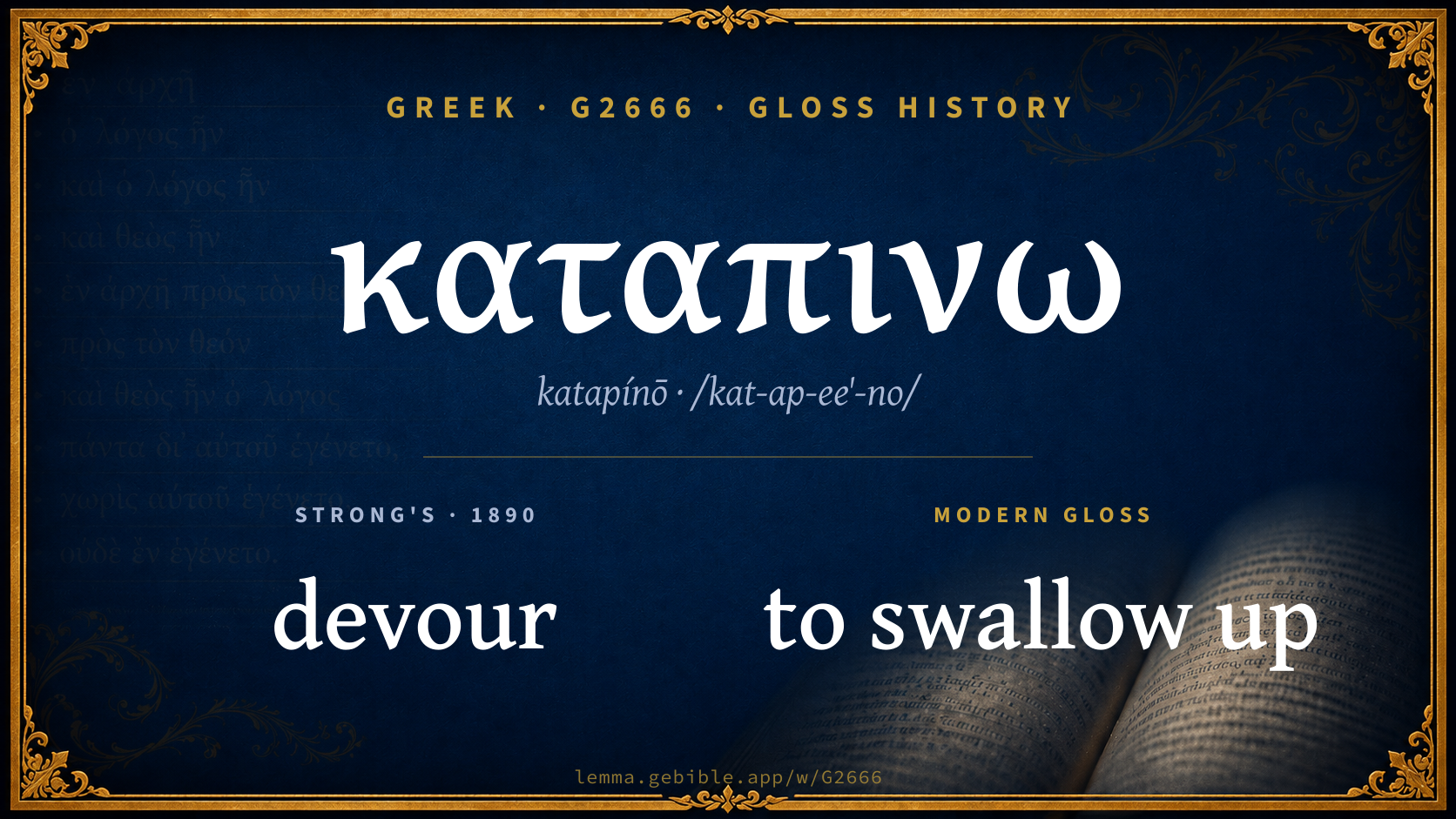
Gloss history
Strong's 1890 vs modern scholarship
About this word
Strong's G2666 catalogs a Greek word from the Greek New Testament.
These counts are not copied from any lexicon or concordance. They are computed here, from the morphology-tagged Greek New Testament. What Lemma adds →
- 7
- distinct verses
- The word appears in 7 distinct verses.
- 6 / 27
- NT books
- The word appears in 6 of 27 New Testament books.
- #1,358
- by frequency
- Top 2500 most frequent Greek words (rank 1,358 of 5,347 Greek words by occurrence).
View all 7 occurrences in the concordance →
Most concentrated in
- 2 Corinthians 2 verses 29%
- Matthew 1 verse 14%
- 1 Corinthians 1 verse 14%
By section of the New Testament
By traditional corpus
Conventional, traditional groupings — biblical authorship is debated, so this is a traditional corpus grouping, not an authorship claim. Some books belong to more than one corpus (Luke is in both the Gospels and the Lukan corpus, and so on), so these shares overlap and need not total 100%. Each figure is a share of the word’s 7 distinct verses.
- Pauline corpus 3 verses · 43%
- Gospels 1 verse · 14%
- Johannine 1 verse · 14%
- Hebrews 1 verse · 14%
- General (Catholic) Epistles 1 verse · 14%
- Revelation 1 verse · 14%
How translations render this word
Counts come from each version’s own published word-to-Strong’s tagging or interlinear alignment — an approximate guide to how each version renders this word, not a word-level alignment the data otherwise carries. Because each total is that version’s own tagged count, the per-version totals vary from one another and need not match the appearance or distinct-verse counts above. These counts may also differ from a printed concordance because Lemma counts each distinctly tagged rendering and does not collapse phrase taggings into a single head-word total. This is a fixed set of word-tagged versions (KJV, ASV, BSB, ULT) and does not change with the reading translation you choose elsewhere. Each version’s license is shown beside its name below (and on Sources).
- King James Version: He may devour 1×, Is swallowed up 1×, Might be swallowed up 1×
- American Standard Version: He may devour 1×, Is swallowed up 1×, Should be swallowed up 1×
- Berean Standard Bible: Devour 1×, Has been swallowed up 1×, May be swallowed up 1×
- unfoldingWord Literal Text: Be overwhelmed 1×, Devour 1×, Is swallowed up 1×
King James Version Public Domain
Renders G2666 across 7 tagged occurrences — most commonly:
American Standard Version Public Domain
Renders G2666 across 7 tagged occurrences — most commonly:
Berean Standard Bible Public Domain
Renders G2666 across 7 tagged occurrences — most commonly:
unfoldingWord Literal Text CC BY-SA 4.0
Renders G2666 across 8 tagged occurrences — most commonly:
Senses in Thayer's
The 3 senses Thayer's distinguishes for this word, in lexicon order (not ranked by frequency or importance). The full entry — with sub-senses — is in the Lexicon Entry tab.
- to drink down, swallow down
- to devour
- to swallow up, destroy
Word origin
Derived from κατα (katá) (G2596) — down.
Forms in the corpus
The 6 distinct written forms G2666 takes in the Greek New Testament, most frequent first — each parse links to that tense’s occurrences in the concordance.
| Form | Parsing | Example | Uses |
|---|---|---|---|
| καταποθῇ katapothē̂ | Verb, Aorist, Passive, Subjunctive, 3rd person, Singular | 2 Corinthians 2:7 | 2 |
| κατέπιεν katépien | Verb, Aorist, Active, Indicative, 3rd person, Singular | Revelation 12:16 | 1 |
| καταπίνοντες katapínontes | Verb, Present, Active, Participle, Nominative, Plural, Masculine | Matthew 23:24 | 1 |
| καταπιεῖν katapieîn | Verb, Aorist, Active, Infinitive | 1 Peter 5:8 | 1 |
| κατεπόθη katepóthē | Verb, Aorist, Passive, Indicative, 3rd person, Singular | 1 Corinthians 15:54 | 1 |
| κατεπόθησαν katepóthēsan | Verb, Aorist, Passive, Indicative, 3rd person, Plural | Hebrews 11:29 | 1 |
Same root — word family
Other Thayer's entries built from the same root as G2666, grouped by Strong’s listed origin. These share a root / origin per the lexicon — not necessarily a shared meaning. Each links to that word’s own entry.
Derives from
Shares the same root
- καθα kathá G2505 according as
- καθαιρεω kathairéō G2507 to tear down
- καθαπτω katháptō G2510 to fasten down
- καθεδρα kathédra G2515 seat
- καθεζομαι kathézomai G2516 to sit down
- καθεξης kathexēs G2517 in order
- καθευδω katheúdō G2518 to fall asleep
- καθηγητης kathēgētḗs G2519 guide
- καθηκω kathḗkō G2520 to come down
- καθημαι káthēmai G2521 to sit down
- καθημερινος kathēmerinós G2522 daily
- καθιημι kathíēmi G2524 to send down
- καθιστημι kathístēmi G2525 to place
- καθο kathó G2526 according to what
- καθολου kathólou G2527 wholly
- καθοπλιζω kathoplízō G2528 to arm
- καθοραω kathoráō G2529 to see clearly
- καθοτι kathóti G2530 according to what
- καθως kathṓs G2531 according as
- καμμυω kammýō G2576 to close eyes
- καταβαινω katabaínō G2597 to descend
- καταβαλλω katabállō G2598 to cast down
- καταβαρεω katabaréō G2599 to weigh down
- καταβιβαζω katabibázō G2601 to bring down
+103 more words share this root (not shown).
Compare all same-root words → Showing 4 of 129 — not the complete family. They share a root, not necessarily a meaning.
Septuagint usage
The same Greek word καταπινω appears 36 times in the Greek Old Testament (Septuagint), across 36 verses in 14 books.
- 36
- LXX occurrences
- Tagged occurrences of this Greek word in the Septuagint.
- 36
- verses
- Distinct Septuagint verses containing this word.
- 14 / 39
- OT books
- The word appears in 14 of the 39 Old Testament books.
Sample Septuagint occurrences
- Genesis 41:7 καταπίνω
- Exodus 7:12 καταπίνω
- Numbers 16:30 καταπίνω
- Deuteronomy 11:6 καταπίνω
- 2 Samuel 17:16 καταπίνω
- Job 7:19 καταπίνω
- Psalms 34:25 καταπίνω
- Proverbs 1:12 καταπίνω
- Isaiah 9:15 καταπίνω
- Jeremiah 28:34 καταπίνω
- Lamentations 2:16 καταπίνω
- Hosea 8:8 καταπίνω
Septuagint occurrences (same lexeme)
Every verse where the same Strong’s number (G2666) appears in the Greek Septuagint. Verse text shown in the World English Bible for context; the Greek form is the matched word — the English is not keyword-highlighted.
- Genesis 41:7 καταπίνω The thin heads of grain swallowed up the seven healthy and full ears. Pharaoh awoke, and, behold, it was a dream.
- Genesis 41:24 καταπίνω The thin heads of grain swallowed up the seven good heads of grain. I told it to the magicians; but there was no one who could explain it to me."
- Exodus 7:12 καταπίνω For they cast down every man his rod, and they became serpents: but Aaron's rod swallowed up their rods.
- Exodus 15:12 καταπίνω You stretched out your right hand. The earth swallowed them.
- Numbers 16:30 καταπίνω But if Yahweh make a new thing, and the ground open its mouth, and swallow them up, with all that appertain to them, and they go down alive into Sheol; then you shall understand that these men have despised Yahweh.
- Numbers 16:32 καταπίνω and the earth opened its mouth, and swallowed them up, and their households, and all the men who appertained to Korah, and all their goods.
- Numbers 16:34 καταπίνω All Israel that were round about them fled at the cry of them; for they said, Lest the earth swallow us up.
- Numbers 21:28 καταπίνω For a fire is gone out of Heshbon, A flame from the city of Sihon: It has devoured Ar of Moab, The lords of the high places of the Arnon.
- Numbers 26:10 καταπίνω and the earth opened its mouth, and swallowed them up together with Korah, when that company died; what time the fire devoured two hundred fifty men, and they became a sign.
- Deuteronomy 11:6 καταπίνω and what he did to Dathan and Abiram, the sons of Eliab, the son of Reuben; how the earth opened its mouth, and swallowed them up, and their households, and their tents, and every living thing that followed them, in the midst of all Israel:
- 2 Samuel 17:16 καταπίνω Now therefore send quickly, and tell David, saying, Don't lodge this night at the fords of the wilderness, but by all means pass over; lest the king be swallowed up, and all the people who are with him.
- Job 7:19 καταπίνω How long will you not look away from me, Nor leave me alone until I swallow down my spittle?
- Job 8:18 καταπίνω If he is destroyed from his place, Then it shall deny him, saying, 'I have not seen you.'
- Psalms 34:25 καταπίνω
- Psalms 57:10 καταπίνω For your great loving kindness reaches to the heavens, And your truth to the skies.
- Psalms 68:16 καταπίνω Why do you look in envy, you rugged mountains, At the mountain where God chooses to reign? Yes, Yahweh will dwell there forever.
- Psalms 105:17 καταπίνω He sent a man before them. Joseph was sold for a slave.
- Psalms 106:27 καταπίνω That he would overthrow their seed among the nations, And scatter them in the lands.
- Psalms 123:3 καταπίνω Have mercy on us, Yahweh, have mercy on us, For we have endured much contempt.
- Psalms 140:6 καταπίνω I said to Yahweh, "You are my God." Listen to the cry of my petitions, Yahweh.
- Proverbs 1:12 καταπίνω Let's swallow them up alive like Sheol, And whole, like those who go down into the pit.
- Proverbs 19:28 καταπίνω A corrupt witness mocks justice, And the mouth of the wicked gulps down iniquity.
- Proverbs 21:20 καταπίνω There is precious treasure and oil in the dwelling of the wise; But a foolish man swallows it up.
- Proverbs 23:7 καταπίνω For as he thinks about the cost, so he is. "Eat and drink!" he says to you, But his heart is not with you.
- Isaiah 9:15 καταπίνω The elder and the honorable man, he is the head; and the prophet who teaches lies, he is the tail.
- Isaiah 16:8 καταπίνω For the fields of Heshbon languish, [and] the vine of Sibmah; the lords of the nations have broken down the choice branches of it, which reached even to Jazer, which wandered into the wilderness; its shoots were spread abroad, they passed over the sea.
- Isaiah 25:8 καταπίνω He has swallowed up death forever; and the Lord Yahweh will wipe away tears from off all faces; and the reproach of his people will he take away from off all the earth: for Yahweh has spoken it.
- Isaiah 28:4 καταπίνω and the fading flower of his glorious beauty, which is on the head of the fat valley, shall be as the first-ripe fig before the summer; which when he who looks on it sees, while it is yet in his hand he eats it up.
- Isaiah 49:19 καταπίνω For, as for your waste and your desolate places, and your land that has been destroyed, surely now shall you be too small for the inhabitants, and those who swallowed you up shall be far away.
- Jeremiah 28:34 καταπίνω
- Jeremiah 28:44 καταπίνω
- Lamentations 2:16 καταπίνω All your enemies have opened their mouth wide against you; They hiss and gnash the teeth; they say, We have swallowed her up; Certainly this is the day that we looked for; we have found, we have seen it.
- Lamentations 3:49 καταπίνω My eye pours down, and doesn't cease, without any intermission,
- Hosea 8:8 καταπίνω Israel is swallowed up. Now they are among the nations like a worthless thing.
- Jonah 2:1 καταπίνω Then Jonah prayed to Yahweh, his God, out of the fish's belly.
- Habakkuk 1:13 καταπίνω You who have purer eyes than to see evil, and who cannot look on perversity, why do you tolerate those who deal treacherously, and keep silent when the wicked swallows up the man who is more righteous than he,
These are occurrences of the same Greek lexeme (G2666) in the Septuagint — not a translation of any one Hebrew word. The store carries no word-level Hebrew↔Greek alignment, so no Hebrew original is asserted here. Counts come from the recovered LXX Strong's tagging — high-frequency vocabulary is well covered, while rare or late forms may be untagged — so they reflect tagged occurrences and may slightly undercount.