
Psalms 140:6

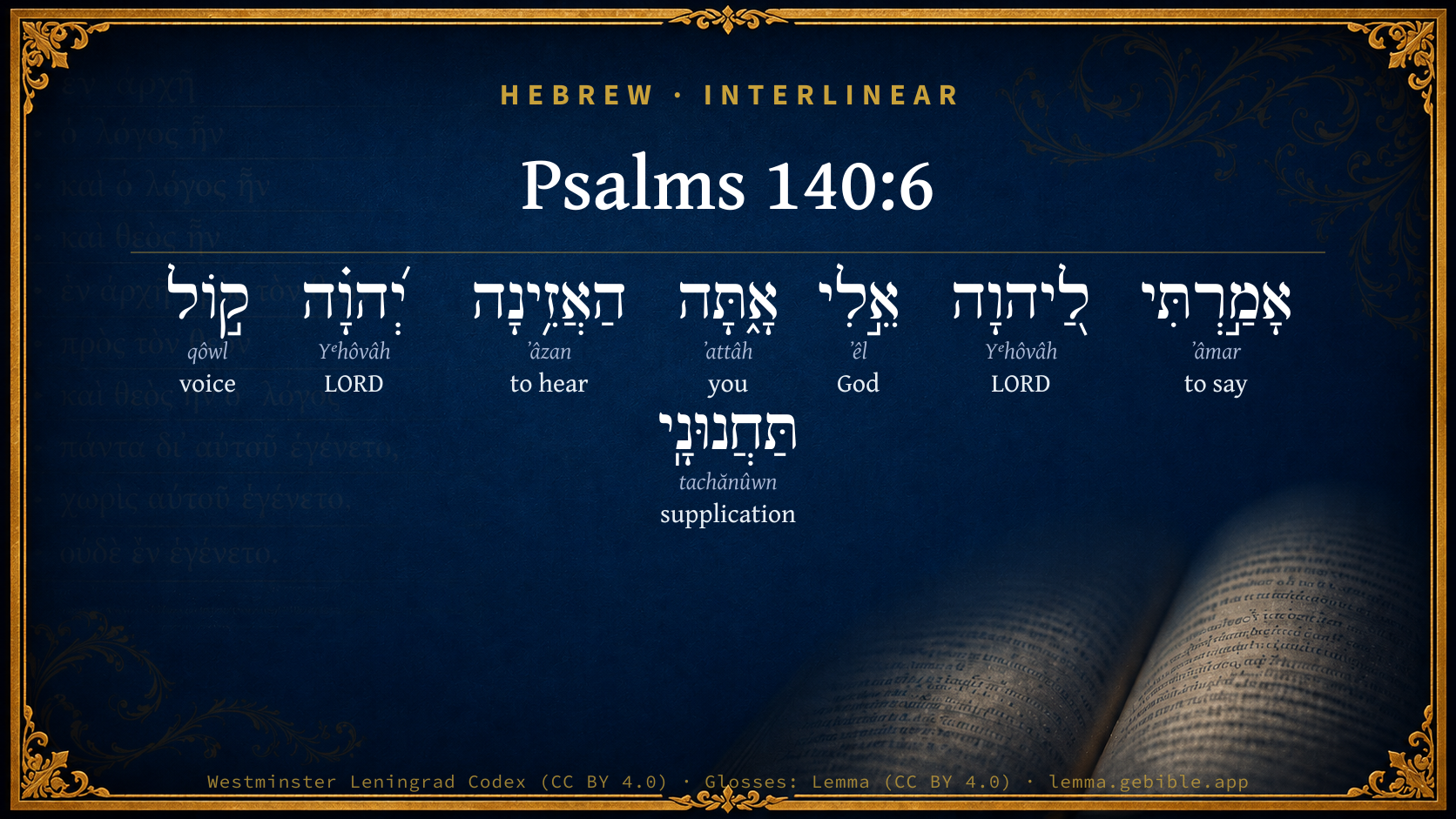
Hebrew (Westminster Leningrad Codex) Psalms 140:6 appears in the Hebrew Old Testament. The text above is from the Westminster Leningrad Codex. Each word links to its Strong’s number, a concise gloss, and parsing drawn from the Open Scriptures Hebrew Bible morphology. Click any word for its full Brown-Driver-Briggs (BDB) entry.
Download image
Cite this verse

Psalms 140:6 (World English Bible). Public Domain. Lemma interlinear Bible study tool, https://lemma.gebible.app/v/psalms/140/6.

Show BibTeX & RIS
BibTeX
RIS
English Translation
I said to Yahweh, "You are my God." Listen to the cry of my petitions, Yahweh.
World English Bible · Public Domain
Download a study sheet

One document with this verse’s original text, its word-by-word gloss line, the meaning frame, cross-references with their text, attributed commentary, and full source and license credits — printable, and it pastes into notes with its structure intact.

This verse Autodidact and up

Study sheet (.html) Plain text (.txt)

A passage Seminary Student

Up to 50 verses in one chapter. A passage sheet keeps up to 6 commentary sources and 12 cross-references per verse, in the order this page ranks them, and says so on the sheet whenever that leaves anything out. Ask for a single verse and you get the Autodidact verse sheet above.

Everything on this page stays free to read, with no account — the sheet is a download of what is already on screen, not access to it.

Want to remove ads? Support Godless Engineer
Compare translations 3

The same verse in 3 English versions, stacked beneath the original-language interlinear above. Click any original word for its lexicon entry.

Each is an independent rendering of the whole verse — the interlinear is not word-aligned to these translations.

Highlighted words mark where these versions differ — a whole-verse word diff, not a word-by-word alignment.

  • World English Bible Public Domain
    I said to Yahweh, "You are my God." Listen to the cry of my petitions, Yahweh.
  • King James Version Public Domain
    I said unto the LORD, Thou art my God: hear the voice of my supplications, O LORD.
  • unfoldingWord Literal Text CC BY-SA 4.0
    I have said to Yahweh, “You my God.” Give ear, Yahweh, to the voice of my supplications.

unfoldingWord Literal Text — © unfoldingWord, licensed CC BY-SA 4.0. Word-aligned USFM3 via Door43 (git.door43.org/unfoldingWord/en_ult).

Versions to compare (up to 4)

3 of 4 selected

Show all 18 translations

Every available English version of this verse, each an independent rendering of the whole verse.

  • World English Bible Public Domain
    I said to Yahweh, "You are my God." Listen to the cry of my petitions, Yahweh.
  • Berean Standard Bible Public Domain
    I say to the LORD, “You are my God.” Hear, O LORD, my cry for help.
  • Majority Standard Bible Public Domain
    I say to the LORD, “You are my God.” Hear, O LORD, my cry for help.
  • King James Version Public Domain
    I said unto the LORD, Thou art my God: hear the voice of my supplications, O LORD.
  • American Standard Version (1901) Public Domain
    I said unto Jehovah, Thou art my God: Give ear unto the voice of my supplications, O Jehovah.
  • Revised Version (1885) Public Domain
    I said unto the LORD, Thou art my God: give ear unto the voice of my supplications, O LORD.
  • Geneva Bible (1599) Public Domain
    Therefore I saide vnto the Lord, Thou art my God: heare, O Lord, the voyce of my prayers.
  • Douay-Rheims (1899) Public Domain
    Thy knowledge is become wonderful to me: it is high, and I cannot reach to it.
  • Young's Literal Translation Public Domain
    I have said to Jehovah, `My God `art' Thou, Hear, Jehovah, the voice of my supplications.'
  • Literal Standard Version CC BY-SA 4.0
    I have said to YHWH, “You [are] my God, || Hear, YHWH, the voice of my supplications.”
  • Unlocked Literal Bible CC BY-SA 4.0
    I said to Yahweh, “You are my God; listen to my cries for mercy.”
  • unfoldingWord Literal Text CC BY-SA 4.0
    I have said to Yahweh, “You my God.” Give ear, Yahweh, to the voice of my supplications.
  • Darby Bible Public Domain
    I have said unto Jehovah, Thou art my ùGod: give ear, O Jehovah, to the voice of my supplications.
  • World Messianic Bible Public Domain
    I said to the LORD, “You are my God.” Listen to the cry of my petitions, LORD.
  • Webster's Bible Public Domain
    \\140:5\\The proud have hid a snare for me, and cords; they have spread a net by the way side: they have set gins for me. Selah.
  • Free Bible Version CC BY-SA 4.0
    I told the Lord, “You are my God! Lord, please listen to my cries for help!”
  • Bible in Basic English Public Domain
    I have said to the Lord, You are my God: give ear, O Lord, to the voice of my prayer.
  • JPS Tanakh (1917) Public Domain
    (140-7) I have said unto the LORD: 'Thou art my God'; give ear, O LORD, unto the voice of my supplications.

Literal Standard Version (2020), Covenant Press — licensed CC BY-SA 4.0. Text via the HelloAO Bible API (eBible.org). Unlocked Literal Bible (unfoldingWord) — licensed CC BY-SA 4.0. Text via the HelloAO Bible API (eBible.org). unfoldingWord Literal Text — © unfoldingWord, licensed CC BY-SA 4.0. Word-aligned USFM3 via Door43 (git.door43.org/unfoldingWord/en_ult). Free Bible Version, Dr. Jonathan Gallagher — licensed CC BY-SA 4.0. Text via the HelloAO Bible API (eBible.org).

Word by word

More ways to search: Search by grammar → Find every occurrence → Compare this word →

Practice this passage: Drill this verse → Learn its vocabulary →

About this verse

These counts appear in no published source. They are computed here, from the morphology-tagged text and Lemma’s own curated glosses. What Lemma adds →

8
words
7
distinct lemmas
Wisdom
section

Notable vocabulary

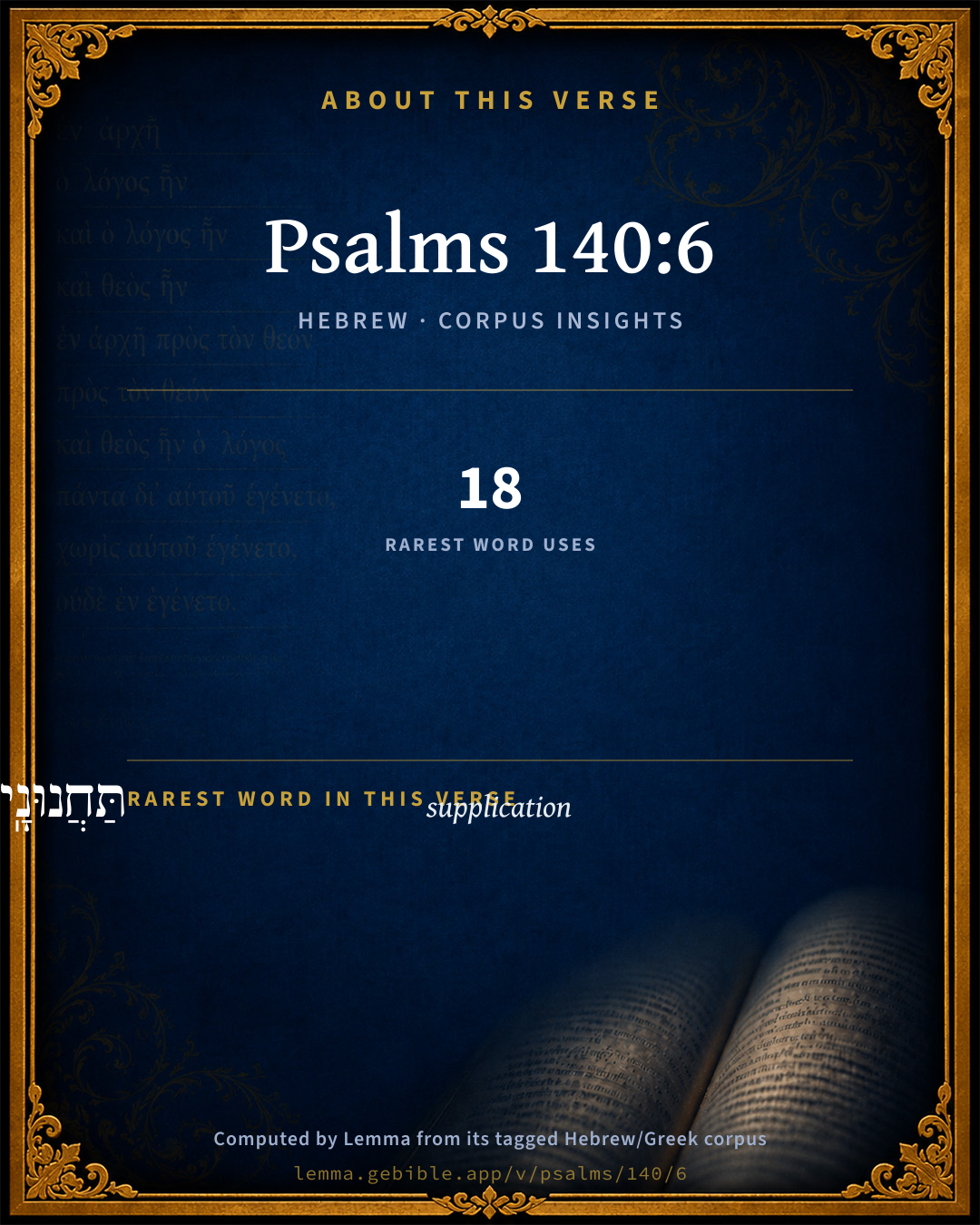
The rarest word here is תַּחֲנוּנָֽי supplication H8469 — appearing just 18 times in the whole Hebrew Bible.

Shared distinctive vocabulary

תַּחֲנוּנָֽי supplication H8469 occurs in 18 verses of the Hebrew Bible. Also found in:

Grammatical profile

  • 2 verbs
  • 5 nouns
  • 1 pronoun

Verb forms

  • אָמַ֣רְתִּי Qal · Perfect
  • הַאֲזִ֥ינָה Hiphil · Imperative

Repetition

A word recurs within this verse — often emphatic in Hebrew:

  • לַ֭יהוָה LORD H3068 ×2

Hebrew & Septuagint length

In English translation the verse runs 16 words from the Hebrew and 18 from the Septuagint (LXX English) — closely comparable.

A rough comparison of the two English renderings, which tokenize alike — not a word-level alignment.

Word counts can differ between the Hebrew and the Greek without any difference in meaning — e.g. the Hebrew direct-object marker אֵת has no separate Greek word, and Greek often adds the article ὁ.

Cross-references

15

Topical passages linked to Psalms 140:6 in the Treasury of Scripture Knowledge — connected by theme and wording, ordered by reader-vote popularity; previews shown in the World English Bible.

  • Psalms 16:2 My soul, you have said to Yahweh, "You are my Lord. Apart from you I have no good thing."
  • Psalms 31:14 But I trust in you, Yahweh. I said, "You are my God."
  • Psalms 119:57 Yahweh is my portion. I promised to obey your words.
  • Psalms 142:5 I cried to you, Yahweh. I said, "You are my refuge, My portion in the land of the living."
  • Zechariah 13:9 I will bring the third part into the fire, And will refine them as silver is refined, And will test them like gold is tested. They will call on my name, and I will hear them. I will say, 'It is my people;' And they will say, 'Yahweh is my God.'"
  • Psalms 16:5–6 Yahweh assigned my portion and my cup. You made my lot secure.
  • Psalms 27:7–8 Hear, Yahweh, when I cry with my voice. Have mercy also on me, and answer me.
  • Psalms 28:1–2 To you, Yahweh, I call. My rock, don't be deaf to me; Lest, if you are silent to me, I would become like those who go down into the pit.
  • Psalms 55:1–2 Listen to my prayer, God. Don't hide yourself from my supplication.
  • Psalms 64:1 Hear my voice, God, in my complaint. Preserve my life from fear of the enemy.
  • Psalms 91:2 I will say of Yahweh, "He is my refuge and my fortress; My God, in whom I trust."
  • Psalms 116:1 I love Yahweh, because he listens to my voice, And my cries for mercy.
  • Psalms 130:2 Lord, hear my voice. Let your ears be attentive to the voice of my petitions.
  • Psalms 143:1 Hear my prayer, Yahweh. Listen to my petitions. In your faithfulness and righteousness, relieve me.
  • Lamentations 3:24 Yahweh is my portion, says my soul; therefore will I hope in him.

Cross-references courtesy of OpenBible.info (CC BY 4.0).

Hebrew and Greek witnesses Masoretic Hebrew ↔ Greek Septuagint

The same verse in the two great witnesses to the Old Testament, shown verse-for-verse.

You’re reading Greek Psalm 139 (Hebrew Psalm 140). The Septuagint counts the superscription, so verse numbers can differ from the Hebrew — chapter-level alignment, not verse-by-verse. Numbering follows Rahlfs.

These are two independent witnesses, not word-aligned to each other, and the Septuagint is shown in lemma (dictionary) form.

Hebrew Psalms 140:6 Masoretic · Westminster Leningrad Codex

אָמַ֣רְתִּי לַ֭יהוָה אֵ֣לִי אָ֑תָּה הַאֲזִ֥ינָה יְ֝הוָ֗ה ק֣וֹל תַּחֲנוּנָֽי

I said to Yahweh, "You are my God." Listen to the cry of my petitions, Yahweh.

World English Bible · Public Domain

Greek LXX Greek Psalm 139:6 Septuagint · lemma form

κρύπτω ὑπερήφανος παγίς ἐγώ καί σχοινίον διατείνω παγίς ὁ πούς ἐγώ ἔχω τρίβος σκάνδαλον τίθημι ἐγώ διάψαλμα

I said to the Lord, You are my God; listen, O Lord, to the voice of my supplication.

LXX2012 (modern English Septuagint) · Public Domain

Hebrew: Westminster Leningrad Codex (CC BY 4.0). Greek: Septuagint (public domain); English from LXX2012 (modern English Septuagint) (Public Domain). How the Septuagint differs from the Hebrew →

Commentary

Notes on Psalms 140:6 from classic Christian and Jewish commentators (each source and its license shown beneath its notes). The classic Christian expositions comment on the surrounding passage and are grouped to its opening verse, so a note may address several verses; the Jewish commentaries on the Tanakh (Rashi and others) are per-verse, so they appear only where the commentator wrote on this verse.

Lemma curates 59 commentaries, every one of them public domain or Creative Commons licensed, each selected and text-cleaned for this edition rather than reprinted as found. About our sources →

Trapp's Complete Commentary

John Trapp

Psa 140:6 I said unto the LORD, Thou [art] my God: hear the voice of my supplications, O LORD.

Ver. 6. I said unto the Lord] Danger drove David home to God; as bugbears do little children to their parents.

John Trapp, A Commentary or Exposition upon All the Books of the Old and New Testament (1647–1656) — public domain. Text from a community e-Sword module.

The Biblical Illustrator

Joseph S. Exell

Psa_140:6-7

I said unto the Lord, Thou art my God.

Davids five-stringed harp

(with verses 12, 13):--There are five things in my text to which I want especially to draw the attention of any who are in sore trouble, and particularly those who are in trouble from enemies who are seeking to ruin them.

I. Possession asserted (verse 6).

1. What was the possession? The Lord Himself. If God be your God, all things are yours, for all things are in God, and the God who has given Himself to us cannot deny us anything.

2. The claim. He exhibited his title-deeds.

3. Who was the attesting Witness? It is a very easy thing to say to the minister, The Lord is my God; but it may not be true. It is a very solemn thing to be able to say to Jehovah, Thou art my God. True believers have dialogues with their God; they are accustomed to speak with the Most High. I said unto Jehovah, Thou art my God.

4. The occasion. When he was in trouble. I said unto Jehovah, Thou art my God. Men said I was a castaway; but I said, Thou art my God. They said I was without a friend; but I said unto Jehovah, Thou art my God.

II. A petition presented. Hear the voice of my supplications.

1. His prayers were frequent. When you have double trouble, take care that you have double prayer.

2. His prayers were full of meaning. Voice.

3. His prayers were meant for God.

4. He could not rest unless he had the Lords attention.

III. Preservation experienced (verse 7).

1. God had been Davids Armour-bearer. Has it not been so with us in days past? Have we not had our heads covered when God held His shield above us? Have we not been guarded from all hurt by the providence and by the grace of the Most High?

2. God had guarded His most vital part.

3. God had been the strength of his salvation.

IV. Protection expected (verse 12).

1. He is the Judge of all the earth, and shall not He do right?

2. Moreover, God is a compassionate Friend; and when He sees any of His dear saints very poor and afflicted, do you not think that, when they cannot take care of themselves, He will take care of them?

V. Praise predicted (verse 13).

1. Praise is assured by gratitude.

2. By holy confidence.

3. By abiding in fellowship with Him. (C. H. Spurgeon.)

The Biblical Illustrator, edited by Joseph S. Exell (c. 1880s–1900s) — public domain. Text from a community e-Sword module.

Joseph Benson's Commentary

Psa 140:6-8. Hear the voice of my supplication — The more malice appears in our enemies against us, and the greater efforts they use to injure us, the more earnest ought we to be in prayer to God, after the example of David here, to take us under his protection. On him believers may depend for security, and may enjoy it and themselves with holy serenity. Those are safe whom God preserves. Thou hast covered my head in the day of battle — With thy powerful protection, as with a helmet or shield. Grant not the desires of the wicked — Suffer not him, who now seeks my destruction, to obtain his desire; further not his wicked device — Let him not succeed in any of his mischievous designs against me. Lest they exalt themselves — Lest he, and those associated with him, grow insolent, so as to dare to attempt all manner of violence against other innocent persons: or, lest they exalt themselves against thee, as if by their power and policy they had frustrated thy design and promise made to me.

Joseph Benson's Commentary on the Old and New Testaments (1811–1818) — public domain. Text from a community e-Sword module.

J. A. Alexander on Psalms

Joseph Addison Alexander

7. (Psa 140:6) I have said to Jehovah, My God (art) thou; give ear, Jehovah, (to) the voice of my supplications. All the component parts of this verse are of constant occurrence in the psalms of David. With the first clause compare Psa 16:2; Psa 31:14. With the second, Psa 5:1-2; Psa 17:1; Psa 28:1; Psa 28:5; Psa 31:22; Psa 39:12; Psa 53:3.

Joseph Addison Alexander, The Psalms Translated and Explained (1850) — public domain. Text from a community e-Sword module.

John Calvin's Commentaries

6. I said to Jehovah. In these words he shows that his prayers were not merely those of the lips, as hypocrites will make loud appeals to God for mere appearance sake, but that he prayed with earnestness, and from a hidden principle of faith. Till we have a persuasion of being saved through the grace of God there can be no sincere prayer. We have here an excellent illustration of the nature of faith, in the Psalmist’s turning himself away from man’s view, that he may address God apart, hypocrisy being excluded in this internal exercise of the heart. This is true prayer — not the mere idle lifting up of the voice, but the presentation of our petitions from an inward principle of faith. To beget in himself a persuasion of his obtaining his present requests from God, he recalls to his mind what deliverance’s God had already extended to him. He speaks of his having been to him as a shield in every time of danger. Some read the words in the future tense — “Thou wilt cover my head in the day of battle.” But it is evident David speaks of protection formerly experienced from the hand of God, and from this derives comfort to his faith. He comes forth, not as a raw and undisciplined recruit, but as a soldier well tried in previous engagements. The strength of salvation is equivalent to salvation displayed with no ordinary power.

John Calvin's Commentaries (1540-1563) — public domain. Text from the Calvin Translation Society English edition (1840s-50s) via the Christian Classics Ethereal Library (ccel.org). Calvin's coverage is partial (roughly two-thirds of the Bible); uncommented books and verses are honest gaps, never fabricated. The 19th-century editor's footnotes and remarks are omitted so the notes are faithfully Calvin's own voice.

The Cambridge Bible for Schools and Colleges

gen. ed. J. J. S. Perowne

6. I said] I have said, or, I say. Cp. Psa_16:1; Psa_31:14. In his distress he appeals to Jehovah, pleading the relation which entitles him to expect protection. Cp. Psa_63:1; Psa_143:10.

hear] R.V., Give ear unto.

6–8. Appeal to Jehovah, the Helper in time of need.

The Cambridge Bible for Schools and Colleges (gen. ed. J. J. S. Perowne; Cambridge University Press, 1878–1918) — public domain. Text from a community e-Sword module.

John Gill's Exposition

I said unto the Lord, thou art my God,.... He said this to the Lord himself; claimed his covenant interest in him, and expressed it in the strength of faith: and this he did when in the midst of trouble and distress; in danger of falling into the hands of evil and violent men; they imagined mischief against him; were bent on his ruin, and laid nets, snares, gins, and traps for him; when he applied to his God, who only could deliver him; and being his covenant God, he had reason to believe he would; see Psa 31:14;

hear the voice of my supplications, O Lord; the requests he put up in an humble manner for deliverance and salvation; and which he expressed vocally, and entreated they might be heard and answered; and nothing could tend more to strengthen his faith in this than that it was his own God and Father he prayed unto; see Psa 28:2; Thus Christ, in the days of his flesh, offered up prayers and supplications with strong crying; and in the midst of his troubles, and surrounded with enemies, declared his faith in God as his God, Heb 5:7.

John Gill's Exposition of the Whole Bible (1746–1763) — public domain (CC PDM 1.0). Text via the HelloAO Bible API.

Albert Barnes' Notes on the Bible

I said unto the Lord, Thou art my God ... - In all these dangers from open war, in all these perils from a crafty enemy lying in ambush, my only refuge was God; my hope was in him alone. From all these dangers, seen and unseen, I knew that he could defend me, and I confidently believed that he would.

Albert Barnes' Notes on the Bible (1834–1885) — public domain. Text from a community e-Sword/MySword module.

The Treasury of David

Charles H. Spurgeon

Ver. 6. I said unto the LORD, Thou art my God. Here was David's stay and hope. He was assured that Jehovah was his God, he expressed that assurance, and he expressed it before Jehovah himself. That had need be a good and full assurance which a man dares to lay before the face of the heart searching Lord. The Psalmist when hunted by man, addressed himself to God. Often the less we say to our foes, and the more we say to our best Friend the better it will fare with us: if we say anything, let it be said unto the Lord. David rejoiced in the fact that he had already said that Jehovah was his God: he was content to have committed himself, he had no wish to draw back. The Lord was David's own by deliberate choice, to which he again sets his seal with delight. The wicked reject God, but the righteous receive him as their own, their treasure, their pleasure, their light and delight. Hear the voice of my supplications, O LORD. Since thou art mine, I pray thee hear my cries. We cannot ask this favour of another man's god, but we may seek it from our own God. The prayers of saints have a voice in them; they are expressive pleadings even when they sound like inarticulate moanings.

The Lord can discern a voice in our waitings, and he can and will hearken thereto. Because he is God he can hear us; because he is our God he will hear us. So long as the Lord doth but hear us we are content: the answer may be according to his own will, but we do entreat to be heard: a soul in distress is grateful to any one who will be kind and patient enough to hearken to its tale, but specially is it thankful for an audience with Jehovah. The more we consider his greatness and our insignificance, his wisdom and our folly, the more shall we be filled with praise when the Lord attends unto our cry.

Ver. 6. The voice of my supplications. The one safety for simple and unlearned people when assailed by the crafty arguments of heretics and infidels is not controversy, but prayer, a weapon their adversaries seldom use and cannot understand. Bruno of Aste, 1123.

Ver. 6.

1. The language of assurance.

2. The plea for acceptance in prayer.

Ver. 6-7. David comforted himself,

1. In his interest in God: "I said...thou art my God."

2. In his access to God: he had leave to speak to him, and might expect an answer of peace: "Hear", etc.

3. In the assurance he had of help from God, and happiness in him (Ps 140:7).

4. In the experience he had formerly of God's care of him: "Thou hast covered my head in the day of battle." Matthew Henry.

Ver. 6-8. Three arguments to be pleaded in a prayer for protection.

1. The believer's covenanted property in God. "I said... thou art my God."

2. The past mercies of God. "Thou hast covered", etc.

3. The impropriety of the wicked being encouraged in their wickedness, Ps 140:8. J. F.

Ver. 6-12. The Consolations of the Believer in Time of Trouble.

1. What he can say.

2. What he can remember.

3. What he is assured of.

Ver. 6-7,12-13. Times of Assault, Slander, and Temptation should be special times of Prayer and Faith. David here makes prominent five things.

1. Possession asserted.

a) The Possession: "My God." Opposed to idols. Beloved by self.

b) The Claim published.

c) The Witness selected. Secret. Sacred. Searching.

d) The Occasion chosen.

2. Petition presented.

a) His prayers were frequent.

b) His prayers were full of meaning.

c) His prayers were meant for God.

d) His prayers needed divine attention.

3. Preservation experienced.

a) God had been his Armour bearer.

b) God had guarded his most vital part.

c) God had saved him.

d) God's strength had been displayed.

4. Protection expected.

a) God is a righteous Judge.

b) God is a compassionate Friend.

c) God is a well known Guardian.

5. Praise predicted.

a) Praise assured by gratitude.

b) Praise expressed by words.

c) Praise implied by confidence.

d) Praise practised by communion.

Psalms 140:7*

Charles H. Spurgeon's The Treasury of David (1869–1885) — public domain. Psalms only. Text from a community e-Sword/MySword module.

Whedon's Commentary on the Bible

Daniel D. Whedon

6. Thou art my God—His refuge is alone in God. No human sagacity could elude the malignant cunning and vigilance of his enemies. The quality and policy of his enemies, as here given, cause humanity to recoil with indignation and horror.

Daniel D. Whedon (gen. ed.), Commentary on the Old and New Testaments (1874–1909) — public domain. Text from a community e-Sword module.

The Pulpit Commentary

I said unto the Lord, Thou art my God: hear the voice of my supplications, O Lord. (comp. Psa_31:14 Psa_143:1) The expressions used are markedly Davidical.

The rest of personally appropriating God.

"I said unto the Lord, Thou art my God". (comp. Psa_16:2, "I have said unto the Lord, Thou art my Lord; I have no good beyond thee;" Psa_27:1, "The Lord is my light and my salvation;" and many other places) Indeed, a characteristic feature of the Psalms is this personal appropriation of God. It is an essential feature of spiritual religion. There must be this sense of kinness with God, and actual relationship to him. So St. Thomas exclaims, "My Lord and my God!" And our Divine Lord, as model and representative Humanity, said, even in a time of overwhelming darkness and distress, "My God, my God, why hast thou forsaken me?" From this psalm we learn how such personal appropriation of God really comes to us.

I IT COMES FROM GOD SEEN IN OUR PAST. "Thou hast covered my head in the day of battle." Some one thing was in the psalmist"s thought, but it would be sure to lead on a great panorama of Divine defenses and interventions. The one thing was like the first star seen in the evening sky. It is "the glorious token of millions more." God has always been on our side. He is our God.

II IT COMES FROM GOD REALIZED IN PRESENT RELATIONS. We express this when we call him the living God. It should always be clearly seen that "living" involves present activity. Silent and inactive Buddha does not live, does not sustain personal relations, is only an object of contemplation. God lives; is active; is in relations; as these relations are seen to be directly present and personal ones, we call him our God. Our God is here now; he is for us now; he is ours now.

III IT COMES FROM GOD FELT AS THE LOVED AND LOVING ONE. We can appropriate a thing in a cold mood of acquisition. We can only appropriate a person by the act of affection. And herein is a remarkable thing. We cannot appropriate a person unless he is willing to be appropriated. He must love us, or our love to him only keeps us at a distance from each other. We may appropriate God in our love because he appropriates us in his love. R.T.

The Pulpit Commentary (1880–1919), ed. H.D.M. Spence-Jones & Joseph S. Exell — public domain. Text from a community e-Sword module.

Keil & Delitzsch

C. F. Keil & F. Delitzsch

Such is the conduct of his enemies; he, however, prays to his God and gets his weapons from beside Him. The day of equipment is the day of the crisis when the battle is fought in full array. The perfect סכּותה states what will then take place on the part of God: He protects the head of His anointed against the deadly blow. Both Psa 140:8 and Psa 140:8 point to the helmet as being מעוז ראשׁ, Psa 60:9; cf. the expression "the helmet of salvation" in Isa 59:17. Beside מאויּי, from the ἅπ. λεγ. מאוה, there is also the reading מאויי, which Abulwald found in his Jerusalem codex (in Saragossa). The regular form would be מאוי, and the boldly irregular ma'awajjê follows the example of מחשׁכּי, מחמדּי, and the like, in a manner that is without example elsewhere. זממז for מזמּתו is also a hapaxlegomenon; according to Gesenius the principal form is זמם, but surely ore correctly זמם (like קרב), which in Aramaic signifies a bridle, and here a plan, device. The Hiph. חפיק (root פק, whence נפק, Arab. nfq) signifies educere in the sense of reportare, Pro 3:13; Pro 8:35; Pro 12:2; Pro 18:22, and of porrigere, Psa 144:13, Isa 58:10. A reaching forth of the plan is equivalent to the reaching forth of that which is projected. The choice of the words used in this Psalm coincides here, as already in מעגּל, with Proverbs and Isaiah. The future ירוּמוּ expresses the consequence (cf. Psa 61:8) against which the poet wishes to guard.

Keil & Delitzsch — Biblical Commentary on the Old Testament (1861–1891) — public domain (CC PDM 1.0). Text via the HelloAO Bible API. (Old Testament only.)

unfoldingWord translationNotes

Door43 World Missions Community

listen to my cries

This is a call for help. AT: "listen to me as I call to you now for help" (See: Metonymy)

you shield my head in the day of battle

A person's head is in great danger during battle. Protecting the person's head represents protecting the whole person. AT: "you protect me when I go to war" (See: Synecdoche and Metaphor)

battle

Here "battle" probably stands for any kind of severe trouble (See: Metaphor)

do not grant the desires of the wicked

"please do not allow the wicked to have what they desire"

the wicked

The adjective "wicked" can be translated as a noun phrase. AT: "wicked people" (See: Nominal Adjectives)

translationWords

God

mercy

lord

save

shield

unfoldingWord translationNotes — © Distant Shores Media and the Door43 World Missions Community, licensed CC BY-SA 4.0. Source: git.door43.org/Door43/en_tn.

Rashi

Rabbi Shlomo Yitzchaki (Rashi)

and [with] ropes they spread a net It is customary to tie a long rope to the end of a net, and when the hunter sees the birds resting under the net, he draws the rope, and the net falls on the birds.

beside [my] path Beside my paths and my steps.

beside Heb. ליד, like (II Sam. 14:30): “See, Joab’s field is near mine (ידי).”

Rashi on the Tanakh — English translations: “The Judaica Press complete Tanach with Rashi, translated by A. J. Rosenberg” (CC BY 4.0); “Pentateuch with Rashi's commentary by M. Rosenbaum and A.M. Silbermann, 1929-1934” (public domain); “The Metsudah Tanach series, Lakewood, N.J” (CC BY 4.0); and “The Book of Joshua, Metsudah Publications, 1997” (CC BY 4.0). Text via Sefaria.

Lesson kit

Teaching starters — assembled from the data on this page, not authored interpretation. Every prompt links to the verse data it draws on. Edit before teaching.

Psalms, in the Wisdom, opens this verse with 8 words (7 distinct Hebrew lemmas). Its most distinctive word is tachănûwn (“supplication”). A historical commentator’s framing appears above. Read the whole chapter for the surrounding context.

Discussion questions

  1. The word tachănûwn carries the sense “supplication.” How does it shape the verse?
  2. How does 2 Chronicles 6:21, which shares the word «supplication», read alongside this verse?
  3. What does the repetition of “LORD” (2× in this one verse) do in this verse?
  4. The translations on this page render this verse differently — a whole-verse word diff, not a word-by-word alignment. What might account for the different wordings?
  5. «אָמַ֣רְתִּי» is a Qal Perfect verb. How does that grammatical form shape the action described?
  6. Compare how Trapp's Complete Commentary and The Biblical Illustrator read this verse. Where do they agree or differ?

Things to notice

Reading settings

Reading text

Shown beneath each verse's original-language words.

Old Testament
Old Testament edition

Read the OT as the Masoretic Hebrew (MT) or the Greek Septuagint (LXX).

English shown for the Greek Septuagint (in the Hebrew ↔ Greek comparison).

Comparing translations? Open the Compare panel on any verse page to stack up to four side by side.