
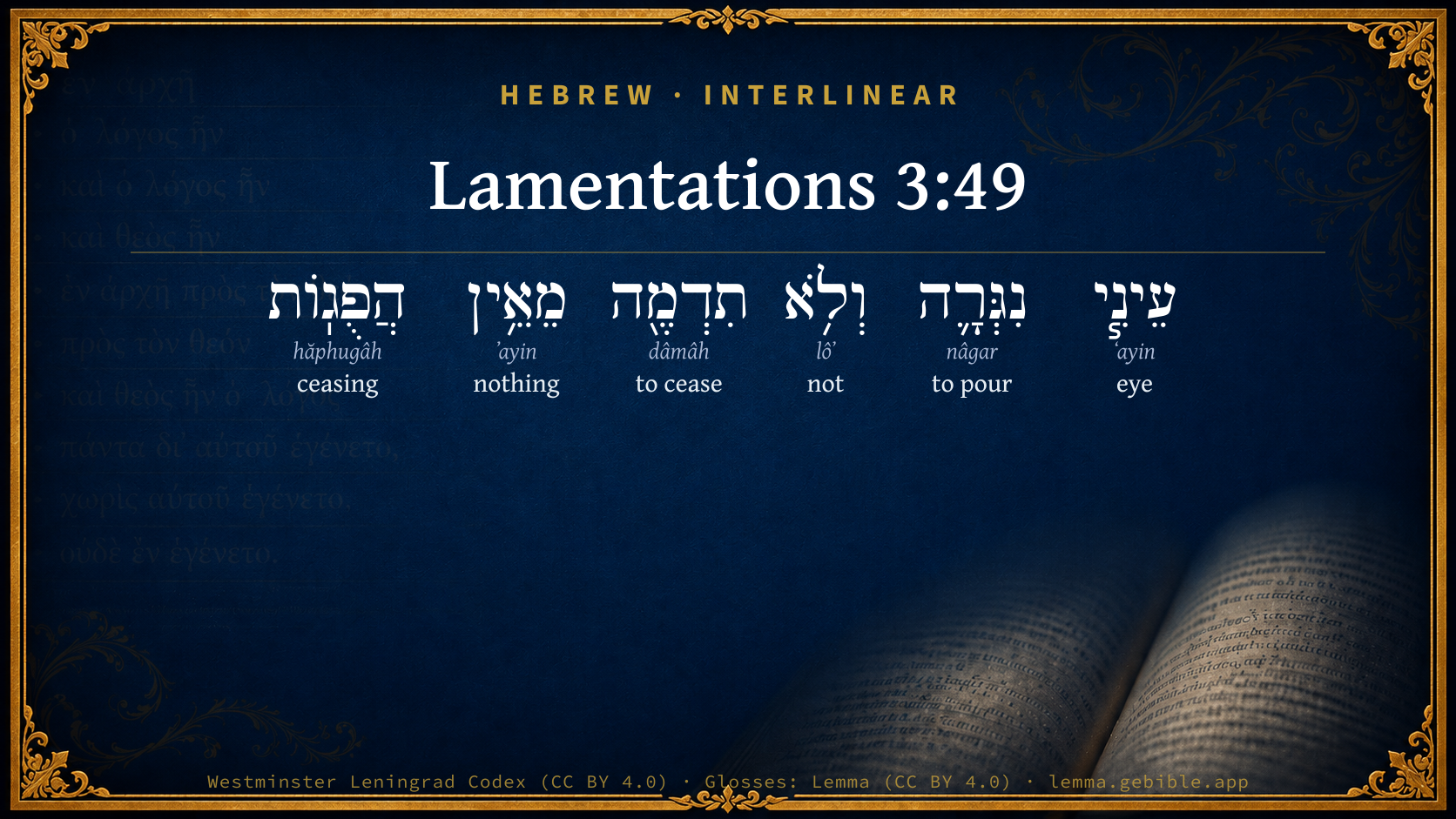
Lamentations 3:49

Hebrew (Westminster Leningrad Codex) Lamentations 3:49 appears in the Hebrew Old Testament. The text above is from the Westminster Leningrad Codex. Each word links to its Strong’s number, a concise gloss, and parsing drawn from the Open Scriptures Hebrew Bible morphology. Click any word for its full Brown-Driver-Briggs (BDB) entry.
Download image
Cite this verse

Lamentations 3:49 (World English Bible). Public Domain. Lemma interlinear Bible study tool, https://lemma.gebible.app/v/lamentations/3/49.

Show BibTeX & RIS
BibTeX
RIS
English Translation
My eye pours down, and doesn't cease, without any intermission,
World English Bible · Public Domain
Highlights Full analysis ↓
Download a study sheet

One document with this verse’s original text, its word-by-word gloss line, the meaning frame, cross-references with their text, attributed commentary, and full source and license credits — printable, and it pastes into notes with its structure intact.

This verse Autodidact and up

Study sheet (.html) Plain text (.txt)

A passage Seminary Student

Up to 50 verses in one chapter. A passage sheet keeps up to 6 commentary sources and 12 cross-references per verse, in the order this page ranks them, and says so on the sheet whenever that leaves anything out. Ask for a single verse and you get the Autodidact verse sheet above.

Everything on this page stays free to read, with no account — the sheet is a download of what is already on screen, not access to it.

Want to remove ads? Support Godless Engineer
Compare translations 3

The same verse in 3 English versions, stacked beneath the original-language interlinear above. Click any original word for its lexicon entry.

Each is an independent rendering of the whole verse — the interlinear is not word-aligned to these translations.

Highlighted words mark where these versions differ — a whole-verse word diff, not a word-by-word alignment.

  • World English Bible Public Domain
    My eye pours down, and doesn't cease, without any intermission,
  • King James Version Public Domain
    Mine eye trickleth down, and ceaseth not, without any intermission.
  • unfoldingWord Literal Text CC BY-SA 4.0
    My eye pours out and does not cease, without stopping,

unfoldingWord Literal Text — © unfoldingWord, licensed CC BY-SA 4.0. Word-aligned USFM3 via Door43 (git.door43.org/unfoldingWord/en_ult).

Versions to compare (up to 4)

3 of 4 selected

Show all 18 translations

Every available English version of this verse, each an independent rendering of the whole verse.

  • World English Bible Public Domain
    My eye pours down, and doesn't cease, without any intermission,
  • Berean Standard Bible Public Domain
    My eyes overflow unceasingly, without relief,
  • Majority Standard Bible Public Domain
    My eyes overflow unceasingly, without relief,
  • King James Version Public Domain
    Mine eye trickleth down, and ceaseth not, without any intermission.
  • American Standard Version (1901) Public Domain
    Mine eye poureth down, and ceaseth not, without any intermission,
  • Revised Version (1885) Public Domain
    Mine eye poureth down, and ceaseth not, without any intermission,
  • Geneva Bible (1599) Public Domain
    Mine eye droppeth without stay and ceaseth not,
  • Douay-Rheims (1899) Public Domain
    Ain. My eye is afflicted, and hath not been quiet, because there was no rest:
  • Young's Literal Translation Public Domain
    Mine eye is poured out, And doth not cease without intermission,
  • Literal Standard Version CC BY-SA 4.0
    My eye is poured out, || And does not cease without intermission,
  • Unlocked Literal Bible CC BY-SA 4.0
    My eyes will shed tears without ceasing, without relief,
  • unfoldingWord Literal Text CC BY-SA 4.0
    My eye pours out and does not cease, without stopping,
  • Darby Bible Public Domain
    Mine eye poureth down, and ceaseth not, without any intermission,
  • World Messianic Bible Public Domain
    My eye pours down and doesn’t cease, without any intermission,
  • Webster's Bible Public Domain
    My eye trickleth down, and ceaseth not, without any intermission,
  • Free Bible Version CC BY-SA 4.0
    My eyes overflow with tears all the time. They won't stop
  • Bible in Basic English Public Domain
    My eyes are streaming without stopping, they have no rest,
  • JPS Tanakh (1917) Public Domain
    Mine eye is poured out, and ceaseth not, without any intermission,

Literal Standard Version (2020), Covenant Press — licensed CC BY-SA 4.0. Text via the HelloAO Bible API (eBible.org). Unlocked Literal Bible (unfoldingWord) — licensed CC BY-SA 4.0. Text via the HelloAO Bible API (eBible.org). unfoldingWord Literal Text — © unfoldingWord, licensed CC BY-SA 4.0. Word-aligned USFM3 via Door43 (git.door43.org/unfoldingWord/en_ult). Free Bible Version, Dr. Jonathan Gallagher — licensed CC BY-SA 4.0. Text via the HelloAO Bible API (eBible.org).

Word by word

More ways to search: Search by grammar → Find every occurrence → Compare this word →

Practice this passage: Drill this verse → Learn its vocabulary →

About this verse

These counts appear in no published source. They are computed here, from the morphology-tagged text and Lemma’s own curated glosses. What Lemma adds →

6
words
6
distinct lemmas
Prophets
section

Notable vocabulary

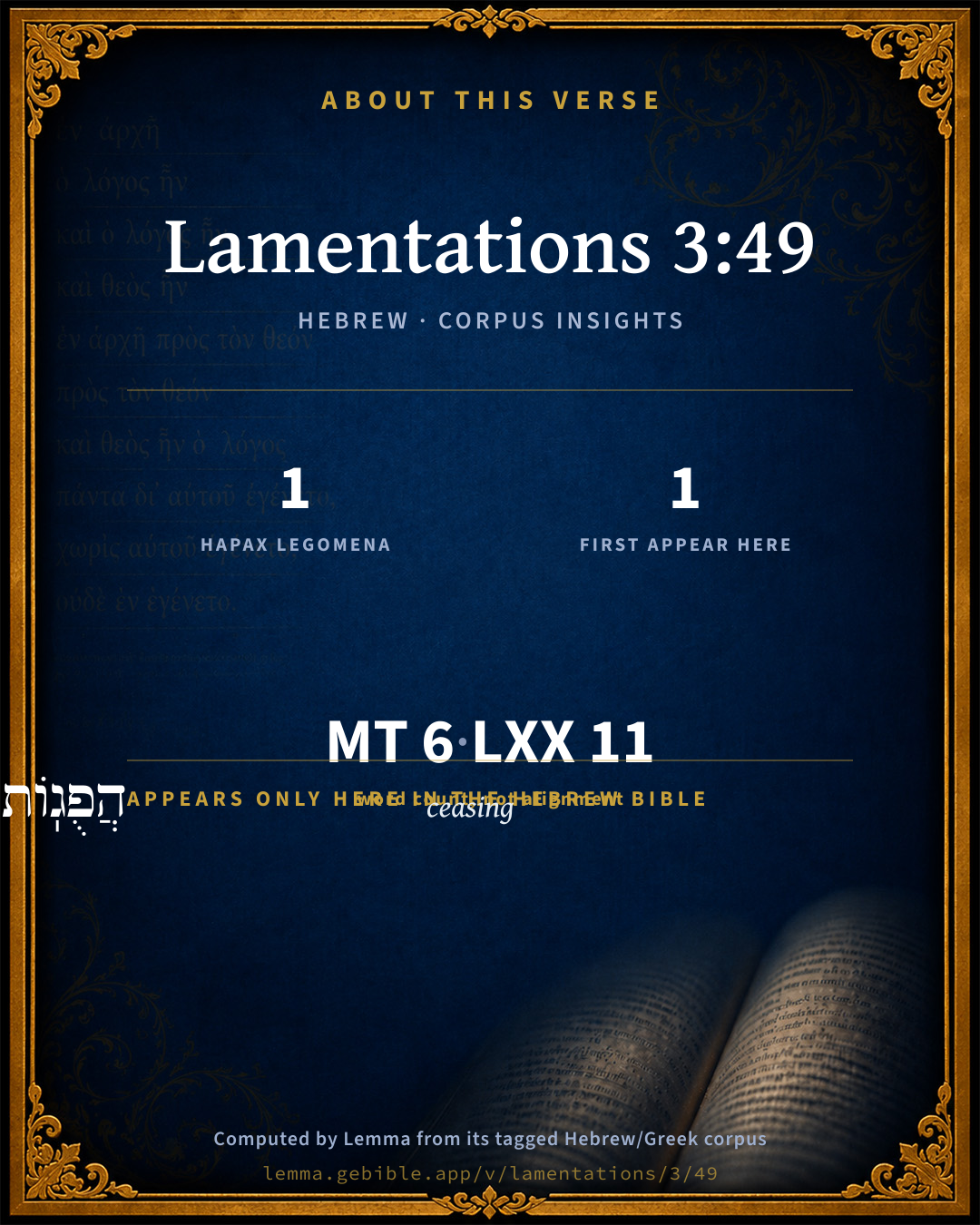
1 hapax legomenon — a word that appears only here in the entire Hebrew Bible:

  • הֲפֻגֽוֹת ceasing H2014

First appearance in Scripture

This word makes its first canonical appearance in the Hebrew Bible here:

  • הֲפֻגֽוֹת ceasing H2014

Shared distinctive vocabulary

נִגְּרָ֛ה to pour H5064 occurs in 10 verses of the Hebrew Bible. Also found in:

Grammatical profile

  • 2 verbs
  • 2 nouns
  • 2 particles

Verb forms

  • נִגְּרָ֛ה Niphal · Perfect
  • תִדְמֶ֖ה Qal · Imperfect

Hebrew & Septuagint length

In English translation the verse runs 10 words from the Hebrew and 20 from the Septuagint (LXX English) — the Septuagint runs noticeably longer here. See the side-by-side →

A rough comparison of the two English renderings, which tokenize alike — not a word-level alignment.

Word counts can differ between the Hebrew and the Greek without any difference in meaning — e.g. the Hebrew direct-object marker אֵת has no separate Greek word, and Greek often adds the article ὁ.

In the original languages it is 6 Hebrew tokens and 11 Greek tokens — but the two are counted differently (Hebrew bundles its prefixes and suffixes into one token; the Greek is in lemma form), so that isn’t a like-for-like length.

Cross-references

3

Topical passages linked to Lamentations 3:49 in the Treasury of Scripture Knowledge — connected by theme and wording, ordered by reader-vote popularity; previews shown in the World English Bible.

  • Jeremiah 14:17 You shall say this word to them, Let my eyes run down with tears night and day, and let them not cease; for the virgin daughter of my people is broken with a great breach, with a very grievous wound.
  • Psalms 77:2 In the day of my trouble I sought the Lord. My hand was stretched out in the night, and didn't get tired. My soul refused to be comforted.
  • Lamentations 1:16 For these things I weep; my eye, my eye runs down with water; Because the comforter who should refresh my soul is far from me: My children are desolate, because the enemy has prevailed.

Cross-references courtesy of OpenBible.info (CC BY 4.0).

Hebrew and Greek witnesses Masoretic Hebrew ↔ Greek Septuagint

The same verse in the two great witnesses to the Old Testament, shown verse-for-verse.

Here the Septuagint runs noticeably longer than the Hebrew — LXX2012 (modern English Septuagint) 20 words vs World English Bible 10. A rough length comparison of the two English translations, not a word-level alignment — read both below.

These are two independent witnesses, not word-aligned to each other, and the Septuagint is shown in lemma (dictionary) form.

Hebrew Lamentations 3:49 Masoretic · Westminster Leningrad Codex

עֵינִ֧י נִגְּרָ֛ה וְלֹ֥א תִדְמֶ֖ה מֵאֵ֥ין הֲפֻגֽוֹת

My eye pours down, and doesn't cease, without any intermission,

World English Bible · Public Domain

Greek LXX Lamentations 3:49 Septuagint · lemma form

ὁ ὀφθαλμός ἐγώ καταπίνω καί οὐ σιγάω ὁ μή εἰμί ἔκνηψις

PHE. My eye is drowned with tears, and I will not be silent, so that there shall be no rest,

LXX2012 (modern English Septuagint) · Public Domain

Hebrew: Westminster Leningrad Codex (CC BY 4.0). Greek: Septuagint (public domain); English from LXX2012 (modern English Septuagint) (Public Domain). How the Septuagint differs from the Hebrew →

Commentary

Notes on Lamentations 3:49 from classic Christian and Jewish commentators (each source and its license shown beneath its notes). The classic Christian expositions comment on the surrounding passage and are grouped to its opening verse, so a note may address several verses; the Jewish commentaries on the Tanakh (Rashi and others) are per-verse, so they appear only where the commentator wrote on this verse.

Lemma curates 59 commentaries, every one of them public domain or Creative Commons licensed, each selected and text-cleaned for this edition rather than reprinted as found. About our sources →

Trapp's Complete Commentary

John Trapp

Lam 3:49 Mine eye trickleth down, and ceaseth not, without any intermission,

Ver. 49. Mine eye trickleth down, and ceaseth not.] Put fire under the still, and water droppeth from roses. Fiery afflictions cause drops of repentance; and repentance, like the philosopher’s stone, maketh golden afflictions. {1Pe 1:7}

John Trapp, A Commentary or Exposition upon All the Books of the Old and New Testament (1647–1656) — public domain. Text from a community e-Sword module.

Jamieson, Fausset & Brown

Robert Jamieson, A. R. Fausset & David Brown

without . . . intermission--or else, "because there is no intermission" [PISCATOR], namely, Of my miseries.

Jamieson, Fausset & Brown — Commentary Critical and Explanatory on the Whole Bible (1871) — public domain (CC PDM 1.0). Text via the HelloAO Bible API.

John Calvin's Commentaries

He repeats the same in other words, — that his eyes flowed down with tears. He still retains the singular number, but this is common in Hebrew. He then says, that his eye without end flowed down, so that there was no rest But it afterwards follows —

John Calvin's Commentaries (1540-1563) — public domain. Text from the Calvin Translation Society English edition (1840s-50s) via the Christian Classics Ethereal Library (ccel.org). Calvin's coverage is partial (roughly two-thirds of the Bible); uncommented books and verses are honest gaps, never fabricated. The 19th-century editor's footnotes and remarks are omitted so the notes are faithfully Calvin's own voice.

Ellicott's Commentary for English Readers

(49) Trickleth down.—Better, poureth down.

A Bible Commentary for English Readers, edited by Charles John Ellicott (1878–1897) — public domain. Text from a community e-Sword module.

The Cambridge Bible for Schools and Colleges

gen. ed. J. J. S. Perowne

49. ceaseth not] Cp. Jer_9:1; Jer_14:17.

The Cambridge Bible for Schools and Colleges (gen. ed. J. J. S. Perowne; Cambridge University Press, 1878–1918) — public domain. Text from a community e-Sword module.

John Gill's Exposition

Waters flowed over mine head,.... As in a pit or dungeon, where there is not only mire and clay, but much water, into which persons being put, sink, and are covered therewith; see Psa 69:1; this is to be understood metaphorically of the waters of afflictions, which overflowed and overwhelmed the people of the Jews. Jarchi interprets it of the nations of the world, as much people are often compared to waters; and here the Chaldeans may be particularly intended, whose army overflowed the land of Judea; and, like a mighty torrent, carried away the people, and wealth of it, and brought them into troubles, which were like deep waters:

then I said, I am cut off; while the waters are only up to a man's loins, he does not apprehend himself in danger; but there is hope of his wading through, and getting out; but when they rise above his head, his hopes are gone; he reckons it all over with him, and that he is just perishing, and his life in the utmost danger; there being scarce any probability or possibility of saving him; so it was with these people.

John Gill's Exposition of the Whole Bible (1746–1763) — public domain (CC PDM 1.0). Text via the HelloAO Bible API.

Matthew Poole's English Annotations

The prophet was deeply affected upon the prospect of this evil before it came, Jer 9:1, and was now much more affected when he saw the judgment was come; he wept plentifully and constantly, as for their sins which had brought these judgments upon them, so for the judgments themselves, as indications of God’s displeasure and wrath against them for their transgressions.

Matthew Poole's English Annotations on the Holy Bible (1683–1685) — public domain. Text from a community e-Sword/MySword module.

The Pulpit Commentary

Trickleth down; rather, poureth down. Ceaseth not; literally, is not silent. (comp. Jer_14:17)

Vers. 49, 50. Tears which only God can wipe away.

I THERE ARE TEARS WHICH ONLY GOD CAN WIPE AWAY. Jerusalem is so desolate that one who mourns her sad estate weeps such tears. But in all ages there have been sufferers in similar trial.

1. When sorrow is acute. The lighter troubles may be patiently endured, or resisted, or mitigated, or driven away by sympathy and brotherly aid. There are troubles which no man can touch, sores which no balm of Gilead can ease, a secret bitterness known only. to the heart of the sufferer. In such agonies of distress comfort is a mockery, to attempt to console is only to intrude into the sanctuary of sorrow and to harrow the wounds we cannot heal.

2. When sorrow is chronic. The sudden flood of tears may be quickly stanched. There are people of mercurial temperament who seem to be in the depths of despair one moment and elated with pleasure the next. It is not difficult to stay the tears of these shallow natures. But when the tears flow on through the bright day as in the long night, this weeping without intermission passes the bounds of human aid. The broken heart, the ruined life, hopes shattered, and joys buried in the grave, open a fountain of grief that only God can stay. Now, it is important to recognize this fact. If we are only driven to see it by hard experience, we may lose ourselves in despair before we can find any consolation in God. It is well to know when we are in smooth water that storms are coming which our vessel cannot weather. Then we may be prepared to look for a haven.

II THERE ARE NO TEARS WHICH GOD CANNOT WIPE AWAY. The sufferer weeps "till the Lord look down, and behold from heaven." But when God looks the tears will be dried. Relief comes from God. It comes in a look from God. It comes when heaven is open to the troubled soul. One look from heaven is enough. How is this?

1. When God looks from heaven he manifests himself. He is always regarding us. But at times it seems to us that we are forgotten and deserted by him. Then again we see that he is observing us. The newly manifested nearness of God is a consolation,

2. When God looks he shows compassion. We express compassion by the eye more than by the voice. The look of pity is its surest, gentlest, most touching expression. This is the look of God when he beholds distress.

3. When God looks at the sufferer he sends help to him. God is not one who can contemplate suffering and then "pass by on the other side." With him to see want is to aid it. It is therefore enough that God regards us. The rest must follow.

4. When God looks from heaven he draws the sufferer up to himself. He attracts by his wonderful look of loving kindness. The revelation of heaven lifts the troubled spirit up to heaven. By communion with heaven earthly tears are wiped away.

The Pulpit Commentary (1880–1919), ed. H.D.M. Spence-Jones & Joseph S. Exell — public domain. Text from a community e-Sword module.

John Wesley's Explanatory Notes

Mine eye - The prophet speaks this of himself.

John Wesley, Explanatory Notes Upon the Whole Bible (1754–1765) — public domain. Text via the GEBible commentary corpus.

Keil & Delitzsch

C. F. Keil & F. Delitzsch

נגּר means to be poured out, empty self; cf. Sa2 14:14; Mic 1:4. "And is not silent" = and rests not, i.e., incessantly; cf. Jer 14:17. מאין הפגות does not mean, eo quod non sint intermissiones miseriarum vel fletus (C. B. Michaelis and Rosenmller, following the Chaldee), but "so that there is no intermission or drying up." As to הפגות, which means the same as פּוּגה, see on Lam 2:18. "Until the Lord look down from heaven and examine," in order to put an end to the distress, or to take compassion on His people. On ישׁקיף, cf. Psa 14:2; Psa 102:20.

Keil & Delitzsch — Biblical Commentary on the Old Testament (1861–1891) — public domain (CC PDM 1.0). Text via the HelloAO Bible API. (Old Testament only.)

Rashi

Rabbi Shlomo Yitzchaki (Rashi)

without respite without change or cessation.

Rashi on the Tanakh — English translations: “The Judaica Press complete Tanach with Rashi, translated by A. J. Rosenberg” (CC BY 4.0); “Pentateuch with Rashi's commentary by M. Rosenbaum and A.M. Silbermann, 1929-1934” (public domain); “The Metsudah Tanach series, Lakewood, N.J” (CC BY 4.0); and “The Book of Joshua, Metsudah Publications, 1997” (CC BY 4.0). Text via Sefaria.

Lesson kit

Teaching starters — assembled from the data on this page, not authored interpretation. Every prompt links to the verse data it draws on. Edit before teaching.

Lamentations, in the Prophets, opens this verse with 6 words (6 distinct Hebrew lemmas). Its most distinctive word is hăphugâh (“ceasing”). The Greek Septuagint runs longer here. A historical commentator’s framing appears above. Read the whole chapter for the surrounding context.

Discussion questions

  1. How does “ceasing” (hăphugâh) shape what this verse is saying?
  2. 1 word here appears nowhere else in the Hebrew Bible. Why might the author reach for such rare wording?
  3. This is the first place “ceasing” appears in Scripture (first appears here). What does its debut here establish?
  4. How does 2 Samuel 14:14, which shares the word «to pour», read alongside this verse?
  5. The Septuagint runs longer here than the Hebrew. What might account for the difference?
  6. The translations on this page render this verse differently — a whole-verse word diff, not a word-by-word alignment. What might account for the different wordings?
  7. «נִגְּרָ֛ה» is a Niphal Perfect verb. How does that grammatical form shape the action described?
  8. Compare how Trapp's Complete Commentary and Jamieson, Fausset & Brown read this verse. Where do they agree or differ?

Things to notice

Reading settings

Reading text

Shown beneath each verse's original-language words.

Old Testament
Old Testament edition

Read the OT as the Masoretic Hebrew (MT) or the Greek Septuagint (LXX).

English shown for the Greek Septuagint (in the Hebrew ↔ Greek comparison).

Comparing translations? Open the Compare panel on any verse page to stack up to four side by side.