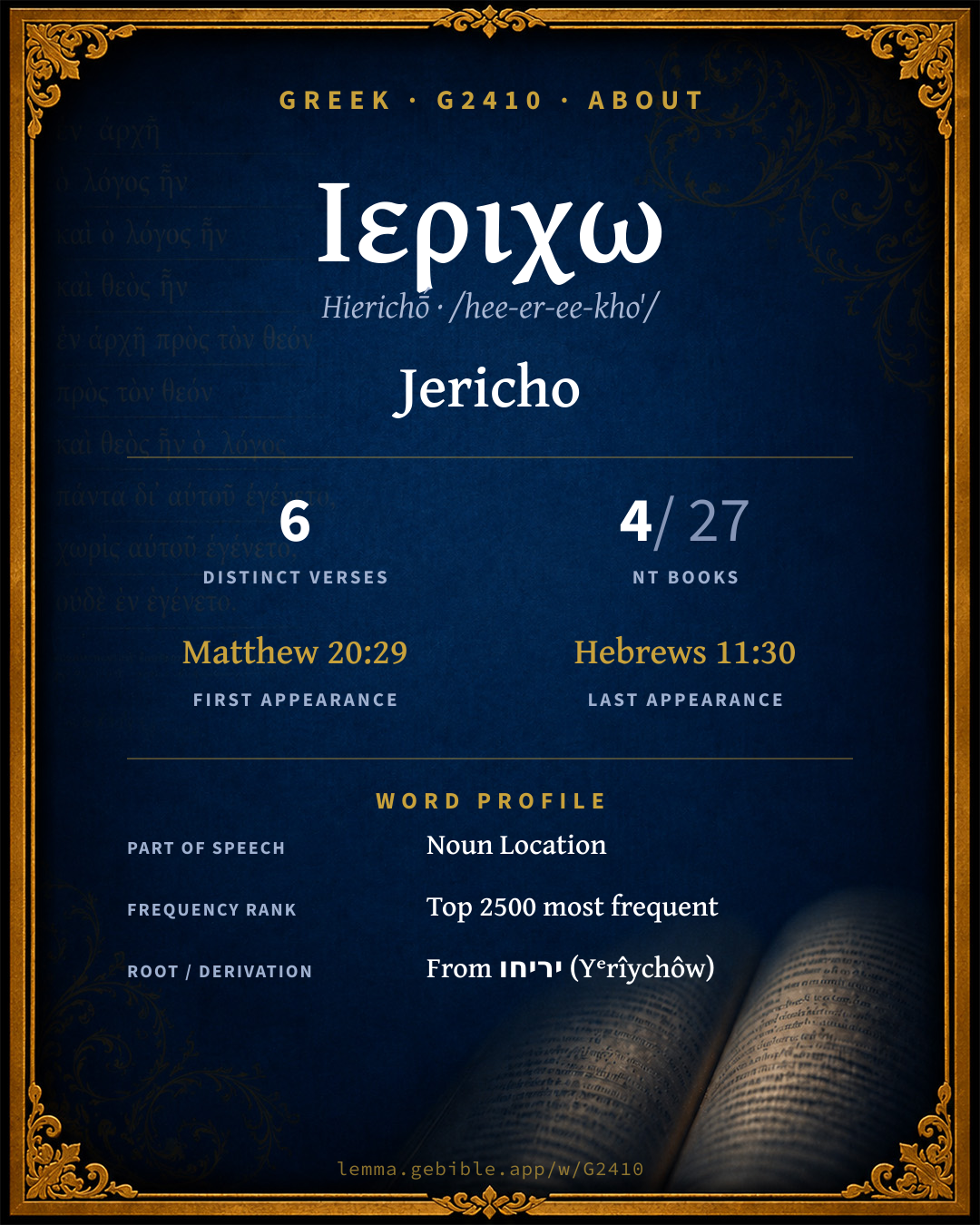
Ἱεριχώ
Jericho
Thayer's lists 2 entries for ‘Jericho’ fuller range ↓
Full lexicon entry — Thayer's Greek Lexicon
From Thayer's Greek Lexicon
Where this word appears
Every verse where G2410 appears in the Book of Luke — 3 distinct verses. Click any verse to open its interlinear word-by-word view. Verse text shown in the World English Bible for context — . Each verse’s Greek form is shown with its reference; the English is not keyword-highlighted, since the data carries no word-level English alignment. Use “Compare translations” on any verse to read it across multiple English versions. This concordance covers the Greek New Testament; Septuagint (Greek Old Testament) occurrences of this word are not indexed here.
Luke
- Luke 10:30 Ἱερειχώ n proper indecl Jesus answered, "A certain man was going down from Jerusalem to Jericho, and he fell among robbers, who both stripped him and beat him, and departed, leaving him half dead.
- Luke 18:35 Ἱερειχὼ n proper indecl It happened, as he came near Jericho, a certain blind man sat by the road, begging.
- Luke 19:1 Ἱερειχώ n proper indecl He entered and was passing through Jericho.
About this entry
At a glance — auto-summarized from this page’s data, not written by a person. Every figure links to its source below. This summary describes the numbers; it doesn’t interpret them.
The Greek name Ιεριχω centers on the idea of “Jericho.” The word gravitates to Luke (50%), then Matthew and Mark. It turns up in 6 verses across 4 books, an uncommon footprint. Its earliest occurrence is Matthew 20:29. For the data behind this summary, explore 6-verse concordance and the renderings breakdown below.
Gloss history
Strong's 1890 vs modern scholarship
About this word
Strong's G2410 catalogs a Greek word from the Greek New Testament.
These counts are not copied from any lexicon or concordance. They are computed here, from the morphology-tagged Greek New Testament. What Lemma adds →
- 6
- distinct verses
- The word appears in 6 distinct verses.
- 4 / 27
- NT books
- The word appears in 4 of 27 New Testament books.
- #1,358
- by frequency
- Top 2500 most frequent Greek words (rank 1,358 of 5,347 Greek words by occurrence).
View all 6 occurrences in the concordance →
By section of the New Testament
By traditional corpus
Conventional, traditional groupings — biblical authorship is debated, so this is a traditional corpus grouping, not an authorship claim. Some books belong to more than one corpus (Luke is in both the Gospels and the Lukan corpus, and so on), so these shares overlap and need not total 100%. Each figure is a share of the word’s 6 distinct verses.
- Gospels 5 verses · 83%
- Lukan (Luke–Acts) 3 verses · 50%
- Hebrews 1 verse · 17%
How translations render this word
Counts come from each version’s own published word-to-Strong’s tagging or interlinear alignment — an approximate guide to how each version renders this word, not a word-level alignment the data otherwise carries. Because each total is that version’s own tagged count, the per-version totals vary from one another and need not match the appearance or distinct-verse counts above. These counts may also differ from a printed concordance because Lemma counts each distinctly tagged rendering and does not collapse phrase taggings into a single head-word total. This is a fixed set of word-tagged versions (KJV, ASV, BSB, ULT) and does not change with the reading translation you choose elsewhere. Each version’s license is shown beside its name below (and on Sources).
- King James Version: Jericho 7×
- American Standard Version: Jericho 6×
- Berean Standard Bible: Jericho 7×
- unfoldingWord Literal Text: Jericho 7×
King James Version Public Domain
Renders G2410 across 7 tagged occurrences — most commonly:
American Standard Version Public Domain
Renders G2410 across 7 tagged occurrences — most commonly:
Plus 1 rendering that appears only once — usually multi-word phrases or single function words the recovered tagging swept in, not distinct renderings.
Berean Standard Bible Public Domain
Renders G2410 across 7 tagged occurrences — most commonly:
unfoldingWord Literal Text CC BY-SA 4.0
Renders G2410 across 8 tagged occurrences — most commonly:
Plus 1 rendering that appears only once — usually multi-word phrases or single function words the recovered tagging swept in, not distinct renderings.
Senses in Thayer's
The 2 senses Thayer's distinguishes for this word, in lexicon order (not ranked by frequency or importance). The full entry — with sub-senses — is in the Lexicon Entry tab.
- Jericho = "place of fragrance"
- a noted city…
Word origin
Derived from יריחו (Yᵉrîychôw) (H3405) — Jericho.
Of hebrew origin [ H3405 ]; Jericho a place in Palestine : - Jericho.
— Strong’s Exhaustive Concordance (1890), public domain.
Forms in the corpus
The 4 distinct written forms G2410 takes in the Greek New Testament, most frequent first — each parse links to that case’s occurrences in the concordance.
| Form | Parsing | Example | Uses |
|---|---|---|---|
| Ἱερειχὼ Hiereichṑ | Noun, Proper, indeclinable | Matthew 20:29 | 3 |
| Ἱερειχώ Hiereichṓ | Noun, Proper, indeclinable | Luke 10:30 | 2 |
| Ἰερειχώ Iereichṓ | Noun, Proper, indeclinable | Mark 10:46 | 1 |
| Ἰερειχὼ Iereichṑ | Noun, Proper, indeclinable | Mark 10:46 | 1 |
Bible dictionary
Public-domain dictionary articles matched to this entry by name (Jericho). A biblical name can be shared by more than one person or place, so an article may treat several.
Easton's Bible Dictionary · M. G. Easton, 1897
Place of fragrance, a fenced city in the midst of a vast grove of palm trees, in the plain of Jordan, over against the place where that river was crossed by the Israelites (Josh. 3:16). Its site was near the Ain es-Sultan, Elisha's Fountain (2 Kings 2:19-22), about 5 miles west of Jordan. It was the most important city in the Jordan valley (Num. 22:1; 34:15), and the strongest fortress in all the land of Canaan. It was the key to Western Palestine.
This city was taken in a very remarkable manner by the Israelites (Josh. 6). God gave it into their hands. The city was "accursed" (Heb. herem, "devoted" to Jehovah), and accordingly (Josh. 6:17; comp. Lev. 27:28, 29; Deut. 13:16) all the inhabitants and all the spoil of the city were to be destroyed, "only the silver, and the gold, and the vessels of brass and of iron" were reserved and "put into the treasury of the house of Jehovah" (Josh. 6:24; comp. Num. 31:22, 23, 50-54). Only Rahab "and her father's household, and all that she had," were preserved from destruction, according to the promise of the spies (Josh. 2:14). In one of the Amarna tablets Adoni-zedec (q.v.) writes to the king of Egypt informing him that the Abiri (Hebrews) had prevailed, and had taken the fortress of Jericho, and were plundering "all the king's lands." It would seem that the Egyptian troops had before this been withdrawn from Palestine.
This city was given to the tribe of Benjamin (Josh. 18:21), and it was inhabited in the time of the Judges (Judg. 3:13; 2 Sam. 10:5). It is not again mentioned till the time of David (2 Sam. 10:5). "Children of Jericho" were among the captives who returned under Zerubbabel Ezra 2:34; Neh. 7:36). Hiel (q.v.) the Bethelite attempted to make it once more a fortified city (1 Kings 16:34). Between the beginning and the end of his undertaking all his children were cut off.
In New Testament times Jericho stood some distance to the south-east of the ancient one, and near the opening of the valley of Achor. It was a rich and flourishing town, having a considerable trade, and celebrated for the palm trees which adorned the plain around. It was visited by our Lord on his last journey to Jerusalem. Here he gave sight to two blind men (Matt. 20:29-34; Mark 10:46-52), and brought salvation to the house of Zacchaeus the publican (Luke 19:2-10).
The poor hamlet of er-Riha, the representative of modern Jericho, is situated some two miles farther to the east. It is in a ruinous condition, having been destroyed by the Turks in 1840. "The soil of the plain," about the middle of which the ancient city stood, "is unsurpassed in fertility; there is abundance of water for irrigation, and many of the old aqueducts are almost perfect; yet nearly the whole plain is waste and desolate...The climate of Jericho is exceedingly hot and unhealthy. This is accounted for by the depression of the plain, which is about 1,200 feet below the level of the sea."
There were three different Jerichos, on three different sites, the Jericho of Joshua, the Jericho of Herod, and the Jericho of the Crusades. Er-Riha, the modern Jericho, dates from the time of the Crusades. Dr. Bliss has found in a hollow scooped out for some purpose or other near the foot of the biggest mound above the Sultan's Spring specimens of Amorite or pre-Israelitish pottery precisely identical with what he had discovered on the site of ancient Lachish. He also traced in this place for a short distance a mud brick wall in situ, which he supposes to be the very wall that fell before the trumpets of Joshua. The wall is not far from the foot of the great precipice of Quarantania and its numerous caverns, and the spies of Joshua could easily have fled from the city and been speedily hidden in these fastnesses.
Smith's Bible Dictionary · William Smith, 1863
(place of fragrance), a city of high antiquity, situated in a plain traversed by the Jordan, and exactly over against where that river was crossed by the Israelites under Joshua. (Joshua 3:16) It was five miles west of the Jordan and seven miles northwest of the Dead Sea. It had a king. Its walls were so considerable that houses were built upon them. ch. (Joshua 2:15) The spoil that was found in it betokened its affluence. Jericho is first mentioned as the city to which the two spies were sent by Joshua from Shittim. (Joshua 2:1-21) It was bestowed by him upon the tribe of Benjamin, ch. (Joshua 18:21) and from this time a long interval elapses before Jericho appears again upon the scene. Its second foundation under Hiel the Bethelite is recorded in (1 Kings 16:34) Once rebuilt, Jericho rose again slowly into consequence. In its immediate vicinity the sons of the prophets sought retirement from the world; Elisha "healed the spring of the waters;" and over against it, beyond Jordan, Elijah "went up by a whirlwind into heaven." (2 Kings 2:1-22) In its plains Zedekiah fell into the hands of the Chaldeans. (2 Kings 25:5; Jeremiah 39:5) In the return under Zerubbabel the "children of Jericho," 345 in number, are comprised. (Ezra 2:34; Nehemiah 7:36) Under Herod the Great it again became an important place. He fortified it and built a number of new palaces, which he named after his friends. If he did not make Jericho his habitual residence, he at last retired thither to die, and it was in the amphitheater of Jericho that the news of his death was announced to the assembled soldiers and people by Salome. Soon afterward the palace was burnt and the town plundered by one Simon, slave to Herod; but Archelaus rebuilt the former sumptuously, and founded a new town on the plain, that bore his own name; and, most important of all, diverted water from a village called Neaera to irrigate the plain which he had planted with palms. Thus Jericho was once more "a city of palms" when our Lord visited it. Here he restored sight to the blind. (Matthew 20:30; Mark 10:46; Luke 18:35) Here the descendant of Rahab did not disdain the hospitality of Zaccaeus the publican. Finally, between Jerusalem and Jericho was laid the scene of his story of the good Samaritan. The city was destroyed by Vespasian. The site of ancient (the first) Jericho is placed by Dr. Robinson in the immediate neighborhood of the fountain of Elisha; and that of the second (the city of the New Testament and of Josephus) at the opening of the Wady Kelt (Cherith), half an hour from the fountain. (The village identified with jericho lies a mile and a half from the ancient site, and is called Riha . It contains probably 200 inhabitants, indolent and licentious and about 40 houses. Dr. Olin says it is the "meanest and foulest village of Palestine;" yet the soil of the plain is of unsurpassed fertility.--ED.)
Hitchcock's Bible Names Dictionary · Roswell D. Hitchcock, 1869
his moon; his month; his sweet smell
Classic public-domain reference works; full attribution on Sources.
Septuagint usage
The same Greek word Ιεριχω appears 57 times in the Greek Old Testament (Septuagint), across 53 verses in 10 books.
- 57
- LXX occurrences
- Tagged occurrences of this Greek word in the Septuagint.
- 53
- verses
- Distinct Septuagint verses containing this word.
- 10 / 39
- OT books
- The word appears in 10 of the 39 Old Testament books.
Sample Septuagint occurrences
- Numbers 22:1 ιεριχω
- Deuteronomy 32:49 ιεριχω
- Joshua 2:1 ιεριχω
- 2 Samuel 10:5 ιεριχω
- 1 Kings 16:34 ιεριχω
- 2 Kings 2:4 ιεριχω
- 1 Chronicles 6:63 ιεριχω
- 2 Chronicles 28:15 ιεριχω
- Ezra 2:34 ιεριχω
- Jeremiah 52:8 ιεριχω
Septuagint occurrences (same lexeme)
Every verse where the same Strong’s number (G2410) appears in the Greek Septuagint — showing the first 50 of 53. Verse text shown in the World English Bible for context; the Greek form is the matched word — the English is not keyword-highlighted.
- Numbers 22:1 ιεριχω The children of Israel traveled, and encamped in the plains of Moab beyond the Jordan at Jericho.
- Numbers 26:3 ιεριχω Moses and Eleazar the priest spoke with them in the plains of Moab by the Jordan at Jericho, saying,
- Numbers 26:63 ιεριχω These are those who were numbered by Moses and Eleazar the priest, who numbered the children of Israel in the plains of Moab by the Jordan at Jericho.
- Numbers 31:12 ιεριχω They brought the captives, and the prey, and the spoil, to Moses, and to Eleazar the priest, and to the congregation of the children of Israel, to the camp at the plains of Moab, which are by the Jordan at Jericho.
- Numbers 33:48 ιεριχω They traveled from the mountains of Abarim, and encamped in the plains of Moab by the Jordan at Jericho.
- Numbers 33:50 ιεριχω Yahweh spoke to Moses in the plains of Moab by the Jordan at Jericho, saying,
- Numbers 34:15 ιεριχω the two tribes and the half-tribe have received their inheritance beyond the Jordan at Jericho eastward, toward the sunrise.
- Numbers 35:1 ιεριχω Yahweh spoke to Moses in the plains of Moab by the Jordan at Jericho, saying,
- Numbers 36:13 ιεριχω These are the commandments and the ordinances which Yahweh commanded by Moses to the children of Israel in the plains of Moab by the Jordan at Jericho.
- Deuteronomy 32:49 ιεριχω Go up into this mountain of Abarim, to Mount Nebo, which is in the land of Moab, that is over against Jericho; and see the land of Canaan, which I give to the children of Israel for a possession;
- Deuteronomy 34:1 ιεριχω Moses went up from the plains of Moab to Mount Nebo, to the top of Pisgah, that is over against Jericho. Yahweh shown him all the land of Gilead, to Dan,
- Deuteronomy 34:3 ιεριχω and the South, and the Plain of the valley of Jericho the city of palm trees, to Zoar.
- Deuteronomy 34:8 ιεριχω The children of Israel wept for Moses in the plains of Moab thirty days: so the days of weeping in the mourning for Moses were ended.
- Joshua 2:1 ιεριχω Joshua the son of Nun sent out of Shittim two men as spies secretly, saying, Go, view the land, and Jericho. They went and came into the house of a prostitute whose name was Rahab, and lay there.
- Joshua 2:2 ιεριχω It was told the king of Jericho, saying, Behold, there came men in here tonight of the children of Israel to search out the land.
- Joshua 2:3 ιεριχω The king of Jericho sent to Rahab, saying, Bring forth the men who are come to you, who have entered into your house; for they have come to search out all the land.
- Joshua 3:16 ιεριχω that the waters which came down from above stood, and rose up in one heap, a great way off, at Adam, the city that is beside Zarethan; and those that went down toward the sea of the Arabah, even the Salt Sea, were wholly cut off: and the people passed over right against Jericho.
- Joshua 4:13 ιεριχω about forty thousand ready armed for war passed over before Yahweh to battle, to the plains of Jericho.
- Joshua 4:19 ιεριχω The people came up out of the Jordan on the tenth day of the first month, and encamped in Gilgal, on the east border of Jericho.
- Joshua 5:10 ιεριχω The children of Israel encamped in Gilgal; and they kept the Passover on the fourteenth day of the month at even in the plains of Jericho.
- Joshua 5:13 ιεριχω It happened, when Joshua was by Jericho, that he lifted up his eyes and looked, and, behold, there stood a man over against him with his sword drawn in his hand: and Joshua went to him, and said to him, Are you for us, or for our adversaries?
- Joshua 6:1 ιεριχω Now Jericho was tightly shut up because of the children of Israel: none went out, and none came in.
- Joshua 6:2 ιεριχω Yahweh said to Joshua, Behold, I have given into your hand Jericho, and the king of it, and the mighty men of valor.
- Joshua 6:25 ιεριχω But Rahab the prostitute, and her father's household, and all that she had, did Joshua save alive; and she lived in the midst of Israel to this day, because she hid the messengers, whom Joshua sent to spy out Jericho.
- Joshua 8:2 ιεριχω You shall do to Ai and her king as you did to Jericho and her king: only the spoil of it, and the cattle of it, shall you take for a prey to yourselves: set you an ambush for the city behind it.
- Joshua 9:3 ιεριχω But when the inhabitants of Gibeon heard what Joshua had done to Jericho and to Ai,
- Joshua 10:1 ιεριχω Now it happened, when Adoni-zedek king of Jerusalem heard how Joshua had taken Ai, and had utterly destroyed it; as he had done to Jericho and her king, so he had done to Ai and her king; and how the inhabitants of Gibeon had made peace with Israel, and were among them;
- Joshua 10:28 ιεριχω Joshua took Makkedah on that day, and struck it with the edge of the sword, and the king of it: he utterly destroyed them and all the souls who were therein; he left none remaining; and he did to the king of Makkedah as he had done to the king of Jericho.
- Joshua 10:30 ιεριχω and Yahweh delivered it also, and the king of it, into the hand of Israel; and he struck it with the edge of the sword, and all the souls who were therein; he left none remaining in it; and he did to the king of it as he had done to the king of Jericho.
- Joshua 12:9 ιεριχω the king of Jericho, one; the king of Ai, which is beside Bethel, one;
- Joshua 13:14 ιεριχω Only to the tribe of Levi he gave no inheritance; the offerings of Yahweh, the God of Israel, made by fire are his inheritance, as he spoke to him.
- Joshua 13:32 ιεριχω These are the inheritances which Moses distributed in the plains of Moab, beyond the Jordan at Jericho, eastward.
- Joshua 16:1 ιεριχω The lot came out for the children of Joseph from the Jordan at Jericho, at the waters of Jericho on the east, even the wilderness, going up from Jericho through the hill-country to Bethel;
- Joshua 16:7 ιεριχω and it went down from Janoah to Ataroth, and to Naarah, and reached to Jericho, and went out at the Jordan.
- Joshua 18:12 ιεριχω Their border on the north quarter was from the Jordan; and the border went up to the side of Jericho on the north, and went up through the hill-country westward; and the goings out of it were at the wilderness of Beth Aven.
- Joshua 18:21 ιεριχω Now the cities of the tribe of the children of Benjamin according to their families were Jericho, and Beth Hoglah, and Emek Keziz,
- Joshua 19:15 ιεριχω and Kattath, and Nahalal, and Shimron, and Idalah, and Bethlehem: twelve cities with their villages.
- Joshua 21:36 ιεριχω Out of the tribe of Reuben, Bezer with its suburbs, and Jahaz with its suburbs,
- Joshua 24:11 ιεριχω You went over the Jordan, and came to Jericho: and the men of Jericho fought against you, the Amorite, and the Perizzite, and the Canaanite, and the Hittite, and the Girgashite, the Hivite, and the Jebusite; and I delivered them into your hand.
- 2 Samuel 10:5 ιεριχω When they told it to David, he sent to meet them; for the men were greatly ashamed. The king said, Wait at Jericho until your beards be grown, and then return.
- 1 Kings 16:34 ιεριχω In his days did Hiel the Bethelite build Jericho: he laid the foundation of it with the loss of Abiram his firstborn, and set up the gates of it with the loss of his youngest son Segub, according to the word of Yahweh, which he spoke by Joshua the son of Nun.
- 2 Kings 2:4 ιεριχω Elijah said to him, Elisha, please wait here, for Yahweh has sent me to Jericho. He said, As Yahweh lives, and as your soul lives, I will not leave you. So they came to Jericho.
- 2 Kings 2:5 ιεριχω The sons of the prophets who were at Jericho came near to Elisha, and said to him, "Do you know that Yahweh will take away your master from your head today?" He answered, "Yes, I know it. Hold your peace."
- 2 Kings 2:15 ιεριχω When the sons of the prophets who were at Jericho over against him saw him, they said, The spirit of Elijah does rest on Elisha. They came to meet him, and bowed themselves to the ground before him.
- 2 Kings 2:18 ιεριχω They came back to him, while he stayed at Jericho; and he said to them, "Didn't I tell you, 'Don't go?'"
- 2 Kings 25:5 ιεριχω But the army of the Chaldeans pursued after the king, and overtook him in the plains of Jericho; and all his army was scattered from him.
- 1 Chronicles 6:63 ιεριχω To the sons of Merari [were given] by lot, according to their families, out of the tribe of Reuben, and out of the tribe of Gad, and out of the tribe of Zebulun, twelve cities.
- 1 Chronicles 19:5 ιεριχω Then there went certain persons, and told David how the men were served. He sent to meet them; for the men were greatly ashamed. The king said, Stay at Jericho until your beards be grown, and then return.
- 2 Chronicles 28:15 ιεριχω The men who have been mentioned by name rose up, and took the captives, and with the spoil clothed all who were naked among them, and arrayed them, and shod them, and gave them to eat and to drink, and anointed them, and carried all the feeble of them on donkeys, and brought them to Jericho, the city of palm trees, to their brothers: then they returned to Samaria.
- Ezra 2:34 ιεριχω The children of Jericho, three hundred forty-five.
These are occurrences of the same Greek lexeme (G2410) in the Septuagint — not a translation of any one Hebrew word. The store carries no word-level Hebrew↔Greek alignment, so no Hebrew original is asserted here. Counts come from the recovered LXX Strong's tagging — high-frequency vocabulary is well covered, while rare or late forms may be untagged — so they reflect tagged occurrences and may slightly undercount.