Joshua 19:15

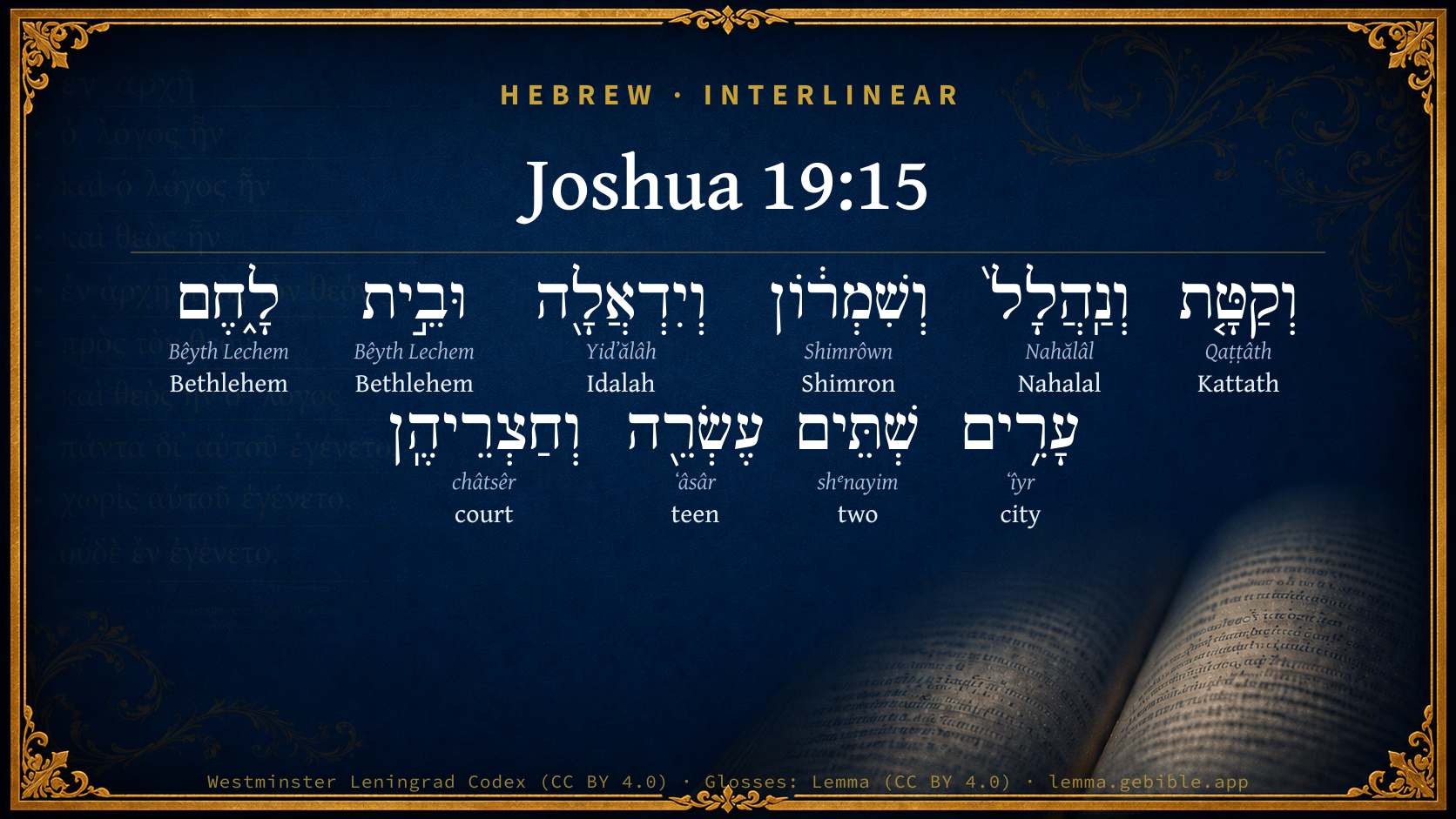
Hebrew (Westminster Leningrad Codex) Joshua 19:15 appears in the Hebrew Old Testament. The text above is from the Westminster Leningrad Codex. Each word links to its Strong’s number, a concise gloss, and parsing drawn from the Open Scriptures Hebrew Bible morphology. Click any word for its full Brown-Driver-Briggs (BDB) entry.
Download image
Cite this verse

Joshua 19:15 (World English Bible). Public Domain. Lemma interlinear Bible study tool, https://lemma.gebible.app/v/joshua/19/15.

Show BibTeX & RIS
BibTeX
RIS
English Translation
and Kattath, and Nahalal, and Shimron, and Idalah, and Bethlehem: twelve cities with their villages.
World English Bible · Public Domain
Highlights Full analysis ↓
Download a study sheet

One document with this verse’s original text, its word-by-word gloss line, the meaning frame, cross-references with their text, attributed commentary, and full source and license credits — printable, and it pastes into notes with its structure intact.

This verse Autodidact and up

Study sheet (.html) Plain text (.txt)

A passage Seminary Student

Up to 50 verses in one chapter. A passage sheet keeps up to 6 commentary sources and 12 cross-references per verse, in the order this page ranks them, and says so on the sheet whenever that leaves anything out. Ask for a single verse and you get the Autodidact verse sheet above.

Everything on this page stays free to read, with no account — the sheet is a download of what is already on screen, not access to it.

Want to remove ads? Support Godless Engineer
Compare translations 3

The same verse in 3 English versions, stacked beneath the original-language interlinear above. Click any original word for its lexicon entry.

Each is an independent rendering of the whole verse — the interlinear is not word-aligned to these translations.

Highlighted words mark where these versions differ — a whole-verse word diff, not a word-by-word alignment.

  • World English Bible Public Domain
    and Kattath, and Nahalal, and Shimron, and Idalah, and Bethlehem: twelve cities with their villages.
  • King James Version Public Domain
    And Kattath, and Nahallal, and Shimron, and Idalah, and Bethlehem: twelve cities with their villages.
  • unfoldingWord Literal Text CC BY-SA 4.0
    And Kattath and Nahalal and Shimron and Idalah and Bethlehem: 12 cities and their villages.

unfoldingWord Literal Text — © unfoldingWord, licensed CC BY-SA 4.0. Word-aligned USFM3 via Door43 (git.door43.org/unfoldingWord/en_ult).

Versions to compare (up to 4)

3 of 4 selected

Show all 18 translations

Every available English version of this verse, each an independent rendering of the whole verse.

  • World English Bible Public Domain
    and Kattath, and Nahalal, and Shimron, and Idalah, and Bethlehem: twelve cities with their villages.
  • Berean Standard Bible Public Domain
    It also included Kattath, Nahalal, Shimron, Idalah, and Bethlehem. There were twelve cities, along with their villages.
  • Majority Standard Bible Public Domain
    It also included Kattath, Nahalal, Shimron, Idalah, and Bethlehem. There were twelve cities, along with their villages.
  • King James Version Public Domain
    And Kattath, and Nahallal, and Shimron, and Idalah, and Bethlehem: twelve cities with their villages.
  • American Standard Version (1901) Public Domain
    and Kattath, and Nahalal, and Shimron, and Idalah, and Bethlehem: twelve cities with their villages.
  • Revised Version (1885) Public Domain
    and Kattath, and Nahalal, and Shimron, and Idalah, and Beth-lehem: twelve cities with their villages.
  • Geneva Bible (1599) Public Domain
    And Kattath, and Nahallal, and Shimron, and Idalah, and Beth-lehem: twelue cities with their villages.
  • Douay-Rheims (1899) Public Domain
    And Cateth and Naalol and Semeron and Jedala and Bethlehem: twelve cities and their villages.
  • Young's Literal Translation Public Domain
    and Kattath, and Nahallal, and Shimron, and Idalah, and Beth-Lehem; twelve cities and their villages.
  • Literal Standard Version CC BY-SA 4.0
    and Kattath, and Nahallal, and Shimron, and Idalah, and Beth-Lehem; twelve cities and their villages.
  • Unlocked Literal Bible CC BY-SA 4.0
    This region included the cities of Kattath, Nahalal, Shimron, Idalah, and Bethlehem. There were twelve cities, including their villages.
  • unfoldingWord Literal Text CC BY-SA 4.0
    And Kattath and Nahalal and Shimron and Idalah and Bethlehem: 12 cities and their villages.
  • Darby Bible Public Domain
    and Kattath, and Nahalal, and Shimron, and Jidalah, and Beth-lehem: twelve cities and their hamlets.
  • World Messianic Bible Public Domain
    Kattath, Nahalal, Shimron, Idalah, and Bethlehem: twelve cities with their villages.
  • Webster's Bible Public Domain
    And Kattath, and Nahallal, and Shimron, and Idalah, and Beth-lehem; twelve cities with their villages.
  • Free Bible Version CC BY-SA 4.0
    The towns included: Kattath, Nahalal, Shimron, Idalah, and Bethlehem —twelve towns with their associated villages.
  • Bible in Basic English Public Domain
    And Kattath and Nahalal and Shimron and Idalah and Beth-lehem; twelve towns with their unwalled places.
  • JPS Tanakh (1917) Public Domain
    and Kattath, and Nahalal, and Shimron, and Idalah, and Beth-lehem; twelve cities with their villages.

Literal Standard Version (2020), Covenant Press — licensed CC BY-SA 4.0. Text via the HelloAO Bible API (eBible.org). Unlocked Literal Bible (unfoldingWord) — licensed CC BY-SA 4.0. Text via the HelloAO Bible API (eBible.org). unfoldingWord Literal Text — © unfoldingWord, licensed CC BY-SA 4.0. Word-aligned USFM3 via Door43 (git.door43.org/unfoldingWord/en_ult). Free Bible Version, Dr. Jonathan Gallagher — licensed CC BY-SA 4.0. Text via the HelloAO Bible API (eBible.org).

Word by word

More ways to search: Search by grammar → Find every occurrence → Compare this word →

Practice this passage: Drill this verse → Learn its vocabulary →

About this verse

These counts appear in no published source. They are computed here, from the morphology-tagged text and Lemma’s own curated glosses. What Lemma adds →

10
words
9
distinct lemmas
Historical
section

Notable vocabulary

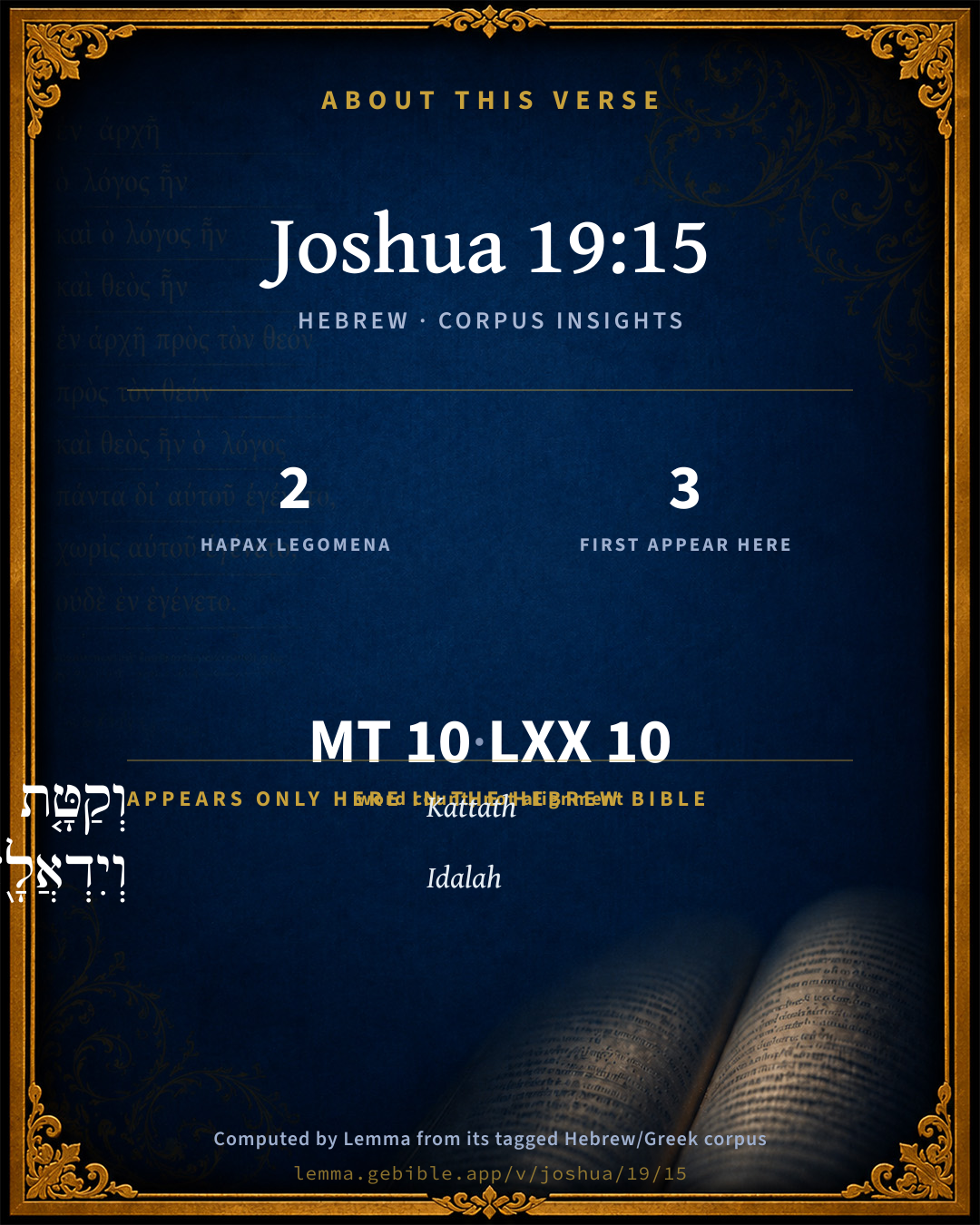
2 hapax legomena — words that appear only here in the entire Hebrew Bible:

  • וְקַטָּ֤ת Kattath H7005
  • וְיִדְאֲלָ֖ה Idalah H3030

First appearance in Scripture

These words make their first canonical appearance in the Hebrew Bible here:

  • וְקַטָּ֤ת Kattath H7005
  • וְנַֽהֲלָל֙ Nahalal H5096
  • וְיִדְאֲלָ֖ה Idalah H3030

Shared distinctive vocabulary

וְנַֽהֲלָל֙ Nahalal H5096 occurs in 3 verses of the Hebrew Bible. Also found in:

Grammatical profile

  • 8 nouns
  • 2 adjectives

Repetition

A word recurs within this verse — often emphatic in Hebrew:

  • וּבֵ֣ית Bethlehem H1035 ×2

Hebrew & Septuagint length

In English translation the verse runs 15 words from the Hebrew and 10 from the Septuagint (LXX English) — the Septuagint runs noticeably shorter here. See the side-by-side →

A rough comparison of the two English renderings, which tokenize alike — not a word-level alignment.

Word counts can differ between the Hebrew and the Greek without any difference in meaning — e.g. the Hebrew direct-object marker אֵת has no separate Greek word, and Greek often adds the article ὁ.

In the original languages it is 10 Hebrew tokens and 10 Greek tokens — but the two are counted differently (Hebrew bundles its prefixes and suffixes into one token; the Greek is in lemma form), so that isn’t a like-for-like length.

Cross-references

7

Topical passages linked to Joshua 19:15 in the Treasury of Scripture Knowledge — connected by theme and wording, ordered by reader-vote popularity; previews shown in the World English Bible.

  • Joshua 11:1 It happened, when Jabin king of Hazor heard of it, that he sent to Jobab king of Madon, and to the king of Shimron, and to the king of Achshaph,
  • Joshua 12:20 the king of Shimron-meron, one; the king of Achshaph, one;
  • Joshua 21:34–35 To the families of the children of Merari, the rest of the Levites, out of the tribe of Zebulun, Jokneam with its suburbs, and Kartah with its suburbs,
  • Judges 1:30 Zebulun didn't drive out the inhabitants of Kitron, nor the inhabitants of Nahalol; but the Canaanites lived among them, and became subject to forced labor.
  • Ruth 1:19 So they two went until they came to Bethlehem. It happened, when they were come to Bethlehem, that all the city was moved about them, and [the women] said, Is this Naomi?
  • 2 Samuel 23:15 David longed, and said, Oh that one would give me water to drink of the well of Bethlehem, which is by the gate!
  • 2 Chronicles 11:6 He built Bethlehem, and Etam, and Tekoa,

Cross-references courtesy of OpenBible.info (CC BY 4.0).

Hebrew and Greek witnesses Masoretic Hebrew ↔ Greek Septuagint

The same verse in the two great witnesses to the Old Testament, shown verse-for-verse.

Here the Septuagint runs noticeably shorter than the Hebrew — LXX2012 (modern English Septuagint) 10 words vs World English Bible 15. A rough length comparison of the two English translations, not a word-level alignment — read both below.

These are two independent witnesses, not word-aligned to each other, and the Septuagint is shown in lemma (dictionary) form.

Hebrew Joshua 19:15 Masoretic · Westminster Leningrad Codex

וְקַטָּ֤ת וְנַֽהֲלָל֙ וְשִׁמְר֔וֹן וְיִדְאֲלָ֖ה וּבֵ֣ית לָ֑חֶם עָרִ֥ים שְׁתֵּים עֶשְׂרֵ֖ה וְחַצְרֵיהֶֽן

and Kattath, and Nahalal, and Shimron, and Idalah, and Bethlehem: twelve cities with their villages.

World English Bible · Public Domain

Greek LXX Joshua 19:15 Septuagint · lemma form

καί καταναθ καί ναβααλ καί συμοων καί ιεριχω καί βαιθμαν

and Catanath, and Nabaal, and Symoon, and Jericho, and Baethman.

LXX2012 (modern English Septuagint) · Public Domain

Hebrew: Westminster Leningrad Codex (CC BY 4.0). Greek: Septuagint (public domain); English from LXX2012 (modern English Septuagint) (Public Domain). How the Septuagint differs from the Hebrew →

Targum (Aramaic paraphrase)

1

The Targum is the ancient Jewish Aramaic paraphrase of the Hebrew Scriptures — an interpretive translation, not the Hebrew text itself. Onkelos (literal) and Pseudo-Jonathan (expansive) render the Torah, and Jonathan the Prophets. Coverage is partial: where no permissively-licensed English translation exists for a verse, only the Aramaic is shown. This is verse-level text, not a word-by-word alignment to the Hebrew.

  1. Targum Jonathan Prophets (Joshua–Malachi)
    וְקַטָת וְנַהֲלָל וְשִׁמְרוֹן וְיִדְאֲלָה וּבֵית לָחֶם קִרְוִין תַּרְתָּא עַסְרֵי וּפַצְחֵיהֶן:

    (no public-domain English translation for this verse)

    Targum Jonathan — Aramaic: “Mikraot Gedolot” (public domain). English: “Sefaria Community Translation” (CC0 1.0 (public-domain dedication)); “London "Chaldee Paraphrase," 1871” (public domain). Text via Sefaria.

Commentary

Notes on Joshua 19:15 from classic Christian and Jewish commentators (each source and its license shown beneath its notes). The classic Christian expositions comment on the surrounding passage and are grouped to its opening verse, so a note may address several verses; the Jewish commentaries on the Tanakh (Rashi and others) are per-verse, so they appear only where the commentator wrote on this verse.

Lemma curates 59 commentaries, every one of them public domain or Creative Commons licensed, each selected and text-cleaned for this edition rather than reprinted as found. About our sources →

Joseph Benson's Commentary

Jos 19:15. Beth-lehem — Not that where Christ was born, which was in Judah, but another. Twelve cities — They are more numerous here, but the rest either were not cities, properly so called, or were not within this tribe, but only bordering upon it, and belonging to other tribes.

Joseph Benson's Commentary on the Old and New Testaments (1811–1818) — public domain. Text from a community e-Sword module.

Tyndale Open Study Notes

Tyndale Open Resources

19:15 This Bethlehem was not the birthplace of David and Jesus in Judah. • More than twelve towns are named; some apparently did not belong to Zebulun but were on its borders.

Tyndale Open Study Notes — © Tyndale Open Resources, licensed CC BY-SA 4.0. Text via the HelloAO Bible API.

Geneva Bible (1599)

Geneva Bible translators

There was another Bethlehem in the tribe of Judah.

Geneva Bible (1599) marginal notes — public domain. Text via Bolls.life.

Adam Clarke's Commentary

Verse 15. Shimron] See Clarke on Jos 12:20.

Beth-lehem] The house of bread; a different place from that in which our Lord was born.

Adam Clarke's Commentary on the Bible (1810–1826) — public domain. Text from a community e-Sword/MySword module.

Ellicott's Commentary for English Readers

(15) Nahallal.—(‘Ain Mahil, sheet 6).

Shimron.—(Simûmieh, west of Nazareth, sheet 5).

Idalah.—(El Huwârah, a ruin just south of Bethlehem, sheet 5).

Beth-lehem.—(Beit-Lahm, sheet v.). It seems right to refer Ibzan of Bethlehem (Jdg_12:8; Jdg_12:10) to this town. The other Bethlehem is called in Judges and Ruth, Bethlehem-Judah; and in Micah, Bethlehem-Ephratah (Jdg_17:7; Jdg_19:1; Rth_1:1; Mic_5:2). Bethlehem-Judah is designated Bethlehem only when it is impossible to mistake it for Bethlehem of Zebulun (e.g., Rth_1:19, and 1Sa_16:4).

Twelve cities.—Ittah-kazin, Neah, Dabbasheth, and Kattath have not been identified, and they may not all be names of towns.

A Bible Commentary for English Readers, edited by Charles John Ellicott (1878–1897) — public domain. Text from a community e-Sword module.

The Cambridge Bible for Schools and Colleges

gen. ed. J. J. S. Perowne

15. and Kattath] The account of the cities here appears to be imperfect. We have only the names of five cities given, though there are said to have been “twelve cities and their villages.” There is nothing to which the list of terms here given, introduced by and, can be attached.

Kattath] This also has been supposed to be “Cana of Galilee.”

Nahallal, Shimron (ch. Jos_11:1), Idalah, are all as yet unknown.

Beth-lehem] This Beth-lehem in Zebulun is not to be confounded with Beth-lehem Ephratah in Judah (Gen_35:19).

The Cambridge Bible for Schools and Colleges (gen. ed. J. J. S. Perowne; Cambridge University Press, 1878–1918) — public domain. Text from a community e-Sword module.

John Gill's Exposition

This is the inheritance of the children of Zebulun, according to their families,.... Which was allotted to it and divided, according to the number of its families:

these cities with their villages; before enumerated, excepting such as only bordered on them; though indeed there were other cities which belonged to them, or might be after given them, not here mentioned, as Kartah and Dimnah, Jos 21:34.

John Gill's Exposition of the Whole Bible (1746–1763) — public domain (CC PDM 1.0). Text via the HelloAO Bible API.

Albert Barnes' Notes on the Bible

Twelve cities - Only five have been mentioned, and the names in the verses preceding are apparently not names of Zebulonite cities, but merely of points in or near the boundary line. It would therefore appear that seven names have disappeared from the text, and perhaps also the definition of the western frontier.

Albert Barnes' Notes on the Bible (1834–1885) — public domain. Text from a community e-Sword/MySword module.

Haydock's Catholic Bible Commentary

Bethlehem, very different from that of Juda. --- Twelve. Nineteen are mentioned, but some of them belong to other tribes, (Calmet) or were not properly cities. (Menochius) --- All the towns of Zabulon are not specified. (Calmet)

George Leo Haydock (1774–1849), Haydock's Catholic Family Bible and Commentary, 1859 edition — public domain. Excludes Psalms (Douay-Rheims chapter numbering differs from Protestant) and Deuterocanonical books (Catholic canon only).

Matthew Poole's English Annotations

Bethlehem; not that where Christ was born, which was in Judah, thence called

Bethlehem Judah, Mat 2:1, but another.

Twelve cities: there are more numbered here, but the rest either were not cities properly so called, having villages under their jurisdiction; or were not within this tribe, but only bordering upon it, and belonging to other tribes, which is evident of some of them, and may well be presumed of others.

Matthew Poole's English Annotations on the Holy Bible (1683–1685) — public domain. Text from a community e-Sword/MySword module.

Whedon's Commentary on the Bible

Daniel D. Whedon

15. Beth-lehem is the only one of the five cities named in this verse which has been with any certainty identified. Dr. Robinson found it about six miles west of Nazareth, still bearing the name Beit-lahm, but only a miserable village, with no traces of antiquity except the name. This verse seems to be only a fragment of the list of cities belonging to Zebulun; a supposition confirmed by the mention of twelve cities when only five are named. Even if we suppose that all the border cities named are counted, we meet with as great a difficulty, for then we have at least sixteen cities named. We may appropriately say with Keil: “From all that has been hitherto ascertained, we can merely decide respecting the inheritance of Zebulun that it comprised the western half of the plain of Esdraelon, between Jokneam and Tabor, and extended to the mountains of Galilee.”]

Daniel D. Whedon (gen. ed.), Commentary on the Old and New Testaments (1874–1909) — public domain. Text from a community e-Sword module.

The Pulpit Commentary

Beth-lehem. This name, signifying the "house of bread," would naturally enough be given to a place in a fertile situation. We are not to suppose that it was "Bethlehem-Ephratah, among the thousands of Jadah". (Mic_5:2) It is now Beit-lahm, about eight miles in a westerly direction from Nazareth.

The Pulpit Commentary (1880–1919), ed. H.D.M. Spence-Jones & Joseph S. Exell — public domain. Text from a community e-Sword module.

John Wesley's Explanatory Notes

Beth-lehem - Not that where Christ was born, which was in Judah, but another. Twelve cities - There are more numbered here, but the rest either were not cities properly so called, or were not within this tribe, but only bordering upon it, and belonging to other tribes.

John Wesley, Explanatory Notes Upon the Whole Bible (1754–1765) — public domain. Text via the GEBible commentary corpus.

Lesson kit

Teaching starters — assembled from the data on this page, not authored interpretation. Every prompt links to the verse data it draws on. Edit before teaching.

Joshua, in the Historical, opens this verse with 10 words (9 distinct Hebrew lemmas). Its most distinctive word is Qaṭṭâth (“Kattath”). The Greek Septuagint runs shorter here. A historical commentator’s framing appears above. Read the whole chapter for the surrounding context.

Discussion questions

  1. What does “Kattath” (Qaṭṭâth) contribute to the verse as a whole?
  2. This verse holds 2 words here found nowhere else in the Hebrew Bible. What might the rare words draw attention to?
  3. 3 words here appear for the first time in Scripture. What is being introduced at this debut?
  4. Joshua 21:35 shares the word «Nahalal» with this verse. How do the two illuminate each other?
  5. “Bethlehem” occurs 2× in this one verse. What is the effect of the repetition?
  6. Compared with the Hebrew, the Septuagint runs shorter here. What questions does that raise?
  7. These translations render this verse differently. What is at stake in choosing one wording over another?
  8. Reading how Joseph Benson's Commentary and Tyndale Open Study Notes read this verse, where do the two commentators agree and where do they part?

Things to notice

  • 2 words in this verse appear nowhere else in the Hebrew Bible.
  • 3 words make their first canonical appearance in Scripture here.
  • This verse counts 10 Hebrew ↔ 10 Greek words.
  • These translations choose different wording for 4 words in this verse.
  • “Bethlehem” occurs 2× in this single verse.

Reading settings

Reading text

Shown beneath each verse's original-language words.

Old Testament
Old Testament edition

Read the OT as the Masoretic Hebrew (MT) or the Greek Septuagint (LXX).

English shown for the Greek Septuagint (in the Hebrew ↔ Greek comparison).

Comparing translations? Open the Compare panel on any verse page to stack up to four side by side.