
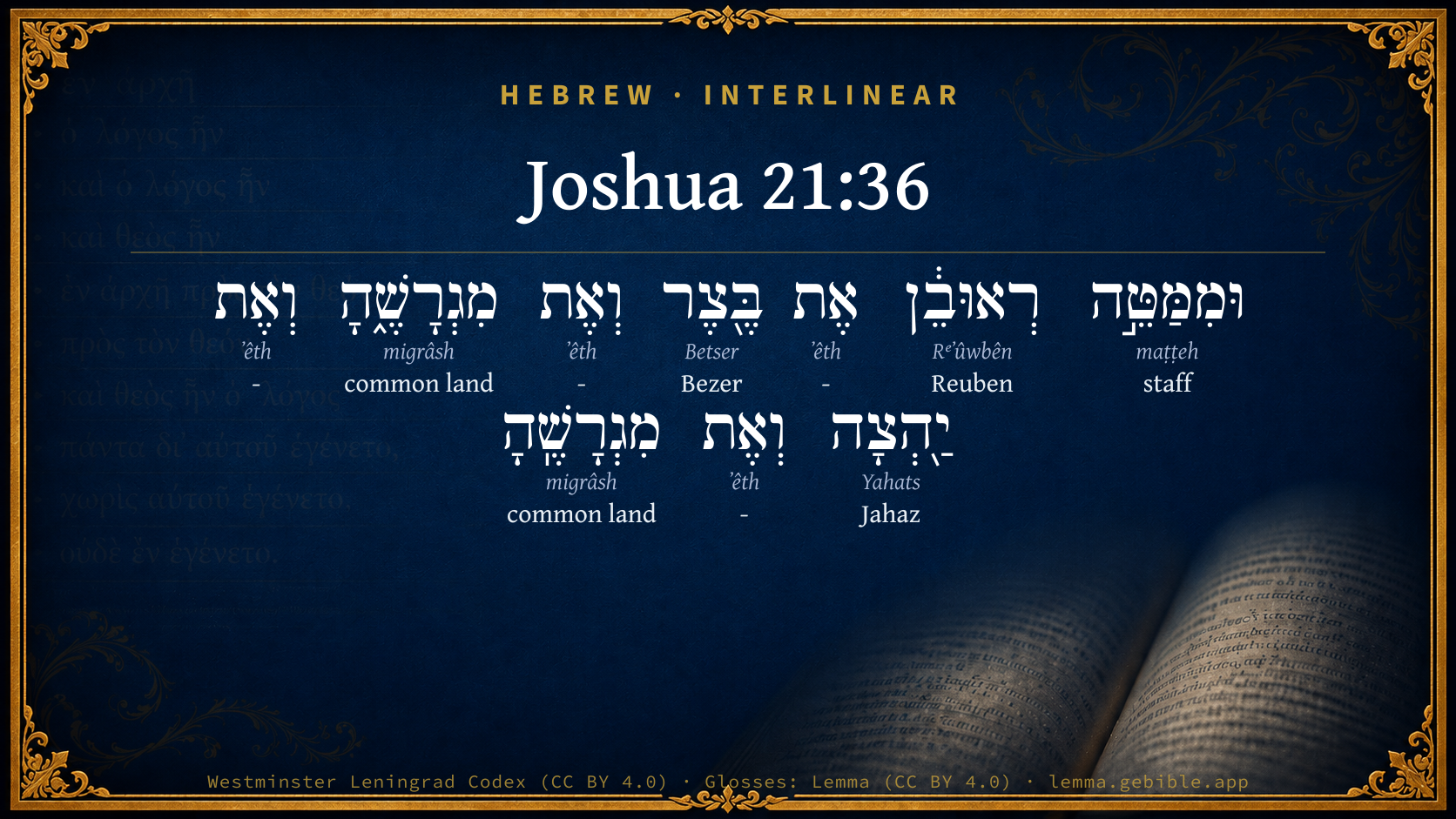
Joshua 21:36

Hebrew (Westminster Leningrad Codex) Joshua 21:36 appears in the Hebrew Old Testament. The text above is from the Westminster Leningrad Codex. Each word links to its Strong’s number, a concise gloss, and parsing drawn from the Open Scriptures Hebrew Bible morphology. Click any word for its full Brown-Driver-Briggs (BDB) entry.
Download image
Cite this verse

Joshua 21:36 (World English Bible). Public Domain. Lemma interlinear Bible study tool, https://lemma.gebible.app/v/joshua/21/36.

Show BibTeX & RIS
BibTeX
RIS
English Translation
Out of the tribe of Reuben, Bezer with its suburbs, and Jahaz with its suburbs,
World English Bible · Public Domain
Download a study sheet

One document with this verse’s original text, its word-by-word gloss line, the meaning frame, cross-references with their text, attributed commentary, and full source and license credits — printable, and it pastes into notes with its structure intact.

This verse Autodidact and up

Study sheet (.html) Plain text (.txt)

A passage Seminary Student

Up to 50 verses in one chapter. A passage sheet keeps up to 6 commentary sources and 12 cross-references per verse, in the order this page ranks them, and says so on the sheet whenever that leaves anything out. Ask for a single verse and you get the Autodidact verse sheet above.

Everything on this page stays free to read, with no account — the sheet is a download of what is already on screen, not access to it.

Want to remove ads? Support Godless Engineer
Compare translations 3

The same verse in 3 English versions, stacked beneath the original-language interlinear above. Click any original word for its lexicon entry.

Each is an independent rendering of the whole verse — the interlinear is not word-aligned to these translations.

Highlighted words mark where these versions differ — a whole-verse word diff, not a word-by-word alignment.

  • World English Bible Public Domain
    Out of the tribe of Reuben, Bezer with its suburbs, and Jahaz with its suburbs,
  • King James Version Public Domain
    And out of the tribe of Reuben, Bezer with her suburbs, and Jahazah with her suburbs,
  • unfoldingWord Literal Text CC BY-SA 4.0
    And from the tribe of Reuben, Bezer and its pasturelands and Jahaz and its pasturelands,

unfoldingWord Literal Text — © unfoldingWord, licensed CC BY-SA 4.0. Word-aligned USFM3 via Door43 (git.door43.org/unfoldingWord/en_ult).

Versions to compare (up to 4)

3 of 4 selected

Show all 18 translations

Every available English version of this verse, each an independent rendering of the whole verse.

  • World English Bible Public Domain
    Out of the tribe of Reuben, Bezer with its suburbs, and Jahaz with its suburbs,
  • Berean Standard Bible Public Domain
    From the tribe of Reuben they were given Bezer, Jahaz,
  • Majority Standard Bible Public Domain
    From the tribe of Reuben they were given Bezer, Jahaz,
  • King James Version Public Domain
    And out of the tribe of Reuben, Bezer with her suburbs, and Jahazah with her suburbs,
  • American Standard Version (1901) Public Domain
    And out of the tribe of Reuben, Bezer with its suburbs, and Jahaz with its suburbs,
  • Revised Version (1885) Public Domain
    And out of the tribe of Reuben, Bezer with her suburbs, and Jahaz with her suburbs,
  • Geneva Bible (1599) Public Domain
    And out of the tribe of Reuben, Bezer with her suburbs, and Iahazah with her suburbs,
  • Douay-Rheims (1899) Public Domain
    Of the tribe of Ruben beyond the Jordan over against Jericho, Bosor in the wilderness, one of the cities of refuge, Miser and Jaser and Jethson and Mephaath, four cities with their suburbs.
  • Young's Literal Translation Public Domain
    And out of the tribe of Reuben, Bezer and its suburbs, and Jahazah and its suburbs,
  • Literal Standard Version CC BY-SA 4.0
    And out of the tribe of Reuben, Bezer and its outskirts, and Jahazah and its outskirts,
  • Unlocked Literal Bible CC BY-SA 4.0
    To the clans of Merari were given from the tribe of Reuben: Bezer with its pasturelands, Jahaz with its pasturelands,
  • unfoldingWord Literal Text CC BY-SA 4.0
    And from the tribe of Reuben, Bezer and its pasturelands and Jahaz and its pasturelands,
  • Darby Bible Public Domain
    and out of the tribe of Reuben, Bezer and its suburbs, and Jahzah and its suburbs,
  • World Messianic Bible Public Domain
    Out of the tribe of Reuben, Bezer with its pasture lands, Jahaz with its pasture lands,
  • Webster's Bible Public Domain
    And out of the tribe of Reuben, Bezer with its suburbs, and Jahazah with its suburbs,
  • Free Bible Version CC BY-SA 4.0
    From the tribe of Reuben the following four towns and their pastures: Bezer, Jahaz,
  • Bible in Basic English Public Domain
    And from the tribe of Reuben, Bezer and Jahaz with their grass-lands;
  • JPS Tanakh (1917) Public Domain
    And out of the tribe of Reuben, Bezer with the open land about it, and Jahaz with the open land about it;

Literal Standard Version (2020), Covenant Press — licensed CC BY-SA 4.0. Text via the HelloAO Bible API (eBible.org). Unlocked Literal Bible (unfoldingWord) — licensed CC BY-SA 4.0. Text via the HelloAO Bible API (eBible.org). unfoldingWord Literal Text — © unfoldingWord, licensed CC BY-SA 4.0. Word-aligned USFM3 via Door43 (git.door43.org/unfoldingWord/en_ult). Free Bible Version, Dr. Jonathan Gallagher — licensed CC BY-SA 4.0. Text via the HelloAO Bible API (eBible.org).

Word by word

More ways to search: Search by grammar → Find every occurrence → Compare this word →

Practice this passage: Drill this verse → Learn its vocabulary →

בֶּ֖צֶר
Betser
H1221
“Bezer”
Noun, Proper
Part of Speech
Noun
Type
Proper
Full BDB Definition

Origin: the same as H1220

TWOT: None

Bezer = "gold ore" or " remote fortress" - son of Zophah, one of the heads of the houses of Asher (noun proper masculine) - a city of refuge in Reuben in the downs on the east of the Jordan (noun proper locative)
  1. וּמִמַּטֵּ֣ה maṭṭeh H4294 “and · from · staff of” Conjunction + Preposition + Noun, Common, Masculine, Singular, Construct
  2. רְאוּבֵ֔ן Rᵉʼûwbên H7205 “Reuben” Noun, Proper
  3. אֶת ʼêth H853 “-” Particle, Direct Object
  4. וְאֶת ʼêth H853 “and · -” Conjunction + Particle, Direct Object
  5. מִגְרָשֶׁ֑הָ migrâsh H4054 “common lands · her” Noun, Common, Masculine, Plural, Construct + Suffix, Personal, 3rd Person, Feminine, Singular
  6. וְאֶת ʼêth H853 “and · -” Conjunction + Particle, Direct Object
  7. יַ֖הְצָה Yahats H3096 “Jahaz · toward” Noun, Proper + Suffix, Demonstrative
  8. וְאֶת ʼêth H853 “and · -” Conjunction + Particle, Direct Object
  9. מִגְרָשֶֽׁהָ migrâsh H4054 “common lands · her” Noun, Common, Masculine, Plural, Construct + Suffix, Personal, 3rd Person, Feminine, Singular

About this verse

These counts appear in no published source. They are computed here, from the morphology-tagged text and Lemma’s own curated glosses. What Lemma adds →

10
words
6
distinct lemmas
Historical
section

Notable vocabulary

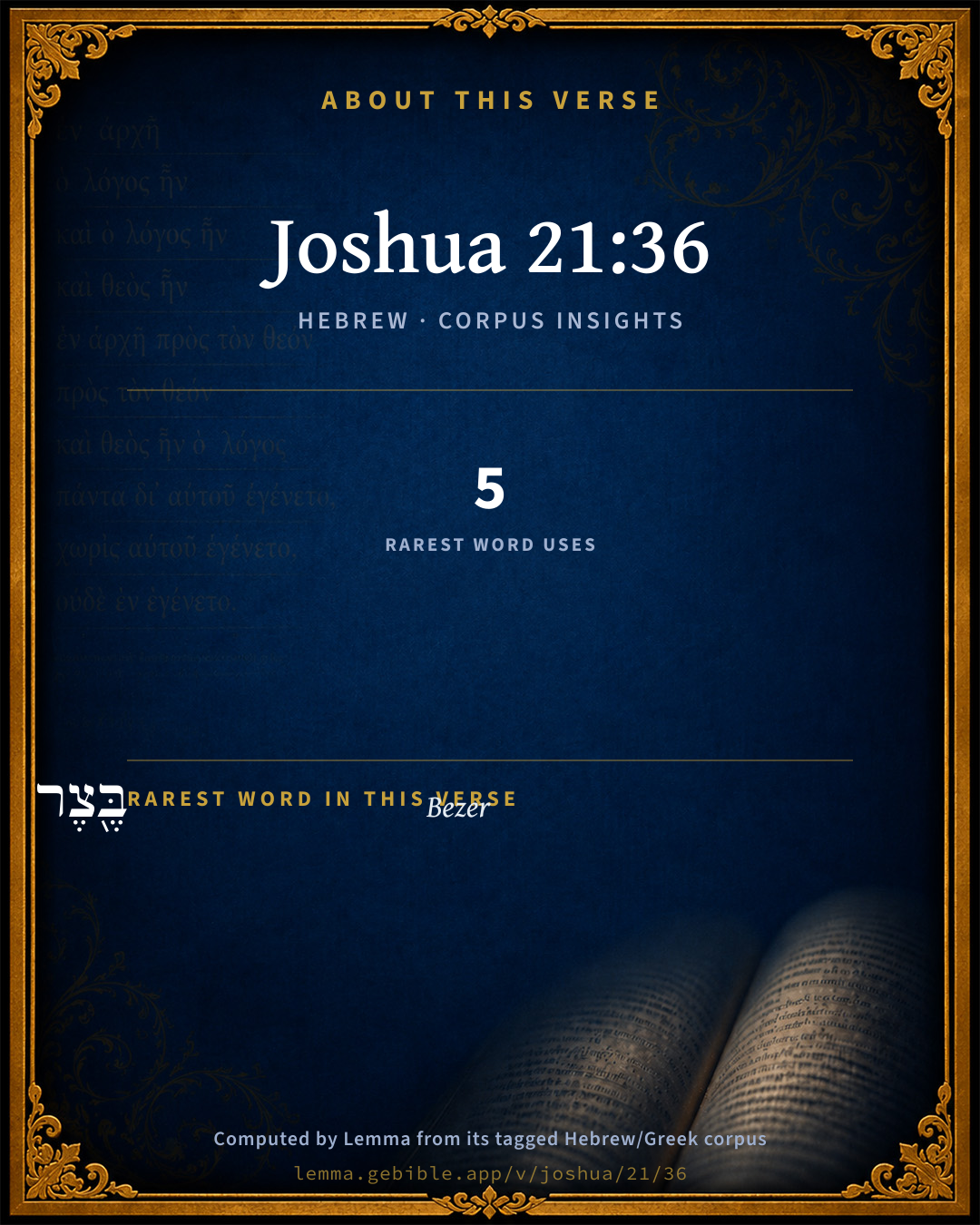
The rarest word here is בֶּ֖צֶר Bezer H1221 — appearing just 5 times in the whole Hebrew Bible.

Shared distinctive vocabulary

בֶּ֖צֶר Bezer H1221 occurs in 5 verses of the Hebrew Bible. Also found in:

Grammatical profile

  • 6 nouns
  • 4 particles

Repetition

A word recurs within this verse — often emphatic in Hebrew:

  • מִגְרָשֶׁ֑הָ common land H4054 ×2

Hebrew & Septuagint length

In English translation the verse runs 15 words from the Hebrew and 44 from the Septuagint (LXX English) — the Septuagint runs noticeably longer here. See the side-by-side →

A rough comparison of the two English renderings, which tokenize alike — not a word-level alignment.

Word counts can differ between the Hebrew and the Greek without any difference in meaning — e.g. the Hebrew direct-object marker אֵת has no separate Greek word, and Greek often adds the article ὁ.

Cross-references

5

Topical passages linked to Joshua 21:36 in the Treasury of Scripture Knowledge — connected by theme and wording, ordered by reader-vote popularity; previews shown in the World English Bible.

  • Joshua 20:8 Beyond the Jordan at Jericho eastward, they assigned Bezer in the wilderness in the plain out of the tribe of Reuben, and Ramoth in Gilead out of the tribe of Gad, and Golan in Bashan out of the tribe of Manasseh.
  • Deuteronomy 4:43 [namely], Bezer in the wilderness, in the plain country, for the Reubenites; and Ramoth in Gilead, for the Gadites; and Golan in Bashan, for the Manassites.
  • Numbers 21:23 Sihon would not allow Israel to pass through his border: but Sihon gathered all his people together, and went out against Israel into the wilderness, and came to Jahaz; and he fought against Israel.
  • Joshua 13:18 and Jahaz, and Kedemoth, and Mephaath,
  • 1 Chronicles 6:78–79 and beyond the Jordan at Jericho, on the east side of the Jordan, [were given them], out of the tribe of Reuben, Bezer in the wilderness with its suburbs, and Jahzah with its suburbs,

Cross-references courtesy of OpenBible.info (CC BY 4.0).

Hebrew and Greek witnesses Masoretic Hebrew ↔ Greek Septuagint

The same verse in the two great witnesses to the Old Testament, shown verse-for-verse.

Here the Septuagint runs noticeably longer than the Hebrew — LXX2012 (modern English Septuagint) 44 words vs World English Bible 15. A rough length comparison of the two English translations, not a word-level alignment — read both below.

These are two independent witnesses, not word-aligned to each other, and the Septuagint is shown in lemma (dictionary) form.

Hebrew Joshua 21:36 Masoretic · Westminster Leningrad Codex

וּמִמַּטֵּ֣ה רְאוּבֵ֔ן אֶת בֶּ֖צֶר וְאֶת מִגְרָשֶׁ֑הָ וְאֶת יַ֖הְצָה וְאֶת מִגְרָשֶֽׁהָ

Out of the tribe of Reuben, Bezer with its suburbs, and Jahaz with its suburbs,

World English Bible · Public Domain

Greek LXX Joshua 21:36 Septuagint · lemma form

καί πέραν ὁ ἰορδάνης ὁ κατά ιεριχω ἐκ ὁ φυλή ρουβην ὁ πόλις ὁ φυγαδευτήριον ὁ φονεύω ὁ βοσορ ἐν ὁ ἔρημος ὁ μισωρ καί ὁ περισπόριον αὐτός καί ὁ ιαζηρ καί ὁ περισπόριον αὐτός

And beyond Jordan over against Jericho, out of the tribe of Ruben, the city of refuge for the slayer, Bosor in the wilderness; Miso and its suburbs; and Jazer and its suburbs; and Decmon and its suburbs; and Mapha and its suburbs; four cities.

LXX2012 (modern English Septuagint) · Public Domain

On this verse, Haydock's Catholic Bible Commentary discusses the Septuagint’s reading. Read the note in Commentary ↓

Hebrew: Westminster Leningrad Codex (CC BY 4.0). Greek: Septuagint (public domain); English from LXX2012 (modern English Septuagint) (Public Domain). How the Septuagint differs from the Hebrew →

Targum (Aramaic paraphrase)

1

The Targum is the ancient Jewish Aramaic paraphrase of the Hebrew Scriptures — an interpretive translation, not the Hebrew text itself. Onkelos (literal) and Pseudo-Jonathan (expansive) render the Torah, and Jonathan the Prophets. Coverage is partial: where no permissively-licensed English translation exists for a verse, only the Aramaic is shown. This is verse-level text, not a word-by-word alignment to the Hebrew.

  1. Targum Jonathan Prophets (Joshua–Malachi)
    (וּמִשִׁבְטָא דִרְאוּבֵן יַת קִרְיַת שֵׁזָבוּת קָטוֹלָא יַת בֶּצֶר בְּמַדְבְּרָא יַת יָהְצָה וְיַת רְוָחָהָא:

    (no public-domain English translation for this verse)

    Targum Jonathan — Aramaic: “Mikraot Gedolot” (public domain). English: “Sefaria Community Translation” (CC0 1.0 (public-domain dedication)); “London "Chaldee Paraphrase," 1871” (public domain). Text via Sefaria.

Commentary

Notes on Joshua 21:36 from classic Christian and Jewish commentators (each source and its license shown beneath its notes). The classic Christian expositions comment on the surrounding passage and are grouped to its opening verse, so a note may address several verses; the Jewish commentaries on the Tanakh (Rashi and others) are per-verse, so they appear only where the commentator wrote on this verse.

Lemma curates 59 commentaries, every one of them public domain or Creative Commons licensed, each selected and text-cleaned for this edition rather than reprinted as found. About our sources →

Geneva Bible (1599)

Geneva Bible translators

Bezer and Ramoth were the cities of refuge under the Merarites and beyond Jordan, Josh. 20:8.

Geneva Bible (1599) marginal notes — public domain. Text via Bolls.life.

Adam Clarke's Commentary

Verse 36. Jahazah] See Clarke on Jos 13:18.

Adam Clarke's Commentary on the Bible (1810–1826) — public domain. Text from a community e-Sword/MySword module.

The Cambridge Bible for Schools and Colleges

gen. ed. J. J. S. Perowne

36. Bezer] See ch. Jos_20:8; Jahazah, ch. Jos_13:18 (Heb.).

The Cambridge Bible for Schools and Colleges (gen. ed. J. J. S. Perowne; Cambridge University Press, 1878–1918) — public domain. Text from a community e-Sword module.

John Gill's Exposition

And out of the tribe of Reuben, Bezer with her suburbs,.... Which was a city of refuge, and the fifth of them in this account, though not observed as such here, but is in the Greek version; see Jos 20:8,

and Jahazah with her suburbs; called Jahaz; see Gill on Num 21:23.

John Gill's Exposition of the Whole Bible (1746–1763) — public domain (CC PDM 1.0). Text via the HelloAO Bible API.

Haydock's Catholic Bible Commentary

Four cities. There are no more, though there be five names: for Misor is the same city as Bosor, which is to be observed in some other places, where the number of names exceeds the number of cities. (Challoner) --- With regard to the 36th and 37th verses, there seems to have been great confusion in the Hebrew manuscripts both ancient and modern. In some they have been totally omitted, in others only a part. (Haydock) --- The famous manuscript of Hillel, and the Masorets, reject them, (Calmet) because they had reckoned only 656 verses in Josue, and these two verses would destroy their authority. Hence they erased them wherever they might be found; and Kimchi assures us, that he never could meet with them "in any manuscript (thus) corrected." Yet the Paralipomena universally acknowledge them, (Kennicott) as the context of Josue must also do, otherwise there will be only eight cities instead of twelve, and four will be wanting to complete the number of forty-eight. The Protestant version therefore is forced to admit them, (Haydock) as they are found in the Eng. Polyglot, on the authority of some ancient manuscripts. They do not, however, express them so fully as the Septuagint have done. (Kennicott) --- These read, "And beyond the Jordan, over-against Jericho, out of the tribe of Ruben, the city of refuge for the slayer Bosor, in the wilderness, (Misor) and her suburbs, and Jazer and her suburbs, (37) and Gedson and her suburbs, and Mapha (Alexandrian copy reads Maspha) and her suburbs, four cities." (Grabe) --- Protestants only admit, "And out of the tribe of Ruben, Bezer with her suburbs, and Jahazah....Kedemoth....and Mephaath with her suburbs, four cities." Kennicott finds in some Hebrew manuscripts, "the city of refuge for the slayer, Bosor;" one manuscript has, "in the wilderness," &c. (Haydock) --- These verses were not in the Hebrew text of the Hexapla, as they are obelized in the Septuagint and in the Syriac manuscript of Masius; and yet, as they are found in the old Greek and Syriac versions, and in the Chaldean paraphrase, they were probably omitted between the year 100 and 200. They are left out in several printed editions of the Hebrew Bible, and even in that of Jablonski, (1699) though in opposition to his better judgment and all the manuscripts which he had consulted: legunt omnia nostra manuscripts. Michaelis (1720) reprinted this text, with some few emendations, particularly with these two verse very laudably inserted. (Kennicott, 2 Diss.) --- In the Bened.[Benedictine?] edition of St. Jerome, Martianay observes, that the Hebrew manuscripts of St. Jerome seem to have been mutilated, for if they had admitted this 36th verse, St. Jerome would have translated it, and it would have been found in the more ancient manuscripts of the Latin edition, where it is wanting. Hence this editor leaves it out. He also remarks that other Hebrew manuscripts omit "a city of refuge for the slayer, in the desert." The last word, he says, occurs in several copies of the best not; and Houbigant inserts it on the authority of the oratorian manuscript 54. (Haydock) --- In some editions of the Vulgate, this verse is transposed, and placed after the cities of Gad. (Louvain; R. Steph.; &c.) --- It is therefore, probably that St. Jerome found it not in Hebrew but, if he inserted it, he borrowed it from the Septuagint. The Syriac version places these verses before the 34th and 35th. All this shews that the Hebrew manuscripts have not been kept with great care in this place. Some have surmised that the Septuagint have inserted this necessary supplement from Paralipomenon. But they do not entirely agree with that book, so that it seems that they found these verses in their Hebrew copies. (Calmet) --- We have already given the Hebrew and Septuagint as it is found in the common editions. In Paralipomenon (vi. 78,) it is thus expressed: Beyond the Jordan also, over-against Jericho, on the east side of the Jordan, out of the tribe of Ruben, Bosor in the wilderness, with its suburbs, and Jassa....79. Cademoth also....and Mephaath with its suburbs. The word Misor, which Grabe’s Septuagint and the Vulgate leave untranslated, is the Hebrew word which denotes a plain, (Haydock) as Aquila and Symmachus agree, and as appears [in] chap. xx. 8. Deuteronomy iv. 43, where Bosor is said to have been upon the plain of the wilderness. This city was the famous Bosra, in the desert Arabia, between Philadelphia and Jazer, towards the east. (Calmet) --- We might translate, "the cities of refuge, Bosor in the wilderness, which is also the plain" of Moab, ver. 21. (Haydock) --- Jaser, or Jassa, (chap. xiii. 18,) different from that [in] ver. 37, which lay on the river of the same name in the tribe of Gad. (Calmet)

George Leo Haydock (1774–1849), Haydock's Catholic Family Bible and Commentary, 1859 edition — public domain. Excludes Psalms (Douay-Rheims chapter numbering differs from Protestant) and Deuterocanonical books (Catholic canon only).

Matthew Poole's English Annotations

Bezer, a city of refuge, as it is called Jos 20:8, and therefore needless to be here repeated.

Matthew Poole's English Annotations on the Holy Bible (1683–1685) — public domain. Text from a community e-Sword/MySword module.

The Pulpit Commentary

And out of the tribe of Reuben. This verse and the succeeding have the Masoretic note appended that they are not found in the Masora or true tradition. Kimchi therefore rejects them. But they are found in the LXX and the rest of the ancient versions, and they are necessary to make up the number of forty-eight cities. Dr. Kennicott, as well as Michaelis, Rosenmuller, and Maurer defended their genuineness. So does Knobel, who complains that Rabbi Jacob Ben Chajim, in his Rabbinical Bible of 1525, has very improperly omitted these towns on the authority of the Masora, and that many editors have foolishly imitated him They have no doubt been omitted by the mistake of a copyist, who passed on from the bra (four) of ver. 35 to that of ver. 37, omitting all that lay between. The LXX adds here "the city of refuge for the slayer," words which may have possibly formed part of the original text, as they do in every other instance. Jahazah. It is worthy of remark that this city, with Heshbon and Jazer and Mephaath, fell into the hands of the Moabites in later times, a sad indication of religious declension. (see Isa 15,isa 16 Jer_48:21, Jer_48:34)

The Pulpit Commentary (1880–1919), ed. H.D.M. Spence-Jones & Joseph S. Exell — public domain. Text from a community e-Sword module.

unfoldingWord translationNotes

Door43 World Missions Community

To the clans of Merari were given from the tribe of Reuben: Bezer

This can be stated in active form. AT: "The clans of Merari received from the tribe of Reuben Bezer" (See: Active or Passive)

four cities

This refers to the total number of cities. (See: Numbers)

Bezer ... Jahaz ... Kedemoth ... Mephaath ... Ramoth

names of cities (See: How to Translate Names)

Out of the tribe of Gad they were given Ramoth

This can be stated in active form. AT: "They received from the tribe of Gad Ramoth" (See: Active or Passive)

Mahanaim

This is the name of a city. (See: How to Translate Names)

translationWords

clan

tribe

Reuben

Gad

Gilead

unfoldingWord translationNotes — © Distant Shores Media and the Door43 World Missions Community, licensed CC BY-SA 4.0. Source: git.door43.org/Door43/en_tn.

Lesson kit

Teaching starters — assembled from the data on this page, not authored interpretation. Every prompt links to the verse data it draws on. Edit before teaching.

Joshua, in the Historical, opens this verse with 10 words (6 distinct Hebrew lemmas). Its most distinctive word is Betser (“Bezer”). The Greek Septuagint runs longer here. A historical commentator’s framing appears above. Read the whole chapter for the surrounding context.

Discussion questions

  1. The word Betser carries the sense “Bezer.” How does it shape the verse?
  2. Deuteronomy 4:43 shares the word «Bezer» with this verse. How do the two illuminate each other?
  3. “common land” occurs 2× in this one verse. What is the effect of the repetition?
  4. Compared with the Hebrew, the Septuagint runs longer here. What questions does that raise?
  5. These translations render this verse differently; the difference is in the English rendering, not the original. What questions does that raise?
  6. Reading how Geneva Bible (1599) and Adam Clarke's Commentary read this verse, where do the two commentators agree and where do they part?

Things to notice

  • These translations choose different wording for 5 words in this verse.
  • “common land” occurs 2× in this single verse.
  • 6 distinct Hebrew lemmas span 10 words in this verse.

Reading settings

Reading text

Shown beneath each verse's original-language words.

Old Testament
Old Testament edition

Read the OT as the Masoretic Hebrew (MT) or the Greek Septuagint (LXX).

English shown for the Greek Septuagint (in the Hebrew ↔ Greek comparison).

Comparing translations? Open the Compare panel on any verse page to stack up to four side by side.