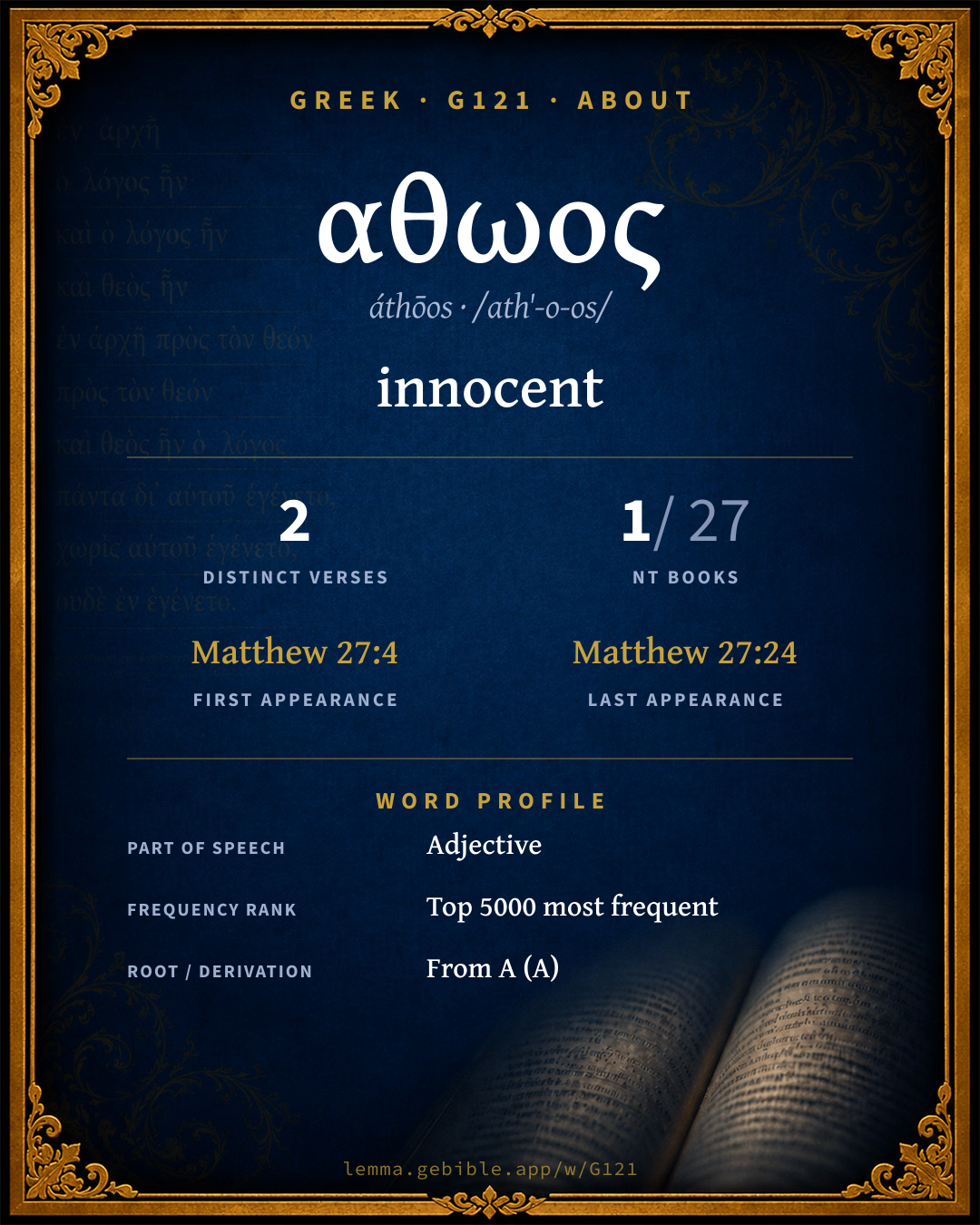
ἄθωος
innocent
Full lexicon entry — Thayer's Greek Lexicon
From Thayer's Greek Lexicon
Where this word appears
See every Accusative-case word in the Greek New Testament →
Grammar key — what these labels mean
Part of speech
- Adjective
- A word that describes or qualifies a noun.
Case
- Accusative
- The case of the direct object and of extent.
- Nominative
- The case of the subject (and the predicate nominative).
Gender
- Neuter
- Grammatically neuter.
- Masculine
- Grammatically masculine.
Number
- Singular
- One.
Grammatical forms
- Adjective, Accusative, Singular, Neuter 1 time (50%)
- Adjective, Nominative, Singular, Masculine 1 time (50%)
Parsed forms decoded from the imported morphology (Robinson–Tischendorf, public domain), counted across 2 parsed occurrences — not distinct verses.
Every verse where G121 appears — 2 distinct verses across 1 book. Click any verse to open its interlinear word-by-word view. Verse text shown in the World English Bible for context — . Each verse’s Greek form is shown with its reference; the English is not keyword-highlighted, since the data carries no word-level English alignment. Use “Compare translations” on any verse to read it across multiple English versions. This concordance covers the Greek New Testament; Septuagint (Greek Old Testament) occurrences of this word are not indexed here.
Matthew 2 verses
- Matthew 27:4 ἀθῷον adj acc sg neut saying, "I have sinned in that I betrayed innocent blood." But they said, "What is that to us? You see to it."
- Matthew 27:24 ἀθῷός adj nom sg masc So when Pilate saw that nothing was being gained, but rather that a disturbance was starting, he took water, and washed his hands before the multitude, saying, "I am innocent of the blood of this righteous person. You see to it."
About this entry
At a glance — auto-summarized from this page’s data, not written by a person. Every figure links to its source below. This summary describes the numbers; it doesn’t interpret them.
The Greek adjective αθωος centers on the idea of “innocent.” A scarce word — 2 verses in all of the Greek New Testament. Matthew dominates its distribution — 2 of 2 verses. Debuting at Matthew 27:4, it then recurs through the corpus. Sharing its root, it stands alongside Α, αβαρης and αβυσσος. For the data behind this summary, explore the sense tree and the renderings breakdown below.
Gloss history
Strong's 1890 vs modern scholarship
About this word
Strong's G121 catalogs a Greek word from the Greek New Testament.
These counts are not copied from any lexicon or concordance. They are computed here, from the morphology-tagged Greek New Testament. What Lemma adds →
- 2
- distinct verses
- The word appears in 2 distinct verses.
- 1 / 27
- NT books
- The word appears in 1 of 27 New Testament books.
- #2,678
- by frequency
- Top 5000 most frequent Greek words (rank 2,678 of 5,347 Greek words by occurrence).
View all 2 occurrences in the concordance →
Most concentrated in
- Matthew 2 verses 100%
By section of the New Testament
By traditional corpus
Conventional, traditional groupings — biblical authorship is debated, so this is a traditional corpus grouping, not an authorship claim. Some books belong to more than one corpus (Luke is in both the Gospels and the Lukan corpus, and so on), so these shares overlap and need not total 100%. Each figure is a share of the word’s 2 distinct verses.
- Gospels 2 verses · 100%
How translations render this word
Counts come from each version’s own published word-to-Strong’s tagging or interlinear alignment — an approximate guide to how each version renders this word, not a word-level alignment the data otherwise carries. Because each total is that version’s own tagged count, the per-version totals vary from one another and need not match the appearance or distinct-verse counts above. These counts may also differ from a printed concordance because Lemma counts each distinctly tagged rendering and does not collapse phrase taggings into a single head-word total. This is a fixed set of word-tagged versions (KJV, ASV, BSB, ULT) and does not change with the reading translation you choose elsewhere. Each version’s license is shown beside its name below (and on Sources).
- King James Version: Innocent 2×
- American Standard Version: Innocent 2×
- Berean Standard Bible: Innocent 2×
- unfoldingWord Literal Text: Innocent 2×
King James Version Public Domain
Renders G121 across 2 tagged occurrences — most commonly:
American Standard Version Public Domain
Renders G121 across 2 tagged occurrences — most commonly:
Berean Standard Bible Public Domain
Renders G121 across 2 tagged occurrences — most commonly:
unfoldingWord Literal Text CC BY-SA 4.0
Renders G121 across 2 tagged occurrences — most commonly:
Senses in Thayer's
The 1 sense Thayer's distinguishes for this word, in lexicon order (not ranked by frequency or importance). The full entry — with sub-senses — is in the Lexicon Entry tab.
- not guilty, innocent, unpunished
Word origin
Derived from Α (A) (G1) — alpha.
Forms in the corpus
The 2 distinct written forms G121 takes in the Greek New Testament, most frequent first — each parse links to that case’s occurrences in the concordance.
| Form | Parsing | Example | Uses |
|---|---|---|---|
| ἀθῷον athō̂on | Adjective, Accusative, Singular, Neuter | Matthew 27:4 | 1 |
| ἀθῷός athō̂ós | Adjective, Nominative, Singular, Masculine | Matthew 27:24 | 1 |
Same root — word family
Other Thayer's entries built from the same root as G121, grouped by Strong’s listed origin. These share a root / origin per the lexicon — not necessarily a shared meaning. Each links to that word’s own entry.
Derives from
Shares the same root
- αβαρης abarḗs G4 light
- αβυσσος ábyssos G12 abyss
- αγαμος ágamos G22 unmarried
- αγενεαλογητος agenealógētos G35 without genealogy
- αγενης agenḗs G36 ignoble
- αγναφος ágnaphos G46 unprocessed
- αγνοεω agnoéō G50 to be ignorant
- αγνωσια agnōsía G56 ignorance
- αγνωστος ágnōstos G57 unknown
- αγραμματος agrámmatos G62 unlearned
- αγρυπνεω agrypnéō G69 to watch
- αδαπανος adápanos G77 free
- αδελφος adelphós G80 brother
- αδηλος ádēlos G82 obscure
- αδης háidēs G86 hell
- αδιακριτος adiákritos G87 clear
- αδιαλειπτος adiáleiptos G88 continual
- αδικος ádikos G94 unjust
- αδοκιμος adókimos G96 unapproved
- αδολος ádolos G97 guileless
- αδυνατος adýnatos G102 weak
- αζυμος ázymos G106 unleavened
- αθανασια athanasía G110 immortal
- αθεμιτος athémitos G111 unlawful
+149 more words share this root (not shown).
Proper names from this root
People and places named from this root — a name, not an additional meaning of the word.
Compare all same-root words → Showing 4 of 176 — not the complete family. 1 of the same-root words is a proper name (a person or place). They share a root, not necessarily a meaning.
Septuagint usage
The same Greek word αθωος appears 46 times in the Greek Old Testament (Septuagint), across 42 verses in 13 books.
- 46
- LXX occurrences
- Tagged occurrences of this Greek word in the Septuagint.
- 42
- verses
- Distinct Septuagint verses containing this word.
- 13 / 39
- OT books
- The word appears in 13 of the 39 Old Testament books.
Sample Septuagint occurrences
- Genesis 24:41 ἀθῷος
- Exodus 21:19 ἀθῷος
- Numbers 5:19 ἀθῷος
- Deuteronomy 24:5 ἀθῷος
- Joshua 2:17 ἀθῷος
- 1 Samuel 19:5 ἀθῷος
- 2 Samuel 3:28 ἀθῷος
- 1 Kings 2:5 ἀθῷος
- 2 Kings 21:16 ἀθῷος
- 2 Chronicles 36:5 ἀθῷος
- Job 9:28 ἀθῷος
- Psalms 9:29 ἀθῷος
Septuagint occurrences (same lexeme)
Every verse where the same Strong’s number (G121) appears in the Greek Septuagint. Verse text shown in the World English Bible for context; the Greek form is the matched word — the English is not keyword-highlighted.
- Genesis 24:41 ἀθῷος Then will you be clear from my oath, when you come to my relatives. If they don't give her to you, you shall be clear from my oath.'
- Exodus 21:19 ἀθῷος if he rises again and walks around with his staff, then he who struck him shall be cleared: only he shall pay for the loss of his time, and shall provide for his healing until he is thoroughly healed.
- Exodus 21:28 ἀθῷος "If a bull gores a man or a woman to death, the bull shall surely be stoned, and its flesh shall not be eaten; but the owner of the bull shall not be held responsible.
- Exodus 23:7 ἀθῷος "Keep far from a false charge, and don't kill the innocent and righteous: for I will not justify the wicked.
- Numbers 5:19 ἀθῷος The priest shall cause her to swear, and shall tell the woman, 'If no man has lain with you, and if you haven't gone aside to uncleanness, being under your husband, be free from this water of bitterness that brings a curse.
- Numbers 5:28 ἀθῷος If the woman isn't defiled, but is clean; then she shall be free, and shall conceive seed.
- Numbers 5:31 ἀθῷος The man shall be free from iniquity, and that woman shall bear her iniquity."
- Numbers 32:22 ἀθῷος and the land is subdued before Yahweh; then afterward you shall return, and be guiltless towards Yahweh, and towards Israel; and this land shall be to you for a possession before Yahweh.
- Deuteronomy 24:5 ἀθῷος When a man takes a new wife, he shall not go out in the host, neither shall he be charged with any business: he shall be free at home one year, and shall cheer his wife whom he has taken.
- Deuteronomy 27:25 ἀθῷος Cursed be he who takes a bribe to kill an innocent person. All the people shall say, Amen.
- Joshua 2:17 ἀθῷος The men said to her, We will be guiltless of this your oath which you have made us to swear.
- Joshua 2:19 ἀθῷος It shall be, that whoever shall go out of the doors of your house into the street, his blood shall be on his head, and we shall be guiltless: and whoever shall be with you in the house, his blood shall be on our head, if any hand be on him.
- Joshua 2:20 ἀθῷος But if you utter this our business, then we shall be guiltless of your oath which you have made us to swear.
- 1 Samuel 19:5 ἀθῷος for he put his life in his hand, and struck the Philistine, and Yahweh worked a great victory for all Israel: you saw it, and did rejoice; why then will you sin against innocent blood, to kill David without a cause?
- 1 Samuel 25:26 ἀθῷος Now therefore, my lord, as Yahweh lives, and as your soul lives, seeing Yahweh has withheld you from blood guiltiness, and from avenging yourself with your own hand, now therefore let your enemies, and those who seek evil to my lord, be as Nabal.
- 1 Samuel 25:31 ἀθῷος that this shall be no grief to you, nor offense of heart to my lord, either that you have shed blood without cause, or that my lord has avenged himself. When Yahweh shall have dealt well with my lord, then remember your handmaid.
- 2 Samuel 3:28 ἀθῷος Afterward, when David heard it, he said, I and my kingdom are guiltless before Yahweh forever of the blood of Abner the son of Ner:
- 2 Samuel 14:9 ἀθῷος The woman of Tekoa said to the king, My lord, O king, the iniquity be on me, and on my father's house; and the king and his throne be guiltless.
- 1 Kings 2:5 ἀθῷος Moreover you know also what Joab the son of Zeruiah did to me, even what he did to the two captains of the hosts of Israel, to Abner the son of Ner, and to Amasa the son of Jether, whom he killed, and shed the blood of war in peace, and put the blood of war on his sash that was about his loins, and in his shoes that were on his feet.
- 2 Kings 21:16 ἀθῷος Moreover Manasseh shed innocent blood very much, until he had filled Jerusalem from one end to another; besides his sin with which he made Judah to sin, in doing that which was evil in the sight of Yahweh.
- 2 Kings 24:4 ἀθῷος and also for the innocent blood that he shed; for he filled Jerusalem with innocent blood: and Yahweh would not pardon.
- 2 Chronicles 36:5 ἀθῷος Jehoiakim was Twenty-five years old when he began to reign; and he reigned eleven years in Jerusalem: and he did that which was evil in the sight of Yahweh his God.
- Job 9:28 ἀθῷος I am afraid of all my sorrows, I know that you will not hold me innocent.
- Job 10:14 ἀθῷος If I sin, then you mark me. You will not acquit me from my iniquity.
- Job 12:6 ἀθῷος The tents of robbers prosper, Those who provoke God are secure; Who carry their God in their hands.
- Job 22:30 ἀθῷος He will even deliver him who is not innocent; Yes, he shall be delivered through the cleanness of your hands."
- Psalms 9:29 ἀθῷος
- Psalms 14:5 ἀθῷος There they were in great fear, For God is in the generation of the righteous.
- Psalms 17:26 ἀθῷος
- Psalms 23:4 ἀθῷος Even though I walk through the valley of the shadow of death, I will fear no evil, for you are with me. Your rod and your staff, they comfort me.
- Psalms 25:6 ἀθῷος Yahweh, remember your tender mercies and your loving kindness, For they are from old times.
- Psalms 72:13 ἀθῷος He will have pity on the poor and needy. He will save the souls of the needy.
- Psalms 93:21 ἀθῷος
- Psalms 105:38 ἀθῷος Egypt was glad when they departed, For the fear of them had fallen on them.
- Jeremiah 2:34 ἀθῷος Also in your skirts is found the blood of the souls of the innocent poor: you did not find them breaking in; but it is because of all these things.
- Jeremiah 2:35 ἀθῷος Yet you said, I am innocent; surely his anger is turned away from me. Behold, I will enter into judgment with you, because you say, I have not sinned.
- Jeremiah 7:6 ἀθῷος if you don't oppress the foreigner, the fatherless, and the widow, and don't shed innocent blood in this place, neither walk after other gods to your own hurt:
- Jeremiah 19:4 ἀθῷος Because they have forsaken me, and have estranged this place, and have burned incense in it to other gods, that they didn't know, they and their fathers and the kings of Judah; and have filled this place with the blood of innocents,
- Jeremiah 22:3 ἀθῷος Thus says Yahweh: Execute you justice and righteousness, and deliver him who is robbed out of the hand of the oppressor: and do no wrong, do no violence, to the foreigner, the fatherless, nor the widow; neither shed innocent blood in this place.
- Jeremiah 22:17 ἀθῷος But your eyes and your heart are not but for your covetousness, and for shedding innocent blood, and for oppression, and for violence, to do it.
- Jeremiah 26:28 ἀθῷος
- Jeremiah 33:15 ἀθῷος In those days, and at that time, will I cause a Branch of righteousness to grow up to David; and he shall execute justice and righteousness in the land.
These are occurrences of the same Greek lexeme (G121) in the Septuagint — not a translation of any one Hebrew word. The store carries no word-level Hebrew↔Greek alignment, so no Hebrew original is asserted here. Counts come from the recovered LXX Strong's tagging — high-frequency vocabulary is well covered, while rare or late forms may be untagged — so they reflect tagged occurrences and may slightly undercount.