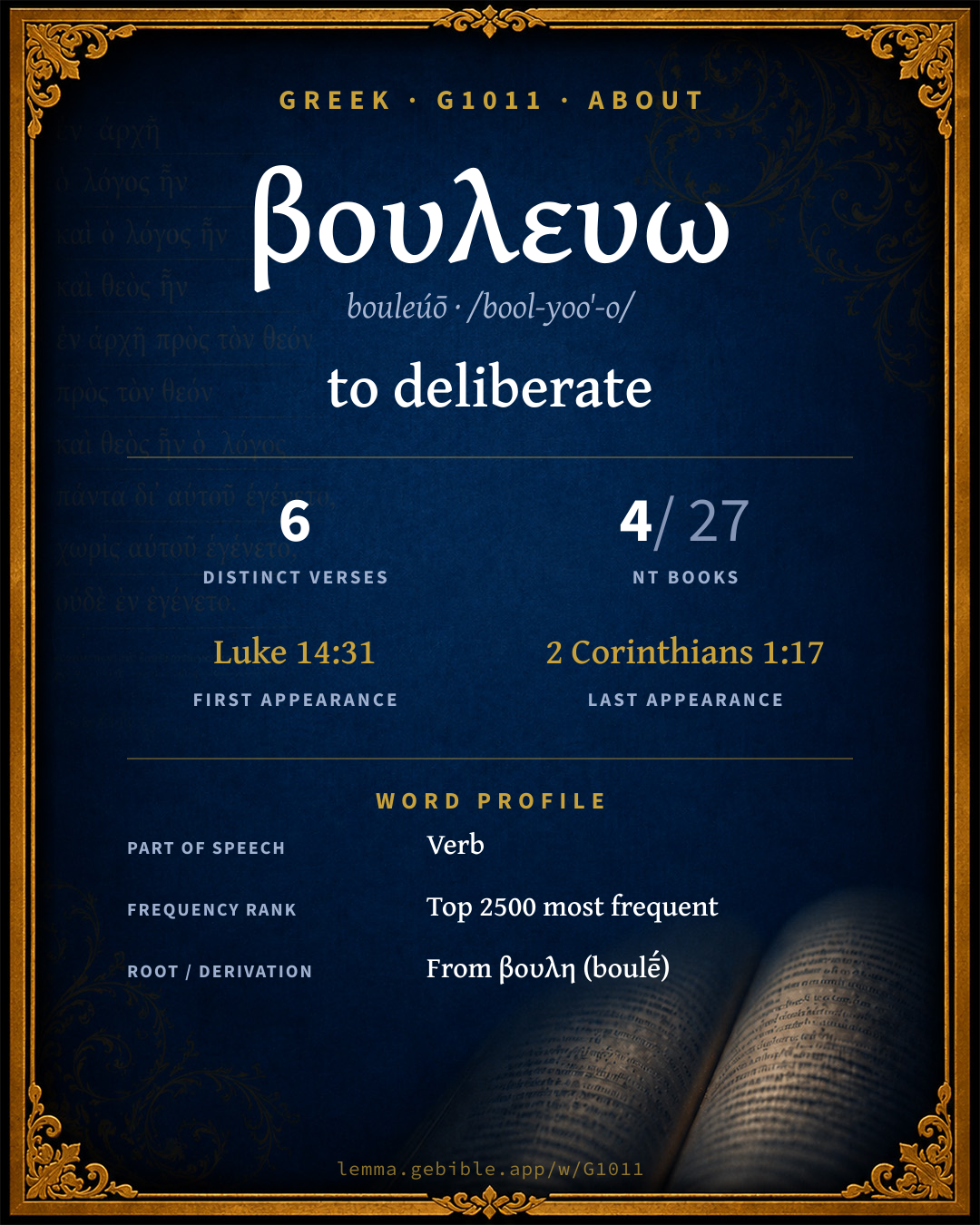
βουλεύω
to deliberate
‘to deliberate’ is one of 2 main senses fuller range ↓
Full lexicon entry — Thayer's Greek Lexicon
From Thayer's Greek Lexicon
Where this word appears
See every Aorist-tense verb in the Greek New Testament →
Grammar key — what these labels mean
Part of speech
- Verb
- An action or state-of-being word.
Tense
- Aorist
- Action viewed as a simple whole, without regard to duration — often past (perfective aspect).
- Imperfect
- Continuous or repeated action in past time (“was writing”).
- Present
- Ongoing or general action in present time (imperfective aspect).
- Future
- Action expected in future time.
Voice
- Middle deponent
- Middle in form but active in meaning.
- Middle or Passive deponent
- Middle/passive in form but active in meaning.
Mood
- Indicative
- States a fact or asks a factual question (the mood of reality).
Person
- 3rd person
- The one spoken about (“he / she / it / they”).
- 1st person
- The speaker (“I / we”).
Number
- Plural
- More than one.
- Singular
- One.
Grammatical forms
- Verb, Aorist, Middle deponent, Indicative, 3rd person, Plural 2 times (29%)
- Verb, Imperfect, Middle or Passive deponent, Indicative, 3rd person, Plural 2 times (29%)
- Verb, Present, Middle or Passive deponent, Indicative, 1st person, Singular 2 times (29%)
- Verb, Future, Middle deponent, Indicative, 3rd person, Singular 1 time (14%)
Parsed forms decoded from the imported morphology (Robinson–Tischendorf, public domain), counted across 7 parsed occurrences — not distinct verses.
Every verse where G1011 appears — 6 distinct verses across 4 books. Click any verse to open its interlinear word-by-word view. Verse text shown in the World English Bible for context — . Each verse’s Greek form is shown with its reference; the English is not keyword-highlighted, since the data carries no word-level English alignment. Use “Compare translations” on any verse to read it across multiple English versions. This concordance covers the Greek New Testament; Septuagint (Greek Old Testament) occurrences of this word are not indexed here.
Luke 1 verse
John 2 verses
Acts 2 verses
- Acts 5:33 ἐβουλεύοντο impf mid/pass.dep ind 3pl But they, when they heard this, were cut to the heart, and determined to kill them.
- Acts 27:39 ἐβουλεύοντο impf mid/pass.dep ind 3pl When it was day, they didn't recognize the land, but they noticed a certain bay with a beach, and they decided to try to drive the ship onto it.
2 Corinthians 1 verse
About this entry
At a glance — auto-summarized from this page’s data, not written by a person. Every figure links to its source below. This summary describes the numbers; it doesn’t interpret them.
βουλευω (bouleúō) is a Greek verb most often rendered “to deliberate.” It first appears in Luke 14:31. The Greek New Testament uses it across 6 verses — uncommon. John dominates its distribution — 2 of 6 verses. Ranging over 2 senses, it is not a single-sense word. The sections below give every sense, occurrence, and version rendering.
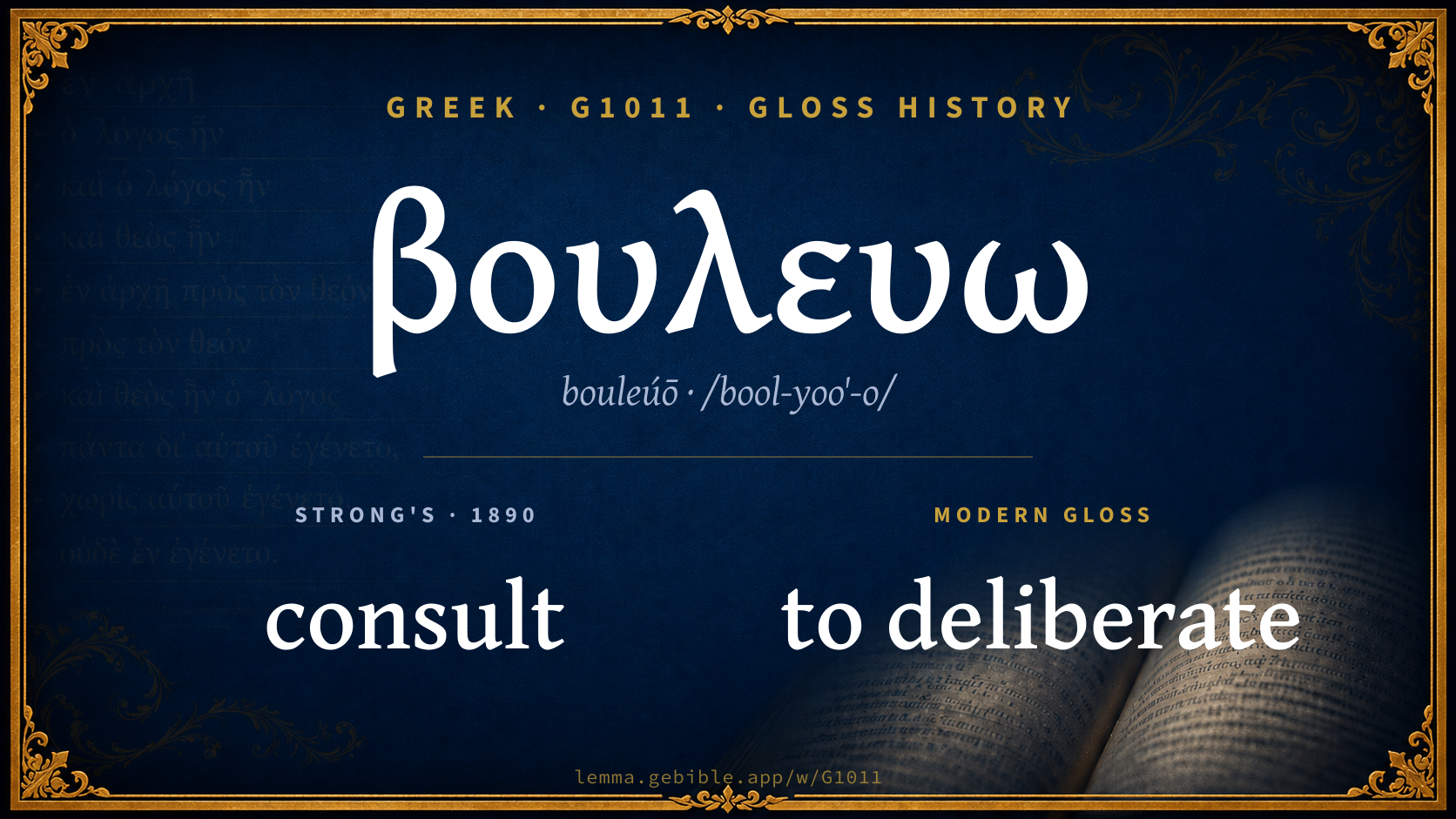
Gloss history
Strong's 1890 vs modern scholarship
About this word
Strong's G1011 catalogs a Greek word from the Greek New Testament.
These counts are not copied from any lexicon or concordance. They are computed here, from the morphology-tagged Greek New Testament. What Lemma adds →
- 6
- distinct verses
- The word appears in 6 distinct verses.
- 4 / 27
- NT books
- The word appears in 4 of 27 New Testament books.
- #1,358
- by frequency
- Top 2500 most frequent Greek words (rank 1,358 of 5,347 Greek words by occurrence).
View all 6 occurrences in the concordance →
By section of the New Testament
By traditional corpus
Conventional, traditional groupings — biblical authorship is debated, so this is a traditional corpus grouping, not an authorship claim. Some books belong to more than one corpus (Luke is in both the Gospels and the Lukan corpus, and so on), so these shares overlap and need not total 100%. Each figure is a share of the word’s 6 distinct verses.
- Gospels 3 verses · 50%
- Lukan (Luke–Acts) 3 verses · 50%
- Johannine 2 verses · 33%
- Pauline corpus 1 verse · 17%
How translations render this word
Counts come from each version’s own published word-to-Strong’s tagging or interlinear alignment — an approximate guide to how each version renders this word, not a word-level alignment the data otherwise carries. Because each total is that version’s own tagged count, the per-version totals vary from one another and need not match the appearance or distinct-verse counts above. These counts may also differ from a printed concordance because Lemma counts each distinctly tagged rendering and does not collapse phrase taggings into a single head-word total. This is a fixed set of word-tagged versions (KJV, ASV, BSB, ULT) and does not change with the reading translation you choose elsewhere. Each version’s license is shown beside its name below (and on Sources).
- King James Version: Consulted 1×, Consulteth 1×, Determined 1×
- American Standard Version: Minded 2×
- Berean Standard Bible: Consider 1×, Do i make my plans 1×, Made plans 1×
- unfoldingWord Literal Text: And 1×, Determine 1×, Do i intend 1×
King James Version Public Domain
Renders G1011 across 10 tagged occurrences — most commonly:
American Standard Version Public Domain
Renders G1011 across 9 tagged occurrences — most commonly:
Plus 7 renderings that appear only once — usually multi-word phrases or single function words the recovered tagging swept in, not distinct renderings.
Berean Standard Bible Public Domain
Renders G1011 across 6 tagged occurrences — most commonly:
Not rendered by a distinct English word in 1 further occurrence.
unfoldingWord Literal Text CC BY-SA 4.0
Renders G1011 across 7 tagged occurrences — most commonly:
Senses in Thayer's
The 2 senses Thayer's distinguishes for this word, in lexicon order (not ranked by frequency or importance). The full entry — with sub-senses — is in the Lexicon Entry tab.
- to deliberate with one's self, consider
- to take counsel, resolve
Word origin
Derived from βουλη (boulḗ) (G1012) — counsel.
From G1012 ; to advise that is (reflexively) deliberate or (by implication) resolve : - consult take counsel determine be minded purpose.
— Strong’s Exhaustive Concordance (1890), public domain.
Forms in the corpus
The 4 distinct written forms G1011 takes in the Greek New Testament, most frequent first — each parse links to that tense’s occurrences in the concordance.
| Form | Parsing | Example | Uses |
|---|---|---|---|
| βουλεύομαι bouleúomai | Verb, Present, Middle or Passive deponent, Indicative, 1st person, Singular | 2 Corinthians 1:17 | 2 |
| ἐβουλεύοντο ebouleúonto | Verb, Imperfect, Middle or Passive deponent, Indicative, 3rd person, Plural | Acts 5:33 | 2 |
| ἐβουλεύσαντο ebouleúsanto | Verb, Aorist, Middle deponent, Indicative, 3rd person, Plural | John 11:53 | 2 |
| βουλεύσεται bouleúsetai | Verb, Future, Middle deponent, Indicative, 3rd person, Singular | Luke 14:31 | 1 |
Same root — word family
Other Thayer's entries built from the same root as G1011, grouped by Strong’s listed origin. These share a root / origin per the lexicon — not necessarily a shared meaning. Each links to that word’s own entry.
Derives from
Derived from this word
Compare all same-root words → They share a root, not necessarily a meaning.
Septuagint usage
The same Greek word βουλευω appears 55 times in the Greek Old Testament (Septuagint), across 53 verses in 16 books.
- 55
- LXX occurrences
- Tagged occurrences of this Greek word in the Septuagint.
- 53
- verses
- Distinct Septuagint verses containing this word.
- 16 / 39
- OT books
- The word appears in 16 of the 39 Old Testament books.
Sample Septuagint occurrences
- Genesis 50:20 βουλεύω
- 2 Samuel 16:23 βουλεύω
- 1 Kings 12:6 βουλεύω
- 2 Kings 6:8 βουλεύω
- 1 Chronicles 13:1 βουλεύω
- 2 Chronicles 10:6 βουλεύω
- Ezra 4:5 βουλεύω
- Esther 3:6 βουλεύω
- Psalms 30:14 βουλεύω
- Proverbs 15:22 βουλεύω
- Isaiah 3:9 βουλεύω
- Jeremiah 27:45 βουλεύω
Septuagint occurrences (same lexeme)
Every verse where the same Strong’s number (G1011) appears in the Greek Septuagint — showing the first 50 of 53. Verse text shown in the World English Bible for context; the Greek form is the matched word — the English is not keyword-highlighted.
- Genesis 50:20 βουλεύω As for you, you meant evil against me, but God meant it for good, to bring to pass, as it is this day, to save many people alive.
- 2 Samuel 16:23 βουλεύω The counsel of Ahithophel, which he gave in those days, was as if a man inquired at the oracle of God: so was all the counsel of Ahithophel both with David and with Absalom.
- 2 Samuel 17:7 βουλεύω Hushai said to Absalom, The counsel that Ahithophel has given this time is not good.
- 2 Samuel 17:21 βουλεύω It happened, after they had departed, that they came up out of the well, and went and told king David; and they said to David, Arise you, and pass quickly over the water; for thus has Ahithophel counseled against you.
- 1 Kings 12:6 βουλεύω King Rehoboam took counsel with the old men, who had stood before Solomon his father while he yet lived, saying, What counsel give you me to return answer to this people?
- 1 Kings 12:28 βουλεύω Whereupon the king took counsel, and made two calves of gold; and he said to them, It is too much for you to go up to Jerusalem: see your gods, Israel, which brought you up out of the land of Egypt.
- 2 Kings 6:8 βουλεύω Now the king of Syria was warring against Israel; and he took counsel with his servants, saying, In such and such a place shall be my camp.
- 1 Chronicles 13:1 βουλεύω David consulted with the captains of thousands and of hundreds, even with every leader.
- 2 Chronicles 10:6 βουλεύω King Rehoboam took counsel with the old men, who had stood before Solomon his father while he yet lived, saying, What counsel give you me to return answer to this people?
- 2 Chronicles 10:9 βουλεύω He said to them, What counsel give you, that we may return answer to this people, who have spoken to me, saying, Make the yoke that your father did put on us lighter?
- 2 Chronicles 20:21 βουλεύω When he had taken counsel with the people, he appointed those who should sing to Yahweh, and give praise in holy array, as they went out before the army, and say, Give thanks to Yahweh; for his loving kindness endures forever.
- 2 Chronicles 25:17 βουλεύω Then Amaziah king of Judah took advice, and sent to Joash, the son of Jehoahaz the son of Jehu, king of Israel, saying, Come, let us look one another in the face.
- 2 Chronicles 30:2 βουλεύω For the king had taken counsel, and his princes, and all the assembly in Jerusalem, to keep the Passover in the second month.
- 2 Chronicles 30:23 βουλεύω The whole assembly took counsel to keep other seven days; and they kept [other] seven days with gladness.
- 2 Chronicles 32:3 βουλεύω he took counsel with his princes and his mighty men to stop the waters of the springs which were outside of the city; and they helped him.
- Ezra 4:5 βουλεύω and hired counselors against them, to frustrate their purpose, all the days of Cyrus king of Persia, even until the reign of Darius king of Persia.
- Ezra 15:7 βουλεύω
- Ezra 16:7 βουλεύω
- Esther 3:6 βουλεύω But he scorned the thought of laying hands on Mordecai alone; for they had made known to him the people of Mordecai: therefore Haman sought to destroy all the Jews who were throughout the whole kingdom of Ahasuerus, even the people of Mordecai.
- Psalms 30:14 βουλεύω
- Psalms 61:5 βουλεύω For you, God, have heard my vows. You have given me the heritage of those who fear your name.
- Psalms 70:10 βουλεύω
- Psalms 82:4 βουλεύω Rescue the weak and needy. Deliver them out of the hand of the wicked."
- Psalms 82:6 βουλεύω I said, "You are gods, All of you are sons of the Most High.
- Proverbs 15:22 βουλεύω Where there is no counsel, plans fail; But in a multitude of counselors they are established.
- Isaiah 3:9 βουλεύω The look of their faces testify against them. They parade their sin like Sodom. They don't hide it. Woe to their soul! For they have brought disaster upon themselves.
- Isaiah 7:5 βουλεύω Because Syria, Ephraim, and the son of Remaliah, have plotted evil against you, saying,
- Isaiah 8:10 βουλεύω Take counsel together, and it shall be brought to nothing; speak the word, and it shall not stand: for God is with us.
- Isaiah 14:24 βουλεύω Yahweh of Hosts has sworn, saying, Surely, as I have thought, so shall it happen; and as I have purposed, so shall it stand:
- Isaiah 14:26 βουλεύω This is the purpose that is purposed on the whole earth; and this is the hand that is stretched out on all the nations.
- Isaiah 14:27 βουλεύω For Yahweh of Hosts has purposed, and who shall annul it? and his hand is stretched out, and who shall turn it back?
- Isaiah 16:3 βουλεύω Give counsel, execute justice; make your shade as the night in the midst of the noonday; hide the outcasts; don't betray the fugitive.
- Isaiah 19:12 βουλεύω Where then are your wise men? and let them tell you now; and let them know what Yahweh of Hosts has purposed concerning Egypt.
- Isaiah 19:17 βουλεύω The land of Judah shall become a terror to Egypt; everyone to whom mention is made of it shall be afraid, because of the purpose of Yahweh of Hosts, which he purposes against it.
- Isaiah 23:8 βουλεύω Who has purposed this against Tyre, the giver of crowns, whose merchants are princes, whose traffickers are the honorable of the earth?
- Isaiah 23:9 βουλεύω Yahweh of hosts has purposed it, to stain the pride of all glory, to bring into contempt all the honorable of the earth.
- Isaiah 28:29 βουλεύω This also comes forth from Yahweh of Hosts, who is wonderful in counsel, and excellent in wisdom.
- Isaiah 31:6 βουλεύω Turn you to him from whom you have deeply revolted, children of Israel.
- Isaiah 32:7 βουλεύω The instruments of the churl are evil: he devises wicked devices to destroy the humble with lying words, even when the needy speaks right.
- Isaiah 32:8 βουλεύω But the noble devises noble things; and in noble things shall he continue.
- Isaiah 45:20 βουλεύω Assemble yourselves and come; draw near together, you who have escaped from the nations: they have no knowledge who carry the wood of their engraved image, and pray to a god that can't save.
- Isaiah 46:10 βουλεύω declaring the end from the beginning, and from ancient times things that are not [yet] done; saying, My counsel shall stand, and I will do all my pleasure;
- Isaiah 46:11 βουλεύω calling a ravenous bird from the east, the man of my counsel from a far country; yes, I have spoken, I will also bring it to pass; I have purposed, I will also do it.
- Isaiah 51:13 βουλεύω and have forgotten Yahweh your Maker, who stretched forth the heavens, and laid the foundations of the earth; and fear continually all the day because of the fury of the oppressor, when he makes ready to destroy? and where is the fury of the oppressor?
- Jeremiah 27:45 βουλεύω
- Jeremiah 30:14 βουλεύω All your lovers have forgotten you; they don't seek you: for I have wounded you with the wound of an enemy, with the chastisement of a cruel one, for the greatness of your iniquity, because your sins were increased.
- Jeremiah 30:25 βουλεύω
- Ezekiel 11:2 βουλεύω He said to me, Son of man, these are the men who devise iniquity, and who give wicked counsel in this city;
- Daniel 6:4 βουλεύω Then the presidents and the satraps sought to find occasion against Daniel as touching the kingdom; but they could find no occasion nor fault, because he was faithful, neither was there any error or fault found in him.
- Daniel 6:5 βουλεύω Then said these men, We shall not find any occasion against this Daniel, except we find it against him concerning the law of his God.
These are occurrences of the same Greek lexeme (G1011) in the Septuagint — not a translation of any one Hebrew word. The store carries no word-level Hebrew↔Greek alignment, so no Hebrew original is asserted here. Counts come from the recovered LXX Strong's tagging — high-frequency vocabulary is well covered, while rare or late forms may be untagged — so they reflect tagged occurrences and may slightly undercount.