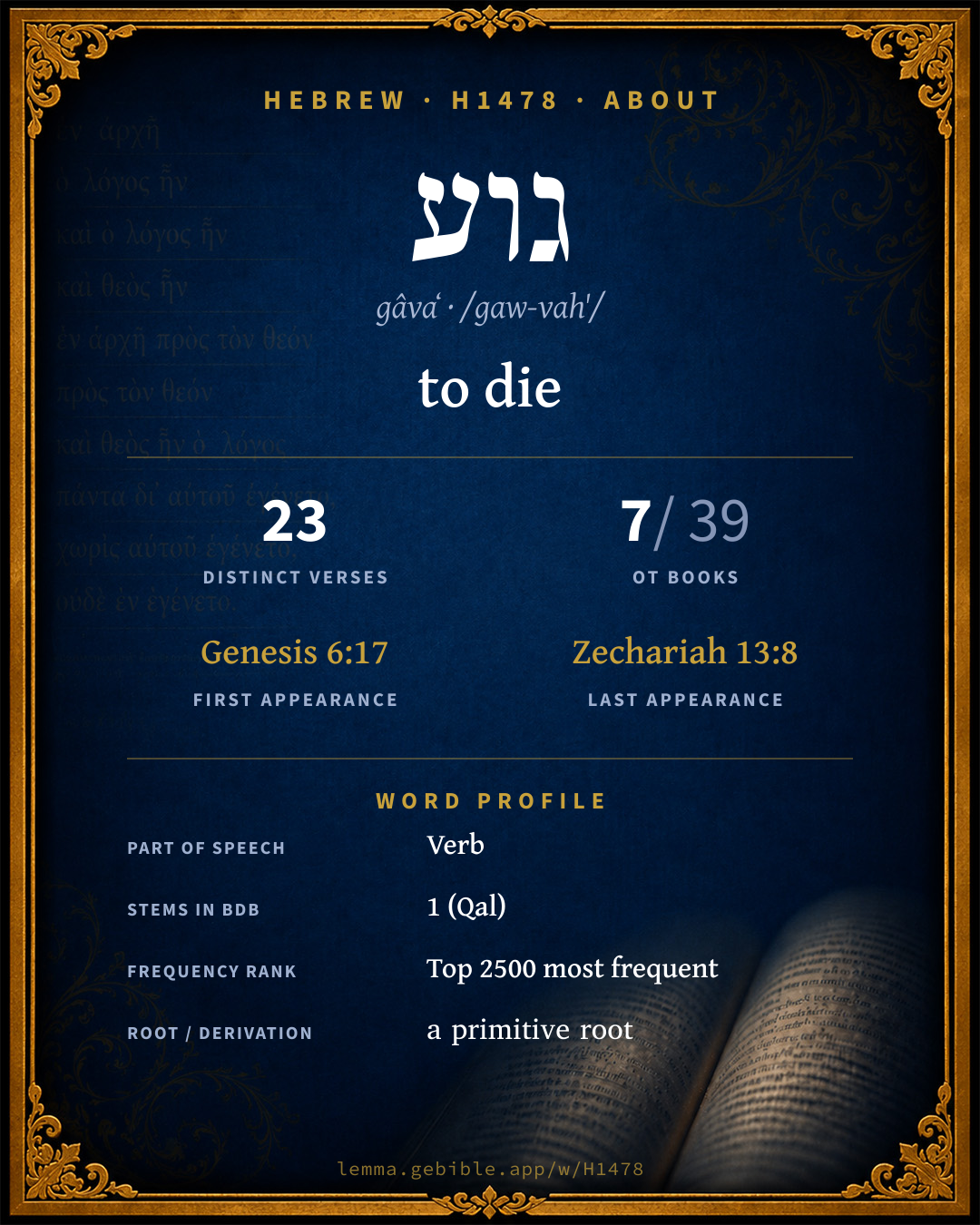
גָּוַע
to die
‘to die’ is one of 2 main senses fuller range ↓
Full lexicon entry — Brown-Driver-Briggs (BDB)
From Brown-Driver-Briggs (BDB)
Where this word appears
Grammar key — what these labels mean
Part of speech
- Verb
- An action or state-of-being word.
Stem
- Qal
- The basic, simple active stem — the plain form of the verb (“he wrote”).
Form
- Sequential Imperfect
- An imperfect with prefixed waw — the standard past-narrative form (waw-consecutive imperfect).
- Imperfect
- An incomplete, ongoing, or future action (“he will / would write”).
- Infinitive Construct
- A bound verbal noun, frequently with prepositions (“to write / in writing”).
- Perfect
- A completed action or state — Hebrew marks aspect (completeness) more than strict tense (“he wrote”).
- Participle Active
- A verbal adjective expressing ongoing or characteristic action (“writing / one who writes”).
State
- Absolute
- The independent form of a noun, not bound to a following word.
Person
- 3rd Person
- The one spoken about (“he / she / it / they”).
- 1st Person
- The speaker (“I / we”).
Gender
- Masculine
- Grammatically masculine.
- Common
- Either gender — not distinguished for this form.
Number
- Singular
- One.
- Plural
- More than one (in Hebrew, generally three or more).
Grammatical forms 9 distinct
- Verb, Qal, Sequential Imperfect, 3rd Person, Masculine, Singular 6 times (25%)
- Verb, Qal, Imperfect, 1st Person, Common, Singular 5 times (21%)
- Verb, Qal, Imperfect, 3rd Person, Masculine, Plural 3 times (13%)
- Verb, Qal, Infinitive Construct 2 times (8%)
- Verb, Qal, Imperfect, 3rd Person, Masculine, Singular 2 times (8%)
- Verb, Qal, Perfect, 1st Person, Common, Plural 2 times (8%)
- Verb, Qal, Perfect, 3rd Person, Masculine, Singular 2 times (8%)
- Verb, Qal, Participle Active, Masculine, Singular, Absolute 1 time (4%)
+1 more form (1 occurrence)
Parsed forms decoded from the imported morphology (morphhb / Westminster Leningrad Codex — WLC text public domain, morphhb tagging CC BY 4.0), counted across 24 parsed occurrences — not distinct verses.
Every verse where H1478 appears — 23 distinct verses across 7 books. Click any verse to open its interlinear word-by-word view. Verse text shown in the World English Bible for context — . Each verse’s Hebrew form is shown with its reference; the English is not keyword-highlighted, since the data carries no word-level English alignment. Use “Compare translations” on any verse to read it across multiple English versions. This concordance covers the Hebrew Bible; Septuagint (Greek Old Testament) occurrences are not indexed here.
Genesis 6 verses
- Genesis 6:17 יִגְוָֽע Qal impf 3ms I, even, I do bring the flood of waters on this earth, to destroy all flesh having the breath of life from under the sky. Everything that is in the earth will die.
- Genesis 7:21 וַ/יִּגְוַ֞ע conj + Qal wimpf 3ms All flesh died that moved on the earth, including birds, cattle, animals, every creeping thing that creeps on the earth, and every man.
- Genesis 25:8 וַ/יִּגְוַ֨ע conj + Qal wimpf 3ms Abraham gave up the spirit, and died in a good old age, an old man, and full of years, and was gathered to his people.
- Genesis 25:17 וַ/יִּגְוַ֣ע conj + Qal wimpf 3ms These are the years of the life of Ishmael: one hundred thirty-seven years. He gave up the spirit and died, and was gathered to his people.
- Genesis 35:29 וַ/יִּגְוַ֨ע conj + Qal wimpf 3ms Isaac gave up the spirit, and died, and was gathered to his people, old and full of days. Esau and Jacob, his sons, buried him.
- Genesis 49:33 וַ/יִּגְוַ֖ע conj + Qal wimpf 3ms When Jacob made an end of charging his sons, he gathered up his feet into the bed, and yielded up the spirit, and was gathered to his people.
Numbers 4 verses
- Numbers 17:12 גָּוַ֛עְנוּ Qal pf 1cp The children of Israel spoke to Moses, saying, Behold, we perish, we are undone, we are all undone.
- Numbers 17:13 לִ/גְוֺֽעַ prep + Qal inf.cs Everyone who comes near, who comes near to the tent of Yahweh, dies: shall we perish all of us?
- Numbers 20:3 גָוַ֛עְנוּ בִּ/גְוַ֥ע Qal pf 1cp prep + Qal inf.cs The people strove with Moses, and spoke, saying, Would that we had died when our brothers died before Yahweh!
- Numbers 20:29 גָוַ֖ע Qal pf 3ms When all the congregation saw that Aaron was dead, they wept for Aaron thirty days, even all the house of Israel.
Joshua 1 verse
Job 8 verses
- Job 3:11 וְ/אֶגְוָֽע conj + Qal impf 1cs "Why didn't I die from the womb? Why didn't I give up the spirit when my mother bore me?
- Job 10:18 אֶ֝גְוַ֗ע Qal impf 1cs "'Why, then, have you brought me forth out of the womb? I wish I had given up the spirit, and no eye had seen me.
- Job 13:19 וְ/אֶגְוָֽע conj + Qal impf 1cs Who is he who will contend with me? For then would I hold my peace and give up the spirit.
- Job 14:10 וַ/יִּגְוַ֖ע conj + Qal wimpf 3ms But man dies, and is laid low. Yes, man gives up the spirit, and where is he?
- Job 27:5 אֶגְוָ֑ע Qal impf 1cs Far be it from me that I should justify you. Until I die I will not put away my integrity from me.
- Job 29:18 אֶגְוָ֑ע Qal impf 1cs Then I said, 'I shall die in my own house, I shall number my days as the sand.
- Job 34:15 יִגְוַ֣ע Qal impf 3ms All flesh would perish together, And man would turn again to dust.
- Job 36:12 וְ֝/יִגְוְע֗וּ conj + Qal impf 3mp But if they don't listen, they shall perish by the sword; They shall die without knowledge.
Psalms 2 verses
Lamentations 1 verse
Zechariah 1 verse
About this entry
At a glance — auto-summarized from this page’s data, not written by a person. Every figure links to its source below. This summary describes the numbers; it doesn’t interpret them.
“to die” is the headline sense of the Hebrew verb גוע (gâvaʻ). Scripture first uses it in Genesis 6:17. With 23 verses in 7 books, it is an uncommon word in the Hebrew Bible. It concentrates in Job, which alone accounts for 35% of its uses. Carrying more than one sense, it rewards its full sense range. The sections below give every sense, occurrence, and version rendering.
Gloss history
Strong's 1890 vs modern scholarship
About this word
Strong's H1478 catalogs a Hebrew word from the Hebrew Old Testament.
These counts are not copied from any lexicon or concordance. They are computed here, from the morphology-tagged Hebrew Old Testament. What Lemma adds →
- 23
- distinct verses
- The word appears in 23 distinct verses.
- 7 / 39
- OT books
- The word appears in 7 of 39 Old Testament books.
- #1,327
- by frequency
- Top 2500 most frequent Hebrew words (rank 1,327 of 8,640 Hebrew words by occurrence).
View all 23 occurrences in the concordance →
By section of the Old Testament
By traditional corpus
Conventional, traditional groupings — biblical authorship is debated, so this is a traditional corpus grouping, not an authorship claim. Each share is this word’s portion of its verses in that division of the Hebrew canon. Each figure is a share of the word’s 23 distinct verses.
- Writings (Ketuvim) 11 verses · 48%
- Torah (Pentateuch) 10 verses · 43%
- Prophets (Nevi'im) 2 verses · 9%
How translations render this word
Counts come from each version’s own published word-to-Strong’s tagging or interlinear alignment — an approximate guide to how each version renders this word, not a word-level alignment the data otherwise carries. Because each total is that version’s own tagged count, the per-version totals vary from one another and need not match the appearance or distinct-verse counts above. These counts may also differ from a printed concordance because Lemma counts each distinctly tagged rendering and does not collapse phrase taggings into a single head-word total. This is a fixed set of word-tagged versions (KJV, ASV, BSB, ULT) and does not change with the reading translation you choose elsewhere. Each version’s license is shown beside its name below (and on Sources).
- King James Version: Gave up the ghost 3×, Died 2×
- American Standard Version: Gave up the ghost 3×, Died 2×
- Berean Standard Bible: Perished 3×, Breathed his last 2×, Die 2×
- unfoldingWord Literal Text: Expired 4×, Exhaled 3×, Expire 3×
King James Version Public Domain
Renders H1478 across 24 tagged occurrences — most commonly:
Plus 19 renderings that appear only once — usually multi-word phrases or single function words the recovered tagging swept in, not distinct renderings.
American Standard Version Public Domain
Renders H1478 across 24 tagged occurrences — most commonly:
Plus 19 renderings that appear only once — usually multi-word phrases or single function words the recovered tagging swept in, not distinct renderings.
Berean Standard Bible Public Domain
Renders H1478 across 23 tagged occurrences — most commonly:
Plus 14 renderings that appear only once — usually multi-word phrases or single function words the recovered tagging swept in, not distinct renderings. Not rendered by a distinct English word in 1 further occurrence.
unfoldingWord Literal Text CC BY-SA 4.0
Renders H1478 across 29 tagged occurrences — most commonly:
Plus 14 renderings that appear only once — usually multi-word phrases or single function words the recovered tagging swept in, not distinct renderings.
Senses in the full BDB
What do BDB’s symbols mean?
BDB uses these scholarly abbreviations:
| Symbol | Meaning |
|---|---|
| 𝔊 | the Septuagint (the ancient Greek translation, LXX) |
| 𝔙 | the Vulgate (the Latin translation) |
| 𝔖 | the Syriac version (the Peshitta) |
| 𝔗 | the Targum (the Aramaic translation) |
| ψ | the Psalms |
| √ | root (the underlying root or stem) |
| ‖ | parallel passage (a synonymous or contrasted parallel) |
| † | the dagger: every passage where the word occurs is cited |
The 1 sense the full Brown-Driver-Briggs lexicon distinguishes for this word, in lexicon order (not ranked by frequency), with BDB’s own verbatim wording and sub-sense lettering. Shown in Hebrew script with BDB’s own scholarly abbreviations. The condensed entry is in the Lexicon Entry tab. See also the Forms in the corpus table below.
Qal
- Pf. גָּוַע Nu 20:29 Jos 22:20, גָּוָ֑עוּ La 1:19, גָּוַעְנוּ Nu 17:27; 20:3; Impf. יִגְוַע Jb 34:15, יִגְוָ֑ע Gn 6:17, יִגְוְעוּ Jb 36:12, יִגְוָ֑עוּ Zc 13:8, יִגְוָע֑וּן ψ 104:29 etc.; Inf. cstr. גְּוַע Nu 20:3, גְּוֹעַ Nu 17:28; Pt. גֹּוֵעַ ψ 88:16;—expire and die, only P & poet.; נ׳ וימת Gn 25:8, 17; 35:29 (all P); ‖ מות Jb 3:11; 14:10 cf. Nu 17:28 (P); ‖ אבד Nu 17:27 we expire, we perish (P); ‖ עָנִי ψ 88:16 (progressive parall.) distressed and about to die; ‖ יאסף אל אבותיו Gn 49:33; ‖ על־עפר ישׁוב Jb 34:15 cf. ψ 104:29; ‖ יִכָּֽרְתוּ Zc 13:8; abs. both prose and (especially) poetry Nu 20:3(×2), 29 Jos 22:20 Gn 6:17; 7:21 (all P) Jb 10:18; 13:19; 27:5; 36:12 La 1:19; Jb 29:18 עִם־קִנִּי אגוע with my nest shall I die, i.e. in full possession of what is mine, cf. Di. e.g. Numbers 20:29
Senses from the full Brown-Driver-Briggs lexicon (Brown, Driver, Briggs; Oxford 1906 — public domain), digitized via Sefaria, supplemented by the OpenScriptures HebrewLexicon (CC BY 4.0). Full attribution on Sources.
Word origin
vb. expire, perish, die (cf. Arabic جَاعَ be empty, hungry)—
— Brown-Driver-Briggs (Oxford 1906, public domain), digitized via Sefaria, supplemented by the OpenScriptures HebrewLexicon (CC BY 4.0). See Sources.
Origin: a primitive root
Jastrow Dictionary
A second Hebrew/Aramaic lexicon for comparison, covering Aramaic and post-biblical (Talmudic, Targumic, Midrashic) usage that the biblical-Hebrew BDB does not. Matched by lemma rather than by Strong’s number, so a lemma may carry more than one Jastrow headword (shown separately below), and the entries cover usage well beyond the Bible.
גָּוַע
- 1. [to shrink,] fail, fall away. Gen. R. s. 31 (explain. יגוע, Gen. VI, 17) יצמוק (Yalk. Gen. 55 ינמוק), v. צָמַק. Gen. R. s. 12 גזעה; s. 19 גרעה, read: גָּוְעָה וכ׳ his stature was reduced. e.g. Genesis 6:17
- 2. (act. v.) to diminish. Tanḥ. Noah 7; ed. Bub. 10 והן גָּוְעוּ אותן וכ׳ and they (the wild beasts) diminished their numbers, as it says (Gen. VII, 21) and there were diminished &c. e.g. Genesis 7:21
A Dictionary of the Targumim, the Talmud Babli and Yerushalmi, and the Midrashic Literature (Marcus Jastrow; London, Luzac, 1903) — Public Domain. Digitized via Sefaria. Digitized via Sefaria. Full attribution on Sources.
Forms in the corpus
The 19 distinct written forms H1478 takes in the Hebrew Bible, most frequent first — each parse links to that stem’s occurrences in the concordance. Hebrew forms include their vowel points and cantillation, so a single lemma takes many written forms.
| Form | Parsing | Example | Uses |
|---|---|---|---|
| אֶגְוָ֑ע | Verb, Qal, Imperfect, 1st Person, Common, Singular | Job 27:5 | 2 |
| גָוַ֖ע | Verb, Qal, Perfect, 3rd Person, Masculine, Singular | Joshua 22:20 | 2 |
| וְ/אֶגְוָֽע | Verb, Qal, Imperfect, 1st Person, Common, Singular | Job 3:11 | 2 |
| וַ/יִּגְוַ֖ע | Verb, Qal, Sequential Imperfect, 3rd Person, Masculine, Singular | Genesis 49:33 | 2 |
| וַ/יִּגְוַ֨ע | Verb, Qal, Sequential Imperfect, 3rd Person, Masculine, Singular | Genesis 25:8 | 2 |
| אֶ֝גְוַ֗ע | Verb, Qal, Imperfect, 1st Person, Common, Singular | Job 10:18 | 1 |
| בִּ/גְוַ֥ע | Verb, Qal, Infinitive Construct | Numbers 20:3 | 1 |
| גָוַ֛עְנוּ | Verb, Qal, Perfect, 1st Person, Common, Plural | Numbers 20:3 | 1 |
| גָּוַ֛עְנוּ | Verb, Qal, Perfect, 1st Person, Common, Plural | Numbers 17:12 | 1 |
| גָּוָ֑עוּ | Verb, Qal, Perfect, 3rd Person, Common, Plural | Lamentations 1:19 | 1 |
| וְ/גֹוֵ֣עַ | Verb, Qal, Participle Active, Masculine, Singular, Absolute | Psalms 88:15 | 1 |
| וְ֝/יִגְוְע֗וּ | Verb, Qal, Imperfect, 3rd Person, Masculine, Plural | Job 36:12 | 1 |
| וַ/יִּגְוַ֞ע | Verb, Qal, Sequential Imperfect, 3rd Person, Masculine, Singular | Genesis 7:21 | 1 |
| וַ/יִּגְוַ֣ע | Verb, Qal, Sequential Imperfect, 3rd Person, Masculine, Singular | Genesis 25:17 | 1 |
| יִגְוַ֣ע | Verb, Qal, Imperfect, 3rd Person, Masculine, Singular | Job 34:15 | 1 |
| יִגְוָ֑עוּ | Verb, Qal, Imperfect, 3rd Person, Masculine, Plural | Zechariah 13:8 | 1 |
| יִגְוָֽע | Verb, Qal, Imperfect, 3rd Person, Masculine, Singular | Genesis 6:17 | 1 |
| יִגְוָע֑וּ/ן | Verb, Qal, Imperfect, 3rd Person, Masculine, Plural | Psalms 104:29 | 1 |
| לִ/גְוֺֽעַ | Verb, Qal, Infinitive Construct | Numbers 17:13 | 1 |
Septuagint verse parallels
This word appears in 23 verses that also exist in the Greek Old Testament (Septuagint), out of the 23 Hebrew verses it occurs in. You can read those verses in Greek by switching the Old Testament edition to the Septuagint.
Read these verses in the Septuagint
This is a verse-level parallel only — the same verses exist in both the Hebrew and Greek Old Testaments. No word-level Hebrew↔Greek correspondence is claimed: the data carries no such alignment, so no Greek word is shown as this Hebrew word’s translation. Coverage is not total — the Septuagint omits the deuterocanon and renumbers the Psalms, so some Hebrew verses have no direct Greek parallel.