
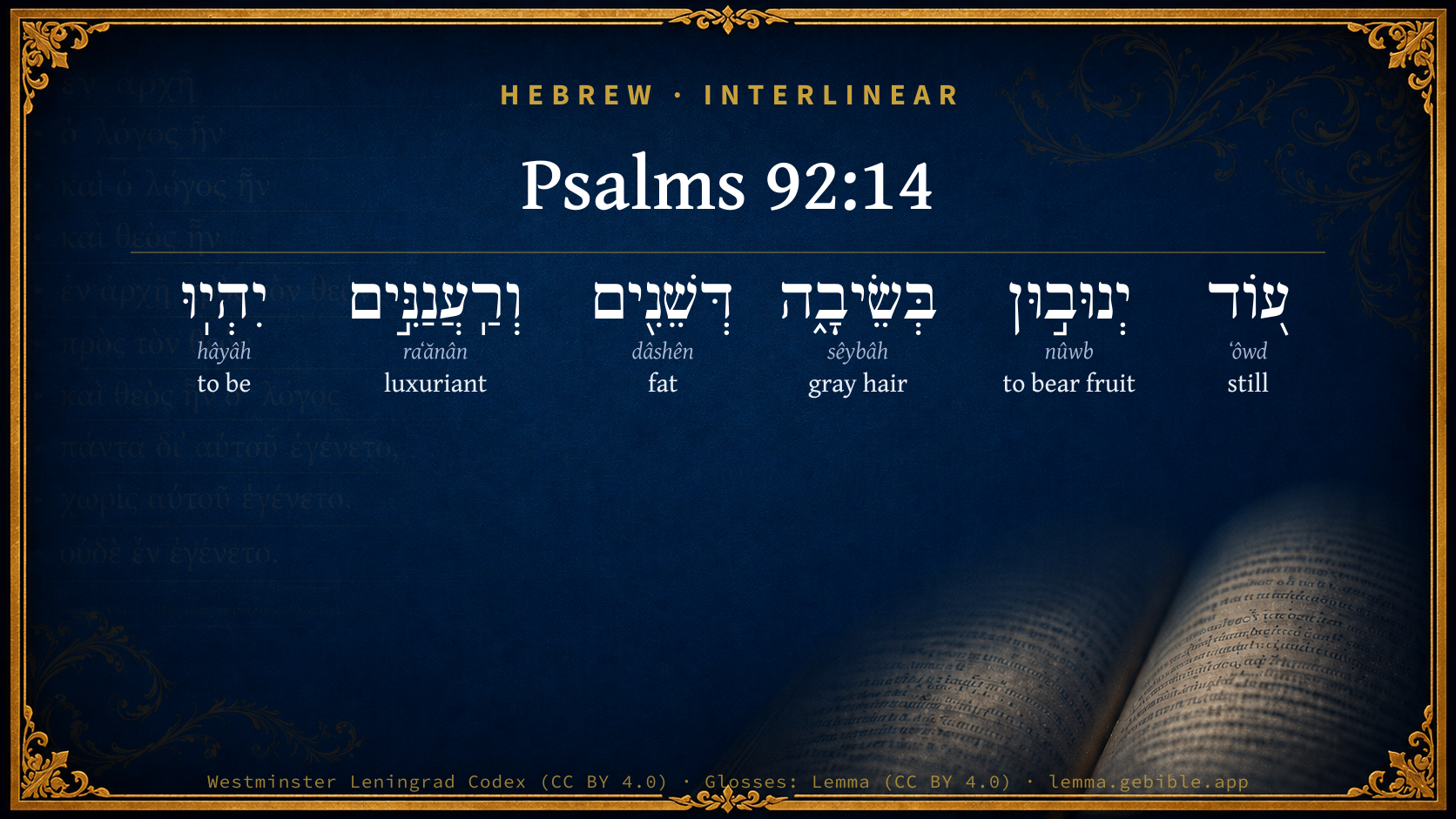
Psalms 92:14

Hebrew (Westminster Leningrad Codex) Psalms 92:14 appears in the Hebrew Old Testament. The text above is from the Westminster Leningrad Codex. Each word links to its Strong’s number, a concise gloss, and parsing drawn from the Open Scriptures Hebrew Bible morphology. Click any word for its full Brown-Driver-Briggs (BDB) entry.
Download image
Cite this verse

Psalms 92:14 (World English Bible). Public Domain. Lemma interlinear Bible study tool, https://lemma.gebible.app/v/psalms/92/14.

Show BibTeX & RIS
BibTeX
RIS
English Translation
They will still bring forth fruit in old age. They will be full of sap and green,
World English Bible · Public Domain
Download a study sheet

One document with this verse’s original text, its word-by-word gloss line, the meaning frame, cross-references with their text, attributed commentary, and full source and license credits — printable, and it pastes into notes with its structure intact.

This verse Autodidact and up

Study sheet (.html) Plain text (.txt)

A passage Seminary Student

Up to 50 verses in one chapter. A passage sheet keeps up to 6 commentary sources and 12 cross-references per verse, in the order this page ranks them, and says so on the sheet whenever that leaves anything out. Ask for a single verse and you get the Autodidact verse sheet above.

Everything on this page stays free to read, with no account — the sheet is a download of what is already on screen, not access to it.

Want to remove ads? Support Godless Engineer
Compare translations 3

The same verse in 3 English versions, stacked beneath the original-language interlinear above. Click any original word for its lexicon entry.

Each is an independent rendering of the whole verse — the interlinear is not word-aligned to these translations.

Highlighted words mark where these versions differ — a whole-verse word diff, not a word-by-word alignment.

  • World English Bible Public Domain
    They will still bring forth fruit in old age. They will be full of sap and green,
  • King James Version Public Domain
    They shall still bring forth fruit in old age; they shall be fat and flourishing;
  • unfoldingWord Literal Text CC BY-SA 4.0
    They bear fruit even when they are old; they are juicy and green,

unfoldingWord Literal Text — © unfoldingWord, licensed CC BY-SA 4.0. Word-aligned USFM3 via Door43 (git.door43.org/unfoldingWord/en_ult).

Versions to compare (up to 4)

3 of 4 selected

Show all 18 translations

Every available English version of this verse, each an independent rendering of the whole verse.

  • World English Bible Public Domain
    They will still bring forth fruit in old age. They will be full of sap and green,
  • Berean Standard Bible Public Domain
    In old age they will still bear fruit; healthy and green they will remain,
  • Majority Standard Bible Public Domain
    In old age they will still bear fruit; healthy and green they will remain,
  • King James Version Public Domain
    They shall still bring forth fruit in old age; they shall be fat and flourishing;
  • American Standard Version (1901) Public Domain
    They shall still bring forth fruit in old age; They shall be full of sap and green:
  • Revised Version (1885) Public Domain
    They shall still bring forth fruit in old age; they shall be full of sap and green:
  • Geneva Bible (1599) Public Domain
    They shall still bring foorth fruite in their age: they shall be fat and flourishing,
  • Douay-Rheims (1899) Public Domain
    They that are planted in the house of the Lord shall flourish in the courts of the house of our God.
  • Young's Literal Translation Public Domain
    Still they bring forth in old age, Fat and flourishing are they,
  • Literal Standard Version CC BY-SA 4.0
    Still they bring forth in old age, || They are fat and flourishing,
  • Unlocked Literal Bible CC BY-SA 4.0
    They bear fruit even when they are old; they stay fresh and green,
  • unfoldingWord Literal Text CC BY-SA 4.0
    They bear fruit even when they are old; they are juicy and green,
  • Darby Bible Public Domain
    They are still vigorous in old age, they are full of sap and green;
  • World Messianic Bible Public Domain
    They will still produce fruit in old age. They will be full of sap and green,
  • Webster's Bible Public Domain
    \\92:13\\Those that are planted in the house of the LORD shall flourish in the courts of our God.
  • Free Bible Version CC BY-SA 4.0
    Even when they are old they will still produce fruit, staying fresh and green.
  • Bible in Basic English Public Domain
    They will give fruit even when they are old; they will be fertile and full of growth;
  • JPS Tanakh (1917) Public Domain
    (92-15) They shall still bring forth fruit in old age; they shall be full of sap and richness;

Literal Standard Version (2020), Covenant Press — licensed CC BY-SA 4.0. Text via the HelloAO Bible API (eBible.org). Unlocked Literal Bible (unfoldingWord) — licensed CC BY-SA 4.0. Text via the HelloAO Bible API (eBible.org). unfoldingWord Literal Text — © unfoldingWord, licensed CC BY-SA 4.0. Word-aligned USFM3 via Door43 (git.door43.org/unfoldingWord/en_ult). Free Bible Version, Dr. Jonathan Gallagher — licensed CC BY-SA 4.0. Text via the HelloAO Bible API (eBible.org).

Word by word

More ways to search: Search by grammar → Find every occurrence → Compare this word →

Practice this passage: Drill this verse → Learn its vocabulary →

About this verse

These counts appear in no published source. They are computed here, from the morphology-tagged text and Lemma’s own curated glosses. What Lemma adds →

6
words
6
distinct lemmas
Wisdom
section

Notable vocabulary

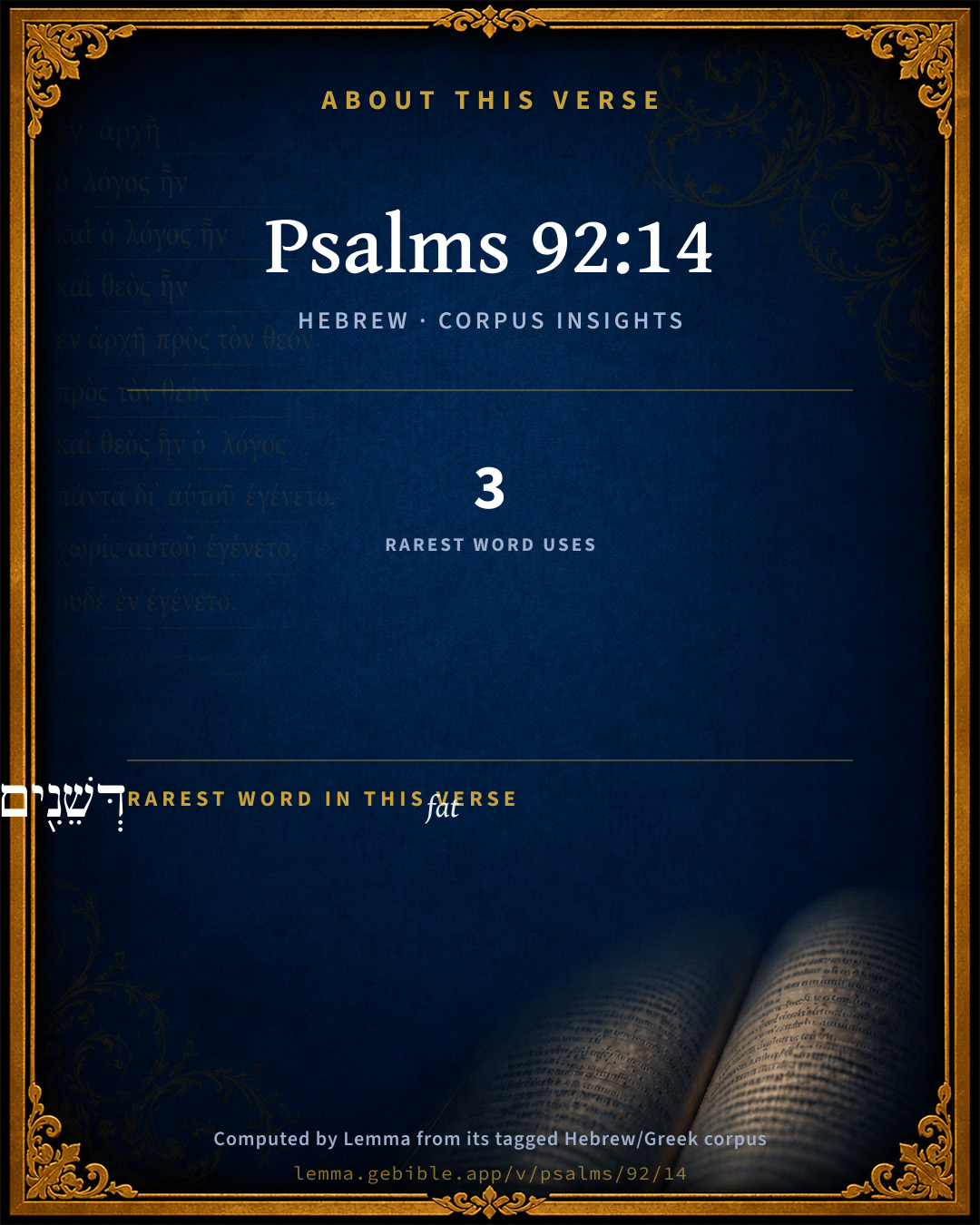
The rarest word here is דְּשֵׁנִ֖ים fat H1879 — appearing just 3 times in the whole Hebrew Bible.

Shared distinctive vocabulary

דְּשֵׁנִ֖ים fat H1879 occurs in 3 verses of the Hebrew Bible. Also found in:

Grammatical profile

  • 2 verbs
  • 1 noun
  • 2 adjectives
  • 1 adverb

Verb forms

  • יְנוּב֣וּן Qal · Imperfect
  • יִהְיֽוּ Qal · Imperfect

Hebrew & Septuagint length

In English translation the verse runs 17 words from the Hebrew and 19 from the Septuagint (LXX English) — closely comparable.

A rough comparison of the two English renderings, which tokenize alike — not a word-level alignment.

Word counts can differ between the Hebrew and the Greek without any difference in meaning — e.g. the Hebrew direct-object marker אֵת has no separate Greek word, and Greek often adds the article ὁ.

Cross-references

13

Topical passages linked to Psalms 92:14 in the Treasury of Scripture Knowledge — connected by theme and wording, ordered by reader-vote popularity; previews shown in the World English Bible.

  • Isaiah 46:4 and even to old age I am he, and even to gray hairs will I carry you. I have made, and I will bear; yes, I will carry, and will deliver.
  • Psalms 71:18 Yes, even when I am old and gray-haired, God, don't forsake me, Until I have declared your strength to the next generation, Your might to everyone who is to come.
  • Jeremiah 17:8 For he shall be as a tree planted by the waters, who spreads out its roots by the river, and shall not fear when heat comes, but its leaf shall be green; and shall not be careful in the year of drought, neither shall cease from yielding fruit.
  • John 15:2–5 Every branch in me that doesn't bear fruit, he takes away. Every branch that bears fruit, he prunes, that it may bear more fruit.
  • Philippians 1:11 being filled with the fruits of righteousness, which are through Jesus Christ, to the glory and praise of God.
  • Job 17:9 Yet shall the righteous hold on his way. He who has clean hands shall grow stronger and stronger.
  • Psalms 1:3 He will be like a tree planted by the streams of water, That brings forth its fruit in its season, Whose leaf also does not wither. Whatever he does shall prosper.
  • Matthew 3:10 "Even now the axe lies at the root of the trees. Therefore, every tree that doesn't bring forth good fruit is cut down, and cast into the fire.
  • Proverbs 4:18 But the path of the righteous is like the dawning light, That shines more and more until the perfect day.
  • Ezekiel 47:12 By the river on the bank of it, on this side and on that side, shall grow every tree for food, whose leaf shall not wither, neither shall the fruit of it fail: it shall bring forth new fruit every month, because the waters of it issue out of the sanctuary; and the fruit of it shall be for food, and the leaf of it for healing.
  • 1 Chronicles 29:1–30 David the king said to all the assembly, Solomon my son, whom alone God has chosen, is yet young and tender, and the work is great; for the palace is not for man, but for Yahweh God.
  • Galatians 5:22–23 But the fruit of the Spirit is love, joy, peace, patience, kindness, goodness, faithfulness,
  • Jude 1:12 These are hidden rocky reefs in your love feasts when they feast with you, shepherds who without fear feed themselves; clouds without water, carried along by winds; autumn leaves without fruit, twice dead, plucked up by the roots;

Cross-references courtesy of OpenBible.info (CC BY 4.0).

Hebrew and Greek witnesses Masoretic Hebrew ↔ Greek Septuagint

The same verse in the two great witnesses to the Old Testament, shown verse-for-verse.

You’re reading Greek Psalm 91 (Hebrew Psalm 92). The Septuagint counts the superscription, so verse numbers can differ from the Hebrew — chapter-level alignment, not verse-by-verse. Numbering follows Rahlfs.

These are two independent witnesses, not word-aligned to each other, and the Septuagint is shown in lemma (dictionary) form.

Hebrew Psalms 92:14 Masoretic · Westminster Leningrad Codex

ע֭וֹד יְנוּב֣וּן בְּשֵׂיבָ֑ה דְּשֵׁנִ֖ים וְרַֽעֲנַנִּ֣ים יִהְיֽוּ

They will still bring forth fruit in old age. They will be full of sap and green,

World English Bible · Public Domain

Greek LXX Greek Psalm 91:14 Septuagint · lemma form

φυτεύω ἐν ὁ οἶκος κύριος ἐν ὁ αὐλή ὁ θεός ἐγώ ἐκ ἀντιἵημι

Then shall they be increased in a fine old age; and they shall be prosperous; that they may declare

LXX2012 (modern English Septuagint) · Public Domain

Hebrew: Westminster Leningrad Codex (CC BY 4.0). Greek: Septuagint (public domain); English from LXX2012 (modern English Septuagint) (Public Domain). How the Septuagint differs from the Hebrew →

Commentary

Notes on Psalms 92:14 from classic Christian and Jewish commentators (each source and its license shown beneath its notes). The classic Christian expositions comment on the surrounding passage and are grouped to its opening verse, so a note may address several verses; the Jewish commentaries on the Tanakh (Rashi and others) are per-verse, so they appear only where the commentator wrote on this verse.

Lemma curates 59 commentaries, every one of them public domain or Creative Commons licensed, each selected and text-cleaned for this edition rather than reprinted as found. About our sources →

Trapp's Complete Commentary

John Trapp

Psa 92:14 They shall still bring forth fruit in old age; they shall be fat and flourishing;

Ver. 14. They shall still bring forth fruit in old age] Quantumvis veteres, non veterascent, though old, yet shall they retain their former vigour and verdure, and be like that Persian tree in Theophrastus, that at the same time doth bud, blossom, and bear fruit, pullulantes et succulentae.

They shall be fat and flourishing] Vividi et vegeti (Bucholcer), not as the Brabanti or Flemings, qui quo magis senescunt, eo magis stultescunt, saith Erasmus, the elder the foolisher; nor as Trapezuntius, who outlived all his learning; but as Moses, whose sight failed not, his heat abated not; as wine, the older the better; as the sun, which shineth most amiably toward the descent.

John Trapp, A Commentary or Exposition upon All the Books of the Old and New Testament (1647–1656) — public domain. Text from a community e-Sword module.

The Biblical Illustrator

Joseph S. Exell

Psa_92:14

They shall still bring forth fruit in old age; they shall be fat and flourishing.

The fruitfulness of aged Christians considered and urged

I. The duty of the righteous.

1. The fruits which may be expected of them. Knowledge, holiness, patience, meekness, quietness of spirit, renunciation of the world, preparedness for death, a heavenly conversation, also a deep concern for the honour of God, the support of religion, and the good of mankind.

2. How reasonable it is, that such fruits should be found in them.

(1) From the nature of religion, as a vital principle, or the Divine life in the soul. True grace is growing. A well of water springing up unto everlasting life.

(2) Through the natural force of habit and custom. Having been so long in Christs school, we reasonably expect that they should have made a great progress in knowledge and religious skill: that they will be expert in the exercises of devotion; have a greater command of their passions and tongues, than younger persons; and not be, like them, tossed about with every wind of doctrine, or the sport of vanity and temptation.

(3) They have more advantages and fewer temptations than others.

(4) They may expect peculiar assistances from the Spirit of God, in proportion to their many prayers and improvements.

II. The privilege and happiness of the righteous. They shall flourish, etc. Time, which impairs their strength and everything else in the natural world, shall improve their graces, meliorate or refine their fruit. And this they are to expect from Divine influences attending the means of grace. The faithfulness of God is engaged to do this. Therefore the psalmist adds, to show that the Lord is upright, or faithful to His promises. He then subjoins his own testimony to the truth of this: He is my rock; I have found Him kind, powerful and faithful in supporting the religious life in my soul, under all my difficulties and trials; and you will also find that there is no unrighteousness in Him.

III. Application.

1. Let aged Christians labour after greater fruitfulness.

(1) For your own peace and comfort.

(2) For the honour of God and your profession.

(3) For an example and encouragement to others.

2. They who would bring forth fruit in old age must begin betimes to do so.

3. Learn the great usefulness of public ordinances. (Job Orton, D.D.)

Old age

I. Let us look at some of these inevitable experiences of advancing years, which evince the need of some principle of greenness and vitality beyond the power of time or of earthly change. In the first place, if we live long, we must outlive the keen enjoyment of mere pleasure,--of the lighter and gayer portions of life. The feeling rapidly grows upon one, that the game of life is too doubtful, and its stakes too desperate, for trifling; and many of the voices, much of the laughter, which used to make him glad, and on which in early life his free soul could float forth in entire sympathy, have become as vapid as the crackling of thorns. With regard to the more serious pursuits of life, a man very early ascertains and exhausts the capacities of his condition, knows all that he is likely to be and do, and sees but little unattained for which he can reasonably hope. Golden visions have grown dim, wide and far-reaching prospects have been narrowed, and the horizon is fast shutting in on every side. The foremost places in society, the commanding posts in public life, are constantly usurped by younger and still younger claimants, so that instead of the fathers are the children and the childrens children. Then, again, though the domestic life of the aged is often serene and happy, it is made so only by the hallowing power of a higher world; for, in an early point of view, it is but little that we can promise ourselves in declining years as to our social and domestic relations.

II. Let us look at some of those things which we shall need for our happiness, under the full consciousness of declining years. In the first place, we must feel that we have lived for some worthy purpose, accomplished some satisfying and permanent results, laid up some treasure that cannot be taken from us. Let us walk with God now,--and then, should the days come when we can no longer walk with men, we shall still retain our hidden life with Him; and in hoary winter, when the harvest of our earthly life has passed, and its sheaves are all gathered in, the fruits of piety shall still be ripening for a better harvest in heaven. Again, would we enjoy a happy old age, let us make kindness and love the law of our lips and our lives. Let us bind ourselves by ties of mutual benefit with as many of our fellow-beings as we may. Again, would we pass a happy old age, let us not forsake the communion of our departed friends. Let us learn of the spirit of Jesus to regard those who have gone as still near and with us, as separated from us but by a thin veil, which faith may make transparent, and as forming a goodly company to welcome us to our final rest, and to shed over the majestic courts of heaven a familiar, homelike aspect. (A. P. Peabody.)

Improvement

The Bible is always telling Christian people to go forwards--to grow--to become wiser and stronger, better and better day by day; that they ought to become better and better, because they can, if they choose, improve. This text tells us so; it says that we shall bring forth more fruit in our old age. Now, what does all this mean? It means that the life of our souls is in some respects like the life of a plant; and therefore, that as plants grow, so our souls are to grow. Why do you plant anything, but in order that it may grow, and become larger, strong, bear flower and fruit? Be sure God has planted us in His garden, Christs Church, for no other reason. Why has God given us senses, eyes, and ears, and understanding? That by them we may feed our souls with things which we see and hear--things which are going on in the world round us. But is this enough? Consider, again, Gods example which He has given us--a tree. If you keep stripping all the leaves off a tree as fast as they grow, what becomes of it? It dies, because without leaves it cannot get nourishment from the air, and the rain, and the sunlight. Again, if you shut up a tree, where it can get neither rain, air, not light, what happens? The tree certainly dies, though it may be planted in the very richest soil, and have the very strongest roots: and why?--because it can get no food from the sky above. So with our souls. We must be fed, and strengthened, and satisfied, with the grace of God from above--with the Spirit of God. Consider how the Bible speaks of Gods Spirit as the breath of God; showing us that as without the airs of heaven the tree would become stunted and cankered, so our souls will without the fresh purifying breath of Gods Spirit. Again, Gods Spirit is often spoken of in Scripture as dew and rain. His grace, or favour, we read, is as dew on the grass; and again, that God shall come unto us as the rain, as the former and latter rain upon the earth; and again, speaking of the outpourings of Gods Spirit on His Church, the psalmist says (Psa_72:6); and to show us that as the tree puts forth buds and leaves, and tender wood, when it drinks in the dew and rains, so our hearts will become tender, and bud out into good thoughts and wise resolves, when Gods Spirit fills them with His grace. (C. Kingsley, M.A.)

Fruit in old age

A cynical statesman said, with more, perhaps, than a grain of truth, youth is an illusion; manhood a blunder; old age a regret. So it may be; so it is--in a life of godlessness. But in such a life only. The righteous shall flourish, etc.

I. The fruits of testimony to God--the witness which a matured Christian bears to Him as the God of our salvation.

1. There is testimony to His faithfulness, to the sure foundation of His Word, especially the Word of His Promise. We are the children of promise, and have to live by it. Is the promise true? Can it be trusted? Will God never fail? The aged among us know that He and His word abide for ever.

2. Testimony to the righteousness of Gods government. He is equitable and just, without respect of persons, showing displeasure to the wicked and favour to the righteous.

3. Testimony to the joy of the Christian life, to the blessedness of fellowship with Christ. Like other men they have been tried and tempted; but how readily will they testify that these experiences could not separate them from the love of God in Christ Jesus their Lord.

II. Fruitfulness is also seen in the inwrought graces of the soul, in the virtues and excellences to which the righteous attain. The life of a Christian man is a growth. He gradually leaves behind him the weaknesses and imperfections of youth.

1. You will generally see in old age a nobler and more perfect patience, not a dull acquiescence in a fate that cannot be averted, but an intelligent, glad submission to the will of a Father who is loved.

2. We often see a generous, unselfish interest in those who shall come after them, interest in work which cannot benefit themselves; the promotion of Christian aims and industries the fruit of which they cannot live to see.

3. The power of Christian hope.

4. The grace of spiritual preparedness, of meetness for the heavenly inheritance, readiness to depart and be with Christ. This God gives before the summons is delivered, so that His people shall not be taken unawares. (J. Stuart.)

Triumphs of old men

Lord Palmerston the famous statesman, when he was sixty-eight, began to feel that he was old, and said: I am getting old; I will be laid aside. There will be no further use for me. But Lord Palmerston went to a library in order to find some particular subject, and while looking for it, he took down the life of Wesley, and found that Wesley preached and taught with unabated strength when he was eighty-six years old. Palmerstons hopes began to rise, and then he happened to hit on the life of Care, and found that Care influenced the world more after he was eighty years of age than during all his previous life. Then Lord Palmerston found in the same library on the same day the life of Julius Caesar, and he read that Julius Caesar had never been a soldier and had never visited a military camp until forty-nine years of age. According to Lord Palmerston, he learned that there had been wrought out in human life the greatest things man has ever done between fifty and sixty years of age. Then he declared: I did not get what I went to the library to secure, but I secured what was far better--hope.

Psa_93:1-5

The Biblical Illustrator, edited by Joseph S. Exell (c. 1880s–1900s) — public domain. Text from a community e-Sword module.

J. A. Alexander on Psalms

Joseph Addison Alexander

15. (Psa 92:14) Still shall they bear fruit in old age; fat and green shall they be. In old age, literally in grey or hoary hair. Of the epithets in the last clause one properly denotes an animal, the other a vegetable quality. The essential idea is that of the foregoing verse carried out into detail.

Joseph Addison Alexander, The Psalms Translated and Explained (1850) — public domain. Text from a community e-Sword module.

Geneva Bible (1599)

Geneva Bible translators

The children of God shall have a power above nature, and their age shall bring forth most fresh fruits.

Geneva Bible (1599) marginal notes — public domain. Text via Bolls.life.

Adam Clarke's Commentary

Verse 14. They shall still bring forth fruit in old age] They shall continue to grow in grace, and be fruitful to the end of their lives. It is a rare case to find a man in old age full of faith, love, and spiritual activity.

Adam Clarke's Commentary on the Bible (1810–1826) — public domain. Text from a community e-Sword/MySword module.

Ellicott's Commentary for English Readers

(14) They shall still bring forth.—Literally, Still shall they sprout in hoary age, sappy and green shall they be, alluding to the great fruitfulness of the date palm, and to the fact that to the very last this fruitfulness continues.

A Bible Commentary for English Readers, edited by Charles John Ellicott (1878–1897) — public domain. Text from a community e-Sword module.

The Cambridge Bible for Schools and Colleges

gen. ed. J. J. S. Perowne

14. They shall still bring forth fruit in old age, like the palm-tree. Doughty (Arabia Deserta, i. 286) speaks of palms 90 feet high and 200 years old, in the oasis of Teyma. They shall be full of sap and green (R.V.), like the olive (Jdg_9:9).

The Cambridge Bible for Schools and Colleges (gen. ed. J. J. S. Perowne; Cambridge University Press, 1878–1918) — public domain. Text from a community e-Sword module.

John Gill's Exposition

To show that the Lord is upright,.... Or righteous, that is, faithful; as he is in his counsels, covenant, and promises, which he makes good by causing his people to grow and flourish, and become fruitful; by carrying on the work of grace upon their souls, and by preserving them to the end safe to his kingdom and glory; by all which it appears that he does not and will not suffer his faithfulness to fail: the Targum is,

"that the inhabitants of the earth may show, &c.''

he is my Rock; the psalmist sets his seal to the truth of God's faithfulness, firmness, and constancy, calling him a Rock for his strength and stability, and claiming his interest in him; declaring he found him to be so by experience,

even the Rock whose work is perfect; who always completes what he undertakes, and finishes what he begins, and will not forsake the work of his own hands:

just and right is he; the Rock of ages, that remains firm, steadfast, and unalterable in all generations:

and there is no unrighteousness in him; as not in his sovereign acts of grace, so neither in his providential dispensations, either towards good men or bad men; not in suffering the wicked to prosper, as in Psa 92:7, and the righteous to be afflicted; nor in punishing bad men here, or hereafter; nor in justifying sinners by the righteousness of his Son, and giving them the crown of righteousness at the last day: all his proceedings are in the most just and equitable manner; see Rom 9:14.

Next: Psalms Chapter 93

John Gill's Exposition of the Whole Bible (1746–1763) — public domain (CC PDM 1.0). Text via the HelloAO Bible API.

Albert Barnes' Notes on the Bible

They shall still bring forth fruit in old age - As a tree that is carefully planted and cultivated may be expected to live long, and to bear fruit even when it is old. It is true that such a tree may be cut down; or that it may be blown down by winds and tempests; or that it may be unproductive, but as a general rule, and as laying the foundation of a reasonable hope, such a tree may be expected to live long, and to produce fruit even when it is old. So of one devoted early to God, and trained up under the influences of religion. The care, the culture, the habits of temperance, of industry, of moderation, and of sobriety so formed, are favorable to length of days, and lay the foundation for usefulness when old age comes. An aged man should be useful. He should feel that whatever wisdom he may possess as the result of long study and experience, belongs to God and to truth; that one great reason for sparing him is that he may be useful; that the world needs the benefit of his counsel and his prayers; that his life is lengthened out not for his own ease or enjoyment, but that virtue and piety may be extended in the world by all the influence which he can bring to bear upon it in advanced years. It may be added that, as a matter of fact, those who are thus trained and are thus preserved, are useful in old age. No one thus spared need be useless; perhaps almost none are. There is something appropriate for old men to do, as there is for the young and the middle-aged; and it should be the object of an aged Christian to find out what that is, and to do it. The word rendered “old age means literally grey or hoary hair.”

They shall be fat - The meaning is, that they shall be vigorous, or have the appearance of vigor and health.

And flourishing - Margin, as in Hebrew, “green.” This image is taken from a tree, as if it were still green in old age, or gave no indications of decay.

Albert Barnes' Notes on the Bible (1834–1885) — public domain. Text from a community e-Sword/MySword module.

Matthew Poole's English Annotations

When their natural strength decayeth, it shall be renewed; their last days shall be their best days, wherein as they shall grow in grace, so they shall increase in comfort and blessedness.

Matthew Poole's English Annotations on the Holy Bible (1683–1685) — public domain. Text from a community e-Sword/MySword module.

The Treasury of David

Charles H. Spurgeon

Ver. 14. They shall still bring forth fruit in old age. Nature decays but grace thrives. Fruit, as far as nature is concerned, belongs to days of vigour; but in the garden of grace, when plants are weak in themselves, they become strong in the Lord, and abound in fruit acceptable with God. Happy they who can sing this Sabbath Psalm, enjoying the rest which breathes through every verse of it; no fear as to the future can distress them, for their evil days, when the strong man faileth, are the subject of a gracious promise, and therefore they await them with quiet expectancy. Aged believers possess a ripe experience, and by their mellow tempers and sweet testimonies they feed many. Even if bedridden, they bear the fruit of patience; if poor and obscure, their lowly and contented spirit becomes the admiration of those who know how to appreciate modest worth. Grace does not leave the saint when the keepers of the house do tremble; the promise is still sure though the eyes can no longer read it; the bread of heaven is fed upon when the grinders fail; and the voice of the Spirit in the soul is still melodious when the daughters of music are brought low. Blessed be the Lord for this! Because even to hoar hairs he is the I AM, who made his people, he therefore bears and carries them.

They shall be fat and flourishing. They do not drag out a wretched, starveling existence, but are like trees full of sap, which bear luxuriant foliage. God does not pinch his poor servants, and diminish their consolations when their infirmities grow upon them; rather does he see to it that they shall renew their strength, for their mouths shall be satisfied with his own good things. Such an one as Paul the aged would not ask our pity, but invite our sympathetic gratitude; however feeble his outward man may be, his inner man is so renewed day by day that we may well envy his perennial peace.

Ver. 14. They shall still bring forth fruit in, old age. The point on which the Psalmist in this passage fixes, as he contemplates the blessedness of God's own children, is the beauty and happiness of their old age. The court or open area in the centre of an eastern dwelling, and especially the court of any great and stately dwelling, was often adorned with a tree, or sometimes with more than one, for beauty, for shade, and, as it might be, for fruit. There sometimes the palm tree, planted by the cool fountain, shot up its tall trunk toward the sky, and waved its green top, far above the roof, in the sunlight and the breeze. There sometimes the olive, transplanted from the rocky hill side, may have flourished under the protection and culture of the household, and may have rewarded their care with the rich abundance of its nutritious berries. With such images in his mind, the Psalmist, having spoken of the brief prosperity of the wicked, and having compared it with the springing and flourishing of the grass, which grows to its little height only to be immediately cut down, naturally and beautifully compares the righteous, not with the deciduous herbage, but with the hardy tree that lives on through the summer's drought and the winter's storms, and from season to season still renews its growth. These trees of righteousness, as the poet conceives of them, are "planted in the house of the Lord"; they stand fair and "flowering in the courts of our God" even "in old age they bring forth fruit" they are "full of sap and flourishing" they are living memorials "to show that the Lord is faithful", and that those who trust in him shall never be confounded. Leonard Bacon, 1845.

Ver. 14. There be three things which constitute a spiritual state, or belong to the life of God. 1. That believers be fat; that is, by the heavenly juice, sap, or fatness of the true olive, of Christ himself, as Ro 11:17. This is the principle of spiritual life and grace derived from him. When this abounds in them, so as to give them strength and rigour in the exercise of grace, to keep them from decays and withering, they are said to be fat; which, in the Scripture phrase, is strong and healthy. 2. That they flourish in the greenness (as the word is) and verdure of profession; for vigorous grace will produce a flourishing profession. 3. That they still bring forth fruit in all duties of holy obedience. All these are promised unto them even in old age.

Even trees, when they grow old (the palm and the cedar), are apt to lose a part of their juice and verdure: and men in old age are subject unto all sorts of decays, both outward and inward. It is a rare thing to see a man in old age naturally vigorous, healthy, and strong; and would it were not more rare to see any spiritually so at the same season! But this is here promised unto believers as an especial grace and privilege, beyond what can be represented in the growth or fruit bearing of plants and trees. The grace intended is, that when believers are under all sorts of bodily and natural decays, and, it may be, have been overtaken with spiritual decays also, there is provision made in the covenant to render them fat, flourishing, and fruitful, vigorous in the power of internal grace, and flourishing in the expression of it in all duties of obedience; which is that which we now inquire after. Blessed be God for this good word of his grace, that he hath given us such encouragement against all the decays and temptations of old age which we have to conflict withal!

And the Psalmist, in the next words, declares the greatness of the privilege: "To shew that the Lord is upright: he is my rock, and there is no unrighteousness in him." Consider the oppositions that lie against the flourishing of believers in old age, the difficulties of it, the temptations that must be conquered, the acting of the mind above its natural abilities which are decayed, the weariness that is apt to befall us in a long spiritual conflict, the cries of the flesh to be spared, and we shall see it to be an evidence of the faithfulness, power, and righteousness of God in covenant; nothing else could produce this mighty effect. So the prophet, treating of the same promise, Ho 14:4-8, closes his discourse with that blessed remark, Ho 14:9, "Who is wise, and he shall understand these things? prudent, and he shall know them? for the ways of the Lord are right, and the just shall walk in them." Spiritual wisdom will make us to see that the faithfulness and power of God are exerted in this work of preserving believers flourishing and fruitful unto the end. John Owen.

Ver. 14. Constancy is an ingredient in the obedience Christ requires. His trees bring forth fruit in old age. Age makes other things decay, but makes a Christian flourish. Some are like hot horses, mettlesome at the beginning of a journey, and tired a long time before they come to their journey's end. A good disciple, as he would not have from God a temporary happiness, so he would not give to God a temporary obedience; as he would have his glory last as long as God lives, so he would have his obedience last as long as he lives. Judas had a fair beginning, but destroyed all in the end by betraying his Master. Stephen Charnook.

Ver. 14. Flourishing. Here is not only mention of growing but of flourishing, and here's flourishing three times mentioned, and it is growing and flourishing not only like a tree, but like a palm tree, (which flourisheth under oppression), and like a cedar (not growing in ordinary places, but) "in Lebanon", where were the goodliest cedars. Nor doth the Spirit promise here a flourishing in boughs and leaves only (as some trees do, and do no more), but in fruit; and this not only fruit for once in a year, or one year, but they still bring forth fruit, and that not only in the years of their youth, or beginnings in grace, but in old age, and that not only in the entrance of that state which is called old age, threescore years, but that which the Scripture calls the perfection of old age, threescore years and ten, as the learned Hebrews observe upon the word used in the psalm. What a divine climax doth the Spirit of God make in this Scripture, to show that the godly man as to his state, is so far from declining, that he is still climbing higher and higher. Joseph Caryl.

Ver. 14-16.

1. Regeneration"planted."

2. Growth in grace"flourish."

3. Usefulness"fruit."

4. Perseverance"old age."

5. The reason of it all"to shew that the Lord", etc.

Psalms 92:15*

Charles H. Spurgeon's The Treasury of David (1869–1885) — public domain. Psalms only. Text from a community e-Sword/MySword module.

Whedon's Commentary on the Bible

Daniel D. Whedon

14. Fruit in old age… fat and flourishing—The greenness and fertility here may allude to the olive tree, (see on Psa_52:8; Psa_128:3;) but the description transcends the laws of nature, as the doctrine of the divine life outsteps the analogy of vegetable life. The fruits of the Spirit are grown upon the stock of the immortal and regenerate mind, and are as unfailing as it. See note on Psa_128:3

Daniel D. Whedon (gen. ed.), Commentary on the Old and New Testaments (1874–1909) — public domain. Text from a community e-Sword module.

The Pulpit Commentary

They shall still bring forth fruit in old age; i.e. even when they are old, they shall still bring forth fruit they shall still glorify God by their good works. They shall be fat and fiourishing; literally, fat and green. The metaphor of ver. 12 is still kept up.

"Fruit in old age.

This is one of the blessed promises of God to his faithful people. Consider

I WHAT THIS FRUIT IS.

1. Much knowledge of Gods ways. What are many years granted to man for, but that he may attain to this knowledge and the practical wisdom thence ensuing?

2. Sanctity of character. The long discipline of life should have trained his spirit, to this, and confirmed him in the ways of God.

3. Patience. Old age should "rest in the Lord, and wait patiently for him.

4. Heavenly mindedness. They cannot bet know how soon their hold on this world will be loosened; and hence it should be their endeavour to be ready for the better world of heaven; their conversation should be much in heaven.

5. Concern for the salvation of others. Their exhortations and testimony will have power, and should not be withheld. God will be glorified and souls eternally blessed. Such is the fruit which old age should bring forth.

II THOUGH SUPERNATURAL, IT IS NOT UNREASONABLE.

1. It is supernatural. Old age is not the natural season for fruit. In the tree we do not look for it. The palm tree is a rare exception. Nor in men. The outward man perishes. Decay of nature sets in. (See for beautiful description of old age, Ecc_12:1-7) The mental faculties and force become feeble. The courage and fearlessness of former days lapse into the caution and timidity of old age. Only of God"s people can it be said"Time, that doth all things else decay, Still makes them flourish strong and fair.

2. But though fruit in old age be supernatural, it may be reasonably looked for. From the nature of religion, the Divine life in the soul must grow, if it lives at all. Where there is spiritual life there must be growth. From the force of holy habit, which enables the righteous to be righteous still, and the holy to be holy still. From the subsidence of the bodily passions, and so the absence of strong temptation, and from the special aid of the Spirit of God according to his sure promise.

III SOME TROUBLE THEMSELVES ABOUT IT WHO SHOULD NOT. Many aged people of God are distressed because they cannot so they think see any of this blessed fruit. But this may be owing:

1. To mistaking feeling for fruit. They cannot summon up those strong rapturous feelings in worship and prayer, and hence they fear lest they have lost their religion. It is not so, for God looks not at feelings they come and go like the clouds but at the heart, the will which alone is the true man. That may be true to God when feeling is but faint and fitful, and has but little rapture and glow.

2. To forgetfulness of the fact that they also serve who only stand and wait. " Activity and toil are possible only to the strong and vigorous. Patient waiting upon God, meek resignation to his will, these are the fruits of old age, and are no less acceptable to God than the strenuous activity of the young and strong.

IV SOME DO NOT TROUBLE THEMSELVES ABOUT IT WHO SHOULD. For they bring forth no fruit. The world has them too surely; their hearts are not right with God. They find fault with others, and complain that the former times were better than these. The means of grace they do not avail themselves of, and they present the sad spectacle of men from whom much might have been expected, but who yield little or no fruit in old age.

V IT IS INFINITELY DESIRABLE.

1. For our own peace and comfort, the esteem of our fellow Christians, and the approval of conscience, depend upon it.

2. Our power to help and bless others. For they will see and reverence fruit in old age, and will own the power of Divine grace and the blessedness of it; whilst, on the other hand, where there is little or no such fruit, they will be confirmed in their own sin and harden themselves yet more against God.

3. For Christ"s sake. It will gladden and glorify him.

VI ITS GREAT GUARANTEE AND AIDS.

1. The abiding grace of God. "Without me," said Christ, "ye can do nothing.

2. Self-examination. Ask of yourself whether you are bringing forth fruit.

3. Diligent use of means of grace prayer, study of the Scriptures, attendance at the house of God, Holy Communion.

4. Definite endeavours to bring others to God. Great is the help of such faithful aggressive work.

5. Bringing forth fruit now ere old age comes. S.C.

The Pulpit Commentary (1880–1919), ed. H.D.M. Spence-Jones & Joseph S. Exell — public domain. Text from a community e-Sword module.

John Wesley's Explanatory Notes

Old age - Their last days shall be their best days, wherein they shall grow in grace, and increase in blessedness.

John Wesley, Explanatory Notes Upon the Whole Bible (1754–1765) — public domain. Text via the GEBible commentary corpus.

unfoldingWord translationNotes

Door43 World Missions Community

They bear fruit

The psalmist speaks of righteous people as if they were trees that produce food. AT: "They please God" (See: Metaphor)

they stay fresh and green

The psalmist speaks of righteous people as if they were trees. AT: "they remain strong and healthy" or "they always do what pleases God" (See: Metaphor)

green, to proclaim that

Possible meanings are 1) "green, so that they can proclaim" or 2) "green. This shows that"

He is my rock

"Yahweh is the one who protects me." The psalmist speaks of Yahweh as if he were a rock that would protect him. See how this is translated in Psalms 18:2. (See: Metaphor)

translationWords

fruit

preach

just

righteous

unfoldingWord translationNotes — © Distant Shores Media and the Door43 World Missions Community, licensed CC BY-SA 4.0. Source: git.door43.org/Door43/en_tn.

Rashi

Rabbi Shlomo Yitzchaki (Rashi)

Planted The righteous will be [planted] in the house of the Lord.

Rashi on the Tanakh — English translations: “The Judaica Press complete Tanach with Rashi, translated by A. J. Rosenberg” (CC BY 4.0); “Pentateuch with Rashi's commentary by M. Rosenbaum and A.M. Silbermann, 1929-1934” (public domain); “The Metsudah Tanach series, Lakewood, N.J” (CC BY 4.0); and “The Book of Joshua, Metsudah Publications, 1997” (CC BY 4.0). Text via Sefaria.

Lesson kit

Teaching starters — assembled from the data on this page, not authored interpretation. Every prompt links to the verse data it draws on. Edit before teaching.

Psalms, in the Wisdom, opens this verse with 6 words (6 distinct Hebrew lemmas). Its most distinctive word is dâshên (“fat”). A historical commentator’s framing appears above. Read the whole chapter for the surrounding context.

Discussion questions

  1. How does “fat” (dâshên) shape what this verse is saying?
  2. Psalms 22:29 shares the word «fat» with this verse. How do the two illuminate each other?
  3. The translations on this page render this verse differently — a whole-verse word diff, not a word-by-word alignment. What might account for the different wordings?
  4. The verb «יְנוּב֣וּן» is Qal Imperfect. How does its form color the action?
  5. Reading how Trapp's Complete Commentary and The Biblical Illustrator read this verse, where do the two commentators agree and where do they part?

Things to notice

Reading settings

Reading text

Shown beneath each verse's original-language words.

Old Testament
Old Testament edition

Read the OT as the Masoretic Hebrew (MT) or the Greek Septuagint (LXX).

English shown for the Greek Septuagint (in the Hebrew ↔ Greek comparison).

Comparing translations? Open the Compare panel on any verse page to stack up to four side by side.