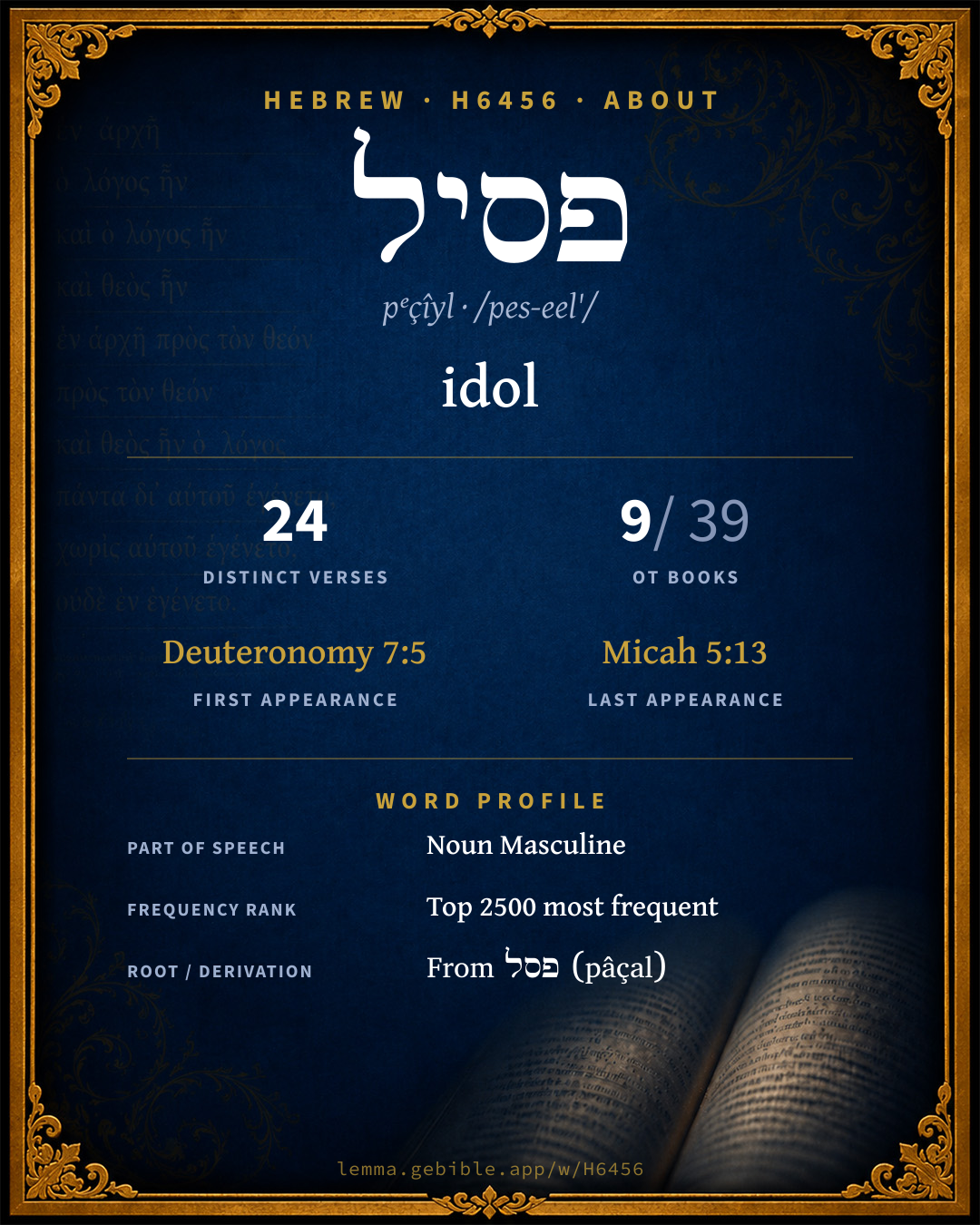
פָּסִיל
idol
Full lexicon entry — Brown-Driver-Briggs (BDB)
From Brown-Driver-Briggs (BDB)
Where this word appears
See every Construct-state word in the Hebrew Bible →
Grammar key — what these labels mean
Part of speech
- Noun
- A naming word — a person, place, thing, or idea.
Noun type
- Common
- A common noun — a general class of person, place, or thing (“king,” “city,” “water”), not a specific name.
State
- Absolute
- The independent form of a noun, not bound to a following word.
- Construct
- A noun bound to a following noun in a possessive / “of” relationship (the construct chain).
Gender
- Masculine
- Grammatically masculine.
Number
- Plural
- More than one (in Hebrew, generally three or more).
- Singular
- One.
Grammatical forms
- Noun, Common, Masculine, Plural, Construct 13 times (54%)
- Noun, Common, Masculine, Plural, Absolute 10 times (42%)
- Noun, Common, Masculine, Singular, Absolute 1 time (4%)
Parsed forms decoded from the imported morphology (morphhb / Westminster Leningrad Codex — WLC text public domain, morphhb tagging CC BY 4.0), counted across 24 parsed occurrences — not distinct verses.
Every verse where H6456 appears — 24 distinct verses across 9 books. Click any verse to open its interlinear word-by-word view. Verse text shown in the World English Bible for context — . Each verse’s Hebrew form is shown with its reference; the English is not keyword-highlighted, since the data carries no word-level English alignment. Use “Compare translations” on any verse to read it across multiple English versions. This concordance covers the Hebrew Bible; Septuagint (Greek Old Testament) occurrences are not indexed here.
Deuteronomy 3 verses
- Deuteronomy 7:5 וּ/פְסִילֵי/הֶ֖ם conj + n c mp cs + sfx pers 3mp But thus shall you deal with them: you shall break down their altars, and dash in pieces their pillars, and hew down their Asherim, and burn their engraved images with fire.
- Deuteronomy 7:25 פְּסִילֵ֥י n c mp cs The engraved images of their gods shall you burn with fire: you shall not covet the silver or the gold that is on them, nor take it to you, lest you be snared therein; for it is an abomination to Yahweh your God.
- Deuteronomy 12:3 וּ/פְסִילֵ֥י conj + n c mp cs and you shall break down their altars, and dash in pieces their pillars, and burn their Asherim with fire; and you shall cut down the engraved images of their gods; and you shall destroy their name out of that place.
Judges 3 verses
- Judges 3:19 הַ/פְּסִילִים֙ ptcl def.art + n c mp But he himself turned back from the quarries that were by Gilgal, and said, I have a secret errand to you, king. He said, Keep silence. All who stood by him went out from him.
- Judges 3:26 הַ/פְּסִילִ֔ים ptcl def.art + n c mp Ehud escaped while they waited, and passed beyond the quarries, and escaped to Seirah.
- Judges 18:17 הַ/פֶּ֨סֶל֙ ptcl def.art + n c ms The five men who went to spy out the land went up, and came in there, and took the engraved image, and the ephod, and the teraphim, and the molten image: and the priest stood by the entrance of the gate with the six hundred men girt with weapons of war.
2 Kings 1 verse
2 Chronicles 5 verses
- 2 Chronicles 33:19 וְ/הַ/פְּסִלִ֔ים conj + ptcl def.art + n c mp His prayer also, and how [God] was entreated of him, and all his sin and his trespass, and the places in which he built high places, and set up the Asherim and the engraved images, before he humbled himself: behold, they are written in the history of Hozai.
- 2 Chronicles 33:22 הַ/פְּסִילִ֗ים ptcl def.art + n c mp He did that which was evil in the sight of Yahweh, as did Manasseh his father; and Amon sacrificed to all the engraved images which Manasseh his father had made, and served them.
- 2 Chronicles 34:3 וְ/הַ/פְּסִלִ֖ים conj + ptcl def.art + n c mp For in the eighth year of his reign, while he was yet young, he began to seek after the God of David his father; and in the twelfth year he began to purge Judah and Jerusalem from the high places, and the Asherim, and the engraved images, and the molten images.
- 2 Chronicles 34:4 וְ/הַ/פְּסִלִ֤ים conj + ptcl def.art + n c mp They broke down the altars of the Baals in his presence; and the sun-images that were on high above them he hewed down; and the Asherim, and the engraved images, and the molten images, he broke in pieces, and made dust of them, and strewed it on the graves [of those] who had sacrificed to them.
- 2 Chronicles 34:7 וְ/הַ/פְּסִלִים֙ conj + ptcl def.art + n c mp He broke down the altars, and beat the Asherim and the engraved images into powder, and hewed down all the sun-images throughout all the land of Israel, and returned to Jerusalem.
Psalms 1 verse
Isaiah 4 verses
- Isaiah 10:10 וּ/פְסִ֣ילֵי/הֶ֔ם conj + n c mp cs + sfx pers 3mp As my hand has found the kingdoms of the idols, whose engraved images did excel them of Jerusalem and of Samaria;
- Isaiah 21:9 פְּסִילֵ֥י n c mp cs and, behold, here comes a troop of men, horsemen in pairs. He answered, Fallen, fallen is Babylon; and all the engraved images of her gods are broken to the ground.
- Isaiah 30:22 פְּסִילֵ֣י n c mp cs You shall defile the overlaying of your engraved images of silver, and the plating of your molten images of gold: you shall cast them away as an unclean thing; you shall tell it, Get you hence.
- Isaiah 42:8 לַ/פְּסִילִֽים prep det + n c mp I am Yahweh, that is my name; and my glory will I not give to another, neither my praise to engraved images.
Jeremiah 4 verses
- Jeremiah 8:19 בִּ/פְסִלֵי/הֶ֖ם prep + n c mp cs + sfx pers 3mp Behold, the voice of the cry of the daughter of my people from a land that is very far off: isn't Yahweh in Zion? Isn't her King in her? Why have they provoked me to anger with their engraved images, and with foreign vanities?
- Jeremiah 50:38 פְּסִלִים֙ n c mp A drought is on her waters, and they shall be dried up; for it is a land of engraved images, and they are mad over idols.
- Jeremiah 51:47 פְּסִילֵ֣י n c mp cs Therefore, behold, the days come, that I will execute judgment on the engraved images of Babylon; and her whole land shall be confounded; and all her slain shall fall in the midst of her.
- Jeremiah 51:52 פְּסִילֶ֑י/הָ n c mp cs + sfx pers 3fs Therefore, behold, the days come, says Yahweh, that I will execute judgment on her engraved images; and through all her land the wounded shall groan.
Hosea 1 verse
Micah 2 verses
- Micah 1:7 פְּסִילֶ֣י/הָ n c mp cs + sfx pers 3fs All her idols will be beaten to pieces, And all her temple gifts will be burned with fire, And all her images I will destroy; For of the hire of a prostitute has she gathered them, And to the hire of a prostitute shall they return."
- Micah 5:13 פְסִילֶ֛י/ךָ n c mp cs + sfx pers 2ms I will cut off your engraved images and your pillars out of your midst; And you shall no more worship the work of your hands.
About this entry
At a glance — auto-summarized from this page’s data, not written by a person. Every figure links to its source below. This summary describes the numbers; it doesn’t interpret them.
“idol” is the headline sense of the Hebrew noun פסיל (pᵉçîyl). Older and newer Bibles part ways — “graven images” in the King James Version, “idols” (Berean Standard Bible) in modern versions. See the renderings breakdown. It turns up in 24 verses across 9 books, an uncommon footprint. Its earliest occurrence is Deuteronomy 7:5. It clusters with פסל and פסל under a shared root. The sections below give every sense, occurrence, and version rendering.
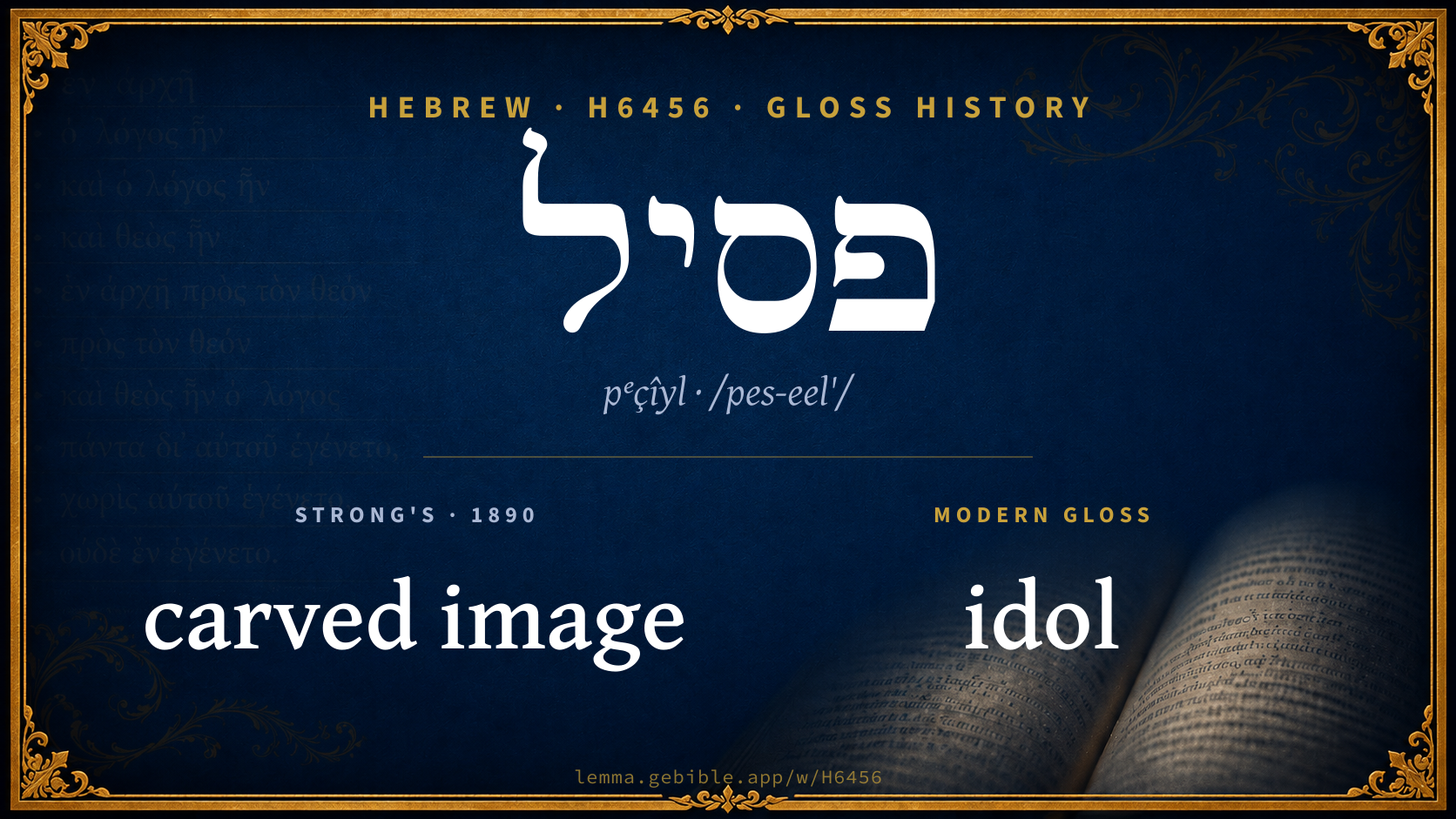
Gloss history
Strong's 1890 vs modern scholarship
About this word
Strong's H6456 catalogs a Hebrew word from the Hebrew Old Testament.
These counts are not copied from any lexicon or concordance. They are computed here, from the morphology-tagged Hebrew Old Testament. What Lemma adds →
- 24
- distinct verses
- The word appears in 24 distinct verses.
- 9 / 39
- OT books
- The word appears in 9 of 39 Old Testament books.
- #1,327
- by frequency
- Top 2500 most frequent Hebrew words (rank 1,327 of 8,640 Hebrew words by occurrence).
View all 24 occurrences in the concordance →
Most concentrated in
- 2 Chronicles 5 verses 21%
- Isaiah 4 verses 17%
- Jeremiah 4 verses 17%
By section of the Old Testament
By traditional corpus
Conventional, traditional groupings — biblical authorship is debated, so this is a traditional corpus grouping, not an authorship claim. Each share is this word’s portion of its verses in that division of the Hebrew canon. Each figure is a share of the word’s 24 distinct verses.
- Prophets (Nevi'im) 15 verses · 63%
- Writings (Ketuvim) 6 verses · 25%
- Torah (Pentateuch) 3 verses · 13%
How translations render this word
Counts come from each version’s own published word-to-Strong’s tagging or interlinear alignment — an approximate guide to how each version renders this word, not a word-level alignment the data otherwise carries. Because each total is that version’s own tagged count, the per-version totals vary from one another and need not match the appearance or distinct-verse counts above. These counts may also differ from a printed concordance because Lemma counts each distinctly tagged rendering and does not collapse phrase taggings into a single head-word total. This is a fixed set of word-tagged versions (KJV, ASV, BSB, ULT) and does not change with the reading translation you choose elsewhere. Each version’s license is shown beside its name below (and on Sources).
- King James Version: Graven images 16×, All the graven images 2×, Carved images 2×
- American Standard Version: Graven images 17×, All the graven images 2×, Quarries 2×
- Berean Standard Bible: Idols 13×, Carved images 4×, Images 3×
- unfoldingWord Literal Text: Idols 10×, Carved images 4×, And 3×
King James Version Public Domain
Renders H6456 across 23 tagged occurrences — most commonly:
Plus 1 rendering that appears only once — usually multi-word phrases or single function words the recovered tagging swept in, not distinct renderings.
American Standard Version Public Domain
Renders H6456 across 25 tagged occurrences — most commonly:
Plus 4 renderings that appear only once — usually multi-word phrases or single function words the recovered tagging swept in, not distinct renderings.
Berean Standard Bible Public Domain
Renders H6456 across 23 tagged occurrences — most commonly:
Plus 1 rendering that appears only once — usually multi-word phrases or single function words the recovered tagging swept in, not distinct renderings.
unfoldingWord Literal Text CC BY-SA 4.0
Renders H6456 across 27 tagged occurrences — most commonly:
Plus 6 renderings that appear only once — usually multi-word phrases or single function words the recovered tagging swept in, not distinct renderings.
Senses in BDB
The 1 sense BDB distinguishes for this word, in lexicon order (not ranked by frequency or importance). The full entry — with sub-senses — is in the Lexicon Entry tab.
- image, idol, graven image
Word origin
Derived from פסל (pâçal) (H6458) — to hew.
Jastrow Dictionary
A second Hebrew/Aramaic lexicon for comparison, covering Aramaic and post-biblical (Talmudic, Targumic, Midrashic) usage that the biblical-Hebrew BDB does not. Matched by lemma rather than by Strong’s number, so a lemma may carry more than one Jastrow headword (shown separately below), and the entries cover usage well beyond the Bible.
פָּסִיל
- 1. hewn image. — Pl. פְּסִילִים. Y. Ber. IV, 8ᵃ ויחללוה עובדי פ׳ and which idolaters have desecrated. Pirké d’R. El. ch. XXX הפ׳ של בית וכ׳ the images of the house of Pharaoh her father; a. e.
- 2. chisel, v. פְּסִילָה.—[Y. Ned. I, 37ᵃ top; Y. Naz. I, beg. 51ᵃ נזיר פסילים, v. פְּסִילּוֹס.]
A Dictionary of the Targumim, the Talmud Babli and Yerushalmi, and the Midrashic Literature (Marcus Jastrow; London, Luzac, 1903) — Public Domain. Digitized via Sefaria. Digitized via Sefaria. Full attribution on Sources.
Forms in the corpus
The 22 distinct written forms H6456 takes in the Hebrew Bible, most frequent first — each parse links to that state’s occurrences in the concordance. Hebrew forms include their vowel points and cantillation, so a single lemma takes many written forms.
Same root — word family
Other BDB entries built from the same root as H6456, grouped by Strong’s listed origin. These share a root / origin per the lexicon — not necessarily a shared meaning. Each links to that word’s own entry.
Derives from
Shares the same root
Compare all same-root words → They share a root, not necessarily a meaning.
Septuagint verse parallels
This word appears in 20 verses that also exist in the Greek Old Testament (Septuagint), out of the 24 Hebrew verses it occurs in. You can read those verses in Greek by switching the Old Testament edition to the Septuagint.
Read these verses in the Septuagint
- Deuteronomy 7:5
- Judges 3:19
- 2 Kings 17:41
- 2 Chronicles 33:19
- Isaiah 10:10
- Jeremiah 8:19
- Hosea 11:2
- Micah 1:7
This is a verse-level parallel only — the same verses exist in both the Hebrew and Greek Old Testaments. No word-level Hebrew↔Greek correspondence is claimed: the data carries no such alignment, so no Greek word is shown as this Hebrew word’s translation. Coverage is not total — the Septuagint omits the deuterocanon and renumbers the Psalms, so some Hebrew verses have no direct Greek parallel.