
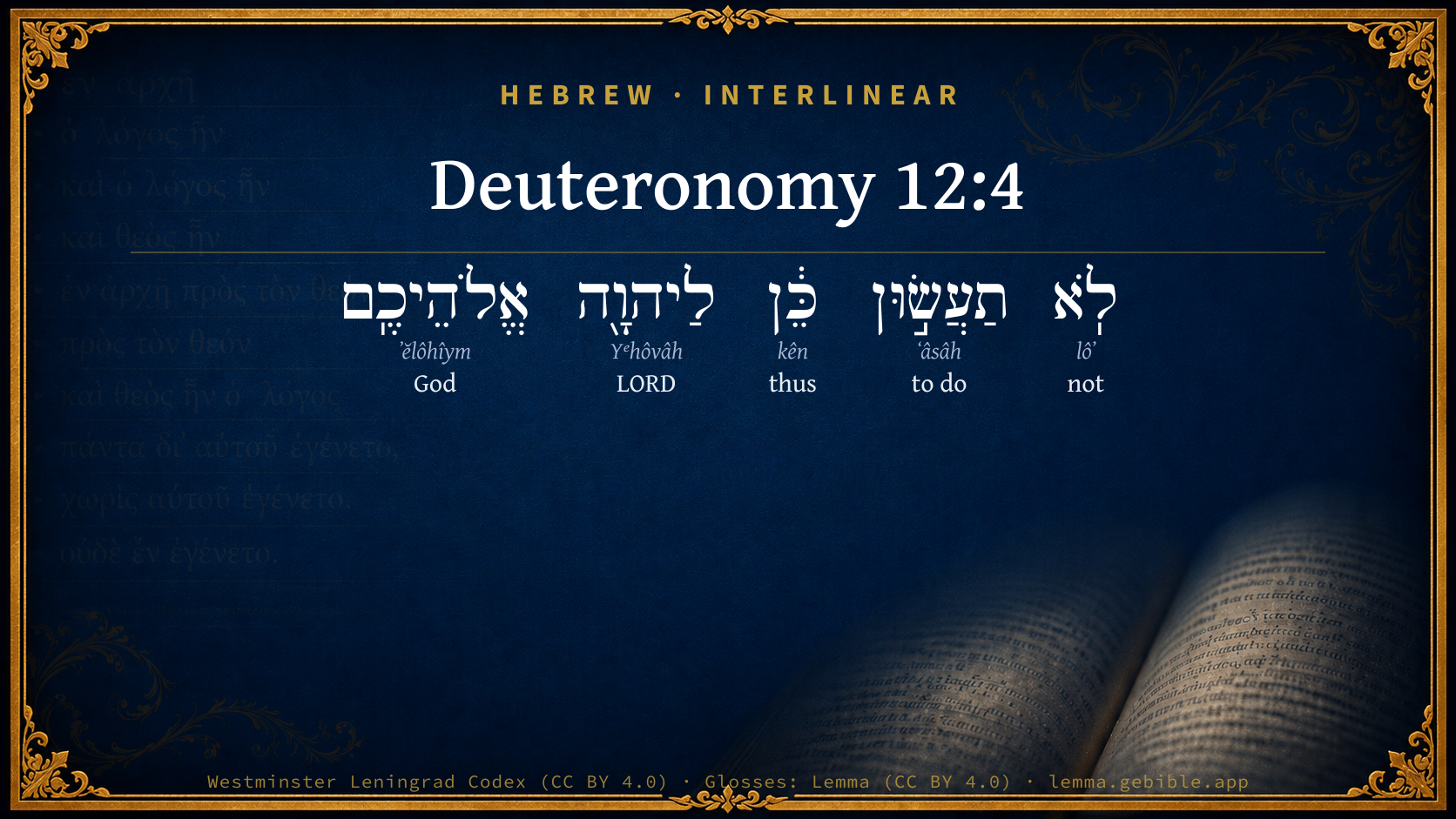
Deuteronomy 12:4

Hebrew (Westminster Leningrad Codex) Deuteronomy 12:4 appears in the Hebrew Old Testament. The text above is from the Westminster Leningrad Codex. Each word links to its Strong’s number, a concise gloss, and parsing drawn from the Open Scriptures Hebrew Bible morphology. Click any word for its full Brown-Driver-Briggs (BDB) entry.
Download image
Cite this verse

Deuteronomy 12:4 (World English Bible). Public Domain. Lemma interlinear Bible study tool, https://lemma.gebible.app/v/deuteronomy/12/4.

Show BibTeX & RIS
BibTeX
RIS
English Translation
You shall not do so to Yahweh your God.
World English Bible · Public Domain
Download a study sheet

One document with this verse’s original text, its word-by-word gloss line, the meaning frame, cross-references with their text, attributed commentary, and full source and license credits — printable, and it pastes into notes with its structure intact.

This verse Autodidact and up

Study sheet (.html) Plain text (.txt)

A passage Seminary Student

Up to 50 verses in one chapter. A passage sheet keeps up to 6 commentary sources and 12 cross-references per verse, in the order this page ranks them, and says so on the sheet whenever that leaves anything out. Ask for a single verse and you get the Autodidact verse sheet above.

Everything on this page stays free to read, with no account — the sheet is a download of what is already on screen, not access to it.

Want to remove ads? Support Godless Engineer
Compare translations 3

The same verse in 3 English versions, stacked beneath the original-language interlinear above. Click any original word for its lexicon entry.

Each is an independent rendering of the whole verse — the interlinear is not word-aligned to these translations.

Highlighted words mark where these versions differ — a whole-verse word diff, not a word-by-word alignment.

  • World English Bible Public Domain
    You shall not do so to Yahweh your God.
  • King James Version Public Domain
    Ye shall not do so unto the LORD your God.
  • unfoldingWord Literal Text CC BY-SA 4.0
    You shall not do thus to Yahweh your God.

unfoldingWord Literal Text — © unfoldingWord, licensed CC BY-SA 4.0. Word-aligned USFM3 via Door43 (git.door43.org/unfoldingWord/en_ult).

Versions to compare (up to 4)

3 of 4 selected

Show all 18 translations

Every available English version of this verse, each an independent rendering of the whole verse.

  • World English Bible Public Domain
    You shall not do so to Yahweh your God.
  • Berean Standard Bible Public Domain
    You shall not worship the LORD your God in this way.
  • Majority Standard Bible Public Domain
    You shall not worship the LORD your God in this way.
  • King James Version Public Domain
    Ye shall not do so unto the LORD your God.
  • American Standard Version (1901) Public Domain
    Ye shall not do so unto Jehovah your God.
  • Revised Version (1885) Public Domain
    Ye shall not do so unto the LORD your God.
  • Geneva Bible (1599) Public Domain
    Ye shall not do so vnto ye Lord your God,
  • Douay-Rheims (1899) Public Domain
    You shall not do so to the Lord your God:
  • Young's Literal Translation Public Domain
    `Ye do not do so to Jehovah your God;
  • Literal Standard Version CC BY-SA 4.0
    You do not do so to your God YHWH;
  • Unlocked Literal Bible CC BY-SA 4.0
    You will not worship Yahweh your God like that.
  • unfoldingWord Literal Text CC BY-SA 4.0
    You shall not do thus to Yahweh your God.
  • Darby Bible Public Domain
    Ye shall not do so unto Jehovah your God;
  • World Messianic Bible Public Domain
    You shall not do so to the LORD your God.
  • Webster's Bible Public Domain
    Ye shall not do so to the LORD your God.
  • Free Bible Version CC BY-SA 4.0
    You are not to worship the Lord your God in the way that they did.
  • Bible in Basic English Public Domain
    Do not so to the Lord your God.
  • JPS Tanakh (1917) Public Domain
    Ye shall not do so unto the LORD your God.

Literal Standard Version (2020), Covenant Press — licensed CC BY-SA 4.0. Text via the HelloAO Bible API (eBible.org). Unlocked Literal Bible (unfoldingWord) — licensed CC BY-SA 4.0. Text via the HelloAO Bible API (eBible.org). unfoldingWord Literal Text — © unfoldingWord, licensed CC BY-SA 4.0. Word-aligned USFM3 via Door43 (git.door43.org/unfoldingWord/en_ult). Free Bible Version, Dr. Jonathan Gallagher — licensed CC BY-SA 4.0. Text via the HelloAO Bible API (eBible.org).

Word by word

More ways to search: Search by grammar → Find every occurrence → Compare this word →

Practice this passage: Drill this verse → Learn its vocabulary →

כֵּ֔ן
kên
H3651
“thus”
Particle, Demonstrative
Part of Speech
Particle
Type
Demonstrative
Full BDB Definition

Origin: from H3559

TWOT: 964a , 964b

so, therefore, thus (adverb) - thus, so - just so - therefore - so ... as (paired with adverb) - then - forasmuch as (in phrase) - (with preposition) - therefore, this being so (specific) - hitherto - therefore, on this ground (general) - afterwards - in such case - right, just, honest, true, veritable (adjective) - right, just, honest - correct - true, veritable - true!, right!, correct! (in assent)
  1. לֹֽא lôʼ H3808 “not” Particle, Negative
  2. תַעֲשׂ֣וּן ʻâsâh H6213 “to do” Verb, Qal, Imperfect, 2nd Person, Masculine, Plural + Suffix, n
  3. לַיהוָ֖ה Yᵉhôvâh H3068 “to/for · LORD” Preposition + Noun, Proper
  4. אֱלֹהֵיכֶֽם ʼĕlôhîym H430 “God(s) · your” Noun, Common, Masculine, Plural, Construct + Suffix, Personal, 2nd Person, Masculine, Plural

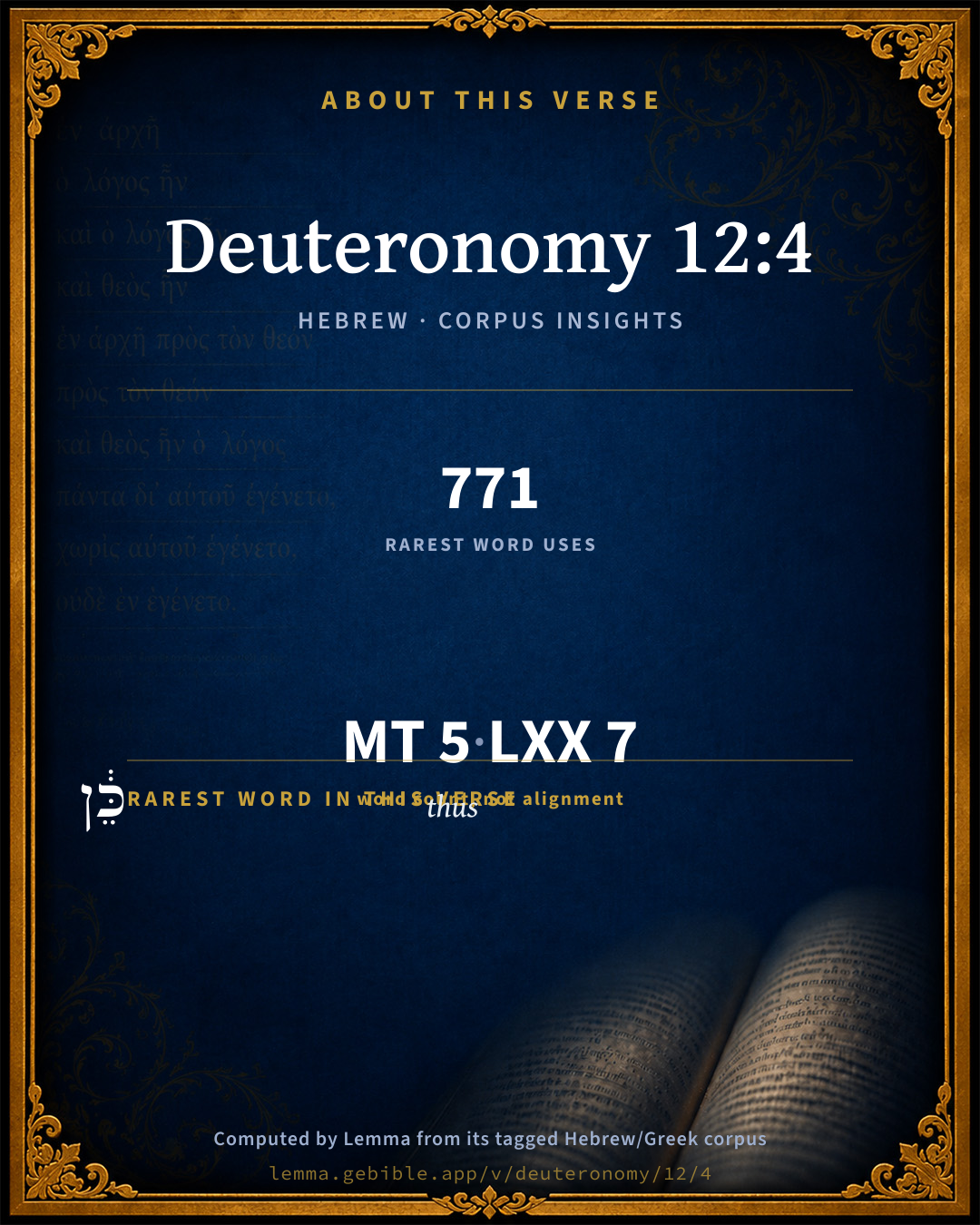
About this verse

These counts appear in no published source. They are computed here, from the morphology-tagged text and Lemma’s own curated glosses. What Lemma adds →

5
words
5
distinct lemmas
Pentateuch
section

Grammatical profile

  • 1 verb
  • 2 nouns
  • 2 particles

Verb forms

  • תַעֲשׂ֣וּן Qal · Imperfect

Hebrew & Septuagint length

In English translation the verse runs 9 words from the Hebrew and 10 from the Septuagint (LXX English) — closely comparable.

A rough comparison of the two English renderings, which tokenize alike — not a word-level alignment.

Word counts can differ between the Hebrew and the Greek without any difference in meaning — e.g. the Hebrew direct-object marker אֵת has no separate Greek word, and Greek often adds the article ὁ.

In the original languages it is 5 Hebrew tokens and 7 Greek tokens — but the two are counted differently (Hebrew bundles its prefixes and suffixes into one token; the Greek is in lemma form), so that isn’t a like-for-like length.

Cross-references

4

Topical passages linked to Deuteronomy 12:4 in the Treasury of Scripture Knowledge — connected by theme and wording, ordered by reader-vote popularity; previews shown in the World English Bible.

  • Leviticus 20:23 You shall not walk in the customs of the nation, which I am casting out before you: for they did all these things, and therefore I abhorred them.
  • Deuteronomy 20:18 that they not teach you to do after all their abominations, which they have done to their gods; so would you sin against Yahweh your God.
  • Deuteronomy 12:30–31 take heed to yourself that you not be ensnared to follow them, after that they are destroyed from before you; and that you not inquire after their gods, saying, How do these nations serve their gods? even so will I do likewise.
  • Deuteronomy 16:21–22 You shall not plant you an Asherah of any kind of tree beside the altar of Yahweh your God, which you shall make you.

Cross-references courtesy of OpenBible.info (CC BY 4.0).

Hebrew and Greek witnesses Masoretic Hebrew ↔ Greek Septuagint

The same verse in the two great witnesses to the Old Testament, shown verse-for-verse.

These are two independent witnesses, not word-aligned to each other, and the Septuagint is shown in lemma (dictionary) form.

Hebrew Deuteronomy 12:4 Masoretic · Westminster Leningrad Codex

לֹֽא תַעֲשׂ֣וּן כֵּ֔ן לַיהוָ֖ה אֱלֹהֵיכֶֽם

You shall not do so to Yahweh your God.

World English Bible · Public Domain

Greek LXX Deuteronomy 12:4 Septuagint · lemma form

οὐ ποιέω οὕτως κύριος ὁ θεός σύ

You⌃ shall not do so to the Lord your God.

LXX2012 (modern English Septuagint) · Public Domain

Hebrew: Westminster Leningrad Codex (CC BY 4.0). Greek: Septuagint (public domain); English from LXX2012 (modern English Septuagint) (Public Domain). How the Septuagint differs from the Hebrew →

Targum (Aramaic paraphrase)

2

The Targum is the ancient Jewish Aramaic paraphrase of the Hebrew Scriptures — an interpretive translation, not the Hebrew text itself. Onkelos (literal) and Pseudo-Jonathan (expansive) render the Torah, and Jonathan the Prophets. Coverage is partial: where no permissively-licensed English translation exists for a verse, only the Aramaic is shown. This is verse-level text, not a word-by-word alignment to the Hebrew.

  1. Targum Onkelos Torah (Genesis–Deuteronomy)
    לָא תַעְבְּדוּן כֵּן קֳדָם יְיָ אֱלָהָכוֹן

    (no public-domain English translation for this verse)

    Targum Onkelos — Aramaic: “Onkelos Genesis” (public domain); “Onkelos Exodus” (public domain); “Onkelos Leviticus” (public domain); “Onkelos Numbers” (public domain); “Onkelos Deuteronomy” (public domain). English: “Sefaria Community Translation” (CC0 1.0 (public-domain dedication)); “J.W. Etheridge. The Targums of Onkelos and Jonathan Ben Uzziel on the Pentateuch. London: Longmans, Green, 1862” (public domain). Text via Sefaria.

  2. Targum Pseudo-Jonathan Torah (Genesis–Deuteronomy)
    לֵיתֵיכוֹן רְשָׁאִין לְמַחְקָא כְּתַב שְׁמָא דַיְיָ אֱלָהָכוֹן

    Not so may you do to blot out the inscription of the Name of the Lord your God.

    Targum Pseudo-Jonathan — Aramaic: “Targum Jonathan on Genesis” (public domain); “Targum Jonathan on Exodus” (public domain); “Targum Jonathan on Leviticus” (public domain); “Targum Jonathan on Numbers” (public domain); “Targum Jonathan on Deuteronomy” (public domain). English: “The Targum of Jonathan ben Uzziel, trans. J. W. Etheridge, London, 1862” (public domain). Text via Sefaria.

Commentary

Notes on Deuteronomy 12:4 from classic Christian and Jewish commentators (each source and its license shown beneath its notes). The classic Christian expositions comment on the surrounding passage and are grouped to its opening verse, so a note may address several verses; the Jewish commentaries on the Tanakh (Rashi and others) are per-verse, so they appear only where the commentator wrote on this verse.

Lemma curates 59 commentaries, every one of them public domain or Creative Commons licensed, each selected and text-cleaned for this edition rather than reprinted as found. About our sources →

Trapp's Complete Commentary

John Trapp

Deu 12:4 Ye shall not do so unto the LORD your God.

Ver. 4. Ye shall not do so.] As wicked Ahaz did, {2Ch 28:24} by the advice and help of Uriah, that turn-coat, {2Ki 16:10-12} who had once passed for a faithful witness, {Isa 7:2} but afterwards proved a factor for the devil.

John Trapp, A Commentary or Exposition upon All the Books of the Old and New Testament (1647–1656) — public domain. Text from a community e-Sword module.

Geneva Bible (1599)

Geneva Bible translators

Ye shall not serve the Lord with superstitions.

Geneva Bible (1599) marginal notes — public domain. Text via Bolls.life.

Ellicott's Commentary for English Readers

(4) Ye shall not do so—i.e. shall not serve Him upon the high mountains, and hills, and under every green tree, after the manner of the nations.

A Bible Commentary for English Readers, edited by Charles John Ellicott (1878–1897) — public domain. Text from a community e-Sword module.

John Gill's Exposition

Ye shall not do so unto the Lord your God. Not sacrifice to him on hills and mountains, and under green trees; though the Jews commonly refer this to the destruction of the names of God, and of any thing appertaining to the temple; that though the temples and the altars of the Heathens were to be overthrown, yet not a stone was to be taken from the house of God, or that belonged to it, nor any of his names to be blotted out; so the Targum of Jonathan and Maimonides (z), who also observes (a), that whoever removes a stone by way of destruction from the altar, or from the temple, or from the court, is to be beaten; so he that burns the holy wood.

(z) Yesode Hattorah, c. 6. sect. 7, 9. (a) Ibid. sect. 8.

John Gill's Exposition of the Whole Bible (1746–1763) — public domain (CC PDM 1.0). Text via the HelloAO Bible API.

Albert Barnes' Notes on the Bible

i. e., “The idolaters set up their altars and images on any high hill, and under every green tree at their pleasure, but ye shall not do so; the Lord Himself shall determine the spot for your worship, and there only shall ye seek Him.” The religion of the Canaanites was human; its modes of worship were of man’s devising. It fixed its holy places on the hills in the vain thought of being nearer heaven, or in deep groves where the silence and gloom might overawe the worshipper. But such superstitious appliances were not worthy of the true religion. God had revealed Himself to people in it, and manifested among them His immediate presence and power. He would Himself assign the sanctuary and the ritual of His own service.

Albert Barnes' Notes on the Bible (1834–1885) — public domain. Text from a community e-Sword/MySword module.

Matthew Poole's English Annotations

i.e. Not worship him in several places, mountains, groves, &c., which sense is evident from the following opposition.

Matthew Poole's English Annotations on the Holy Bible (1683–1685) — public domain. Text from a community e-Sword/MySword module.

Whedon's Commentary on the Bible

Daniel D. Whedon

4. Ye shall not do so unto the Lord your God — You are not to follow the example of these nations and select places for worship. You must conform to Jehovah’s requirements, and worship in the place he appoints.

Daniel D. Whedon (gen. ed.), Commentary on the Old and New Testaments (1874–1909) — public domain. Text from a community e-Sword module.

The Pulpit Commentary

Vers. 4-6. The heathen placed their altars and offered their worship wherever they thought fit, according to their notions of the deity and his service; but Israel was not to do so unto Jehovah their God: he himself would choose the places where he was to be worshipped, and there alone might they come with offering and service. As the revealed God the God whose being and perfections had been made known, not by a vague revelation of him in nature merely, but expressly by his putting or recording his Name historically and locally among men (cf. Exo_20:24) so should there be a definite place chosen and appointed by him where he would come to receive the worship of his people, where he would record his Name, and where he would be known for a Refuge and a Helper to all who put their trust in him (Psa_48:3 Psa_76:1, etc.; Dan_9:18) The Name of God is God himself as revealed; and he puts his Name on any place where he specially manifests himself as present, (cf. 1Ki_8:29) and which is consequently to be regarded as his habitation or dwelling-place. Hence the temple at Jerusalem was in later times known as the place of the Name of Jehovah, (Isa_18:7) the dwelling-place of his glory. (Psa_26:8) But he is the God of the whole earth, and therefore, wherever he is pleased to reveal himself, in whatever place he makes his Name to be known, there he is to be worshipped. There is no reference in this passage to the temple at Jerusalem specially, as some have supposed; what is here enjoined is only a practical application of the Divine promise, that in all places where God would record his Name, there he would come to bless his people. (Exo_20:24) The reference here, therefore, is quite general, and applies to any place where, by the Divine appointment, the tabernacle might be set up and the worship of Jehovah instituted. Unto his habitation shall ye seek. To seek to any place means, primarily, to resort to it, to frequent it, (cf. 2Ch_1:5) but with the implied purpose of inquiring there for something, as for responses or oracles, when the place resorted to was that in which God had put his Name.

Vers. 4-14. Centralization in worship.

It is quite unnecessary that we should here enter upon the criticism which has been raging upon this important passage, as indicating something post-Mosaic. The directions in Exodus do not necessarily imply a multiplicity of altars at the same time, but rather successive alterations of locality in conformity with the requirements of the pilgrimage. Besides, the genius of the Jewish worship implied the centralization of it in contrast to the multiplicity of places arising out of polytheism. The idea of a central altar is implied in the erection of the tabernacle at Sinai, and all the legislation which gathers round it. We believe, therefore, that Moses, in here formulating the centralization in worship, was merely making plainer what had already been implied.

I CENTRALIZATION IN WORSHIP SEEMS A CONVENIENT STEPPING-STONE FROM THE DANGERS OF POLYTHEISM TO UNIVERSAL SPIRITUAL WORSHIP. Abraham, in setting up the new worship in Canaan, had erected altars at the different places where God appeared unto him. His fine intellect realized that it was the One God he worshipped at the different places. His descendants also, in their pilgrimage to Palestine, realized that it was the One God who called upon them out of the cloudy pillar to halt from time to time, and to erect his altar, and whom they there worshipped; and they would also feel that this direction about a single central altar was but the necessary corollary to the entire legislation. The ideal of worship, to which the Old Testament dispensation pointed, was, "when the true worshippers shall worship the Father in spirit and in truth: for the Father seeketh such to worship him"; (Joh_4:23) meanwhile it was most important to have the Divine unity publicly recognized and expressed by a central altar. At this they were to aim when settled beyond the Jordan.

II THE CENTRAL ALTAR IS TO GATHER ROUND IT JOYFUL WORSHIPPERS. (Vers. 6, 7.) Burnt offering, sacrifice, heave offering, etc., were to reach their climax in the eating before the Lord the peace offering, and in the joy which springs from fellowship. This is the purpose of all worship. If joy be not reached, then the worshippers are living below their privileges.

III ALLOWANCE IS MADE FOR THE EXIGENCIES OF THE MARCH AND OF WAR. Means of grace have to be extemporized often in times of battle and marches, and men must do what is right in their own eyes, in a way that would not be lawful in times of settled avocations and of peace. Moses is instructed, therefore, to remind them of the freedom they necessarily practice in the unsettled condition, which must be relinquished when they settle down beyond the Jordan (vers. 8, 9).

IV GOD RESERVES THE RIGHT OF CHOOSING THE CENTRAL PLACE OF WORSHIP. (Vers. 10-14.) This prevents all license in such an important matter. It is not what they think advisable, but what God directs, that they are in the locality of worship to follow. This reservation is surely most significant. It indicates that in worship, which is the payment of due homage unto God, his will and wisdom are to be regarded as supreme. The right God holds in his hand of indicating whether he is to be worshipped in one place or everywhere.

V GOD REVEALED THE CENTRAL PLACE IN DUE SEASON. A good deal of the current criticism seems to overlook the distinction between the principle of centralization in worship and the place where it was to be observed. The principle was stated long before the place was indicated. It was centuries before Jerusalem became the recognized center of the Jewish religion. Had the name been indicated earlier, it would have prevented the natural development of the ritual in Canaan. It is not necessary to suppose that Moses had any definite idea of the central place when he uttered on the banks of the Jordan the will of God. God can express his will through historical developments, just as he can through natural developments. "The nature of things" may be justly regarded as the expression of the Divine mind; and so may a historical procession. Meanwhile, it is well for us to rejoice in the freedom and universality of spiritual worship to which we have come. Now the true worshippers, emancipated from the cumbrous ritual through its fulfillment in Christ, can "worship the Father in spirit and in truth" in every place. R.M.E.

The Pulpit Commentary (1880–1919), ed. H.D.M. Spence-Jones & Joseph S. Exell — public domain. Text from a community e-Sword module.

John Wesley's Explanatory Notes

Not do so - That is, not worship him in several places, mountains, and groves.

John Wesley, Explanatory Notes Upon the Whole Bible (1754–1765) — public domain. Text via the GEBible commentary corpus.

Rashi

Rabbi Shlomo Yitzchaki (Rashi)

לא תעשון כן YE SHALL NOT DO SO [UNTO THE LORD YOUR GOD] — i.e. to burn offerings to God at any place you choose (as do the idolaters, cf. v. 2), but at the place which He will choose (cf. vv. 5—6). — Another explanation is: ונתצתם את מזבחתם … ואבדתם את שמם … לא תעשון כן YE SHALL PULL DOWN THEIR ALTARS … YE SHALL DESTROY THEIR NAMES … BUT YE SHALL NOT DO THIS [TO THE LORD YOUR GOD] — It is a prohibition addressed to one who would blot out the Name of God from any writing, or would pull out a stone from the altar or from the forecourt (cf. Sifrei Devarim 61:12; Makkot 22a). R. Ishmael said: “But can the idea enter your mind that the Israelites would pull down the altars of God?” But the meaning of לא תעשון כן is that you should not do like their doings so that your sins would cause the Sanctuary of (built by) your fathers to be laid waste (Sifrei Devarim 61:7).

Rashi on the Tanakh — English translations: “The Judaica Press complete Tanach with Rashi, translated by A. J. Rosenberg” (CC BY 4.0); “Pentateuch with Rashi's commentary by M. Rosenbaum and A.M. Silbermann, 1929-1934” (public domain); “The Metsudah Tanach series, Lakewood, N.J” (CC BY 4.0); and “The Book of Joshua, Metsudah Publications, 1997” (CC BY 4.0). Text via Sefaria.

Ramban (Nachmanides)

Rabbi Moshe ben Nachman (Ramban / Nachmanides)

YE SHALL NOT DO SO UNTO THE ETERNAL YOUR G-D — “to burn offerings to G-d at any place [you choose], but only at the place He shall choose. Another interpretation: And ye shall break down their altars etc., and ye shall destroy their name — ye shall not do so unto the Eternal your G-d, this being an admonition against erasing the Name of G-d, or dismantling any stone of the altar or of the Sanctuary Court. Said Rabbi Yishmael: ‘Could it even occur to you that the Israelites would break down the altars [of G-d]? But the meaning of the verse is that you are not to imitate the deeds [of the idolators] lest your sins cause your ancestors’ Sanctuary to be destroyed.’” This is Rashi’s language. Now the words of Rabbi Yishmael are words of Agadah (homily) based on a Scriptural support [and they are not meant to be taken as the plain meaning of the verse]. However, the verse according to the opinion of our Rabbis, constitutes an admonition against erasing the Divine Name. It is so expressly stated in Tractate Makkoth: “But there is yet the penalty for erasing the Divine Name which is whipping, and the prohibition is to be found in these words, Ye shall not do so unto the Eternal.” And the language of the Sifre is as follows: 61. “Whence do I know that he who dismantles one stone [of the altar] etc.? Rabbi Yishmael says: ‘Whence do I know that he who erases one letter of the Divine Name transgresses a negative commandment? Because it is written, and ye shall destroy their name — Ye shall not do so unto the Eternal your G-d.’ Rabban Gamaliel the son of Rabbi says: ‘But how could it occur to you [that the Israelites would dismantle] etc.’” Thus [it is clear that] the words of Rabbi Yishmael [quoted by Rashi] were not meant to dispute [the opinion of the unnamed First Sage]; etc., to be only an admonition against erasing G-d’s Name, and that such is also the opinion of Rabbi Yishmael. Rabbi Yishmael’s words quoted by Rashi are a clarification, teaching that “erasing the Divine Name is equivalent to dismantling a stone of the Divine altar.” Furthermore, the text quoted by Rashi in the name of Rabbi Yishmael is attributed by the Sifre to Rabban Gamaliel, which perforce is only a homiletic statement, that sinning is tantamount to destruction of G-d’s altar. Hence the same text in Rashi must also be understood in the same light (Mizrachi). rather, they are a clarification that erasing the Divine Name is equivalent to dismantling a stone of the altar. And if so, the meaning of the verses would be: “And ye shall break down their altars etc. and ye shall destroy their name out of that place — but ye shall not do so unto the Eternal your G-d to break down His altar, nor to destroy His Name. Instead, give glory to His Name and His altar, and to the place which He shall choose there to establish His altar; to [the place where] His Name dwells shall you seek, and bring your burnt-offerings before Him.”

Ramban (Nachmanides) on the Tanakh — English translation: “Commentary on the Torah by Ramban (Nachmanides). Translated and annotated by Charles B. Chavel. New York, Shilo Pub. House, 1971-1976” (CC BY 4.0). Text via Sefaria.

Ibn Ezra

Rabbi Abraham ibn Ezra

Do not act this way. You should not offer sacrifices on the mountains and the hills, only in the place where Hashem places His name.

Ibn Ezra on the Tanakh — English translations: “Sefaria Community Translation” (CC0 1.0 (public-domain dedication)); “Yalkut, Sifsei Chachomim Chumash, Metsudah Publications, 2009” (CC BY 4.0); and “Commentary of Ibn Ezra on Isaiah - trans. by M. Friedlander, 1873” (public domain). Text via Sefaria.

Lesson kit

Teaching starters — assembled from the data on this page, not authored interpretation. Every prompt links to the verse data it draws on. Edit before teaching.

Deuteronomy, in the Pentateuch, opens this verse with 5 words (5 distinct Hebrew lemmas). Its most distinctive word is kên (“thus”). A historical commentator’s framing appears above. Read the whole chapter for the surrounding context.

Discussion questions

  1. How does “thus” (kên) shape what this verse is saying?
  2. Leviticus 20:23 shares this passage’s theme. How do the two illuminate each other?
  3. The translations on this page render this verse differently — a whole-verse word diff, not a word-by-word alignment. What might account for the different wordings?
  4. The verb «תַעֲשׂ֣וּן» is Qal Imperfect. How does its form color the action?
  5. Reading how Trapp's Complete Commentary and Geneva Bible (1599) read this verse, where do the two commentators agree and where do they part?

Things to notice

Reading settings

Reading text

Shown beneath each verse's original-language words.

Old Testament
Old Testament edition

Read the OT as the Masoretic Hebrew (MT) or the Greek Septuagint (LXX).

English shown for the Greek Septuagint (in the Hebrew ↔ Greek comparison).

Comparing translations? Open the Compare panel on any verse page to stack up to four side by side.