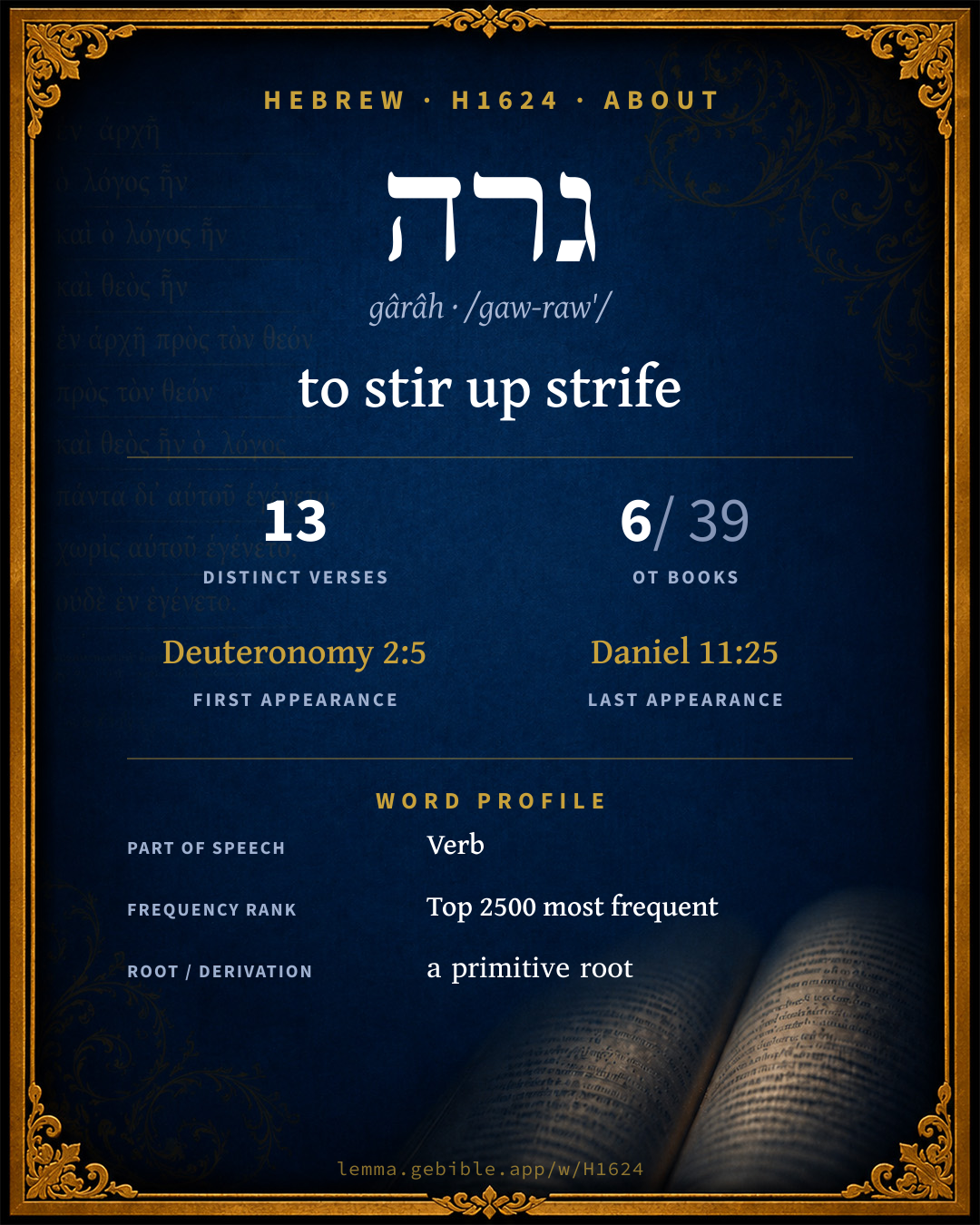
גָּרָה
to stir up strife
‘to stir up strife’ is one of 2 main senses fuller range ↓
Full lexicon entry — Brown-Driver-Briggs (BDB)
From Brown-Driver-Briggs (BDB)
Where this word appears
See every Hithpael verb in the Hebrew Bible →
Grammar key — what these labels mean
Part of speech
- Verb
- An action or state-of-being word.
Stem
- Piel
- An intensive or resultative active stem.
- Hithpael
- The reflexive or reciprocal stem (the subject acts on itself).
Form
- Imperfect
- An incomplete, ongoing, or future action (“he will / would write”).
- Jussive
- A third- or second-person volitional form expressing wish or command (“let him write”).
- Imperative
- A direct command (“write!”).
- Perfect
- A completed action or state — Hebrew marks aspect (completeness) more than strict tense (“he wrote”).
Person
- 3rd Person
- The one spoken about (“he / she / it / they”).
- 2nd Person
- The one addressed (“you”).
Gender
- Masculine
- Grammatically masculine.
- Feminine
- Grammatically feminine.
Number
- Singular
- One.
- Plural
- More than one (in Hebrew, generally three or more).
Grammatical forms
- Verb, Piel, Imperfect, 3rd Person, Masculine, Singular 3 times (20%)
- Verb, Hithpael, Imperfect, 3rd Person, Masculine, Plural 3 times (20%)
- Verb, Hithpael, Imperfect, 2nd Person, Masculine, Singular 2 times (13%)
- Verb, Hithpael, Jussive, 2nd Person, Masculine, Singular 2 times (13%)
- Verb, Hithpael, Imperfect, 3rd Person, Masculine, Singular 2 times (13%)
- Verb, Hithpael, Imperative, 2nd Person, Masculine, Singular 1 time (7%)
- Verb, Hithpael, Jussive, 2nd Person, Masculine, Plural 1 time (7%)
- Verb, Hithpael, Perfect, 2nd Person, Feminine, Singular 1 time (7%)
Parsed forms decoded from the imported morphology (morphhb / Westminster Leningrad Codex — WLC text public domain, morphhb tagging CC BY 4.0), counted across 15 parsed occurrences — not distinct verses.
Every verse where H1624 appears — 13 distinct verses across 6 books. Click any verse to open its interlinear word-by-word view. Verse text shown in the World English Bible for context — . Each verse’s Hebrew form is shown with its reference; the English is not keyword-highlighted, since the data carries no word-level English alignment. Use “Compare translations” on any verse to read it across multiple English versions. This concordance covers the Hebrew Bible; Septuagint (Greek Old Testament) occurrences are not indexed here.
Deuteronomy 4 verses
- Deuteronomy 2:5 תִּתְגָּר֣וּ Hithpael juss 2mp don't contend with them; for I will not give you of their land, no, not so much as for the sole of the foot to tread on; because I have given Mount Seir to Esau for a possession.
- Deuteronomy 2:9 תִּתְגָּ֥ר Hithpael juss 2ms Yahweh said to me, Don't bother Moab, neither contend with them in battle; for I will not give you of his land for a possession; because I have given Ar to the children of Lot for a possession.
- Deuteronomy 2:19 תִּתְגָּ֣ר Hithpael juss 2ms and when you come near over against the children of Ammon, don't bother them, nor contend with them; for I will not give you of the land of the children of Ammon for a possession; because I have given it to the children of Lot for a possession.
- Deuteronomy 2:24 וְ/הִתְגָּ֥ר conj + Hithpael impv 2ms Rise up, take your journey, and pass over the valley of the Arnon: behold, I have given into your hand Sihon the Amorite, king of Heshbon, and his land; begin to possess it, and contend with him in battle.
2 Kings 1 verse
2 Chronicles 1 verse
Proverbs 4 verses
- Proverbs 15:18 יְגָרֶ֣ה Piel impf 3ms A wrathful man stirs up contention, But one who is slow to anger appeases strife.
- Proverbs 28:4 יִתְגָּ֥רוּ Hithpael impf 3mp Those who forsake the law praise the wicked; But those who keep the law contend with them.
- Proverbs 28:25 יְגָרֶ֣ה Piel impf 3ms One who is greedy stirs up strife; But one who trusts in Yahweh will prosper.
- Proverbs 29:22 יְגָרֶ֣ה Piel impf 3ms An angry man stirs up strife, And a wrathful man abounds in sin.
Jeremiah 1 verse
Daniel 2 verses
- Daniel 11:10 יִתְגָּר֗וּ ו/יתגרו וְ/יִתְגָּרֶ֖ה Hithpael impf 3mp conj + Hithpael impf 3mp conj + Hithpael impf 3ms His sons shall war, and shall assemble a multitude of great forces, which shall come on, and overflow, and pass through; and they shall return and war, even to his fortress.
- Daniel 11:25 יִתְגָּרֶה֙ Hithpael impf 3ms He shall stir up his power and his courage against the king of the south with a great army; and the king of the south shall war in battle with an exceeding great and mighty army; but he shall not stand; for they shall devise devices against him.
About this entry
At a glance — auto-summarized from this page’s data, not written by a person. Every figure links to its source below. This summary describes the numbers; it doesn’t interpret them.
“to stir up strife” is the headline sense of the Hebrew verb גרה (gârâh). Its earliest occurrence is Deuteronomy 2:5. It turns up in 13 verses across 6 books, an uncommon footprint. It concentrates in Deuteronomy, which alone accounts for 31% of its uses. Lexicons map it across 2 senses. See the sense tree, 13-verse concordance, and the renderings breakdown below.
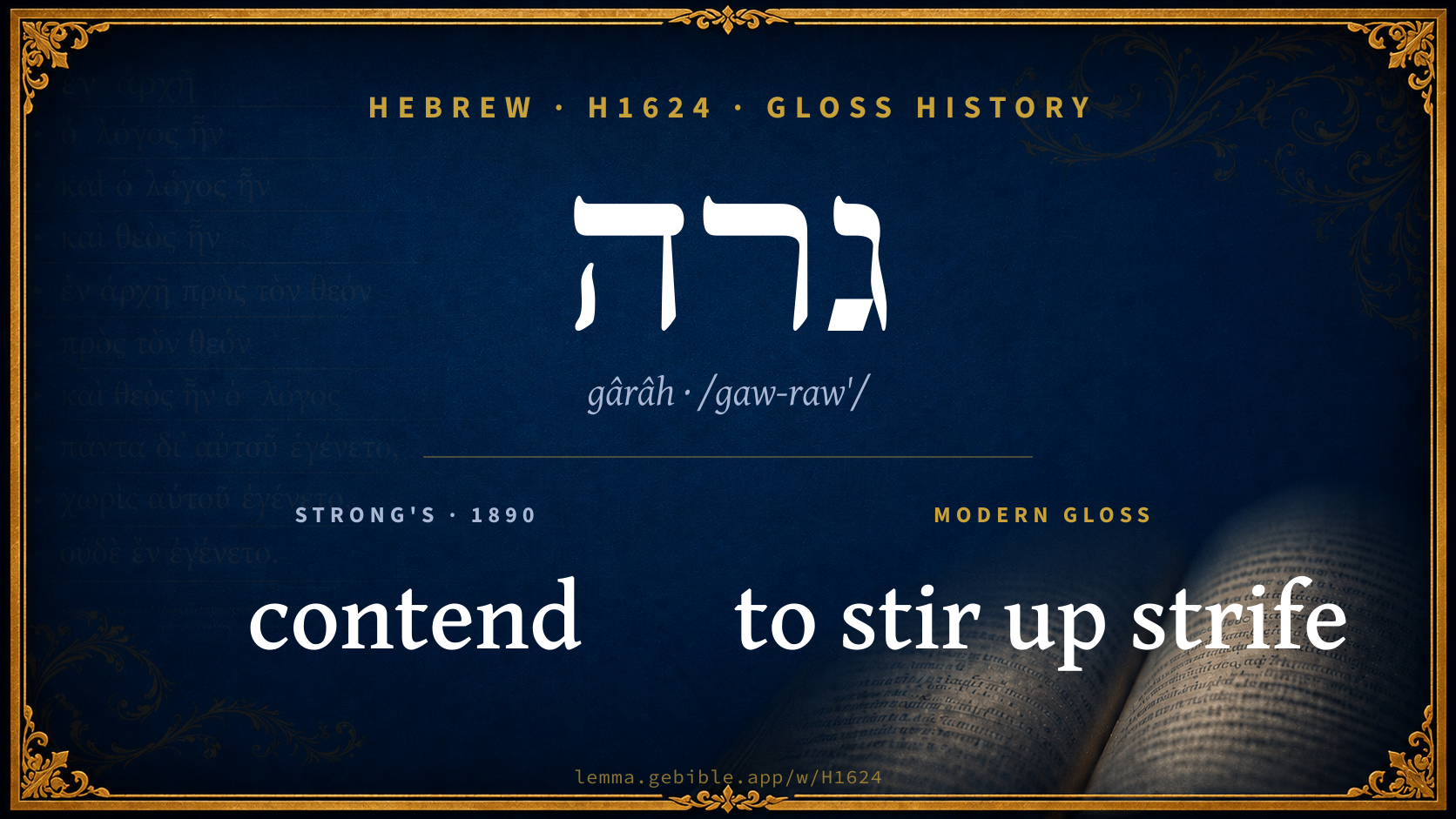
Gloss history
Strong's 1890 vs modern scholarship
About this word
Strong's H1624 catalogs a Hebrew word from the Hebrew Old Testament.
These counts are not copied from any lexicon or concordance. They are computed here, from the morphology-tagged Hebrew Old Testament. What Lemma adds →
- 13
- distinct verses
- The word appears in 13 distinct verses.
- 6 / 39
- OT books
- The word appears in 6 of 39 Old Testament books.
- #1,836
- by frequency
- Top 2500 most frequent Hebrew words (rank 1,836 of 8,640 Hebrew words by occurrence).
View all 13 occurrences in the concordance →
Most concentrated in
- Deuteronomy 4 verses 31%
- Proverbs 4 verses 31%
- Daniel 2 verses 15%
By section of the Old Testament
By traditional corpus
Conventional, traditional groupings — biblical authorship is debated, so this is a traditional corpus grouping, not an authorship claim. Each share is this word’s portion of its verses in that division of the Hebrew canon. Each figure is a share of the word’s 13 distinct verses.
- Writings (Ketuvim) 7 verses · 54%
- Torah (Pentateuch) 4 verses · 31%
- Prophets (Nevi'im) 2 verses · 15%
How translations render this word
Counts come from each version’s own published word-to-Strong’s tagging or interlinear alignment — an approximate guide to how each version renders this word, not a word-level alignment the data otherwise carries. Because each total is that version’s own tagged count, the per-version totals vary from one another and need not match the appearance or distinct-verse counts above. These counts may also differ from a printed concordance because Lemma counts each distinctly tagged rendering and does not collapse phrase taggings into a single head-word total. This is a fixed set of word-tagged versions (KJV, ASV, BSB, ULT) and does not change with the reading translation you choose elsewhere. Each version’s license is shown beside its name below (and on Sources).
- King James Version: Contend 3×, Stirreth up 3×, Meddle 2×
- American Standard Version: Stirreth up 3×, Contend 2×, Shall war 2×
- Berean Standard Bible: Stirs up 3×, Provoke 2×, Should you stir up 2×
- unfoldingWord Literal Text: Fight 4×, Stirs up 3×, You shall 3×
King James Version Public Domain
Renders H1624 across 14 tagged occurrences — most commonly:
Plus 2 renderings that appear only once — usually multi-word phrases or single function words the recovered tagging swept in, not distinct renderings.
American Standard Version Public Domain
Renders H1624 across 14 tagged occurrences — most commonly:
Plus 5 renderings that appear only once — usually multi-word phrases or single function words the recovered tagging swept in, not distinct renderings.
Berean Standard Bible Public Domain
Renders H1624 across 14 tagged occurrences — most commonly:
Plus 7 renderings that appear only once — usually multi-word phrases or single function words the recovered tagging swept in, not distinct renderings.
unfoldingWord Literal Text CC BY-SA 4.0
Renders H1624 across 16 tagged occurrences — most commonly:
Plus 6 renderings that appear only once — usually multi-word phrases or single function words the recovered tagging swept in, not distinct renderings.
Senses in BDB
The 2 senses BDB distinguishes for this word, in lexicon order (not ranked by frequency or importance). The full entry — with sub-senses — is in the Lexicon Entry tab.
- to cause strife, stir up, contend, meddle, strive, be stirred up
- (Piel) to stir up strife, excite strife
Word origin
[ גָּרָה ] vb. only Pi. stir up strife, Hithp. engage in strife
— Brown-Driver-Briggs (Oxford 1906, public domain), digitized via Sefaria, supplemented by the OpenScriptures HebrewLexicon (CC BY 4.0). See Sources.
Origin: a primitive root
Jastrow Dictionary
A second Hebrew/Aramaic lexicon for comparison, covering Aramaic and post-biblical (Talmudic, Targumic, Midrashic) usage that the biblical-Hebrew BDB does not. Matched by lemma rather than by Strong’s number, so a lemma may carry more than one Jastrow headword (shown separately below), and the entries cover usage well beyond the Bible.
גָּרָה
- , v. גרי
גֵּרָה I
- 1. gerah (a grain), name of a coin. Bekh. 50ᵃ
- 2. the seed of St. John’s bread, v. next w.
גֵּרָה II
- (גרר, v. גִּירָא II) a shoot, stalk (of flax or asparagus). Mekh. Mshp., N’zikin, s. 13 המערב את הג׳ בתלתן (Var. גֵּירָה, גררה) he who mixes (other) stalks among stalks of fenugrec; Yalk. Ex. 343; Tosef. B. Kam. VII, 8 גידה ed. Zuck. (Var. גירה, גורה). [Löw Pfl. p. 317: seed of St. John’s bread among seeds of fenugrec.]
גֵּרָה III
- (גרר, cmp. גָרוֹן, גַּרְגֶּרֶת)
- 1. [the rough, cmp. τραχεῖα,] throat, larynx with wind-pipe, lungs and heart. Tam. III, 1. Ib. IV, 3. Yoma II, 7.
- 2. (b. h.; ground food, cud. מַעֲלֵה ג׳ ruminant. Bekh. 6ᵃ; Sifra Sh’mini Par. 2, ch. III; a. e.
גֵּרָה IV
- f., v. גֵּר
גרי
- (b. h.)
- 1. to be rough, grating, scraping; v. גֵּרָה, גָּרוֹן &c.
- 2. to be hot, burn, singe (cmp. חָרָה).
- to incite, stir up, let loose. Snh. 107ᵇ שגי׳ דובים וכ׳ because he let the bears loose against the children. Ex. R. s. 21 ג׳ לפרעה He incited Pharaoh &c. Gen. R. s. 19, end (interpret. hishshiani, Gen. III, 13) גִּירַנִי. Cant. R. to I, 4 (play on משכני ib.) ממה שגֵּרִיתָ בי שכני הרעים from my hostile neighbors whom thou hast incited against me.—Trnsf. ג׳ את הדוב ב־ to let temptation loose against. Gen. R. s. 87 אני מְגָרֶה בך וכ׳ I shall lay temptation in thy way; a. fr.—Lev. R. s. 17 ביום שיְגָרֶה וכ׳ on the day when the Lord shall stir up his anger &c. e.g. Genesis 3:13
- , Nithpa. נִתְגָּרֶה
- 1. to be inflamed, jealous; to rival. Snh. 19ᵃ מִתְגָּרוֹת זו בזו jealous of one another.
- 2. to engage in battle, to fight. Ber. 7ᵇ; Meg. 6ᵇ מותר להִתְגָּרוֹת וכ׳ it is permitted to enter into combat with the wicked (with reference to b. h. התחרה).—Num. R. s. 19 נתג׳ בהם he attacked them.
- 3. to be let loose. Esth. R. introd. נִתְגָּרְתָה אותה הדוב that temptation was aroused (against Joseph), v. supra; Num. R. s. 13 מִתְגָּרַת.
- 4. to have a passion for, to indulge freely in. Yoma 76ᵇ wine is called תיר̇ש̇, because he המִתְגָּרֶה בו נעשה ר̇ש̇ who indulges in it becomes poor. Ab. Zar. 18ᵇ; 19ᵇ אֶתְגָּרֶה בשינה I will freely indulge in sleep (idleness).
- 5. (denom. of תִּגְרָה) to incite. Num. R. s. 18; Tanḥ. Koraḥ 3 להִתְגָּרוֹת בו את וכֹ׳ to incite Israel against him.
A Dictionary of the Targumim, the Talmud Babli and Yerushalmi, and the Midrashic Literature (Marcus Jastrow; London, Luzac, 1903) — Public Domain. Digitized via Sefaria. Digitized via Sefaria. Full attribution on Sources.
Forms in the corpus
The 12 distinct written forms H1624 takes in the Hebrew Bible, most frequent first — each parse links to that stem’s occurrences in the concordance. Hebrew forms include their vowel points and cantillation, so a single lemma takes many written forms.
Same root — word family
Other BDB entries built from the same root as H1624, grouped by Strong’s listed origin. These share a root / origin per the lexicon — not necessarily a shared meaning. Each links to that word’s own entry.
Derived from this word
Compare all same-root words → They share a root, not necessarily a meaning.
Septuagint verse parallels
This word appears in 12 verses that also exist in the Greek Old Testament (Septuagint), out of the 13 Hebrew verses it occurs in. You can read those verses in Greek by switching the Old Testament edition to the Septuagint.
Read these verses in the Septuagint
This is a verse-level parallel only — the same verses exist in both the Hebrew and Greek Old Testaments. No word-level Hebrew↔Greek correspondence is claimed: the data carries no such alignment, so no Greek word is shown as this Hebrew word’s translation. Coverage is not total — the Septuagint omits the deuterocanon and renumbers the Psalms, so some Hebrew verses have no direct Greek parallel.