
Numbers 25:10

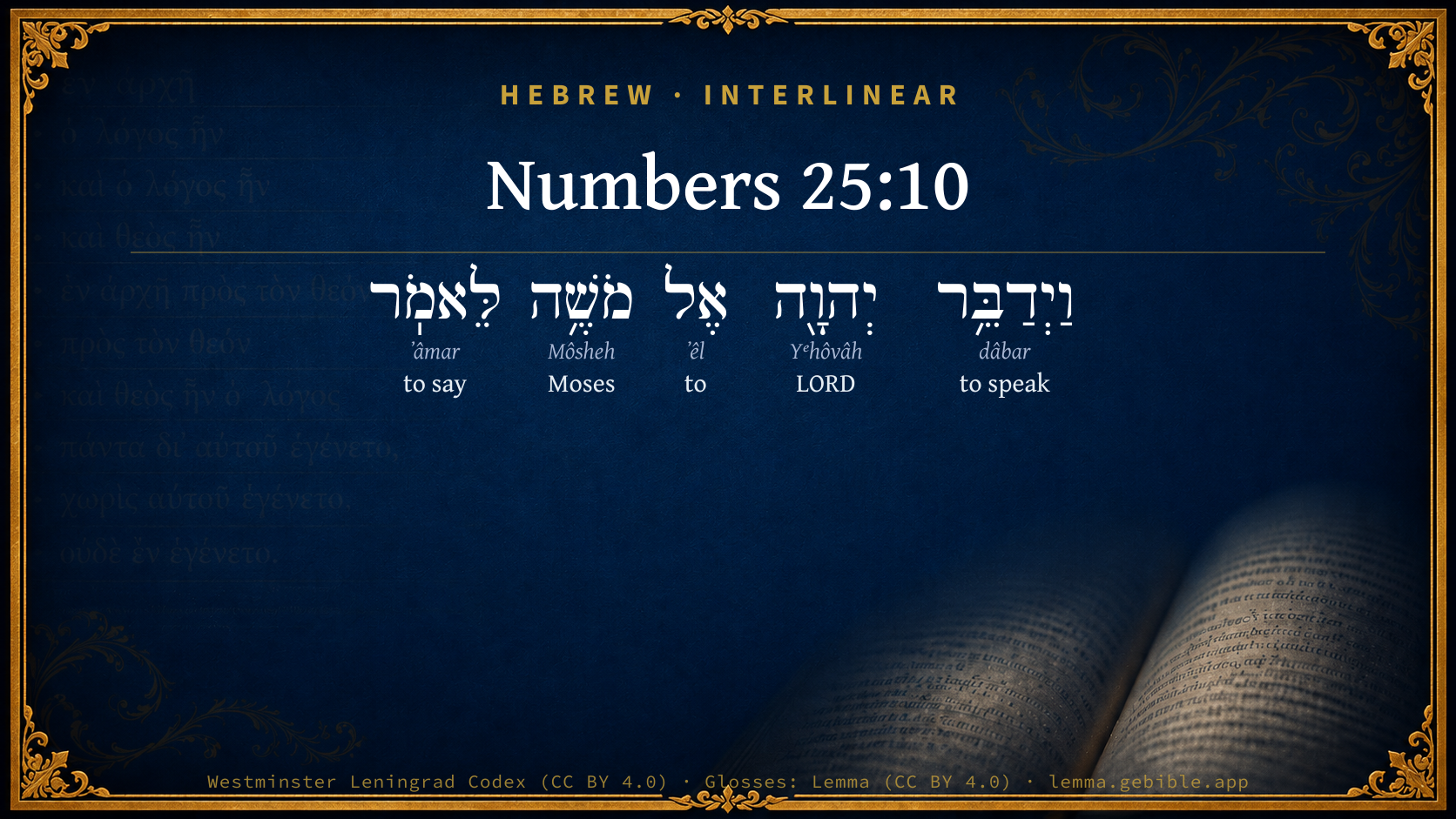
Hebrew (Westminster Leningrad Codex) Numbers 25:10 appears in the Hebrew Old Testament. The text above is from the Westminster Leningrad Codex. Each word links to its Strong’s number, a concise gloss, and parsing drawn from the Open Scriptures Hebrew Bible morphology. Click any word for its full Brown-Driver-Briggs (BDB) entry.
Download image
Cite this verse

Numbers 25:10 (World English Bible). Public Domain. Lemma interlinear Bible study tool, https://lemma.gebible.app/v/numbers/25/10.

Show BibTeX & RIS
BibTeX
RIS
English Translation
Yahweh spoke to Moses, saying,
World English Bible · Public Domain
Download a study sheet

One document with this verse’s original text, its word-by-word gloss line, the meaning frame, cross-references with their text, attributed commentary, and full source and license credits — printable, and it pastes into notes with its structure intact.

This verse Autodidact and up

Study sheet (.html) Plain text (.txt)

A passage Seminary Student

Up to 50 verses in one chapter. A passage sheet keeps up to 6 commentary sources and 12 cross-references per verse, in the order this page ranks them, and says so on the sheet whenever that leaves anything out. Ask for a single verse and you get the Autodidact verse sheet above.

Everything on this page stays free to read, with no account — the sheet is a download of what is already on screen, not access to it.

Want to remove ads? Support Godless Engineer
Compare translations 3

The same verse in 3 English versions, stacked beneath the original-language interlinear above. Click any original word for its lexicon entry.

Each is an independent rendering of the whole verse — the interlinear is not word-aligned to these translations.

Highlighted words mark where these versions differ — a whole-verse word diff, not a word-by-word alignment.

  • World English Bible Public Domain
    Yahweh spoke to Moses, saying,
  • King James Version Public Domain
    And the LORD spake unto Moses, saying,
  • unfoldingWord Literal Text CC BY-SA 4.0
    And Yahweh spoke to Moses, saying,

unfoldingWord Literal Text — © unfoldingWord, licensed CC BY-SA 4.0. Word-aligned USFM3 via Door43 (git.door43.org/unfoldingWord/en_ult).

Versions to compare (up to 4)

3 of 4 selected

Show all 18 translations

Every available English version of this verse, each an independent rendering of the whole verse.

  • World English Bible Public Domain
    Yahweh spoke to Moses, saying,
  • Berean Standard Bible Public Domain
    Then the LORD said to Moses,
  • Majority Standard Bible Public Domain
    Then the LORD said to Moses,
  • King James Version Public Domain
    And the LORD spake unto Moses, saying,
  • American Standard Version (1901) Public Domain
    And Jehovah spake unto Moses, saying,
  • Revised Version (1885) Public Domain
    And the LORD spake unto Moses, saying,
  • Geneva Bible (1599) Public Domain
    Then the Lord spake vnto Moses, saying,
  • Douay-Rheims (1899) Public Domain
    And the Lord said to Moses:
  • Young's Literal Translation Public Domain
    And Jehovah speaketh unto Moses, saying,
  • Literal Standard Version CC BY-SA 4.0
    And YHWH speaks to Moses, saying,
  • Unlocked Literal Bible CC BY-SA 4.0
    Yahweh spoke to Moses and said,
  • unfoldingWord Literal Text CC BY-SA 4.0
    And Yahweh spoke to Moses, saying,
  • Darby Bible Public Domain
    And Jehovah spoke to Moses, saying,
  • World Messianic Bible Public Domain
    The LORD spoke to Moses, saying,
  • Webster's Bible Public Domain
    And the LORD spoke to Moses, saying,
  • Free Bible Version CC BY-SA 4.0
    The Lord told Moses,
  • Bible in Basic English Public Domain
    And the Lord said to Moses,
  • JPS Tanakh (1917) Public Domain
    And the LORD spoke unto Moses, saying:

Literal Standard Version (2020), Covenant Press — licensed CC BY-SA 4.0. Text via the HelloAO Bible API (eBible.org). Unlocked Literal Bible (unfoldingWord) — licensed CC BY-SA 4.0. Text via the HelloAO Bible API (eBible.org). unfoldingWord Literal Text — © unfoldingWord, licensed CC BY-SA 4.0. Word-aligned USFM3 via Door43 (git.door43.org/unfoldingWord/en_ult). Free Bible Version, Dr. Jonathan Gallagher — licensed CC BY-SA 4.0. Text via the HelloAO Bible API (eBible.org).

Word by word

More ways to search: Search by grammar → Find every occurrence → Compare this word →

Practice this passage: Drill this verse → Learn its vocabulary →

About this verse

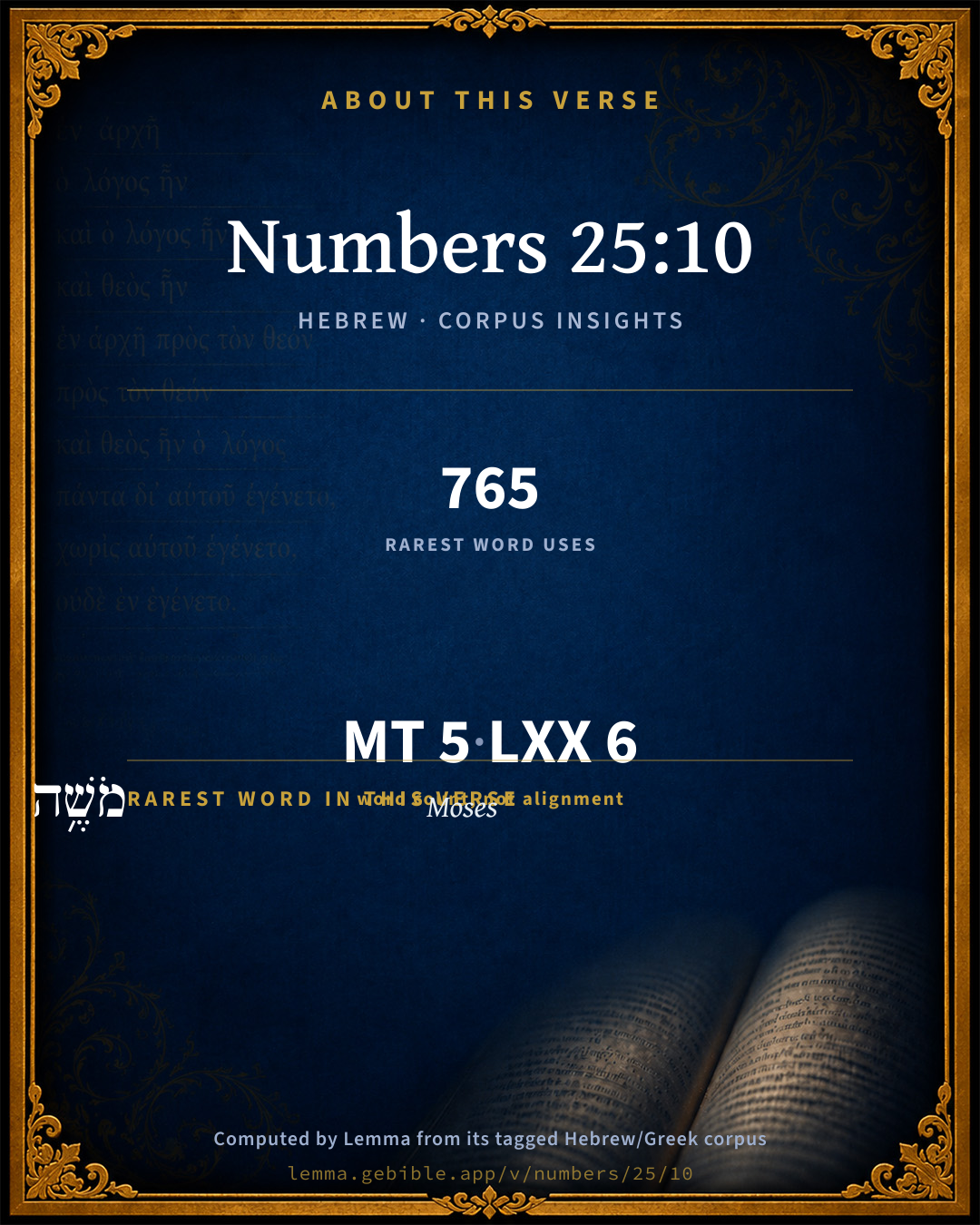
These counts appear in no published source. They are computed here, from the morphology-tagged text and Lemma’s own curated glosses. What Lemma adds →

5
words
5
distinct lemmas
Pentateuch
section

Grammatical profile

  • 2 verbs
  • 2 nouns
  • 1 preposition

Verb forms

  • וַיְדַבֵּ֥ר Piel · Sequential Imperfect
  • לֵּאמֹֽר Qal · Infinitive Construct

Hebrew & Septuagint length

In English translation the verse runs 5 words from the Hebrew and 7 from the Septuagint (LXX English) — closely comparable.

A rough comparison of the two English renderings, which tokenize alike — not a word-level alignment.

Word counts can differ between the Hebrew and the Greek without any difference in meaning — e.g. the Hebrew direct-object marker אֵת has no separate Greek word, and Greek often adds the article ὁ.

In the original languages it is 5 Hebrew tokens and 6 Greek tokens — but the two are counted differently (Hebrew bundles its prefixes and suffixes into one token; the Greek is in lemma form), so that isn’t a like-for-like length.

Hebrew and Greek witnesses Masoretic Hebrew ↔ Greek Septuagint

The same verse in the two great witnesses to the Old Testament, shown verse-for-verse.

These are two independent witnesses, not word-aligned to each other, and the Septuagint is shown in lemma (dictionary) form.

Hebrew Numbers 25:10 Masoretic · Westminster Leningrad Codex

וַיְדַבֵּ֥ר יְהוָ֖ה אֶל מֹשֶׁ֥ה לֵּאמֹֽר

Yahweh spoke to Moses, saying,

World English Bible · Public Domain

Greek LXX Numbers 25:10 Septuagint · lemma form

καί λαλέω κύριος πρός μωυσῆς λέγω

And the Lord spoke to Moses, saying,

LXX2012 (modern English Septuagint) · Public Domain

Hebrew: Westminster Leningrad Codex (CC BY 4.0). Greek: Septuagint (public domain); English from LXX2012 (modern English Septuagint) (Public Domain). How the Septuagint differs from the Hebrew →

Targum (Aramaic paraphrase)

2

The Targum is the ancient Jewish Aramaic paraphrase of the Hebrew Scriptures — an interpretive translation, not the Hebrew text itself. Onkelos (literal) and Pseudo-Jonathan (expansive) render the Torah, and Jonathan the Prophets. Coverage is partial: where no permissively-licensed English translation exists for a verse, only the Aramaic is shown. This is verse-level text, not a word-by-word alignment to the Hebrew.

  1. Targum Onkelos Torah (Genesis–Deuteronomy)
    וּמַלִיל יְיָ עִם משֶׁה לְמֵימָר

    (no public-domain English translation for this verse)

    Targum Onkelos — Aramaic: “Onkelos Genesis” (public domain); “Onkelos Exodus” (public domain); “Onkelos Leviticus” (public domain); “Onkelos Numbers” (public domain); “Onkelos Deuteronomy” (public domain). English: “Sefaria Community Translation” (CC0 1.0 (public-domain dedication)); “J.W. Etheridge. The Targums of Onkelos and Jonathan Ben Uzziel on the Pentateuch. London: Longmans, Green, 1862” (public domain). Text via Sefaria.

  2. Targum Pseudo-Jonathan Torah (Genesis–Deuteronomy)
    וידבר יי וּמַלֵיל יְיָ עִם משֶׁה לְמֵימָר

    AND the Lord spake with Mosheh, saying:

    Targum Pseudo-Jonathan — Aramaic: “Targum Jonathan on Genesis” (public domain); “Targum Jonathan on Exodus” (public domain); “Targum Jonathan on Leviticus” (public domain); “Targum Jonathan on Numbers” (public domain); “Targum Jonathan on Deuteronomy” (public domain). English: “The Targum of Jonathan ben Uzziel, trans. J. W. Etheridge, London, 1862” (public domain). Text via Sefaria.

Commentary

Notes on Numbers 25:10 from classic Christian and Jewish commentators (each source and its license shown beneath its notes). The classic Christian expositions comment on the surrounding passage and are grouped to its opening verse, so a note may address several verses; the Jewish commentaries on the Tanakh (Rashi and others) are per-verse, so they appear only where the commentator wrote on this verse.

Lemma curates 59 commentaries, every one of them public domain or Creative Commons licensed, each selected and text-cleaned for this edition rather than reprinted as found. About our sources →

The Biblical Illustrator

Joseph S. Exell

Num_25:10-13

Phinehas, the son of Eleazar, the son of Aaron the priest, hath turned My wrath away . . . because he was zealous for his God, and made an atonement for the children of Israel

Godly zeal

We can lay no claim to saintship without zeal.

When wickedness increases, then zeal must be bold and daring.

I. The source of godly zeal The indwelling of the Holy Ghost. Grace in the heart must break forth.

II. Godly zeal has its seat in the heart.

III. Mark the object of holy zeal. Good works. It is the fervour of heavenly benevolence.

IV. True zeal is blended with knowledge. To enlighten ourselves, we must have light ourselves.

V. Zeal is forgetful of self. (The Study.)

The zeal of Phinehas

Phinehas appears as a rainbow on the bosom of a storm. He is as a flower on a wild heath, a fertile spot in a parched desert, pure ore in a rude quarry, a fragrant rose upon a thorny hedge, faithful among faithless.

1. He was zealous for his God. He could not fold his arms and see Gods law insulted, His rule defied, His will despised, His majesty and empire scorned. The servants heart blazed in one blaze of godly indignation. He must be up to vindicate his Lord. His fervent love, his bold resolve, fear nothing in a righteous cause.

2. Mark, next, the zeal of Phinehas is sound-minded. It is not as a courser without rein, a torrent unembanked, a hurricane let loose. Its steps are set in orders path. It executes Gods own will in Gods own way. The mandate says, let the offenders die. He aims a death-blow, then, with obedient hand. The zeal, which heaven kindles, is always a submissive grace.

3. This zeal wrought wonders. It seemed to open heavens gates for blessing to rush forth. God testifies, He hath turned My wrath away from the children of Israel. He hath made atonement for them. My name is rescued from dishonour. The haughty sinner is laid low. Therefore I can restrain My vengeance. Men see that sin is not unpunished; mercy may now fly righteously to heal. Zeal is indeed a wonder-working grace. Who can conceive what countries, districts, cities, families, and men, have sprung to life, because zeal prayed?

4. Next mark how heavenly smiles beam on the zeal of Phinehas. Honour decks those who honour God. The priesthood shall be his. This lessen ends not here. Phinehas for ever stands a noble type. Yes, Christ is here. In Phinehas we see Christs heart, and zeal, and work, and mightily constraining impulse. In Phinehas we see Christ crowned, too, with the priesthoods glory. (Dean Law.)

The circumstances which moved the zeal of Phinehas

I. There was the enormity of their sin. It included false doctrine and sinful practices, between which there is a closer connection than is always recognised.

II. There was the character of the instigator to the sin. Balaam, a strange mixture of a man.

III. There was the extent to which the sin prevailed. Among all classes.

IV. There was the misery occasioned by the sin. To the guilty, to their connections, to the community.

V. There was the dishonour done to God.

1. We should be zealous in religion.

2. Our zeal in contending against the sins of others should begin in zeal in contending against our own. (George Brooks.)

The zealous spirit

In fact, a zealous spirit is essential to eminent success in anything. Perhaps there is the more need to insist upon this because enthusiasm is out of fashion. It is bad form nowadays to admire anything very warmly. To be strenuously in earnest is almost vulgar. Especially is this so in regard to religion. Our Joe is a very good young man, said an old nurse the other day; but he do go so mad on religion. That was the fly in the ointment--which spoilt all. Did not Pope say long ago, The worst of madness is a saint run mad? And he only put in terse and pithy speech what other people say more clumsily.

1. And yet how can one be a Christian without being an enthusiast? Indifferent, half-hearted Christians are not true Christians at all. I would thou weft either cold or hot, says our Lord. Lukewarmness is his utter abhorrence. And the author of Ecce Homo cannot be said to exaggerate in his declaration that Christianity is an enthusiasm, or it is nothing.

2. And what good work has ever been wrought without enthusiasm? Said a great preacher, If you want to drive a pointed piece of iron through a thick board, the surest way is to heat your skewer. It is always easier to burn our way than to bore it. Only a soul all flame is likely to accomplish much in the teeth of the difficulties which beset every lofty enterprise. The great movements which have most widely blessed the world have been led by men of passionate earnestness and fervid zeal. It is not the cool, calculating votaries of prudence who have done the work. Was it not written of our Lord Himself, The zeal of Thy house hath eaten me up? (G. Howard James.)

The faithful bring a blessing upon their families

We have seen the zeal of Phinehas in executing judgment upon the evil-doers, which brought a grievous plague upon the people. His spirit was stirred within him, being first stirred by the Spirit of God, which moved him to take a spear, and to thrust through the adulterer and adulteress. Now we shall see the reward that was given unto him for that work which was acceptable unto God, and profitable unto His people. He hath a covenant of peace made with him, and the priesthood confirmed unto him and his posterity. God is so pleased with the obedience of His people that He will show mercy to such as belong to them. This is plentifully proved unto us in the Word of God. When God saw Noah righteous before Him in that corrupt age, He made all that belonged unto him partakers of a great deliverance, saying unto him, Enter thou and all thine house into the ark; for thee have I seen righteous before Me in this age (Gen_7:1). This appeareth in the person of Abraham, when God had called him out of his country, and from his kindred, and made a covenant with him to bless him (Gen_12:2-3). This is oftentimes remembered unto us in the Acts of the Apostles. When God had opened the heart of Lydia that she attended unto the things which Paul delivered, She was baptized and all her household (Act_16:15; Act_16:33). The reasons to enforce this doctrine are evident, if we consider either the person of God or the condition of the faithful.

1. God hath in great mercy and goodness promised to show favour not only to the faithful themselves, but to the seed of the faithful that fear Him (Exo_20:6; Exo_34:6-7).

2. As the mercy of God is great, so the faith of the godly is effectual for themselves and their children. This is the tenor of the covenant that God hath made with all the faithful. God will be our God, and the God of our seed after us (Gen_17:7). For as a father that purchaseth house or land, giveth thereby an interest unto his son therein; so he that layeth hold on the promise which God hath made to all godly parents, doth convey it unto his children; so that albeit they want faith by reason of their years, yet they are made partakers of Christ, and ingrafted into His body. The uses remain to be handled.

(1) We learn that the children of faithful parents have right to baptism, and are to receive the seal of the covenant. This the apostle teacheth (1Co_7:14).

(2) We are taught on the other side that evil parents bring the curse of God into their houses, and upon their posterity.

(3) It is required of us to repent and believe the gospel, that so we may procure a blessing upon ourselves and our children. (W. Attersoll.)

.

The Biblical Illustrator, edited by Joseph S. Exell (c. 1880s–1900s) — public domain. Text from a community e-Sword module.

Tyndale Open Study Notes

Tyndale Open Resources

25:10-13 Israel’s identity as the Lord’s people was severely threatened by their unfaithfulness on this occasion. Phinehas was as zealous as God in his pursuit of holiness and justice. As a result, Phinehas and his descendants were granted a special status; God made a special covenant of peace with Phinehas, and qualified men in his family inherited a permanent right to the priesthood (cp. Mal 2:5). This unconditional covenant was similar to that extended to David (see Jer 33:19-22).

Tyndale Open Study Notes — © Tyndale Open Resources, licensed CC BY-SA 4.0. Text via the HelloAO Bible API.

John Gill's Exposition

Phinehas, the son of Eleazar, the son of Aaron the priest,.... His descent and genealogy is observed as before, partly to show that he was not a private person, but a man of public authority that did the above fact; perhaps one of the judges that Moses ordered to slay every man his man, and therefore what he did by the order of the supreme magistrate; and partly to show that he was heir apparent to the office of high priest, who in course was to succeed in it; nor should this action of his hinder it, but rather serve to secure and confirm it to him:

hath turned away my wrath from the children of Israel; caused the effects of it to cease, by slaying the two persons, as before related:

while he was zealous for my sake among you; for the glory of God, the honour of his law, the credit of religion, and the good of his people, which is a good cause to be zealously affected in, Gal 4:18 in which he was a type of Christ, whose zeal for the house of God, for the doctrine, discipline, and worship of it, for the salvation of his people, and the glory of God thereby, ate him up, Psa 69:9 as well as in his turning away wrath from Israel; sin is the cause of wrath, and for it is revealed from heaven; the people of God are deserving of it as others; but Christ has bore it for them, and so has delivered them from it and all the effects of it, and they are secure from its coming upon them:

that I consumed not the children of Israel in my jealousy; by the plague sent among them, being so highly provoked with their shocking abominations.

John Gill's Exposition of the Whole Bible (1746–1763) — public domain (CC PDM 1.0). Text via the HelloAO Bible API.

The Pulpit Commentary

The Lord spake unto Moses, saying. On the Divine commendation here bestowed upon the act of Phinehas see the note at the end of the chapter. In the Hebrew Bible a new section begins here.

HOMILIES BY E.S. PROUT Vers. 10-13. A terrible atonement.

We see in this narrative

I THE NATION WHICH GOD HAD BLESSED, CURSED THROUGH ITS OWN SINS. The Israelites, impregnable against the curses of Balaam, succumb to his wiles. We discover parts of a plot. In the foreground are women (true daughters of Eve the tempter), alluring feasts, flatteries, idolatries. In the background we discern the malignant face of the covetous Balaam, (Num_31:16 Rev_2:14) and behind him his master the devil. Learn to discriminate the seen and unseen agents of temptation, (Eph_6:12) and to guard against the devices of our diabolical foe. (2Co_2:11 2Co_11:14, 2Co_11:15) Sin did what Balaam could not do. The wrath of God, the plague on the thousands of Israelites, the execution of the ringleaders, follow in quick succession. Note the destructiveness of sin. Of every sinner it may be said as of Achan, "That man perished not alone in his iniquity." The guilt of the nation reached its climax in the shamelessness and audacity of the sin of Zimri. While shame, one of the precious relies of paradise, survives, there is more hope of restoration, but when shame is gone, sin is ripe for judgment. (Jer_5:7-9 Jer_6:15) If God"s wrath had continued to burn, the whole nation must have perished.

II THE WRATH REMOVED BY A TERRIBLE ATONEMENT.

1. The essence of it was not an outward act, but a state of heart. It was Phinehas" zeal for God which made the act possible and acceptable. Just so in the atonement, of a very different character, made by the Lord Jesus Christ, the essence of it was the zeal for the will of God which prompted the obedience unto death, the offering of the body of Christ once for all. (Heb_10:5-10)

2. The form of the atonement was a terrible manifestation of the righteousness of God in the prompt punishment of the two audacious transgressors. They expiated their crime by their lives. Phinehas" conduct, being inspired by godly zeal, is justified by God himself. Instead of being treated as a crime, it is regarded as a covering over of the nation"s sin. Where that sin reached its climax, there it received such sudden retribution as to stamp it as an abominable thing which God hates. Zimri and his paramour are branded with eternal infamy, while Phinehas is rewarded by "the covenant of an everlasting priesthood." We learn thus that there is more than one way of making an atonement to God. In both cases it is by the manifestation of the righteousness of God, (Rom_3:21, Rom_3:25) but in different ways.

3. By his holy wrath flaming forth against sin, whether immediately (e.g., Jos_7:11, Jos_7:12) or through the zeal of a man of God. The weeping of the people was not an atonement, for it did not manifest the righteousness of God as the act of Phinehas did.

4. By his righteous grace allowing another to interpose on behalf of sinners, to do or to suffer whatever God sees needful for a manifestation of his righteousness in the covering over of sin. Thus Moses (Exo_32:30-33) and Paul (Rom_9:3) were willing to have made atonement, if possible. Thus the sinless Son of God did atone, (Rom_3:21-26) and sin is covered not by the destruction of the sinner, but by the righteous pardon of penitents trusting the atonement of Christ. P.

The Pulpit Commentary (1880–1919), ed. H.D.M. Spence-Jones & Joseph S. Exell — public domain. Text from a community e-Sword module.

Keil & Delitzsch

C. F. Keil & F. Delitzsch

For this act of divine zeal the eternal possession of the priesthood was promised to Phinehas and his posterity as Jehovah's covenant of peace. בּקנאו, by displaying my zeal in the midst of them (viz., the Israelites). קנאתי is not "zeal for me," but "my zeal," the zeal of Jehovah with which Phinehas was filled, and impelled to put the daring sinners to death. By doing this he had averted destruction from the Israelites, and restrained the working of Jehovah's zeal, which had manifested itself in the plague. "I gave him my covenant of peace" (the suffix is attached to the governing noun, as in Lev 6:3). בּרית נתן, as in Gen 17:2, to give, i.e., to fulfil the covenant, to grant what was promised in the covenant. The covenant granted to Phinehas consisted in the fact, that an "eternal priesthood" (i.e., the eternal possession of the priesthood) was secured to him, not for himself alone, but for his descendants also, as a covenant, i.e., in a covenant, or irrevocable form, since God never breaks a covenant that He has made. In accordance with this promise, the high-priesthood which passed from Eleazar to Phinehas (Jdg 20:28) continued in his family, with the exception of a brief interruption in Eli's days (see at 1 Sam 1-3 and Sa1 14:3), until the time of the last gradual dissolution of the Jewish state through the tyranny of Herod and his successors (see my Archologie, 38). - In Num 25:14, Num 25:15, the names of the two daring sinners are given. The father of Cozbi, the Midianitish princess, was named Zur, and is described here as "head of the tribes (אמּות, see at Gen 25:16) of a father's house in Midian," i.e., as the head of several of the Midianitish tribes that were descended from one tribe-father; in Num 31:8, however, he is described as a king, and classed among the five kings of Midian who were slain by the Israelites.

Keil & Delitzsch — Biblical Commentary on the Old Testament (1861–1891) — public domain (CC PDM 1.0). Text via the HelloAO Bible API. (Old Testament only.)

unfoldingWord translationNotes

Door43 World Missions Community

turned my rage away from the people of Israel

God's rage is spoken of as if it were something that could be physically pushed aside in order to stop it. AT: "caused me to no longer be angry with the people of Israel" (See: Metaphor)

I have not consumed the people of Israel in my fierceness

God is spoken of as if he were a fierce animal that could have eaten up the people of Israel. AT: "I have not destroyed the people of Israel in my terrible anger" (See: Metaphor)

translationWords

Yahweh

Moses

Phinehas

rage

turn

Israel

zeal

consume

unfoldingWord translationNotes — © Distant Shores Media and the Door43 World Missions Community, licensed CC BY-SA 4.0. Source: git.door43.org/Door43/en_tn.

Lesson kit

Teaching starters — assembled from the data on this page, not authored interpretation. Every prompt links to the verse data it draws on. Edit before teaching.

Numbers, in the Pentateuch, opens this verse with 5 words (5 distinct Hebrew lemmas). Its most distinctive word is Môsheh (“Moses”). A historical commentator’s framing appears above. Read the whole chapter for the surrounding context.

Discussion questions

  1. The word Môsheh carries the sense “Moses.” How does it shape the verse?
  2. These translations render this verse differently. What is at stake in choosing one wording over another?
  3. The verb «וַיְדַבֵּ֥ר» is Piel Sequential Imperfect. How does its form color the action?
  4. Reading how The Biblical Illustrator and Tyndale Open Study Notes read this verse, where do the two commentators agree and where do they part?

Things to notice

Reading settings

Reading text

Shown beneath each verse's original-language words.

Old Testament
Old Testament edition

Read the OT as the Masoretic Hebrew (MT) or the Greek Septuagint (LXX).

English shown for the Greek Septuagint (in the Hebrew ↔ Greek comparison).

Comparing translations? Open the Compare panel on any verse page to stack up to four side by side.