
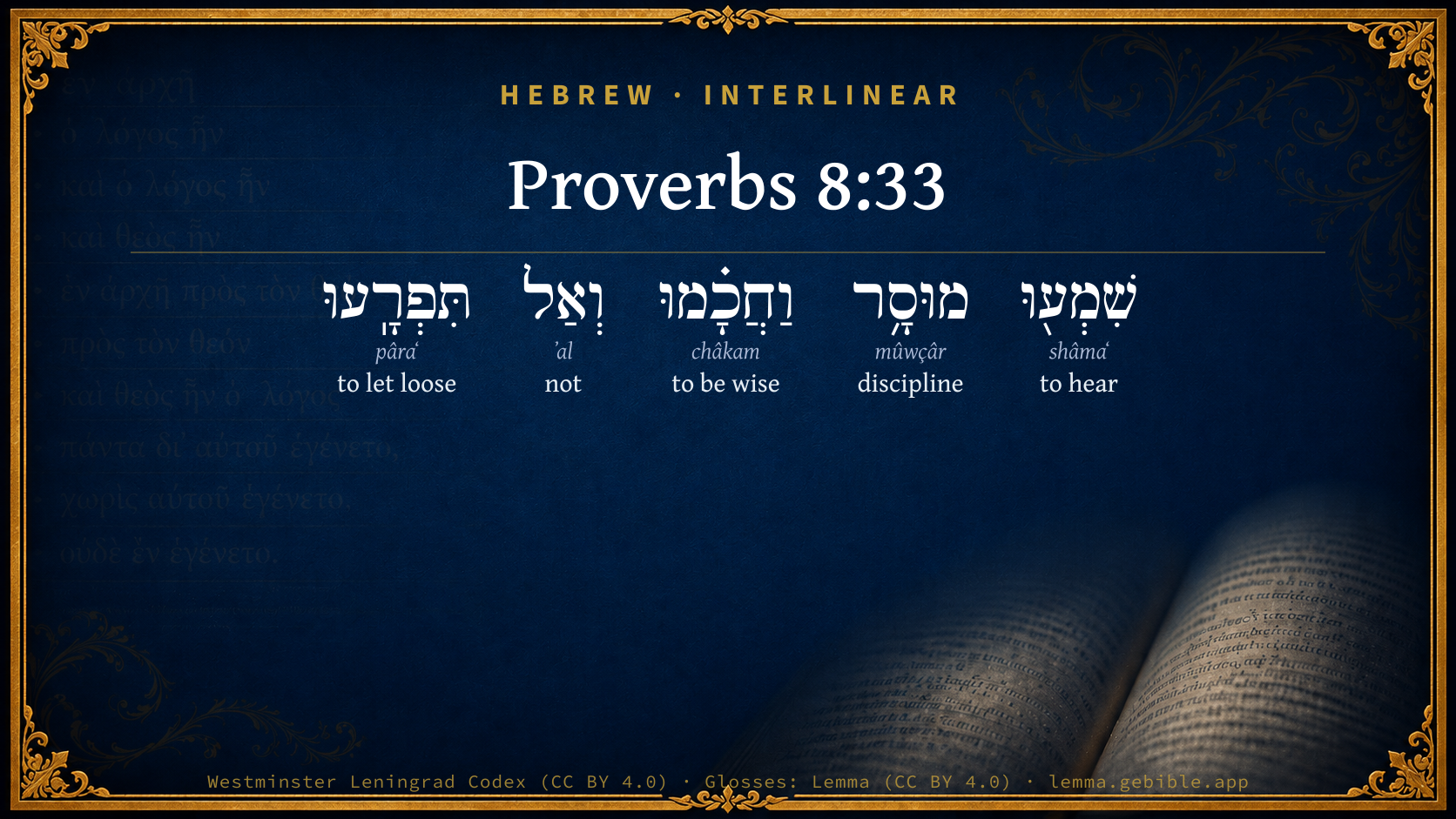
Proverbs 8:33

Hebrew (Westminster Leningrad Codex) Proverbs 8:33 appears in the Hebrew Old Testament. The text above is from the Westminster Leningrad Codex. Each word links to its Strong’s number, a concise gloss, and parsing drawn from the Open Scriptures Hebrew Bible morphology. Click any word for its full Brown-Driver-Briggs (BDB) entry.
Download image
Cite this verse

Proverbs 8:33 (World English Bible). Public Domain. Lemma interlinear Bible study tool, https://lemma.gebible.app/v/proverbs/8/33.

Show BibTeX & RIS
BibTeX
RIS
English Translation
Hear instruction, and be wise. Don't refuse it.
World English Bible · Public Domain
Download a study sheet

One document with this verse’s original text, its word-by-word gloss line, the meaning frame, cross-references with their text, attributed commentary, and full source and license credits — printable, and it pastes into notes with its structure intact.

This verse Autodidact and up

Study sheet (.html) Plain text (.txt)

A passage Seminary Student

Up to 50 verses in one chapter. A passage sheet keeps up to 6 commentary sources and 12 cross-references per verse, in the order this page ranks them, and says so on the sheet whenever that leaves anything out. Ask for a single verse and you get the Autodidact verse sheet above.

Everything on this page stays free to read, with no account — the sheet is a download of what is already on screen, not access to it.

Want to remove ads? Support Godless Engineer
Compare translations 3

The same verse in 3 English versions, stacked beneath the original-language interlinear above. Click any original word for its lexicon entry.

Each is an independent rendering of the whole verse — the interlinear is not word-aligned to these translations.

Highlighted words mark where these versions differ — a whole-verse word diff, not a word-by-word alignment.

  • World English Bible Public Domain
    Hear instruction, and be wise. Don't refuse it.
  • King James Version Public Domain
    Hear instruction, and be wise, and refuse it not.
  • unfoldingWord Literal Text CC BY-SA 4.0
    Hear instruction, and be wise, and do not neglect.

unfoldingWord Literal Text — © unfoldingWord, licensed CC BY-SA 4.0. Word-aligned USFM3 via Door43 (git.door43.org/unfoldingWord/en_ult).

Versions to compare (up to 4)

3 of 4 selected

Show all 18 translations

Every available English version of this verse, each an independent rendering of the whole verse.

  • World English Bible Public Domain
    Hear instruction, and be wise. Don't refuse it.
  • Berean Standard Bible Public Domain
    Listen to instruction and be wise; do not ignore it.
  • Majority Standard Bible Public Domain
    Listen to instruction and be wise; do not ignore it.
  • King James Version Public Domain
    Hear instruction, and be wise, and refuse it not.
  • American Standard Version (1901) Public Domain
    Hear instruction, and be wise, And refuse it not.
  • Revised Version (1885) Public Domain
    Hear instruction, and be wise, and refuse it not.
  • Geneva Bible (1599) Public Domain
    Heare instruction, and be ye wise, and refuse it not: blessed is the man that heareth mee, watching dayly at my gates, and giuing attendance at the postes of my doores.
  • Douay-Rheims (1899) Public Domain
    Hear instruction and be wise, and refuse it not.
  • Young's Literal Translation Public Domain
    Hear instruction, and be wise, and slight not.
  • Literal Standard Version CC BY-SA 4.0
    Hear instruction, and be wise, and do not slight.
  • Unlocked Literal Bible CC BY-SA 4.0
    Listen to my instruction and be wise; do not neglect it.
  • unfoldingWord Literal Text CC BY-SA 4.0
    Hear instruction, and be wise, and do not neglect.
  • Darby Bible Public Domain
    hear instruction and be wise, and refuse it not.
  • World Messianic Bible Public Domain
    Hear instruction, and be wise. Don’t refuse it.
  • Webster's Bible Public Domain
    Hear instruction, and be wise, and refuse it not.
  • Free Bible Version CC BY-SA 4.0
    Listen to my instruction and be wise—do not reject it.
  • Bible in Basic English Public Domain
    Take my teaching and be wise; do not let it go.
  • JPS Tanakh (1917) Public Domain
    Hear instruction, and be wise, and refuse it not.

Literal Standard Version (2020), Covenant Press — licensed CC BY-SA 4.0. Text via the HelloAO Bible API (eBible.org). Unlocked Literal Bible (unfoldingWord) — licensed CC BY-SA 4.0. Text via the HelloAO Bible API (eBible.org). unfoldingWord Literal Text — © unfoldingWord, licensed CC BY-SA 4.0. Word-aligned USFM3 via Door43 (git.door43.org/unfoldingWord/en_ult). Free Bible Version, Dr. Jonathan Gallagher — licensed CC BY-SA 4.0. Text via the HelloAO Bible API (eBible.org).

Word by word

More ways to search: Search by grammar → Find every occurrence → Compare this word →

Practice this passage: Drill this verse → Learn its vocabulary →

תִּפְרָֽעוּ
pâraʻ
H6544
“to let loose”
Verb, Qal, Jussive, 2nd Person, Masculine, Plural
Part of Speech
Verb
Stem
Qal
Form
Jussive
Person
2nd Person
Gender
Masculine
Number
Plural
Full BDB Definition

Origin: a primitive root

TWOT: 1822 , 1823 , 1824

to lead, act as leader - to let go, let loose, ignore, let alone - (Qal) - to let go, let loose - to let alone, avoid, neglect - to loosen - (Niphal) to be let loose, be loosened of restraint - (Hiphil) - to cause to refrain - to show lack of restraint - to let loose restraints
  1. שִׁמְע֖וּ shâmaʻ H8085 “hear” Verb, Qal, Imperative, 2nd Person, Masculine, Plural
  2. מוּסָ֥ר mûwçâr H4148 “discipline” Noun, Common, Masculine, Singular, Absolute
  3. וַחֲכָ֗מוּ châkam H2449 “and · be wise” Conjunction + Verb, Qal, Imperative, 2nd Person, Masculine, Plural
  4. וְאַל ʼal H408 “and · not” Conjunction + Particle, Negative

About this verse

These counts appear in no published source. They are computed here, from the morphology-tagged text and Lemma’s own curated glosses. What Lemma adds →

5
words
5
distinct lemmas
Wisdom
section

Notable vocabulary

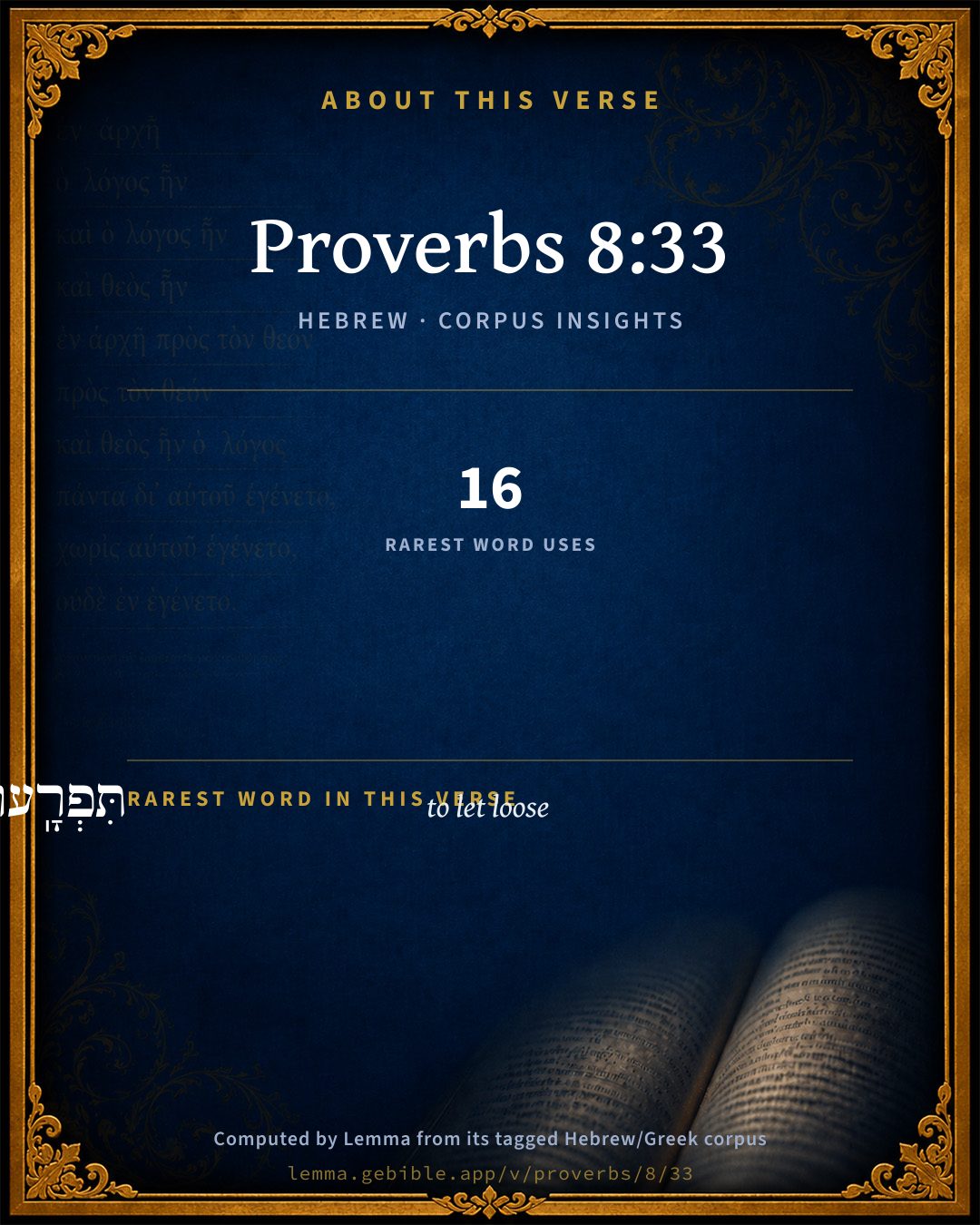
The rarest word here is תִּפְרָֽעוּ to let loose H6544 — appearing just 16 times in the whole Hebrew Bible.

Shared distinctive vocabulary

תִּפְרָֽעוּ to let loose H6544 occurs in 15 verses of the Hebrew Bible. Also found in:

Grammatical profile

  • 3 verbs
  • 1 noun
  • 1 particle

Verb forms

  • שִׁמְע֖וּ Qal · Imperative
  • וַחֲכָ֗מוּ Qal · Imperative
  • תִּפְרָֽעוּ Qal · Jussive

Hebrew & Septuagint length

In English translation the verse runs 8 words from the Hebrew and 11 from the Septuagint (LXX English) — closely comparable.

A rough comparison of the two English renderings, which tokenize alike — not a word-level alignment.

Word counts can differ between the Hebrew and the Greek without any difference in meaning — e.g. the Hebrew direct-object marker אֵת has no separate Greek word, and Greek often adds the article ὁ.

Cross-references

10

Topical passages linked to Proverbs 8:33 in the Treasury of Scripture Knowledge — connected by theme and wording, ordered by reader-vote popularity; previews shown in the World English Bible.

  • Proverbs 4:1 Listen, sons, to a father's instruction. Pay attention and know understanding;
  • Psalms 81:11–12 But my people didn't listen to my voice. Israel desired none of me.
  • Proverbs 1:8 My son, listen to your father's instruction, And don't forsake your mother's teaching:
  • Proverbs 5:1 My son, pay attention to my wisdom. Turn your ear to my understanding:
  • Proverbs 1:2–3 To know wisdom and instruction; To discern the words of understanding;
  • Romans 10:16–17 But they didn't all listen to the glad news. For Isaiah says, "Lord, who has believed our report?"
  • Hebrews 12:25 See that you don't refuse him who speaks. For if they didn't escape when they refused him who warned on the Earth, how much more will we not escape who turn away from him who warns from heaven,
  • Proverbs 1:21 She calls at the head of noisy places. At the entrance of the city gates, she utters her words:
  • Isaiah 55:1–3 Ho, everyone who thirsts, come you to the waters, and he who has no money; come you, buy, and eat; yes, come, buy wine and milk without money and without price.
  • Acts 7:35–37 "This Moses, whom they refused, saying, 'Who made you a ruler and a judge?'--God has sent him as both a ruler and a deliverer by the hand of the angel who appeared to him in the bush.

Cross-references courtesy of OpenBible.info (CC BY 4.0).

Hebrew and Greek witnesses Masoretic Hebrew ↔ Greek Septuagint

The same verse in the two great witnesses to the Old Testament, shown verse-for-verse.

These are two independent witnesses, not word-aligned to each other, and the Septuagint is shown in lemma (dictionary) form.

Hebrew Proverbs 8:33 Masoretic · Westminster Leningrad Codex

שִׁמְע֖וּ מוּסָ֥ר וַחֲכָ֗מוּ וְאַל תִּפְרָֽעוּ

Hear instruction, and be wise. Don't refuse it.

World English Bible · Public Domain

Greek LXX Proverbs 8:33 Septuagint · lemma form
Hear wisdom and be wise, and be not strangers to it.

LXX2012 (modern English Septuagint) · Public Domain

On this verse, The Pulpit Commentary discusses the Septuagint’s reading. Read the note in Commentary ↓

Hebrew: Westminster Leningrad Codex (CC BY 4.0). Greek: Septuagint (public domain); English from LXX2012 (modern English Septuagint) (Public Domain). How the Septuagint differs from the Hebrew →

Commentary

Notes on Proverbs 8:33 from classic Christian and Jewish commentators (each source and its license shown beneath its notes). The classic Christian expositions comment on the surrounding passage and are grouped to its opening verse, so a note may address several verses; the Jewish commentaries on the Tanakh (Rashi and others) are per-verse, so they appear only where the commentator wrote on this verse.

Lemma curates 59 commentaries, every one of them public domain or Creative Commons licensed, each selected and text-cleaned for this edition rather than reprinted as found. About our sources →

Trapp's Complete Commentary

John Trapp

Pro 8:33 Hear instruction, and be wise, and refuse it not.

Ver. 33. Hear instruction, and be wise.] This way wisdom enters into the soul. Hear, therefore, for else there is no hope; hear, howsoever. Augustine, coming to Ambrose to have his ears tickled, had his heart touched.

John Trapp, A Commentary or Exposition upon All the Books of the Old and New Testament (1647–1656) — public domain. Text from a community e-Sword module.

The Biblical Illustrator

Joseph S. Exell

Pro_8:33

Hear instruction, and be wise.

Motives for hearing sermons

Contempt of Gods Sabbaths and disregard of ministerial instruction are melancholy characteristics of the age in which we live.

I. The tendency of preaching and meaning the word to promote our best interest. This tendency is sufficient to enforce the duty recommended in my text. The sacred oracles are profitable. The doctrines revealed in them are not doubtful speculations, or light and trivial matters, but truths of infallible certainty, of the most sublime and excellent nature, and, to us men, of infinite importance. The learned as well as illiterate need to go to church on their own account. None, in this imperfect state, arrive at such extent and exactness of Christian knowledge as to need no further assistance for knowing more. For wise reasons the Bible was not written in a systematic form. In searching the Scriptures we need to use the fittest and most effectual means in our power. What can be better suited to assist us in the attainment of religious knowledge than the discourses of those who have not only made it their chief business to study the sacred oracles, but who, by cultivating their rational powers, have acquired a facility of forming distinct conceptions of things, and of expressing those conceptions with plainness and propriety? And knowledge, however extensive, if it hath no suitable influence on mens hearts and lives, will profit them nothing. Therefore men need a faithful monitor, to awaken in us a practical sense of danger and of duty. So sensible was Julian the apostate how wise an institution preaching was for promoting the knowledge and practice of religion, that he appointed men to preach moral philosophy, and to harangue, publicly, in defence of heathenism.

II. Hearing the Word of God is enjoined by express Divine authority. In the Old Testament dispensation (Deu_24:8; Ecc_12:9-11; Neh_8:7-11; Hag_2:11; Mal_2:7) synagogue worship had to be regularly attended. New Testament injunctions are Eph_4:11-13; 1Ti_4:16; 2Ti_2:15; 2Ti_4:2; Tit_1:9; Tit_2:1; Tit_2:7-8.

III. The dreadful threatenings denounced and executed against those who refuse to hear Gods Word. Such as Pro_1:24-31; Pro_21:16; Pro_28:9; Mat_10:14; Heb_2:2-3; Heb_10:28-29; Heb_12:25. On the other hand, God hath promised His special presence and blessing to the faithful preaching, and conscientious hearing of His Word. To support and strengthen our hopes let us review former accomplishments of these exceeding great and precious promises. In how miraculous a manner hath the Word of God often triumphed over the greatest opposition. (J. Erskine, D. D.)

The Biblical Illustrator, edited by Joseph S. Exell (c. 1880s–1900s) — public domain. Text from a community e-Sword module.

John Gill's Exposition

Hear instruction,.... The instruction of wisdom, the Gospel of Christ; which instructs men in things relating to God the Father; as that he is the God and Father of his people, the God of all grace, the giver and sender of Christ, and all good things by him; in things respecting Christ, his person, office, grace, and righteousness; in things that appertain to the Spirit of God, his deity, personality, and operations of grace on the souls of men; in the knowledge of themselves, their impurity, impotence, and unrighteousness; and in the way of salvation by Jesus Christ, and therefore to be hearkened to;

and be wise; this is the way to be wise to that which is good, both as to the knowledge and practice of it; to be wise unto salvation, and with respect to everlasting things and a future state; and the Gospel instruction teaches men to behave wisely, to walk in wisdom towards them that are without;

and refuse it not; for this is not to be wise, but to act the part of fools; and such as do so despise their own souls, show that they have no care of them, or concern for their eternal welfare, Pro 1:7; for, if this is rejected, there is no escaping eternal damnation, Heb 2:3.

John Gill's Exposition of the Whole Bible (1746–1763) — public domain (CC PDM 1.0). Text via the HelloAO Bible API.

Matthew Poole's English Annotations

Or, do not make it void or unprofitable to you by your own sloth or wilfulness.

Matthew Poole's English Annotations on the Holy Bible (1683–1685) — public domain. Text from a community e-Sword/MySword module.

The Pulpit Commentary

Be wise. This will be the effect of attending to the injunction, Hear instruction. (see on Pro_3:4) The Vatican text of the Septuagint omits this verse; it is added in the Alexandrian and Sin.

The Pulpit Commentary (1880–1919), ed. H.D.M. Spence-Jones & Joseph S. Exell — public domain. Text from a community e-Sword module.

Keil & Delitzsch

C. F. Keil & F. Delitzsch

The summons 32a, and its reason 32b, are repeated in these verses which follow:

33 "Hear instruction, and be wise,

And withdraw not.

34 Blessed is the man who hears me,

Watching daily at my gates,

Waiting at the posts of my doors!

35 For whosoever findeth me has found life,

And has obtained favour from Jahve;

36 And whosoever misseth me doeth wrong to himself;

All they who hate me love death."

The imper. וחכמוּ, 33a (et sapite), is to be judged after Pro 4:4, וחיה, cf. the Chethı̂b, Pro 13:20; one sees this from the words ואל־תּפרעוּ which follow, to which, after Pro 15:32, as at Pro 4:13, to אל־תּרף, מוּסר is to be placed as object: and throw not to the winds (ne missam faciatis; vid., regarding פרע at Pro 1:25), viz., instruction (disciplinam).

Pro 8:34

The אשׁרי here following שׁמעוּ is related to it as assigning a motive, like the ואשׁרי (Pro 8:32) following שׁמעו; according to the Masora, we have to write אשׁרי with Mercha, and on the first syllable Gaja (vid., Baer's Torath Emeth, pp. 26, 29; cf. under Psa 1:1). לשׁקד signifies to watch, not in the sense of ad vigilandum, but vigilando, as Isa 5:22; Isa 30:1; Ewald, 380d. In contradistinction to העיר and הקיץ, which denote watching as the consequence of wakefulness or an interruption of sleep, שׁקד signifies watching as a condition, and that as one which a person willingly maintains (Psychol. p. 275), the intentional watching (cf. Arab. shaḳidha, to fix penetrating eyes upon anything), with על of the place and object and aim (Jer 5:6; cf. העיר על, Job 8:6). The plurals דּלתות (fores, as חמות, Jer 1:18, maenia) and פתחים are amplifying plurs. of extension, suggesting the idea of a palace or temple; מזוּזת (postes portae, in quibus cardines ejus moventur, from זוּז, to move hither and thither) is intended to indicate that he to whom the discourse refers holds himself in closest nearness to the entrance, that he might not miss the moment when it is opened, or when she who dwells there presents herself to view. "The figure is derived from the service of a court: Wisdom is honoured by her disciples, as a queen or high patroness; cf. Samachschari's Golden Necklaces, Pr. 35: Blessed is the man who knocks only at God's door, and who departs not a nail's breadth from God's threshold" (Fl.).

Pro 8:35

This verse gives the reason for pronouncing those happy who honour Wisdom. The Chethı̂b is כי מצאי מצאי חיּים, but the passing over into the sing. 35b is harsh and objectionable; the Kerı̂ rightly regards the second מצאי as a mistaken repetition of the first, and substitutes כי מצאי מצא חיים, with which the וחטאי (Pro 8:36) of the antithesis agrees. Regarding מצאי, for which, less accurately, מצאי (only with the Dech without Metheg) is generally written, vid., Accentuationssystem, vii. 2. הפיק, to get out = reach, exchanged with מצא, Pro 3:13 (vid., there); according to its etymon, it is connected with מן, of him from or by whom one has reached anything; here, as Pro 12:2; Pro 18:22, God's favour, favorem a Jova impetravit.

Pro 8:36

חטאי may, it is true, mean "my sinning one = he who sins against me (חטא לי)," as קמי is frequently equivalent to קמים עלי; but the contrast of מצאי places it beyond a doubt that חטא stands here in its oldest signification: to miss something after which one runs (Pro 19:2), seeks (Job 5:24), at which one shoots (Hiph. Jdg 20:16), etc., id non attingere quod petitur, Arab. âkhṭa, to miss, opposite to âṣab, to hit (Fl.). Just because it is the idea of missing, which, ethically applied, passes over into that of sin and guilt (of fault, mistake, false step, "Fehls, Fehlers, Fehltritts"), חטא can stand not only with the accusative of the subject in regard to which one errs, Lev 5:16, but also with the accusative of the subject which one forfeits, i.e., misses and loses, Pro 20:2, cf. Hab 2:10; so that not only מאס נפשׁו, Pro 15:32 (animam suam nihili facit), but also חוטא נפשׁו, Pro 20:2 (animam suam pessumdat), is synonymous with חמס נפשׁו (animae suae h. e. sibi ipsi injuriam facit). Whoever misses Wisdom by taking some other way than that which leads to her, acts suicidally: all they who wilfully hate (Piel) wisdom love death, for wisdom is the tree of life, Pro 3:18; wisdom and life are one, 35a, as the Incarnate Wisdom saith, Joh 8:51, "If a man keep my sayings, he shall never see death." In the Logos, Wisdom has her self-existence; in Him she has her personification, her justification, and her truth.

Keil & Delitzsch — Biblical Commentary on the Old Testament (1861–1891) — public domain (CC PDM 1.0). Text via the HelloAO Bible API. (Old Testament only.)

Rashi

Rabbi Shlomo Yitzchaki (Rashi)

and do not put it to naught Heb. תפרעו, and do not put my discipline to naught.

Rashi on the Tanakh — English translations: “The Judaica Press complete Tanach with Rashi, translated by A. J. Rosenberg” (CC BY 4.0); “Pentateuch with Rashi's commentary by M. Rosenbaum and A.M. Silbermann, 1929-1934” (public domain); “The Metsudah Tanach series, Lakewood, N.J” (CC BY 4.0); and “The Book of Joshua, Metsudah Publications, 1997” (CC BY 4.0). Text via Sefaria.

Lesson kit

Teaching starters — assembled from the data on this page, not authored interpretation. Every prompt links to the verse data it draws on. Edit before teaching.

Proverbs, in the Wisdom, opens this verse with 5 words (5 distinct Hebrew lemmas). Its most distinctive word is pâraʻ (“to let loose”). A historical commentator’s framing appears above. Read the whole chapter for the surrounding context.

Discussion questions

  1. What does “to let loose” (pâraʻ) contribute to the verse as a whole?
  2. How does Exodus 5:4, which shares the word «to let loose», read alongside this verse?
  3. These translations render this verse differently; the difference is in the English rendering, not the original. What questions does that raise?
  4. «שִׁמְע֖וּ» is a Qal Imperative verb. How does that grammatical form shape the action described?
  5. Compare how Trapp's Complete Commentary and The Biblical Illustrator read this verse. Where do they agree or differ?

Things to notice

Reading settings

Reading text

Shown beneath each verse's original-language words.

Old Testament
Old Testament edition

Read the OT as the Masoretic Hebrew (MT) or the Greek Septuagint (LXX).

English shown for the Greek Septuagint (in the Hebrew ↔ Greek comparison).

Comparing translations? Open the Compare panel on any verse page to stack up to four side by side.