
Ezekiel 37:27

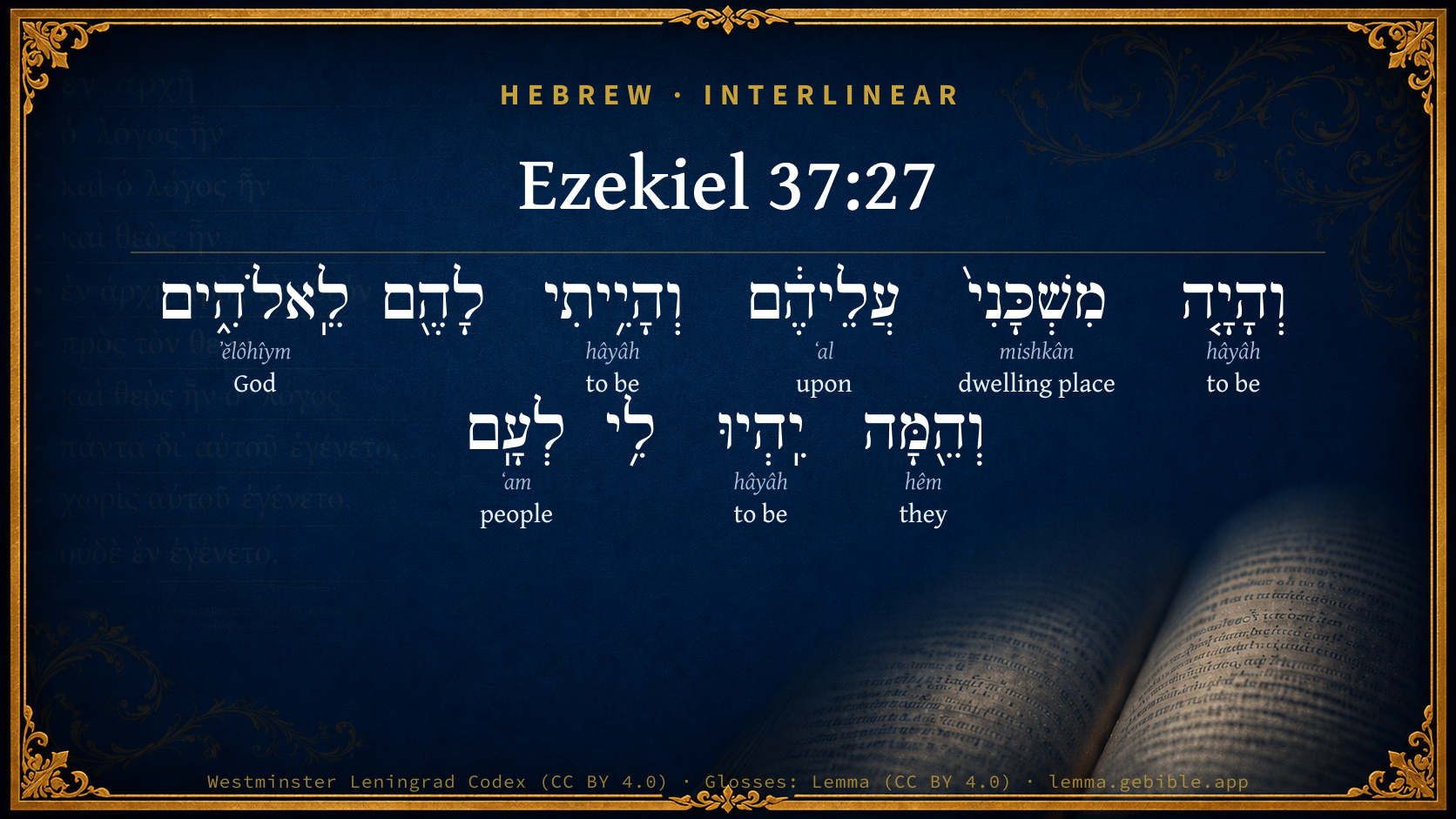
Hebrew (Westminster Leningrad Codex) Ezekiel 37:27 appears in the Hebrew Old Testament. The text above is from the Westminster Leningrad Codex. Each word links to its Strong’s number, a concise gloss, and parsing drawn from the Open Scriptures Hebrew Bible morphology. Click any word for its full Brown-Driver-Briggs (BDB) entry.
Download image
Cite this verse

Ezekiel 37:27 (World English Bible). Public Domain. Lemma interlinear Bible study tool, https://lemma.gebible.app/v/ezekiel/37/27.

Show BibTeX & RIS
BibTeX
RIS
English Translation
My tent also shall be with them; and I will be their God, and they shall be my people.
World English Bible · Public Domain
Download a study sheet

One document with this verse’s original text, its word-by-word gloss line, the meaning frame, cross-references with their text, attributed commentary, and full source and license credits — printable, and it pastes into notes with its structure intact.

This verse Autodidact and up

Study sheet (.html) Plain text (.txt)

A passage Seminary Student

Up to 50 verses in one chapter. A passage sheet keeps up to 6 commentary sources and 12 cross-references per verse, in the order this page ranks them, and says so on the sheet whenever that leaves anything out. Ask for a single verse and you get the Autodidact verse sheet above.

Everything on this page stays free to read, with no account — the sheet is a download of what is already on screen, not access to it.

Want to remove ads? Support Godless Engineer
Compare translations 3

The same verse in 3 English versions, stacked beneath the original-language interlinear above. Click any original word for its lexicon entry.

Each is an independent rendering of the whole verse — the interlinear is not word-aligned to these translations.

Highlighted words mark where these versions differ — a whole-verse word diff, not a word-by-word alignment.

  • World English Bible Public Domain
    My tent also shall be with them; and I will be their God, and they shall be my people.
  • King James Version Public Domain
    My tabernacle also shall be with them: yea, I will be their God, and they shall be my people.
  • unfoldingWord Literal Text CC BY-SA 4.0
    My dwelling place will be with them; I will be their God, and they will be my people.

unfoldingWord Literal Text — © unfoldingWord, licensed CC BY-SA 4.0. Word-aligned USFM3 via Door43 (git.door43.org/unfoldingWord/en_ult).

Versions to compare (up to 4)

3 of 4 selected

Show all 18 translations

Every available English version of this verse, each an independent rendering of the whole verse.

  • World English Bible Public Domain
    My tent also shall be with them; and I will be their God, and they shall be my people.
  • Berean Standard Bible Public Domain
    My dwelling place will be with them; I will be their God, and they will be My people.
  • Majority Standard Bible Public Domain
    My dwelling place will be with them; I will be their God, and they will be My people.
  • King James Version Public Domain
    My tabernacle also shall be with them: yea, I will be their God, and they shall be my people.
  • American Standard Version (1901) Public Domain
    My tabernacle also shall be with them; and I will be their God, and they shall be my people.
  • Revised Version (1885) Public Domain
    My tabernacle also shall be with them; and I will be their God, and they shall be my people.
  • Geneva Bible (1599) Public Domain
    My tabernacle also shalbe with them: yea, I will be their God, and they shalbe my people.
  • Douay-Rheims (1899) Public Domain
    And my tabernacle shall be with them: and I will be their God, and they shall be my people.
  • Young's Literal Translation Public Domain
    And My tabernacle hath been over them, And I have been to them for God, And they have been to Me for a people.
  • Literal Standard Version CC BY-SA 4.0
    And My dwelling place has been over them, || And I have been to them for God, || And they have been to Me for a people.
  • Unlocked Literal Bible CC BY-SA 4.0
    My dwelling place will be with them; I will be their God, and they will be my people.
  • unfoldingWord Literal Text CC BY-SA 4.0
    My dwelling place will be with them; I will be their God, and they will be my people.
  • Darby Bible Public Domain
    And my tabernacle shall be over them; and I will be their God, and they shall be my people.
  • World Messianic Bible Public Domain
    My tent also will be with them. I will be their God, and they will be my people.
  • Webster's Bible Public Domain
    My tabernacle also shall be with them: and I will be their God, and they shall be my people.
  • Free Bible Version CC BY-SA 4.0
    My Tabernacle will be with them. I will be their God, and they will be my people.
  • Bible in Basic English Public Domain
    And my House will be over them; and I will be to them a God, and they will be to me a people.
  • JPS Tanakh (1917) Public Domain
    My dwelling-place also shall be over them; and I will be their God, and they shall be My people.

Literal Standard Version (2020), Covenant Press — licensed CC BY-SA 4.0. Text via the HelloAO Bible API (eBible.org). Unlocked Literal Bible (unfoldingWord) — licensed CC BY-SA 4.0. Text via the HelloAO Bible API (eBible.org). unfoldingWord Literal Text — © unfoldingWord, licensed CC BY-SA 4.0. Word-aligned USFM3 via Door43 (git.door43.org/unfoldingWord/en_ult). Free Bible Version, Dr. Jonathan Gallagher — licensed CC BY-SA 4.0. Text via the HelloAO Bible API (eBible.org).

Word by word

More ways to search: Search by grammar → Find every occurrence → Compare this word →

Practice this passage: Drill this verse → Learn its vocabulary →

מִשְׁכָּנִי֙
mishkân
H4908
“dwelling place · my”
Noun, Common, Masculine, Singular, Construct + Suffix, Personal, 1st Person, Common, Singular
Part of Speech
Noun
Type
Common
Gender
Masculine
Number
Singular
State
Construct
Full BDB Definition

Origin: from H7931

TWOT: 2387c

dwelling place, tabernacle - dwelling-place - dwellings
  1. וְהָיָ֤ה hâyâh H1961 “and · to be” Conjunction + Verb, Qal, Sequential Perfect, 3rd Person, Masculine, Singular
  2. עֲלֵיהֶ֔ם ʻal H5921 “upon · them” Preposition + Suffix, Personal, 3rd Person, Masculine, Plural
  3. וְהָיִ֥יתִי hâyâh H1961 “and · to be” Conjunction + Verb, Qal, Sequential Perfect, 1st Person, Common, Singular
  4. לֵֽאלֹהִ֑ים ʼĕlôhîym H430 “to/for · God(s)” Preposition + Noun, Common, Masculine, Plural, Absolute
  5. וְהֵ֖מָּה hêm H1992 “and · they” Conjunction + Pronoun, Personal, 3rd Person, Masculine, Plural
  6. יִֽהְיוּ hâyâh H1961 “to be” Verb, Qal, Imperfect, 3rd Person, Masculine, Plural
  7. לְעָֽם ʻam H5971 “to/for · people” Preposition + Noun, Common, Masculine, Singular, Absolute

About this verse

These counts appear in no published source. They are computed here, from the morphology-tagged text and Lemma’s own curated glosses. What Lemma adds →

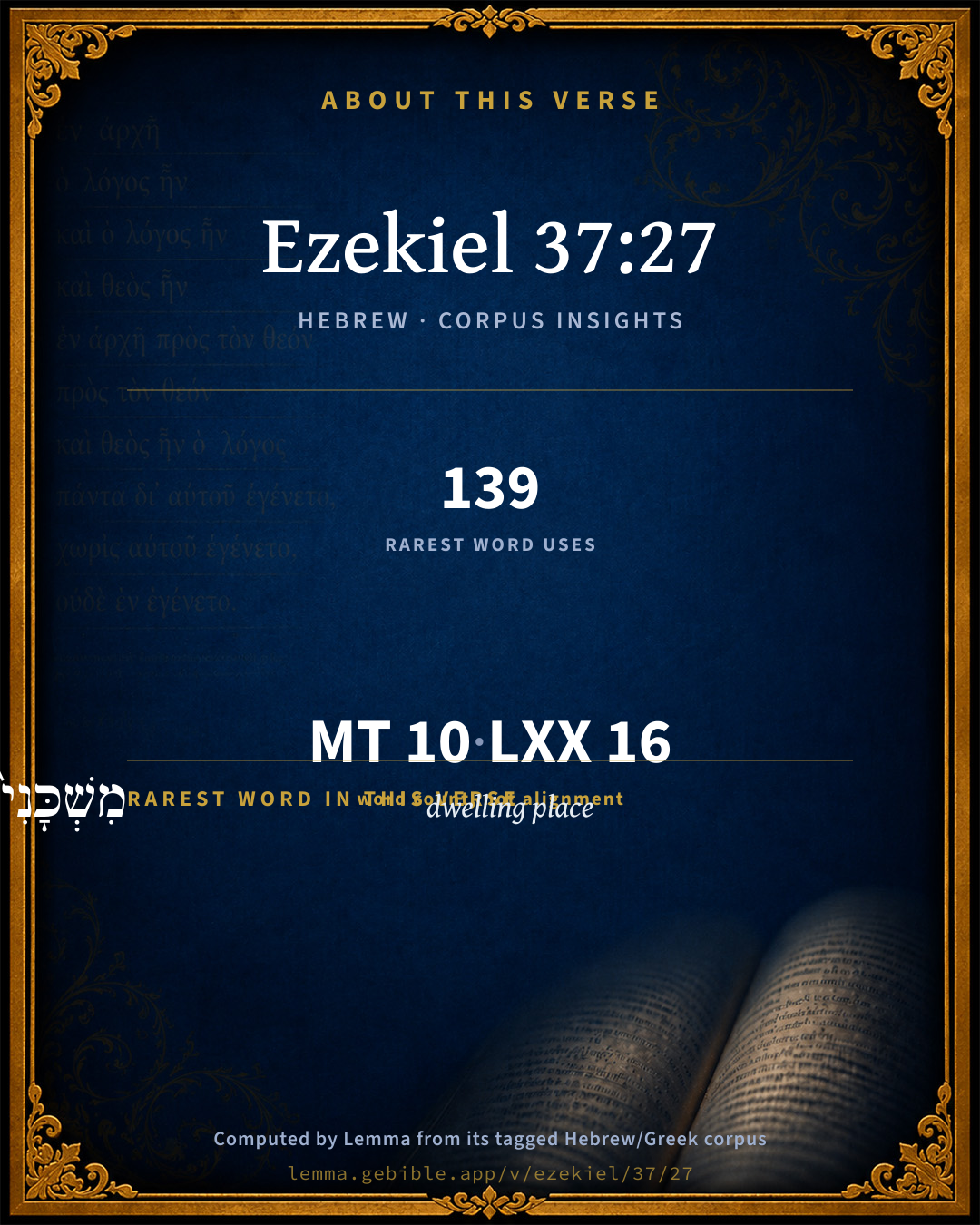
10
words
6
distinct lemmas
Prophets
section

Grammatical profile

  • 3 verbs
  • 3 nouns
  • 1 pronoun
  • 3 prepositions

Verb forms

  • וְהָיָ֤ה Qal · Sequential Perfect
  • וְהָיִ֥יתִי Qal · Sequential Perfect
  • יִֽהְיוּ Qal · Imperfect

Repetition

A word recurs within this verse — often emphatic in Hebrew:

  • וְהָיָ֤ה to be H1961 ×3

Hebrew & Septuagint length

In English translation the verse runs 19 words from the Hebrew and 21 from the Septuagint (LXX English) — closely comparable.

A rough comparison of the two English renderings, which tokenize alike — not a word-level alignment.

Word counts can differ between the Hebrew and the Greek without any difference in meaning — e.g. the Hebrew direct-object marker אֵת has no separate Greek word, and Greek often adds the article ὁ.

In the original languages it is 10 Hebrew tokens and 16 Greek tokens — but the two are counted differently (Hebrew bundles its prefixes and suffixes into one token; the Greek is in lemma form), so that isn’t a like-for-like length.

Cross-references

11

Topical passages linked to Ezekiel 37:27 in the Treasury of Scripture Knowledge — connected by theme and wording, ordered by reader-vote popularity; previews shown in the World English Bible.

  • Revelation 21:3 I heard a loud voice out of heaven saying, "Behold, God's dwelling is with people, and he will dwell with them, and they will be his people, and God himself will be with them as their God.
  • Ezekiel 37:23 neither shall they defile themselves any more with their idols, nor with their detestable things, nor with any of their transgressions; but I will save them out of all their dwelling-places, in which they have sinned, and will cleanse them: so shall they be my people, and I will be their God.
  • John 1:14 The Word became flesh, and lived among us. We saw his glory, such glory as of the one and only Son of the Father, full of grace and truth.
  • Colossians 2:9–10 For in him all the fullness of the Godhead dwells bodily,
  • Leviticus 26:11–12 I will set my tent among you: and my soul won't abhor you.
  • 2 Corinthians 6:16 What agreement has a temple of God with idols? For you are a temple of the living God. Even as God said, "I will dwell in them, and walk in them; and I will be their God, and they will be my people."
  • Ezekiel 11:20 that they may walk in my statutes, and keep my ordinances, and do them: and they shall be my people, and I will be their God.
  • Ezekiel 36:28 You shall dwell in the land that I gave to your fathers; and you shall be my people, and I will be your God.
  • Hosea 2:23 I will sow her to me in the earth; And I will have mercy on her who had not obtained mercy; And I will tell those who were not my people, 'You are my people;' And they will say, 'My God!'"
  • Ezekiel 14:11 that the house of Israel may go no more astray from me, neither defile themselves any more with all their transgressions; but that they may be my people, and I may be their God, says the Lord Yahweh.
  • Revelation 21:22 I saw no temple in it, for the Lord God, the Almighty, and the Lamb, are its temple.

Cross-references courtesy of OpenBible.info (CC BY 4.0).

Hebrew and Greek witnesses Masoretic Hebrew ↔ Greek Septuagint

The same verse in the two great witnesses to the Old Testament, shown verse-for-verse.

These are two independent witnesses, not word-aligned to each other, and the Septuagint is shown in lemma (dictionary) form.

Hebrew Ezekiel 37:27 Masoretic · Westminster Leningrad Codex

וְהָיָ֤ה מִשְׁכָּנִי֙ עֲלֵיהֶ֔ם וְהָיִ֥יתִי לָהֶ֖ם לֵֽאלֹהִ֑ים וְהֵ֖מָּה יִֽהְיוּ לִ֥י לְעָֽם

My tent also shall be with them; and I will be their God, and they shall be my people.

World English Bible · Public Domain

Greek LXX Ezekiel 37:27 Septuagint · lemma form

καί εἰμί ὁ κατασκήνωσις ἐγώ ἐν αὐτός καί εἰμί αὐτός θεός καί αὐτός ἐγώ εἰμί λαός

And my tabernacle shall be among them; and I will be to them a God, and they shall be my people.

LXX2012 (modern English Septuagint) · Public Domain

Hebrew: Westminster Leningrad Codex (CC BY 4.0). Greek: Septuagint (public domain); English from LXX2012 (modern English Septuagint) (Public Domain). How the Septuagint differs from the Hebrew →

Targum (Aramaic paraphrase)

1

The Targum is the ancient Jewish Aramaic paraphrase of the Hebrew Scriptures — an interpretive translation, not the Hebrew text itself. Onkelos (literal) and Pseudo-Jonathan (expansive) render the Torah, and Jonathan the Prophets. Coverage is partial: where no permissively-licensed English translation exists for a verse, only the Aramaic is shown. This is verse-level text, not a word-by-word alignment to the Hebrew.

  1. Targum Jonathan Prophets (Joshua–Malachi)
    וְאַשְׁרֵי שְׁכִינְתִּי בֵּינֵיהוֹן וְאֶהֱוֵי לְהוֹן לֵאלָהָא וְאִינוּן יְהוֹן קֳדָמַי לְעָם:

    (no public-domain English translation for this verse)

    Targum Jonathan — Aramaic: “Mikraot Gedolot” (public domain). English: “Sefaria Community Translation” (CC0 1.0 (public-domain dedication)); “London "Chaldee Paraphrase," 1871” (public domain). Text via Sefaria.

Commentary

Notes on Ezekiel 37:27 from classic Christian and Jewish commentators (each source and its license shown beneath its notes). The classic Christian expositions comment on the surrounding passage and are grouped to its opening verse, so a note may address several verses; the Jewish commentaries on the Tanakh (Rashi and others) are per-verse, so they appear only where the commentator wrote on this verse.

Lemma curates 59 commentaries, every one of them public domain or Creative Commons licensed, each selected and text-cleaned for this edition rather than reprinted as found. About our sources →

Trapp's Complete Commentary

John Trapp

Eze 37:27 My tabernacle also shall be with them: yea, I will be their God, and they shall be my people.

Ver. 27. My tabernacle also,] i.e., Mine ordinances, those testimonies of my spedal presence. See Rev 21:3.

John Trapp, A Commentary or Exposition upon All the Books of the Old and New Testament (1647–1656) — public domain. Text from a community e-Sword module.

Jamieson, Fausset & Brown

Robert Jamieson, A. R. Fausset & David Brown

My tabernacle . . . with them--as foretold (Gen 9:27); Joh 1:14, "The Word . . . dwelt among us" (literally, "tabernacled"); first, in humiliation; hereafter, in manifested glory (Rev 21:3).

Jamieson, Fausset & Brown — Commentary Critical and Explanatory on the Whole Bible (1871) — public domain (CC PDM 1.0). Text via the HelloAO Bible API.

Adam Clarke's Commentary

Verse 27. My tabernacle] Jesus Christ, the true tabernacle, in whom dwelt all the fulness of the Godhead bodily.

Adam Clarke's Commentary on the Bible (1810–1826) — public domain. Text from a community e-Sword/MySword module.

Ellicott's Commentary for English Readers

(27) My tabernacle also.—Compare the whole promise of this verse with 2Co_6:16 : “Ye are the temple of the living God; as God hath said, I will dwell in them, and walk in them: and I will be their God, and they shall be my people.” This promise of “a sanctuary in the midst of them for evermore” was in type and shadow set before the eyes of the people with the restoration of the Temple of Zerubbabel; but in its reality began to be fulfilled at the incarnation of the Son of God, of whom it is said by St. John (Joh_1:14) that “He dwelt (literally, tabernacled) among us,” and is continued by the indwelling of the Holy Spirit in the hearts of believers (1Co_3:16; 1Co_6:19); while it is to receive its final consummation in that future when the tabernacle of God shall be with men, and “the Lord God Almighty and the Lamb are the temple” of the heavenly Jerusalem (Rev_21:3-22). See Excursus F at end of this book.

A Bible Commentary for English Readers, edited by Charles John Ellicott (1878–1897) — public domain. Text from a community e-Sword module.

The Cambridge Bible for Schools and Colleges

gen. ed. J. J. S. Perowne

27. My tabernacle also] And my dwelling place … and I will be. The words repeat the idea in Eze_37:26. The last words of the Book are, “The Lord is there.” The phrase with them, i.e. by or beside them (cf. Eze_2:6), might mean over them, reference being to the situation of the temple, high above the city (Eze_40:2), but this has little probability. It would be more natural to take over in the ideal sense of a “protection” to them. The sanctuary, however, does not protect, it sanctifies, although being sanctified Jehovah will protect them (ch. 38–39). The expression “I will be their God” varies the idea of his dwelling place being with them, Eze_11:20, Eze_14:11, Eze_36:28.

The Cambridge Bible for Schools and Colleges (gen. ed. J. J. S. Perowne; Cambridge University Press, 1878–1918) — public domain. Text from a community e-Sword module.

John Gill's Exposition

My tabernacle also shall be with them,.... The symbol of his presence: the meaning is, that he shall dwell in them by his Spirit and grace; and everyone of them shall be the temple of the living God, in whom he will walk and dwell:

yea, I will be their God, and they shall be my people; which is repeated for the confirmation of it; see Eze 37:23.

John Gill's Exposition of the Whole Bible (1746–1763) — public domain (CC PDM 1.0). Text via the HelloAO Bible API.

Matthew Poole's English Annotations

My tabernacle; the tabernacle of my presence, or wherein I will show my presence among them. Their fathers had a tabernacle of witness, so shall they; that was brought by Joshua into Canaan, but the Messiah shall bring with him a better, a spiritual and heavenly.

I will be their God: see Eze 11:20; Rev 21:1-3.

They shall be my people; by my grace I will make them holy, as the people of a holy God ought to be, and I will make them happy, as the people of the ever-blessed God expect and hope to be.

Matthew Poole's English Annotations on the Holy Bible (1683–1685) — public domain. Text from a community e-Sword/MySword module.

The Pulpit Commentary

God"s tabernacle.

I GOD IS IN THE MIDST OF HIS PEOPLE. He is not a distant divinity seated on cloud-capped Olympus or hidden in remote heavenly regions. He visits the earth and even dwells there. We recognize his presence in the beauty of spring and the wealth of autumn; we hear his voice in the thunderstorm, and we see his glory in the sunshine. He haunts the cathedral aisles of the forest; he unveils his glory beneath the blue dome that covers the fair fields of nature. Assuredly he is in our homes shedding peace and love; he draws very near to our souls in the night of sorrow; and he smiles upon us in our innocent joys. Moreover, while God is thus universally present, he manifests himself especially to his people as he does not unto the world. (Joh_14:22, Joh_14:23) This is not on account of any unreasonable partiality, any unfair favoritism. He says justly, "I love them that love me; and those that seek me early shall find me". (Pro_8:17)

II GOD"S PRESENCE IS A PROTECTION FOR HIS PEOPLE. He says that his tabernacle shall be not merely "with them," but "over them," as the phrase should be rendered. We think of a sheltering tent protecting the people from the heat of the sun by day and from the frosts by night. In the olden times the tabernacle was planted in the midst of the camp, but the people generally were not admitted to its covered shrine, which was reserved for a privileged priesthood. Now, however, the veil is rent, and now all God"s people are priests, as the apostle to the Jews declared. (1Pe_2:9) Now, therefore, God"s tabernacle is not only in the midst of the camp, gazed at with admiration by a surrounding host. It is spread over the people of God, because they are allowed to enter its most holy place. Our safety lies in our nearness to God, and when we truly seek to enter into close communion with Heaven we find that there is a sense of security and peace that can be found in no other way.

1. God then protects from trouble, even when the blow falls, by strengthening us to bear it.

2. He protects from temptation by giving us a joy greater than that of the pleasures of sin.

3. He protects from the guilt of the past, by taking away our sins and giving free forgiveness.

4. He protects from the fear of the future, by assuring us that he will never leave us nor forsake us.

III GOD"S PRESENCE WITH HIS PEOPLE SECURES THEIR UNION WITH HIM. "Yea, I will be their God, and they shall be my people." It is difficult to love and trust an absent Being, but nearness stimulates affection and confidence.

1. The people own God. He is "their God." This signifies willing acceptance following deliberate choice. No man has a true experience of religion until he can say from his heart, "The Lord is my God.

2. God owns his people. They are his by right of creation; they are still more his by right of redemption bought with a price." God"s ownership implies

1. his right to do as he will with his people;

2. his care to preserve his possession;

3. his joy in dwelling among his children.

Observe, in conclusion:

1. Sin removes the tabernacle of God from our midst. When Israel sinned, the tabernacle was pitched outside the comp.

2. Christ brings Goal back into closest association with us. In Christ he "pitches his tent among us". (Joh_1:14)

The tabernacle of God with men.

There can be no question that one great purpose of the appointment, first of the tabernacle, and then of the temple, as the center of the national and religious life of Israel, was to familiarize the people with the thought of God"s constant presence in the midst of them, as well as to provide means and opportunities for special intercommunion between the Divine King and his subjects. The coming of Christ whose body was the temple of Deity, the coming of the Holy Spirit whose abiding indwelling constitutes the temple, the Church, of God, did away with the necessity for a local and temporary dwelling-place of God upon earth, but secured the permanent reality of the fellowship of which such a dwelling-place was the symbol and the means.

I GOD"S TABERNACLE WITH MEN REMINDS US OF THE UNIVERSAL PRESENCE OF THE DEITY UPON EARTH THROUGHOUT ALL TIME.

II AND OF HIS SPECIAL AND CONGENIAL PRESENCE AMONG AND WITH HIS OWN PEOPLE.

III AND OF HIS GRACIOUS PURPOSE TO REVEAL UNTO THEM HIS OWN CHARACTER AND WILL.

IV AND OF HIS CONSTANT WILLINGNESS TO RECEIVE THEIR WORSHIP AND HOMAGE.

V AND OF HIS DESIRE TO MAINTAIN CLOSE AND UNBROKEN RELATIONS OF CORDIALITY AND KINDNESS WITH HIS PEOPLE.

APPLICATION. The privilege of fellowship with God should be reverently cherished, prized, and cultivated. The means and occasions of such fellowship should not be mistaken for the fellowship itself. The truest dignity and sacredness of this earthly life consists in the opportunity it offers of communion with the unseen but ever-present God and Savior. The strongest attraction of the life to come lies in the prospect of a closer approach to God, a more uninterrupted fellowship with God, and a nearer assimilation to his perfect and glorious character. T.

The Pulpit Commentary (1880–1919), ed. H.D.M. Spence-Jones & Joseph S. Exell — public domain. Text from a community e-Sword module.

John Wesley's Explanatory Notes

My tabernacle - The tabernacle wherein I will shew my presence among them. Their fathers had a tabernacle, but the Messiah shall bring with him a better, a spiritual, and an heavenly. They shall be my people - By my grace I will make them holy, as the people of a holy God; and I will make them happy, as the people of the ever blessed God.

John Wesley, Explanatory Notes Upon the Whole Bible (1754–1765) — public domain. Text via the GEBible commentary corpus.

Lesson kit

Teaching starters — assembled from the data on this page, not authored interpretation. Every prompt links to the verse data it draws on. Edit before teaching.

Ezekiel, in the Prophets, opens this verse with 10 words (6 distinct Hebrew lemmas). Its most distinctive word is mishkân (“dwelling place”). A historical commentator’s framing appears above. Read the whole chapter for the surrounding context.

Discussion questions

  1. How does “dwelling place” (mishkân) shape what this verse is saying?
  2. Revelation 21:3 shares this passage’s theme. How do the two illuminate each other?
  3. “to be” occurs 3× in this one verse. What is the effect of the repetition?
  4. The translations on this page render this verse differently — a whole-verse word diff, not a word-by-word alignment. What might account for the different wordings?
  5. The verb «וְהָיָ֤ה» is Qal Sequential Perfect. How does its form color the action?
  6. Reading how Trapp's Complete Commentary and Jamieson, Fausset & Brown read this verse, where do the two commentators agree and where do they part?

Things to notice

Reading settings

Reading text

Shown beneath each verse's original-language words.

Old Testament
Old Testament edition

Read the OT as the Masoretic Hebrew (MT) or the Greek Septuagint (LXX).

English shown for the Greek Septuagint (in the Hebrew ↔ Greek comparison).

Comparing translations? Open the Compare panel on any verse page to stack up to four side by side.