
1 Kings 12:4

Hebrew (Westminster Leningrad Codex) 1 Kings 12:4 appears in the Hebrew Old Testament. The text above is from the Westminster Leningrad Codex. Each word links to its Strong’s number, a concise gloss, and parsing drawn from the Open Scriptures Hebrew Bible morphology. Click any word for its full Brown-Driver-Briggs (BDB) entry.
Download image
Cite this verse

1 Kings 12:4 (World English Bible). Public Domain. Lemma interlinear Bible study tool, https://lemma.gebible.app/v/1-kings/12/4.

Show BibTeX & RIS
BibTeX
RIS
English Translation
Your father made our yoke grievous: now therefore make you the grievous service of your father, and his heavy yoke which he put on us, lighter, and we will serve you.
World English Bible · Public Domain
Download a study sheet

One document with this verse’s original text, its word-by-word gloss line, the meaning frame, cross-references with their text, attributed commentary, and full source and license credits — printable, and it pastes into notes with its structure intact.

This verse Autodidact and up

Study sheet (.html) Plain text (.txt)

A passage Seminary Student

Up to 50 verses in one chapter. A passage sheet keeps up to 6 commentary sources and 12 cross-references per verse, in the order this page ranks them, and says so on the sheet whenever that leaves anything out. Ask for a single verse and you get the Autodidact verse sheet above.

Everything on this page stays free to read, with no account — the sheet is a download of what is already on screen, not access to it.

Want to remove ads? Support Godless Engineer
Compare translations 3

The same verse in 3 English versions, stacked beneath the original-language interlinear above. Click any original word for its lexicon entry.

Each is an independent rendering of the whole verse — the interlinear is not word-aligned to these translations.

Highlighted words mark where these versions differ — a whole-verse word diff, not a word-by-word alignment.

  • World English Bible Public Domain
    Your father made our yoke grievous: now therefore make you the grievous service of your father, and his heavy yoke which he put on us, lighter, and we will serve you.
  • King James Version Public Domain
    Thy father made our yoke grievous: now therefore make thou the grievous service of thy father, and his heavy yoke which he put upon us, lighter, and we will serve thee.
  • unfoldingWord Literal Text CC BY-SA 4.0
    “Your father made our yoke hard. But you, now make lighter than the hard service of your father and than his heavy yoke that he put on us, and we will serve you.”

unfoldingWord Literal Text — © unfoldingWord, licensed CC BY-SA 4.0. Word-aligned USFM3 via Door43 (git.door43.org/unfoldingWord/en_ult).

Versions to compare (up to 4)

3 of 4 selected

Show all 18 translations

Every available English version of this verse, each an independent rendering of the whole verse.

  • World English Bible Public Domain
    Your father made our yoke grievous: now therefore make you the grievous service of your father, and his heavy yoke which he put on us, lighter, and we will serve you.
  • Berean Standard Bible Public Domain
    “Your father put a heavy yoke on us. But now you should lighten the burden of your father’s service and the heavy yoke he put on us, and we will serve you.”
  • Majority Standard Bible Public Domain
    “Your father put a heavy yoke on us. But now you must lighten the burden of your father’s service and the heavy yoke he put on us, and we will serve you.”
  • King James Version Public Domain
    Thy father made our yoke grievous: now therefore make thou the grievous service of thy father, and his heavy yoke which he put upon us, lighter, and we will serve thee.
  • American Standard Version (1901) Public Domain
    Thy father made our yoke grievous: now therefore make thou the grievous service of thy father, and his heavy yoke which he put upon us, lighter, and we will serve thee.
  • Revised Version (1885) Public Domain
    Thy father made our yoke grievous: now therefore make thou the grievous service of thy father, and his heavy yoke which he put upon us, lighter, and we will serve thee.
  • Geneva Bible (1599) Public Domain
    Thy father made our yoke grieuous: now therefore make thou the grieuous seruitude of thy father, and his sore yoke which he put vpon vs, lighter, and we will serue thee.
  • Douay-Rheims (1899) Public Domain
    Thy father laid a grievous yoke upon us: now therefore do thou take off a little of the grievous service of thy father, and of his most heavy yoke, which he put upon us, and we will serve thee.
  • Young's Literal Translation Public Domain
    `Thy father made hard our yoke, and thou, now, make light `some' of the hard service of thy father, and his heavy yoke that he put upon us, and we serve thee.'
  • Literal Standard Version CC BY-SA 4.0
    “Your father hardened our yoke, and you, now, lighten [some] of the hard service of your father, and his heavy yoke that he put on us, and we serve you.”
  • Unlocked Literal Bible CC BY-SA 4.0
    “Your father made our yoke heavy. Now make lighter the hard work of your father and make lighter the heavy yoke that he put on us, and we will serve you.”
  • unfoldingWord Literal Text CC BY-SA 4.0
    “Your father made our yoke hard. But you, now make lighter than the hard service of your father and than his heavy yoke that he put on us, and we will serve you.”
  • Darby Bible Public Domain
    Thy father made our yoke grievous; and now lighten thou the grievous servitude of thy father and his heavy yoke that he put upon us, and we will serve thee.
  • World Messianic Bible Public Domain
    “Your father made our yoke difficult. Now therefore make the hard service of your father, and his heavy yoke which he put on us, lighter, and we will serve you.”
  • Webster's Bible Public Domain
    Thy father made our yoke grievous: now therefore make thou the grievous service of thy father, and his heavy yoke which he put upon us, lighter, and we will serve thee.
  • Free Bible Version CC BY-SA 4.0
    “Your father placed a heavy burden on us,” they told him. “But now if you lighten the load from when we served your father and the heavy demands he imposed on us, we will serve you.”
  • Bible in Basic English Public Domain
    Your father put a hard yoke on us: if you will make the conditions under which your father kept us down less cruel, and the weight of the yoke he put on us less hard, then we will be your servants.
  • JPS Tanakh (1917) Public Domain
    'Thy father made our yoke grievous; now therefore make thou the grievous service of thy father, and his heavy yoke which he put upon us, lighter, and we will serve thee.'

Literal Standard Version (2020), Covenant Press — licensed CC BY-SA 4.0. Text via the HelloAO Bible API (eBible.org). Unlocked Literal Bible (unfoldingWord) — licensed CC BY-SA 4.0. Text via the HelloAO Bible API (eBible.org). unfoldingWord Literal Text — © unfoldingWord, licensed CC BY-SA 4.0. Word-aligned USFM3 via Door43 (git.door43.org/unfoldingWord/en_ult). Free Bible Version, Dr. Jonathan Gallagher — licensed CC BY-SA 4.0. Text via the HelloAO Bible API (eBible.org).

Word by word

More ways to search: Search by grammar → Find every occurrence → Compare this word →

Practice this passage: Drill this verse → Learn its vocabulary →

הִקְשָׁ֣ה
qâshâh
H7185
“to be hard”
Verb, Hiphil, Perfect, 3rd Person, Masculine, Singular
Part of Speech
Verb
Stem
Hiphil
Form
Perfect
Person
3rd Person
Gender
Masculine
Number
Singular
Full BDB Definition

Origin: a primitive root

TWOT: 2085

to be hard, be severe, be fierce, be harsh - (Qal) - to be hard, be difficult - to be hard, be severe - (Niphal) - to be ill-treated - to be hard pressed - (Piel) to have severe labour (of women) - (Hiphil) - to make difficult, make difficulty - to make severe, make burdensome - to make hard, make stiff, make stubborn - of obstinacy (figuratively) - to show stubbornness
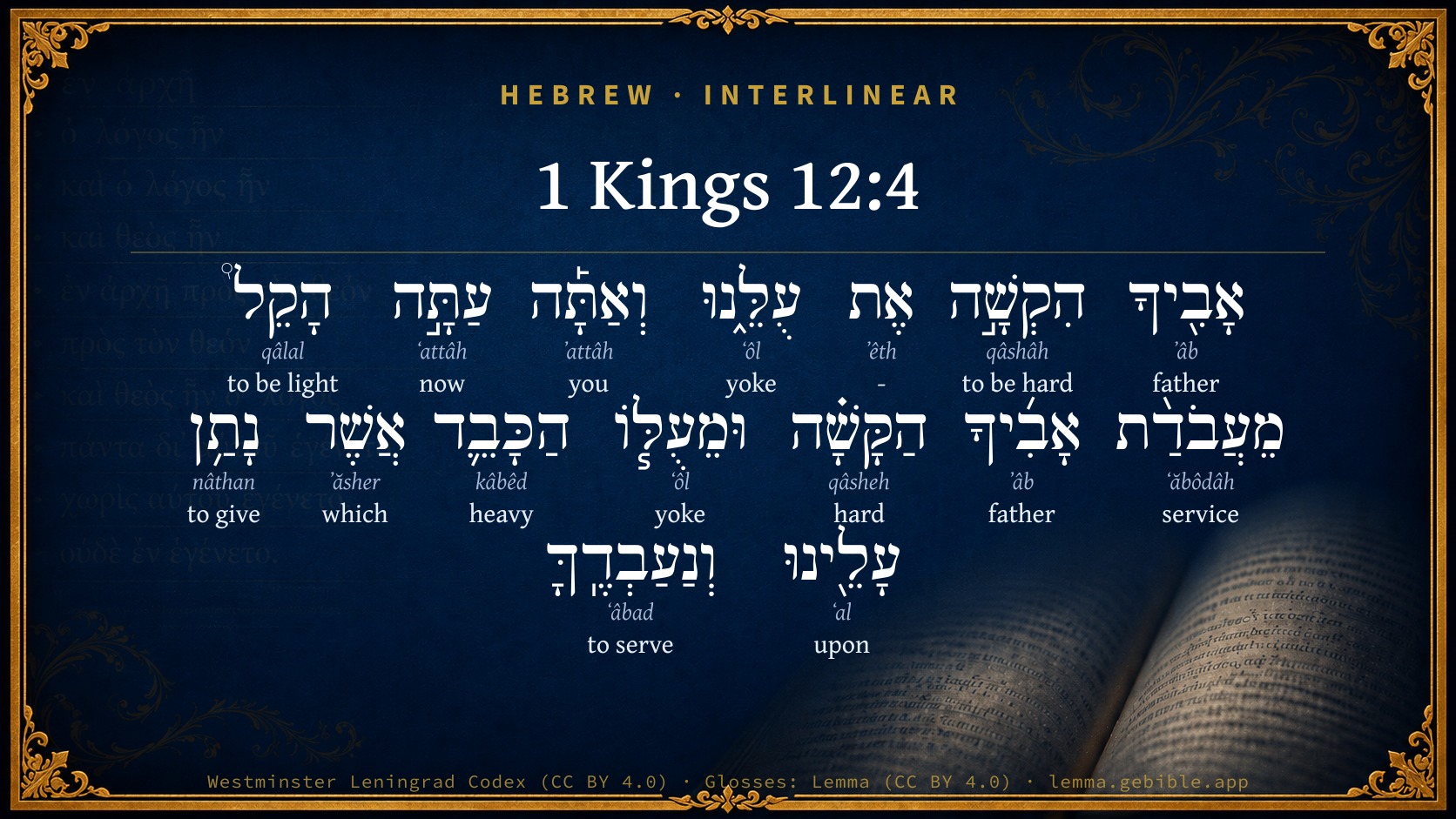
  1. אָבִ֖יךָ ʼâb H1 “father · your” Noun, Common, Masculine, Singular, Construct + Suffix, Personal, 2nd Person, Masculine, Singular
  2. אֶת ʼêth H853 “-” Particle, Direct Object
  3. עֻלֵּ֑נוּ ʻôl H5923 “yoke · our” Noun, Common, Masculine, Singular, Construct + Suffix, Personal, 1st Person, Common, Plural
  4. וְאַתָּ֡ה ʼattâh H859 “and · you” Conjunction + Pronoun, Personal, 2nd Person, Masculine, Singular
  5. עַתָּ֣ה ʻattâh H6258 “now” Adverb
  6. הָקֵל֩ qâlal H7043 “be light” Verb, Hiphil, Imperative, 2nd Person, Masculine, Singular
  7. מֵעֲבֹדַ֨ת ʻăbôdâh H5656 “from · service of” Preposition + Noun, Common, Feminine, Singular, Construct
  8. אָבִ֜יךָ ʼâb H1 “father · your” Noun, Common, Masculine, Singular, Construct + Suffix, Personal, 2nd Person, Masculine, Singular
  9. הַקָּשָׁ֗ה qâsheh H7186 “the · hard” Particle, Definite Article + Adjective, Adjective, Feminine, Singular, Absolute
  10. וּמֵעֻלּ֧וֹ ʻôl H5923 “and · from · yoke · his” Conjunction + Preposition + Noun, Common, Masculine, Singular, Construct + Suffix, Personal, 3rd Person, Masculine, Singular
  11. הַכָּבֵ֛ד kâbêd H3515 “the · heavy” Particle, Definite Article + Adjective, Adjective, Masculine, Singular, Absolute
  12. אֲשֶׁר ʼăsher H834 “which” Particle, Relative
  13. נָתַ֥ן nâthan H5414 “to give” Verb, Qal, Perfect, 3rd Person, Masculine, Singular
  14. עָלֵ֖ינוּ ʻal H5921 “upon · us” Preposition + Suffix, Personal, 1st Person, Common, Plural
  15. וְנַעַבְדֶֽךָּ ʻâbad H5647 “and · to serve · you” Conjunction + Verb, Qal, Imperfect, 1st Person, Common, Plural + Suffix, Personal, 2nd Person, Masculine, Singular

About this verse

These counts appear in no published source. They are computed here, from the morphology-tagged text and Lemma’s own curated glosses. What Lemma adds →

16
words
14
distinct lemmas
Historical
section

Shared distinctive vocabulary

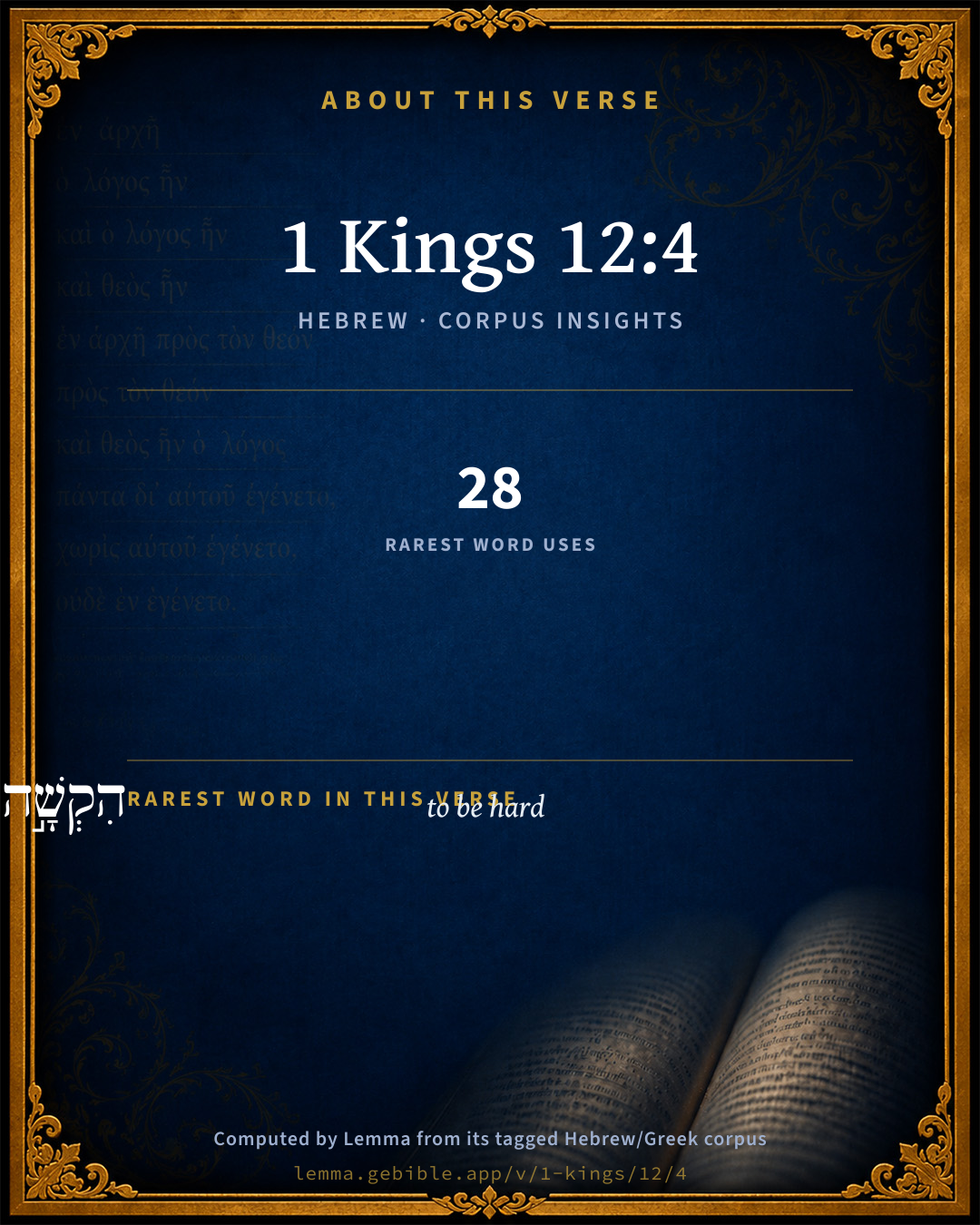
הִקְשָׁ֣ה to be hard H7185 occurs in 28 verses of the Hebrew Bible. Also found in:

Grammatical profile

  • 4 verbs
  • 5 nouns
  • 2 adjectives
  • 1 pronoun
  • 1 preposition
  • 1 adverb
  • 2 particles

Verb forms

  • הִקְשָׁ֣ה Hiphil · Perfect
  • הָקֵל֩ Hiphil · Imperative
  • נָתַ֥ן Qal · Perfect
  • וְנַעַבְדֶֽךָּ Qal · Imperfect

Repetition

Words recur within this verse — often emphatic in Hebrew:

  • אָבִ֖יךָ father H1 ×2
  • עֻלֵּ֑נוּ yoke H5923 ×2

Hebrew & Septuagint length

In English translation the verse runs 31 words from the Hebrew and 28 from the Septuagint (LXX English) — closely comparable.

A rough comparison of the two English renderings, which tokenize alike — not a word-level alignment.

Word counts can differ between the Hebrew and the Greek without any difference in meaning — e.g. the Hebrew direct-object marker אֵת has no separate Greek word, and Greek often adds the article ὁ.

Cross-references

9

Topical passages linked to 1 Kings 12:4 in the Treasury of Scripture Knowledge — connected by theme and wording, ordered by reader-vote popularity; previews shown in the World English Bible.

  • 1 Samuel 8:11–18 He said, This will be the manner of the king who shall reign over you: he will take your sons, and appoint them to him, for his chariots, and to be his horsemen; and they shall run before his chariots;
  • 1 Kings 4:7 Solomon had twelve officers over all Israel, who provided food for the king and his household: each man had to make provision for a month in the year.
  • Matthew 11:29–30 Take my yoke upon you, and learn from me, for I am gentle and lowly in heart; and you will find rest for your souls.
  • 1 Kings 4:20–25 Judah and Israel were many as the sand which is by the sea in multitude, eating and drinking and making merry.
  • 2 Chronicles 10:4–5 Your father made our yoke grievous: now therefore make you the grievous service of your father, and his heavy yoke which he put on us, lighter, and we will serve you.
  • Matthew 23:4 For they bind heavy burdens that are grievous to be borne, and lay them on men's shoulders; but they themselves will not lift a finger to help them.
  • 1 Kings 9:15 This is the reason of the levy which king Solomon raised, to build the house of Yahweh, and his own house, and Millo, and the wall of Jerusalem, and Hazor, and Megiddo, and Gezer.
  • 1 Kings 9:22–23 But of the children of Israel did Solomon make no bondservants; but they were the men of war, and his servants, and his princes, and his captains, and rulers of his chariots and of his horsemen.
  • 1 John 5:3 For this is the love of God, that we keep his commandments. His commandments are not grievous.

Cross-references courtesy of OpenBible.info (CC BY 4.0).

Hebrew and Greek witnesses Masoretic Hebrew ↔ Greek Septuagint

The same verse in the two great witnesses to the Old Testament, shown verse-for-verse.

These are two independent witnesses, not word-aligned to each other, and the Septuagint is shown in lemma (dictionary) form.

Hebrew 1 Kings 12:4 Masoretic · Westminster Leningrad Codex

אָבִ֖יךָ הִקְשָׁ֣ה אֶת עֻלֵּ֑נוּ וְאַתָּ֡ה עַתָּ֣ה הָקֵל֩ מֵעֲבֹדַ֨ת אָבִ֜יךָ הַקָּשָׁ֗ה וּמֵעֻלּ֧וֹ הַכָּבֵ֛ד אֲשֶׁר נָתַ֥ן עָלֵ֖ינוּ וְנַעַבְדֶֽךָּ

Your father made our yoke grievous: now therefore make you the grievous service of your father, and his heavy yoke which he put on us, lighter, and we will serve you.

World English Bible · Public Domain

Greek LXX 1 Kings 12:4 Septuagint · lemma form

ὁ πατήρ σύ βαρύνω ὁ κλοιός ἐγώ καί σύ νῦν κουφίζω ἀπό ὁ δουλεία ὁ πατήρ σύ ὁ σκληρός καί ἀπό ὁ κλοιός αὐτός ὁ βαρύς ὅς δίδωμι ἐπί ἐγώ καί δουλεύω σύ

but do you now lighten somewhat of the hard service of your father, and of his heavy yoke which he put upon us, and we will serve you.

LXX2012 (modern English Septuagint) · Public Domain

Hebrew: Westminster Leningrad Codex (CC BY 4.0). Greek: Septuagint (public domain); English from LXX2012 (modern English Septuagint) (Public Domain). How the Septuagint differs from the Hebrew →

Targum (Aramaic paraphrase)

1

The Targum is the ancient Jewish Aramaic paraphrase of the Hebrew Scriptures — an interpretive translation, not the Hebrew text itself. Onkelos (literal) and Pseudo-Jonathan (expansive) render the Torah, and Jonathan the Prophets. Coverage is partial: where no permissively-licensed English translation exists for a verse, only the Aramaic is shown. This is verse-level text, not a word-by-word alignment to the Hebrew.

  1. Targum Jonathan Prophets (Joshua–Malachi)
    אֲבוּךְ אַקְשֵׁי יַת נִירָנָא וְאַתְּ כְּעַן אֲקֵיל יַת פּוּלְחָנָא דַאֲבוּךְ קַשְׁיָא וּמִנִירֵיהּ תַּקִיפָא דִיהַב עֲלָנָא וְנַפְלְחִינָךְ:

    (no public-domain English translation for this verse)

    Targum Jonathan — Aramaic: “Mikraot Gedolot” (public domain). English: “Sefaria Community Translation” (CC0 1.0 (public-domain dedication)); “London "Chaldee Paraphrase," 1871” (public domain). Text via Sefaria.

Commentary

Notes on 1 Kings 12:4 from classic Christian and Jewish commentators (each source and its license shown beneath its notes). The classic Christian expositions comment on the surrounding passage and are grouped to its opening verse, so a note may address several verses; the Jewish commentaries on the Tanakh (Rashi and others) are per-verse, so they appear only where the commentator wrote on this verse.

Lemma curates 59 commentaries, every one of them public domain or Creative Commons licensed, each selected and text-cleaned for this edition rather than reprinted as found. About our sources →

Trapp's Complete Commentary

John Trapp

1Ki 12:4 Thy father made our yoke grievous: now therefore make thou the grievous service of thy father, and his heavy yoke which he put upon us, lighter, and we will serve thee.

Ver. 4. Thy father made our yoke grievous.] We are sensible how our necks were pinched and galled by means of thy father’s works and wars; the hard services and great taxes put upon us for the maintenance of his royalty, and great retinue of strange women especially; which charge they could not bear, but their idolatry they could well enough brook. Worldly men are only sensible of worldly damages: Mundi divitias magis amant quam Christi delicias.

Make thou his heavy yoke lighter.] Alleva iugum. These malcontented Mεμψιμοιροι had had a fine time, a golden age under Solomon’s government, but never found the worth, till they felt the want of it. Bona a tergo sunt formosissima, blessings are most beautiful behind.

John Trapp, A Commentary or Exposition upon All the Books of the Old and New Testament (1647–1656) — public domain. Text from a community e-Sword module.

Joseph Benson's Commentary

1Ki 12:4. Thy father made our yoke grievous — By heavy taxes and impositions, not only for the temple and his magnificent buildings, but for the expenses of his numerous court, and of so many wives and concubines, and the maintenance of so many chariots and horses. Thus they began with a complaint against the former government; and, as Solomon had so grossly forsaken God, it is no wonder if he oppressed the people. The burdens, however, of which they complain, could not be so heavy as they represented them, considering the peace and plenty which they enjoyed, (1Ki 4:25,) and the vast riches he brought into the kingdom; and it is expressly said, (1Ki 9:22,) that Solomon made no Israelite a bondman. But to those desirous of a change, a light cause seems sufficient. Make thou the grievous service of thy father lighter, &c. — They promise to submit to Rehoboam as their king, and be his faithful subjects, if he would promise to ease them of those burdens which his father had imposed on them.

Joseph Benson's Commentary on the Old and New Testaments (1811–1818) — public domain. Text from a community e-Sword module.

The Pulpit Commentary

Thy father made our yoke see for the literal sense of the Num_19:2; Deu_21:3, etc.; for its tropical use, (Lev_26:13; Deu_28:48, etc.) grievous Heb. heavy. Was this complaint a just one? It is one which occasions us some surprise, as the reign of Solomon had not only been glorious, but the people had apparently enjoyed the greatest plenty and prosperity (1Ki_4:20, 1Ki_4:25; cf. 8:66). Bishop Hall, Bahr, and other writers, consequently, who see in the fact that the ten tribes had chosen Jeroboam for their mouthpiece a settled determination on their part to revolt, affirm that their grievances were purely factitious. But we must not forget that, despite the unbroken peace (see Hall, "Contempl." 2:136) and general prosperity and affluence, the people had had one burden at least to bear which is always galling and vexatious, the burden of a conscription. It is by no means certain, though it is constantly assumed, and is not in itself improbable, that the taxes and imposts had been heavy, the passages alleged in support of that view (1Ki_10:15, 25 12:4) being quite inconclusive. But while we have no right to speak of the, enormous exactions of the late king" (Stanley), we may be perfectly sure that such an establishment as his (1Ki_4:22, 1Ki_4:26) and such undertakings (1Ki_6:14, 22 3:1 7:9:26, 17, 18) would be extremely costly, and that their cost was not altogether defrayed by the presents of subject princes (1Ki_4:21; cf. 10:10, 14), the profits of the king"s merchants, (1Ki_10:28) or the imports of the. (1Ki 5:20) But the people had certainly had to pay a more odious tribute, that of forced labour, of servile work (1Ki_4:6,heb 1Ki_5:14; cf. 1Ki_9:21. sm is almost always used of a tribute rendered by labour, Gesen.) It is quite true that Solomon was not the first to institute this; that David had exacted it before him; (2Sa_20:24) that the burden was one with which all subjects of the old-world monarchies, especially in the East, were familiar; and that in this case it had been imposed with peculiar considerateness. (1Ki_5:14) But it is none the less certain, when we consider the magnitude of Solomon"s undertakings, and the number of men necessarily employed in executing them, that it must have involved some hardships and created much dissatisfaction; such results are inevitable in all conscriptions. "Forced labour has been amongst the causes leading to insurrection in many ages and countries. It alienated the people of Rome from the last Tarquin; it helped to bring about the French Revolution; and it was for many years one of the principal grievances of the Russian serfs" (Rawlinson). But we may find instances of its working perhaps as more Eastern, more closely illustrative of the text amongst the Fellahin of Egypt. "According to Pliny, 360, 000 men had to work 20 years long at one pyramid" (Bahr). In the construction of the great Mahmoudieh canal, by Mehemet All, over 300, 000 labourers were employed. They worked under the lash, and such were the fatigues and hardships of their life that many thousands died in the space of a few months (cf., too, Exo_1:11 sqq.; 2:23: now therefore make thou the grievous Heb. hard, heavy service of thy father, and his heavy yoke which he put upon us, lighter lit., lighten somewhat from," etc., and we will serve thee. Their stipulations seem reasonable enough. Bahr, who says, "We cannot admit the complaint of too hard tribute work to be well founded," and Keil, who maintains that "there cannot have been any well-grounded occasion for complaint," surely forget that both the aged counsellors (ver. 7) and also the writer of this book (vers. 13-15) manifest some degree of sympathy with the complainants.

The Pulpit Commentary (1880–1919), ed. H.D.M. Spence-Jones & Joseph S. Exell — public domain. Text from a community e-Sword module.

Tyndale Open Study Notes

Tyndale Open Resources

12:4 harsh labor demands and heavy taxes: See 4:7, 22-23; 5:13-18; 9:20-23; 11:27-28.

Tyndale Open Study Notes — © Tyndale Open Resources, licensed CC BY-SA 4.0. Text via the HelloAO Bible API.

Geneva Bible (1599)

Geneva Bible translators

Oppress us not with so great charges, which we are not able to sustain.

Geneva Bible (1599) marginal notes — public domain. Text via Bolls.life.

Jamieson, Fausset & Brown

Robert Jamieson, A. R. Fausset & David Brown

Thy father made our yoke grievous--The splendor of Solomon's court and the magnitude of his undertakings being such, that neither the tribute of dependent states, nor the presents of foreign princes, nor the profits of his commercial enterprises, were adequate to carry them on, he had been obliged, for obtaining the necessary revenue, to begin a system of heavy taxation. The people looked only to the burdens, not to the benefits they derived from Solomon's peaceful and prosperous reign--and the evils from which they demanded deliverance were civil oppressions, not idolatry, to which they appear to have been indifferent or approving.

Jamieson, Fausset & Brown — Commentary Critical and Explanatory on the Whole Bible (1871) — public domain (CC PDM 1.0). Text via the HelloAO Bible API.

Adam Clarke's Commentary

Verse 4. The grievous service - and - heavy yoke] They seem here to complain of two things - excessively laborious service, and a heavy taxation. At first it is supposed Solomon employed no Israelite in drudgery: afterwards, when he forsook the God of compassion, he seems to have used them as slaves, and to have revived the Egyptian bondage.

Adam Clarke's Commentary on the Bible (1810–1826) — public domain. Text from a community e-Sword/MySword module.

Ellicott's Commentary for English Readers

(4) We will serve thee.—It seems evident from the tone of the narrative, and especially from the absence of all resentment on the part of the king on the presentation of these conditions, that they were acting within their right; and whatever Jeroboam’s designs may have been, there is no sign of any general predetermination of rebellion. The imposition of the burdens of heavy taxation and forced labour on the people was against old traditions, and even against the practice of Solomon’s earlier years. (See 1Ki_4:20; 1Ki_9:20-22.) To demand a removal, or alleviation of these was perfectly compatible with a loyal willingness to “serve” the new king. The demand might naturally be suggested by Jeroboam, who, by his official position, knew well the severity of the burden.

A Bible Commentary for English Readers, edited by Charles John Ellicott (1878–1897) — public domain. Text from a community e-Sword module.

The Cambridge Bible for Schools and Colleges

gen. ed. J. J. S. Perowne

4. make thou the grievous service … lighter] Josephus says they naturally expected to gain their request, and especially as the king was a young man. The house of Joseph, i.e. the Ephraimites, are specially mentioned as having been engaged in the compulsory labour (see 1Ki_11:28) in the previous reign, and over these Jeroboam had been in charge, so that he was conversant with their grievances.

The Cambridge Bible for Schools and Colleges (gen. ed. J. J. S. Perowne; Cambridge University Press, 1878–1918) — public domain. Text from a community e-Sword module.

John Gill's Exposition

Thy father made our yoke grievous,.... Laid heavy taxes upon them, for the finishing of his buildings, for the maintenance of his household, for keeping such a large number of horses and chariots, and for the salaries of his officers, and for the support of his magnificent court; though they had very little reason to complain, since this was for the honour and grandeur of their nation, and they enjoyed their liberty, and lived in peace, plenty, and safety all his days; and such an abundance of riches was brought unto them by him that silver was as the stones of the street; though perhaps the taxes might be increased in the latter part of his life, for the support of his vast number of wives, and of their idolatrous worship, and for the defence of himself and kingdom against the attempts of Hadad and Rezon; but, as most interpreters observe, what they find most reason to complain of, they take no notice of, even the idolatry he had set up among them:

now therefore make thou the grievous service of thy father, and his heavy yoke which he put upon us lighter; that is, ease them of their taxes, or lessen them:

and we will serve thee; acknowledge him as their king, give him homage, and yield obedience to him.

John Gill's Exposition of the Whole Bible (1746–1763) — public domain (CC PDM 1.0). Text via the HelloAO Bible API.

Albert Barnes' Notes on the Bible

The complaint was probably twofold. The Israelites no doubt complained in part of the heavy weight of taxation laid upon them for the maintenance of the monarch and his court 1Ki 4:19-23. But their chief grievance was the forced labor to which they had been subjected 1Ki 5:13-14; 1Ki 11:28. Forced labor has been among the causes leading to insurrection in many ages and countries. It helped to bring about the French Revolution, and it was for many years one of the principal grievances of the Russian serfs. Jeroboam’s position as superintendent of the forced labors of the tribe of Ephraim 1Ki 11:28 revealed to him the large amount of dissatisfaction which Solomon’s system had produced, and his contemplated rebellion in Solomon’s reign may have been connected with this standing grievance.

Albert Barnes' Notes on the Bible (1834–1885) — public domain. Text from a community e-Sword/MySword module.

Haydock's Catholic Bible Commentary

Yoke, of personal service, (Calmet) first to build the temple, and afterwards to erect palaces, fortify cities, &c. The works of Mello gave the greatest discontent. (Haydock)

George Leo Haydock (1774–1849), Haydock's Catholic Family Bible and Commentary, 1859 edition — public domain. Excludes Psalms (Douay-Rheims chapter numbering differs from Protestant) and Deuterocanonical books (Catholic canon only).

Matthew Poole's English Annotations

Thy father made our yoke grievous by heavy taxes and impositions, not only for the temple and his magnificent buildings, but for the expenses of his numerous court, and of so many wives and concubines, whose luxury and idolatry must needs be very costly. And Solomon having so grossly forsaken God, it is no wonder if he oppressed the people, and made their yoke most grievous, as they speak. But here the people’s perverseness is very observable, both in this, that they mention and aggravate only the grievances of the government, but take no notice of the vast benefits which they received from it; and in that, that they mind nothing but their outward pressures, and have no regard unto that abominable idolatry which he set up among them; being, it seemed, either leavened with it by his pernicious example, or grown careless and negligent of all the concerns of religion; by which, see how ripe they were for all those dreadful judgments of God which are now hastening upon them.

Matthew Poole's English Annotations on the Holy Bible (1683–1685) — public domain. Text from a community e-Sword/MySword module.

Whedon's Commentary on the Bible

Daniel D. Whedon

4. Thy father made our yoke grievous — Some have doubted whether Solomon really oppressed the people with severe exactions, and have thought that these complaints were only a pretence to cover their purpose of rebellion. But the probability is, that these complaints had some foundation. The people who once clamoured for a king that they might be like the nations round them, now began to realize the truth of Samuel’s prediction as to the cost of maintaining a king and a court. 1Sa_8:11-18. The vast levies of men raised by Solomon to build the temple, and the palace, and the fortifications of Jerusalem and other cities, (1Ki_9:15,) must have severely taxed the people, and this grievous yoke quite likely grew heavier with Solomon’s advance in years.

And we will serve thee — Was this promise made in good faith? Doubtless their purpose of revolt was fixed in case Rehoboam refused to accede to their demands; but had he agreed to make their burdens lighter, there is reason to believe they would have remained in allegiance to the house of David.

Daniel D. Whedon (gen. ed.), Commentary on the Old and New Testaments (1874–1909) — public domain. Text from a community e-Sword module.

John Wesley's Explanatory Notes

Grievous - By heavy taxes and impositions, not only for the temple and his magnificent buildings, but for the expenses of his numerous court, and of so many wives and concubines. And Solomon having so grossly forsaken God, it is no wonder if he oppressed the people.

John Wesley, Explanatory Notes Upon the Whole Bible (1754–1765) — public domain. Text via the GEBible commentary corpus.

Lesson kit

Teaching starters — assembled from the data on this page, not authored interpretation. Every prompt links to the verse data it draws on. Edit before teaching.

1 Kings, in the Historical, opens this verse with 16 words (14 distinct Hebrew lemmas). Its most distinctive word is qâshâh (“to be hard”). A historical commentator’s framing appears above. Read the whole chapter for the surrounding context.

Discussion questions

  1. What does “to be hard” (qâshâh) contribute to the verse as a whole?
  2. Genesis 35:16 shares the word «to be hard» with this verse. How do the two illuminate each other?
  3. “father” occurs 2× in this one verse. What is the effect of the repetition?
  4. These translations render this verse differently. What is at stake in choosing one wording over another?
  5. The verb «הִקְשָׁ֣ה» is Hiphil Perfect. How does its form color the action?
  6. Reading how Trapp's Complete Commentary and Joseph Benson's Commentary read this verse, where do the two commentators agree and where do they part?

Things to notice

Reading settings

Reading text

Shown beneath each verse's original-language words.

Old Testament
Old Testament edition

Read the OT as the Masoretic Hebrew (MT) or the Greek Septuagint (LXX).

English shown for the Greek Septuagint (in the Hebrew ↔ Greek comparison).

Comparing translations? Open the Compare panel on any verse page to stack up to four side by side.