Jeremiah 7:27

Hebrew (Westminster Leningrad Codex) Jeremiah 7:27 appears in the Hebrew Old Testament. The text above is from the Westminster Leningrad Codex. Each word links to its Strong’s number, a concise gloss, and parsing drawn from the Open Scriptures Hebrew Bible morphology. Click any word for its full Brown-Driver-Briggs (BDB) entry.
Download image
Cite this verse

Jeremiah 7:27 (World English Bible). Public Domain. Lemma interlinear Bible study tool, https://lemma.gebible.app/v/jeremiah/7/27.

Show BibTeX & RIS
BibTeX
RIS
English Translation
You shall speak all these words to them; but they will not listen to you: you shall also call to them; but they will not answer you.
World English Bible · Public Domain
Download a study sheet

One document with this verse’s original text, its word-by-word gloss line, the meaning frame, cross-references with their text, attributed commentary, and full source and license credits — printable, and it pastes into notes with its structure intact.

This verse Autodidact and up

Study sheet (.html) Plain text (.txt)

A passage Seminary Student

Up to 50 verses in one chapter. A passage sheet keeps up to 6 commentary sources and 12 cross-references per verse, in the order this page ranks them, and says so on the sheet whenever that leaves anything out. Ask for a single verse and you get the Autodidact verse sheet above.

Everything on this page stays free to read, with no account — the sheet is a download of what is already on screen, not access to it.

Want to remove ads? Support Godless Engineer
Compare translations 3

The same verse in 3 English versions, stacked beneath the original-language interlinear above. Click any original word for its lexicon entry.

Each is an independent rendering of the whole verse — the interlinear is not word-aligned to these translations.

Highlighted words mark where these versions differ — a whole-verse word diff, not a word-by-word alignment.

  • World English Bible Public Domain
    You shall speak all these words to them; but they will not listen to you: you shall also call to them; but they will not answer you.
  • King James Version Public Domain
    Therefore thou shalt speak all these words unto them; but they will not hearken to thee: thou shalt also call unto them; but they will not answer thee.
  • unfoldingWord Literal Text CC BY-SA 4.0
    So you shall speak all these words to them, but they will not listen to you. And you shall call to them, but they will not answer you.

unfoldingWord Literal Text — © unfoldingWord, licensed CC BY-SA 4.0. Word-aligned USFM3 via Door43 (git.door43.org/unfoldingWord/en_ult).

Versions to compare (up to 4)

3 of 4 selected

Show all 18 translations

Every available English version of this verse, each an independent rendering of the whole verse.

  • World English Bible Public Domain
    You shall speak all these words to them; but they will not listen to you: you shall also call to them; but they will not answer you.
  • Berean Standard Bible Public Domain
    When you tell them all these things, they will not listen to you. When you call to them, they will not answer.
  • Majority Standard Bible Public Domain
    When you tell them all these things, they will not listen to you. When you call to them, they will not answer.
  • King James Version Public Domain
    Therefore thou shalt speak all these words unto them; but they will not hearken to thee: thou shalt also call unto them; but they will not answer thee.
  • American Standard Version (1901) Public Domain
    And thou shalt speak all these words unto them; but they will not hearken to thee: thou shalt also call unto them; but they will not answer thee.
  • Revised Version (1885) Public Domain
    And thou shalt speak all these words unto them; but they will not hearken to thee: thou shalt also call unto them; but they will not answer thee.
  • Geneva Bible (1599) Public Domain
    Therefore shalt thou speake al these words vnto them, but they will not heare thee: thou shalt also crie vnto them, but they will not answere thee.
  • Douay-Rheims (1899) Public Domain
    And thou shalt speak to them all these words, but they will not hearken to thee: and thou shalt call them, but they will not answer thee.
  • Young's Literal Translation Public Domain
    And thou hast spoken unto them all these words, And they do not hearken to thee, And thou hast called unto them, And they do not answer thee.
  • Literal Standard Version CC BY-SA 4.0
    And you have spoken all these words to them, || And they do not listen to you, || And you have called to them, || And they do not answer you.
  • Unlocked Literal Bible CC BY-SA 4.0
    So proclaim all these words to them, but they will not listen to you. Proclaim these things to them, but they will not answer you.
  • unfoldingWord Literal Text CC BY-SA 4.0
    So you shall speak all these words to them, but they will not listen to you. And you shall call to them, but they will not answer you.
  • Darby Bible Public Domain
    And thou shalt speak all these words unto them, but they will not hearken unto thee; and thou shalt call unto them, but they will not answer thee.
  • World Messianic Bible Public Domain
    “You shall speak all these words to them, but they will not listen to you. You shall also call to them, but they will not answer you.
  • Webster's Bible Public Domain
    Therefore thou shalt speak all these words to them; but they will not hearken to thee: thou shalt also call to them; but they will not answer thee.
  • Free Bible Version CC BY-SA 4.0
    When you tell them all this, they won't listen to you. When you call out to them, they won't answer.
  • Bible in Basic English Public Domain
    And you are to say all these words to them, but they will not give ear to you: you will send out your voice to them, but they will give no answer.
  • JPS Tanakh (1917) Public Domain
    And thou shalt speak all these words unto them, but they will not hearken to thee; thou shalt also call unto them, but they will not answer thee.

Literal Standard Version (2020), Covenant Press — licensed CC BY-SA 4.0. Text via the HelloAO Bible API (eBible.org). Unlocked Literal Bible (unfoldingWord) — licensed CC BY-SA 4.0. Text via the HelloAO Bible API (eBible.org). unfoldingWord Literal Text — © unfoldingWord, licensed CC BY-SA 4.0. Word-aligned USFM3 via Door43 (git.door43.org/unfoldingWord/en_ult). Free Bible Version, Dr. Jonathan Gallagher — licensed CC BY-SA 4.0. Text via the HelloAO Bible API (eBible.org).

Word by word

More ways to search: Search by grammar → Find every occurrence → Compare this word →

Practice this passage: Drill this verse → Learn its vocabulary →

יַעֲנֽוּכָה
ʻânâh
H6030
“to answer · you”
Verb, Qal, Imperfect, 3rd Person, Masculine, Plural + Suffix, Personal, 2nd Person, Masculine, Singular
Part of Speech
Verb
Stem
Qal
Form
Imperfect
Person
3rd Person
Gender
Masculine
Number
Plural
Full BDB Definition

Origin: a primitive root

TWOT: 1650 , 1653

to answer, respond, testify, speak, shout - (Qal) - to answer, respond to - to testify, respond as a witness - (Niphal) - to make answer - to be answered, receive answer - (Qal) to sing, utter tunefully - (Qal) to dwell
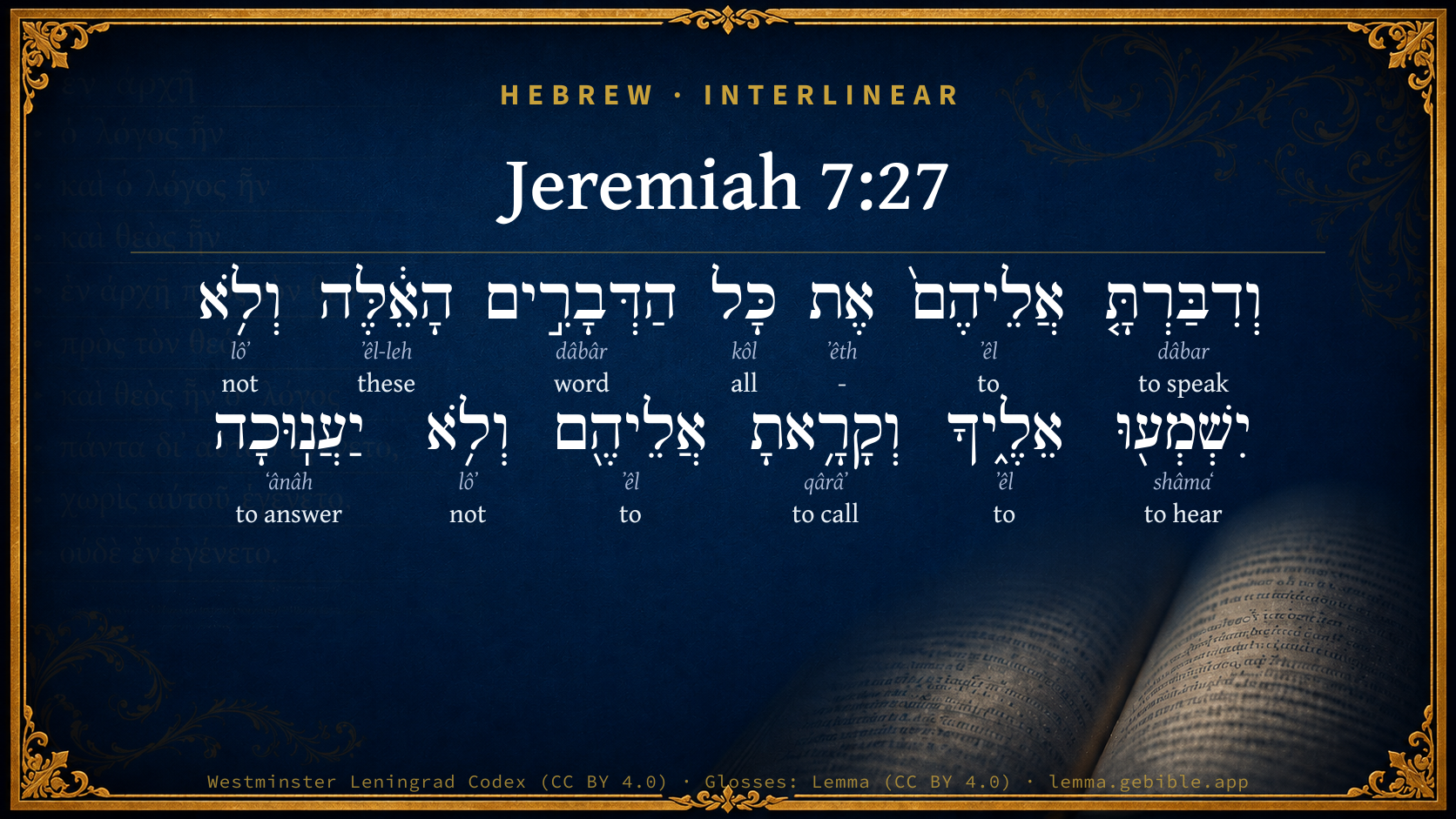
  1. וְדִבַּרְתָּ֤ dâbar H1696 “and · to speak” Conjunction + Verb, Piel, Sequential Perfect, 2nd Person, Masculine, Singular
  2. אֲלֵיהֶם֙ ʼêl H413 “to · them” Preposition + Suffix, Personal, 3rd Person, Masculine, Plural
  3. אֶת ʼêth H853 “-” Particle, Direct Object
  4. כָּל kôl H3605 “all of” Noun, Common, Masculine, Singular, Construct
  5. הַדְּבָרִ֣ים dâbâr H1697 “the · words” Particle, Definite Article + Noun, Common, Masculine, Plural, Absolute
  6. הָאֵ֔לֶּה ʼêl-leh H428 “the · these” Particle, Definite Article + Pronoun, Demonstrative, Common, Plural
  7. וְלֹ֥א lôʼ H3808 “and · not” Conjunction + Particle, Negative
  8. יִשְׁמְע֖וּ shâmaʻ H8085 “to hear” Verb, Qal, Imperfect, 3rd Person, Masculine, Plural
  9. אֵלֶ֑יךָ ʼêl H413 “to · you” Preposition + Suffix, Personal, 2nd Person, Masculine, Singular
  10. וְקָרָ֥אתָ qârâʼ H7121 “and · to call” Conjunction + Verb, Qal, Sequential Perfect, 2nd Person, Masculine, Singular
  11. אֲלֵיהֶ֖ם ʼêl H413 “to · them” Preposition + Suffix, Personal, 3rd Person, Masculine, Plural
  12. וְלֹ֥א lôʼ H3808 “and · not” Conjunction + Particle, Negative

About this verse

These counts appear in no published source. They are computed here, from the morphology-tagged text and Lemma’s own curated glosses. What Lemma adds →

13
words
10
distinct lemmas
Prophets
section

Grammatical profile

  • 4 verbs
  • 2 nouns
  • 1 pronoun
  • 3 prepositions
  • 3 particles

Verb forms

  • וְדִבַּרְתָּ֤ Piel · Sequential Perfect
  • יִשְׁמְע֖וּ Qal · Imperfect
  • וְקָרָ֥אתָ Qal · Sequential Perfect
  • יַעֲנֽוּכָה Qal · Imperfect

Repetition

Words recur within this verse — often emphatic in Hebrew:

  • אֲלֵיהֶם֙ to H413 ×3
  • וְלֹ֥א not H3808 ×2

Cross-references

11

Topical passages linked to Jeremiah 7:27 in the Treasury of Scripture Knowledge — connected by theme and wording, ordered by reader-vote popularity; previews shown in the World English Bible.

  • Isaiah 50:2 Why, when I came, was there no man? when I called, was there none to answer? Is my hand shortened at all, that it can't redeem? or have I no power to deliver? Behold, at my rebuke I dry up the sea, I make the rivers a wilderness: their fish stink, because there is no water, and die for thirst.
  • Isaiah 65:12 I will destine you to the sword, and you shall all bow down to the slaughter; because when I called, you did not answer; when I spoke, you did not hear; but you did that which was evil in my eyes, and chose that in which I didn't delight.
  • Jeremiah 1:7 But Yahweh said to me, Don't say, I am a child; for to whoever I shall send you, you shall go, and whatever I shall command you, you shall speak.
  • Jeremiah 26:2 Thus says Yahweh: Stand in the court of Yahweh's house, and speak to all the cities of Judah, which come to worship in Yahweh's house, all the words that I command you to speak to them; don't diminish a word.
  • Zechariah 7:13 It has come to pass that, as he called, and they refused to listen, so they will call, and I will not listen," said Yahweh of Hosts;
  • Isaiah 6:9–10 He said, "Go, and tell this people, 'You hear indeed, But don't understand; And you see indeed, But don't perceive.'
  • Jeremiah 1:19 They shall fight against you; but they shall not prevail against you: for I am with you, says Yahweh, to deliver you.
  • Ezekiel 2:4–7 The children are impudent and stiff-hearted: I do sent you to them; and you shall tell them, Thus says the Lord Yahweh.
  • Ezekiel 3:4–11 He said to me, Son of man, go, get you to the house of Israel, and speak with my words to them.
  • Ezekiel 3:17–18 Son of man, I have made you a watchman to the house of Israel: therefore hear the word at my mouth, and give them warning from me.
  • Acts 20:27 for I didn't shrink from declaring to you the whole counsel of God.

Cross-references courtesy of OpenBible.info (CC BY 4.0).

Hebrew and Greek witnesses Masoretic Hebrew ↔ Greek Septuagint

The same verse in the two great witnesses to the Old Testament, shown verse-for-verse.

These are two independent witnesses, not word-aligned to each other, and the Septuagint is shown in lemma (dictionary) form.

Hebrew Jeremiah 7:27 Masoretic · Westminster Leningrad Codex

וְדִבַּרְתָּ֤ אֲלֵיהֶם֙ אֶת כָּל הַדְּבָרִ֣ים הָאֵ֔לֶּה וְלֹ֥א יִשְׁמְע֖וּ אֵלֶ֑יךָ וְקָרָ֥אתָ אֲלֵיהֶ֖ם וְלֹ֥א יַעֲנֽוּכָה

You shall speak all these words to them; but they will not listen to you: you shall also call to them; but they will not answer you.

World English Bible · Public Domain

Greek LXX Structure differs

In the Septuagint, Jeremiah is about an eighth shorter than the Hebrew and arranges its material differently — the Oracles Against the Nations (Hebrew chapters 46–51) appear in the middle of the Greek book, after 25:13. Because the chapter and verse boundaries do not line up, a verse-for-verse comparison with the Hebrew is not shown.

A verse-for-verse comparison isn’t shown here because the chapters and verses don’t line up. Switch to the LXX edition with the MT / LXX toggle above to read the Greek directly.

On this verse, The Cambridge Bible for Schools and Colleges discusses the Septuagint’s reading. Read the note in Commentary ↓

Hebrew: Westminster Leningrad Codex (CC BY 4.0). Greek: Septuagint (public domain); English from a public-domain English Septuagint. How the Septuagint differs from the Hebrew →

Targum (Aramaic paraphrase)

1

The Targum is the ancient Jewish Aramaic paraphrase of the Hebrew Scriptures — an interpretive translation, not the Hebrew text itself. Onkelos (literal) and Pseudo-Jonathan (expansive) render the Torah, and Jonathan the Prophets. Coverage is partial: where no permissively-licensed English translation exists for a verse, only the Aramaic is shown. This is verse-level text, not a word-by-word alignment to the Hebrew.

  1. Targum Jonathan Prophets (Joshua–Malachi)
    וּתְמַלֵיל עִמְהוֹן יַת כָּל פִּתְגָמַיָא הָאִלֵין וְלָא יְקַבְּלוּן מִנָךְ וְתִתְנַבֵּי לְהוֹן וְלָא יְתִיבוּנָךְ:

    (no public-domain English translation for this verse)

    Targum Jonathan — Aramaic: “Mikraot Gedolot” (public domain). English: “Sefaria Community Translation” (CC0 1.0 (public-domain dedication)); “London "Chaldee Paraphrase," 1871” (public domain). Text via Sefaria.

Commentary

Notes on Jeremiah 7:27 from classic Christian and Jewish commentators (each source and its license shown beneath its notes). The classic Christian expositions comment on the surrounding passage and are grouped to its opening verse, so a note may address several verses; the Jewish commentaries on the Tanakh (Rashi and others) are per-verse, so they appear only where the commentator wrote on this verse.

Lemma curates 59 commentaries, every one of them public domain or Creative Commons licensed, each selected and text-cleaned for this edition rather than reprinted as found. About our sources →

Trapp's Complete Commentary

John Trapp

Jer 7:27 Therefore thou shalt speak all these words unto them; but they will not hearken to thee: thou shalt also call unto them; but they will not answer thee.

Ver. 27. But they will not hearken unto thee.] Howbeit speak - "whether they will hear, or whether they will forbear" - for a testimony against them.

John Trapp, A Commentary or Exposition upon All the Books of the Old and New Testament (1647–1656) — public domain. Text from a community e-Sword module.

The Biblical Illustrator

Joseph S. Exell

Jer_7:27

They will not hearken to thee.

Gods foreknowledge of the sinners refusal of His Word

I. Instances illustrative of the text.

1. The original transgression of first parents.

2. The old world.

3. Pharaoh.

4. Jews as a nation.

II. How can this be explained and defended?

1. Unless God did know results such as described He would be imperfect.

2. He is not the cause of the rebellion He foretells.

3. He never influences men to do wrong.

4. There are many ends to be attained by God.

By speaking, though He knows men will not hearken.

(1) God exhibits His true desire for their salvation.

(2) He treats men as reasonable and responsible beings.

(3) He leaves them without excuse.

Conclusion--

1. Mans free agency is his glory.

2. Gods infinite goodness is undoubted.

3. Our duty is manifest--to hear, obey, believe.

4. Thus men will be finally inexcusable, having had means employed for their restoration to holiness and God. (J. Burns, D. D.)

Preaching without effect

God has been putting into the mouth of His servant Jeremiah a varied message of reproof and counsel, of promise and blessing. The message contains equal encouragement to those who should repent, and denunciations of wrath on all who, rashly confident in external privileges, should continue to insult by the impiety of their lives. Thus, there is a close resemblance between the sermon which the prophet was instructed to deliver and those which, in our days, the ministers of God must utter. We know it to be our business, in dealing with a mixed assembly of those who make profession of religion and those who make none, to use language very similar to that which Jeremiah here employs; conjuring men that they trust not in lying words which, cannot profit, but that they amend their ways and their doings, lest Gods anger and Gods fury be poured out and burn, and there be none to quench it. Here, then, it is, that our text comes in upon us with all its startling and perplexing assertion; that losing sight of the peculiar circumstances of the Jews, we may regard the ministers of the Gospel as commanded to preach, even if beforehand assured that their preaching would be fruitless. We cannot but think, that, determining by human computation what course would be the most fraught with advantage to their hearers, preachers would reckon it best to keep silence if they were certain none would be converted by their message. It admits not of question, that men, who hear the Gospel, and give no heed to its announcements, are disadvantaged by the very circumstance of having been its auditors. Now there was actually given to Jeremiah that information, which, for the sake of argument, we have supposed imparted to ourselves. Yet he was not on this account to abstain from delivering his message. The certainty of rejection was in no degree to interfere with the duty of proclamation. Now if ineffectiveness of preaching in bringing round conversion, supposing it previously ascertained, would be no sufficient reason for abstaining from preaching, there must be ends answered by the publication of the Gospel over and above that of the gathering in of the elect people of God. The way which shall be made by the preached Word in each separate case is necessarily already known to the Omniscient, so that with God it is previously a thing of as much certainty as it afterwards can be with ourselves, who will receive and who reject the proffered salvation. The foreknowledge has no influence on the reception; it lays no constraint on the will, and it gives no bias to the will. And now, allowing only that Gods foreknowledge, and not Gods predestination, enters as a prerequisite into such a declaration as that made in our text, the question still remains to be examined, why God should enjoin the preaching of the Gospel in cases where He is assured that this preaching will be ineffective? We think that the grand answer to this question is to be found in the demands of that high moral government which God undoubtedly exercises over the creatures of this earth. Let it be remembered, that each amongst us lives under the moral government of God, which takes its character from the interference of Christ; that we are to be tried before the assembled universe as beings to whom was offered deliverance through a Surety; and is it not clear that, if this our last trial be conducted with that rigid justice which must characterise every procedure of God, it shall be made evident to every rank of intelligence that those that perish might have been saved; and forasmuch as they are condemned for having rejected salvation, salvation had been literally placed within their reach! (H. Melvill, B. D.)

.

The Biblical Illustrator, edited by Joseph S. Exell (c. 1880s–1900s) — public domain. Text from a community e-Sword module.

Tyndale Open Study Notes

Tyndale Open Resources

7:27-29 The Lord instructed Jeremiah to continue to proclaim his messages even though the people of Judah had totally rejected the Lord and would not listen (cp. Ezek 2:7). The appropriate action for Jeremiah to take was to shave his head, mourn, and weep alone on the mountains (cp. Job 1:20).

Tyndale Open Study Notes — © Tyndale Open Resources, licensed CC BY-SA 4.0. Text via the HelloAO Bible API.

Geneva Bible (1599)

Geneva Bible translators

Whereby he showeth that the pastors ought not to leave their flocks in their obstinacy, for the Lord will use the means of his servants to make the wicked more faulty and to prove his.

Geneva Bible (1599) marginal notes — public domain. Text via Bolls.life.

Jamieson, Fausset & Brown

Robert Jamieson, A. R. Fausset & David Brown

Therefore--rather, "Though thou speak . . . yet they will not hearken" [MAURER], (Eze 2:7), a trial to the prophet's faith; though he knew his warnings would be unheeded, still he was to give them in obedience to God.

Jamieson, Fausset & Brown — Commentary Critical and Explanatory on the Whole Bible (1871) — public domain (CC PDM 1.0). Text via the HelloAO Bible API.

John Calvin's Commentaries

Here is seen more clearly what I have stated, — that the Jews were not addressed, because they had no ears. Here then God addresses his Prophet and says, “The children will be like their parents: for thou shalt indeed bear the commands which I give thee, but it will be without any advantage; for they will not hear, and when thou callest to them, they will not answer ” It was a most grievous trial to the Prophet to know that his words would pass away with the air and produce no good. What was to be expected but that God’s wrath would thus be still more kindled against the people? The Prophet then must have had his mind greatly depressed; for he doubtless labored for the good of his own nation; and we shall hereafter see how sad he was when he understood that their final ruin was at hand. But, as we have said elsewhere, the prophets were influenced by two feelings: for they did not divest themselves of all human affections, inasmuch as they loved their own nation and felt great sorrow, when God declared that he was coming to execute judgment: but this sympathy and sorrow did not prevent them from executing, in a bold manner, and with unshaken zeal, what God had committed to them. Thus then the prophets had feelings to condole with their own kindred, and at the same time were enabled to surmount whatever might check or hinder them from performing their office. Jeremiah did thus condole with his own nation, when he knew that shortly ruin would overtake them; but yet he felt bound to execute what God had bidden him to do, and to obey his call.

However bitter therefore was the declaration, Thou shalt speak to them, but they will not hear, yet Jeremiah went forth; for he knew that he must obey God’s command, whatever might be the issue. The same resolution ought to be formed at this day by all the faithful ministers of God. They ought to strive as far as they can to promote the salvation of the people; but still when they see that their doctrine succeeds not as they wish, and that it is the savor of death to the whole world, they ought nevertheless to follow their course: why? because they are always a sweet and good savor to God, whatever may be the event. God then declares to his servant what would be the issue, in order that he might not cease to execute his office with invincible courage, even if no fruit appeared. It was also his purpose to shew before the time to the people their perverseness, if there was possibly any hope, or at least, that he might doubly prove them to be unhealable. It was further his design to consult the good of those few who cherished true religion in their hearts, though the multitude were running headlong to their own ruin.

In like manner at this day it is necessary thus to sustain the souls of the faithful; for while the ungodly rave against God, and while almost the whole world is seized with this madness, what would become of the godly, had they not this fact to think of, — that it is nothing new for hypocrites, who boast that they are God’s people and his Church, to reject his grace and to regard as nothing his servants. This truth then is serviceable to us at this day, and may be applied in the same way, so that our minds may not despond nor vacillate, when we see the majority of those, whom God addresses by his servants, heedless and deaf. Thou shalt speak to them, he says, all these words

He says not without a reason, All these words; for if the Prophet had only briefly declared to them what he had heard from God’s mouth, he might have discharged his office with less weariness; but when he had often repeated what had been committed to him, it was not done without great trouble and sorrow; for as we have said at the beginning, he spent his labor on the people, not for one year or for ten years; for he preached to them for twenty, thirty, forty years, and pursued his course even beyond that time. When he saw the truth of God thus rejected by the people, how could he otherwise than feel weariness at times? It is therefore not in vain intimated, as I have said, that he was chosen, that he might try, not only for one day, or for a few months or years, whether he could recover the people to the way of salvation, but that he was to go on through all obstacles, so as not to faint, whatever might take place. They will not hear thee, he says: and further, —

Thou shalt call to them, and they will not answer thee This also, which God foretells him, is emphatical, — that if the Prophet called most loudly, (as Isaiah is bidden to do, (Isaiah 58:1,) and in his person all teachers,) and called even to hoarseness, yet he is told they would not answer. This shews still more fully their perverseness; for they were not only deaf to God’s voice and neglected plain teaching, but also disregarded the most vehement exhortations, he then adds —

John Calvin's Commentaries (1540-1563) — public domain. Text from the Calvin Translation Society English edition (1840s-50s) via the Christian Classics Ethereal Library (ccel.org). Calvin's coverage is partial (roughly two-thirds of the Bible); uncommented books and verses are honest gaps, never fabricated. The 19th-century editor's footnotes and remarks are omitted so the notes are faithfully Calvin's own voice.

Ellicott's Commentary for English Readers

(27) Therefore . . . also.—Better, in both cases, though thou shalt speak, yet they will not hearken; though thou shalt call unto them, yet they will not answer thee.

A Bible Commentary for English Readers, edited by Charles John Ellicott (1878–1897) — public domain. Text from a community e-Sword module.

The Cambridge Bible for Schools and Colleges

gen. ed. J. J. S. Perowne

27, 28. For And thou shalt speak … say unto them, LXX has only And thou shalt say unto them this word, pointing to a probable amplification on the part of MT.

The Cambridge Bible for Schools and Colleges (gen. ed. J. J. S. Perowne; Cambridge University Press, 1878–1918) — public domain. Text from a community e-Sword module.

John Gill's Exposition

Therefore thou shalt speak all these words unto them,.... Before mentioned in the chapter; exhortations to duty, dehortations from sin, promises and threatenings:

but they will not hearken to thee: so as to reform from their evil ways, and do the will of God; they will neither be allured by promises, nor awed by menaces:

thou shalt also call unto them; with a loud voice, showing great vehemency and earnestness, being concerned for their good, and knowing the danger they were in:

but they will not answer thee; this the Lord knew, being God omniscient; and therefore, when it came to pass, it would be a confirmation to the prophet of his mission; and being told of it beforehand, was prepared to meet with and expect such a reception from them; so that he would not be discouraged at it; and at the same time it would confirm the character given of this people before.

John Gill's Exposition of the Whole Bible (1746–1763) — public domain (CC PDM 1.0). Text via the HelloAO Bible API.

Albert Barnes' Notes on the Bible

Rather, Though thou ... yet etc.

Albert Barnes' Notes on the Bible (1834–1885) — public domain. Text from a community e-Sword/MySword module.

Haydock's Catholic Bible Commentary

Thee. Septuagint omit this verse, which Grabe replaces. The people will be more inexcusable. (Haydock)

George Leo Haydock (1774–1849), Haydock's Catholic Family Bible and Commentary, 1859 edition — public domain. Excludes Psalms (Douay-Rheims chapter numbering differs from Protestant) and Deuterocanonical books (Catholic canon only).

Matthew Poole's English Annotations

Therefore thou shalt speak all these words unto them, viz. revive upon them all that thou hast been speaking to them from me these forty years and upwards. Whereby God shows that there is nothing wanting on his part; for notwithstanding all their perverseness, yet he still warns them by his prophet, which will leave them the more inexcusable, Eze 2:5,7.

But they will not hearken to thee: this must needs be a great trial to the prophet, that he is assured that he shall speak to them in vain. But this God acquaints him with beforehand, partly for Jeremiah’s sake, that he should not be discouraged, but the more emboldened, though he saw no success, Eze 2:7; and partly for the people’s sake, that being foretold of their obstinacy, they might bethink themselves and repent, if yet there might be hope, Lam 3:29.

Thou shalt also call unto them, but they will not answer thee: this shows their further refractoriness, that were not only deaf to God’s message by his prophet, but though he cried loud, followed one exhortation with another, yet they would make no return unto it.

Matthew Poole's English Annotations on the Holy Bible (1683–1685) — public domain. Text from a community e-Sword/MySword module.

Whedon's Commentary on the Bible

Daniel D. Whedon

27. Thou shalt speak, etc. — The exact thought is, though thou speakest they will not hearken.

Daniel D. Whedon (gen. ed.), Commentary on the Old and New Testaments (1874–1909) — public domain. Text from a community e-Sword module.

The Pulpit Commentary

Therefore thou shalt speak etc. rather, and though thou speak... yet will they not, etc.; and though thou call unto them, yet will they not answer thee.

The Pulpit Commentary (1880–1919), ed. H.D.M. Spence-Jones & Joseph S. Exell — public domain. Text from a community e-Sword module.

Keil & Delitzsch

C. F. Keil & F. Delitzsch

Just as little will they listen to Jeremiah's words. ודבּרתּ with ו consec. is properly: Speak to them, and they will not hearken to thee, for: Even if thou speakest to them, they will not hearken to thee.

Keil & Delitzsch — Biblical Commentary on the Old Testament (1861–1891) — public domain (CC PDM 1.0). Text via the HelloAO Bible API. (Old Testament only.)

unfoldingWord translationNotes

Door43 World Missions Community

Connecting Statement:

Yahweh continues giving Jeremiah his message to the people of Judah.

General Information:

The words "them" and "they" in these verses refer to the people of Judah.

So proclaim all these words to them, but they will not listen to you. Proclaim these things to them, but they will not answer you.

These two sentences say the same thing, The second emphasizes the message of the first. AT: "Tell them my message, but they will not listen to you or answer you." (See: Parallelism)

the voice of Yahweh its God

Here "the voice of Yahweh" represents what Yahweh has said. See how you translated this in Jeremiah 3:25. AT: "what Yahweh its God has said" (See: Metonymy)

Truth is destroyed and cut off from their mouths

Yahweh speaks of truth as if it was something the people could destroy and stop saying. This can be stated in active form. AT: "The people destroy truth and cut it off from their mouths" or "The people tell only lies" (See: Active or Passive and Idiom)

Truth is destroyed

The abstract noun "truth" can be translated using the adjective "truthful." AT: "What is truthful is destroyed" (See: Abstract Nouns)

translationWords

preach

nation

receive

discipline

true

cut off

unfoldingWord translationNotes — © Distant Shores Media and the Door43 World Missions Community, licensed CC BY-SA 4.0. Source: git.door43.org/Door43/en_tn.

Lesson kit

Teaching starters — assembled from the data on this page, not authored interpretation. Every prompt links to the verse data it draws on. Edit before teaching.

Jeremiah, in the Prophets, opens this verse with 13 words (10 distinct Hebrew lemmas). Its most distinctive word is ʻânâh (“to answer”). A historical commentator’s framing appears above. Read the whole chapter for the surrounding context.

Discussion questions

  1. How does “to answer” (ʻânâh) shape what this verse is saying?
  2. How does Isaiah 50:2, which shares this passage’s theme, read alongside this verse?
  3. What does the repetition of “to” (3× in this one verse) do in this verse?
  4. The translations on this page render this verse differently — a whole-verse word diff, not a word-by-word alignment. What might account for the different wordings?
  5. «וְדִבַּרְתָּ֤» is a Piel Sequential Perfect verb. How does that grammatical form shape the action described?
  6. Compare how Trapp's Complete Commentary and The Biblical Illustrator read this verse. Where do they agree or differ?

Things to notice

Reading settings

Reading text

Shown beneath each verse's original-language words.

Old Testament
Old Testament edition

Read the OT as the Masoretic Hebrew (MT) or the Greek Septuagint (LXX).

English shown for the Greek Septuagint (in the Hebrew ↔ Greek comparison).

Comparing translations? Open the Compare panel on any verse page to stack up to four side by side.