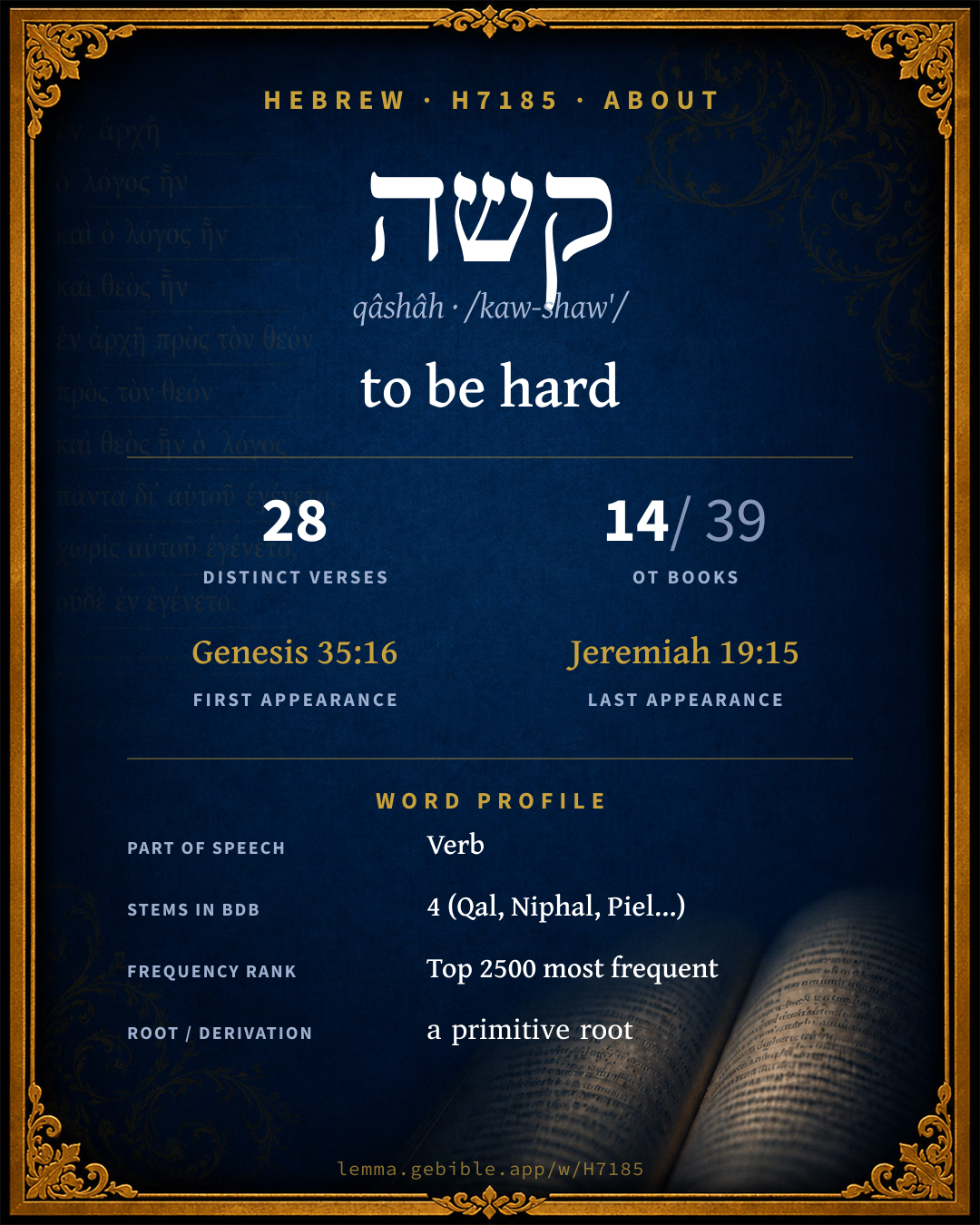
קָשָׁה
to be hard
also: be severe, be fierce, be harsh fuller range ↓
Full lexicon entry — Brown-Driver-Briggs (BDB)
From Brown-Driver-Briggs (BDB)
Where this word appears
See every Hiphil verb in the Hebrew Bible →
Grammar key — what these labels mean
Part of speech
- Verb
- An action or state-of-being word.
Stem
- Hiphil
- The causative active stem (“he caused / brought about”). Here: ‘make difficult’
- Qal
- The basic, simple active stem — the plain form of the verb (“he wrote”). Here: ‘be hard’
- Piel
- An intensive or resultative active stem.
- Niphal
- Usually the simple passive or reflexive of the Qal (“he was written”).
Form
- Sequential Imperfect
- An imperfect with prefixed waw — the standard past-narrative form (waw-consecutive imperfect).
- Perfect
- A completed action or state — Hebrew marks aspect (completeness) more than strict tense (“he wrote”).
- Jussive
- A third- or second-person volitional form expressing wish or command (“let him write”).
- Imperfect
- An incomplete, ongoing, or future action (“he will / would write”).
- Participle Active
- A verbal adjective expressing ongoing or characteristic action (“writing / one who writes”).
- Infinitive Construct
- A bound verbal noun, frequently with prepositions (“to write / in writing”).
State
- Absolute
- The independent form of a noun, not bound to a following word.
Person
- 3rd Person
- The one spoken about (“he / she / it / they”).
- 2nd Person
- The one addressed (“you”).
- 1st Person
- The speaker (“I / we”).
Gender
- Masculine
- Grammatically masculine.
- Common
- Either gender — not distinguished for this form.
- Feminine
- Grammatically feminine.
Number
- Plural
- More than one (in Hebrew, generally three or more).
- Singular
- One.
Grammatical forms 15 distinct
- Verb, Hiphil, Sequential Imperfect, 3rd Person, Masculine, Plural 5 times (18%)
- Verb, Hiphil, Perfect, 3rd Person, Masculine, Singular 5 times (18%)
- Verb, Hiphil, Jussive, 2nd Person, Masculine, Plural 2 times (7%)
- Verb, Hiphil, Perfect, 3rd Person, Common, Plural 2 times (7%)
- Verb, Qal, Imperfect, 3rd Person, Masculine, Singular 2 times (7%)
- Verb, Qal, Perfect, 3rd Person, Feminine, Singular 2 times (7%)
- Verb, Hiphil, Participle Active, Masculine, Singular, Absolute 2 times (7%)
- Verb, Hiphil, Sequential Imperfect, 3rd Person, Masculine, Singular 1 time (4%)
+7 more forms (7 occurrences)
Parsed forms decoded from the imported morphology (morphhb / Westminster Leningrad Codex — WLC text public domain, morphhb tagging CC BY 4.0), counted across 28 parsed occurrences — not distinct verses.
Every verse where H7185 appears — 28 distinct verses across 14 books. Click any verse to open its interlinear word-by-word view. Verse text shown in the World English Bible for context — . Each verse’s Hebrew form is shown with its reference; the English is not keyword-highlighted, since the data carries no word-level English alignment. Use “Compare translations” on any verse to read it across multiple English versions. This concordance covers the Hebrew Bible; Septuagint (Greek Old Testament) occurrences are not indexed here.
Genesis 3 verses
- Genesis 35:16 וַ/תְּקַ֥שׁ conj + Piel wimpf 3fs They traveled from Bethel. There was still some distance to come to Ephrath, and Rachel travailed. She had hard labor.
- Genesis 35:17 בְ/הַקְשֹׁתָ֖/הּ prep + Hiphil inf.cs + sfx pers 3fs It happened that, when she was in hard labor, that the midwife said to her, "Don't be afraid, for now you will have another son."
- Genesis 49:7 קָשָׁ֑תָה Qal pf 3fs Cursed be their anger, for it was fierce; And their wrath, for it was cruel. I will divide them in Jacob, Scatter them in Israel.
Exodus 2 verses
- Exodus 7:3 אַקְשֶׁ֖ה Hiphil impf 1cs I will harden Pharaoh's heart, and multiply my signs and my wonders in the land of Egypt.
- Exodus 13:15 הִקְשָׁ֣ה Hiphil pf 3ms and it happened, when Pharaoh would hardly let us go, that Yahweh killed all the firstborn in the land of Egypt, both the firstborn of man, and the firstborn of animal. Therefore I sacrifice to Yahweh all that opens the womb, being males; but all the firstborn of my sons I redeem.'
Deuteronomy 4 verses
- Deuteronomy 1:17 יִקְשֶׁ֣ה Qal impf 3ms You shall not show partiality in judgment; you shall hear the small and the great alike; you shall not be afraid of the face of man; for the judgment is God's: and the cause that is too hard for you, you shall bring to me, and I will hear it.
- Deuteronomy 2:30 הִקְשָׁה֩ Hiphil pf 3ms But Sihon king of Heshbon would not let us pass by him; for Yahweh your God hardened his spirit, and made his heart obstinate, that he might deliver him into your hand, as at this day.
- Deuteronomy 10:16 תַקְשׁ֖וּ Hiphil impf 2mp Circumcise therefore the foreskin of your heart, and be no more stiff-necked.
- Deuteronomy 15:18 יִקְשֶׁ֣ה Qal impf 3ms It shall not seem hard to you, when you let him go free from you; for to the double of the hire of a hireling has he served you six years: and Yahweh your God will bless you in all that you do.
1 Samuel 1 verse
2 Samuel 1 verse
1 Kings 1 verse
2 Kings 2 verses
- 2 Kings 2:10 הִקְשִׁ֣יתָ Hiphil pf 2ms He said, You have asked a hard thing: [nevertheless], if you see me when I am taken from you, it shall be so to you; but if not, it shall not be so.
- 2 Kings 17:14 וַ/יַּקְשׁ֤וּ conj + Hiphil wimpf 3mp Notwithstanding, they would not hear, but hardened their neck, like the neck of their fathers, who didn't believe in Yahweh their God.
2 Chronicles 3 verses
- 2 Chronicles 10:4 הִקְשָׁ֣ה Hiphil pf 3ms Your father made our yoke grievous: now therefore make you the grievous service of your father, and his heavy yoke which he put on us, lighter, and we will serve you.
- 2 Chronicles 30:8 תַּקְשׁ֥וּ Hiphil juss 2mp Now don't you be stiff-necked, as your fathers were; but yield yourselves to Yahweh, and enter into his sanctuary, which he has sanctified forever, and serve Yahweh your God, that his fierce anger may turn away from you.
- 2 Chronicles 36:13 וַ/יֶּ֤קֶשׁ conj + Hiphil wimpf 3ms He also rebelled against king Nebuchadnezzar, who had made him swear by God: but he stiffened his neck, and hardened his heart against turning to Yahweh, the God of Israel.
Nehemiah 3 verses
- Nehemiah 9:16 וַ/יַּקְשׁוּ֙ conj + Hiphil wimpf 3mp But they and our fathers dealt proudly and hardened their neck, and didn't listen to your commandments,
- Nehemiah 9:17 וַ/יַּקְשׁוּ֙ conj + Hiphil wimpf 3mp and refused to obey, neither were mindful of your wonders that you did among them, but hardened their neck, and in their rebellion appointed a captain to return to their bondage. But you are a God ready to pardon, gracious and merciful, slow to anger, and abundant in loving kindness, and didn't forsake them.
- Nehemiah 9:29 הִקְשׁ֖וּ Hiphil pf 3cp and testified against them, that you might bring them again to your law. Yet they dealt proudly, and didn't listen to your commandments, but sinned against your ordinances, (which if a man do, he shall live in them), and withdrew the shoulder, and hardened their neck, and would not hear.
Job 1 verse
Psalms 1 verse
Proverbs 2 verses
Isaiah 1 verse
Jeremiah 3 verses
- Jeremiah 7:26 וַ/יַּקְשׁוּ֙ conj + Hiphil wimpf 3mp yet they didn't listen to me, nor inclined their ear, but made their neck stiff: they did worse than their fathers.
- Jeremiah 17:23 וַ/יַּקְשׁוּ֙ conj + Hiphil wimpf 3mp But they didn't listen, neither turn their ear, but made their neck stiff, that they might not hear, and might not receive instruction.
- Jeremiah 19:15 הִקְשׁוּ֙ Hiphil pf 3cp Thus says Yahweh of Hosts, the God of Israel, Behold, I will bring on this city and on all its towns all the evil that I have pronounced against it; because they have made their neck stiff, that they may not hear my words.
About this entry
At a glance — auto-summarized from this page’s data, not written by a person. Every figure links to its source below. This summary describes the numbers; it doesn’t interpret them.
קשה (qâshâh) is a Hebrew verb most often rendered “to be hard.” Older and newer Bibles part ways — “hardened” in the King James Version, “they stiffened” (Berean Standard Bible) in modern versions. See the renderings breakdown. It turns up in 28 verses across 14 books, a moderately common footprint. Scripture first uses it in Genesis 35:16. As a verb its force shifts by stem, across 4 stems (Qal, Niphal, and more). The sections below give every sense, occurrence, and version rendering.
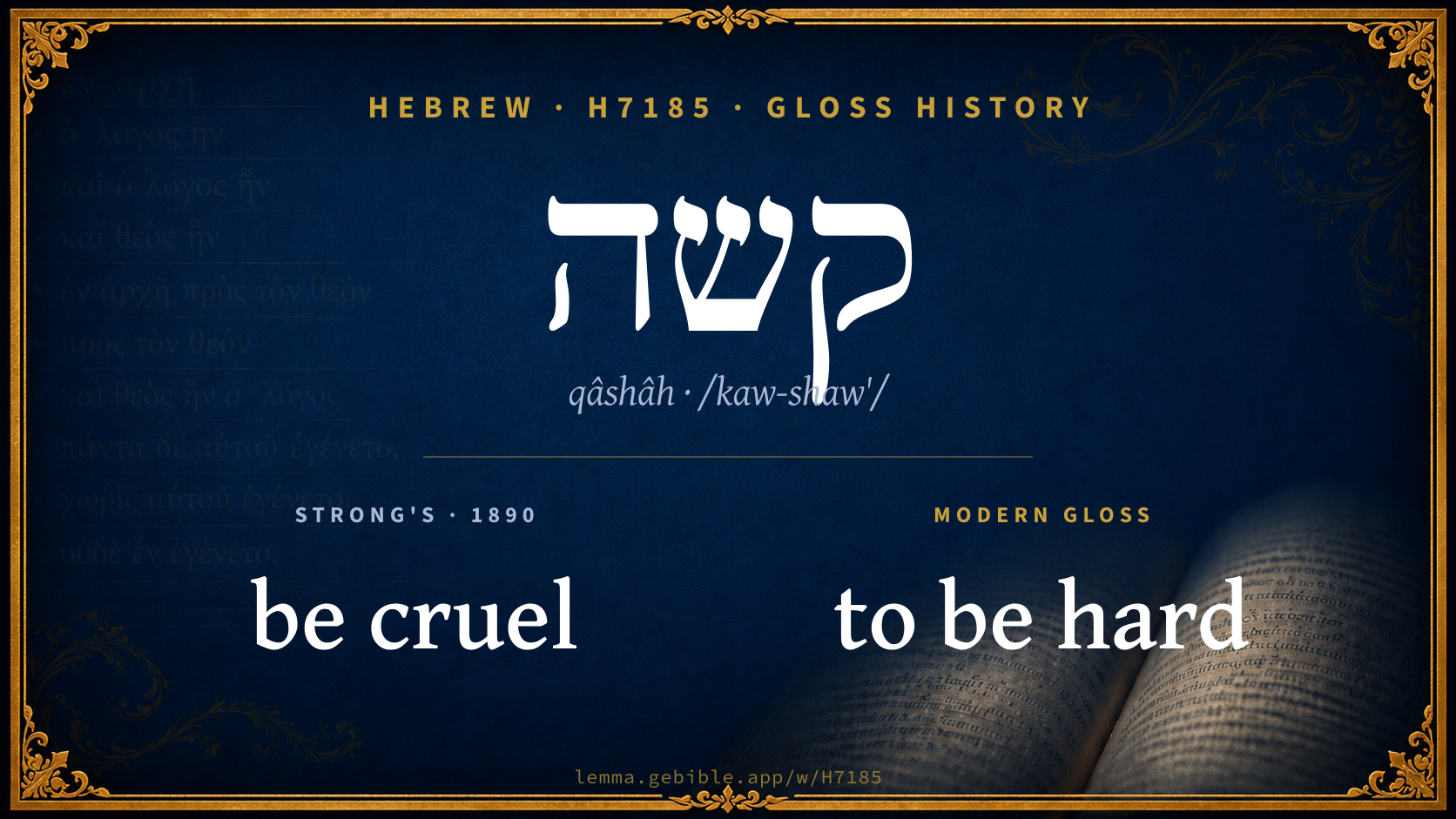
Gloss history
Strong's 1890 vs modern scholarship
About this word
Strong's H7185 catalogs a Hebrew word from the Hebrew Old Testament.
These counts are not copied from any lexicon or concordance. They are computed here, from the morphology-tagged Hebrew Old Testament. What Lemma adds →
- 28
- distinct verses
- The word appears in 28 distinct verses.
- 14 / 39
- OT books
- The word appears in 14 of 39 Old Testament books.
- #1,190
- by frequency
- Top 2500 most frequent Hebrew words (rank 1,190 of 8,640 Hebrew words by occurrence).
View all 28 occurrences in the concordance →
Most concentrated in
- Deuteronomy 4 verses 14%
- Genesis 3 verses 11%
- 2 Chronicles 3 verses 11%
By section of the Old Testament
By traditional corpus
Conventional, traditional groupings — biblical authorship is debated, so this is a traditional corpus grouping, not an authorship claim. Each share is this word’s portion of its verses in that division of the Hebrew canon. Each figure is a share of the word’s 28 distinct verses.
- Writings (Ketuvim) 10 verses · 36%
- Torah (Pentateuch) 9 verses · 32%
- Prophets (Nevi'im) 9 verses · 32%
How translations render this word
Counts come from each version’s own published word-to-Strong’s tagging or interlinear alignment — an approximate guide to how each version renders this word, not a word-level alignment the data otherwise carries. Because each total is that version’s own tagged count, the per-version totals vary from one another and need not match the appearance or distinct-verse counts above. These counts may also differ from a printed concordance because Lemma counts each distinctly tagged rendering and does not collapse phrase taggings into a single head-word total. This is a fixed set of word-tagged versions (KJV, ASV, BSB, ULT) and does not change with the reading translation you choose elsewhere. Each version’s license is shown beside its name below (and on Sources).
- King James Version: Hardened 5×, Grievous 2×
- American Standard Version: Hardened 3×, Grievous 2×, Stiff 2×
- Berean Standard Bible: They stiffened 5×, Put a heavy 2×, Stiffen 2×
- unfoldingWord Literal Text: They stiffened 4×, Do 2×, Harden 2×
King James Version Public Domain
Renders H7185 across 28 tagged occurrences — most commonly:
Plus 21 renderings that appear only once — usually multi-word phrases or single function words the recovered tagging swept in, not distinct renderings. Not rendered by a distinct English word in 1 further occurrence.
American Standard Version Public Domain
Renders H7185 across 28 tagged occurrences — most commonly:
Plus 21 renderings that appear only once — usually multi-word phrases or single function words the recovered tagging swept in, not distinct renderings.
Berean Standard Bible Public Domain
Renders H7185 across 28 tagged occurrences — most commonly:
Plus 19 renderings that appear only once — usually multi-word phrases or single function words the recovered tagging swept in, not distinct renderings.
unfoldingWord Literal Text CC BY-SA 4.0
Renders H7185 across 34 tagged occurrences — most commonly:
Plus 24 renderings that appear only once — usually multi-word phrases or single function words the recovered tagging swept in, not distinct renderings.
10 senses and sub-senses in the full BDB
Hebrew verbs can shift meaning by stem (binyan): Qal is the basic action, Niphal is often passive or reflexive, Piel often intensifies or makes it factitive, and Hiphil is typically causative. The senses below are grouped under the stem BDB assigns to each.
What do BDB’s symbols mean?
BDB uses these scholarly abbreviations:
| Symbol | Meaning |
|---|---|
| 𝔊 | the Septuagint (the ancient Greek translation, LXX) |
| 𝔙 | the Vulgate (the Latin translation) |
| 𝔖 | the Syriac version (the Peshitta) |
| 𝔗 | the Targum (the Aramaic translation) |
| ψ | the Psalms |
| √ | root (the underlying root or stem) |
| ‖ | parallel passage (a synonymous or contrasted parallel) |
| † | the dagger: every passage where the word occurs is cited |
The 10 senses and sub-senses the full Brown-Driver-Briggs lexicon distinguishes for this word, in lexicon order (not ranked by frequency), with BDB’s own verbatim wording and sub-sense lettering. Shown in Hebrew script with BDB’s own scholarly abbreviations. The condensed entry is in the Lexicon Entry tab. See also the Forms in the corpus table below.
Qal
- Pf. 3 fs. קָֽשְׁתָה 1 S 5:7, קָשָׁ֑תָה Gn 49:7; Impf. 3 ms. יִקְשֶׁה Dt 1:17; 15:18, וַיִּ֫קֶשׁ 2 S 19:44;— e.g. 1 Samuel 5:7
- 1. be hard, difficult Dt 1:17 (of a legal case; מִן compar.). e.g. Deuteronomy 1:17
- 2. be hard, severe, ק׳ יָדוֹ עָלֵינוּ 1 S 5:7 (of י׳, in judgment); יִק׳ בְעֵינֶ֑ךָ Dt 15:18 it shall not be hard in thine eyes (seem a severe trial, an injustice); of wrath Gn 49:7 (poem in J; ‖ עָ֑ז); of fierce words 2 S 19:44. e.g. 1 Samuel 5:7
Niphal
- Pt. נִקְשֶׁה Is 8:21 hardly bestead, hard pressed. e.g. Isaiah 8:21
Piel
- Impf. 3 fs. וַתְּקַשׁ בְּלִדְתָּהּ Gn 35:16 (E) she made hard in her bearing (had severe labour). e.g. Genesis 35:16
Hiphil
- Pf. 3 ms. הִקְשָׁה Ex 13:15 +, etc.; Impf. 3 ms. וַיֶּקֶשׁ 2 Ch 36:13; 3 mpl. וַיַּקְשׁוּ Je 7:26 +, etc.; Inf. cstr. sf. בְּהַקְשֹׁתָהּ Gn 35:17; Pt. מַקְשֶׁה Pr 28:14; 29:1;— e.g. Exodus 13:15
- 1. make difficult, difficulty: הִקְשָׁה לְשַׁלְּחֵנוּ Ex 13:15 Pharach made difficulty about sending us away; of travail Gn 35:17 (E; as Pi.); הַקְשִׁיתָ לִשְׁאוֹל 2 K 2:10 thou hast made hard to ask, asked a hard thing. e.g. Exodus 13:15
- 2. make severe, burdensome, yoke imposed by king 1 K 12:4 = 2 Ch 10:4. e.g. 1 Kings 12:4
- 3.
- a. make hard, stiff, stubborn, fig. of obstinacy: וַיַּקְשׁוּ אֶת־עָרְפָּם 2 K 17:14 they stiffened their neck, so Je 7:26; 17:23; 19:15; Dt 10:16; 2 Ch 30:8; 36:13; Ne 9:16, 17, 29 Pr 29:1; אַל־תַּקְשׁוּ לְבַבְכֶם ψ 95:8, cf. Pr 28:14; subj. י׳, אַקְשֶׁה אֶת־לֵב פ׳ Ex 7:3 (P), acc. אֶת־רוּחוֹ Dt 2:30. e.g. 2 Kings 17:14
- b. shew stubbornness Jb 9:4 (c. אֶל pers. [י׳]). e.g. Job 9:4
Senses from the full Brown-Driver-Briggs lexicon (Brown, Driver, Briggs; Oxford 1906 — public domain), digitized via Sefaria, supplemented by the OpenScriptures HebrewLexicon (CC BY 4.0). Full attribution on Sources.
Word origin
vb. be hard, severe, fierce (NH קָשָׁח be severe; Arabic قَسَا (ى) be hard, dry, iii. endure, struggle against, severity; Aramaic קְשָׁא, ܩܫܳܐ be hard, difficult; J.Aram קְשִׁי, קַשְׁיָה adj. hard);—
— Brown-Driver-Briggs (Oxford 1906, public domain), digitized via Sefaria, supplemented by the OpenScriptures HebrewLexicon (CC BY 4.0). See Sources.
Origin: a primitive root
Jastrow Dictionary
A second Hebrew/Aramaic lexicon for comparison, covering Aramaic and post-biblical (Talmudic, Targumic, Midrashic) usage that the biblical-Hebrew BDB does not. Matched by lemma rather than by Strong’s number, so a lemma may carry more than one Jastrow headword (shown separately below), and the entries cover usage well beyond the Bible.
קָשָׁה
- , v. קשי
קְשֵׁה
- , v. קְשֵׁי
קָשֶׁה
- , קָשָׁה f. (b. h.; preced.) stiff, hard, difficult, severe; strong. Tosef. Sabb. IX (X), 2 שני זייפין מן הק׳ וכ׳ (some ed. הקַשׁ) two of the stiffest bristles of the swine; Sabb. 90ᵇ מקָשָׁה של חזיר אחת carrying one of the stiff bristles of the swine is punishable. Taan. 20ᵇ ק׳ כארז, v. קָנֶה. B. Bath. 88ᵇ ק׳ עונשן של וכ׳ the responsibility for fraud in measures is severer than that for incest. Ib. ק׳ גזל הדיוט וכ׳ robbing an individual is worse than robbing the altar. Gen. R. s. 26, end ק׳ היא המחלוקת וכ׳ strife is as bad as (the sins of) the generation of the flood. Gen. R. s. 71 ק׳ היא התפלה וכ׳ prayer is a powerful factor, for it reversed the divine decree. Taan. 8ᵃ שלמודו ק׳ עליו וכ׳ to whom his study is as hard as iron. Ib. 8ᵇ (in Chald. dict.) ק׳ יומא וכ׳, v. קָשֵׁי. Ex. R. s. 6 היה ק׳ בעיניהם וכ׳ it seemed too hard a task for them to give up idolatry; a. v. fr.—Erub. 83ᵇ בק׳ with difficulty, v. נַחַת.—[Num. R. s. 16 end קשה ערפם, v. קְשִׁי.]—Pl. קָשִׁים, קָשִׁין; קָשׁוֹת. Yeb. 47ᵇ, a. e. ק׳ גרים וכ׳, v. סַפַּחַת. Sot. 2ᵃ ק׳ לזווגן (Snh. 22ᵃ קשה), v. זָוַג. Pes. 118ᵃ ק׳ … כקריעת וכ׳ the providential support of man is as difficult (wonderful) as the splitting of the Red Sea. Ib. ק׳ … כפלים וכ׳ man’s support is twice as hard (painful) as travailing. Ber. 57ᵇ (etymolog. play on קישואים) מפני שהם ק׳ לגוף וכ׳ because they are as hard on the body as swords. Koh. R. to XII, 7 נבואות ק׳ hard (evil) prophecies; a. v. fr.
קשי
- (b. h.) to be stiff, hard, difficult. Y. Ber. I, 2ᶜ top קָשְׁתָה על דעתך this is difficult according to (not reconcilable with) thy opinion; ib. למה א"ל קשתה (not קשתיה) why did he say to him, it is difficult?—V. קָשֶׁה.
- (קִישְּׁתָה, with לילד or without) to have hard labor in travailing. Ḥull. IV, 1 בהמה המְקַשָּׁה לילד וכ׳ if an animal is in labor, and &c., v. עוּבָּר. Nidd. IV, 4 קִשְּׁתָה שלשה וכ׳ if she was in pain for three days within eleven days; Tosef. ib. V, 8 קִישֵּׁת, קִשֵּׁת. Ib. 10; a. fr.—[Gen. R. s. 61 שהיו מקשין וכ׳, read: מקישין, v. נָקַשׁ.]
- 1. to stiffen, harden. Nidd. 13ᵇ המַקְשֶׁה עצמו וכ׳ he who causes erection wilfully. Ex. R. s. 11 הרשע הזה ה׳ את לבו וכ׳ this wicked (Pharaoh) hardened his heart against the first three signs; a. e.
- 2. to become hard. Y. Pes. VI, 35ᵇ top שסופו להַקְשׁוֹת which gets hard in the course of time. Shebi. II, 10 אם הִקְשׁוּ וכ׳ (Y. ed. a. Bart. הוּקְשׁוּ Hof.) if they became hard (dry) and unfit for man to eat before New Year. (Y. ib. 34ᵃ bot. הקשו a. הוקשו).
- 3. to be severe. Gen. R. s. 19, opp. ריתה, v. רָתָה.
- 1. to become hard, v. supra.
- 2. to be found hard, distasteful. Tanḥ. Sh’laḥ 5; Num. R. s. 16 ה׳ הדבר והרע וכ׳ the thing was distasteful to and displeased his father.
- 1. to suffer severely (in travailing). Gen. R. s. 84 נִתְקַשֵּׁת אמו וכ׳ his mother was in hard labor at his birth.
- 2. to become hard, stiff. Tosef. Nidd. VI, 4 משׁיִתְקַשּׁוּ, v. קִשְׁקֵשׁ I, a. II. Gen. R. s. 98, a. שׁנִתְקַשֵּׁיתָה, v. קַשְׁיוּת.
- 3. to find one’s self in difficulty, to be perplexed, unable to understand or remember. Num. R. s. 15 beg. נ׳ משה במעשה וכ׳ Moses found the work of the candlestick more difficult to understand than &c.; כיון שנ׳ אמר וכ׳ when he still could not remember it, the Lord said &c. Ib.10; Tanḥ. B’haʿăl. 6 נִתְקַשֵּׁיתִי לעשותה I could not understand how to do it. Ib. נ׳ על משה it was too difficult for Moses; a. fr.
- 4. to be reluctant, strive against. Tanḥ. Sh’moth 18 כמה נ׳ יונה שלא וכ׳ how hard did Jonah strive not to go on his mission. Deut. R. s. 9 מִתְקַשֶּׁה כנגדו (the sun) refused to obey; a. e.
- 5. to make one’s self obnoxious. Gen. R. s. 61; Yalk. Chr. 1073 (play on יקשן, Gen. XXV, 2) שהיו מִתְקַשִּׁין בעולם they were obnoxious to the world (were hard to deal with); (Midr. Till. to Ps. XCII ed. Bub. שהיו בני אדם קשין). e.g. Genesis 25:2
A Dictionary of the Targumim, the Talmud Babli and Yerushalmi, and the Midrashic Literature (Marcus Jastrow; London, Luzac, 1903) — Public Domain. Digitized via Sefaria. Digitized via Sefaria. Full attribution on Sources.
Forms in the corpus
The 22 distinct written forms H7185 takes in the Hebrew Bible, most frequent first — each parse links to that stem’s occurrences in the concordance. Hebrew forms include their vowel points and cantillation, so a single lemma takes many written forms.
Same root — word family
Other BDB entries built from the same root as H7185, grouped by Strong’s listed origin. These share a root / origin per the lexicon — not necessarily a shared meaning. Each links to that word’s own entry.
Derived from this word
- מקשה miqsheh H4748 turned work
- קשה qâsheh H7186 hard
- קשי qᵉshîy H7190 stubbornness
- קשת qesheth H7198 bow
Compare all same-root words → Showing 4 of 5 — not the complete family. They share a root, not necessarily a meaning.
Septuagint verse parallels
This word appears in 25 verses that also exist in the Greek Old Testament (Septuagint), out of the 28 Hebrew verses it occurs in. You can read those verses in Greek by switching the Old Testament edition to the Septuagint.
Read these verses in the Septuagint
- Genesis 35:16
- Exodus 7:3
- Deuteronomy 1:17
- 1 Samuel 5:7
- 2 Samuel 19:43
- 1 Kings 12:4
- 2 Kings 2:10
- 2 Chronicles 10:4
- Job 9:4
- Psalms 95:8
- Proverbs 28:14
- Isaiah 8:21
This is a verse-level parallel only — the same verses exist in both the Hebrew and Greek Old Testaments. No word-level Hebrew↔Greek correspondence is claimed: the data carries no such alignment, so no Greek word is shown as this Hebrew word’s translation. Coverage is not total — the Septuagint omits the deuterocanon and renumbers the Psalms, so some Hebrew verses have no direct Greek parallel.