Psalms 69:2

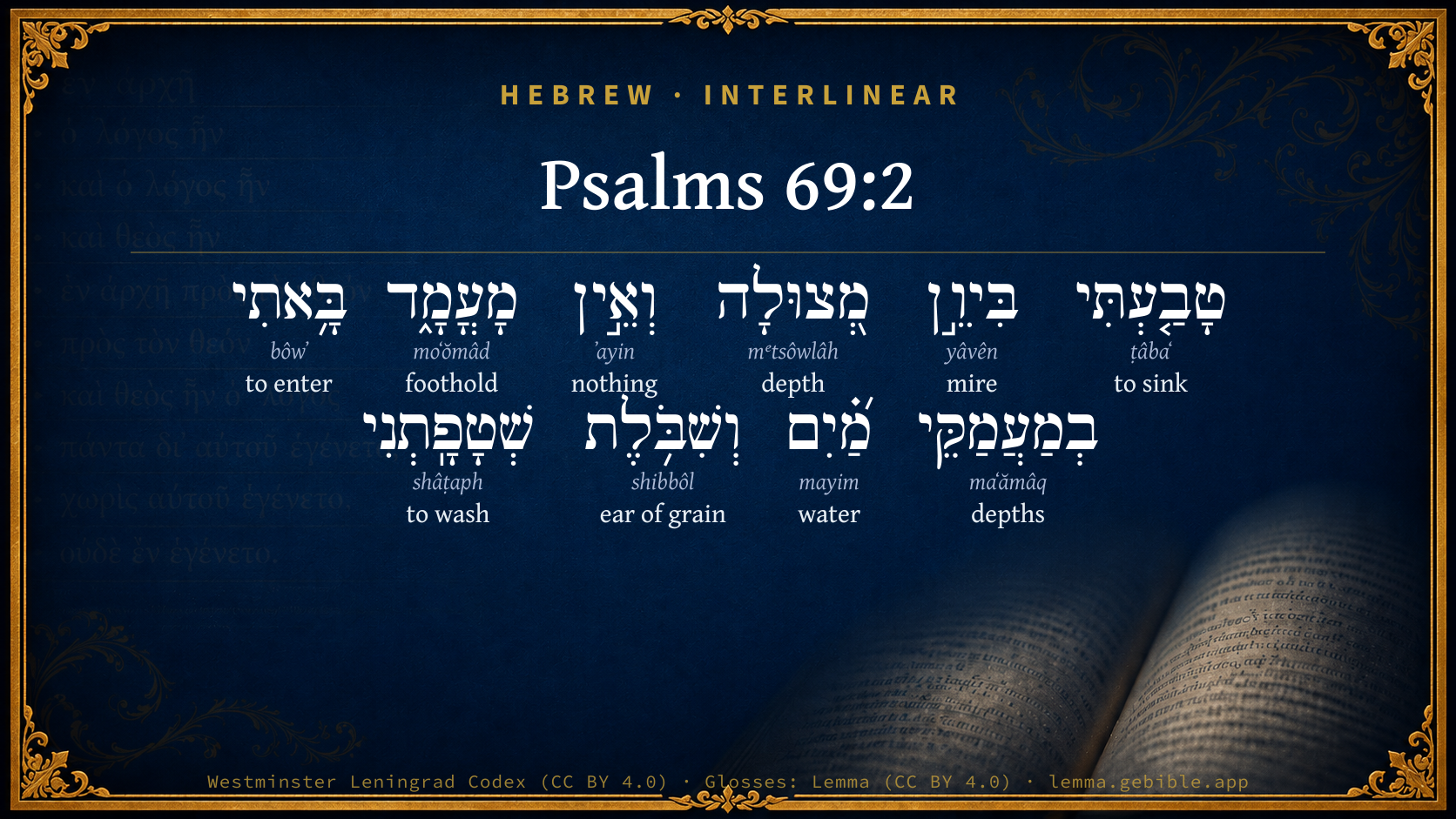
Hebrew (Westminster Leningrad Codex) Psalms 69:2 appears in the Hebrew Old Testament. The text above is from the Westminster Leningrad Codex. Each word links to its Strong’s number, a concise gloss, and parsing drawn from the Open Scriptures Hebrew Bible morphology. Click any word for its full Brown-Driver-Briggs (BDB) entry.
Download image
Cite this verse

Psalms 69:2 (World English Bible). Public Domain. Lemma interlinear Bible study tool, https://lemma.gebible.app/v/psalms/69/2.

Show BibTeX & RIS
BibTeX
RIS
English Translation
I sink in deep mire, where there is no foothold. I have come into deep waters, where the floods overflow me.
World English Bible · Public Domain
Highlights
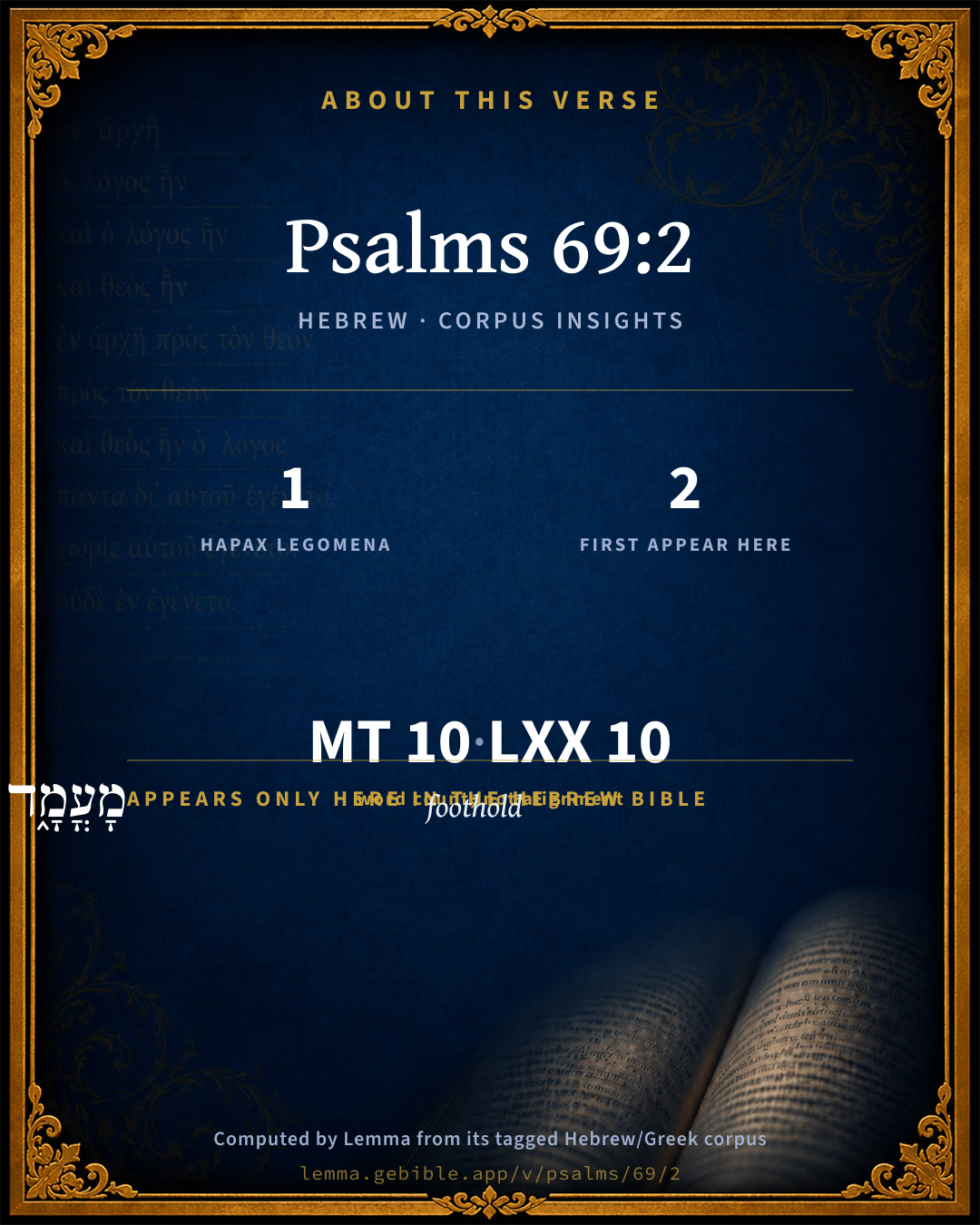
  • 1 hapax legomenon — only here in the Hebrew Bible
  • 2 first appearances in the Hebrew Bible
Full analysis ↓
Download a study sheet

One document with this verse’s original text, its word-by-word gloss line, the meaning frame, cross-references with their text, attributed commentary, and full source and license credits — printable, and it pastes into notes with its structure intact.

This verse Autodidact and up

Study sheet (.html) Plain text (.txt)

A passage Seminary Student

Up to 50 verses in one chapter. A passage sheet keeps up to 6 commentary sources and 12 cross-references per verse, in the order this page ranks them, and says so on the sheet whenever that leaves anything out. Ask for a single verse and you get the Autodidact verse sheet above.

Everything on this page stays free to read, with no account — the sheet is a download of what is already on screen, not access to it.

Want to remove ads? Support Godless Engineer
Compare translations 3

The same verse in 3 English versions, stacked beneath the original-language interlinear above. Click any original word for its lexicon entry.

Each is an independent rendering of the whole verse — the interlinear is not word-aligned to these translations.

Highlighted words mark where these versions differ — a whole-verse word diff, not a word-by-word alignment.

  • World English Bible Public Domain
    I sink in deep mire, where there is no foothold. I have come into deep waters, where the floods overflow me.
  • King James Version Public Domain
    I sink in deep mire, where there is no standing: I am come into deep waters, where the floods overflow me.
  • unfoldingWord Literal Text CC BY-SA 4.0
    I have sunk in mire of depth, and there is no standing. I have come into depths of waters, and a flood overflows me.

unfoldingWord Literal Text — © unfoldingWord, licensed CC BY-SA 4.0. Word-aligned USFM3 via Door43 (git.door43.org/unfoldingWord/en_ult).

Versions to compare (up to 4)

3 of 4 selected

Show all 18 translations

Every available English version of this verse, each an independent rendering of the whole verse.

  • World English Bible Public Domain
    I sink in deep mire, where there is no foothold. I have come into deep waters, where the floods overflow me.
  • Berean Standard Bible Public Domain
    I have sunk into the miry depths, where there is no footing; I have drifted into deep waters, where the flood engulfs me.
  • Majority Standard Bible Public Domain
    I have sunk into the miry depths, where there is no footing; I have drifted into deep waters, where the flood engulfs me.
  • King James Version Public Domain
    I sink in deep mire, where there is no standing: I am come into deep waters, where the floods overflow me.
  • American Standard Version (1901) Public Domain
    I sink in deep mire, where there is no standing: I am come into deep waters, where the floods overflow me.
  • Revised Version (1885) Public Domain
    I sink in deep mire, where there is no standing: I am come into deep waters, where the floods overflow me.
  • Geneva Bible (1599) Public Domain
    I sticke fast in the deepe myre, where no staie is: I am come into deepe waters, and the streames runne ouer me.
  • Douay-Rheims (1899) Public Domain
    SAVE me, O God: for the waters are come in even unto my soul.
  • Young's Literal Translation Public Domain
    I have sunk in deep mire, And there is no standing, I have come into the depths of the waters, And a flood hath overflown me.
  • Literal Standard Version CC BY-SA 4.0
    I have sunk in deep mire, || And there is no standing, || I have come into the depths of the waters, || And a flood has overflown me.
  • Unlocked Literal Bible CC BY-SA 4.0
    I sink in deep mire, where there is no place to stand; I have come into deep waters, where the floods flow over me.
  • unfoldingWord Literal Text CC BY-SA 4.0
    I have sunk in mire of depth, and there is no standing. I have come into depths of waters, and a flood overflows me.
  • Darby Bible Public Domain
    I sink in deep mire, where there is no standing; I am come into the depths of waters, and the flood overfloweth me.
  • World Messianic Bible Public Domain
    I sink in deep mire, where there is no foothold. I have come into deep waters, where the floods overflow me.
  • Webster's Bible Public Domain
    \\69:1\\To the chief Musician upon Shoshannim, A Psalm of David. Save me, O God; for the waters are come in to my soul.
  • Free Bible Version CC BY-SA 4.0
    I'm sinking deeper into the mud—there's no solid ground for me to stand. I find myself in deep water; floods wash over me.
  • Bible in Basic English Public Domain
    My feet are deep in the soft earth, where there is no support; I have come into deep waters, the waves are flowing over me.
  • JPS Tanakh (1917) Public Domain
    (69-3) I am sunk in deep mire, where there is no standing; I am come into deep waters, and the flood overwhelmeth me.

Literal Standard Version (2020), Covenant Press — licensed CC BY-SA 4.0. Text via the HelloAO Bible API (eBible.org). Unlocked Literal Bible (unfoldingWord) — licensed CC BY-SA 4.0. Text via the HelloAO Bible API (eBible.org). unfoldingWord Literal Text — © unfoldingWord, licensed CC BY-SA 4.0. Word-aligned USFM3 via Door43 (git.door43.org/unfoldingWord/en_ult). Free Bible Version, Dr. Jonathan Gallagher — licensed CC BY-SA 4.0. Text via the HelloAO Bible API (eBible.org).

Word by word

More ways to search: Search by grammar → Find every occurrence → Compare this word →

Practice this passage: Drill this verse → Learn its vocabulary →

מָעֳמָ֑ד
moʻŏmâd
H4613
“foothold”
Noun, Common, Masculine, Singular, Absolute
Part of Speech
Noun
Type
Common
Gender
Masculine
Number
Singular
State
Absolute
Full BDB Definition

Origin: from H5975

TWOT: 1637e

foothold, standing ground
  1. טָבַ֤עְתִּי ṭâbaʻ H2883 “to sink” Verb, Qal, Perfect, 1st Person, Common, Singular
  2. בִּיוֵ֣ן yâvên H3121 “in/at · mire of” Preposition + Noun, Common, Masculine, Singular, Construct
  3. מְ֭צוּלָה mᵉtsôwlâh H4688 “depth” Noun, Common, Feminine, Singular, Absolute
  4. וְאֵ֣ין ʼayin H369 “and · nothing” Conjunction + Particle, Negative
  5. בָּ֥אתִי bôwʼ H935 “to enter” Verb, Qal, Perfect, 1st Person, Common, Singular
  6. בְמַעֲמַקֵּי maʻămâq H4615 “in/at · depths of” Preposition + Noun, Common, Masculine, Plural, Construct
  7. מַ֝֗יִם mayim H4325 “water(s)” Noun, Common, Masculine, Plural, Absolute
  8. וְשִׁבֹּ֥לֶת shibbôl H7641 “and · ear of grain” Conjunction + Noun, Common, Feminine, Singular, Absolute
  9. שְׁטָפָֽתְנִי shâṭaph H7857 “to wash · me” Verb, Qal, Perfect, 3rd Person, Feminine, Singular + Suffix, Personal, 1st Person, Common, Singular

About this verse

These counts appear in no published source. They are computed here, from the morphology-tagged text and Lemma’s own curated glosses. What Lemma adds →

10
words
10
distinct lemmas
Wisdom
section

Notable vocabulary

1 hapax legomenon — a word that appears only here in the entire Hebrew Bible:

  • מָעֳמָ֑ד foothold H4613

First appearance in Scripture

These words make their first canonical appearance in the Hebrew Bible here:

  • מָעֳמָ֑ד foothold H4613
  • בְמַעֲמַקֵּי depths H4615

Shared distinctive vocabulary

בִּיוֵ֣ן mire H3121 occurs in 2 verses of the Hebrew Bible. Also found in:

Grammatical profile

  • 3 verbs
  • 6 nouns
  • 1 particle

Verb forms

  • טָבַ֤עְתִּי Qal · Perfect
  • בָּ֥אתִי Qal · Perfect
  • שְׁטָפָֽתְנִי Qal · Perfect

Hebrew & Septuagint length

In English translation the verse runs 21 words from the Hebrew and 28 from the Septuagint (LXX English) — closely comparable.

A rough comparison of the two English renderings, which tokenize alike — not a word-level alignment.

Word counts can differ between the Hebrew and the Greek without any difference in meaning — e.g. the Hebrew direct-object marker אֵת has no separate Greek word, and Greek often adds the article ὁ.

In the original languages it is 10 Hebrew tokens and 10 Greek tokens — but the two are counted differently (Hebrew bundles its prefixes and suffixes into one token; the Greek is in lemma form), so that isn’t a like-for-like length.

Cross-references

8

Topical passages linked to Psalms 69:2 in the Treasury of Scripture Knowledge — connected by theme and wording, ordered by reader-vote popularity; previews shown in the World English Bible.

  • Psalms 40:2 He brought me up also out of a horrible pit, Out of the miry clay. He set my feet on a rock, And gave me a firm place to stand.
  • Matthew 7:25 The rain came down, the floods came, and the winds blew, and beat on that house; and it didn't fall, for it was founded on the rock.
  • Psalms 32:6 For this, let everyone who is godly pray to you in a time when you may be found. Surely when the great waters overflow, they shall not reach to him.
  • Psalms 88:6–7 You have laid me in the lowest pit, In the darkest depths.
  • Jeremiah 38:6 Then took they Jeremiah, and cast him into the dungeon of Malchijah the king's son, that was in the court of the guard: and they let down Jeremiah with cords. In the dungeon there was no water, but mire; and Jeremiah sank in the mire.
  • Jeremiah 38:22 behold, all the women who are left in the king of Judah's house shall be brought forth to the king of Babylon's princes, and those women shall say, Your familiar friends have set you on, and have prevailed over you: [now that] your feet are sunk in the mire, they are turned away back.
  • Genesis 7:17–23 The flood was forty days on the earth. The waters increased, and lifted up the ark, and it was lifted up above the earth.
  • Matthew 26:37–38 He took with him Peter and the two sons of Zebedee, and began to be sorrowful and severely troubled.

Cross-references courtesy of OpenBible.info (CC BY 4.0).

Hebrew and Greek witnesses Masoretic Hebrew ↔ Greek Septuagint

The same verse in the two great witnesses to the Old Testament, shown verse-for-verse.

You’re reading Greek Psalm 68 (Hebrew Psalm 69). The Septuagint counts the superscription, so verse numbers can differ from the Hebrew — chapter-level alignment, not verse-by-verse. Numbering follows Rahlfs.

These are two independent witnesses, not word-aligned to each other, and the Septuagint is shown in lemma (dictionary) form.

Hebrew Psalms 69:2 Masoretic · Westminster Leningrad Codex

טָבַ֤עְתִּי בִּיוֵ֣ן מְ֭צוּלָה וְאֵ֣ין מָעֳמָ֑ד בָּ֥אתִי בְמַעֲמַקֵּי מַ֝֗יִם וְשִׁבֹּ֥לֶת שְׁטָפָֽתְנִי

I sink in deep mire, where there is no foothold. I have come into deep waters, where the floods overflow me.

World English Bible · Public Domain

Greek LXX Greek Psalm 68:2 Septuagint · lemma form

σώζω ἐγώ ὁ θεός ὅτι εἰςἔρχομαι ὕδωρ ἕως ψυχή ἐγώ

I am stuck fast in deep mire, and there is no standing: I am come in to the depths of the sea, and a storm has overwhelmed me.

LXX2012 (modern English Septuagint) · Public Domain

Hebrew: Westminster Leningrad Codex (CC BY 4.0). Greek: Septuagint (public domain); English from LXX2012 (modern English Septuagint) (Public Domain). How the Septuagint differs from the Hebrew →

Commentary

Notes on Psalms 69:2 from classic Christian and Jewish commentators (each source and its license shown beneath its notes). The classic Christian expositions comment on the surrounding passage and are grouped to its opening verse, so a note may address several verses; the Jewish commentaries on the Tanakh (Rashi and others) are per-verse, so they appear only where the commentator wrote on this verse.

Lemma curates 59 commentaries, every one of them public domain or Creative Commons licensed, each selected and text-cleaned for this edition rather than reprinted as found. About our sources →

Trapp's Complete Commentary

John Trapp

Psa 69:2 I sink in deep mire, where [there is] no standing: I am come into deep waters, where the floods overflow me.

Ver. 2. I sink in deep mire] Heb. in the mire of depth, or gulf, as Babylon was afterwards called, Isa 44:27. Here he stuck, and under water, and so must perish, if he had not present help.

John Trapp, A Commentary or Exposition upon All the Books of the Old and New Testament (1647–1656) — public domain. Text from a community e-Sword module.

J. A. Alexander on Psalms

Joseph Addison Alexander

3. (Psa 69:2). I have sunk in the mire of the.depth (or deep place) (where) there is no standing; I have come into depths of water, and the flood has overwhelmed me. The image is that of one sunk in the bottom, of a sea or river. Mire of depth is not merely deep mire, but the mire found in a deep place.

Joseph Addison Alexander, The Psalms Translated and Explained (1850) — public domain. Text from a community e-Sword module.

Geneva Bible (1599)

Geneva Bible translators

No firmity of stableness to settle my feet.

Geneva Bible (1599) marginal notes — public domain. Text via Bolls.life.

John Calvin's Commentaries

2. I am sunk in deep mire, where there is no standing place Here he compares his afflictions to a deep sink of mire, where there is still greater danger; for if a man fixes his feet upon a solid bottom, he may raise himself up, there having been many instances in which persons, placing their feet on the bottom, have by a sudden spring emerged and escaped the peril of the waters; but when a man finds himself once sunk in some slough or muddy river, it is all over with him, he has no means of saving himself. The Psalmist adduces additional circumstances in illustration of his afflicted condition. He declares that he was inundated by the flowing of the waters; an expression indicating the disorder and confusion which his distresses and persecutions produced.

John Calvin's Commentaries (1540-1563) — public domain. Text from the Calvin Translation Society English edition (1840s-50s) via the Christian Classics Ethereal Library (ccel.org). Calvin's coverage is partial (roughly two-thirds of the Bible); uncommented books and verses are honest gaps, never fabricated. The 19th-century editor's footnotes and remarks are omitted so the notes are faithfully Calvin's own voice.

The Cambridge Bible for Schools and Colleges

gen. ed. J. J. S. Perowne

2. He is like a man floundering in a morass or quicksand where there is no footing and his struggles only plunge him deeper, or fording a river and in imminent danger of being swept away by the current. Quagmires, ‘treacherous to the last degree,’ are common in Palestine. See Thomson’s Land and the Book, p. 360; and Dr Tristram’s description of the vast and impenetrable swamp of Huleh, where a false step off the roots of the papyrus “will take the intruder over head in suffocating peat mud.” Land of Israel, p. 579.

the floods overflow me] Or, the current—‘Shibbôleth,’ Jdg_12:6—sweeps me away.

The Cambridge Bible for Schools and Colleges (gen. ed. J. J. S. Perowne; Cambridge University Press, 1878–1918) — public domain. Text from a community e-Sword module.

John Gill's Exposition

I sink in deep mire, where there is no standing,.... Which signifies not despair of mind, but difficult and distressed circumstances; the Messiah now bearing the filthy sins of his people, and the punishment of them, and so was got into the horrible pit, the mire and clay; See Gill on Psa 40:2;

I am come into deep waters, where the floods overflow me: as afflictions are often compared to waters in Scripture, Christ's sorrows and sufferings are very aptly signified by deep waters and overflowing floods; and therefore rightly called a baptism, as by himself, Luk 12:50, when he was as one immersed in and overwhelmed with water.

John Gill's Exposition of the Whole Bible (1746–1763) — public domain (CC PDM 1.0). Text via the HelloAO Bible API.

Albert Barnes' Notes on the Bible

I sink in deep mire - Margin, as in Hebrew, “the mire of the depth.” This would denote either mire which was itself so deep that one could not extricate himself from it; or, mire found in a deep place, as at the bottom of a pit. Compare the notes at Psa 40:2. An illustration of this might be drawn from the case of Joseph, cast by his brethren into a deep pit Gen 37:24; or from the case of Jeremiah, thrown into a deep dungeon: “And they let down Jeremiah with cords; and in the dungeon there was no water, but mire: so Jeremiah sunk in the mire,” Jer 38:6.

Where there is no standing - No solid ground; nothing for the foot to rest on. “I am come into deep waters.” Margin, as in Hebrew, “depth of waters.” That is, waters where he could not touch the bottom - an image of some peril that threatened his life.

Where the floods overflow me - The waters. They break over my head. My life is “in danger.”

Albert Barnes' Notes on the Bible (1834–1885) — public domain. Text from a community e-Sword/MySword module.

Matthew Poole's English Annotations

In deep mire, Heb. in the mire of the deep waters. I am not in the shallows, or nigh the bank, but in the middle and deepest parts, and in the very mire, which is at the bottom of the waters.

No standing; no firm and sure footing, but I sink in deeper and deeper, and, without thy speedy and almighty help, shall be overwhelmed and destroyed.

Matthew Poole's English Annotations on the Holy Bible (1683–1685) — public domain. Text from a community e-Sword/MySword module.

The Treasury of David

Charles H. Spurgeon

Ver. 2. I sink in deep mire. In water one might swim, but in mud and mire all struggling is hopeless; the mire sucks down its victim.

Where there is no standing. Everything gave way under the Sufferer; he could not get foothold for support--this is a worse fate than drowning. Here our Lord pictures the close, clinging nature of his heart's woes. "He began to be sorrowful, and very heavy." Sin is as mire for its filthiness, and the holy soul of the Saviour must have loathed even that connection with it which was necessary for its expiation. His pure and sensitive nature seemed to sink in it, for it was not his element, he was not like us born and acclimatised to this great dismal swamp. Here our Redeemer became another Jeremiah, of whom it is recorded (Jer 38:6) that his enemies cast him into a dungeon wherein "was no water, but mire: so Jeremiah sunk in the mire." Let our hearts feel the emotions, both of contrition and gratitude, as we see in this simile the deep humiliation of our Lord.

I am come into deep waters, where the floods overflow me. The sorrow gathers even greater force; he is as one cast into the sea, the waters go over his head. His sorrows were first within, then around, and now above him. Our Lord was no fainthearted sentimentalist; his were real woes, and though he bore them heroically, yet were they terrible even to him. His sufferings were unlike all others in degree, the waters were such as soaked into the soul; the mire was the mire of the abyss itself, and the floods were deep and overflowing. To us the promise is, "the rivers shall not overflow thee, "but no such word of consolation was vouchsafed to him. My soul, thy Well beloved endured all this for thee. Many waters could not quench his love, neither could the floods drown it; and, because of this, thou hast the rich benefit of that covenant assurance, "as I have sworn that the waters of Noah should no more go over the earth; so have I sworn that I would not be wroth with thee, nor rebuke thee." He stemmed the torrent of almighty wrath, that we might for ever rest in Jehovah's love.

Ver. 2. I sink in deep mire. I was taking a quiet walk along the banks (of the Nile), when I came to a part so soft and miry that I was brought to a stand, as my foot sank at every step... Being brought to a stand, I hailed the reis to heave to, and take me on board. One of the men was, therefore sent in the small boat; but the river, near the western side, was so shallow that he could not get the boat within some distance of the bank. He, consequently, as is usual in such cases, jumped overboard that he might carry me to the boat on his back. No sooner, however, had he sprung from the boat than I heard him scream. I turned to see what was the matter, when I found him struggling in the mud. He was sinking as though in quicksand; and the more he struggled, the faster and deeper he sank. His fellow boatmen were not slack. They quickly saw the dilemma he was in, and two of them dashed into the water and swam to the small boat. I was almost choked with terror, and I breathed, or rather gasped, with difficulty. "Can they reach the poor fellow?" I said to myself; "if not, he must inevitably be swallowed up alive!" Now they reach the boat! Now they near him! And now, praise the Lord, he grasps firmly hold. O that death like grasp of the side of the boat! But this was not until he had sunk up to his bosom! Seeing him safe, I breathed more freely; and I feel that now, though only relating the circumstance, the excitement has caused an increased and painful action of the heart. How I thought of poor David! Had he really witnessed a similar scene to this literally when, speaking of the feelings of his soul, spiritually, he said: I sink in deep mire, where there is no standing: I am come into deep waters, where the floods overflow me? O what an agonizing state to be in! and yet many of my readers, I have no doubt, who never witnessed such a scene literally, know something about it spiritually, as David did, whether he had seen it with his bodily eye or not. Well might he, in the struggling of his soul, exclaim: "Deliver me out of the mire, and let me not sink!" Let me grasp firmly hold of the ark, and be pulled safely on board! Well! just at the right time, just before the poor fellow's arms (shall I say his arms of faith?) were disabled, swallowed up, deliverance came. John Gadsby, in "My Wanderings."

Ver. 2. I sink, --there is no standing. I saw indeed there was cause of rejoicing for those that held to Jesus; but as for me, I had cut myself off by my transgressions, and left myself neither foothold, nor handhold, amongst all the stays and props in the precious word of life. And truly I did now feel myself to sink into a gulf, as an house whose foundation is destroyed; I did liken myself, in this condition, unto the case of a child that was fallen into a mill pit, who, though it could make some shift to scrabble and sprawl in the water, yet, because it could find neither hold for hand nor foot, therefore, at last, it must die in that condition. John Bunyan.

Ver. 2. Mire. If the abyss be only full of water, a good swimmer has still the hope or rising again to the surface. The Berleb. Bible.

Ver. 2. Where the floods overflow me. The plea in effect is this: Lord, I am ready to drown; if ever thou wouldst save a poor perishing servant of thine, save me: my troubles and temptations are too deep for me, I am ready to sink over head and ears in them, and therefore, Lord, reach hither thy gracious hand, and bear up my head above water, lest otherwise I miscarry. Especially if such extremities continue, the continuance of them may be pleaded. Thomas Cobbet.

Ver. 2. The floods overflow me. The word flood in these two verses is the well known Shibboleth which the Ephraimites were unable to pronounce. Jud 12:6. It occurs again, Isa 27:12, "the flood of the river." J. J. Stewart Perowne.

Ver. 2-3. The sinner aware of his position, unable to hope, overwhelmed with fear, finding no comfort in prayer, unvisited with divine consolation. Direct and console him.

Psalms 69:3*

Charles H. Spurgeon's The Treasury of David (1869–1885) — public domain. Psalms only. Text from a community e-Sword/MySword module.

Whedon's Commentary on the Bible

Daniel D. Whedon

2. Deep mire—The figure changes to mud, quicksand without bottom. Yet God can save even here. Comp. Psa_69:15 and Psa_68:22; Psa_40:2

Daniel D. Whedon (gen. ed.), Commentary on the Old and New Testaments (1874–1909) — public domain. Text from a community e-Sword module.

The Pulpit Commentary

I sink in deep mire, where there is no standing. "Mire" and "clay" are metaphors for dangers and difficulties, which entangle a man and incapacitate him from exertion. (comp. Psa_40:2) I am come into deep waters. (comp. ver. 15; and see also Psa_124:4, 5 130:1) Where the floods overflow me; i.e. "I am utterly overwhelmed by my misfortunes."

The Pulpit Commentary (1880–1919), ed. H.D.M. Spence-Jones & Joseph S. Exell — public domain. Text from a community e-Sword module.

Rashi

Rabbi Shlomo Yitzchaki (Rashi)

for water has come up the nations.

Rashi on the Tanakh — English translations: “The Judaica Press complete Tanach with Rashi, translated by A. J. Rosenberg” (CC BY 4.0); “Pentateuch with Rashi's commentary by M. Rosenbaum and A.M. Silbermann, 1929-1934” (public domain); “The Metsudah Tanach series, Lakewood, N.J” (CC BY 4.0); and “The Book of Joshua, Metsudah Publications, 1997” (CC BY 4.0). Text via Sefaria.

Lesson kit

Teaching starters — assembled from the data on this page, not authored interpretation. Every prompt links to the verse data it draws on. Edit before teaching.

Psalms, in the Wisdom, opens this verse with 10 words (10 distinct Hebrew lemmas). Its most distinctive word is moʻŏmâd (“foothold”). A historical commentator’s framing appears above. Read the whole chapter for the surrounding context.

Discussion questions

  1. The word moʻŏmâd carries the sense “foothold.” How does it shape the verse?
  2. 1 word here appears nowhere else in the Hebrew Bible. Why might the author reach for such rare wording?
  3. 2 words make their first appearance in Scripture here. What does this debut establish?
  4. How does Psalms 40:2, which shares the word «mire», read alongside this verse?
  5. The translations on this page render this verse differently — a whole-verse word diff, not a word-by-word alignment. What might account for the different wordings?
  6. «טָבַ֤עְתִּי» is a Qal Perfect verb. How does that grammatical form shape the action described?
  7. Compare how Trapp's Complete Commentary and J. A. Alexander on Psalms read this verse. Where do they agree or differ?

Things to notice

Reading settings

Reading text

Shown beneath each verse's original-language words.

Old Testament
Old Testament edition

Read the OT as the Masoretic Hebrew (MT) or the Greek Septuagint (LXX).

English shown for the Greek Septuagint (in the Hebrew ↔ Greek comparison).

Comparing translations? Open the Compare panel on any verse page to stack up to four side by side.